

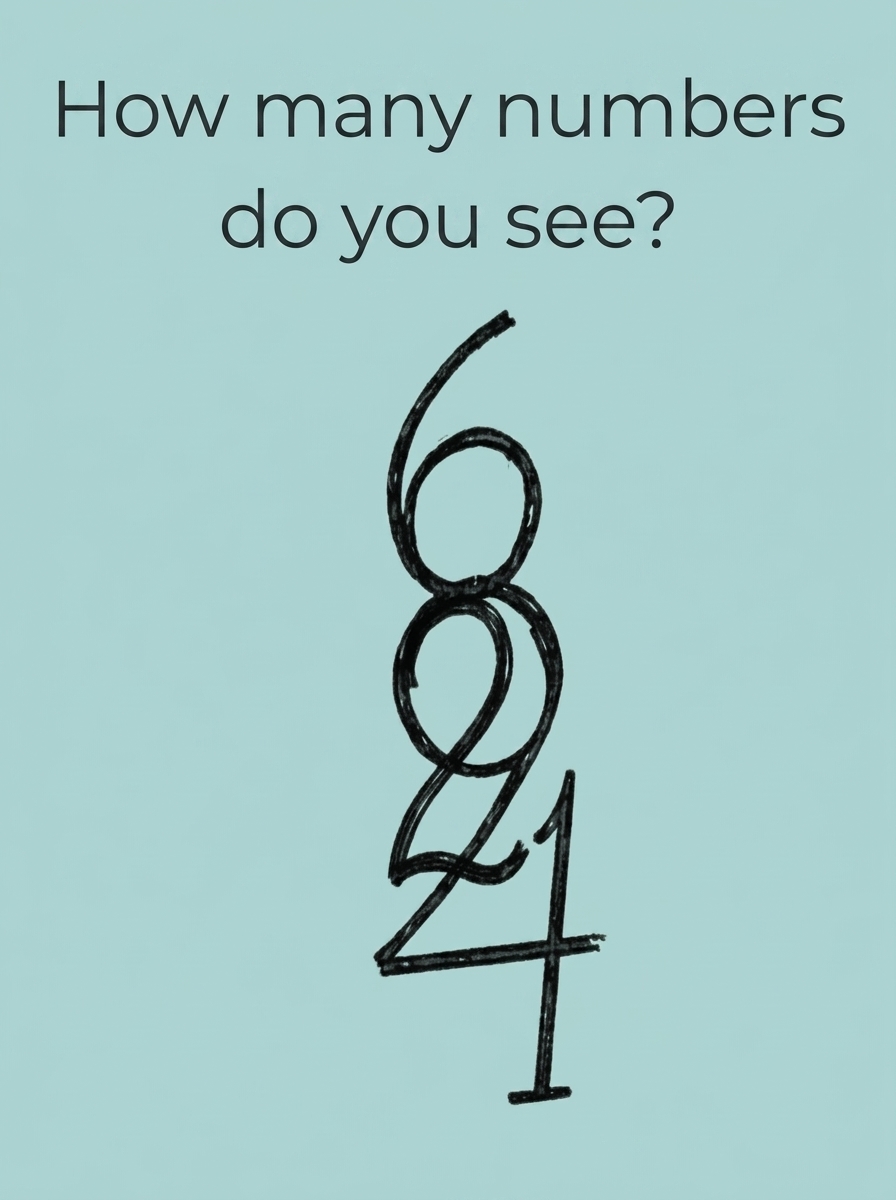
Brain teasers and optical illusions have always captured attention, especially when a simple-looking image leads to completely different answers. One of the latest viral challenges asks a very direct question:
“How many numbers do you see?”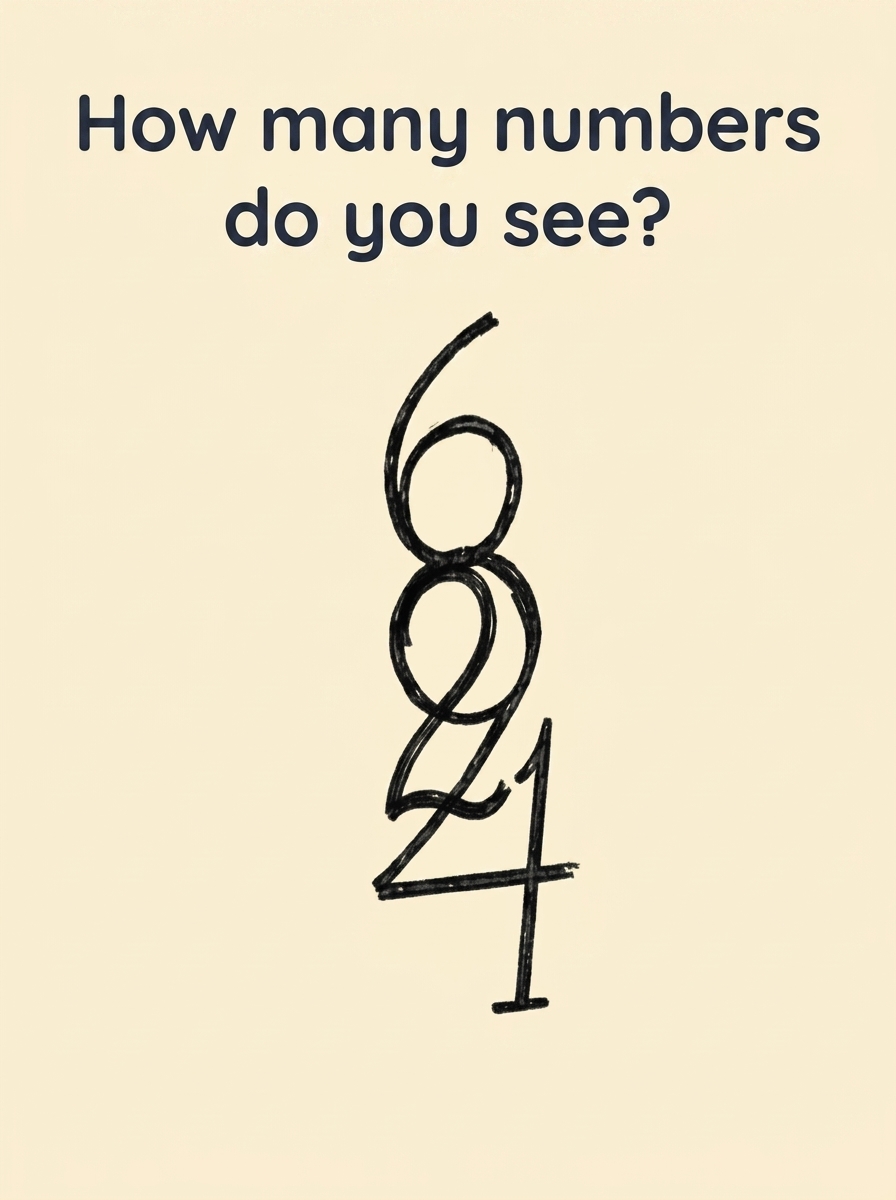
At first glance, the image seems like a messy overlap of digits. But the more you observe it, the more numbers appear to emerge. That is exactly what makes this puzzle so compelling—and why people often disagree on the final answer.
EXAMINING THE IMAGE CLOSELY
The illustration is made up of several numbers layered over one another. Depending on how you interpret the curves and intersecting lines, different digits can be identified within the same design.
Most viewers easily recognize the following:
6 – Formed by the large curved stroke at the top and the loop beneath it.
8 – Created by the two connected loops in the center.
2 – Visible in the curved diagonal line across the lower section.
4 – Shaped by the straight horizontal and vertical strokes near the bottom.
1 – The clean vertical line on the right side.
These five digits are the most obvious and are generally accepted by most observers.
ARE THERE ADDITIONAL NUMBERS HIDDEN?
This is where opinions begin to split.
Some viewers also interpret:
9 – The upper loop combined with a descending curve can resemble a nine.
0 – Either circular loop may be seen as a zero.
3 – Overlapping curves may form the shape of a three.
Because the design is intentionally ambiguous, there is no single agreed-upon solution. The puzzle depends entirely on visual perception, and different viewers focus on different shapes.
For illustrative purposes only
THE MOST COMMON ANSWERS
Across online discussions and puzzle communities, the most frequently given answers are:
5 NUMBERS
Those who choose 5 typically see:
6, 8, 2, 4, and 1
This is often considered the most conservative interpretation, since these digits are the most clearly defined.
6 NUMBERS
Others count:
6, 8, 9, 2, 4, and 1
In this version, the top section is interpreted as both 6 and 9.
7 OR MORE NUMBERS
More enthusiastic puzzle solvers identify: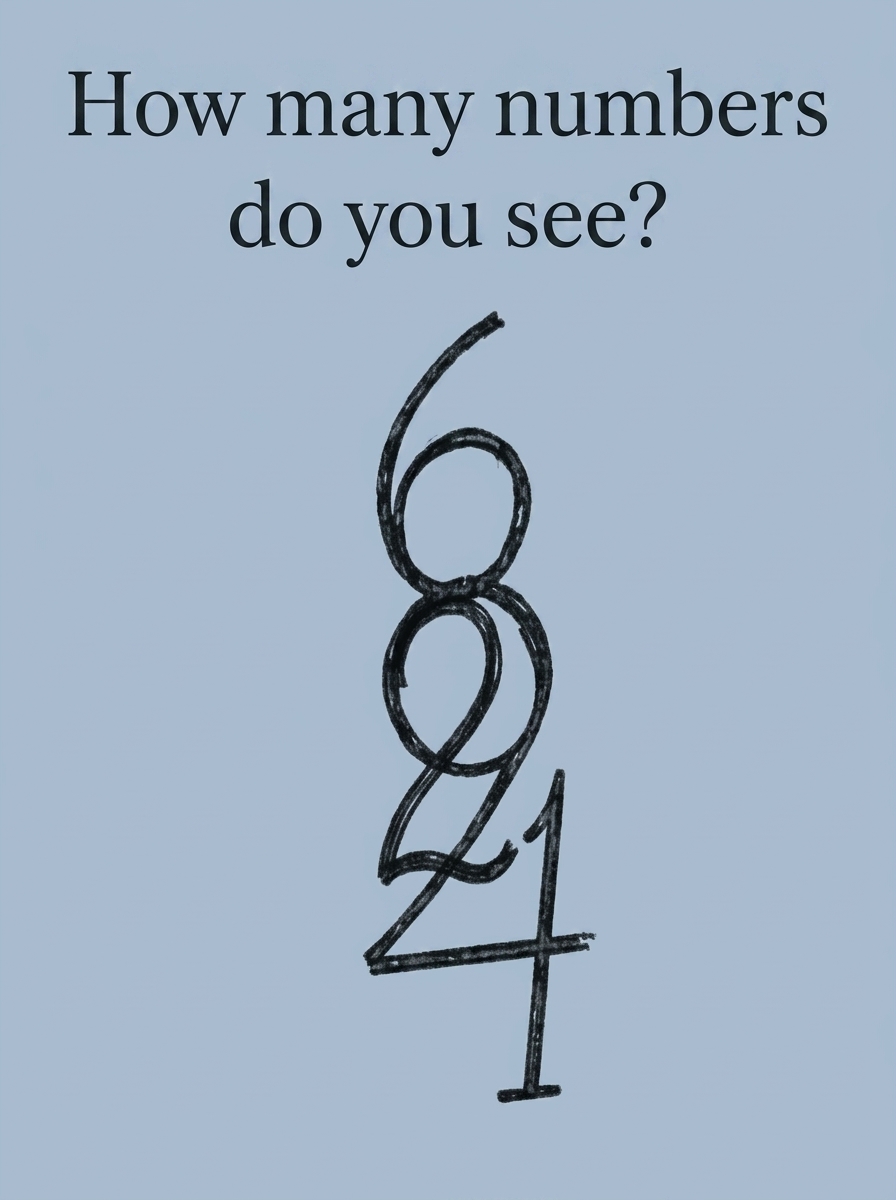
0, 1, 2, 3, 4, 6, 8, and 9
This interpretation treats overlapping shapes as multiple valid digits.
WHY DO PEOPLE SEE DIFFERENT ANSWERS?
The human brain is built to recognize patterns. When it encounters incomplete or overlapping forms, it instinctively tries to match them with familiar symbols—in this case, numbers.
Psychologists call this pattern recognition and visual interpretation. Two people can look at the same image and focus on completely different visual cues, leading to different conclusions.
This is the same mechanism behind optical illusions. The brain doesn’t simply record what the eyes see—it actively interprets it.
For illustrative purposes only
IS THERE A DEFINITIVE ANSWER?
The honest answer is: not necessarily.
Unlike a math problem with a fixed solution, this puzzle is designed to be open-ended. There is no official answer provided by the creator, which is why debate continues online.
If we only count the clearly visible digits, the most grounded answer is:
6, 8, 2, 4, and 1 = 5 numbers
However, if overlapping shapes are also interpreted as separate digits, the total can rise to 6, 7, or even 8, depending on perception.
FINAL VERDICT
For most viewers, the image clearly shows five numbers: 6, 8, 2, 4, and 1. That makes 5 the most widely accepted answer.
Still, the real point of the puzzle is not a single correct result. It is to demonstrate how differently people can interpret the same visual input. That is why one person confidently says “5,” another says “6,” and someone else insists there are “8” hidden numbers.
So, how many do you see? The answer may say more about your perception than about the image itself.
