

I was thirty-five the night my son graduated.
The auditorium was bright and loud, overflowing with flowers, flashing cameras, and proud families who believed the hardest part of parenting was finally over.
I sat alone in the third row.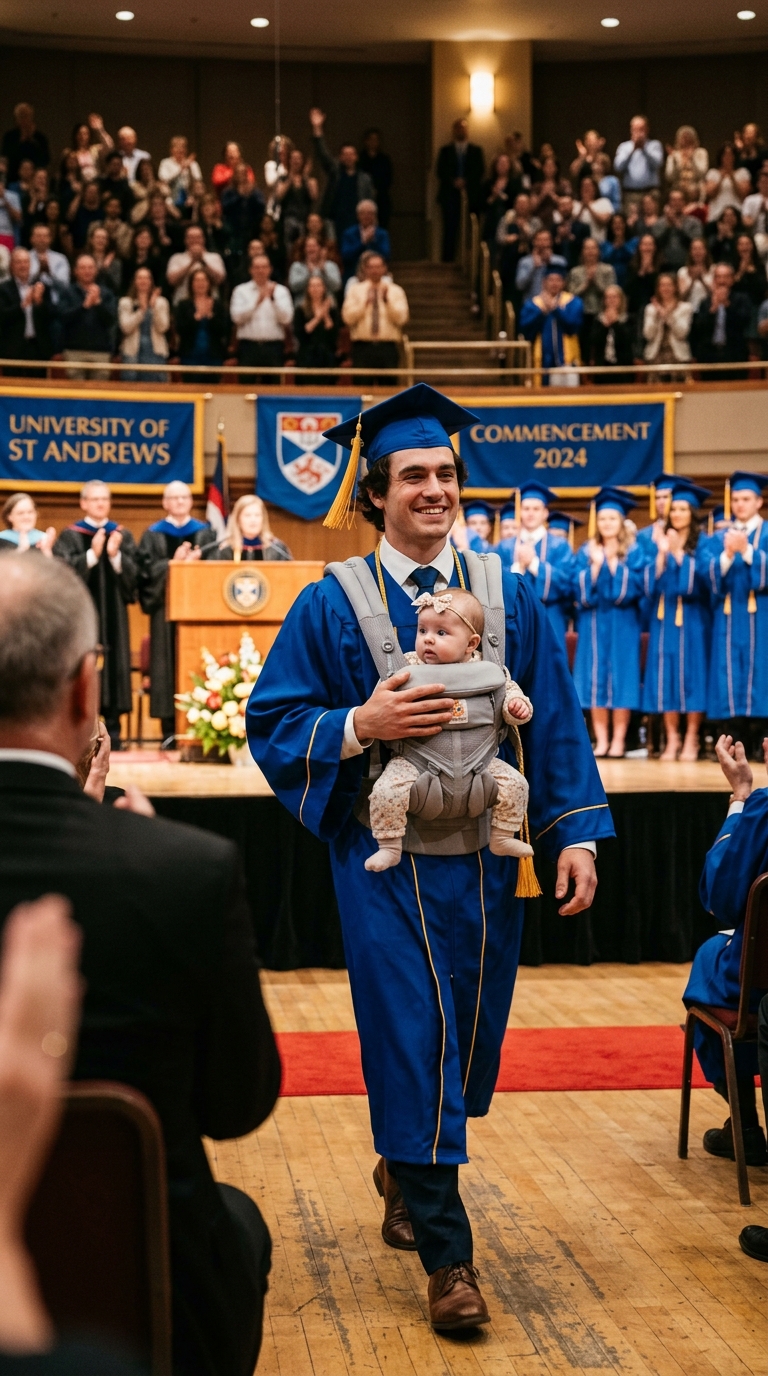
My dress was plain. My shoes hurt. And at my feet, tucked beside my purse, was a diaper bag—out of place in the version of this moment everyone else seemed to be living. For eighteen years, my life had been survival.
I had Adrian at seventeen. His father, Caleb, didn’t slowly drift away—he disappeared overnight. One morning his closet was empty, his phone unreachable, and every promise he had ever made was gone with him.
So it was always just the two of us.
Adrian grew up in the quiet gaps of my exhaustion—between double shifts, overdue bills, and silent prayers over cheap groceries. He wasn’t loud. He didn’t ask for much. But he noticed everything.
He noticed when I skipped meals.
He noticed when I cried in the shower.
He learned what it meant to stay.
By his senior year, I thought we had finally survived the hardest part.
Good grades. Scholarships waiting. A future that finally looked steady.
Then something changed.
He started coming home late.
Taking extra shifts.
Keeping his phone face down.
Some nights he looked afraid. Other nights, strangely calm—like someone carrying something too heavy to put down.
Three nights before graduation, he stood in the kitchen doorway, nervously twisting his sleeve.
“Mom,” he said quietly, “I need you to hear everything before you decide how disappointed you are.”
My heart dropped.
Then he told me everything.
About Hannah.
About the pregnancy.
About the baby girl born less than two weeks earlier.
About the hospital visits he had hidden.
And about the promise he made to himself—
That no matter how scared he was, he would not disappear the way his father had.
Then he asked me something I wasn’t ready to hear.
“If I have to bring her to graduation… will you still stay?”
I didn’t sleep that night.
And even then, I wasn’t prepared.
For illustrative purposes only
The ceremony began like any other.
Names. Applause. Speeches.
Then Adrian stepped out of line.
He walked straight toward me.
“Mom,” he whispered, holding out his arms, “give her to me.”
My body moved before my thoughts could catch up.
I placed the tiny baby girl into his arms.
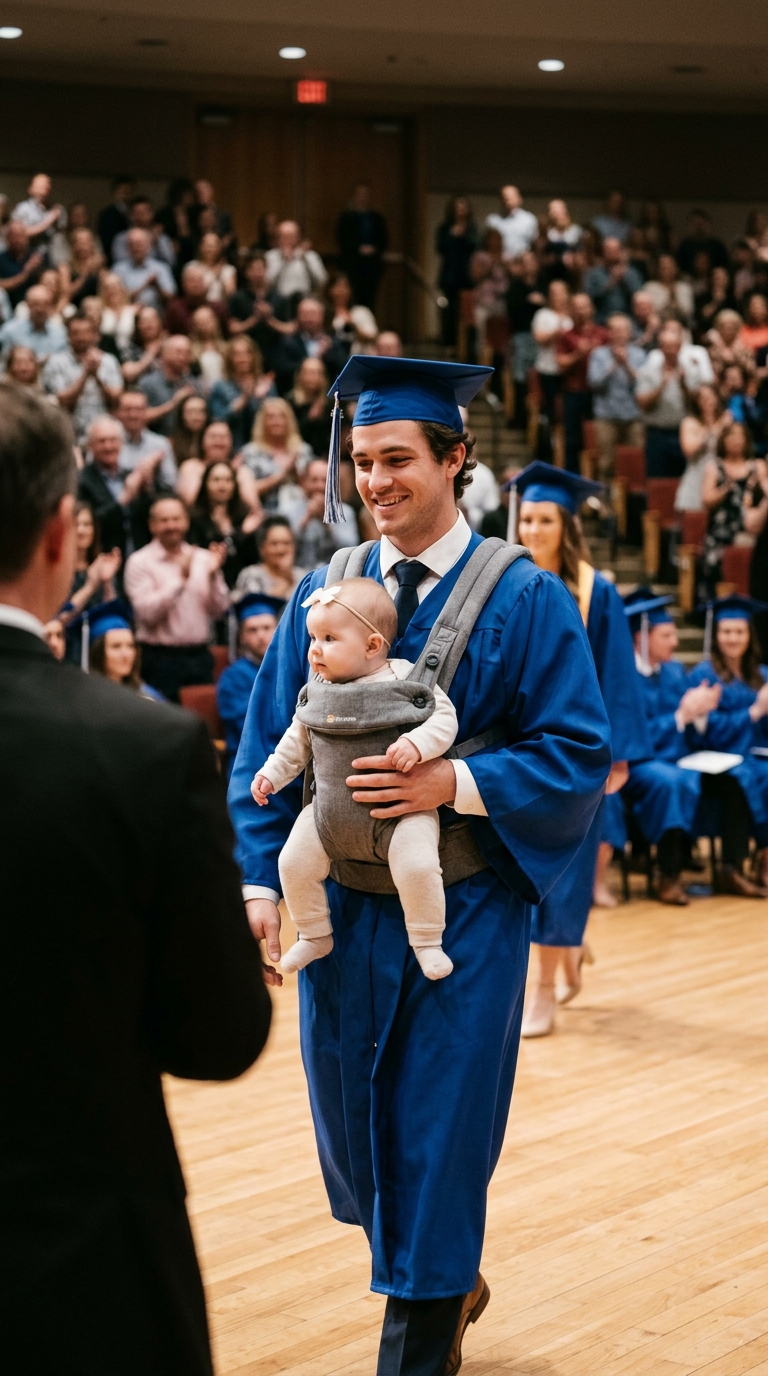
He held her carefully against his chest, tucked beneath his gown, her small face peeking out from a soft pink blanket.
Then he turned—and walked toward the stage.
The whispers started instantly.
Then came the laughter.
Soft at first… then spreading.
“Are you serious?”
“Wow…”
And then, just behind me, a woman hissed loud enough for me to hear—
“Just like his mother.”
It hit like a blow.
For a moment, I couldn’t breathe.
I wanted to disappear.
To go back.
To undo every mistake that had led here.
But Adrian didn’t stop.
He didn’t look down.
He didn’t hesitate.
He climbed the steps steadily, holding his daughter like she belonged there.
He accepted his diploma.
Then he didn’t leave.
Instead, he walked to the microphone.
The room shifted.
The laughter faded into confusion.
Then silence.
Adrian adjusted the mic with one hand, the other still supporting his daughter.
And then he spoke:
“My mom taught me what staying looks like.”
The entire auditorium went still.
“My whole life,” he continued, voice steady but breaking slightly, “people looked at us and saw what was missing. A father who left. A mom who had me too young. A future that didn’t look promising.”
He paused, looking down at the baby.
“But that’s not what I saw.”
Then he looked up.
“I saw a woman who worked until her hands hurt and still showed up for me. I saw someone who chose me every single day—even when it was hard. Especially when it was hard.”
My vision blurred.
“I found out a few months ago I was going to be a father,” he said. “And yeah—I was terrified. I still am. But I knew one thing for sure…”
His voice shook for just a moment.
“I’m not leaving her.” The room was completely silent now. “Some of you laughed,” he went on, not with anger, but with calm honesty. “Maybe you think this baby means I failed before I even started.”
He carefully adjusted the blanket around her small body.
“But she’s not my failure.”
“She’s my responsibility.”
“And she’s never going to wonder if her dad stayed.”
Somewhere in the crowd, a quiet sob broke through.
Adrian turned his gaze directly toward me.
“My mom was seventeen when she had me. People saw a mistake.”
He paused, swallowing hard.
“I saw a miracle.”
Something inside my chest cracked wide open.
“If I can be even half the parent she was… my daughter is going to be just fine.”
For a brief moment, there was nothing but stillness.
Then one person stood up.
Then another.
And another.
Until the entire auditorium rose to its feet.
Clapping.
Crying.
The same people who had laughed moments earlier could no longer meet his eyes.
After the ceremony, everything became a blur.
Teachers embraced him.
Parents avoided looking at me.
A woman—maybe the same one who had whispered—walked past quickly with her head down.
But none of it mattered.
Because my son walked off that stage holding his daughter close—
And keeping his head high.
That night, we went straight to the hospital.
Hannah looked pale, exhausted, and scared.
“I ruined everything,” she whispered when she saw us.
Adrian crossed the room without a moment of hesitation.
“You didn’t ruin anything,” he said.
And when her eyes met mine—searching for judgment—
I only asked softly,
“Have you eaten?”
That was when she broke.
A few days later, she came home with us.
Not because everything was planned or perfect.
But because no one in that home would face life alone.
We made space.
We adjusted.
We struggled.
But we stayed.
A year later, our house is louder, messier, harder—
and fuller than I ever imagined.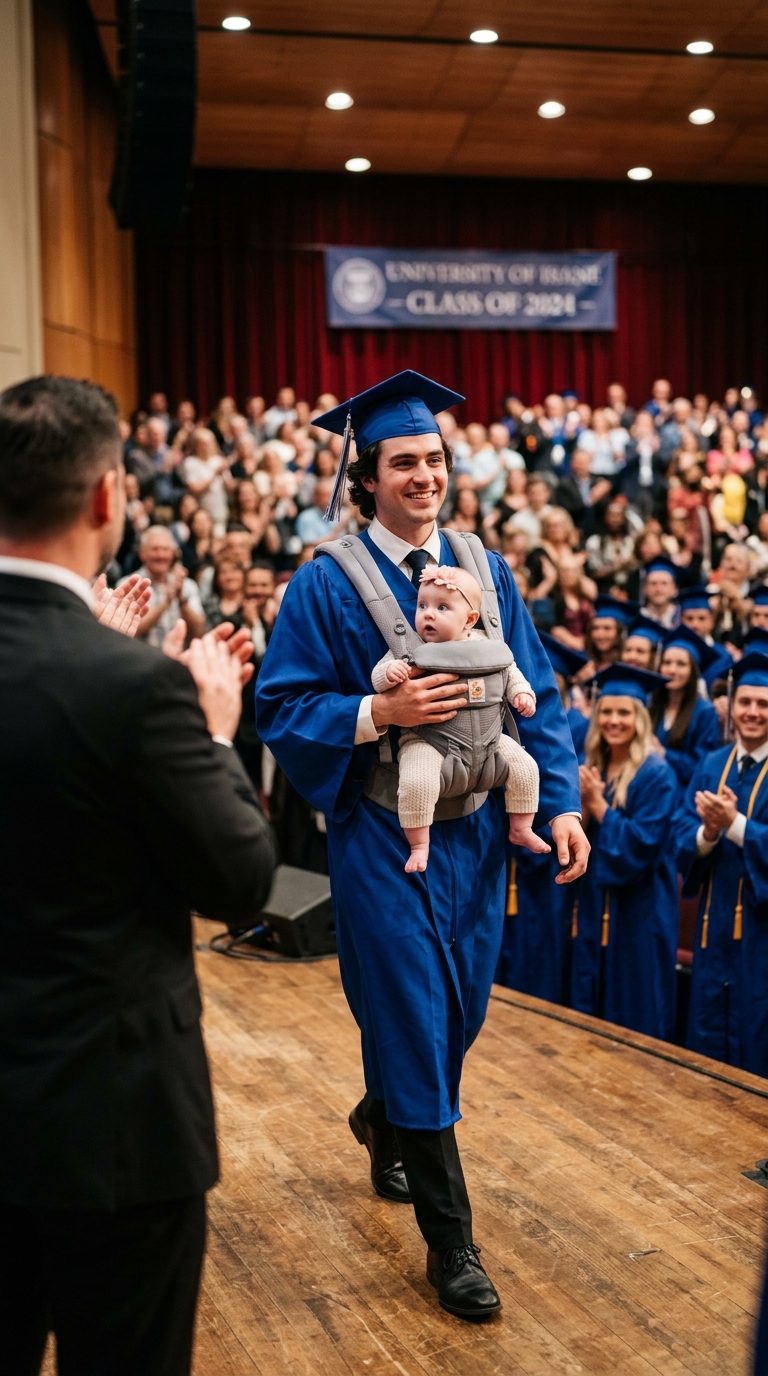
Sometimes I still return to that night.
The laughter.
The whisper: “just like his mother.”
And she was right.
He is just like me.
He chose love when running would have been easier.
He was afraid—and stayed anyway.
And in that auditorium, I finally understood something I had carried for eighteen years began to loosen its grip:
The story was never theirs to define.
It was ours.
And my son made sure of one thing—
the last word was never laughter.
It was truth.
