

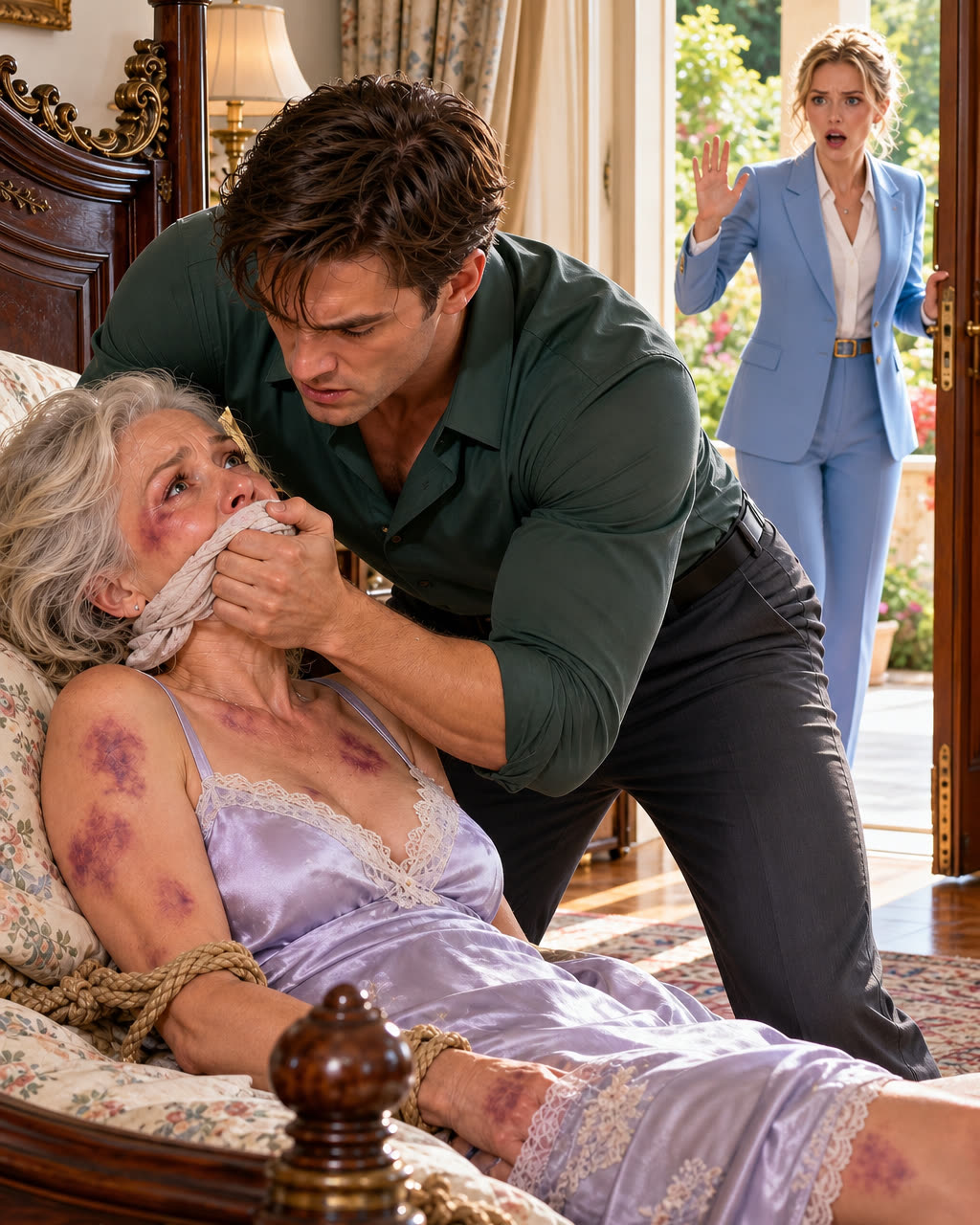
Part 1: The Long Flight from the Desert & The Barricaded Door
The air inside the cabin of Qatar Airways Flight 771 was pressurized, sterile, and cold enough to make my joints ache. For fourteen hours over the Atlantic, while every other passenger slept under fleece blankets, I sat bolt upright in seat 28A, staring at the dark reflection of my own face in the double-paned window. Under the low, steady hum of the jet turbines, my mind ran through the cold, immutable arithmetic of thirty-four months in exile.
Thirty-four months. One thousand and thirty-four days. In Doha the heat did not simply warm you; from May until October it pressed against your chest like a heated iron plate. I had lived in a windowless studio apartment behind the industrial logistics park in the Al Wakrah district, six miles from the glittering glass spires of West Bay. I ate boiled lentils, white rice, and canned sardines. I washed my three corporate polo shirts by hand in the bathroom sink to save laundromat coins. As an executive operations manager for an international petroleum logistics conglomerate, I earned a significant salary: one hundred and twenty thousand dollars a year, tax-free, boosted by performance bonuses for keeping twenty-four-hour supply chains running through the Red Sea corridor. I kept six hundred dollars a month for myself. Every other cent, nine thousand dollars on the first of each month, wired by direct international transfer, went to the account ending in 4102 at Suncoast Credit Union in Fort Myers, Florida.
I did it for my mother, Rose. Rose Morales was seventy-one years old. She had crossed the Florida Straits on a wooden boat during the Mariel boatlift in 1980, carrying me as an infant wrapped in canvas. She spent thirty-one years scrubbing porcelain toilets and changing king-sized sheets in luxury hotels on South Beach, her knees calloused into gray leather, her spine curving under the weight of commercial laundry carts, all so I could attend the University of Florida and wear a tailored blazer. Three years ago an ischemic stroke had stolen the fine motor control from her right hand and left her with a mild, halting aphasia. She needed full-time, dedicated in-home care: physical therapy, occupational rehabilitation, and the gentle, dignified comfort of her own home.
My husband, Mark Vance, had stepped forward with open arms and an easy, practiced smile. Mark was thirty-six and tall, with that sun-bleached, charismatic, country-club handsome look that made people trust him on sight. He sold European sports cars at a boutique dealership in Naples, or at least that was the story he told our neighbors. When my mother fell ill, he took my hands across our kitchen table, looked into my tear-filled eyes, and offered the grand compromise. “Take the overseas contract, Elena,” he whispered, his thumbs wiping the moisture from my cheeks. “The tax advantages are enormous. You fund the household from Doha. My mother, Brenda, and my sister, Heather, will move into the guest suite. We will take care of Rose twenty-four hours a day. We will cook her meals, bathe her, take her to the beach, and manage her therapy. You sacrifice over there, and we protect the fortress over here.” I believed him. I kissed him at the airport curb, trusted him with the deed to my home, and surrendered my life to the desert.
The first cracks in the facade appeared six months ago. The weekly video calls with my mother began to stutter. First Mark claimed Rose was sleeping. Then she had an “ocular migraine” and couldn’t bear the light of a tablet screen. Then her phone was broken. Two days ago, when I demanded to see her, Mark’s voice turned sharp, brittle, and condescending over the line. “Don’t turn this into a tragedy from three thousand miles away, Elena,” he snapped, the clink of ice in an expensive glass audible behind his words. “Her cognitive decline is accelerating. She’s becoming paranoid. Seeing your face only agitates her. Focus on your contract, keep the transfers coming, and let the professionals handle her.” He did not know that my contract in Qatar had ended forty-eight hours earlier. He did not know my corporate director had handed me a final seventy-five-thousand-dollar completion bonus in a cashier’s draft. And he certainly did not know that I was steering a rented sedan through the manicured, palm-lined entrance of 1204 Pelican Bay Drive.
The Florida afternoon heat hit me the moment I opened the car door, a thick, wet, swampy ninety degrees that smelled of sulfur, damp sod, and hot asphalt. I stood on the driveway with my small carry-on gripped in my right hand, and stopped. The house before me was unrecognizable. Three years ago, 1204 Pelican Bay had been a warm, modest, four-bedroom coastal ranch with a honey-oak front door, cream stucco walls, and my mother’s sprawling garden of potted bougainvillea and hibiscus lining the walkway. Now the exterior had been aggressively stripped and modernized into an ostentatious white-and-charcoal monstrosity. The bougainvillea had been ripped out and replaced by sharp, cold architectural river rocks and minimalist black metal planters. Parked in the double driveway was not my seven-year-old Honda but a brand-new, matte-gray Porsche Macan and an eighty-thousand-dollar Mercedes-Benz E-Class cabriolet.
My key still fit the master lock. I turned the brass deadbolt and it clicked open with a heavy, oiled smoothness. I pushed the door wide and stepped across the threshold, and the shock was violent. The foyer floor had been ripped down to the slab and replaced with high-gloss white Italian porcelain tile that reflected the glare of an eight-foot contemporary crystal chandelier. The living room walls had been knocked down to create a vast, open-concept gallery dominated by an eighty-five-inch OLED television and a floating gas fireplace framed in bookmatched black quartz. The furniture was all white, untreated bouclé, the kind that cannot survive a single drop of real life. On the twelve-foot waterfall island in the kitchen sat a commercial-grade, four-thousand-dollar La Marzocco espresso machine. Standing beside it, in a pastel-pink silk resort caftan, was my mother-in-law, Brenda Vance. Her bleached-blonde hair was immaculately coiffed; her skin was tanned to a deep walnut and tight with fresh dermal fillers. She held a crystal tumbler of sparkling water with lime.
And resting against her breastbone, gleaming under the recessed LED spotlights, was a piece of jewelry that made my vision blur with white-hot static. A solid-gold, hand-engraved sunburst pendant on a heavy rope chain. My mother’s pendant. The only heirloom Rose possessed, smuggled out of Havana in the lining of her brassiere in 1980. My mother had worn it every day of her life; she never removed it, not even for surgeries, taping it to her chest with medical adhesive. Brenda looked up, and the crystal tumbler slipped in her fingers, water splashing across the quartz counter. “Elena?!” Brenda gasped, her voice jumping two octaves, her eyes bulging in naked shock. “What… what are you doing here?! Mark said your flight wasn’t until December!” I did not drop my carry-on. I did not smile. My eyes stayed locked on the gold sunburst. “Where is my mother, Brenda?” I asked. My voice was not loud. It was a flat, low hum, carrying the terrifying stillness of an ocean pulling back from the shore before a tsunami. “She’s… she’s resting, darling!” Brenda stammered, frantically dabbing at the spilled water with a linen napkin, trying to angle her body between me and the hallway. “She’s had an awful turn this week! The doctors changed her prescriptions, and she’s deeply confused! She shouldn’t be disturbed—”
I did not wait for her to finish. When Brenda moved to block the hallway, I did not negotiate. I dropped my shoulder, drove my weight through her center of gravity, and shoved her aside. She slammed into the quartz island with an undignified grunt, her crystal glass shattering on the porcelain. I took the stairs two at a time. The upper floor had not been renovated. The white porcelain ended at the top step, replaced by the original, worn berber carpet, and the air up here did not smell of espresso or designer candles. It smelled of decay. A thick, sour, suffocating stench of ammonia, stale urine, and rotten starch rolled down the corridor, so potent it burned my throat. I walked toward the master guest suite at the end of the hall, the large, sunny corner room that had been set aside for Rose. The door was closed, and pushed flush against the outside of the frame was a six-drawer, solid-oak antique dresser loaded with heavy boxes of seasonal decorations, physically barricading it from the hallway. My heart did not pound; it seized. I threw my entire body against the dresser. The wood groaned, the metal casters screaming across the floorboards as I shoved it aside with the frantic strength of an animal tearing through a trap. I wrenched the brass knob and kicked the door open.
The room was pitch black. The heavy blackout curtains had been nailed into the window trim with industrial drywall screws, sealing out the Florida sun. The ceiling air vent had been blocked with cardboard and duct tape, turning the room into a ninety-five-degree incubator of human misery. A cloud of black flies swarmed near the dead, motionless ceiling fan. “Mom?” I cried out, my voice breaking into a jagged sob as my hand found the wall switch. The overhead fluorescent tube flickered to life. My mother was lying on a bare, stained, urine-soaked foam mattress laid directly across the rusted springs of a metal cot. She weighed no more than seventy pounds. Her nightgown was shredded and soiled, hanging off her sharp clavicles like a rag on a scarecrow, and her skin was a horrifying, translucent gray-yellow stretched paper-thin over her cheekbones. Tied around her frail, bruised waist, looped through the rusted iron frame and pulled into tight double-knotted hitches, were four strips of torn bedsheet. She was tied down like an animal in a slaughterhouse chute. On the floor beside her head sat a paper plate of congealed gray rice and dried beans, and two massive cockroaches scurried across it, vanishing beneath the mattress as the light hit them. “Mom! Oh God, Mom!” I dropped to my knees on the filthy floor, my hands shaking violently as I reached for the knots.
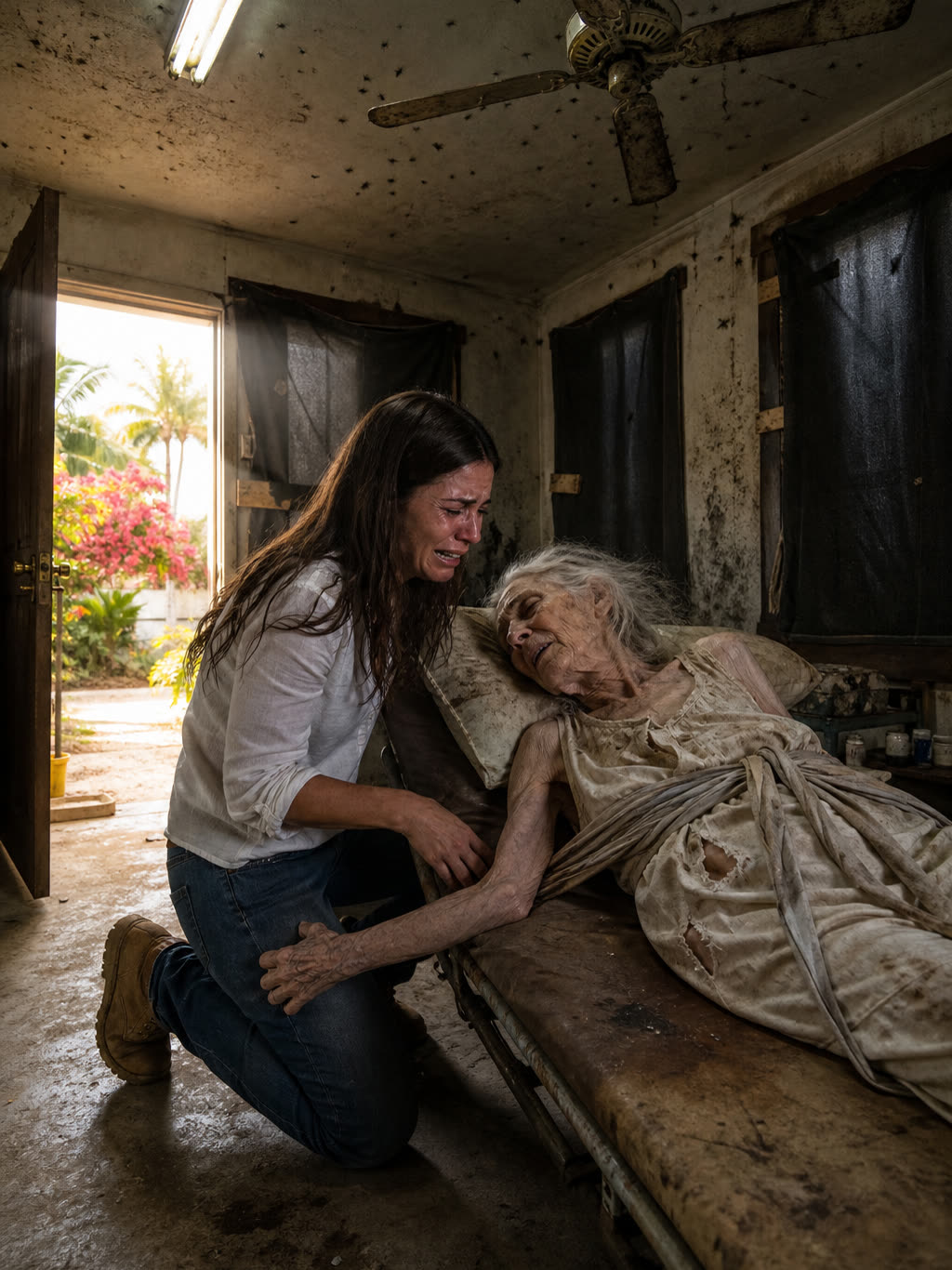
Rose turned her head with agonizing slowness. Her eyes were sunken, swimming in cloudy, yellowed sclera, her lips split into raw, bleeding fissures from dehydration. She did not cry out. She did not weep. She looked at me through the haze of whatever poison was circulating in her blood, and her skeletal left hand moved, hooking into the denim of my jeans with a desperate, surprising strength. “Don’t untie me yet,” she whispered. Her voice sounded like dry gravel crushed under a heavy boot. “Check… underneath… the mattress… first.”
“Mom, I need to get you an ambulance right now—”
“Under… the foam, Elena,” she wheezed, her breath shallow and smelling of acetone. “Look. Before he comes.”
I swallowed the scream rising in my chest. I hooked my fingers beneath the stained, rotting edge of the foam and hauled it up three inches. Tucked into the rusted springs beneath her ribs was a clear, gallon-sized plastic freezer bag. I yanked it out. Inside was a thick, legal-sized manila dossier. I tore the plastic open, my fingers slick with cold sweat. The first document was a certified copy of a General Durable Power of Attorney, dated sixteen months ago. At the bottom, where my signature was required to authorize Mark Vance as co-conservator of Rose’s affairs, stood a signature in blue ballpoint ink: Elena Morales. It was a clumsy, shaky, traced forgery. The “M” was looped incorrectly; the terminal stroke lacked the sharp downward hook I had used since high school. Beside it was the stamp of a mobile notary in Cape Coral.
Beneath the power of attorney were bank statements for Rose’s private retirement account, the one holding the one hundred and forty thousand dollars my mother had saved over thirty years of cleaning hotel rooms. The balance as of thirty days ago was $14.12. Every dollar had been drained in sixteen consecutive transfers to an account titled Vance Commercial Acquisitions LLC. And at the very bottom of the stack was a thick, embossed contract bearing the dark blue emblem of Pacific Mutual Life & Casualty. Policy Number: PML-99482-TX. Insured: Elena Morales. Primary Beneficiary: Mark Vance (Husband). Contingent Beneficiary: Brenda Vance (Mother-in-law). Total Coverage Amount: $1,500,000. Rider: Accidental Death & Dismemberment, $3,000,000 total payout. My eyes tracked down to the bold, capitalized field at the center of the declaration page: EFFECTIVE COMMENCEMENT OF COVERAGE: JUNE 14, 00:01 EST. I checked the digital watch on my wrist. Today was June 12th. The policy would become active in precisely forty-eight hours.
“Elena, please… listen to me for one second.” The voice came from the doorway. I did not turn quickly. I stood slowly from the floor, holding the policy in my left hand, the paper rattling against my palm. Mark stood in the doorframe. He had taken off his sunglasses. He wore an Italian linen shirt, unbuttoned at the collar, and white trousers. His skin was pale as skim milk, his jaw working soundlessly like a fish hauled onto a dock. From the bottom of the stairs, the manic screech of his sister Heather cut through the house like a rusty saw: “Mark! The bonus isn’t in her bag! I tore the inner lining out with a razor! Where did the bitch put the cash?!”
Rose weakly gripped my ankle from the mattress, her voice a dying thread of sound: “Elena… don’t drink the water… the blue jar on the counter… they put powder in it every morning…” Mark took one slow, deliberate step into the room, his eyes dropping to the Pacific Mutual policy in my hand. His face shifted. The handsome, charming salesman vanished entirely, replaced by the hollow, desperate, feral stare of a predator whose trap had just been uncovered while the prey was still armed. He reached into his pocket. And from three blocks away, slicing through the dense, swampy Florida heat, came the high-velocity, multi-tonal wail of three emergency vehicle sirens running Code Three. Mark’s pupils dilated in absolute, unadulterated terror.
Part 2: The Suitcase Lens & The Forensic Dissection of a Marriage
“You called the police?” Mark whispered. The words left his throat not as a challenge but as a horrified, stuttering realization. His hands came out of his pockets, palms up, his chest heaving beneath his linen shirt as his eyes darted from the folder in my hands to the narrow window behind my mother’s cot. “Elena, wait. You don’t understand the context here,” he began, stepping forward, his voice sliding into the oily, persuasive cadence he used on car lots. “Your mother’s dementia was dangerous. She was wandering into the street naked! She tried to turn the gas burners on while we were asleep! We had to keep her in here for her own safety—”
“She was tied to a rusted bed frame with torn sheets, Mark,” I said. My voice was dead, the sound of a stone dropping into an abandoned well. “There are cockroaches crawling across her food. She has stage-three pressure ulcers on her sacrum. And you took out a three-million-dollar accidental death policy on my life forty-eight hours before I landed.”
Mark lunged. He did not try to strike me. He went for the paper in my hands, his manicured fingers clawing at the thick stock of the Pacific Mutual contract, desperate to shred the evidence before the boots now thundering up the driveway reached the porch. I did not step back. I had spent three years managing roughneck crews on offshore platforms in the Persian Gulf, and I had separated knife fights between drunk contractors in the desert heat. As Mark reached for the folder, I drove the steel-reinforced heel of my work boot into the top of his right foot with the full force of my body weight. Crack. The small bones of his foot yielded with a sickening pop. Mark let out a high, breathless shriek of agony, his knee buckling, and collapsed sideways into the doorframe, clutching his foot, his face the color of wet cement.
Downstairs, the front door was kicked wide open. “POLICE DEPARTMENT! DON’T MOVE!” The roar of tactical voices echoed through the house, followed by the heavy, synchronized thud of combat boots sprinting across the imported Italian tile. Brenda’s voice erupted into a piercing, theatrical scream in the foyer: “Officers, thank God you’re here! Up here! My daughter-in-law broke in! She attacked my son! She’s having a violent psychotic episode! She abandoned her mother for three years and now she’s trying to kill us!”
Two uniformed patrolmen from the Lee County Sheriff’s Office, sidearms at low-ready, rounded the top of the stairs, followed by Paramedic Davis. “Sheriff’s office! Hands where we can see them!” barked the lead deputy, a veteran named Miller, sweeping his weapon across the hallway. His eyes locked onto Mark writhing on the carpet, clutching his broken foot. Then his gaze traveled past the shattered door into the sweltering, dark bedroom.
Paramedic Davis pushed past him and stepped into the room. He took one breath of the ammonia-choked air, looked down at Rose tied to the rusted cot, and his professional composure evaporated into pure, incandescent fury. “Holy Mother of God,” Davis breathed, dropping his trauma kit. He pulled out his heavy shears and knelt beside my mother. With two violent, furious snips he severed the cloth bindings around her waist and wrists.
“We have an active, felonious elder abuse and unlawful imprisonment scene here, Miller!” Davis bellowed down the stairwell, his voice shaking with rage. “Get the Sergeant up here right now! This woman is severely malnourished, completely dehydrated, and she’s in acute renal failure! Call for a second advanced life support unit!” Deputy Miller holstered his sidearm, unclipped a pair of carbon-steel handcuffs, and drove his knee into the small of Mark’s back, forcing my husband flat against the hallway carpet. Clack-clack. The steel ratcheted down around Mark’s wrists, biting deep into the bone. “I didn’t do anything!” Mark sobbed into the carpet, spit and snot smearing across the floor. “It was my mother! She manages the house! I was just trying to protect my family!”
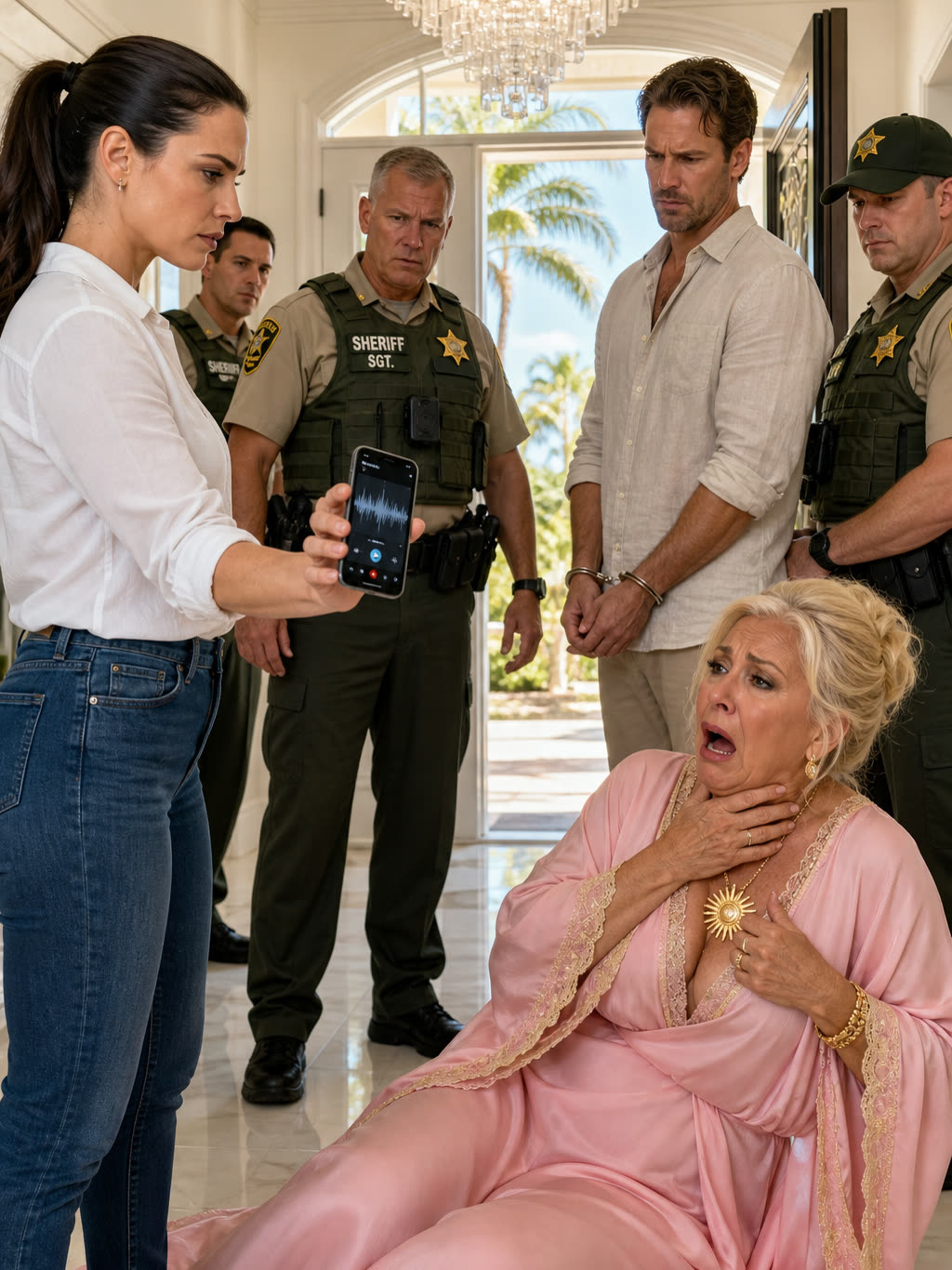
I walked out of the bedroom and stepped over my husband’s shackled legs as if he were a pile of dirty laundry. I carried the red legal dossier in my left hand and my smartphone in my right. I walked down the grand floating staircase, my heels clicking against the porcelain. The foyer was an arena of chaos. Heather Vance, Mark’s twenty-four-year-old sister, was pinned against the front door by a female deputy, her hands cuffed behind her back, her face red, screaming profanities. Brenda stood in the center of the living room, clutching her gold sunburst pendant, hyperventilating in an Oscar-caliber performance as an innocent, battered grandmother. “Officer, please!” Brenda wept to a second deputy. “My son is a saint! We sacrificed our lives to clean up Rose’s messes! She has violent Alzheimer’s! She begged us to tie her down so she wouldn’t jump out the window! Elena is framing us! She’s an operative for an oil company, she knows how to manipulate people—” “She wasn’t begging, Brenda,” I said, reaching the bottom of the stairs. The room fell into an immediate, heavy silence.
I did not look at Brenda. I walked directly to Sergeant Kowalski, the senior supervisor who had just come through the front door, and unlocked my phone. “Sergeant,” I said, my voice steady, clinical, and devoid of emotion. “I am Elena Morales. I am the legal owner of this residence. I arrived from Doha, Qatar, two hours ago.” I pointed to my black canvas carry-on, which sat near the entryway table, its fabric ripped open where Heather had used a razor to search for cash. “Before I departed Qatar,” I continued, “I was warned by my bank’s fraud division that multiple unauthorized loans had been initiated against this property. I hired an independent private security technician in Miami to modify my luggage.” I tapped the screen. The phone was not displaying a recording; it was connected over local Wi-Fi to a continuous, high-definition flash memory drive embedded in the reinforced handle of the suitcase.
I turned the volume to maximum. The speaker filled the crystal-lit foyer with uncompressed audio recorded thirty minutes earlier, while I was upstairs discovering my mother. The room heard the tearing of fabric as Heather shredded my suitcase. “Mark! The Qatar bonus isn’t in her bag! Where did she put the cash?!” Heather’s recorded voice shrieked through the house. Then came Brenda’s voice, smooth, cold, and calculating: “Check the lining of her cosmetics bag, Heather. Make sure Mark gives Elena the chamomile tea tonight. I ground the phenobarbital tablets into the tin this morning. Once she drinks it and passes out, we stage the fall down the stairs into the pool before the Pacific Mutual policy becomes active on Friday. We need the coroner to list it as an accidental drowning before the bank runs the audit.” The silence that followed was absolute, the silence of a tomb being sealed from the outside. Brenda’s knees gave out. She did not slide down gracefully; she collapsed like a sack of wet flour onto the porcelain, her caftan bunching around her hips, her hands clutching her throat as if she were suffocating on her own words.
Heather stopped screaming. She stared at the phone in my hand, her mouth hanging slack, her eyes wide with the realization that she had just listened to her own conviction for conspiracy to commit capital murder. Deputy Miller came down the stairs, dragging a handcuffed, limping Mark behind him. As they reached the foyer, Mark’s smartphone, which had fallen from his pocket during the arrest and lay on the marble console table, chimed with an automated calendar alert. The screen flared white, displaying for every officer in the room to read: REMINDER: ELENA ARRIVES — FINAL DOSE PREPARED — CHECK POOL FILTERS. Sergeant Kowalski looked down at Mark, then at Brenda on the floor. He unclipped his radio, his voice dropping into an icy, disgusted growl: “Dispatch, this is Unit 1. Notify the State Attorney’s Major Crimes Division. Call the Crime Scene Unit, the Medical Examiner’s special investigators, and Adult Protective Services.” He looked into Mark’s dead, weeping eyes. “We have three in custody for Attempted Premeditated Capital Murder, Aggravated Human Trafficking, and Felony Elder Abuse. Bring the transport van.”
The private consultation suite on the sixth floor of Lee Memorial Hospital in Fort Myers did not look like a medical office; it looked like a tactical command center for an economic war. It was 3:15 AM on Wednesday. Through the double-paned observation window of the adjoining room I could see my mother. Rose slept in a specialized, pressure-relieving ICU bed, connected to three infusion lines: lactated Ringer’s for her severe dehydration, high-dose broad-spectrum antibiotics for a raging urinary tract infection caused by weeks of neglect, and a slow infusion of albumin to stabilize her collapsing liver enzymes. Her skin was still gray, but the hollow rattle in her breathing had softened into an even, rhythmic pulse. A uniformed Lee County deputy sat on a folding chair outside her door, his hand resting on his duty holster, under strict orders from the State Attorney: No one enters without written clearance from Elena Morales.
Across the laminate conference table sat Clara Benitez. Clara was fifty-five, with the sharp, predatory cheekbones of an Andean falcon, wearing a tailored charcoal-gray pantsuit that looked as though it had been pressed with industrial steam. She had been my late father’s cousin, but more importantly she was the managing senior partner of Benitez, Vance & Sterling, the most ruthless and feared forensic estate litigation firm in southern Florida. She had driven across the state from Miami in a torrential downpour, arriving at 1:30 AM with three associate attorneys and four heavy cardboard boxes of certified corporate and banking records. She dropped a three-hundred-page, leather-bound forensic audit ledger on the table. It hit the surface with a concussive THUD. “They didn’t just steal your remittances, Elena,” Clara said, her voice flat, clinical, and vibrating with icy professional rage.
She pulled gold-rimmed reading glasses from her pocket and opened the first tabbed section. “For thirty-four months, Mark Vance has been running a sophisticated, multi-layered embezzlement scheme using your family’s home as collateral. When you left for Doha, your mother’s primary savings account held one hundred and forty-two thousand dollars in liquid certificates of deposit, the entirety of her thirty-year hotel retirement severance.” She tapped a red-highlighted line. “Within ninety days of your departure, Mark used the forged power of attorney to liquidate those CDs. He moved the money through three shell accounts registered under the name Suncoast Capital Management, an entity where his sister, Heather, was listed as sole corporate officer.” “Where did the money go, Clara?” I asked, my voice barely louder than the hum of the air conditioning.
Clara flipped to a cascading nightmare of merchant receipts. “Eighty-four thousand dollars to Naples Marine & Luxury Auto to clear the negative equity on Mark’s leased Porsche,” she read, her tone sharp enough to sever steel. “Forty-two thousand dollars to Van Cleef & Arpels and Cartier for Brenda’s jewelry. Nineteen thousand dollars for Heather’s breast augmentation and trip to Tulum last winter. And when your mother’s savings were completely exhausted sixteen months ago…” She turned to a certified mortgage instrument bearing the seal of the county recorder. “…Mark executed an emergency, maximum-capacity Home Equity Line of Credit against this house for two hundred and fifteen thousand dollars. He claimed you were an incapacitated non-resident, forged your signature using digital tracing software, and paid a local title agent five thousand dollars under the table to bypass the mandatory spousal verification call to Qatar.”
I stared at the numbers. Two hundred and fifteen thousand dollars. Every tile in that glossy living room. The black floating quartz fireplace. The four-thousand-dollar espresso machine. The eighty-five-inch television. It was not a home renovation. It was an open, mocking monument built from the stolen blood and sweat of a seventy-one-year-old immigrant woman who was dying of starvation on a bare foam mattress thirty feet above their heads.
The door swung open. Detective Miller walked in with Dr. Robert Chen, the chief toxicologist for the district medical examiner’s office. Miller looked exhausted, his tie undone, carrying two evidence bags of amber glass vials. “The preliminary laboratory results on the kitchen sweep just cleared the state lab in Tampa,” he said, sitting heavily across from Clara. Dr. Chen adjusted his spectacles and laid a printed mass-spectrometry graph on the table. “The tea leaves seized from the ceramic canister on the kitchen counter were saturated with concentrated, liquid Phenobarbital and Xylazine,” he stated with chilling scientific detachment. “Phenobarbital is an antique, long-acting barbiturate. Xylazine is an alpha-2 adrenergic agonist used exclusively in veterinary medicine to sedate five-hundred-pound horses. In humans, the combination produces profound central nervous system depression, severe bradycardia, hypothermia, and complete muscular flaccidity.”
Dr. Chen tapped the jagged peaks on the analysis. “They were dosing your mother’s tea every morning at eight o’clock, Mrs. Morales. The dosage was calibrated with terrifying, sadistic precision. It was not enough to kill her immediately; an acute overdose would have raised red flags on a standard hospital tox screen if she were admitted. It was just enough to keep her motor neurons paralyzed, suppress her vocal cords so she couldn’t scream, and slowly induce congestive renal and heart failure over a period of months.” “And the life insurance policy?” Clara asked, leaning forward, her eyes narrowing like an eagle sighting prey. Miller pulled a legal memo from his jacket. “We executed a search warrant on the private office of Arthur Pendelton, the independent broker who underwrote the Pacific Mutual policy, two hours ago,” he said. “Pendelton folded like a cheap lawn chair the second my investigators put him in cuffs. He surrendered his private encrypted text messages with Mark Vance.” The detective looked at me, his face grim as granite. “Mark promised Pendelton fifty thousand dollars in cash out of the accidental death settlement. The plan was fully documented in their WhatsApp logs, Elena.”
Miller laid out a printed transcript. ‘MARK: The pool construction is finished. The deep end is nine feet. Once the policy clears the 48-hour contestability window on Friday night, Brenda will give her the heavy dose in the soup. I will carry her down to the patio after midnight, drop her into the water, and leave her slippers by the edge. By the time the sun comes up, she’s an accidental drowning victim who wandered outside in a state of confusion. Clean payout. No autopsy required for an elderly person with a history of dementia.’ I sat in the chair. I did not weep. I did not gasp. The rage inside me was no longer a fire. Fire is wild, unpredictable, and burns itself out when the fuel is consumed. My rage had become an architectural blueprint, a cold, mathematical structure of total, irreversible destruction.
“Clara,” I said softly, my voice cutting through the hum of the medical monitors. “Yes, Elena?” “I want the civil emergency filings on the judge’s desk at eight o’clock sharp.” “They are already drafted, darling,” Clara replied, tapping the thick binder. “I want every bank account tied to Mark, Brenda, and Heather frozen under an emergency prejudgment writ of attachment,” I continued, every word landing with the weight of an iron coffin lid. “I want the title to the Pelican Bay house severed, reverting one hundred percent of the fee-simple ownership to my mother’s name under the statutory elder-abuse forfeiture provisions. I want the vehicles seized by the county sheriff by noon. And Clara?” “Yes?” “Contact the State Attorney. Tell them that if they even consider offering Mark Vance, Brenda Vance, or Heather Vance a plea deal that includes the possibility of parole, I will hire three private investigative agencies to audit every single public campaign contribution their office has received for the last ten years.”
Clara Benitez closed her gold-rimmed glasses, slipped them into her pocket, and smiled, a terrifying, radiant, predatory expression that belonged to a shark tasting blood in the water. “They are facing Attempted Premeditated Capital Murder, Conspiracy to Commit Murder for Financial Gain, Aggravated Elder Abuse with Great Bodily Harm, and Grand Theft in the First Degree,” Clara purred. “In the State of Florida, Elena, that is not a prison sentence. That is an execution without a date.” And somewhere across town, in a cell I had not yet visited, a man who still believed he could talk his way out of everything was about to learn that his wife was walking toward him.
Part 3: The Eviction of the Parasites & The Reconstruction of Rose
By 1:30 PM on Thursday afternoon, the quiet, affluent cul-de-sac of Pelican Bay Drive had been transformed into an open-air public tribunal. The Florida sun beat down with blinding intensity, reflecting off the chrome grilles of four marked Lee County Sheriff’s cruisers, two unmarked white forensic vans, and a massive commercial flatbed tow truck from the county contractor. Yellow crime-scene tape stretched from the mailbox to the garage pillars, fluttering lazily in the humid breeze.
Along the sidewalks across the street, thirty neighbors, women in tennis skirts, retired executives in golf polos, and mothers pushing high-end strollers, had gathered in a whispering, horrified semi-circle. These were the same neighbors who had attended Brenda’s housewarming cocktail party three months earlier, sipping prosecco while praising Mark’s “filial devotion” to his sick mother-in-law. Now they watched in stunned silence as technicians in blue latex gloves carried the physical architecture of the crime out of the front door.
First came the eighty-five-inch OLED television, seized under a court-ordered civil asset forfeiture warrant. Next came the designer leather armchairs, the four-thousand-dollar espresso machine, and twenty-four heavy boxes of luxury clothing, Italian shoes, and perfume confiscated from Brenda’s and Heather’s suites. And then the heavy double doors opened, and Paramedic Davis, accompanied by two crime scene investigators, carried out the stained, yellowed, rotting foam mattress from the upstairs room.
A collective, nauseated gasp rippled through the crowd as the biological stench of the mattress drifted across the manicured lawn. The torn bedsheet restraints, still knotted to the rusted frame, dangled in the sunlight. “That was what was inside,” an elderly woman whispered, covering her mouth in horror. “Dear God… they kept her up there like an animal.”
Across town, inside the reinforced concrete basement of the Lee County Jail, the atmosphere was stripped of all sunlight, luxury, and pretense. In the high-security booking corridor, the sound of steel chains dragging across the polished gray epoxy floor was continuous and rhythmic. Mark Vance sat on a stainless-steel bench inside Interview Room B. His bespoke Italian linen shirt was torn at the collar and stained with dirt and sweat. His right foot, swollen to twice its normal size and turning a mottled purple from the fractured bones, was propped on a plastic chair, throbbing with unmedicated pain. He had been denied private medical transport; the jail physician had merely wrapped the foot in an elastic bandage, handed him two generic ibuprofen tablets, and told him the orthopedic clinic would see him on Friday.
Through the perforated aluminum grate in the steel door separating his room from Interview Room C, the hysterical screaming of his mother had been echoing for forty-five minutes. “He told me she was rich!” Brenda shrieked at her court-appointed public defender, her voice hoarse, cracking into a ragged, animalistic wail. “Mark told me Elena had millions hidden in offshore Qatari banks! He said she wouldn’t notice fifty thousand dollars! He’s the one who bought the veterinary drugs from his friend in Ocala! He’s the one who tied her down because she kept knocking on the floorboards with her shoes! I was just cooking the meals! I was a victim of his coercion! I want state’s evidence! Tell the prosecutor I will testify against my son right now!”
“Shut your lying mouth, Mom!” Mark roared, throwing his body against the steel partition, the waist-chains around his torso rattling with violent, metallic fury. “You’re the one who found the insurance broker! You’re the one who told me that two old women in one house was a waste of resources! You ground the pills into the tea leaves every morning with your mortar and pestle! You told me to make sure she was in the pool before sunrise so the chlorine would mask the smell of the sedatives!” They were tearing each other’s flesh from the bone, their decades of toxic, codependent enabling disintegrating into the feral, sniveling panic of cornered animals realizing the cage was made of reinforced titanium.
The heavy exterior door of the interview corridor buzzed open. CLACK-WHIRR. I stepped into the corridor, flanked by Clara Benitez and Detective Miller. I was not wearing the travel-worn clothes of a weary expat. I wore an immaculate, bespoke ivory silk blouse, black tailored trousers, and dark leather flats. My hair was pulled into a severe, elegant chignon; my face was calm, unlined, and radiant with the untouchable peace of absolute sovereignty. Detective Miller tapped on the glass of Interview Room B, and the deputy inside unlocked the steel door and escorted Mark into the central holding vestibule for his transfer to the maximum-security tier. Mark shuffled forward, his broken foot dragging across the floor, his hands shackled to an iron ring at his navel. He saw me. He stopped dead. The color drained from his face, his jaw trembling, his eyes wide and bloodshot, swimming with profound terror and desperate, manipulative pleading.
“Elena…” Mark wept. The sound was pathetic, the wet whimper of a little boy caught stealing from the pantry, stripped of the handsome swagger that had seduced me six years ago. “Elena, baby, please… look at my foot. It’s broken. I can’t walk. They won’t give me any pain medication in here. They’re treating me like a monster, Elena. You know me. You know my heart. I was drowning in debt. The dealership was going to fire me. The lenders were threatening to break my legs. My mother… she pushed me into it. She manipulated me. You have to tell the judge to grant bail. We can sell the house, pay back the loans, and start over. We’re husband and wife, Elena! God joined us together!”
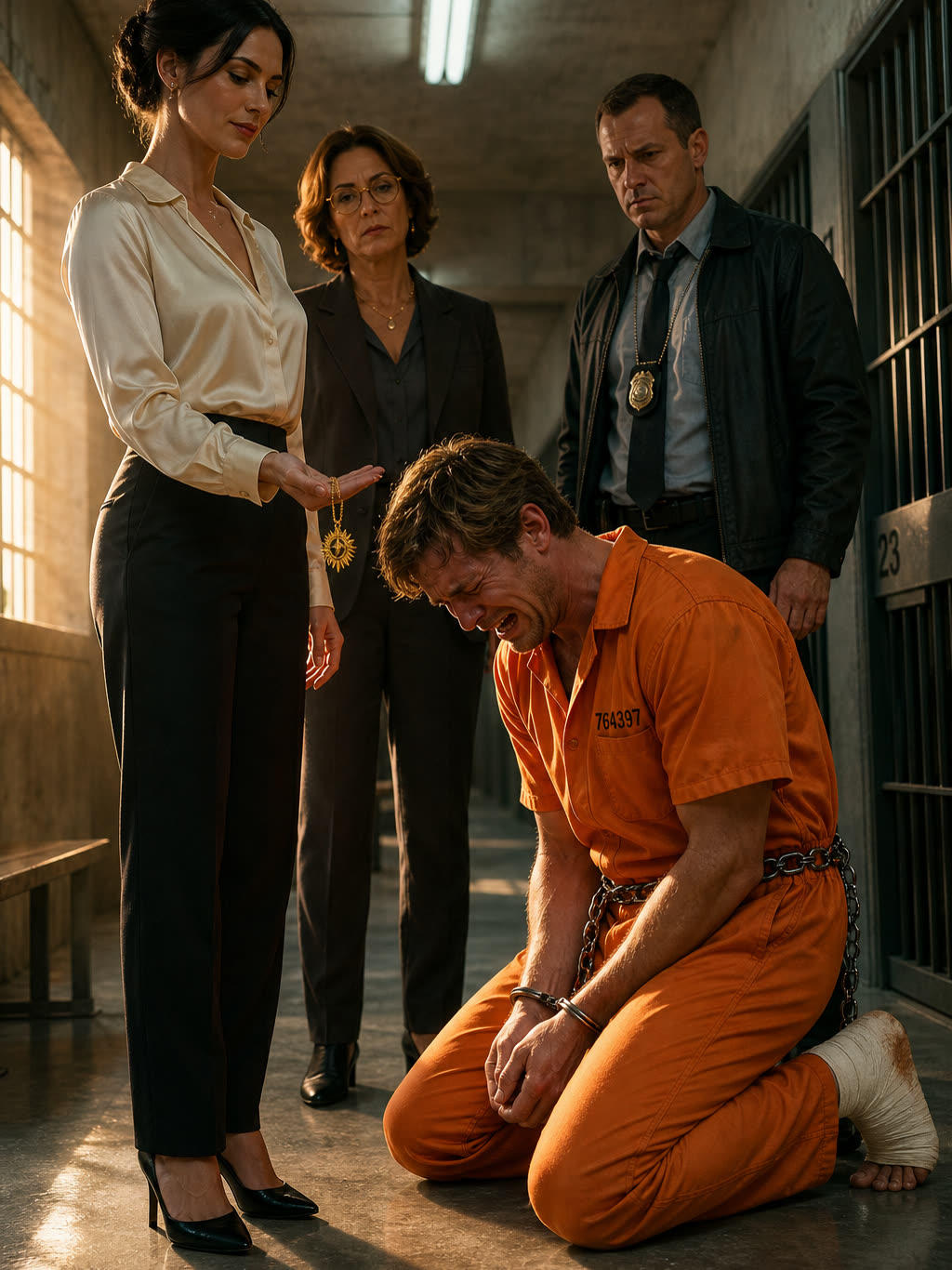
I did not blink. I did not step backward. I reached into the pocket of my blazer and pulled out my mother’s solid-gold sunburst pendant, the heirloom Detective Miller had released to my custody an hour earlier after the crime lab processed it for Brenda’s skin cells. I held the heavy gold in my palm, the institutional fluorescent light catching its sharp, hand-engraved rays. I rubbed my thumb over the initials R.M. on the reverse. Then I looked directly into the dilated, terrified pupils of my husband. “You told me not to turn this into a tragedy from three thousand miles away, Mark,” I whispered. My voice was not a shout. It was soft, intimate, and sharp enough to split a diamond along its grain. Mark’s breath caught in his throat. His lips trembled, unable to form a word.
“You were right,” I continued, every syllable dropping like an iron weight into the silence between us. “I didn’t turn it into a tragedy. I turned it into an execution.” I stepped closer, until the toe of my shoe was an inch from his swollen foot. “The Pelican Bay house was seized under the Florida Elder Abuse Forfeiture Act twenty minutes ago. It belongs exclusively to Rose Morales. Your Porsche is in the county impound lot. Your mother’s jewelry is in an evidence vault. And the Pacific Mutual life insurance policy you took out on my life…” I smiled, a slow, terrible, beautiful thing that made Mark’s knees visibly buckle beneath his orange jumpsuit. “…has been canceled for material criminal fraud. The broker who backdated it was arrested forty minutes ago. You won’t be collecting three million dollars, Mark.” I leaned in, my breath cold against his ear. “You will be collecting thirty years in the state penitentiary in Raiford. And every morning when they open your steel door, you will remember the sound of my mother’s breath on that mattress.”
“Elena, no! Please! DON’T LEAVE ME IN HERE!” Mark screamed, thrashing against his waist chains, falling to his knees on the concrete, his forehead smashing against my shoe as he tried to grasp my trousers with his shackled fingers. Two burly corrections deputies grabbed him by the armpits and hauled his writhing, sobbing, hyperventilating frame backward down the hallway toward the holding cells. “ELENA! I’M YOUR HUSBAND! ELENA!” His screams echoed until the heavy hydraulic security door slammed shut with a concussive, final BOOM. Silence returned to the hallway. Clara Benitez stepped up beside me and handed me a silver fountain pen and a three-page legal document stamped by the Chief Judge of the Twentieth Judicial Circuit. “The emergency petition for absolute dissolution of marriage with prejudice, Elena,” Clara said softly. “Sole legal, physical, and financial restoration granted. The name Vance is legally excised from your records.” I took the pen. I did not hesitate. With a smooth, unyielding, permanent stroke of black ink, I signed my name: Elena Morales. The daughter of Rose. And the architect of their doom.
The recovery of a human soul from the depths of calculated starvation is not an overnight miracle. It is a slow, agonizing, sacred process of cellular and psychological reconstruction. Six months later, the world had washed itself clean of the Vance name. The trial never happened. Faced with forty-two hours of uncompressed 4K video from my suitcase, the chemical analysis of the phenobarbital tea leaves, the recorded jailhouse confessions of mother and son tearing each other apart, and the devastating testimony of Arthur Pendelton, the corrupt broker who turned state’s evidence to save himself from a life sentence, the defense attorneys collapsed before the preliminary motions were even argued. In Courtroom 3B of the Lee County Justice Center, the gavel fell with biblical finality. Mark Vance pleaded guilty to one count of Attempted Capital Murder for Financial Gain, one count of Aggravated Exploitation of an Elderly Person, and one count of Grand Theft in the First Degree: thirty years at the Florida State Prison in Raiford, with no possibility of early release. Brenda Vance pleaded guilty to Conspiracy to Commit Capital Murder and Aggravated Abuse of an Elderly Person: twenty-two years at Lowell Correctional Institution. Heather Vance pleaded guilty to Felony Grand Larceny and Operating an Illicit Corporate Shell: eight years at Gadsden Correctional Facility, with mandatory restitution of one hundred and ten thousand dollars.
Every asset acquired during their three-year reign of terror had been liquidated by the court-appointed receiver. The renovated house on Pelican Bay Drive, whose walls were soaked in the memory of my mother’s suffering, was sold to an out-of-state commercial developer for nine hundred and eighty thousand dollars. Every dollar of the proceeds, along with the recovered savings and the three-hundred-thousand-dollar civil settlement extracted from the brokerage’s liability policy, went into an ironclad, court-supervised trust: The Rose Morales Irrevocable Healthcare and Rehabilitation Trust.
It was a Tuesday morning in late December. The sun poured like warm honey over the wide, hand-hewn cedar deck of our new home, a light-filled, mid-century modern coastal bungalow on a private one-acre lot at the quiet northern tip of Siesta Key in Sarasota. The property was ringed by ancient, moss-draped live oaks, towering sea grapes, and lush beds of vibrant red hibiscus. The air was a crisp seventy-four degrees, smelling of sea salt, sweet jasmine, and the restorative breeze drifting off the Gulf of Mexico. Sitting in a deep, high-backed wicker armchair, wrapped in a soft cream cashmere shawl, was my mother. Her transformation was nothing short of a medical resurrection. Under the daily care of two private physical therapists, a licensed clinical nutritionist, and a restorative neurologist from Johns Hopkins, the emaciated ghost from the mattress had vanished. Rose’s cheeks were full and flushed with a vibrant pink. Her silver hair had been trimmed into an elegant bob. The severe bedsores on her back had healed into smooth, silver scars. Her right hand, once paralyzed by the stroke and the toxic sedation, held a porcelain cup of organic peppermint tea without a single tremor. And resting against her yellow sundress, catching the morning light like an unyielding star, was her solid-gold sunburst pendant.
Clara Benitez sat across the glass patio table in a crisp linen blazer, reviewing the final accounting statements from the probate court. “The trust accounts are fully secured, Elena,” Clara smiled, setting her fountain pen down with a satisfying clack. “The restitution liens have been satisfied down to the final penny. The house is paid in full. There are zero mortgages, zero liabilities, and the remaining liquid capital will generate seventy-two thousand dollars a year in passive municipal bond interest for the rest of your mother’s life.” Her sharp eyes softened with familial affection as she looked at Rose. “You are safe, Tía Rose,” Clara murmured in Spanish. “The monsters are in cages that have no doors.”
Rose set her teacup down on its saucer with a steady, delicate hand. She looked at Clara. Then she looked at me. She did not reach for the lightweight carbon-fiber walker beside her chair. She did not ask for my hand. Slowly, deliberately, her back straight, her chin lifted with the ancient dignity of a woman who had crossed ninety miles of open ocean, Rose Morales pushed herself up from the wicker armchair. She stood on her own two feet. Her balance was absolute. She took one step across the warm cedar planks. Two steps. Three steps. She reached the edge of my chair, bent down, and wrapped both arms tightly, fiercely around my neck, pulling my face against the soft cotton of her dress. She smelled of clean lavender soap, sunshine, and fresh bread.
“My daughter,” Rose whispered into my ear, her voice clear, strong, and completely unburdened by the gravel of the dark room. “You did not just bring me home, Elena. You gave me back my name.” I held her. I buried my face in the curve of her neck, my arms around her waist, weeping for the first time in six months. They were not tears of trauma or of grief. They were the holy, torrential tears of a daughter who had walked through the valley of the shadow of death, looked the wolves in the eye, and dragged her mother back into the light of the sun.
After breakfast, while my mother sat by the garden happily watching a pair of ruby-throated hummingbirds dart among the red hibiscus blossoms, I sat alone at the outdoor table with my laptop and opened the local hard drive. I navigated to the folder titled EVIDENCE_CASE_44812_PELICAN_BAY. Inside were forty gigabytes of data: the 4K video of Heather tearing my luggage, the audio files of Brenda discussing the poison in the tea, the crime-scene photographs of the mattress, the forged power of attorney. I looked at the folder for precisely three seconds. My pulse remained a steady, rhythmic fifty-two beats per minute. I did not need the files anymore. The state had its copies. The prisons had their inmates. I pressed the master shortcut: Shift + Command + Delete. A dialogue box appeared: Are you sure you want to permanently erase these items? This action cannot be undone. I hit Enter. The progress bar flashed for half a second, and the folder vanished. The screen returned to an immaculate, empty desktop displaying the Gulf of Mexico at sunrise. The past was not just closed. It was incinerated.
A year had passed.
The golden light of the late-afternoon sun spread across the brilliant white quartz sands of Crescent Beach, transforming the Gulf’s softly breaking waves into an endless, glittering pathway of turquoise and gold.
The temperature hovered at eighty-two degrees, and the refreshing, fragrant breeze carried the unmistakable flavors of ocean salt, coconut oil, and complete, untouchable freedom.
I stood where the shoreline met the sea, dressed in a breezy linen tunic and trousers rolled above my ankles, my bare feet settling into the damp, cool sand as gentle waves washed around them. I held a cold glass of freshly prepared pineapple-and-mint agua fresca in one hand.
About fifty yards farther along the shore, my mother strolled beside the water.
At seventy-two, she moved with long, effortless, assured steps, an enormous straw sunhat shading her face above her sunglasses. Racing playfully around her and barking excitedly at passing seagulls was Barnaby, our silly, golden-coated, ninety-pound rescue retriever whom we had brought home from the county animal shelter nine months earlier.
Mom burst into laughter, a bright, ringing, melodic sound that traveled easily above the soft thunder of the surf, when Barnaby deposited a soaking wet tennis ball covered in sand directly against her bare toes, eagerly demanding another game.
She leaned forward, picked up the ball with her right hand, and tossed it thirty feet out into the shallow waves, smiling as the dog bounded without hesitation into the sparkling turquoise sea.
She was complete. She was full of energy. She was finally enjoying the existence she had deserved after spending thirty years scrubbing rooms for other people.
A vibration came from the smartphone tucked into my linen pants.
I reached into my pocket and retrieved it.
An automatically generated administrative alert had arrived through the Victim Information and Notification Everyday (VINE) system connected to the Florida Department of Corrections:
Inmate Details: Mark Vance (DC# 84920). Facility: Florida State Prison — Maximum Security Wing (Starke, FL). Status: Institutional Disciplinary Action Logged — Loss of Commissary Privileges (90 Days). Administrative Action: Petition for Sentence Review / Compassionate Release — SUMMARILY REJECTED BY DISTRICT COURT OF APPEAL.
A short, single-paragraph update concerning Brenda Vance was included as an attachment:
She remained assigned to the institutional laundry department at Lowell Correctional, spending forty hours every week separating commercial prison uniforms for twenty cents an hour, while her requests for medical relocation continued to be refused.
I studied the illuminated display for exactly two seconds.
My pulse remained perfectly steady.
My breathing never faltered.
I experienced no rush of cruel satisfaction or bitter revenge. Not even the smallest trace of lingering resentment remained within me.
Hatred is a poisonous and costly indulgence, demanding that you sacrifice your precious energy to preserve an emotional attachment to individuals who had already demonstrated the emptiness of their souls.
What I experienced instead was the immense, peaceful, lasting contentment of an architect who had discovered a dangerously unstable building, its foundations decaying and its walls consumed by termites, torn it completely down to solid bedrock, removed every fragment of wreckage, and constructed an impregnable refuge filled with sunlight on the newly cleared ground.
I touched the screen with my thumb.
Delete Notification. Unsubscribe from System Alerts.
The display faded to black, leaving only the reflection of the vivid blue heavens and the warm golden sunshine of a Florida afternoon.
I returned the phone to my pocket.
Those fortunate enough never to have endured organized, narcissistic cruelty frequently question how truly monstrous individuals manage to exist openly among ordinary people. They struggle to comprehend how an attractive man dressed in an expensive Italian suit, a refined mother adorned with diamonds, and a daughter wearing a polished country-club smile can exchange friendly greetings with their neighbors while imprisoning an elderly woman inside a dark, cockroach-infested room.
What they fail to recognize is that the deadliest hunters in this world do not reveal themselves through sharp fangs.
Nor do they lurk in shadowy alleyways.
They wear marriage bands. They walk around carrying business briefcases. They disguise their consuming selfishness beneath carefully chosen words about affection, responsibility, and family loyalty. They observe women who earn their living through hard work—women who scrub floors and rooms, women who coordinate every practical detail, women who supply the financial support—and convince themselves that such women are powerless, gullible, and simple to erase from existence.
In doing so, they commit one devastating, irreversible mistake that threatens everything they believe about their own power.
They overlook the fact that women who spend their lives cleaning up the world understand better than anyone how to dispose of garbage.
They fail to realize that the devotion a daughter feels toward her mother cannot be bought or negotiated; it is an ancient, sacred, indestructible bond created through shared blood and cherished memories.
And the moment you endanger that bond…
The moment you lift your hand against the woman who sacrificed her own life so her daughter could rise…
That daughter will do far more than escape the prison you prepared for her.
She will cross oceans to return. She will expose and dismantle every deception with the exacting accuracy of a forensic surgeon. She will reclaim every last particle of soil you wrongfully seized, and she will abandon you to decay inside the very concrete prison you intended to construct around her.
“Elena!”
My mother called out across the waves, her voice cheerful, unmistakable, and overflowing with genuine happiness.
Standing in the shallow surf, she waved enthusiastically in my direction, lifting an enormous, perfectly intact pink conch shell that the retreating water had exposed upon a sandbar. Barnaby bounded through the water beside her, his wagging tail swinging back and forth with the regular rhythm of a metronome.
“Elena! Look what the ocean brought us!”
A smile spread across my face.
I placed my drink on the weather-beaten driftwood log lying beside my beach towel.
I slipped out of my sandals, savoring the gentle warmth of the fine quartz sand beneath my feet and the sunshine brushing my shoulders as I hurried toward the surf, toward my mother, and toward the beautiful existence that was finally ours alone.
The sunshine remained brilliant. The ocean water was transparent. And the distant horizon, at long last, stretched before us beautifully clear, entirely open, and free from every condition.
Disclaimer: This story is a work of fiction inspired by real-life themes. Names, characters, places and events are fictionalized, and any resemblance to real persons is purely coincidental. Images are for illustration purposes only.
