


Part 1: The List
At exactly 4:17 on Sunday afternoon, my daughter-in-law came home from nine luxurious days in Cabo. She slid her key into the front door, and it refused to turn.
Nine days before that, she had pressed a handwritten list into the hands of a sixty-nine-year-old widow, which was me. It named every chore she expected me to finish while she lounged on a beach with my son and my grandchildren.
Wash their sheets. Scrub their bathrooms. Do their laundry. Buy their groceries. Organize their belongings.
She had even underlined the last line: EVERYTHING MUST BE DONE BEFORE WE RETURN.
What Nicole never noticed was that I had written one more task beneath her list.
11. CLEAN OUT THE HOUSE.
By the time she finally walked inside, her enormous television, her costly decorations, her designer clothes and nearly everything else she had carried into my home had vanished.
Yet the biggest shock sat waiting in a blue folder on my coffee table. It held the papers that would end the arrangement she had exploited for sixteen months.
And when my son finally read her original list, the expression on his face told me that something had shifted for good.
My name is Margaret. I am sixty-nine, and for most of my life I believed that keeping my family content was among my most important duties. That belief almost cost me my house. It all reached a head on the morning my son Eric, his wife Nicole and their two children set off for Mexico. I stood in my kitchen savoring a quiet cup of tea when I heard suitcases rumbling down the stairs.
“Eric, did you pack the chargers?” Nicole called.
“Yes.”
“And Lily’s medication?”
“Already in the bag.”
“Are you sure?”
“Nicole, I’ve checked everything.”
I smiled faintly. After sixteen months under one roof, I had grown used to their daily exchanges.
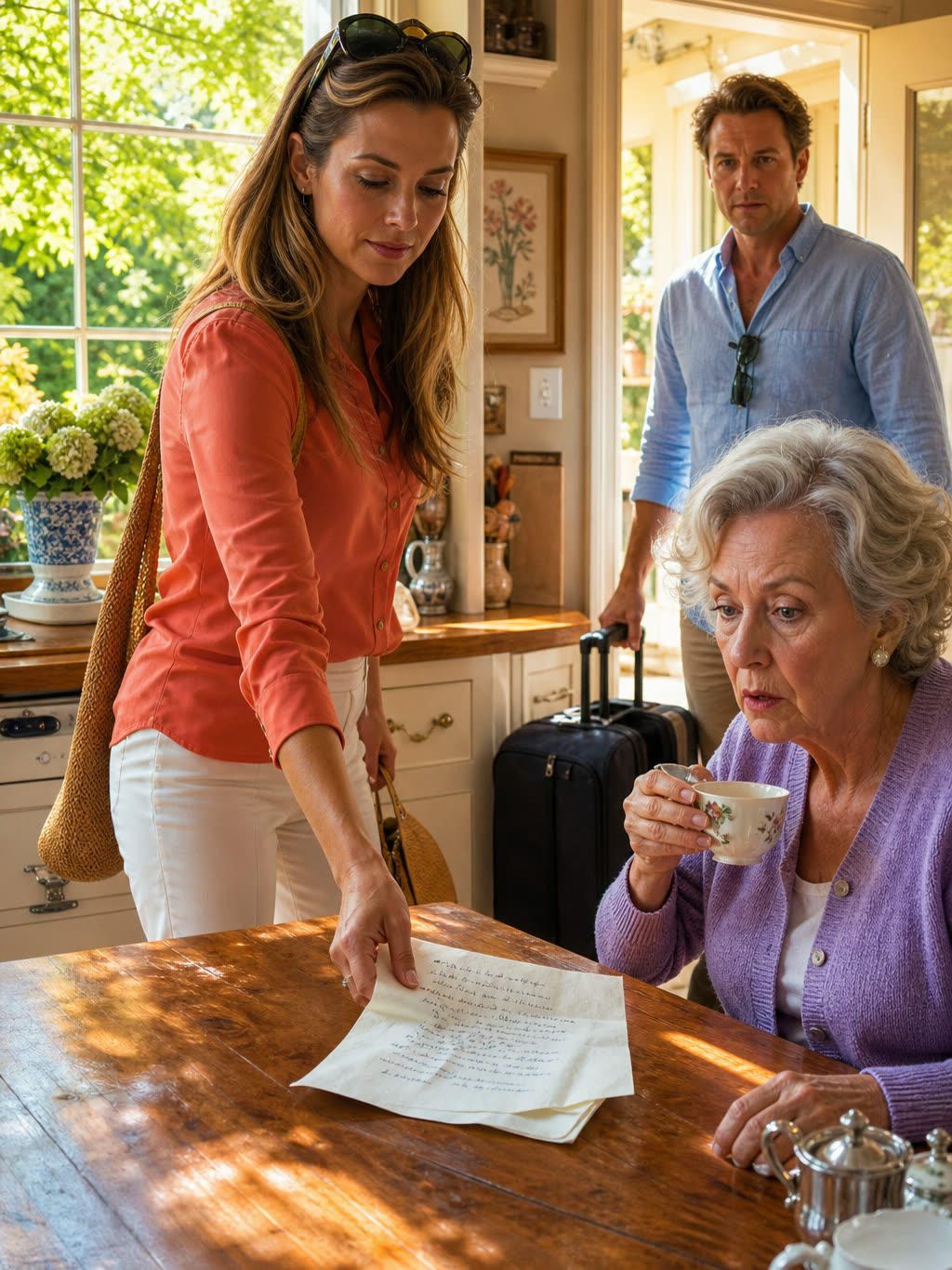
A moment later Nicole swept into the kitchen in white trousers and stylish sandals, huge sunglasses resting on top of her head. She drew a folded sheet from her handbag and set it squarely in front of me.
“Margaret, here’s what I need you to take care of while we’re away.”
I looked down. At first I assumed she had jotted down how to water the plants, or some emergency phone numbers. Instead I found a long catalog of household labor.
Wash everyone’s bedding. Deep-clean both bathrooms. Finish the children’s laundry. Empty and clean the refrigerator. Collect Eric’s clothes from the dry cleaner. Vacuum the upstairs rooms. Organize the garage. Buy enough groceries for their return. Water the plants. And last, clean Eric and Nicole’s bedroom.
At the bottom, in capital letters, she had written: MAKE SURE EVERYTHING IS FINISHED BEFORE SUNDAY.
I stared at the page.
“Nicole, are you asking me to do all of this?”
She seemed truly surprised that I would ask.
“Of course. We’ll be away for nine days. You’ll have plenty of time.”
I slowly set my teacup down.
“I’m not sure I understand why your bedroom needs cleaning while you’re on vacation.”
She sighed.
“Margaret, it’s just basic housework. We’re going to be exhausted when we get home.”
Before I could reply, Eric appeared with two suitcases in his hands.
“Everyone ready?”
“Almost,” Nicole said. “I just gave your mother the things that need doing.”
My son glanced briefly at the paper. Then he smiled at me.
“Thanks, Mom. You’re wonderful.”
He kissed my cheek, grabbed another bag and walked out toward the driveway.
He had not even read the list.
Ten minutes later their SUV slipped around the corner. My eight-year-old granddaughter Lily waved wildly through the back window.
“Bye, Grandma! I’ll bring you something from the beach!”
“Find me a pretty seashell!” I called.
Eleven-year-old Noah waved from beside her. I stood watching until the car was out of sight, and then I went back to the kitchen.
Nicole’s list was still lying on the counter. I picked it up and read each instruction once more.
Oddly, I did not feel angry at first. I felt embarrassed. Not because of what Nicole had done, but because I had let our relationship become what it was.
Nobody had turned me into an unpaid housekeeper overnight. It had crept up on me. One favor. One needless apology. One uncomfortable conversation I dodged. One promise that I would make things easier for everyone. And after sixteen months, here I was in my own kitchen, receiving instructions like a hired employee.
I sat by the window and gazed at the enormous maple in the backyard. My husband, Frank, had planted it thirty-three years earlier, when it barely reached our son’s shoulders. Now its branches spread across most of the garden.
Frank adored that tree. He adored our house, too. We had bought it thirty-seven years before, young and hopeful and barely able to afford the mortgage. We raised Eric beneath that roof. We marked birthdays, graduations, Christmas mornings and countless family dinners there.
Frank built the living room bookshelves with his own hands. They leaned slightly to one side for years before he finally agreed to fix them. He installed the kitchen cabinets, mended the floors, and repainted the guest room three times because I kept changing my mind about the color. He grumbled about every project, but he always finished them.
When Frank died four years ago, the house became mine. The mortgage was already paid off. I had a modest pension, some savings and no debts. I did not depend on my son. If anything, the reverse was true.
Sixteen months earlier, Eric had phoned me late one Tuesday evening.
“Mom, can I ask you something?”
I knew right away that something was wrong. He rarely called so late.
“Of course, sweetheart.”
He hesitated.
“My company eliminated my position.”
My heart sank.
“Oh, Eric. I’m so sorry.”
“We’ll manage,” he said. “But our lease is ending, and money’s going to be tight for a while.”
I waited. Then came the question I could already hear approaching.
“Would it be possible for us to stay with you temporarily?”
“How long?”
“Maybe six months. Hopefully less.”
I looked around my silent living room. Since Frank’s passing, the house had sometimes felt painfully empty. The thought of my grandchildren close by was a comfort. And Eric was my only child.
So I said yes.
They arrived the following weekend with a moving truck. Nicole hugged me and thanked me again and again.
“You have no idea how much this means, Margaret. We’ll never forget your kindness.”
For the first few weeks, things went reasonably well. We shared meals. The children played in the backyard. Eric hunted for work. Nicole pitched in around the house. I truly enjoyed having everyone together.
But six months passed. Then seven. Then eight. Eric eventually found another job, one that paid enough for them to rent a place of their own. Naturally, I assumed they would start looking for a new home.
Instead, Nicole bought a new SUV. A few weeks later they spent a weekend in Las Vegas. Then came pricey restaurant dinners, designer handbags, a steady stream of online deliveries and electronics.
One Saturday a seventy-five-inch television arrived. Nicole proudly oversaw its installation in my living room.
“Isn’t it gorgeous?” she asked.
I looked at the giant screen. It hid much of the wooden shelving Frank had built.
“Where’s the photograph of your father and me?” I asked Eric.
Nicole answered before he could.
“Oh, I moved some of the old pictures. They made the room look cluttered.”
“Where did you put them?”
“Somewhere safe.”
I should have insisted on knowing. Instead I let it go. That became my habit. Whenever something bothered me, I told myself it was not worth an argument.
Little by little, my home stopped feeling like mine. My favorite reading chair was shifted because Nicole said it disrupted the design of the room. The kitchen cabinets were rearranged. My belongings disappeared into drawers and storage boxes. The children’s toys spilled across the hallways. Laundry baskets appeared beside the stairs.
And the requests kept coming. At first Nicole asked politely.
“Margaret, would you mind putting these towels in the dryer?”
Then she started assuming.
“The kids need dinner at six.”
“Don’t forget Eric’s dry cleaning.”
“We’re out of milk.”
“Noah needs help with his homework.”
In time she stopped asking at all. She simply told me what needed doing. Whenever I tried to talk to Eric about it, he gave the same explanation.
“Mom, Nicole’s under a lot of pressure.”
Or, worse:
“Come on, Mom. We’re family.”
Those words became his answer to nearly everything. But being family evidently meant I was expected to supply free housing, childcare, meals, cleaning and errands, while my own needs mattered a little less each month.
Three weeks before the Cabo trip, I overheard a conversation that changed everything. I was on my way to the laundry room when I heard Nicole chatting with her sister on the phone.
“Margaret doesn’t mind helping,” she said, laughing.
I stopped walking.
“Seriously, she needs things to keep herself busy. I think doing things for us makes her feel useful.”
I stood frozen in the hallway. Then Nicole added something I will never forget.
“Besides, why would we hurry to move out? We’re saving an incredible amount of money.”
My stomach tightened. I had suspected they were growing too comfortable. But hearing my generosity discussed as a financial advantage was something else entirely.
I crept back to the living room. The huge television dominated the wall. My husband’s books had been shoved aside. My reading chair sat awkwardly in a corner. And suddenly I understood. I had welcomed them into my home because they needed temporary help. They had turned that kindness into a permanent convenience.
That evening, after everyone had gone upstairs, I called David Mercer. David had been Frank’s closest friend for forty years. He was also the attorney who had handled my husband’s estate.
“Margaret?” he answered. “Is everything alright?”
I nearly said yes. Instead I told him the truth. I explained how six months had stretched into sixteen. How my son’s family lived without paying rent. How I was buying groceries for five people and spending my days running errands. How my daughter-in-law had slowly taken control of the house. And how I no longer felt comfortable in rooms I had lived in for decades.
David listened patiently. When I finished, he asked a simple question.
“Margaret, what do you want?”
I looked around the living room. At Nicole’s decorations. At the enormous television. At the bookshelves Frank had built. Then I answered.
“I want my house back.”
David was quiet for a moment.
“Then come to my office tomorrow. We’ll discuss how to handle this properly.”
I did. He explained that I would need to follow the applicable legal procedures, document the arrangement, give any required notices and protect everyone’s belongings. He also cautioned me against acting out of anger.
“Don’t make this about revenge,” he said.
“I don’t want to hurt anyone.”
“Then what do you want?”
“Peace, David. I just want peace.”
He nodded.
“Then we’ll work toward that.”
For several weeks I turned his words over in my mind. Part of me hoped Eric would see the problem without my having to force the issue. I wanted my son to remember that this was the home his father and I had spent our lives building. I wanted Nicole to understand that helping was a choice, not an obligation.
Nothing changed. Then, on the morning of their vacation, Nicole handed me that list. Somehow, seeing her demands written out on paper made the decision easier.
After they left, I sat alone at the kitchen table. The final instruction stared back at me.
EVERYTHING MUST BE FINISHED BEFORE WE RETURN.
I opened the drawer beside the refrigerator. I took out a pen. And I added another line.
11. CLEAN OUT THE HOUSE.
For several seconds I simply looked at those words. My heart was beating faster than usual. Not because I wanted a confrontation, but because I was finally ready to take back the life I had let other people control.
Then I picked up the phone and called David.
Part 2: The Empty Rooms
The following morning, David arrived carrying his briefcase. I showed him the list, and he read it carefully.
When he reached the instruction telling me to clean Nicole’s bedroom, he slowly raised his eyebrows.
“She actually gave you this?”
“Yes.”
“And expected you to finish everything while they vacationed?”
“Apparently, retirement means I have unlimited free time.”
David nearly smiled. Then his face turned serious.
“Margaret, we’re going to do this carefully.”
Together we went over the documents he had prepared, the notice requirements, the access arrangements and the steps needed to handle the family’s possessions lawfully. He stressed that I must not destroy, discard or interfere with anything that belonged to them. I agreed completely.
The children, especially, deserved consideration. Lily and Noah had done nothing wrong. Whatever lay between their parents and me, I would not punish my grandchildren.
Once David was satisfied with the arrangements, I began contacting the professionals we needed. A moving company. A storage facility. And a locksmith, with any lock changes to be made only when legally permitted.
The next several days were unlike anything I had experienced in months. For the first time, I could hear my own thoughts. Nobody asked me to cook dinner. Nobody expected me to drive across town. No laundry baskets appeared outside my bedroom door. Nobody criticized the way I organized my kitchen. And gradually the silence began to feel wonderful.
When the movers arrived, we carefully inventoried and packed the possessions that could be moved under the arrangements David had organized. Every box was labeled. Large items were photographed. The children’s belongings were handled separately.
I personally wrapped Lily’s favorite stuffed rabbit in a clean pillowcase. I protected Noah’s baseball trophies with tissue paper. I wanted their things returned safely.
Then we turned to Eric and Nicole’s belongings. Clothes. Shoes. Suitcases. Bathroom organizers. Electronics. Decorations. Boxes of purchases I had watched arrive throughout the previous year. Slowly, the guest bedroom began to look like the room Frank and I had once prepared for visitors.
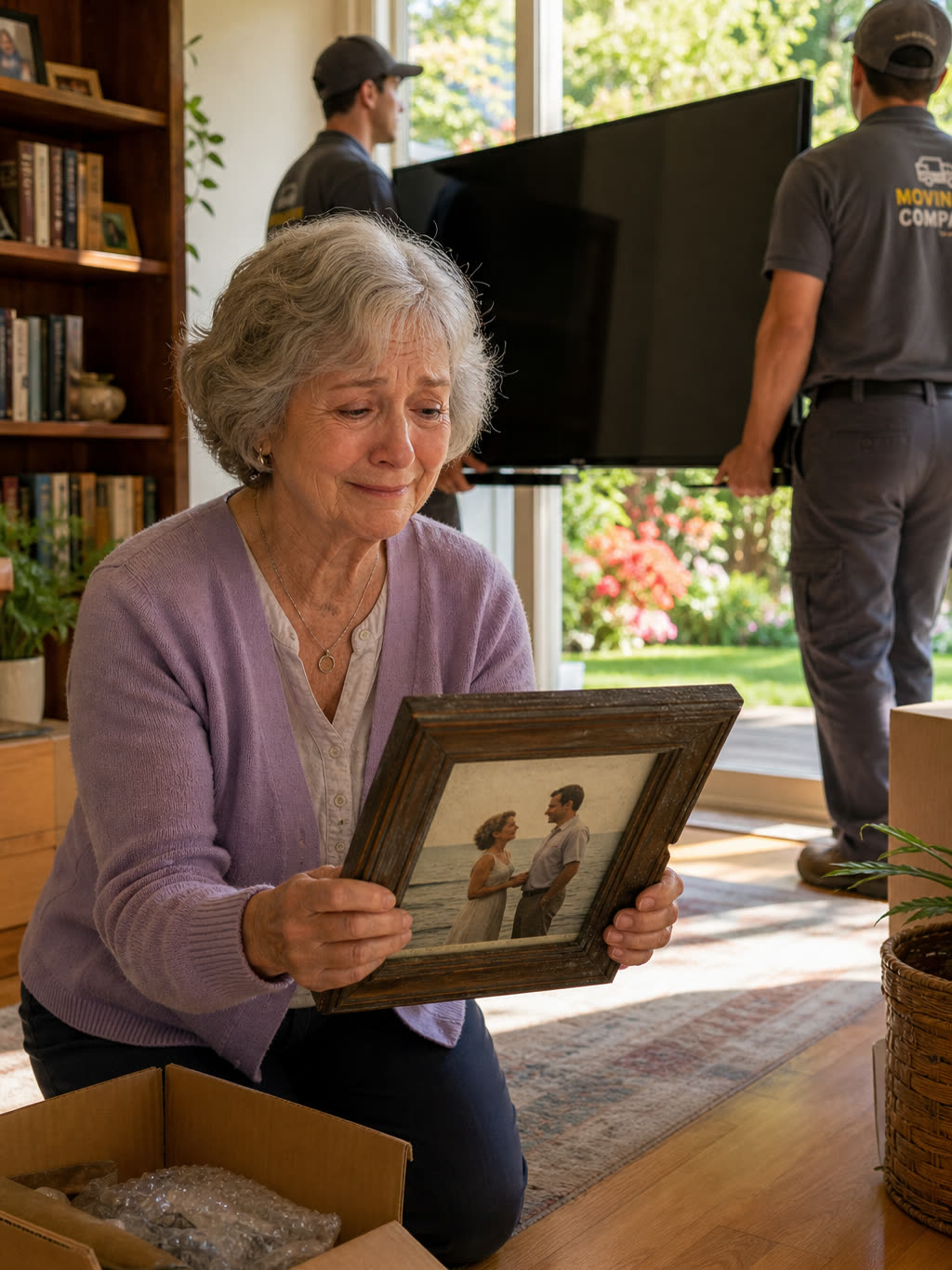
But the most emotional moment came when we reached the living room. Two movers carefully unplugged Nicole’s enormous television. As they lifted it away, something caught my eye. A dark wooden picture frame was wedged behind the cabinet.
“Wait,” I said.
The movers stopped. I bent down and pulled the frame free. Dust coated the glass, but I recognized it immediately. It was a photograph from my thirtieth wedding anniversary. Frank and I stood beside the ocean. His arm was around my waist, and instead of looking at the camera, he was smiling at me.
I remembered teasing him about it.
“Frank, you’re supposed to look at the photographer.”
“I’d rather look at you,” he had replied.
I had searched for that photograph for nearly a year. Nicole had assured me she had put it somewhere safe. And there it was, forgotten behind a television.
I gently wiped the dust from the glass. Tears filled my eyes.
“Are you alright, ma’am?” one of the movers asked.
I nodded.
“Just give me a moment.”
Then I walked to the mantel. Nicole’s white ceramic decoration stood where the photograph had once been. I carefully lifted it and handed it to the mover.
“That belongs with her things.”
I set Frank’s picture back in its original place. For a long moment I stood looking at it.
“There you are,” I whispered.
By Thursday, the transformation was remarkable. Frank’s books were back on the shelves. My reading chair had returned to its favorite spot beside the window. The kitchen cabinets held my dishes arranged the way I preferred. The upstairs hallway was finally clear. And the living room looked like the home I had loved for thirty-seven years.
Not an empty house. My house.
On Friday I went grocery shopping. For the first time in more than a year, I bought food for one person. Eggs. Bread. Vegetables. Salmon. Tea. A small container of ice cream.
When I saw the total at checkout, I laughed. The cashier looked concerned.
“Is something wrong?”
“No,” I replied. “I’m just realizing how much I’ve been spending on groceries.”
“Is that a good thing?”
“Today, it is.”
On Saturday evening, Nicole sent me a photograph. She, Eric and the children were smiling on a beautiful beach beneath a brilliant sunset. Below it she had written:
Flying home tomorrow! Hope you’re getting everything done!
I studied the picture. Then I looked at the list still attached to my refrigerator. I typed a short reply.
Everything is finished.
Nicole answered at once.
You’re the best! ❤️
I put my phone down. For once, I agreed with her.
Sunday arrived bright and warm. I changed my own bedsheets. Watered my plants. Made tea. Then I spent the afternoon reading a mystery novel in the chair beside the window.
At noon David called to confirm that the necessary paperwork, inventory records and storage arrangements were all ready.
“Are you nervous?” he asked.
“A little.”
“That’s understandable.”
“I keep thinking about Lily and Noah.”
His voice softened.
“You can love your grandchildren without being responsible for providing their parents with a permanent home.”
I knew he was right. But knowing something and feeling comfortable with it are not always the same thing.
At four o’clock I placed the blue folder on my coffee table. Inside were the notices, records, photographs and information about the belongings. Then I sat down.
At 4:10 the house was still quiet.
At precisely 4:17, I heard a car door slam. Then another. The children’s voices drifted across the front yard. Suitcase wheels rattled along the driveway.
And then Nicole spoke.
“Why isn’t my key working?”
I stayed seated. I heard metal scrape inside the lock. A pause. Another attempt. Then Eric’s voice.
“Here, let me try.”
A moment later the doorbell rang.
I rose slowly, straightened my cardigan and glanced once at Frank’s photograph. For sixteen months I had waited for someone else to recognize that I deserved respect inside my own home. Now I understood that I could not keep waiting.
I walked toward the entrance. When I opened the door, Nicole stood there looking irritated.
“Margaret, what’s wrong with the lock?”
“I changed the access arrangements.”
Part 3: The Eleventh Task
She stared at me.
“Why would you do that?”
“Come inside. We need to talk.”
The children rushed toward me.
“Grandma!”
Lily threw her arms around my waist. I hugged her tightly.
“Did you find my seashell?”
She proudly pulled three little shells from her bag. I smiled and thanked her. Then I encouraged the children to spend a few minutes in the backyard while the adults talked.
Nicole walked into the living room. She took three steps. Then she stopped. Her eyes moved toward the wall. The seventy-five-inch television was missing. So were her expensive cushions, decorative sculptures and other belongings. In their place stood Frank’s books and our family photographs.
She slowly removed her sunglasses.

“Where’s our television?”
“It’s been carefully packed.”
She turned toward me.
“What do you mean, packed?”
“Your belongings have been inventoried and placed into the arrangements described in these documents.”
Nicole stared at me. Then she hurried upstairs. Seconds later I heard her calling for Eric. He followed her. I waited downstairs, trying to steady my breathing.
When they returned, Nicole looked furious.
“Our clothes are gone! The bedroom’s been cleared!”
“Yes.”
“Even the children’s things?”
“They’ve all been handled carefully. Nothing has been thrown away.”
I picked up the blue folder and handed it to Eric.
“Please read this.”
He opened it. First came the photographs. Then the inventory. Then the storage information and the formal paperwork. As he read, his expression changed.
“Mom, you’re asking us to move out?”
“I’ve begun the proper process for ending the arrangement. David has explained the details.”
Nicole shook her head.
“You can’t do this! This is our home!”
I looked at her calmly.
“No, Nicole. This is the home Frank and I bought thirty-seven years ago. We allowed you to stay here temporarily.”
“We’ve lived here for sixteen months!”
“Yes,” I replied. “Sixteen months after you promised it would be six.”
She folded her arms.
“And what about the children?”
I glanced toward the backyard.
“I love Lily and Noah more than I can explain. They’ll always be welcome in my life. But their parents are responsible for providing their home.”
Nicole opened her mouth to argue again. Then her eyes landed on the refrigerator. The chore list was still fastened beneath a small magnet. She walked over to it. Slowly she read through her own instructions. Then her eyes reached the bottom.
11. CLEAN OUT THE HOUSE.
Her expression hardened.
“You think this is some kind of joke?”
“No.”
“Then why did you write that?”
I looked at the list.
“Because it’s the last time anyone will leave orders for me in my own kitchen.”
For several seconds nobody spoke. Then Eric stepped toward the refrigerator.
“What list?”
Nicole tried to stop him, but he had already pulled the paper free. He began reading aloud.
“Wash all the bedding. Clean both bathrooms. Do the children’s laundry…”
His voice slowed.
“Pick up my dry cleaning?”
He looked at his wife.
“Nicole, why did you tell Mom to collect my clothes?”
She shrugged.
“Because you needed them.”
He kept reading.
“Organize the garage. Buy groceries. Clean our bedroom.”
He stared at her.
“You asked my mother to clean our bedroom while we were vacationing?”
Nicole looked annoyed.
“You saw the list before we left!”
“I glanced at it.”
“Then that’s your problem.”
Eric fell silent, because she was right about one thing. He had seen the paper. He had thanked me without bothering to understand what his wife was demanding. He had kissed my cheek and walked away.
For the first time, I watched my son recognize something I had struggled to explain for months. He slowly sat down.
“Mom,” he whispered, “I’m sorry.”
Nicole turned on him.
“Seriously? You’re taking her side?”
Eric looked around the living room. At his father’s bookshelves. At the photograph on the mantel. At the chair beside the window. Then he shook his head.
“This isn’t about taking sides.”
He looked at Nicole.
“It’s Mom’s house.”
She said nothing.
“We were supposed to stay for six months,” he continued. “We’ve been here sixteen.”
“We needed time to save,” Nicole protested.
I looked at her.
“Save for what? The new SUV? Las Vegas? Nine days in Cabo?”
She glanced away. Eric stared at the suitcases near the door. The truth seemed to settle over him. They had enjoyed vacations and expensive purchases while I paid for their housing and much of their daily living. And then they had left me a chore list.
“I didn’t realize how bad it had become,” he said quietly.
I shook my head.
“You didn’t want to realize it.”
He looked at me. For a moment I thought he would argue. Instead his eyes filled with tears.
“You’re right.”
He took a breath.
“I let you become our cook, our cleaner, our babysitter. Every time you asked for something, I told you we were family.”
I stayed silent.
“And I forgot that being family should mean caring about what we’re asking you to give up.”
Tears burned behind my eyes. I still loved my son, and I probably always would. But I could not go back to the arrangement that had made me dread hearing footsteps in my own hallway.
“I love you, Eric,” I said.
“I know, Mom.”
“But you still need to find another place to live.”
He nodded.
“I understand.”
Nicole began to cry. For the first time that afternoon she seemed more frightened than angry.
“Where are we supposed to go?”
Eric answered before I could.
“We’ll stay at a hotel tonight and make plans from there.”
“But we can’t afford a house this big!”
“Then we’ll find something smaller.”
I watched him carefully. For the first time in months, I recognized the thoughtful young man Frank and I had raised. Not because he had suddenly become perfect, but because he had stopped expecting me to solve every problem for him.
Later, when Lily came inside and asked whether they were leaving, Eric crouched beside her.
“Yes, sweetheart. We’re going to stay somewhere else.”
“Did we do something wrong?” she asked.
My heart ached. I knelt beside her.
“Of course not. Grandma loves you.”
“Then why can’t we stay here?”
Eric gently explained.
“Because Grandma needs her home back.”
Lily frowned.
“But it is Grandma’s home.”
He gave a small, sad smile.
“Exactly.”
The children accepted the explanation more easily than the adults had. Before long, Eric and Nicole arranged to leave for the hotel, with their belongings to be collected through the documented process. Lily hugged me. Noah promised to visit. Eric stood beside the door for a long moment.
“I’ll call you tomorrow, Mom.”
“Alright.”
He hugged me tightly. Then they left.
When the front door closed, I leaned against it. My hands were shaking. I had imagined I would feel victorious. Instead I cried. Because setting a necessary boundary does not always feel like winning. Sometimes it feels like losing the family arrangement you had desperately hoped would work.
That evening I sat in my reading chair and looked at Frank’s photograph.
“I hope I did the right thing,” I whispered.
Of course the photograph could not answer. But I knew what Frank would have said. He spent our marriage reminding me that kindness mattered. He also reminded me that kindness should never require a person to disappear.
The following weeks were hard. Eric and Nicole stayed in a hotel for several nights. Their belongings were collected through the arrangements David had established. Then, within three weeks, they rented a smaller townhouse. It was not as spacious as mine. There was no enormous living room, no convenient grandmother downstairs to cook dinner. But it was theirs. And that mattered.
Nicole did not contact me for nearly two months. I gave her that space. In the past I would have called repeatedly, apologized, or offered something just to end the tension. This time I did not.
Eric called every Sunday. At first our conversations were short and awkward.
“How are you, Mom?”
“I’m fine.”
“The kids are doing well.”
“I’m glad.”
“Love you.”
“Love you too.”
But slowly the calls grew longer. He started asking about my life. My books. My garden. The friends I had visited. The plans I was making. One afternoon he asked whether I needed anything. I almost laughed.
“No dry cleaning to collect?” I teased.
He groaned.
“Mom, I’ll never live that down, will I?”
“Probably not.”
We both laughed. It was the first comfortable conversation we had shared in a long time.
A few weeks later Eric arrived carrying a small box.
“I found something while unpacking,” he said.
Inside was Frank’s old wristwatch. The silver band was scratched, and the face had a tiny mark beside the number four. My husband had worn it almost every day for more than twenty years. I had thought it was lost.
Eric watched as I held it.
“Dad used to check that watch constantly whenever I came home late.”
I smiled.
“He wanted you to think he was watching the time. Usually he was looking out the window waiting for you.”
Eric’s expression softened. Then he lowered his eyes.
“Dad would be disappointed in me.”
I did not rush to reassure him. Finally I said, “He would have been disappointed by how you treated me.”
Eric nodded.
“But he’d also expect you to learn from it.”
He looked up.
“I’m trying.”
“I can see that.”
And I could. Eric was finally taking responsibility for his family. If Noah missed the school bus, Eric handled it. If Lily became ill, her parents adjusted their schedules. When something broke in their townhouse, they arranged the repairs. These were ordinary responsibilities, but for sixteen months many of them had somehow become mine. Now my son was learning that adulthood does not stop being inconvenient simply because his mother is available.
Then, three months after their Cabo vacation, my doorbell rang unexpectedly. When I opened it, Nicole stood on the porch. Alone. She held an apple pie.
For several seconds neither of us spoke.
“I made this,” she finally said.
“For me?”
She nodded. I stepped aside.
“Come in.”
We sat at the kitchen table. The silence was uncomfortable, but I no longer felt responsible for filling every silence. Eventually Nicole looked toward Frank’s photograph.
“You found that picture.”
“Behind your television.”
She winced.
“I honestly didn’t know it was there.”
“I believe you.”
“I should have taken better care of your things.”
“Yes.”
She looked down. Then she said something I had not expected.
“I treated you like hired help.”
I nodded.
“You did.”
Her eyes filled.
“When we first moved in, I was embarrassed. Eric had lost his job, and everyone we knew seemed to be doing better than us.”
She paused.
“When he started working again, I wanted to feel successful. So I bought things. The SUV, the television, vacations…”
“And you kept postponing moving out,” I said.
“Yes.”
She took a breath.
“Then I started acting as though the house belonged to us. And I convinced myself you enjoyed doing everything for the family.”
“I did enjoy helping,” I replied. “But helping someone because you want to is very different from being told what to do.”
Nicole slowly nodded.
“I understand that now.”
She wiped her eyes.
“I’m sorry, Margaret.”
For the first time, her apology came without excuses. I believed she meant it.
“I accept your apology.”
She looked relieved. But I added something important.
“That doesn’t mean you can move back.”
A small smile appeared on her face.
“I know.”
We both laughed. Then we shared the apple pie. It was a little too sweet. I decided not to mention that.
Over the following year, our relationship improved gradually. They began asking before visiting. They checked whether I was available before requesting help with the children. Sometimes I said yes. Sometimes I said no. And to my surprise, nothing terrible happened when I refused.
One Saturday Nicole asked whether I could watch Lily and Noah while she and Eric attended a friend’s anniversary dinner.
“I already have plans,” I told her.
There was a short pause. Then she said, “No problem. I’ll ask my sister.”
That was all. No complaints. No guilt. No reminders about my responsibilities as a grandmother. I hung up and smiled. For years I had feared that saying no would damage my relationships. Now I was learning that healthy relationships could survive disappointment.
Gradually I began building a life that belonged to me again. I visited friends. Joined a reading group. Spent afternoons gardening. Went to lunch without checking whether someone needed a ride. And sometimes I simply sat in my favorite chair with a cup of tea. My house was quieter, but it no longer felt lonely.
There is a difference between being alone and feeling forgotten. I had been surrounded by family for sixteen months, yet I had often felt invisible. Now I could spend an entire afternoon by myself and feel completely at peace.
I kept Nicole’s old chore list inside the blue folder. Not because I wanted to punish her. Not because I was still angry. But because it reminded me of something important. Ten instructions had been written by someone who assumed my time belonged to her. The eleventh had been written by a woman who had finally remembered her own worth.
I never washed Nicole’s bedding. Never collected Eric’s dry cleaning. Never scrubbed their bedroom. Never bought groceries for their return from Cabo. But I did finish the one task that mattered most. I reclaimed my home.
More importantly, I reclaimed the right to decide how my time, energy and kindness would be shared. And the most surprising part was that setting boundaries did not destroy my family. It slowly taught us how to become a healthier one.
One evening I stood in the living room watching the last sunlight fall across Frank’s bookshelves. His photograph rested on the mantel. His old wristwatch was safely tucked away upstairs. The house carried decades of memories, and I knew I would always miss him. But I also knew that my own life was not over. At sixty-nine, I still had years ahead of me. Years I deserved to spend with peace, independence and people who respected me.
I turned off the kitchen light and looked around one last time. Nicole had been right about one thing. There really had been a great deal of cleaning to do before she returned from Cabo. I just hadn’t needed to scrub her bathroom or fold her laundry. I needed to clear away the belief that being a loving mother meant sacrificing every part of myself.
And when that final task was complete, I could finally say something I had not felt in sixteen months.
This house was mine again.
And so was my life.
Disclaimer: This story is a work of fiction inspired by real-life themes. Names, characters, places and events are fictionalized, and any resemblance to real persons is purely coincidental. Images are for illustration purposes only.
