

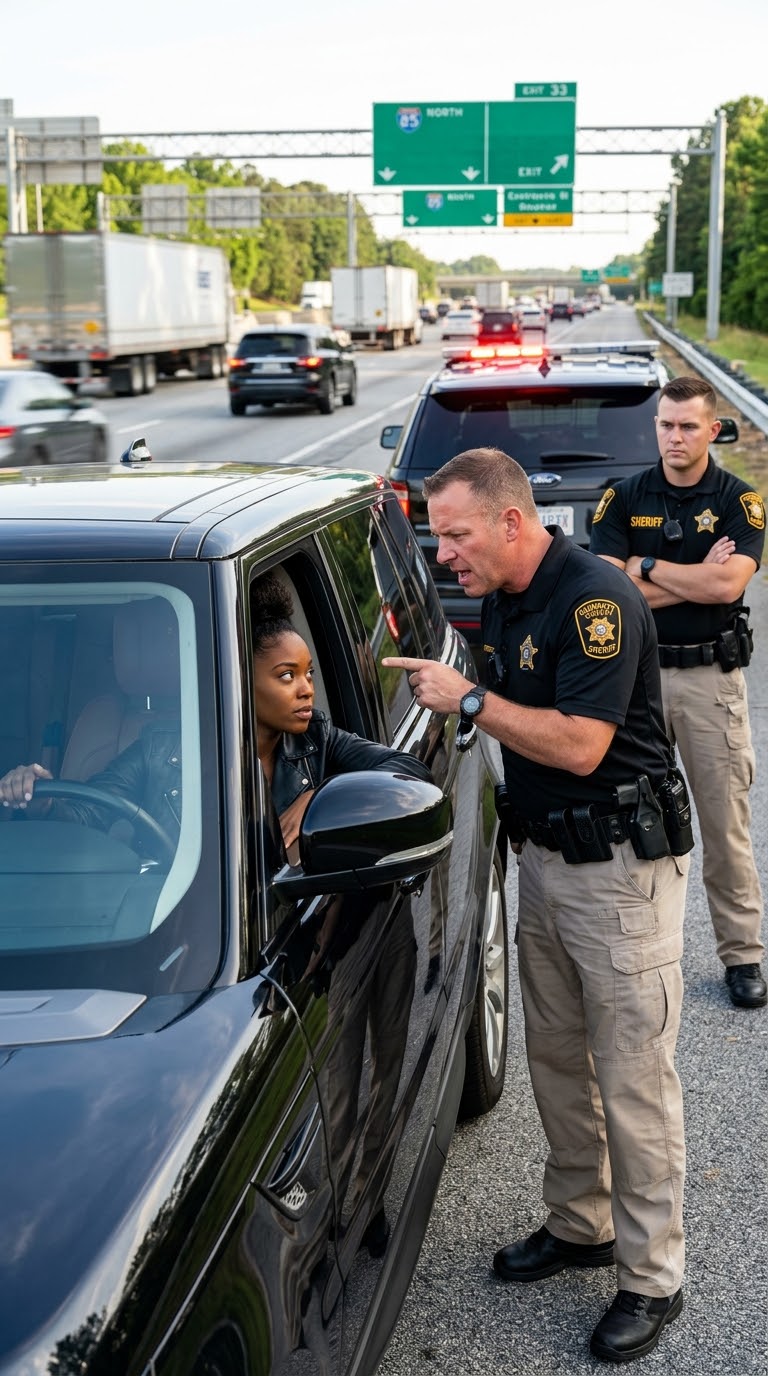
PART 5
Alexis remained awake throughout the night.
By morning, she had organized the evidence into a detailed map of the department’s connections and financial activities.
Her mother remained in custody.
Outside, two news vans continued watching the house.
Alexis ignored them.
She showered, ate a protein bar, drank black coffee, and secured her files inside a briefcase.
Then she drove to Harper’s office.
Cross was already there.
Both he and Harper were watching another news report portraying Alexis as an unstable veteran.
“They’re really pushing the unstable veteran angle,” Harper said.
Alexis placed the briefcase on the desk.
“I know where this goes next.”
“Briggs will keep escalating until someone dies. So, we end it first.”
She opened the case.
Inside were financial records, witness statements, recordings, timestamps, and evidence gathered through private contacts.
The documents showed striking profit increases at private prison corporations during special enforcement periods conducted by Briggs’s department.
Other records suggested traffic-stop quotas targeting particular neighborhoods.
Consulting payments appeared to conceal kickbacks.
Cross examined the papers.
“How did you get these financial records?”
“I have contacts who owed me favors. Everything’s authenticated.”
Alexis opened another folder.
“Three years of dash cam footage Briggs claimed was accidentally deleted.”
Private server backups contained recordings of repeated harassment and excessive force.
Harper leaned forward.
“This is exactly what we need.”
She also understood the danger.
The corporations involved had considerable political influence.
Alexis remained determined.
“They also have a serious paper trail.”
“Names, dates, dollar amounts, enough to trigger multiple federal investigations.”
Cross reviewed the evidence.
“This level of coordination between law enforcement and private prisons. It’s systemic corruption.”
He warned that exposing the scheme could provoke even more dangerous retaliation.
Alexis answered immediately.
“They already are.”
“But now we have proof of why.”
Harper began identifying possible charges.
Cross discussed protecting witnesses and offering cooperation agreements to officers willing to testify.
Timing would be critical.
If Briggs discovered what they possessed, he might destroy additional records or disappear.
Alexis proposed provoking a reaction that federal investigators could document.
She showed them photographs of Briggs meeting privately with prison executives.
She believed that public exposure of the financial records would make him suspect betrayal within his own circle.
Harper was concerned.
“He’s already paranoid. When these hit the media, he’ll assume someone in his inner circle betrayed him.”
“He’ll make mistakes.”
“He’ll also become more dangerous,” Harper warned.
“You’re literally threatening his entire power structure.”
“Good,” Alexis replied.
“Let him feel threatened. Let him gather his most loyal thugs. Let him think he can still solve this with force.”
She pointed toward a map.
An abandoned impound lot stood near the edge of town.
Surveillance indicated that Briggs’s deputies had been using it for unauthorized meetings.
Alexis believed it could become the location of their final confrontation.
Cross studied the map.
“Perfect place for an ambush.”
“Exactly.”
Alexis wanted Briggs to believe she would be there alone.
Federal surveillance teams would observe the location.
Harper shook her head.
“It’s incredibly risky.”
“Even with your training.”
“It’s necessary,” Alexis replied.
“We need them all in one place.”
“Making one last criminal act we can document. Clean, clear evidence of conspiracy.”
Cross considered the proposal.
“You’re talking about using yourself as bait.”
“I’m talking about ending this completely.”
They spent hours reviewing the plan.
Harper coordinated with trusted reporters.
Cross prepared federal surveillance personnel.
Alexis examined the location and anticipated how Briggs might respond.
Throughout the afternoon, she continued checking for updates about her mother.
The jail was still refusing visits.
By late afternoon, their sources reported unusual activity among Briggs’s deputies.
Vehicles were being moved toward the impound lot.
Officers were receiving private instructions.
The confrontation was taking shape.
After dark, Alexis parked a block away.
Several vehicles were already gathered beyond the chain-link fence.
More headlights approached from nearby streets.
A message arrived from Cross.
“Surveillance in position. Still time to wait for backup.”
Alexis stepped out into the night.
Inside the lot, Briggs stood surrounded by nearly a dozen deputies.
Shipping containers formed narrow passages between rows of damaged vehicles.
The ground was scattered with chains, tools, and other debris.
Briggs called toward her.
“You just couldn’t let it go.”
“Had to keep pushing until you forced our hand.”
Alexis surveyed the deputies.
Several held batons, pipes, or heavy chains.
Others kept their hands close to their firearms.
Briggs addressed his men.
“Nobody leaves here until she’s dealt with.”
“Permanently.”
Some deputies shifted uneasily.
Alexis remained calm.
“Last chance to walk away.”
“Anyone who leaves now stays off the indictment list.”
A young deputy began stepping backward.
Briggs turned on him.
“You move. Your career is over.”
“Everyone here is committed. No backing out.”
The young officer froze.
Briggs faced Alexis again.
“Take her.”
The first deputy charged with a chain.
Alexis moved inside the swing, seized his wrist, and forced him to drop the weapon.
He fell, crying out.
Other deputies rushed forward.
Alexis dodged a baton and redirected its owner into two approaching officers.
A metal pipe struck a shipping container beside her.
She countered with a blow that left its wielder doubled over.
The fight spread across the lot.
Alexis moved between obstacles, preventing the deputies from surrounding her.
Three attempted to trap her against a container.
She climbed onto its roof.
Briggs shouted from below.
“Don’t let her stay up there. Get her down.”
Two deputies attempted to follow.
Alexis forced one backward and pulled the other across the metal surface before sending him tumbling down.
Others began throwing tools.
She avoided them while searching for a safer position.
Then Briggs issued a new order.
“Use your firearms.”
The sound of holsters opening echoed through the darkness.
Gunshots followed.
Bullets struck metal.
Alexis moved along the container and dropped behind cover.
The deputies continued advancing.
She intercepted one attack, disarmed its owner, and forced another officer backward.
The fighting became chaotic.
Chains struck concrete.
Batons hit metal.
Officers collided with one another.
The young deputy eventually rushed toward Alexis with a pipe.
She took the weapon and pushed him away.
“Stay down,” she advised.
“This isn’t your fight.”
He retreated.
Briggs continued shouting commands.
But his deputies were exhausted.
Several were injured.
Others no longer seemed willing to continue.
Alexis emerged into the open.
The remaining officers formed a semicircle.
Two held pistols.
Others carried pipes, chains, and batons.
“Form up!” Briggs shouted.
“Don’t let her pick you off.”
Alexis watched them carefully.
“Last warning,” she called.
“Drop your weapons and walk away.”
A deputy fired.
Alexis moved toward cover as the shot rang out.
The confrontation intensified.
She disarmed one attacker and forced another into a damaged vehicle.
Several deputies stumbled or fell while attempting to surround her.
The remaining men began retreating.
One officer raised his pistol with trembling hands.
Alexis closed the distance and forced him to release it.
“Please,” he gasped.
“Don’t.”
She let him go.
He fled into the darkness.
At last, only Briggs remained standing.
Around him, deputies lay injured or refused to rise.
Dropped weapons covered the concrete.
Briggs gripped a steel pipe.
His face showed a mixture of fury and fear.
Then he charged.
