

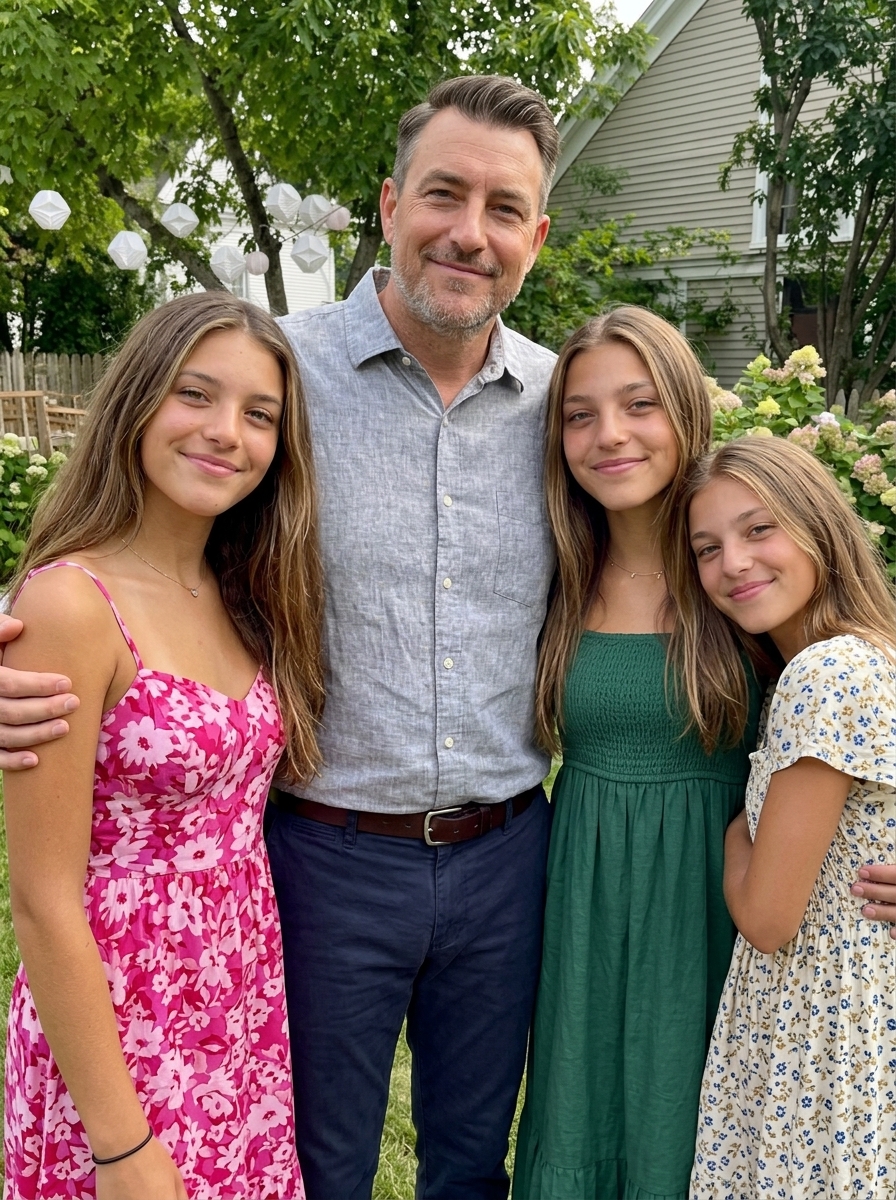
My wife suddenly passed away, leaving me alone to care for our four children. Four days after the funeral, my mother-in-law placed a sealed box in my hands and said, “Sarah made me promise you’d get this.” When I finally opened it, I discovered that my wife had uncovered a betrayal powerful enough to destroy everything our family had built.
For most of my adult life, I believed I was one of the lucky ones.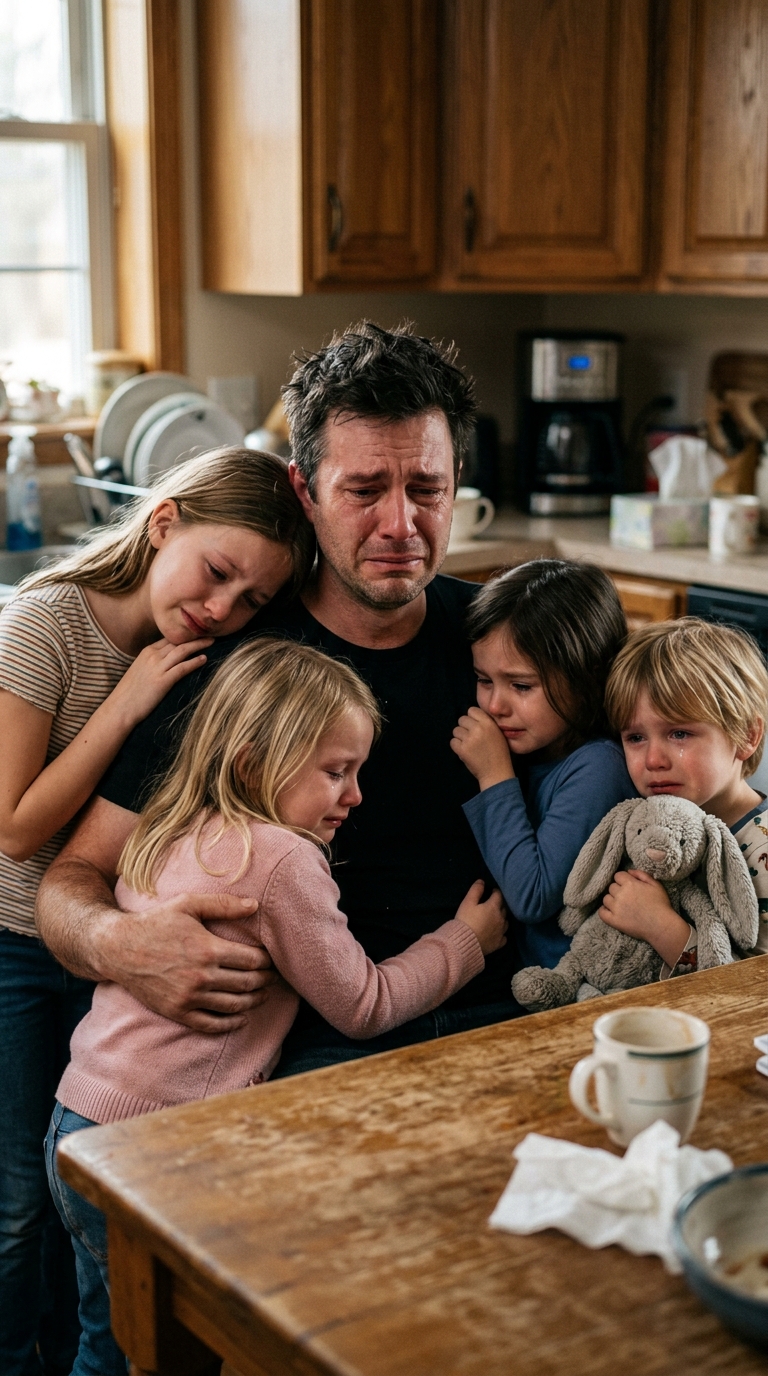
Fifteen years of marriage had given me a woman I loved with all my heart and four amazing children. Then, on an ordinary Tuesday, Sarah came home from work looking pale and unstable.
“I think I just need to lie down,” she told me, brushing away my concern. “It’s probably nothing.”
“You’re burning up, Sarah. Let me drive you to the hospital.”
“Don’t scare the kids. I’ll be fine by morning.”
She wasn’t fine by morning.
Less than forty-eight hours later, a doctor told me she was gone.
I don’t remember driving home that night.
I only remember standing at the entrance of our bedroom, staring at her side of the bed, unable to take another step inside.
I had no idea then that she had died carrying a devastating secret she could never let go of.
The funeral passed in a blur of broken moments.
Neighbors delivered casseroles.
People hugged me and whispered comforting words that I couldn’t hold onto. Through everything, the four kids stayed wrapped around my legs like frightened ducklings afraid of losing the only parent they had left.
The first morning after the burial, Joan climbed into my lap before sunrise.
“Daddy, are you going to get sick too?”
“No, sweetheart. I’m not going anywhere.”
“Promise?”
“I promise.”
Jeremy walked in behind her, dragging the blanket Sarah had stitched his name onto.
He didn’t say anything.
He simply climbed beside me and rested his cheek against my chest.
Julie stood quietly in the doorway.
“Daddy, who’s going to braid Joan’s hair for school?” she asked.
“I’ll learn,” I told her. “Give me a week. I’ll be terrible at first.”
“Mom did a fishtail.”
“Then I’ll learn a fishtail.”
Joyce slipped around her sister and tugged on my sleeve.
“Can we eat cereal for breakfast?” Joyce asked. “Mom always made pancakes on Saturdays, but I don’t want pancakes today.”
“Cereal it is.”
I poured four bowls and watched them eat in silence.
The kitchen, which used to be the loudest place in our home, felt as quiet as a library.
And I had no idea how I was supposed to keep myself and my children from breaking apart.
That afternoon, I tried folding a basket of laundry and ended up sitting on the floor, holding one of Sarah’s sweaters against my face.
I cried until I could barely catch my breath.
Then I wiped my eyes because Jeremy walked in searching for his stuffed rabbit.
“Are you sad, Daddy?”
“Yeah, buddy. I’m sad.”
“Me too.”
He sat down beside me, leaned against my arm, and stayed there for a long time.
The days afterward blended into a slow, colorless routine of school drop-offs, unfinished meals, and bedtime stories I struggled to complete without my voice cracking.
I told myself I only needed to make it through one hour at a time.
I believed that eventually, life might start feeling easier.
But then a knock at the door showed me that the nightmare was far from over.
The knock came shortly after three in the afternoon.
I expected a neighbor, or maybe one of Sarah’s friends stopping by to check on the children.
Instead, when I opened the door, I found my mother-in-law standing on the porch, gripping a small wooden box tightly against her chest.
“Can I come in?” she asked, even though she was already walking past me.
I slowly closed the door.
The children were upstairs, and the only sound in the house was their quiet movement above us.
She walked straight into the kitchen and placed the box on the table.
No embrace.
No question about how the kids were coping.
“Sarah made me promise,” she said, turning to face me. “If anything ever happened to her, you were supposed to get this.”
I looked down at the box.
“Why would she leave something like this with you?” I asked. “She was thirty-six years old. She wasn’t sick.”
“I don’t know what’s inside. She just made me swear.”
Something in her voice felt rehearsed, like she had repeated those exact words before entering the house.
“You don’t seem upset to be here,” I said softly.
She tilted her head. “Excuse me?”
“You buried your daughter four days ago. And you’re standing in my kitchen like you’re just dropping off a package.”
Her jaw tightened.
“Don’t twist this. I’m respecting her wishes. That’s all.”
She grabbed her purse and moved toward the door.
“Open it when you’re ready. But open it alone.”
The door closed behind her, and silence filled the house once again.
I sat at the table, staring at the box for what felt like forever.
What could Sarah have left behind for me?
My hands trembled as I finally opened the lid.
There were no memories or personal items inside.
Only documents.
And the moment I started reading, I realized Sarah had been keeping a massive secret from me.
A thick pile of bank statements was held together with a black clip.
Underneath was a single folded letter written in Sarah’s handwriting.
I opened the letter first.
My love, if you’re reading this, something happened to me, and I’m so sorry I couldn’t tell you everything in person. Please don’t panic. Read every page. Trust the numbers, not the words she’ll use.
I read it twice.
Then I picked up the bank statements.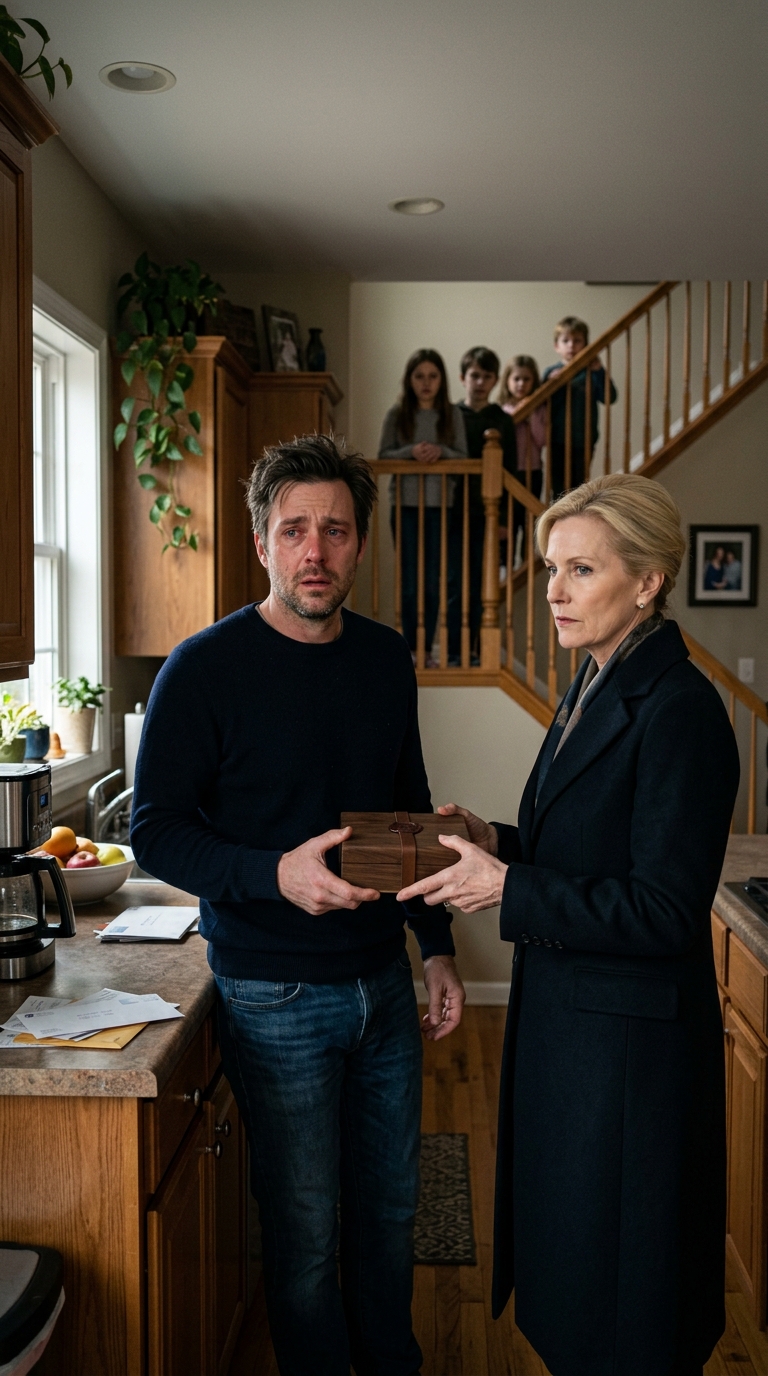
They were copies from the children’s college fund accounts.
I had personally opened those accounts eight years earlier.
Sarah’s mother had insisted on being added as a backup trustee, saying it was needed for tax purposes.
The balances shown at the bottom of each statement made my stomach turn.
Julie’s account: four hundred and twelve dollars.
Joyce’s: three hundred and sixty.
Joan’s: under three hundred.
Jeremy’s: empty.
Each account had been slowly drained over six years through small withdrawals.
Every withdrawal carried the same signature.
HER.
Something inside me broke.
Why would Sarah hide this from me instead of telling me?
I picked up the letter again.
I found out two months ago. I was going to tell you after I confronted her, but I wanted proof first. I asked the bank for everything. If you’re seeing this, I never got the chance. Please be careful with her. She is not who she pretends to be.
I leaned back in my chair and stared at the wall.
For six years, while we clipped coupons, skipped family trips, and told the kids they had to wait before getting new bikes, Sarah’s mother had been secretly taking money from our children.
And the woman who had brought me that box, acting like she had no idea what was inside, had looked me in the eyes and called it Sarah’s final wish.
Why?
I heard Julie walking down the stairs.
“Dad? Are you okay?”
I quickly placed the papers back into the box and forced a smile.
“Yeah, sweetheart. I’m okay.”
She nodded and went back upstairs.
I picked up my phone, found my mother-in-law’s name, and called.
She answered on the third ring.
“I opened the box,” I said. “You stole from my children for years. How could you do that to Sarah? To them?”
“Don’t be dramatic,” she replied. “I borrowed. None of that matters now, anyway. I delivered that box because you and I need to discuss Sarah’s life insurance payout.”
“Excuse me?”
“I want my share,” she said.
“You can’t be serious, Linda.”
“Let me make this simple,” she said. Her voice became colder, more controlled. “You sign the insurance money over to me. I disappear. The kids never have to know any of this. If you don’t, then I file for emergency custody tomorrow morning.”
I sat there with my heartbeat pounding in my ears.
Now I understood why Linda had brought the box herself.
It was a calculated move.
Which meant she still had another one waiting.
“Why would I do that?” I asked.
“It won’t be difficult to convince a social worker to visit that house and see that you’re barely holding everything together. My lawyer already prepared a petition explaining how you’ve been neglecting the children. A judge will look at your situation and give them to me.”
“Sarah would never want that,” I said.
“Sarah isn’t here anymore,” she answered coldly. “I am. And I am their grandmother. I have rights.”
Julie was upstairs reading with Jeremy. Joyce and Joan sat in the living room, quietly coloring at the coffee table.
The idea of someone trying to take them away from this home, away from me, made it hard to breathe.
How was I supposed to stop her?
“You wouldn’t win,” I said, though my voice lacked confidence.
“Wouldn’t I?” Her voice became softer, almost sympathetic. “Think about it. You forgot Joan’s medication twice this week. The school contacted you about Julie missing assignments. I’ve been keeping track.”
“You’ve been watching us?”
“I’ve been concerned,” she corrected. “Any judge will see a father who is overwhelmed. I’m offering you a solution. Give me what belongs to me, and I’ll let you keep them.”
“What belongs to you?” I repeated. “None of it belongs to you.”
“Sarah owed me,” she said. “She knew that. That’s why she never fought me over the money.”
I closed my eyes and forced myself to stay calm.
The insurance payout was meant to protect our family for years.
But choosing between money and my children was not a choice at all.
“How much time do I have?” I asked.
“Forty-eight hours,” she answered. “I’ll bring the paperwork myself. A simple transfer. No attorneys. No questions. And we never speak again.”
I should have told her I would fight her in every courtroom available.
Instead, I heard myself say, “I need to think.”
“Don’t take too long,” she replied. “I’d hate for those children to spend tonight wondering which bedroom they’ll be sleeping in next week.”
The call ended.
I remained sitting in the kitchen for a long time.
Outside, the afternoon disappeared into the soft gray light Sarah had always loved.
She used to say that was when the house felt the warmest.
Now it felt unfamiliar.
I thought about contacting an attorney.
But she had been quietly building her story for years.
The missed pickups.
The late tuition payments she had conveniently offered to handle.
The casual remarks she made to neighbors about my long work hours.
She had been preparing a case against me long before I realized there was a fight coming.
I looked back at Sarah’s letter, hoping I had overlooked something.
“What do I do, Sarah?” I whispered into the empty kitchen. “Tell me what to do.”
I lifted the box to place the letter back inside.
That was when I noticed something strange.
The bottom of the box was deeper than it appeared.
There was nearly an inch of hidden space that shouldn’t have been there.
My fingers found the edge of a thin wooden panel, and slowly, carefully, I pulled it loose.
Hidden beneath it was a neatly folded stack of stamped and notarized legal documents.
My eyes immediately moved across the first page.
Sarah had created a completed trust only six days before she died.
Every asset, every dollar from the life insurance, every cent from the children’s accounts was secured inside a protected trust naming me as the sole trustee.
Attached behind it was a prepared petition for a restraining order against her mother, ready to be submitted.
That same night, I called Linda and asked her to come to the house.
She arrived twenty minutes later carrying a folder under her arm.
“You made the right choice,” she said as she walked inside.
Then she stopped.
She had not entered an empty kitchen.
A woman in a navy suit was standing beside the table.
“My name is Rebecca,” she said calmly. “I’m the attorney your daughter retained.”
My mother-in-law’s smile vanished.
She stared at me.
“You lied.”
“You threatened to take my children,” I said. “I wasn’t going to face you alone.”
The attorney pushed a folder across the table toward her.
“These are copies of the bank records your daughter collected, showing years of withdrawals from her grandchildren’s education funds. We have already notified the bank and started the recovery process for those funds.”
Her face lost all color.
“You can’t prove—”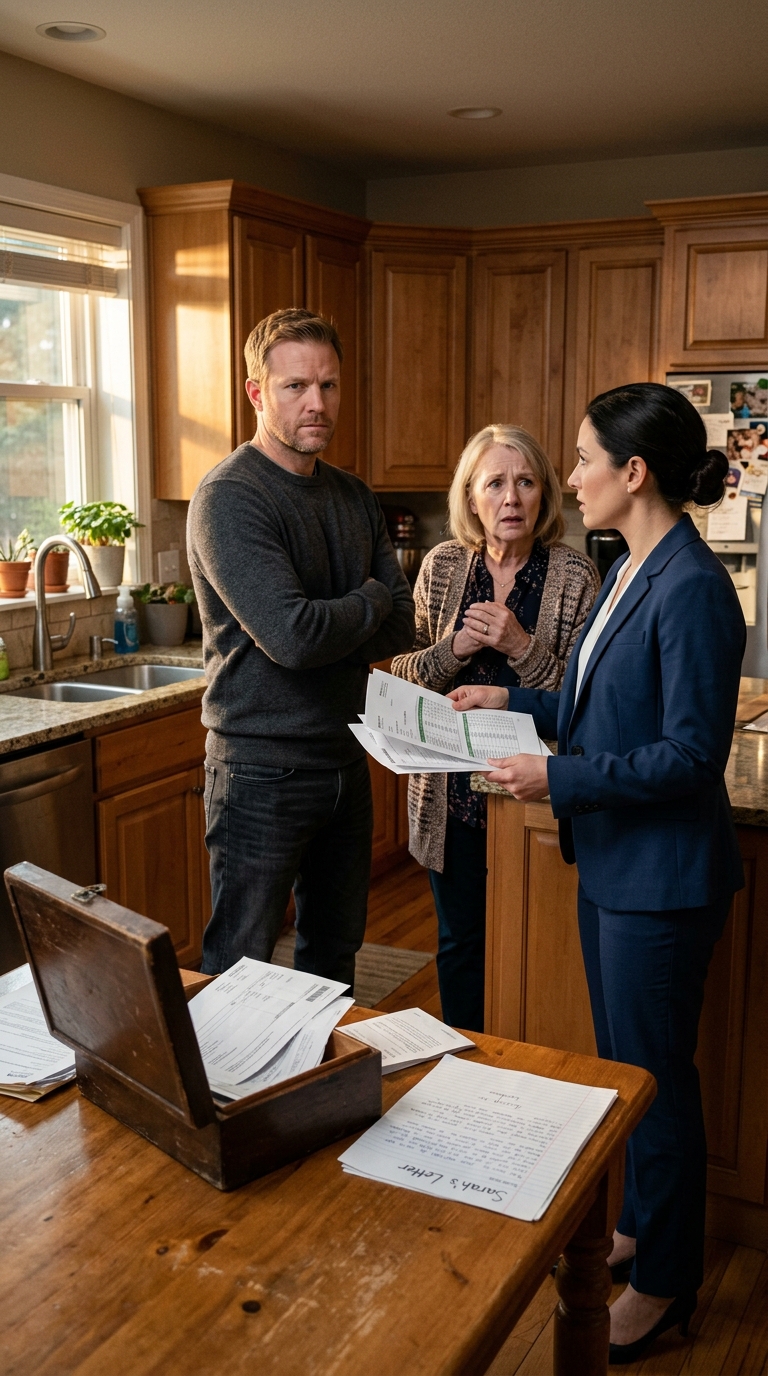
“We can,” the attorney cut in. “Every withdrawal was approved through your trustee access. Sarah documented everything.”
For the first time since she stepped into my home, she had nothing to say.
The attorney continued.
“And because of the threats you made today involving custody and the insurance money, we have also filed a petition requesting that the court restrict any financial involvement with the children’s assets until this matter is settled.”
My mother-in-law looked between the attorney and me, searching for someone she could still intimidate.
She found no one.
No one stopped her as she walked toward the door.
No one followed behind her.
—
That evening, I sat around the dinner table with Julie, Joyce, Joan, and Jeremy.
The woman who tried to steal their future was gone.
The future Sarah had fought so hard to protect still belonged to them.
