


PART ONE: The Burden They Toasted
Barely an hour after my twelve-year marriage was officially over, my former husband’s family started celebrating as if they had hit the jackpot. I only found out because they had overlooked one small but important detail: I was still a member of their family WhatsApp group. They had been so busy congratulating themselves that nobody had thought to remove the woman they were so eager to forget.
It was a bitterly cold afternoon in Manhattan. I had just walked out of Family Court, where a judge had formally dissolved my marriage to Noah Thatcher. Twelve years of shared life had been boiled down to a few signed pages and some final words from the bench. By every normal measure, I should have felt devastated. Instead, I felt strangely hollow, as though something had been scooped out of me and nothing had yet moved in to fill the space.
I sank into the leather seat of my car, and my phone began to buzz again and again. Messages were pouring into the Thatcher family group chat. The first was a photograph posted by my former sister-in-law, Harper. It showed a lavish private dining room at the Waldorf Astoria. A huge mahogany table had been dressed with white orchids, sparkling crystal glasses, and bottles of costly vintage wine. Behind it hung a banner in gold lettering. "HERE’S TO A NEW BEGINNING!"
Harper had added a cheerful note beneath the picture. "Everyone better be here tonight! Anyone who arrives late owes the rest of us three drinks!" One of the relatives asked what exactly they were celebrating. Harper’s answer popped up almost instantly. "Noah is finally free! Tonight we’re celebrating the end of that miserable burden!"
I stared at the screen for a long moment. That burden. Apparently, I was the burden. I was the woman who had paid for their vacations, covered their bills, rescued their businesses, and stepped in every single time they needed money. I had not even finished clearing my belongings out of our former home, and already they were arranging a luxury banquet to celebrate being rid of me.
Then another photograph appeared. My former mother-in-law, Shirley Thatcher, was wearing an expensive burgundy silk dress that I had bought for her the previous Christmas. She was seated next to Beatrice Noble, the woman Noah had been secretly seeing for months. Shirley had one arm draped fondly around Beatrice and was smiling as though she had at last welcomed the perfect daughter-in-law into the family.
Beatrice posted a message under the photograph. "Thank you so much for including me, Mrs. Thatcher. I almost feel guilty attending a family celebration!" Shirley replied right away. "Don’t be silly, darling! You’re already one of us!" I let out a laugh with no humor in it. When I married Noah, it had taken years of patience, generosity, and endless compromise to win even a sliver of acceptance from his relatives. Beatrice had managed the very same thing simply by having an affair with him.
Then someone in the chat asked about the division of the family’s properties, and my finger froze on the screen. Shirley answered with obvious pride. "The mansion is still in Noah’s name. Eleanor agreed to everything. It’s completely secure." Harper chimed in with another message. "We kept the house and the business. Now we can finally move forward without her dragging us down."
I read those words over and over. For years I had treated the Thatchers as my own family. When Noah’s interior design company nearly collapsed, I had supplied the money that kept it alive. When Shirley needed expensive spinal surgery, I had arranged private specialists and paid every medical bill. When Harper wanted to open a luxury spa, I had financed it. And now they sincerely believed I had contributed nothing. Worse, they were convinced they had taken possession of a $1.5 million mansion that I had almost entirely paid for.
But the Thatchers had missed something crucial. The wealth that held up their glittering lifestyle had never really belonged to them. It had come from me. My name is Eleanor Vance. I was thirty-nine years old, a senior executive at Vance & Sons, the family business I had inherited, and my personal finances were far stronger than anything Noah had ever earned. During our marriage I had arranged five premium credit cards for the Thatcher family. Noah had two, one for personal spending and one for business expenses. Shirley had one. Harper had another. The fifth was used for shared family purchases. Every thirty days the balances were paid automatically from my primary account, and for years they had spent freely without ever worrying about a statement.

I opened my mobile banking app and then called my private banking representative. "Good afternoon, Ms. Vance. How may I assist you?" "I need you to identify the five authorized-user cards connected to my main account." After I completed the required verification, the representative confirmed which cards they were. "Those are the ones," I replied. "Please permanently revoke all five authorizations." He hesitated for a moment. "To clarify, are you requesting a temporary security freeze or permanent cancellation of their card privileges?" "Permanent cancellation." He explained that once the request was processed, any future transactions on those cards would be declined. I looked once more at Shirley’s smiling face beside Beatrice’s. Then I answered. "I understand. Please proceed."
A few seconds later, the notifications began to arrive. CARD ONE — CANCELED. CARD TWO — CANCELED. CARD THREE — CANCELED. Then the last two. Just like that, the Thatcher family’s unlimited access to my generosity was over. I switched back to WhatsApp, where Harper had uploaded yet another photograph. This time it showed an enormous seafood platter. "Order more lobster!" she wrote. "Tonight is about celebrating, not counting money!"
I shook my head slowly. They were about to learn something. The person they were celebrating getting rid of was the very person whose account had been paying for their celebrations. And when the restaurant bill arrived, their evening would take a very different turn. But I had something far more important to deal with.
Noah believed that because his name was on the deed to our $1.5 million Hamptons mansion, he had successfully taken it from me. What he did not know was that my late father had insisted on a legal document years earlier, a document Noah had signed without taking it seriously. That single piece of paper was about to become the biggest problem of his life. To understand how the Thatcher family grew so entitled, I have to go back to the beginning of my relationship with Noah.
When we married, he was a charming salesman for a furniture supplier. He was not wealthy. In fact, he was barely earning enough to cover his rent and everyday expenses. But he was ambitious, and I loved that about him. Soon after our wedding he held my hands and made me a promise. "Eleanor, I can’t offer you a fortune right now. But if I ever become successful, I promise I’ll always remember the woman who believed in me." I trusted him completely. When Noah decided he wanted to start an interior design business, I backed the idea. I sold part of my personal investment portfolio and provided $350,000 to launch Thatcher Interiors. He was overjoyed, and for a while everything seemed wonderful.
The business slowly attracted customers, and Noah began winning larger contracts. Two years later, we decided to buy a summer home in the Hamptons. It was a beautiful mansion with a cedar roof, landscaped gardens, and spacious rooms looking out over the grounds. The purchase price was $1.5 million. I sold an undeveloped parcel of land that my parents had given me and combined the proceeds with my savings. In total I contributed $1.3 million, and Noah supplied the remaining $200,000. I expected the property to belong to both of us. But shortly before closing, Noah made an unusual request. "Sweetheart, what would you think about putting the deed in my name?"
I frowned. "Why would we do that?" He explained that he was trying to expand Thatcher Interiors and believed that holding an expensive property in his name would improve his credibility with commercial lenders. I was not convinced, since I was providing nearly the entire purchase price. But Noah smiled and kissed my forehead. "Darling, we’re married. What’s mine is yours. It makes no difference whose name is on the paperwork." Shirley backed him up at once. "A good wife trusts her husband, Eleanor. Noah is the one building a business. This is the sensible thing to do." Then she added something I would remember for years. "Besides, I’ll be living here with you. Nobody would ever take your home away."
In the end I agreed. My father, Enrique Vance, was far less trusting. He had built his business empire on careful planning, financial discipline, and legally enforceable contracts. He insisted that Noah sign a formal promissory note recognizing my $1.3 million contribution as a loan. Noah laughed when he saw it. "Your father worries too much. Eleanor and I will still be together when we’re old and gray." He signed anyway. My father simply replied, "The best contract is one that never needs to be enforced." For years that document sat forgotten. At least, Noah seemed to believe it had been.
After we moved into the mansion, the Thatcher family’s way of living changed dramatically. Shirley, who had once carefully clipped grocery coupons, began using private transportation to get to her appointments. Harper treated our home as her personal luxury retreat and borrowed money repeatedly, often never paying it back. And Noah slowly turned into someone I hardly recognized. He started coming home smelling of expensive whiskey and unfamiliar cologne. His phone was always placed facedown on the kitchen counter. Every weekend seemed to demand another urgent client meeting.
The turning point came on a cold Saturday evening the previous November. Shirley phoned and insisted I come home early for a special dinner, saying Noah had invited an important business contact. When I arrived, the dining room was already beautifully arranged, and Harper was laughing beside a young woman in a cream silk dress. I recognized her. Beatrice Noble. She worked for an events agency that often collaborated with Thatcher Interiors. "Good evening, Eleanor," she greeted me. Then she smiled. "Noah speaks about you all the time." Shirley hurried over. "Beatrice has visited several times while you’ve been away working. She’s practically part of the family now!" My hands stopped halfway through taking off my coat. Several times? Nobody had said a word about those visits.
All through dinner, Shirley praised Beatrice without pause. She served her the best portions, complimented her looks, and repeatedly called her thoughtful and gentle. Eventually she turned to me. "It’s admirable when a woman earns her own money," she said. "But men need warmth and affection at home. Intelligence is useful, Eleanor, but sweetness is what keeps a husband happy." Beatrice lowered her eyes modestly. "Oh, Mrs. Thatcher. Eleanor is very accomplished." Shirley waved the comment away. "Being accomplished and being a loving wife are two different things." I looked at Noah. Surely he would say something. Surely he would defend me in my own home. Instead, he calmly took a sip of wine. "Let’s eat before dinner gets cold." That moment hurt more than I wanted to admit.
Later, when I questioned him privately, he accused me of creating unnecessary drama. Two weeks afterward, I discovered the truth. I was hunting for a phone charger when Noah’s phone lit up on his bedside table. A message had arrived from Beatrice. "You promised that once things at home were settled, we wouldn’t have to hide anymore. How much longer am I supposed to wait?" I stood completely still. The affair was real. They had been talking about a future together. And while I had been working to keep his business profitable, Noah had been preparing to replace me.
I did not confront him right away. Instead, I started going through my financial records. Because I had finally understood that if Noah was planning to walk away from our marriage, he intended to take as much of my money with him as he possibly could.
PART TWO: The Gates That Wouldn’t Open
Noah brought up the subject of divorce on a Tuesday evening. He was sitting in the living room with a stack of documents on the coffee table, and his mother and sister were conveniently nowhere to be seen. "Eleanor, sit down. We need to discuss something." I set my handbag on a chair. "I’m listening." He slid the documents toward me. "I think it’s time we separated. This marriage isn’t working anymore." His tone was remarkably casual, as if he were canceling a business subscription rather than ending twelve years together.
He did not mention Beatrice. He did not apologize. He simply said we had grown apart. I studied the paperwork. "And what happens to the Hamptons house?" Noah answered immediately. "The deed is in my name." He said it so quickly that I suspected he had rehearsed the sentence. I looked up. "And what about the money I contributed?" He sighed with impatience. "My mother lives here. She’s getting older. It would be cruel to force her to move." Then he waved a hand vaguely. "You already have the Tribeca penthouse and the family business. You don’t need this house too."
I nearly laughed. I had provided $1.3 million toward its purchase, yet Noah was treating me as unreasonable for wanting that money recognized. He even offered to let me keep my own car, as if it were a generous concession. I went through the property division section carefully, and one clause immediately caught my attention. The agreement stated that the Hamptons property would not be divided through the divorce proceedings and that any outstanding civil financial obligations would be resolved separately.
Noah seemed to believe that leaving the house in his name meant he could keep it without any further consequences. But I understood something he had overlooked. The promissory note was a separate financial obligation, and nothing in the proposed agreement automatically erased it. "Are you having second thoughts?" he asked nervously. I looked at him. "Are you absolutely certain you want me to move out permanently?" "Yes," he replied. "It’s best for everyone." I picked up my pen. "Alright." I signed the agreement.
Noah visibly relaxed. "I knew you’d be reasonable." I looked at him calmly. "Don’t celebrate too early." That evening, while I packed my belongings, I overheard Noah speaking to Shirley. "Did she sign?" his mother whispered. "Yes. She barely argued." "And the house?" "It’s mine, Mom. My name is on the deed. Everything is settled." Shirley sounded relieved. "Thank goodness. I was terrified she might demand that money back."
Standing in the hallway, I felt an unexpected wave of sadness. For twelve years I had called this woman Mom. I had paid for her medical treatment and supported her lifestyle. Yet her greatest worry was not that her son had destroyed his marriage. It was that I might reclaim my own money.
The day after our divorce became final, I drove out to the mansion to retrieve a safe holding important financial records. When I reached the iron gates, my remote did not work. I typed in the security code, and the screen answered with two words. ACCESS DENIED. I tried the emergency key. The lock had been changed.
A security guard eventually walked over and explained that Noah had ordered the locks replaced that very morning. He had also instructed the staff not to let me onto the property without his permission. Some of my belongings, he said, had been moved into an outdoor storage shed. I stood there in front of a house I had paid for almost entirely, shut out like a stranger, with the gardens glowing behind the bars as if mocking me.
I called Noah. "Did you change the locks?" "Of course," he answered. "You moved out. I’m organizing my house." "My financial documents are still inside." "Send me a list. I’ll have them mailed to you." I reminded him that I had paid nearly the entire purchase price. He laughed. "It’s my property, Eleanor. The deed proves it."
I remained silent for a moment. Then I replied, "Remember that statement, Noah." I ended the call and drove straight to my attorney’s office.

Mr. Brooks was already waiting. When I explained what had happened, he laid a thick folder on his desk. Inside was the original 2017 promissory note, with the principal amount clearly stated. $1,300,000. We also had the bank transfer records backing up the transaction. Mr. Brooks looked at me. "What would you like to do?" "Send him a formal demand for repayment." He nodded. "Once we do that, this will become a serious legal dispute." I looked out toward the Manhattan skyline. Noah believed he had won. He had the mansion. He had Beatrice. And his family was already celebrating my departure. But he had forgotten that a property deed and an unpaid debt were not the same thing. "Proceed," I said.
While my attorney prepared the formal demand, the consequences of canceling the Thatcher family’s credit cards were already unfolding. I had not gone to their elaborate celebration at the Waldorf Astoria. But Noah’s cousin Felicia called me late that night. She had attended the banquet and wanted me to know what had happened. According to her, the family had spared no expense. The private dining room was packed with flowers, champagne, and expensive seafood, and nearly forty relatives had gathered.
Shirley had stood to make a toast, wearing the pearl necklace I had given her. She praised Noah for finally freeing himself from a marriage that had supposedly held him back. Harper urged everyone to order more wine. Beatrice sat beside Noah, smiling as though she had already taken my place. Then, shortly after ten o’clock, the waiter brought the bill. More than $15,000. Harper confidently handed over her premium credit card. The payment was declined. She tried again. Declined. Shirley offered her card. Declined. Noah reached for his business card. That one failed too.
According to Felicia, the atmosphere changed instantly. The laughter stopped, and the hotel manager came to assist. The family eventually learned that the authorized-user cards connected to my account had been permanently canceled. Not frozen temporarily. Not affected by a banking error. Canceled. The Thatchers suddenly realized they would have to pay for their own celebration. Noah phoned me from the hotel hallway. "Why did you cancel the cards?" he shouted. I was sitting in my Tribeca penthouse, sipping chamomile tea. "Because you organized a party to celebrate getting rid of me," I answered. "Why would you expect me to finance it?" He began shouting again, and I ended the call.
Without access to my money, the family scrambled to gather enough funds to settle the bill. They used their personal accounts and begged relatives and friends for emergency transfers. Eventually they paid and left the hotel humiliated. But their financial problems were only beginning. The following afternoon, Noah received the formal demand for repayment of the $1.3 million loan, and he called me immediately. "What is this nonsense your lawyer sent?" "It’s a demand for repayment, Noah." "We were married! That money was for our home!" "You signed a promissory note recognizing it as a loan."
He claimed the document had only been signed to satisfy my father. I reminded him that he had also signed a reaffirmation of the debt the previous January. He insisted the house belonged to him. I calmly replied, "You can make that argument through your attorney. I’m not asking you to give me the house. I’m asking you to repay what you owe." Then another problem surfaced. A commercial loan officer contacted me about the personal guarantee I had provided for Thatcher Interiors. The guarantee was due to expire, and the bank wanted to know whether I intended to renew it. I answered no. The officer explained that without a replacement guarantee, the company’s credit agreement could be affected.
Soon afterward, Noah started calling repeatedly. He pleaded with me not to withdraw my financial backing and warned that his business depended on access to working capital. But I had spent years supporting Thatcher Interiors. Our marriage was over, and I was no longer willing to guarantee its debts. I arranged a financial review of the company, and the findings were alarming. Despite Noah’s public image as a successful entrepreneur, Thatcher Interiors was losing large amounts of money. Even more troubling, nearly $450,000 had been transferred to an outside contractor called HT Communications. Its registered agent was Harper Thatcher, my former sister-in-law. The records suggested that Noah and Harper had been using a related company to divert funds out of Thatcher Interiors.
As the financial pressure mounted, Noah’s options narrowed. He considered refinancing the Hamptons mansion to raise cash, but the disputed $1.3 million debt complicated any attempt to use the property as collateral. Then his attorney produced a document that changed the direction of the entire case. It was supposedly a release of liability signed the previous August. According to the paper, Noah had already repaid the full $1.3 million loan. At the bottom was my signature, and it was notarized.
I studied the scanned document closely. The handwriting resembled mine. But I knew immediately that something was wrong. I had never received that repayment, and I had never signed any release. "It’s forged," I told Mr. Brooks. He began reviewing the document and its supporting records. Then we remembered another important detail. Noah had signed a debt reaffirmation the following January. Why would he acknowledge an outstanding debt months after supposedly paying it off? The documents flatly contradicted each other. I also remembered that Harper had once worked as an intern at Vance & Sons, where she had access to many papers bearing my signature.
Suddenly the situation was far more serious. Noah was not simply refusing to repay a debt. Someone appeared to have fabricated evidence in an attempt to defeat the claim. And that decision would eventually unravel the entire Thatcher family.
PART THREE: The Recording That Ended Everything
As the dispute escalated, tensions inside the Hamptons mansion grew increasingly severe. Noah needed money. Harper feared the consequences of the questionable company transfers. Shirley was terrified of losing the home she had come to regard as her permanent residence. And Beatrice was beginning to discover that the man she had chosen was not nearly as successful as he pretended to be.
I later learned that Noah had promised Harper $350,000 from a future refinancing arrangement if she helped prepare the false financial documents. But now investigators were examining the paperwork, and Harper was frightened. Noah attempted another maneuver. He arranged a proposed sale of the mansion to an old acquaintance at a price far below its market value. The deal appeared designed to move the property beyond the reach of the debt dispute.
Mr. Brooks discovered the proposed transaction through property records and sought an emergency court order to block the transfer. Further investigation tied the proposed buyer’s initial payment to Harper’s company. The situation was deteriorating fast. Then Noah called a private family meeting. Shirley, Harper, and Beatrice attended. He wanted everyone to agree on what they would say if they were questioned about the disputed documents.
According to the recording later given to us, Noah instructed Harper to take full responsibility for preparing the authorization. He told her to claim she had acted on her own and that he had known nothing about it. Harper was furious. "You want me to go to prison for something you told me to do?" Noah insisted that protecting him was necessary to preserve the family business.
What he did not know was that Beatrice was recording the conversation on her phone. For months she had believed Noah would leave his marriage and build a luxurious future with her. Now she was watching him get ready to sacrifice his own sister to protect himself. She began to wonder what he might do to her if she ever became inconvenient.
That evening, Beatrice left the mansion. Several days later, her attorney contacted Mr. Brooks. She was willing to hand over the recording in exchange for resolving her potential exposure to civil claims. We met in a conference room. Beatrice did not apologize for the affair, and she did not try to justify her relationship with Noah. She simply placed a small USB drive on the table.
The recording held a conversation about the forged documents, the financial transfers, and the missing promissory note. It also revealed something unexpected. Shirley had taken the original January debt reaffirmation from my safe. But she had not destroyed it. She had hidden it inside a compartment in her dressing room, apparently intending to keep it as leverage in future family disputes.
By the end of April, my attorney and I arranged a meeting at the Hamptons property. When we walked into the mansion, the atmosphere was completely different from the lavish home I remembered. Shirley looked exhausted. Noah sat rigidly on the sofa. The air felt thick, as if the walls themselves had been waiting for this day.
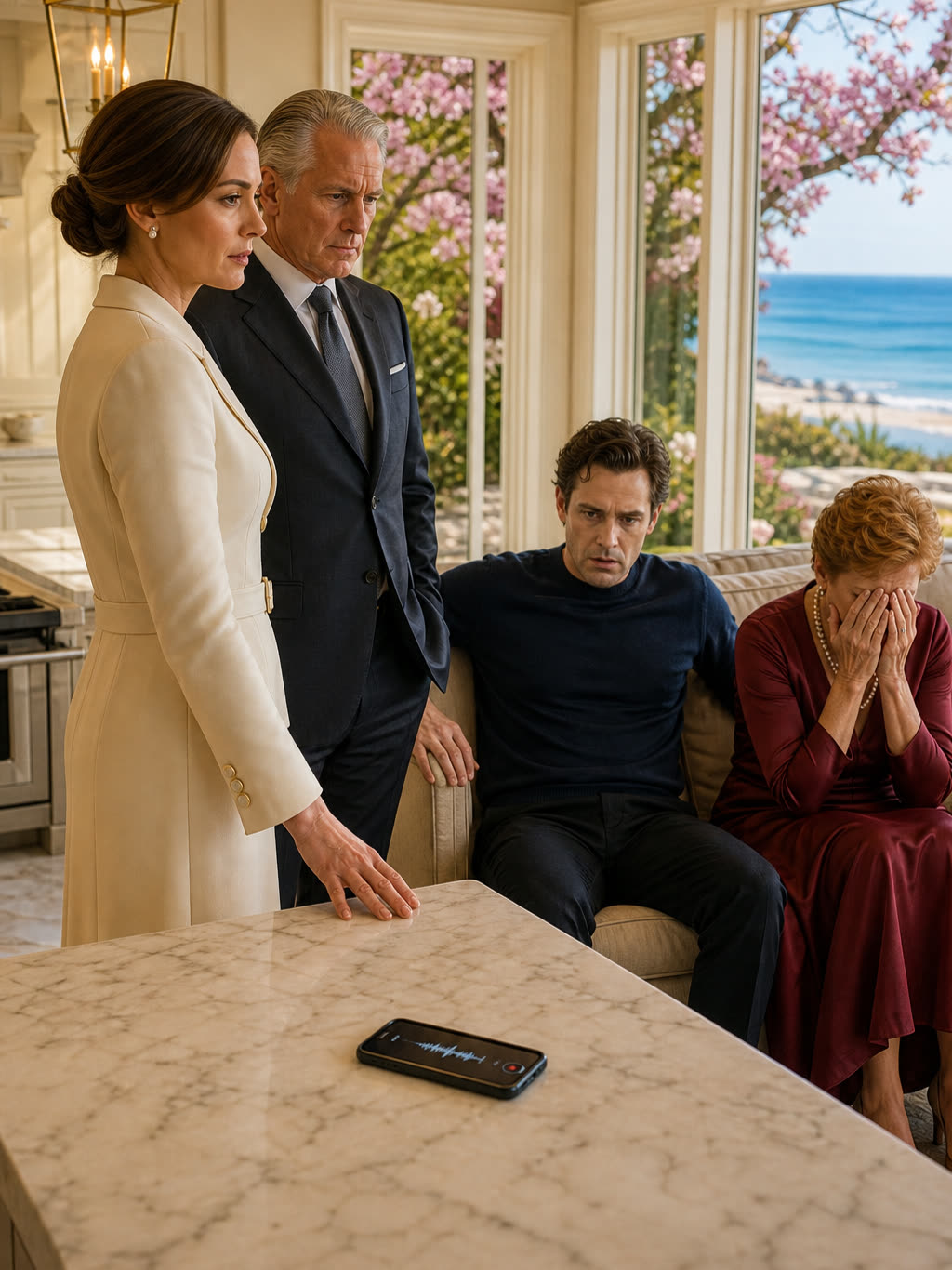
I set my phone down on the kitchen island. Then I played the recording. Noah’s own voice filled the room. He could be heard discussing the forged paperwork and telling Harper to accept responsibility. He also referred to the original debt document that his mother had removed. Noah’s face turned pale. Shirley began to cry. For several minutes nobody spoke.
Finally, she disappeared upstairs. When she came back, she was carrying a folder. Inside was the original debt reaffirmation. She handed it to my attorney. The document bore Noah’s signature, and it confirmed that the debt had remained outstanding. The evidence had become overwhelming.
My attorney notified the relevant lenders about the financial allegations. The banks reviewed Noah’s credit arrangements and began taking action under their agreements. Thatcher Interiors faced a severe liquidity crisis, and Noah could no longer keep up the appearance of financial stability. Eventually his attorneys agreed to binding arbitration over the debt. Faced with the financial records, the original contracts, and the recording, Noah accepted a settlement.
The Hamptons mansion was transferred to me in satisfaction of the outstanding obligation. The house he had insisted was unquestionably his was now legally mine. But when I received confirmation of the transfer, I felt no urge to celebrate. I simply wanted the whole ordeal to end.
EPILOGUE — THE PRICE OF TAKING SOMEONE FOR GRANTED. In the months that followed, the Thatcher family’s carefully built image of wealth fell apart. Thatcher Interiors filed for Chapter 11 bankruptcy protection, and its three showrooms closed while the company tried to restructure its debts. Harper sold her boutique spa and used much of the proceeds to cover legal expenses tied to the investigation into her business dealings. Beatrice left New York. Before departing, she reportedly told Noah, "I thought you would eventually choose me. Now I realize the only person you’ve ever truly chosen is yourself."
Shirley could no longer afford the luxurious lifestyle she had grown used to. The private transportation stopped. The expensive dinners disappeared. She packed away her designer handbags and moved into a modest one-bedroom apartment belonging to extended family members. And Noah? The man who once proudly called himself a self-made success had to face the reality that much of his comfortable life had rested on money and support from the wife he betrayed.
When the Hamptons property was officially transferred to me, I visited it alone. I walked through the front entrance and stood beneath the grand staircase. Everywhere I looked, I saw reminders of the life I had once believed we were building together. The expensive furniture I had purchased. The carefully decorated dining room. The beautiful windows overlooking the gardens. And the table where Shirley had publicly humiliated me while praising Noah’s mistress. For years I had considered that mansion a symbol of everything we had achieved. Now it felt like a monument to everything I had lost. I expected to feel victorious. Instead, I felt uncomfortable. The house no longer represented happiness. It represented betrayal.
The following morning, I contacted a real estate agent and put the mansion up for sale. A month later, a couple from Connecticut bought it. The proceeds allowed me to recover the money owed and finally put the financial dispute behind me. Some friends were surprised. "Why didn’t you keep it?" one asked. "You could have lived there and reminded Noah every day that he lost everything." I smiled. "I don’t need a mansion to prove my worth to people who treated me like their personal bank."
The truth was that I had spent twelve years confusing generosity with responsibility. I believed that loving someone meant helping whenever they needed support. I gave Noah money to start his business. I helped Shirley through serious medical problems. I funded Harper’s ambitions. I made sure everyone had opportunities and comforts they might otherwise have struggled to afford. And I did not regret every act of kindness. But somewhere along the way, the Thatchers had stopped seeing my help as a gift. They began treating it as an entitlement. My money became their money. My success became Noah’s success. And my willingness to support them became proof that I would tolerate anything.
They were wrong. I learned that generosity needs boundaries. That marriage does not erase financial accountability. And that loving someone should never require surrendering your dignity or allowing them to exploit your trust. The Thatcher family celebrated the end of our marriage with champagne, lobster, and a $15,000 banquet. They believed they had removed the only obstacle standing between them and the luxurious future they deserved. But when their cards were declined, their debts became due, and their financial secrets emerged, they discovered something they should have understood years earlier. A lifestyle built entirely on someone else’s generosity can disappear the moment that generosity ends.
I lost a twelve-year marriage. But I recovered my independence. My finances. My peace. And most importantly, my belief that I deserved relationships built on respect rather than obligation. The people who celebrated getting rid of me had called me a burden. In the end, I discovered that leaving them behind was the first truly liberating decision I had made in years. THE END
Disclaimer: This story is a work of fiction inspired by real-life themes. Names, characters, places and events are fictionalized, and any resemblance to real persons is purely coincidental. Images are for illustration purposes only.
