

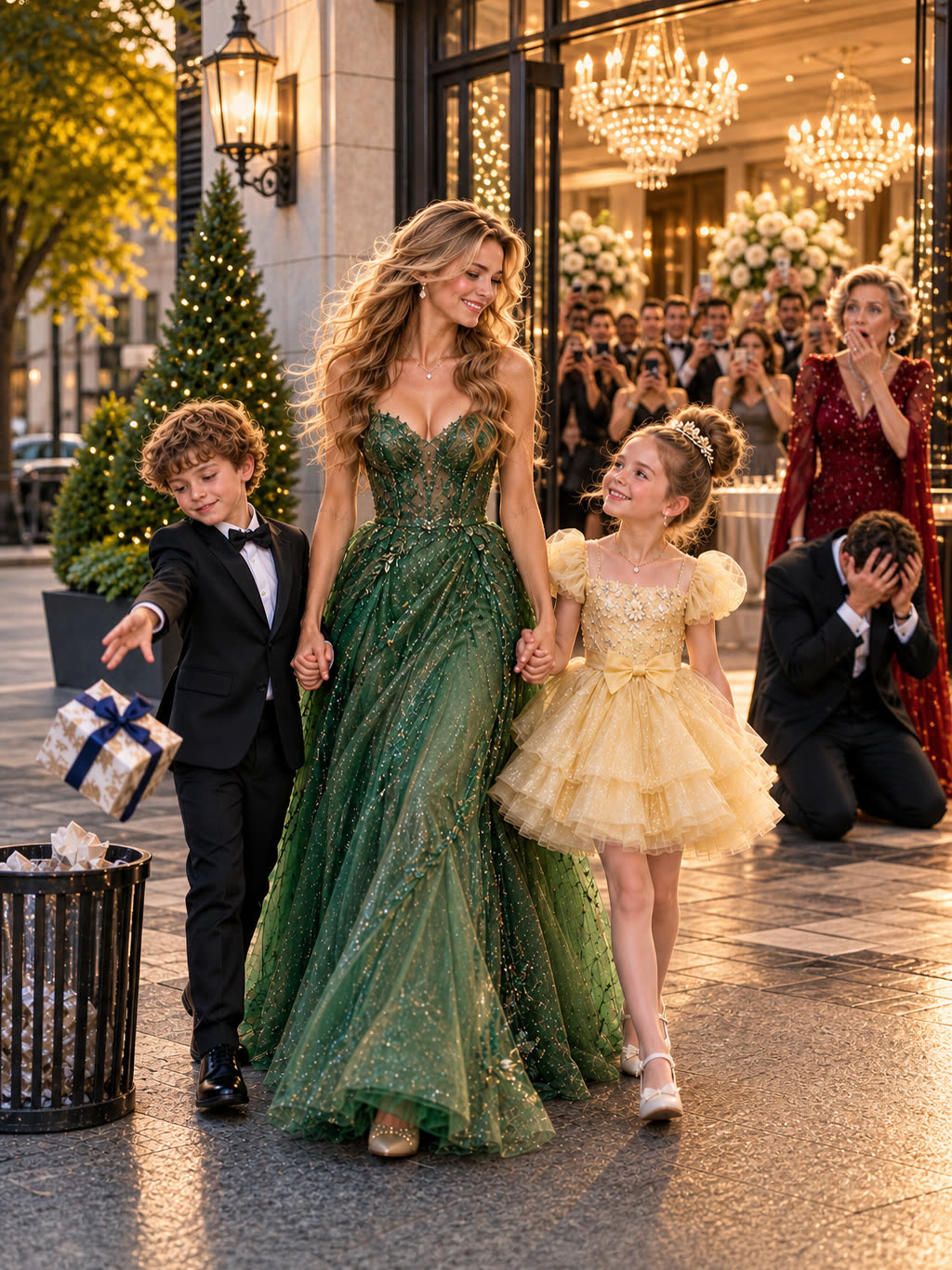
Part 1: The Door That Stayed Closed
The night my husband abandoned my children outside his mother’s birthday celebration, I finally understood that I had spent years defending a marriage that would never defend us.
Yet when Nathan came home that night, furious about the money I had refused to spend on his mother’s party, he made one enormous mistake.
He threatened to force me out of the penthouse.
And when I told him that neither our luxurious home nor his mother’s expensive condominium belonged to him at all, the color drained from his face.
What Nathan didn’t realize was that the truth about those properties was only the first layer of a secret that would eventually turn his whole family upside down. And the person who would expose its most devastating part was someone he had never thought important enough to listen to.
My fourteen-year-old daughter.
Three hours earlier, I had been standing in front of one of the most exclusive restaurants in Boston’s Back Bay, holding my nine-year-old son’s hand.
White orchids framed the entrance to the private dining room. Crystal chandeliers lit tables dressed in costly linen, and a jazz trio played softly behind the glass doors. A photographer drifted among the elegantly dressed guests while waiters moved through the room with champagne.
It all looked magnificent, and I knew exactly why, because I had paid for nearly every detail. My mother-in-law, Margaret Cole, was celebrating her sixty-fifth birthday, and my husband had insisted the evening be unforgettable. Weeks earlier he had said, “Caroline, Mom only turns sixty-five once. Please, let me give her one evening she can brag about for the rest of her life.” So I had agreed. The restaurant deposit went onto my American Express card, and the final event payment came straight from my own account. I approved the menu myself, negotiated the private dining package, and arranged the flowers, the photographer, and the musicians. Margaret had even demanded that the floral arrangements be changed three times because the original orchids supposedly didn’t look expensive enough.
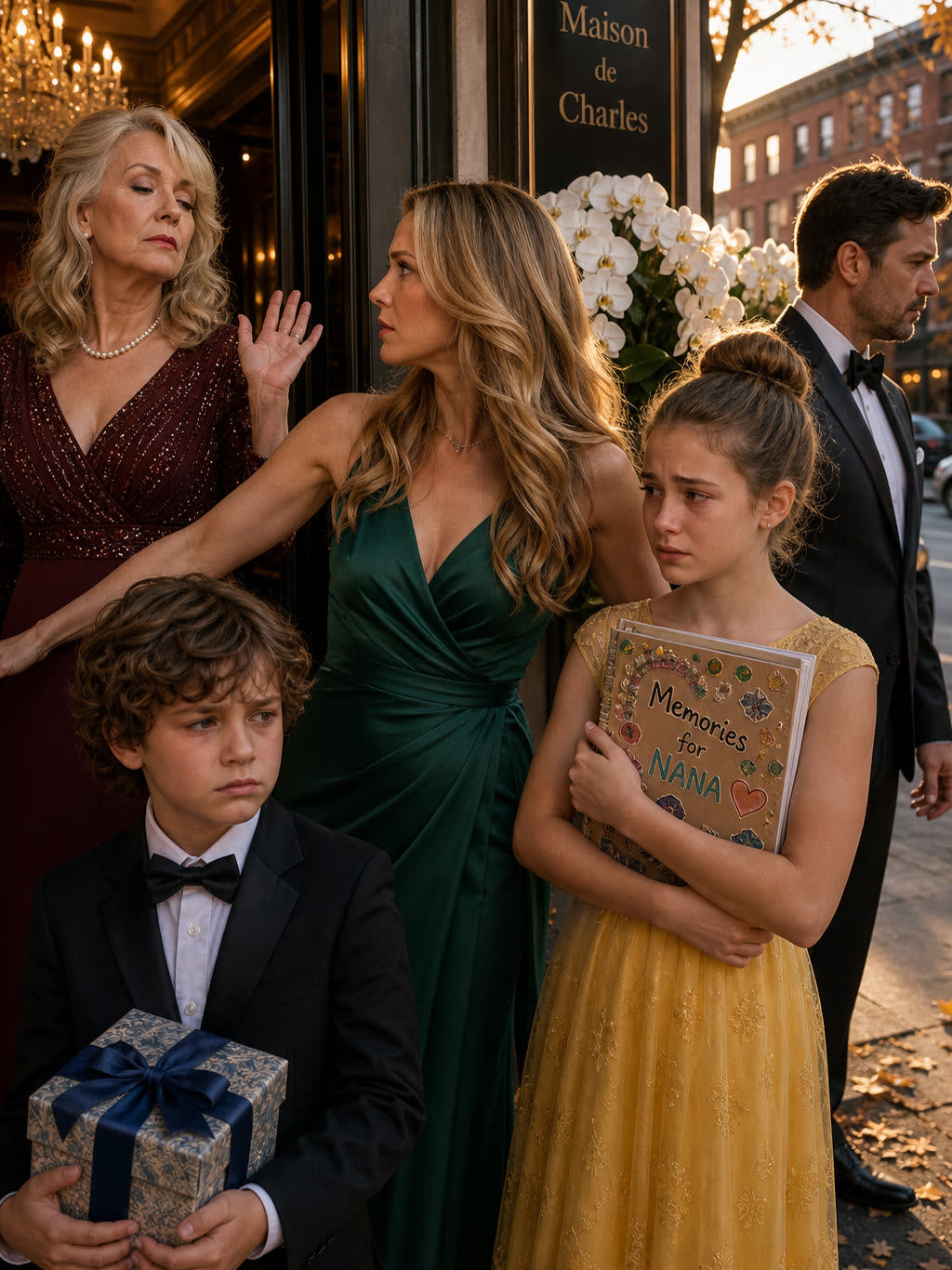
And yet when we arrived, she stood in the doorway, smiled at us, and said, “Only Nathan is coming inside. You and the children can wait somewhere else.”
I was sure I had misheard her.
“Excuse me?”
Margaret adjusted her pearl necklace.
“This is an adults-only celebration. Nathan is welcome, of course, but you and the children should make other arrangements.”
Beside me, my fourteen-year-old daughter, Sophie, pressed a handmade scrapbook tightly to her chest. She had spent a whole week filling it with family photographs, handwritten memories, and little notes about the things she loved most about her grandmother.
My nine-year-old son, Caleb, was carefully holding a wrapped box that contained a porcelain tea set. He had saved his allowance for months to afford it.
“Grandma,” he said quietly, “I picked the blue flowers because Mom said blue was your favorite. I saved up all my money.”
Margaret hardly glanced at the gift.
“Put it away, sweetheart. I want a peaceful evening without complications.”
Caleb’s smile vanished, and my stomach tightened.
“Margaret, these are your grandchildren.”
She gave a dismissive laugh.
“They are your children, Caroline. Let’s not confuse things.”
Then she turned to Nathan.
“My son already does more than enough for you and those two. I am not rearranging my birthday around another man’s children.”
Another man’s children.
Sophie went completely still.
Their father, Daniel, had died in a car accident six years earlier, and Margaret knew how deeply my children still missed him. She knew that Caleb sometimes woke up crying because he could no longer remember the sound of his father’s voice. She knew that Sophie kept Daniel’s old photographs beside her bed.
I stepped between Margaret and my daughter.
“You will not speak about my children that way.”
Margaret’s face hardened.
“Nathan already supports you, two children who aren’t his, and that expensive apartment you all enjoy. Don’t stand here pretending you’re the one making sacrifices.”
Then Caleb tugged gently at my sleeve.
“Mom?”
I looked down. His eyes were shining.
“Are we a burden?”
That question broke something inside me that had been barely holding together for far too long. I knelt and cupped his face in my hands.
“Never, sweetheart. You and Sophie are the best things that ever happened to me.”
Then I stood and looked straight at my husband.
“Are you going inside without us?”
Nathan glanced at the waiting guests. Then at his mother. Finally he looked at me.
“Caroline, please understand. I cannot ruin her birthday.”
And he walked inside.
Margaret immediately slipped her arm through his. Before following him in, she turned and gave me one last, satisfied smile.
“A well-bred woman knows when to step aside.”
I didn’t shout, and I didn’t beg Nathan to come back. I simply took Caleb’s hand, put my other arm around Sophie, and steered them toward the valet stand.
The marriage I had been trying to protect was already over.
Once we were in the car, I called my older brother. James Monroe was a litigation attorney with an office downtown, and he answered on the second ring.
“Caroline? Everything okay?”
“Start preparing divorce papers.”
There was a short silence.
“Where are you?”
“Outside the restaurant where I just paid for Margaret’s birthday party. She refused to let my children inside, and Nathan went in without us.”
James’s voice turned calm.
“Don’t argue with him tonight. Save every message, every contract, and every bank record. And stop any new discretionary charges immediately.”
I opened my email. Within minutes I had sent the restaurant manager written instructions withdrawing my authorization for additional wine, overtime, upgraded service, and any charges beyond the prepaid contract. Ten minutes later, he confirmed that my instructions had been recorded.
Then I drove home.
Sophie barely said a word during the drive. Caleb sat in the back seat with his unopened present resting on his knees. When we reached the penthouse, he carried the box into his bedroom and set it inside his closet.
“Can we just give it to somebody else?” he asked.
I kissed his forehead.
“Of course we can.”
He nodded, but his eyes stayed wet.
After both children had fallen asleep, I sat alone in the living room, the city lights glittering beyond the enormous windows. For years I had believed that if I were simply patient enough, generous enough, and understanding enough, Margaret would one day accept my children. Now I saw that I had been teaching Sophie and Caleb to tolerate mistreatment in exchange for the chance of being loved.
Nathan came home shortly after midnight and shut the front door hard.
“What was that supposed to be about?” he demanded.
I looked up.
“What?”
“The restaurant made me put the extra wine and overtime on my own card! You embarrassed me in front of everyone!”
I put down my phone.
“The embarrassment happened when you walked through that door without Sophie and Caleb.”
“My mother was emotional!”
“And you chose to go inside.”
He threw his hands in the air.
“You’re seriously ending our marriage over one dinner?”
“No, Nathan. I’m ending it because that dinner showed me exactly who you become whenever your mother asks you to choose.”
He stared at me. Then he laughed bitterly.
“And what exactly are you planning to do? Make me leave my own home?”
I stood up.
“The Seaport penthouse has never been yours.”
His expression froze.
“And the Brookline condo where your mother lives? My father purchased it as an investment. Neither of you owns that property, either.”
Nathan stepped back.
“You never told me that.”
“You never asked. You were too busy telling everyone how generously you provided for us.”
He snatched up his phone.
“I’m calling my mother.”
“Go ahead. But tomorrow, James will be contacting you regarding the divorce.”
His eyes widened.
“You can’t be serious.”
“I’ve never been more serious.”
Suddenly his phone rang. Margaret. He answered at once and put her on speaker.
“Nathan! My building manager just called. Why is someone requesting ownership documents?”
I smiled faintly.
“Because, Margaret, I’ve decided it’s time to review the arrangements regarding your apartment.”
“You ungrateful woman!” she shouted. “After everything my son has done for you!”
Before I could answer, Sophie appeared in the hallway.
“Mom?”
Her voice shook.
“Did Grandma really mean what she said about us?”
Nathan turned toward her.
“Sophie, honey, listen—”
She stepped backward.
“Please don’t.”
Her voice cracked.
“You left us outside.”
Nathan opened his mouth, but nothing came out.
Then my phone vibrated. It was a message from James.
Caroline, do not let Nathan remove any documents from the apartment tonight. I found something connected to the Brookline property. Call me immediately.
I read it twice, then looked at my husband.
“James needs to speak with me.”
Nathan’s face tightened.
“About what?”
“I don’t know yet.”
I walked into my bedroom and closed the door. When James answered, his first words made my chest go tight.
“Caroline, has Nathan ever asked you to sign anything concerning your father’s property?”
I sank onto the edge of the bed.
“What do you mean?”
“Think carefully. Any document. Any authorization. Any paperwork he claimed was connected to taxes or insurance.”
I searched my memory. Three weeks earlier, Nathan had brought home a folder of documents. He had told me that Margaret needed to update her insurance information because of changes in the building’s management. One page had needed my signature, and I remembered signing it at the kitchen counter while Caleb asked for help with his homework.
“Yes,” I whispered.
“What did the document say?”
“I didn’t read every page.”
James let out a slow breath.
“All right. Don’t panic. I’m going to send you something.”
A moment later an email appeared on my phone, with a scanned document attached. I opened it. At the bottom of the page was my signature. Above it were words I had never noticed before.
Authorization for Property Transfer and Financial Representation.
My chest tightened.
“James, I never agreed to this.”
“I know. Your father asked me to review the ownership records this evening after you called. The building manager mentioned that Nathan had recently requested ownership documentation, claiming he was handling a financial transaction for the condo.”
“What transaction?”
“That’s what we’re going to find out.”
I stared at the signature. It looked exactly like mine, because it was mine. But the document above it was not the one Nathan had put in front of me.
“Are you saying he switched the pages?”
“I can’t establish that yet. But I need you to preserve everything. Don’t confront him about the paperwork until we’ve reviewed the original documents.”
I pressed a hand to my forehead.
“James, why would he need authorization over Dad’s condo?”
There was a pause.
“Because somebody appears to be attempting to use that property as security for a substantial loan.”
I felt the room tilt.
“How substantial?”
“The documents I’ve reviewed refer to eight hundred and forty thousand dollars.”
I stopped breathing.
Nathan had not merely stood by while his mother humiliated my children. He had apparently been preparing something far more serious.
And he had used my signature to do it.
Part 2: The Papers in the Scrapbook
The following morning, I sent Sophie and Caleb to my father’s house. Richard Monroe was a retired real estate developer who had spent his career buying and restoring residential properties across Massachusetts. He had never cared about showing off his wealth. He drove the same old Volvo for years, wore inexpensive sweaters, and believed money was most valuable when it gave people choices.
When Daniel died, Dad was the one who held my family together. He paid for the funeral arrangements when I couldn’t bear to make decisions. He sat beside Caleb through nights of endless crying. And when Sophie asked why her father hadn’t come home, Dad listened for an hour before admitting he had no answer that would make her pain disappear.
Two years after Daniel’s death, I met Nathan at a charity event. He was charming, attentive, and seemingly at ease around children. At first Sophie kept her distance, but Nathan remembered her birthday, came to school concerts, and helped Caleb build model airplanes. He told me he didn’t expect to replace Daniel. He only wanted to become someone my children could depend on. I had believed him.
When we married, Dad gave us access to the Seaport penthouse, which had been bought before the wedding and was held in a family trust. Nathan often introduced it as our apartment. Eventually he began calling it his. I rarely corrected him, thinking that protecting his pride was a small price for protecting our family. Now I understood how costly that silence had become.
At James’s office, I met with him and a family-law attorney named Erin Wallace. She would handle the divorce while James helped investigate the questionable financial documents.
Erin made one point very clear.
“Caroline, we need to proceed carefully. The fact that the penthouse is held in a family trust does not automatically settle every potential financial issue in a divorce. We’ll examine the trust documents and your financial records before drawing conclusions.”
I appreciated her honesty. For the first time in years, someone was telling me what I needed to hear instead of what would make me easier to handle.
James laid several folders across the conference table.
“Now, let’s discuss Brookline.”
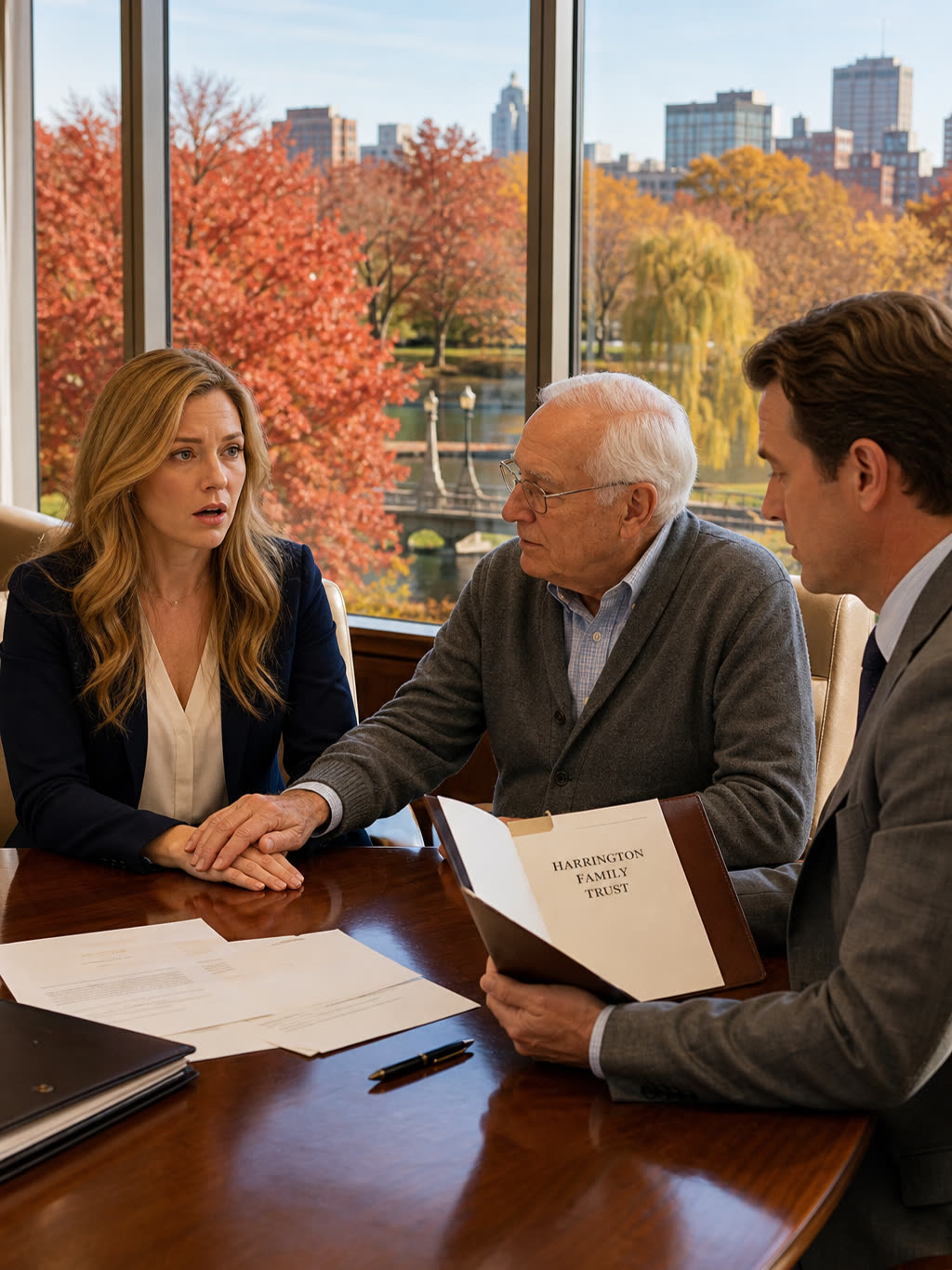
He showed me the property records. Dad had originally bought the condo through an investment company. Margaret had been allowed to live there under a written occupancy agreement, with below-market monthly payments and no ownership interest. I already knew most of that. What I hadn’t known was that Nathan had recently approached a private lender about borrowing against the property. He had supplied documents suggesting Margaret would soon receive ownership of the condo, and he had also submitted what appeared to be my authorization for the transaction.
“But Dad owns it,” I said.
“That is what Nathan appears to have assumed,” James replied. “And that’s why I need to speak with your father before we go any further.”
I looked at him.
“Why?”
James closed the folder.
“Because Richard changed the ownership arrangement eighteen months ago.”
Dad arrived an hour later, looking older than he had the afternoon before. When James explained what we had found, Dad took off his glasses and rubbed his eyes.
“I was worried something like this might happen.”
I stared at him.
“What does that mean?”
Dad turned toward the window.
“Caroline, I never liked the way Nathan talked about your money.”
“He never talked about my money.”
“Not around you.”
A strange coldness settled across my chest. Dad explained that Nathan had come to him twice during the previous year. The first time, he proposed transferring the Brookline condo to Margaret as a birthday gift, and Dad refused. The second time, Nathan suggested using the property to secure a business loan, claiming he had found an extraordinary investment opportunity and needed temporary collateral. Dad refused again.
“Why didn’t you tell me?” I asked.
“Because Nathan said he wanted to surprise you. He told me you were overwhelmed with work and that he was trying to create something for your family’s future.”
Dad looked ashamed.
“I should have told you right away.”
I reached across the table and took his hand.
“We both trusted things we shouldn’t have.”
James opened another folder.
“Dad, tell Caroline about the trust.”
My father hesitated. Then he looked straight at me.
“Eighteen months ago, I transferred the Brookline property into a trust for Sophie and Caleb.”
I blinked.
“What?”
“I wanted them to have something secure. Something that would remain theirs regardless of what happened to either of us.”
I looked down at the documents. The trust named my children as beneficiaries, with Dad serving as trustee. When he passed away or stepped down, an independent successor trustee would take over until the children reached the ages set out in the agreement. The condo was no longer just an investment property my father planned to leave behind. It was an asset being held for my children.
And Nathan had been trying to use it as collateral for a loan, a loan that could have affected the very people his mother had called burdens.
I couldn’t speak. Then James turned another page.
“There’s something else.”
He pointed to the financial information Nathan had given the lender.
“The proposed loan wasn’t for a business.”
My heart began to pound.
“What was it for?”
James looked at Dad, then back at me.
“It appears Nathan was trying to cover a significant amount of personal debt.”
By that afternoon, the evidence was forming a picture I could barely recognize. Nathan had presented himself as a successful financial consultant. He talked constantly about his clients, his investment strategies, and the importance of building generational wealth. But the statements James obtained with my authorization told a very different story. Nathan had borrowed heavily against his own investments. Several speculative ventures had failed. He had unpaid personal loans, large credit card balances, and a habit of shifting money between accounts to cover payments as they came due. The expensive gifts he gave Margaret had not been proof of success. They had been part of an increasingly unstable appearance. And the Brookline property had become his proposed solution.
James advised me to preserve the documents and avoid discussing the investigation with Nathan, while Erin began preparing the divorce filing.
That evening I came home and found Nathan sitting in the living room. He had arranged flowers on the coffee table, and beside them lay a handwritten card.
I’m sorry about last night. Let’s talk.
For one brief moment, I remembered the man who used to bring me coffee whenever I worked late. The man who had held my hand at Sophie’s first school performance after Daniel died. The man who had promised never to make my children feel like outsiders. Then I remembered Caleb standing outside the restaurant, asking whether he was a burden.
I left the flowers untouched. Nathan stood.
“Caroline, we need to stop this.”
“Stop what?”
“Letting one misunderstanding end our marriage.”
I looked at him.
“Did you tell Margaret that Sophie and Caleb weren’t welcome?”
He hesitated.
“Mom wanted an adults-only party.”
“Did you know before we arrived?”
His silence was my answer. He had known. For days I had imagined that Margaret ambushed him at the entrance, telling myself Nathan had made a terrible decision under pressure. But he had known exactly what was going to happen, and he had let my children spend a week preparing gifts for a celebration they were never going to attend.
“Why didn’t you tell me?” I whispered.
“Because you would have made it a big deal.”
I stared at him.
“It was a big deal, Nathan.”
He rubbed his forehead.
“Mom thought it would be easier if she explained it when we arrived.”
Something inside me went very quiet.
“You both knew what would happen when we arrived.”
“That’s not fair.”
“Neither was leaving two children outside a party their mother paid for.”
His expression shifted.
“Are you really going to walk away from everything we’ve built?”
I looked around the beautiful apartment. The furniture. The artwork. The enormous windows overlooking the city. For years I had mistaken these things for evidence of a successful family. Now they looked like expensive decorations surrounding an incredibly lonely life.
“I’m not walking away from my family, Nathan. I’m choosing the part of it that never should have had to compete for my love.”
The next morning, Margaret called me seventeen times. I didn’t answer. By lunchtime she had started posting photographs from her birthday on social media. One showed Nathan kissing her cheek beneath the chandeliers. Another showed her holding a champagne glass beside a towering arrangement of white orchids. The caption read:
Some people understand the importance of family. Others only understand the importance of money.
I stared at the words, and then I noticed the comments. Several of Margaret’s friends were asking why Nathan’s wife and children hadn’t come. Margaret replied that we had chosen to stay away because I had become upset about the party expenses, and she claimed Nathan had generously paid for the celebration himself.
My hands began to tremble. For years I had quietly paid bills, planned holidays, and helped Margaret whenever she needed something. I had never asked for public credit. Now she was using that silence to build a version of events in which Nathan was the generous son and I was the selfish wife.
I forwarded screenshots to James, and his answer came quickly.
Don’t engage publicly. We have the records.
That evening I received a message from someone I barely knew. Her name was Helen Parker. She had attended Margaret’s party with her husband.
Caroline, I hope you don’t mind me contacting you. I was near the entrance when Margaret spoke to your daughter. What happened was awful. I wanted you to know that not everyone believed the story she told afterward.
I stared at the screen. Then another message arrived.
My husband and I left shortly after you did. I couldn’t enjoy the party after seeing your son’s face.
I thanked her. And for the first time since the restaurant, I cried. Not because of what Margaret had done, but because someone had witnessed it and refused to act as though it was normal.
Two days later, Sophie came into my bedroom carrying her scrapbook.
“Mom, can I show you something?”
I sat beside her on the bed, and she opened the book. The first pages held photographs of our family. Caleb at the beach, laughing with ice cream on his face. Sophie receiving an award at school. Nathan helping the children decorate a Christmas tree three years earlier. Then came a photograph of Daniel, sitting on the grass with Sophie on his shoulders while Caleb, still a baby, laughed in his arms.
I touched the picture.
“I remember that day.”
Sophie nodded.
“Dad kept making me pretend I was an airplane.”
We sat quietly for a moment. Then she turned several pages, and I recognized the photographs at once. Margaret’s birthday lunch the year before. Christmas dinner at our apartment. A picture of Caleb helping Margaret carry groceries. Underneath it, Sophie had written:
Grandma always says she likes fresh flowers, so Caleb and I helped her buy some.
My throat tightened.
“Sweetheart, why did you put all these pictures in the book?”
Sophie looked down.
“Because I thought if Grandma saw how many happy memories we had together, she might finally like us.”
I closed my eyes. She went on, very softly.
“Sometimes I thought maybe I just wasn’t trying hard enough.”
I pulled her into my arms.
“You never had to earn a place in this family, Sophie. And you never have to prove that you’re worth loving.”
She cried against my shoulder. After a while she reached into the back pocket of the scrapbook.
“There’s something else.”
She handed me a folded sheet of paper. It was a photocopy of a financial document. My name was near the top, Nathan’s name beneath it, and at the bottom was a signature that looked exactly like mine. My whole body went cold.
“Where did you get this?”
Sophie twisted her fingers together.
“I found it in the printer about two weeks ago. Nathan asked me to bring him some papers, and this was mixed in with them.”
“Why did you keep it?”
“Because there were other pages with your signature on them. They all looked the same.”
I stared at her.
“What do you mean?”
She swallowed.
“Mom, I think he printed your signature onto those documents.”
I called James immediately. Within an hour I was sitting in his office with the photocopy Sophie had kept. He studied it carefully. The page showed an image of my signature placed over a blank authorization line. It was a draft document, and unlike the completed authorization Nathan had given the lender, this version carried a small printed note near the bottom.
Signature placement test.
James looked at me.
“This is important.”
I felt sick.
“Does it prove he created the other document without my permission?”
“It strongly supports the need for a formal investigation. We need the original files and the lender’s records before we can determine exactly what happened.”
I explained how Sophie had found it, and James’s expression softened.
“She did the right thing by bringing it to you.”
Then he asked another question.
“Caroline, who has access to your home computer?”
“Nathan and I. Sophie sometimes uses it for school.”
“Do you know whether Nathan keeps other financial documents there?”
I nodded.
“He has an entire folder of business records.”
James advised me not to search or alter Nathan’s private accounts myself. Instead, he would work with Erin to obtain the records through proper legal channels.
I went home and sat beside Sophie.
“Sweetheart, thank you for showing me that paper.”
She looked worried.
“Is Nathan in trouble?”
“I don’t know yet. But the adults will handle it.”
She nodded. Then she asked the question I had been dreading.
“Are you going to divorce him?”
I took her hand.
“Yes.”
Her eyes filled.
“Because of us?”
I shook my head at once.
“No, Sophie. Because of the choices he made.”
She looked down. Then, so quietly that I almost missed it, she said:
“I’m glad.”
The next several weeks changed everything. Erin filed the divorce petition. I opened a separate account for my income and began carefully reviewing our shared financial responsibilities. Nathan moved into a furnished apartment while the legal arrangements were worked out. Margaret kept calling, leaving messages that swung between anger, accusations, and requests for money.
One afternoon she showed up at my building, and the concierge called upstairs.
“Mrs. Cole is here. She says she needs to speak with you urgently.”
I asked him to tell her that any legal or financial questions should be directed to my attorneys. Margaret refused to leave, so eventually I went downstairs. She stood in the lobby in an expensive cream-colored coat, her handbag clamped against her side.
“Caroline, this has gone far enough.”
I stopped several feet away.
“What do you want, Margaret?”
She lowered her voice.
“Nathan tells me you’ve involved lawyers.”
“Yes.”
“Over one unfortunate evening?”
I looked at her.
“Did you know Sophie spent a week making you that scrapbook?”
Margaret sighed.
“Caroline, children need to learn that not everything revolves around them.”
“Did you know Caleb saved for months to buy your gift?”
“Please don’t start.”
I took a breath.
“Then tell me something. What did you expect my children to do while you celebrated your birthday?”
She looked irritated.
“I expected you to behave like an adult and take them somewhere else.”
“While Nathan stayed inside?”
“He’s my son.”
“And they are my children.”
Margaret shook her head.
“You’re going to regret this.”
For the first time, her words didn’t frighten me.
“I already regret far too much, Margaret.”
I turned toward the elevators. Then she called after me.
“Your father can’t just make me leave my home!”
I stopped. The lobby went very quiet. I looked back at her.
“No, Margaret. He can’t.”
For a moment she looked relieved. Then I continued.
“But you should speak with James before making any assumptions about who owns it.”
Her relief disappeared.
The investigation into Nathan’s proposed loan went on. The lender suspended the application after being notified that the ownership and authorization documents were disputed. James helped Dad and the trust’s attorneys preserve the relevant records and report the suspected document problem to the proper authorities. No criminal charges had been filed at that point, and James reminded me again and again that a legal investigation required evidence, not assumptions.
But Nathan’s financial situation was getting harder to hide. His creditors were demanding payment. A business associate had threatened legal action over an unpaid personal loan. And the company he had described as his most promising investment had stopped operating months earlier.
One evening Nathan called me. His voice sounded exhausted.
“Caroline, I need to talk to you.”
“About what?”
“The loan.”
I sat down.
“What loan?”
He was silent for several seconds. Then he said, “I was trying to fix things.”
“By using my father’s property?”
“I was going to pay everything back.”
“With what money?”
He didn’t answer. I closed my eyes.
“Did Margaret know?”
“Mom knew I needed help.”
“Did she know you were trying to use the condo?”
Another silence. Then Nathan whispered:
“She was the one who suggested it.”
A chill ran through me.
Part 3: The Yellow Door
“Suggested what?”
“She said your father would never give me the money directly. But if we could arrange for the property to be transferred into her name, I could refinance it.”
“And the documents with my signature?”
“Caroline—”
“Did you place my signature on those documents without my permission?”
His breathing changed.
“I didn’t think you’d agree if I asked.”
I stared at the wall. For weeks I had wondered how much Margaret knew and how much Nathan had kept from her. Now I had heard his explanation. They had both apparently known about the plan. I ended the call, wrote down everything he had said, and sent the account to James.
A month later, James arranged a formal meeting about the Brookline property. Margaret arrived with Nathan and an attorney. My father came with the trust’s counsel, and I sat beside James. The atmosphere was tense from the start.
Margaret insisted she had always understood the condo would eventually be hers. Nathan claimed Dad had verbally promised to transfer it to the family. Dad calmly denied ever making such a promise. The attorney for the trust explained that Margaret’s written occupancy agreement gave her no ownership rights, and that any change to her occupancy would have to follow the agreement and applicable law.
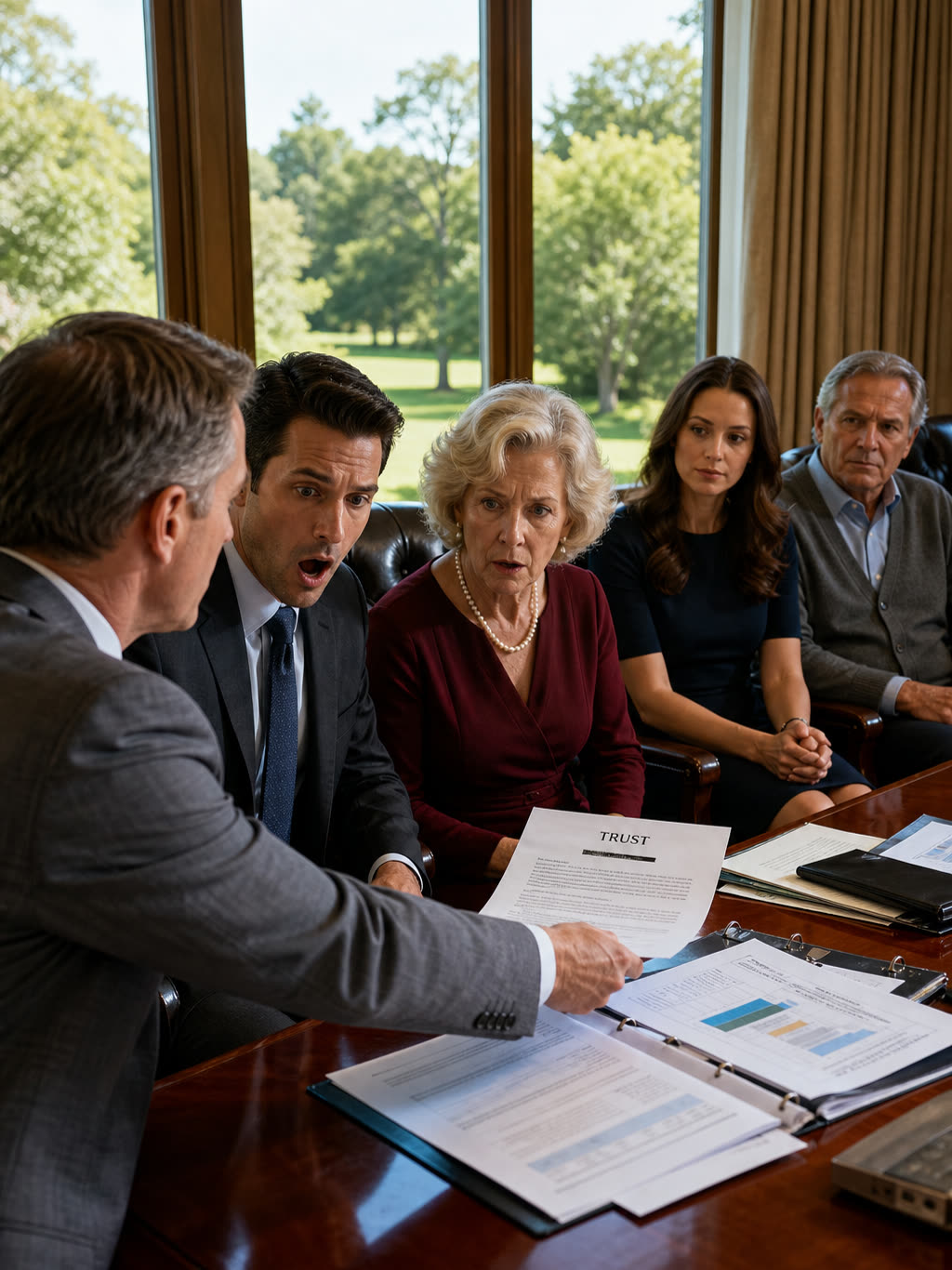
Margaret looked furious.
“This is ridiculous. I’ve lived there for years!”
Dad spoke quietly.
“And during those years, Margaret, you paid substantially less than the market rate.”
She turned to him.
“Because your daughter and my son are married!”
“They are getting divorced.”
Margaret pointed at me.
“She is doing this to punish me.”
I looked at her.
“No. I am doing what I should have done a long time ago. I’m making sure my children’s future is protected.”
Nathan leaned forward.
“Caroline, please. There has to be another solution.”
James set a document on the table.
“There is something you both need to understand before we discuss anything further.”
Margaret glanced at the paper.
“What is that?”
“The trust agreement governing the Brookline property.”
Nathan frowned.
“We know Richard owns the property.”
James shook his head.
“Richard purchased it originally. But he transferred it eighteen months ago.”
Margaret looked at my father.
“Transferred it to whom?”
Dad didn’t answer right away. Instead he turned to me.
“Caroline, I think it’s time they understood why I made that decision.”
James opened the document, and what happened next was something I would remember for the rest of my life.
“The Brookline condominium is currently held by a trust established for the benefit of two children,” James explained. He turned the document toward Nathan. “The beneficiaries are Sophie and Caleb.”
Margaret stared at him. For several seconds she seemed unable to take in the words.
“What?”
James spoke slowly.
“Your occupancy agreement concerns property held for Caroline’s children.”
Nathan’s mouth fell open. I watched the realization reach him. The property he had tried to use to solve his financial problems was held in trust for the two children he had left outside his mother’s birthday party.
Margaret shook her head.
“No. Richard owns that apartment.”
“I purchased it,” Dad said. “And I later transferred it into the children’s trust.”
Margaret turned to Nathan.
“Tell them!”
Nathan said nothing. She looked back at James.
“So what are you saying? That two children are my landlords?”
“The trust holds legal title through its trustee,” James replied. “Sophie and Caleb are its beneficiaries.”
Margaret’s expression changed. She looked at me with something I had never seen from her before. Concern. Then she said something that made my stomach clench.
“Well, surely Caroline can explain to them that Grandma needs somewhere to live.”
I stared at her. The woman who had refused to let my children into her birthday party was now appealing to their generosity. The children she had called burdens were the very people whose trust had been providing her with a comfortable home.
But James was not finished. He reached into his folder.
“There’s one more matter we need to address.”
Nathan looked up.
“What matter?”
James laid a second document beside the trust agreement. It was a statement from the private lender, listing the proposed loan amount. Eight hundred and forty thousand dollars. And beneath the proposed disbursement instructions was an account name.
I leaned forward. For a moment I couldn’t understand what I was seeing. The account was not Nathan’s. It was not Margaret’s personal account. It belonged to a limited liability company I had never heard of. James pointed to the company name.
“We have obtained the publicly available registration records for this entity.”
He looked directly at Nathan.
“Would you like to explain why the company designated to receive the loan proceeds lists your mother as its sole manager?”
Margaret went completely pale. Nathan stared at the document.
“Mom?”
Margaret didn’t answer.
“Mom, what is this?”
She clasped her hands together.
“It’s nothing.”
James continued.
“The records also show that this company recently entered into a purchase agreement for a waterfront condominium in Florida.”
I looked at Margaret. She had spent years telling everyone she was a lonely widow who relied on her son’s generosity. She often complained that Boston winters were becoming unbearable. More than once she had mentioned that she deserved a beautiful retirement somewhere warm. Now the pieces were fitting together. Nathan had borrowed money to address his debts. Margaret had encouraged him to use the Brookline property. But the proposed loan proceeds were headed to a company under her control.
“Margaret,” I said slowly, “were you planning to purchase another apartment for yourself?”
She looked away. Nathan shoved his chair back.
“You told me the money was going to pay my creditors!”
“I was going to help you!”
“With eight hundred and forty thousand dollars?”
Margaret’s expression hardened.
“After everything I’ve sacrificed for you, Nathan, I deserve something of my own!”
He stared at her. For the first time, I saw him feel the same confusion my children had felt outside the restaurant. He had believed his mother was looking out for him. Instead, she seemed to have been looking out for herself.
But I didn’t feel triumphant. I felt exhausted.
James closed the folder.
“The proposed loan did not proceed. The disputed documents have been preserved, and the appropriate authorities have been notified. Any further questions regarding the transaction should go through counsel.”
Margaret abruptly stood.
“This meeting is over.”
She hurried toward the door. Nathan stayed in his seat and looked at me.
“Caroline, I didn’t know about the Florida apartment.”
I believed him. But it didn’t change what he had done. He had been willing to put my children’s future at risk to protect his own financial reputation, and no deception by his mother could erase that decision.
The months that followed were not easy. Divorce rarely is. There were financial disclosures, difficult negotiations, and days when I felt as though the life I had built was being taken apart one document at a time.
Eventually Nathan stopped disputing the basic facts about the restaurant incident. He acknowledged that he had known beforehand that Margaret intended to exclude Sophie and Caleb. He also admitted that he had let me believe the children were welcome because he didn’t want to face my reaction before the party. That admission hurt almost as much as the original betrayal. But it also gave me clarity. I no longer needed to wonder whether I had misunderstood what happened. I hadn’t.
Nathan and I reached a divorce settlement after long negotiations. The disputed financial documents remained a separate matter, subject to further investigation. Margaret’s Florida purchase did not proceed. The trust’s attorneys reviewed her Brookline occupancy agreement and handled the required notices and arrangements according to its terms.
There was no dramatic midnight eviction. No furniture placed on the sidewalk. No sudden changing of locks. I had no interest in teaching my children that cruelty was an acceptable answer to cruelty. Margaret eventually arranged to move into a smaller rental apartment. She complained to anyone willing to listen that I had turned her family against her. But I no longer spent my evenings trying to correct her version of events. The people who mattered knew the truth.
And Sophie and Caleb were beginning to heal.
One Saturday afternoon, several months after the birthday party, Caleb walked into the kitchen carrying the porcelain tea set. The blue floral pattern looked delicate and beautiful in the sunlight.
“Mom, can we take this to Grandpa’s house?”
I smiled.
“Why?”
“Because he likes tea.”
I laughed softly.
“Yes, he does.”
Caleb studied the box for a moment.
“Do you think he’ll like it?”
I crouched beside him.
“Caleb, Grandpa will love it.”
He grinned. Then he asked, “Can Sophie come, too?”
“Of course.”
That evening we drove to Dad’s house, and he opened the door before we even reached the porch. Caleb proudly handed him the gift. Dad carefully unwrapped it and examined the little porcelain cups.
“Well,” he said, “this is the finest tea set I’ve ever owned.”
Caleb beamed. Sophie had brought her scrapbook, but this time she had taken out the pages she had originally meant for Margaret and replaced them with photographs of our family. Dad helping Caleb learn to ride a bicycle. The three of us baking cookies. Daniel carrying Sophie on his shoulders. And one new photograph, showing Dad opening his front door as Caleb ran toward him. Underneath, Sophie had written:
“Family is where nobody has to ask if they are allowed inside.”
I turned away before she could see my tears.
Several weeks later, Dad invited us back for dinner. He had something he wanted to show the children. After dessert, he carried a small wooden box into the living room. Inside were photographs, letters, and several documents that had belonged to Daniel. I recognized the box immediately. Daniel had kept it in his study. After his death, I had given it to Dad because I couldn’t bring myself to sort through everything.
“Caroline,” Dad said gently, “I think you’re ready for these now.”
Sophie sat beside me, and Caleb climbed onto the couch. We spent the next hour looking through old photographs. Daniel standing beside our first apartment. Daniel holding newborn Caleb. Daniel and Sophie making pancakes on a Sunday morning. Then Dad reached the bottom of the box and took out a sealed envelope. My name was written across the front, in Daniel’s handwriting.
I stared at it.
“Dad, what is this?”
He looked puzzled.
“I found it inside the box while I was organizing the photographs. I don’t remember seeing it before.”
My hands trembled as I opened it. Inside was a letter Daniel had written shortly before his accident. He had been preparing for a business trip and, as he sometimes did, had left me a note to find while he was away. It began with a joke about how I would probably reorganize the entire kitchen before he got back. I laughed through my tears. Then I reached the final paragraph, and everything inside me went still.
Caroline, if there’s one thing I want our children to understand, it’s that love should never make them feel small.
Whatever happens in life, please make sure they always have a home where they are wanted, where they feel safe, and where nobody makes them wonder whether they belong.
I pressed the letter to my chest. For six years I had been trying to build the family I believed Daniel would have wanted for us. I had convinced myself that keeping my marriage together was the same as keeping my children safe. But somewhere along the way I had forgotten the most important part. A family is not something you preserve at the expense of the people inside it.
A year after Margaret’s birthday, Sophie asked whether we could celebrate Caleb’s tenth birthday at the same restaurant. I looked at her in surprise.
“Are you sure?”
She nodded.
“I don’t want that place to remind him of what happened last time.”
I thought about her words. Then I called the restaurant manager, who remembered us right away. When I explained what Sophie wanted, he offered to arrange a small private lunch. Nothing extravagant. Just our family, a few friends, and the people who had shown up for my children when it mattered.
On the afternoon of the celebration, Caleb arrived in a little navy blazer, with Sophie beside him carrying a new scrapbook. Dad was waiting near the entrance, and James stood next to him holding a brightly wrapped present. When the restaurant doors opened, Caleb hesitated, and I felt his hand tighten around mine. Then Dad stepped forward.
“There’s the birthday boy!”
He opened his arms, and Caleb ran to him. The manager smiled and gestured toward the dining room.
“Your table is ready.”
For one brief moment, I remembered Margaret standing in that doorway. I remembered Sophie turning pale. I remembered Caleb asking whether he was a burden. Then I looked at my son. He was laughing. He was happy. And every person waiting inside had come because they truly wanted to celebrate him. Nobody was being asked to step aside.
Near the end of lunch, James came over.
“Caroline, there’s one final thing you should know about the Brookline trust.”
I smiled.
“Please tell me nobody has tried to borrow another eight hundred thousand dollars.”
He laughed.
“No. Nothing like that.”
He handed me a small envelope.
“Your father asked me to give you this today.”
Inside was a letter from Dad. He explained that he had recently updated the trust’s instructions. When the children reached adulthood, they would have access to resources meant to help them build independent lives. But Dad had also included a personal request. He hoped they would remember that money was not simply something to accumulate. It was something that could provide safety, dignity, and opportunity for people who needed it.
I carefully folded the letter. Then Sophie came up to us.
“Mom, Grandpa told us about the trust.”
I looked at Dad across the room, and he smiled. Sophie continued.
“Caleb and I have been talking.”
“About what?”
She looked at her brother, and he nodded eagerly.
“We want to do something with the condo.”
I crouched between them.
“What would you like to do?”
Sophie took a breath.
“Grandma always said we weren’t really her family because Dad wasn’t Nathan.”
My chest tightened.
“But Grandpa says family is about what you do for people.”
I nodded.
“He’s right.”
She smiled.
“So we thought that when we’re older, maybe we could use some of the money from the condo to help kids who don’t have a safe home.”
Caleb jumped in.
“Like kids who need somewhere to go when nobody wants them!”
I pulled them both into my arms. For a moment I couldn’t speak. Then I whispered:
“That sounds like a beautiful idea.”
But Sophie wasn’t finished. She reached into her scrapbook and took out a small photograph of her father, Daniel, holding her when she was little. On the back she had written a sentence.
Dad gave us love. Mom gave us courage. Grandpa gave us a home. Now we want to help someone else find one.
I held the photograph against my heart. For the first time in a very long time, I felt something stronger than grief. I felt hope.
Two years later, the Brookline condo was sold through the trust’s authorized procedures, and the proceeds stayed protected for Sophie and Caleb. With help from our family and independent advisers, Dad also set up a separate charitable fund in Daniel’s memory. Its purpose was simple. To help families facing sudden housing insecurity after the death of a parent. Sophie helped design the fund’s first information brochure. Caleb insisted that it include a drawing of a house with a bright yellow front door. When I asked why the door had to be yellow, he shrugged.
“Because yellow looks happy.”
Then he added:
“And because people should know they’re allowed to come inside.”
I smiled. But the final surprise came several weeks later, when James called to tell me the fund had received its first anonymous donation. It was a substantial amount, enough to help several families with emergency housing expenses.
“Do we know who sent it?” I asked.
James hesitated.
“The donor requested confidentiality.”
I thanked him and ended the call. The next morning, an envelope arrived at my apartment with no return address. Inside was a handwritten letter, and I recognized the handwriting immediately.
Nathan.
Caroline,
I heard about the fund you created in Daniel’s name. I know I have no right to expect your forgiveness, and I am not writing to ask for it.
I’ve spent a long time thinking about what happened at my mother’s birthday celebration.
For years, I convinced myself that being a good son meant giving my mother whatever she wanted. I used that belief to excuse choices that hurt people who trusted me.
I cannot change what I did to Sophie and Caleb.
But I can stop pretending that I was simply the victim of someone else’s decisions.
I have started repaying what I owe, and I am finally accepting responsibility for the consequences of my choices.
I made a donation to the fund because Daniel’s children deserve to grow up knowing that their father is remembered for the love he gave them, not for the ways I disappointed them.
Please don’t tell the children the money came from me. I don’t want them to feel that they owe me anything.
Nathan.
I read the letter twice, then folded it and placed it in a drawer. I did not call him. I did not send him a message. And I did not mistake one thoughtful act for proof that the past had been repaired. Forgiveness, responsibility, and reconciliation are not the same thing. Nathan was finally beginning to accept responsibility for his choices. But my children did not owe him another chance to disappoint them.
That evening I found Sophie and Caleb sitting on the living room floor, surrounded by photographs. They were making a new scrapbook. I sat down beside them.
“What’s this one about?”
Sophie smiled.
“Our family.”
I looked at the first page. A photograph of Daniel holding Sophie. A picture of Dad helping Caleb ride his bicycle. A photograph of James laughing at our kitchen table. And a picture from Caleb’s birthday lunch at the restaurant, with everyone smiling. Underneath, Sophie had written:
“The people who stayed.”
Caleb pointed to an empty space at the bottom of the page.
“Mom, we need a picture of you.”
I laughed.
“Why?”
“Because you’re the one who opened the door.”
I pulled them close. Outside our windows, Boston glittered beneath the evening sky.
For years I had believed the most important thing I could give my children was a complete family. A mother. A father. A grandmother. A beautiful home. I had been so determined to preserve that picture that I nearly failed to notice what was happening inside it. My children were being taught to tolerate rejection. To apologize for taking up space. To feel grateful for affection that came with conditions. And I had nearly allowed it because I was terrified of losing another family.
But the night Margaret left us standing outside her birthday celebration, something finally changed. I stopped asking whether I could convince those people to love us. I started asking whether they deserved access to the love my children had given them so freely.
That single question changed everything. It changed my marriage. It changed my relationship with Margaret. It changed the way I thought about our home, our money, and our future. Most importantly, it changed what Sophie and Caleb would grow up believing about themselves.
They would never have to earn their place at my table. They would never have to apologize for needing protection. And they would never have to stand outside a door, holding gifts for someone who made them feel unwelcome, wondering whether they were worthy of being invited inside.
I kissed the tops of their heads. Then I looked at the photograph Sophie had placed in the center of her scrapbook. It showed the three of us standing together outside our new home, smiling in the afternoon sunlight. Caleb had his arms wrapped around my waist. Sophie was holding my hand. And behind us, the front door stood wide open.
We had lost the family I once believed we needed.
But we had finally found the family we deserved.
Disclaimer: This story is a work of fiction inspired by real-life themes. Names, characters, places and events are fictionalized, and any resemblance to real persons is purely coincidental. Images are for illustration purposes only.
