

Part 1: A Bargain Made in Desperation
At 43, I never imagined I would marry a 20-year-old millionaire, least of all a young man who had spent six months as my patient. Yet when your only daughter lies motionless in a hospital bed and cannot wake up, you start weighing choices you would once have dismissed as unthinkable. A mother will walk through fire if she believes it might lead her child back to her. I walked into something far stranger than fire, and I did it with my eyes open, because love for my daughter left me with no sense of shame and very little pride.
My name is Vivian Hale, and my daughter, Iris, was everything to me. Her father left us when she was 3 years old, and from that day I raised her alone. We did not have much, but we had a small home full of noise, laughter, and burned dinners that we ate anyway. I worked long hours and she grew up quickly, becoming steady and generous in ways I never taught her. By the time she was 19, she was studying nursing, dreaming of becoming someone who could help people when they needed it most. I used to watch her studying at the kitchen table and feel my chest swell with a pride so large it frightened me.
Then, 8 months ago, a terrible accident destroyed the life we had built. Iris was driving home when she stopped to help the victims of a highway crash. That was simply who she was; she could not drive past someone in trouble. While she was trying to warn approaching motorists, another vehicle struck her. The phone call came late at night, and I remember how strange my own voice sounded when I asked the nurse to repeat herself. I do not remember the drive to the hospital. I only remember the fluorescent lights, the smell of antiseptic, and a doctor choosing his words too carefully.
She suffered a severe traumatic brain injury and never regained consciousness. In the first days I told myself she was only sleeping, that she would open her eyes and complain about the hospital food. The doctors did everything they could, and I will never say otherwise. But months passed without meaningful improvement, and hope became something I had to rebuild each morning, like a fire that kept dying in the night. I sat beside her bed and talked to her about nothing, reading her old messages aloud, begging her to answer me.
Eventually, her neurologist suggested a specialized rehabilitation program that included experimental neurostimulation. He sat across from me in a small office, folded his hands, and spoke gently. “There’s no guarantee she’ll wake up, Mrs. Hale,” he explained. “But we believe she deserves an evaluation. If she’s eligible, it may offer another opportunity for recovery.” I clung to the word opportunity as if it were a rope. It was the first time in months that anyone had offered me something other than waiting.
The cost was devastating. I had already sold my car, emptied my savings, and borrowed money from everyone I knew. I had run out of people to ask and things to sell, and every figure the hospital administrator showed me seemed to belong to another universe. I lay awake doing arithmetic that never worked. When a private care agency offered me a well-paying position assisting a young millionaire named Bennett Vale, I accepted immediately. I did not even ask many questions. Pride was a luxury, and I had spent it all.
Bennett was only 20. He had lost both parents in a car crash several months earlier, and a spinal cord injury had left him paralyzed from the waist down. He lived in a magnificent mansion, surrounded by luxury but almost entirely alone. The halls were so quiet that my footsteps echoed, and the rooms were filled with beautiful things that nobody seemed to use. His uncle, Roland Vale, managed the family corporation and represented Bennett’s interests in the family trust until Bennett became eligible to take control. I saw Roland only occasionally, always in a perfect suit, always with a smile that never quite reached his eyes.
Despite his wealth, Bennett was remarkably kind. I had expected arrogance, or at least the entitlement I imagined came with money, but he treated me like a person rather than an employee. “Please don’t call me sir,” he told me during my first week. “I’m 20, not somebody’s grandfather.” I laughed for the first time in months, a startled sound that surprised us both. Something in my chest, long clenched tight, loosened a little. I remember thinking that if I had to spend my days anywhere while my daughter slept, at least it was beside someone gentle.
Over the following six months, I helped Bennett with his daily routine, accompanied him to appointments, and read to him when severe migraines kept him in bed. I sat in dim rooms with the curtains drawn while he pressed his hand to his forehead, and I read until his breathing slowed. He learned about Iris and often asked how she was doing. Sometimes, he sent flowers to her hospital room. Other times, he insisted I leave early so I could spend more time with her. We became close, although I never thought of our relationship as anything romantic. To me he was a lonely boy who deserved kindness, and I gave it as I would have wanted someone to give it to my own child.
Then, one rainy afternoon, Bennett rolled into the kitchen while I was preparing dinner. Rain streaked the tall windows and the room smelled of onions and warm bread. He stopped near the counter, his hands tight on the wheels, and I could tell something was on his mind. “Vivian, I want you to marry me.” I nearly dropped the knife. For a moment I thought I had misheard him over the sound of the rain, and I stood frozen with the blade in my hand and my heart pounding.
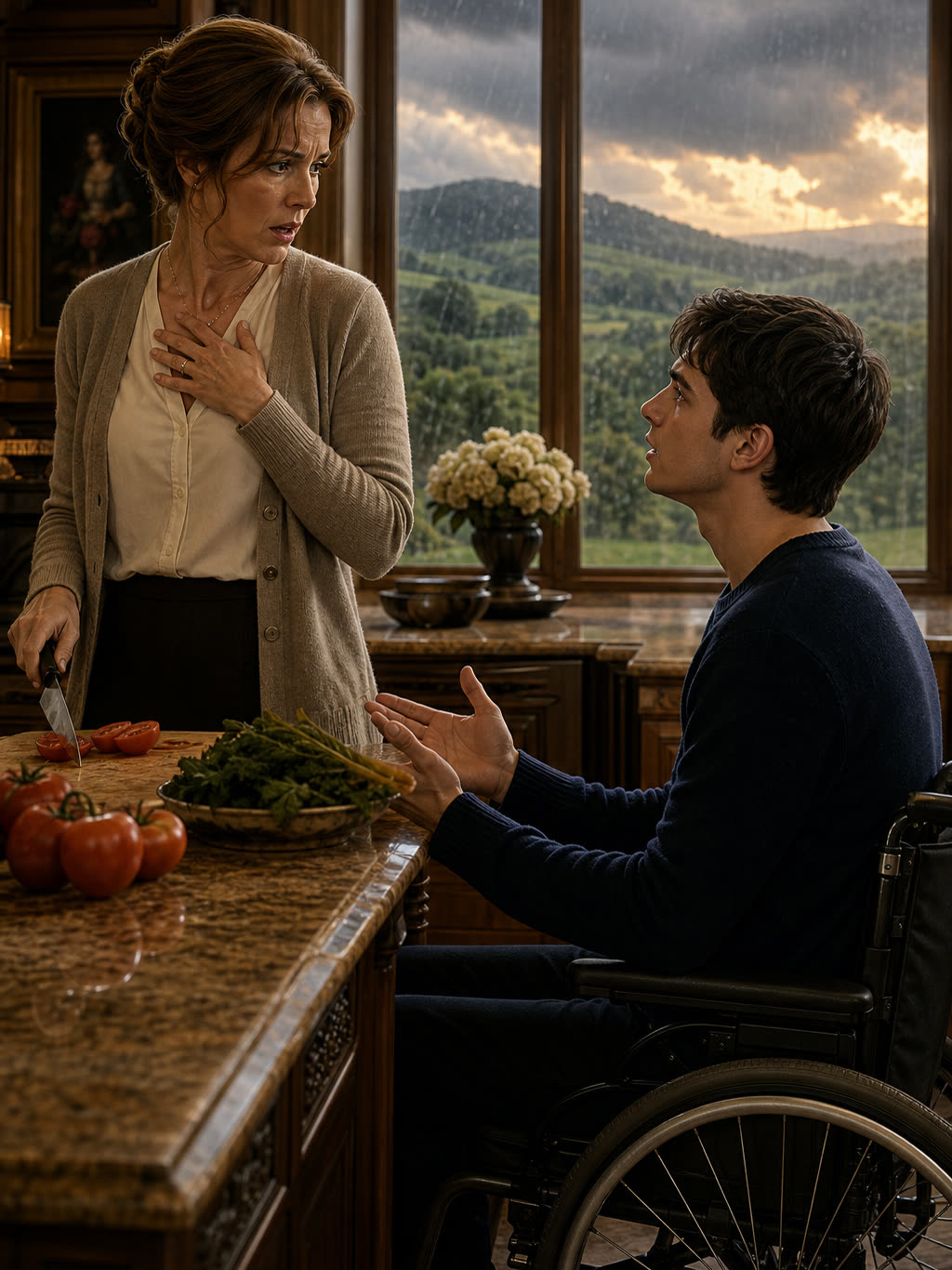
“What?” The word came out as little more than a breath. “I’m serious,” he said, looking straight at me. “Bennett, you’re 20! I’m old enough to be your mother!” I laughed, but it came out shaky, because his face was not the face of a boy playing a joke. “But you’re not my mother,” he replied. “You’re the only person in this house I completely trust.” I set the knife down carefully, as though it might go off, and stared at him.
“Why would you want to marry me?” I asked. He hesitated, and in that pause I saw how hard he was working to choose his words. “There’s something I need to do, and marriage would help me accomplish it. I can’t explain everything yet.” I crossed my arms. “That’s not much of an answer.” “I know. But I care about you, Vivian. And I know what Iris’s treatment will cost.” My heart tightened painfully. Hearing her name in that room, attached to a proposal I did not understand, made my skin prickle.
“What are you saying?” I asked, though some part of me already knew. “If you marry me, I can arrange the money she needs. Not just for the evaluation, but for her continuing treatment.” The offer hung in the warm kitchen air like a hand held out over a cliff edge. I should have been grateful. Instead, I felt something close to anger, because it was the one thing in the world he could have said to make me listen, and he knew it. I shook my head slowly.
“I won’t sell myself for money.” My voice was steadier than I expected. “I’m not asking you to,” Bennett said quickly, and his eyes were earnest. “I would never expect anything from you that you don’t freely choose to give.” I believed that he meant it. That was what made it so confusing. Still, I refused, and I turned back to the stove with trembling hands, pretending to stir a pot that did not need stirring until he quietly rolled out of the room.
But that evening, the hospital called. A place had opened at the rehabilitation center, and Iris needed financial approval within two weeks. Without it, she would lose her opportunity. The voice on the phone was kind and professional and utterly merciless in its simplicity. I thanked her, hung up, and sat on the edge of my narrow bed staring at the wall. Two weeks. After months of waiting, the clock had finally started, and I had nothing to feed it.
For two nights, I sat beside my daughter’s bed, wondering how much longer I could keep fighting a battle I couldn’t afford. I held her hand, which felt thinner every day, and I told her about the call. I told her about Bennett’s proposal, half laughing and half crying, as though she might sit up and roll her eyes at the absurdity of it. The monitors beeped. Her chest rose and fell. Nothing answered me. Somewhere in those long hours, my principles began to lose their argument with my love for her.
On the third morning, I returned to Bennett. He was in the sunroom, a book unopened on his lap, and I suspect he had been waiting there since sunrise. I stood in front of him with my hands knotted together. “If I agree, I want everything legally documented.” He nodded immediately, without even a flicker of hesitation, and that eased something in me. Whatever his secret was, he did not seem to want to trap me. He seemed almost afraid I would change my mind.
Before the wedding, I consulted an independent attorney. She reviewed our agreement, confirmed that Bennett could not control my personal finances, and ensured I would be free to leave the marriage. I read every line twice. Bennett also hired professional nurses to take over his personal care, so that I would no longer be his caregiver in any sense. His lawyer arranged short-term financing to secure Iris’s rehabilitation evaluation. I still didn’t fully understand why he needed a wife, but he promised to explain once certain legal documents had been filed. Against my better judgment, I agreed.
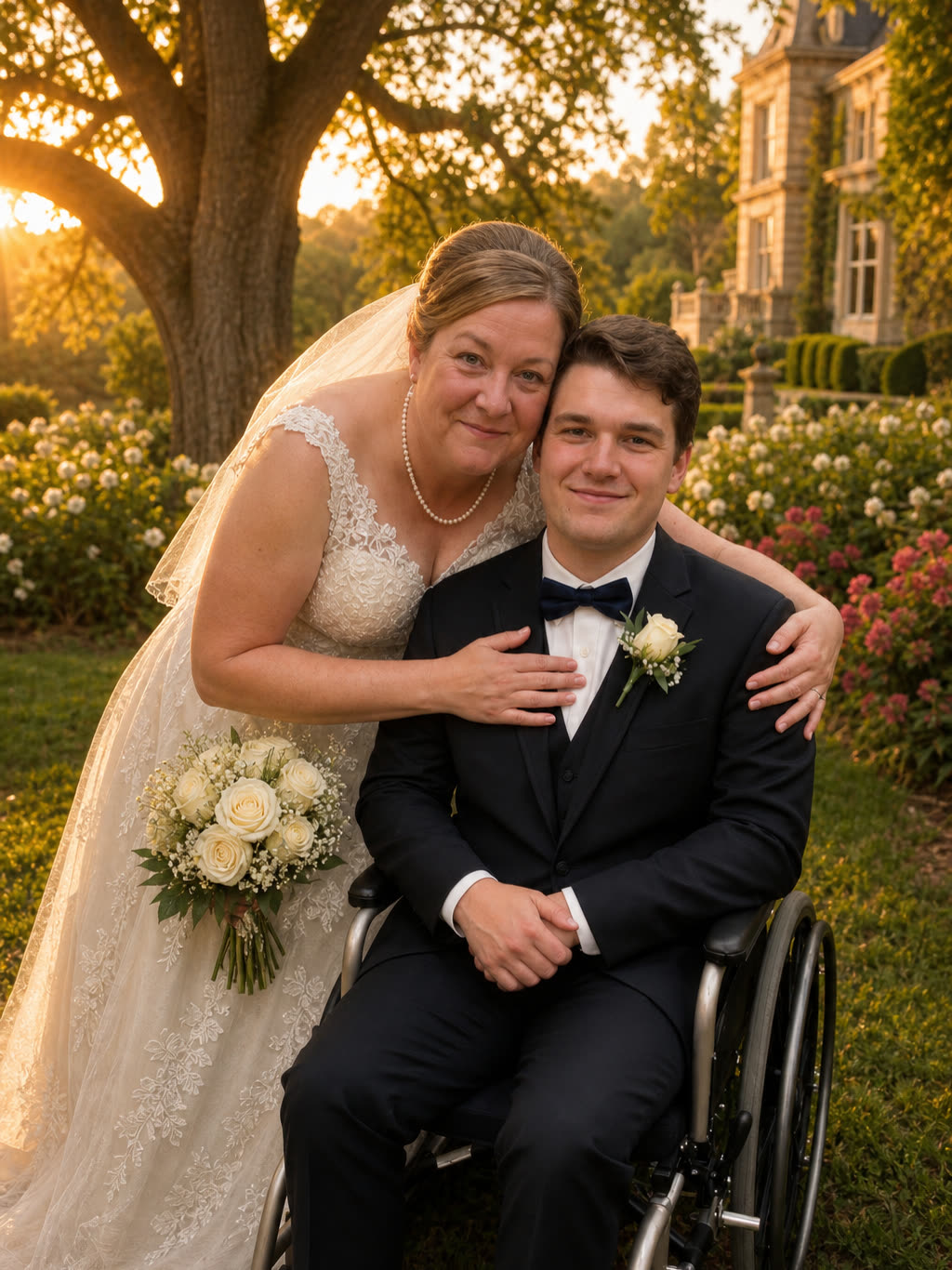
We married 9 days later. There were only 2 witnesses, a simple cream dress, and a small bouquet of white roses. It did not feel like a wedding in any way I had ever imagined one. There was no music, no laughter, and nobody to cry in the front row. When the officiant pronounced us husband and wife, Bennett squeezed my hand. His fingers were trembling. I looked down at them and felt a strange wave of tenderness, mixed with a creeping dread that I had stepped into something I could not see the edges of.
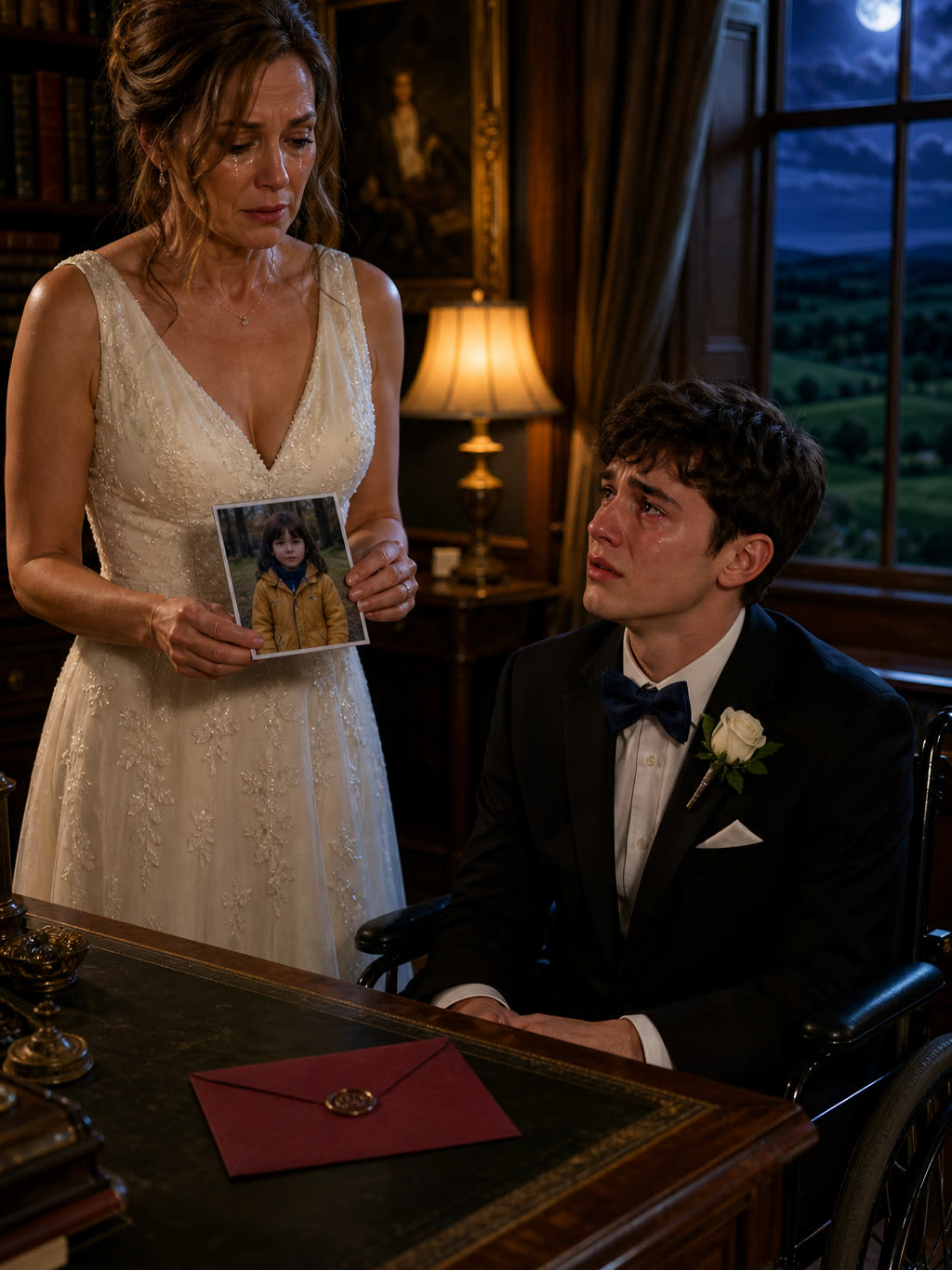
That evening, we returned to the mansion. The house felt different, as though it were listening. Bennett asked everyone to give us privacy, and one by one the staff withdrew until the only sound was the clock in the hall. Then he invited me into his study, rolled to the desk, opened a drawer, and removed a crimson envelope. Across the front was a name written in neat black letters. IRIS HALE. My daughter’s name. I froze, the white roses still in my hand. “Why is her name on that envelope?” I whispered, and Bennett looked at me, his eyes filling with tears.
Part 2: The Truth Behind the Crimson Envelope
“There’s no going back on what I’ve set in motion now. The marriage is registered, and my attorney has filed the trust documents.” Bennett’s voice was low and unsteady. The lamp on his desk cast long shadows over the shelves, and for the first time since I had met him, he looked afraid of me. He placed the envelope in my hands. It felt heavier than paper should. “It’s time I told you why I really married you.”
My fingers shook as I opened it. Inside was a photograph, and I almost did not look at it, because some part of me understood that nothing would be the same afterward. It showed a young woman wearing a yellow jacket kneeling beside an injured man on the roadside. The image was grainy, taken from the dashcam of a motorist who had stopped to help. But I recognized that yellow jacket immediately. I had bought it for Iris on her 19th birthday. She had twirled in it and called it her lucky jacket.
My hands began shaking so badly that the photograph rattled against the envelope. “Where did you get this?” I asked. Bennett swallowed, and a tear slid down his face. “Your daughter saved my life.” I stared at him, certain I had not heard correctly, as though the words belonged to another language. “What?” The room seemed to tilt, and I gripped the edge of the desk with the hand that was not holding my daughter’s face.
“The night my parents died, we were driving home from a charity event. Our brakes failed, and the car went off the highway.” His voice cracked on the last word. He stared at the carpet, then forced himself to continue. “My parents died in the crash. I was trapped inside, unable to move my legs. Smoke was filling the car, and I thought I was going to die.” He looked at the photograph in my hand. I could barely breathe.
“Then Iris appeared. She called emergency services, climbed down the embankment, and managed to open the damaged door. Another driver helped her pull me away from the wreckage before the fire spread.” Tears rolled down his cheeks, and he did not wipe them away. I pictured my daughter in the dark, smoke in her lungs, scrambling down a slope toward a stranger. It was so exactly like her that it hurt. “She stayed with me until she heard sirens approaching. Then she went back toward the highway to warn other drivers about the crash.”
I covered my mouth with my hand. The final piece of the picture slid into place with terrible clarity. “That’s when she was hit?” He nodded. “I never saw it happen. I had already lost consciousness.” My knees weakened, and I sank into a chair. The police had told me Iris was injured while helping at a highway accident, but nobody had identified the person she rescued. Her collision had been documented separately from the original crash.
I knew Bennett’s parents had died in a car accident, but he rarely discussed it, and I had never connected the 2 tragedies. I had spent those first terrible weeks in the hospital, barely aware of anything beyond my daughter’s condition. The world had narrowed to a single bed and a single heartbeat. Now, in a quiet study, the edges of that world cracked open to reveal that the boy I had been feeding and reading to had been connected to my child the entire time. “Why didn’t you tell me?” I whispered.
Bennett looked down at his hands. “Because there’s more.” He took another document from the drawer and held it out, and his arm trembled. It was a thick folder with a private investigator’s name stamped on the front. I did not want to take it, but I did. “My parents’ crash wasn’t an accident.” I looked up sharply, my pulse thundering in my ears. “What?” “The brakes were deliberately sabotaged.” The words fell into the silent room like stones into a well.
The report contained photographs of the damaged brake system, suspicious financial transfers, and statements from employees of a vehicle maintenance contractor. I turned the pages with numb fingers, understanding only half of what I saw. “My father discovered that Uncle Roland had been stealing money from the company,” Bennett explained. “He was preparing to report him and remove him from his position.” My stomach tightened. I thought of Roland’s polished smile and the way he had once squeezed Bennett’s shoulder in my presence, and a chill climbed my spine.
“You’re saying Roland k1:lled your parents?” I breathed. “I believe he arranged the sabotage to stop my father. He didn’t care that my mother and I were in the car too.” Bennett clenched his hands until his knuckles whitened. “When I survived, Roland used my injuries and the trust restrictions to keep control of the company.” I felt sick. For six months I had walked the halls of that mansion with a murderer’s footsteps in the rooms beside mine, and I had never known.
“Have you told the police?” “Yes. I reported my suspicions months ago. But the evidence wasn’t enough to charge him, and the financial records that could prove his involvement were controlled by the company.” He took a slow breath and wiped his face with the back of his hand. “That’s where our marriage comes in.” I stared at him, trying to see how a wedding could fit into a story of stolen money and cut brakes. He saw my confusion and pressed on.
“My parents created a trust that would give me full control of my inheritance at 25. But they included an unusual provision allowing control to transfer earlier if I married after turning 18.” “Why?” “They believed marriage demonstrated a willingness to take responsibility for a family. My attorney confirmed the provision was valid.” He continued, and the words came faster now, as though he had rehearsed them many nights and was afraid he would lose his courage. I listened with my heart pounding, still holding the crumpled photograph of my daughter.
“Roland was acting as the company’s manager and one of the trust’s representatives. I couldn’t freely access most of my inheritance or the corporate records while he controlled everything. An independent trustee, however, is legally required to transfer control once the marriage conditions are satisfied.” He looked at me, and there was an apology in his eyes before he even said it. “My lawyer prepared the documents secretly. Once the marriage was registered, he formally requested the transfer. Roland can challenge it, but he can’t simply ignore the trust.”
Suddenly, I understood. The whole shape of it rose up before me, cold and clear: the sudden proposal, the vague answers, the urgency, the legal papers he had promised to explain. “You married me to get your money.” Bennett didn’t deny it. The silence stretched until I wanted to scream. “Partly, yes.” I felt as though the floor had disappeared beneath me. All the gentleness of those six months seemed suddenly like a stage set, and I did not know which parts of it were real.
Then another thought struck, sharper than the first. “Wait. How did you know Iris was my daughter?” His silence was unbearable. I watched his throat work as he tried to find an answer that would not wound me, and I knew before he spoke that there was no such answer. “Bennett?” “I found out who she was while I was recovering. My investigator identified her from the emergency reports.” My pulse roared. “And you knew she was in a coma?” He nodded. “Then how did I get this job?”
He closed his eyes. “I asked the agency to offer it to you.” I stood up so quickly that my chair scraped against the floor, and the white roses slipped from my hand and fell, forgotten. “You arranged everything?” “I wanted to help you. I couldn’t access enough money for Iris’s long-term treatment, but I could pay you a good salary from my personal account.” “And you never told me?” “I was afraid you’d refuse the job. Later, when I began investigating Roland, I was afraid he’d discover what I knew.”
I stared at him through tears that blurred the lamp into a smear of gold. “For 6 months, you watched me cry over my daughter. You knew she had saved your life, and you said nothing!” “I know. I’m sorry.” “You used me!” He lowered his head, and his shoulders shook. “I did. I convinced myself I was protecting you, but I was also protecting my plan.” I turned away, trembling so hard that I had to hold on to the bookshelf. I could not look at him, and I could not leave.
Then he spoke again, very softly. “Vivian, please look at the last page.” I almost refused. But something in his voice, a pleading that had nothing to do with plans or money, made me turn back. Inside the envelope was a statement from the paramedic who had treated Iris. According to his report, she had briefly remained conscious after being struck. Despite her injuries, she repeatedly asked whether the young man she rescued had survived.
“Is he okay?” she kept whispering. The paramedic assured her Bennett was alive and receiving help. Only then had she stopped trying to speak. I broke down. The sobs came from somewhere deeper than I had known I could reach, and I pressed the page against my chest. Even while fighting for her own life, my daughter had been worried about someone else. Of course she had. It was the truest thing I had ever read about her, and it came from a stranger’s handwriting.
Bennett waited until I could look at him again. “I can’t undo what I hid from you,” he said quietly. “But I can make sure Iris receives the care she deserves.” He explained that the short-term loan had secured her initial evaluation. Once the trust assets became available, his attorney would establish an independently administered medical fund for her rehabilitation. “And if I divorce you?” I asked, my voice rough. “The fund will still be hers. I won’t make her treatment dependent on our marriage.”
I studied his face, searching for the lie, and found only exhaustion and fear. “Why?” “Because she saved my life, Vivian.” His voice trembled. “And because somewhere during those 6 months, I fell in love with you.” I looked away, because I could not bear it. “You’re 20, Bennett. And you’ve been lying to me since the day we met.” “I know. I’m not asking you to forgive me tonight.” I didn’t. I packed a bag that same night and went to stay with my sister.
For weeks, I considered ending the marriage. I lay awake in my sister’s spare room, turning the evidence over and over, wondering how a person could be both a liar and a savior. Bennett never tried to stop me. He did not call, did not send messages begging me to return. Only silence came from the mansion, and somehow that silence was harder to endure than any plea would have been. But a storm was already gathering beyond my sister’s door.
Meanwhile, Roland discovered what had happened and immediately challenged the trust transfer, claiming Bennett was being manipulated by an older woman who wanted his fortune. When my sister read the news aloud to me, my hands went cold. I could see the headline in my mind, my name beside the word gold digger, my daughter’s fragile life reduced to a legal weapon. I knew then that leaving the marriage would not take me out of the battle. The fight had only just begun, and I did not know whose side the courts would choose.
Part 3: Justice, Recovery, and a Second Chance
The legal battle that followed was ugly, and I felt every blow of it. Roland’s lawyers painted me as a desperate caregiver who had trapped a vulnerable young man. Reporters called my sister’s house. Strangers whispered. I sat in my attorney’s office with my hands pressed between my knees, listening to her explain the arguments that would be made. She told me to remember the paperwork we had signed before the wedding. For the first time in a long while, I was glad of my own caution.
But Bennett’s independent legal assessments, our marriage agreement, and the trust’s explicit terms defeated his attempt to block the transfer. I remember the call from my attorney, her voice brisk and relieved. The agreement I had insisted on, the one I had read twice with a wary heart, was the very thing that shielded both of us. Roland could not claim that I held any power over Bennett’s money. I hung up and sat down on the edge of the bed, shaking with a relief I had not expected to feel on his behalf.
Once Bennett gained control, his lawyers secured the corporate records and handed the relevant evidence to police. I learned all of this afterward, in pieces, from newspapers and from my attorney. The records Roland had hidden behind his position were finally open, line after line of them, and they told a story that no smile could disguise. Investigators traced payments from Roland’s associates to the contractor responsible for maintaining the family’s car. One employee eventually cooperated, providing messages and financial records that linked Roland to the sabotage.
Roland and 2 accomplices were arrested. When I heard the news, I was standing at my sister’s kitchen sink, and I gripped the porcelain until my fingers ached. I thought of Bennett’s parents, of the car going off the highway, of the smoke. The criminal proceedings lasted more than a year, but Roland was ultimately convicted for his role in the conspiracy that k1:lled Bennett’s parents. Bennett finally had justice. And he kept his promise to my daughter.
As soon as the trust assets were transferred, his attorney established the medical fund. My own lawyer verified that it was legally protected and would remain available regardless of what happened to our marriage. I read the documents three times, searching for hidden conditions or traps, and I found none. It was exactly what he had told me in the study. A man who had lied to me for six months had, once the lies were over, kept every word he spoke after them. That unsettled me more than anything, because it was harder to hate someone like that.
Iris began her specialized rehabilitation. The first day, I walked behind the gurney down a bright corridor, holding her hand, and told her we were going to a place that might help her. There were no overnight miracles. For months, her progress was painfully slow. I sat with her through every session, watching therapists lift her arms, speak to her, play music, and wait. Most days she lay as still as before, and I learned to measure hope in the smallest of things, the flutter of an eyelid or a change in her breathing.
Then she began turning toward familiar voices. The first time it happened, I thought I had imagined it, and I called her name again with my heart in my throat. Her head moved. Slowly, deliberately, she turned toward me. Later, she responded to simple instructions. The first time she deliberately squeezed my hand, I cried until I couldn’t breathe. The therapist put a hand on my shoulder and said nothing. There was nothing to say. My daughter was coming back to me, one small movement at a time.
Bennett occasionally visited, always asking permission first. He would send a message to ask whether he might come, and he waited patiently for my answer, sometimes for days. He never mentioned our marriage or asked me to return. He simply sat beside Iris and spoke to her. Sometimes, he told her about his physical therapy or the books he was reading. Other times, he quietly thanked her for saving him. I stood in the doorway more than once, listening, with a mixture of pain and wonder that I did not have a name for.
I began to see something I hadn’t noticed before. Bennett wasn’t helping Iris to keep me beside him. He was helping because he believed it was the right thing to do. Even after I moved into my own apartment and resumed working, he continued supporting her rehabilitation without asking anything in return. There was no hook in it, no hidden condition waiting to pull me back. I tested it, in my own suspicious way, by staying away. The care continued exactly as before. Gradually, something in my anger began to give way.
Gradually, we started talking again. At first, only about Iris. We spoke in the corridor, over the sound of footsteps and rolling carts, careful and formal, like two people crossing thin ice. Then about his work, my life, and the loneliness we’d both experienced. He apologized without making excuses, and every time I waited for the excuse to come, it did not. I told him that loving someone didn’t give him the right to make decisions for them. He listened. He did not argue, did not defend himself. He only nodded and said I was right.
Over time, we attended counseling and began rebuilding the trust he’d broken. It was slow, awkward work. There were sessions where neither of us could speak, and sessions where I said things I had held in for months and watched them land on his face. He never turned away from them. Slowly, the person I had met in the kitchen, kind and lonely and wrong, became someone I could look at without flinching. I did not forgive him in a single moment. I forgave him in a hundred small ones.
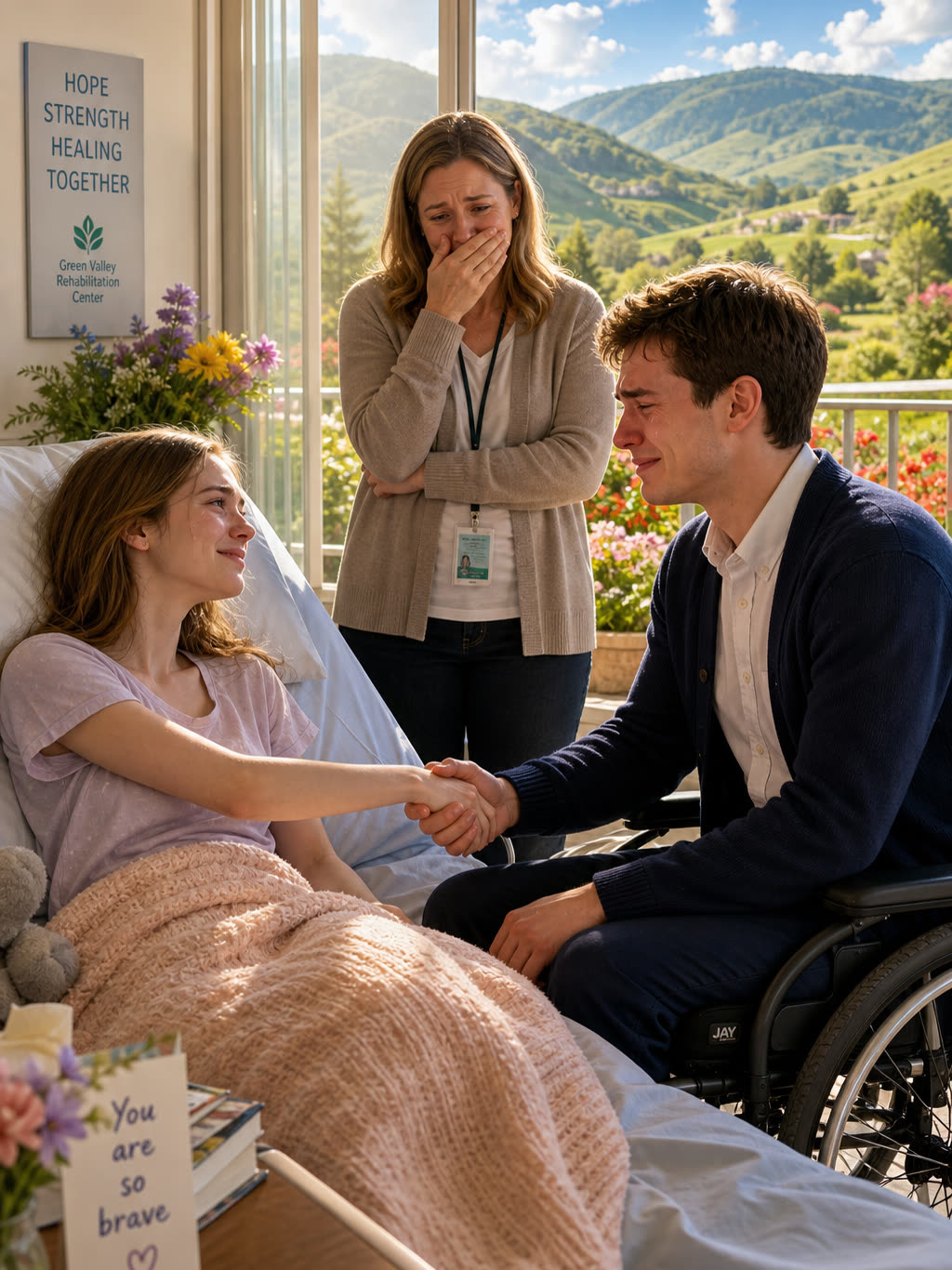
Almost 2 years after the accident, Iris had regained enough awareness to communicate in short sentences. She still struggled with fatigue, memory problems, and physical coordination, but she was making progress. Every word she spoke was a small miracle that I tucked away in my heart. One afternoon, Bennett visited her rehabilitation center. I sat nearby, my pulse unsteady, as he rolled his wheelchair toward her bed. Iris studied him for a moment. “You’re Bennett?” she asked softly. He nodded. “Yes.”
She looked at his wheelchair. “Mom told me about the accident.” He smiled sadly. “I’ve wanted to thank you for a very long time.” Iris was quiet. Then she whispered, “I remember smoke.” Bennett’s eyes filled with tears. “You helped get me out.” She looked at him. “You’re okay?” He nodded. “Because of you.” Iris reached for his hand. For several moments, neither spoke. Watching them together, I realized that although the accident had taken so much from all of us, it had also connected our lives in a way none of us could have imagined.
By then, Bennett and I had spent many months rebuilding our relationship. I had my own income, my own choices, and no financial reason to stay married. Nothing bound me to him except what I felt. And somewhere along the way, I had fallen in love with him. Not because he was wealthy. Not because he had helped Iris. But because he had taken responsibility for his mistakes and worked patiently to become someone I could trust. That was the thing that finally undid me.
On our second wedding anniversary, Bennett invited me to the mansion’s garden. Iris was visiting that afternoon, resting on the terrace after her therapy session. The light was golden, and the garden was alive with color. Bennett waited beneath the old oak tree. When I approached, he smiled and handed me a crimson envelope. I stopped. “Another one?” He laughed nervously. “I promise this one won’t turn your world upside down.” I took it with a smile I could not hide.
Inside was a photograph of the 3 of us smiling together. Behind it was a handwritten letter. Vivian, The first time I asked you to marry me, I was hiding the truth. I thought I could solve everything by controlling the people and circumstances around me. I was wrong. You taught me that love isn’t about saving someone or making their choices for them. It’s about honesty, respect, and being there even when you have nothing to gain.
Today, I’m not asking you to stay because your daughter needs treatment or because I need control of my inheritance. I’m asking because I love you. If you’re willing, I’d like us to start again, with no secrets and no promises we cannot keep. Will you choose this life with me? I looked up through my tears. “Are you proposing again?” He smiled. “Not exactly. We’re already married.” “Then what are you asking?” “For another chance to be the husband you deserve.”
I knelt beside his wheelchair and wrapped my arms around him. “You already have that chance,” I whispered. “Just don’t waste it.” He held me close, and I felt the same trembling in his hands I had felt on our wedding day, but now it was joy. Behind us, Iris called from the terrace. “Mom! Are you two crying again?” We both laughed. The sound rose into the branches of the oak tree and drifted out across the garden.
My daughter still had a long road ahead of her. Bennett would always face challenges from his injuries. And our marriage would never be an ordinary one. But for the first time in years, I wasn’t afraid of the future. I had married Bennett because I was desperate to save my daughter. He had married me because he needed control of his inheritance, wanted justice for his parents, and hoped to repay the girl who had saved his life. Neither of us had understood what our marriage would become.
But 2 years later, standing beneath that oak tree, I finally realized something. The first time, we married because we believed we had no other choice. The second time, we chose each other because we finally did.
Disclaimer: This story is a work of fiction inspired by real-life themes. Names, characters, places and events are fictionalized, and any resemblance to real persons is purely coincidental. Images are for illustration purposes only.
