

PART 1 — THE CELEBRATION HE THOUGHT HE COULD KEEP
On the evening before our wedding, my fiancé left me for his pregnant mistress and expected me to surrender the luxury reception I had spent nearly $30,000 arranging. I didn’t shout or cause a scene. Instead, I had all thirty banquet tables moved during the night. By the time his replacement bride arrived, the reception he had promised her was gone—and his family’s version of events was about to unravel. It began at 9:14 p.m., fewer than nineteen hours before I was meant to walk down the aisle. “The wedding is off, Tessa. I’m marrying Brielle tomorrow. But don’t touch the thirty banquet tables. We still need the reception.” For a moment, those words were almost impossible to understand. “Excuse me?”
“Brielle’s pregnant. It’s my baby. Her family wants us married immediately, and honestly, I think it’s the right thing to do.” What Graham said next showed me that the man I had loved for four years was more than unfaithful. “Listen, you’ve already paid for everything. The tent, the flowers, the catering, the chandeliers. My parents invited over two hundred people, and we can’t disappoint them. Just leave everything where it is. Brielle can take your place tomorrow.” I tried to comprehend the entitlement behind his request. “You want your mistress to walk into my wedding reception?” “Don’t call her that.” “What would you prefer? My replacement?” “You’re making this unnecessarily ugly.” Then came another concern, apparently more urgent than what he had just done to me. “Ask her about the lobster. Make sure she doesn’t cancel the lobster.”
“Is your mother there?” I asked. “Graham?” “She’s helping Brielle get ready.” Only the previous afternoon, Diane Calder had wrapped her arms around me and said I was the daughter she had always wished for. Now she was preparing another woman to step into the wedding I had arranged. And she was worried about the lobster. “How long have you known?” I asked. “Known what?” “That you were replacing me.” “Tessa, please.” “How long?” “Brielle told me about the pregnancy two days ago.” “And your parents?” They had stood by while I spent almost $30,000 turning the vacant lot beside their home into a reception venue. They had seen the expensive seafood arrive and watched florists place hundreds of ivory roses. All the while, they had let me think I was preparing for the happiest day of my life.
“You’re a successful businesswoman,” Graham continued. “You can absorb this financially. Brielle doesn’t have your independence. She needs me.” His reasoning seemed to make my ability to support myself an obligation to support their wedding. “So I should pay for your wedding because I’m financially stable?” “That’s not what I’m saying.” “Then explain.” “We can settle the money later. I’ll sign something if you want. But you can’t punish my entire family because our relationship didn’t work out.” He made it sound like an ordinary breakup, as though he had not kissed me goodbye that very afternoon before leaving to see the woman he intended to marry in my place. I looked at the framed photograph on my desk. In it, my grandmother, Edith Merritt, stood beside me at my college graduation, her hands resting proudly on my shoulders.
Grandma had brought me up after my parents died in a winter highway crash when I was eleven. She had worked double shifts in a school cafeteria so I could attend college. Tomorrow, she was supposed to watch me marry Graham. It was also her eightieth birthday, and we had intended to mark it with a smaller family gathering after the wedding weekend. Before I could think about any of that, I needed him to confirm precisely what he expected. “Graham, just so we’re clear, you intend to marry Brielle using the reception I paid for?” “Yes. I mean, if you’re reasonable about it.” “And you’ll tell your guests that Brielle was always supposed to be the bride?” “That would probably be easiest.” “Easiest for whom?” “Tessa, don’t start.” At last, the whole arrangement became clear. “All right,” I said. “Seriously?” “You’ve made your decision.” “Thank God. I knew you’d understand.” “I understand perfectly.” “You’re an incredible woman, Tess.” “Goodbye, Graham.”
I slipped off my engagement ring and set it next to my laptop. Four years of holidays, promises, quiet plans, and mornings when I had believed waking beside him would be enough had brought me here. Then came a message thanking me for being mature, asking me not to make trouble for Graham and Brielle, and insisting that I respect the family during their important occasion. It ended by asking me to confirm the caterers would still arrive. I opened the folder holding my wedding paperwork. My signature appeared on every vendor agreement. Every payment had been drawn from my personal or business accounts. The Calders owned the land, but the rented equipment belonged to companies I had contracted. I was their client, and the signed site agreement permitted the vendors to enter the property through the following afternoon. The catering contract covered my event—not Graham’s, and certainly not Brielle’s.
When I reached Felix, his greeting was cheerful. “Tessa? Everything okay? Big day tomorrow.” “The wedding’s canceled.” “What?” “The groom is marrying his pregnant mistress instead.” “You’re kidding.” “I wish I were.” My next instruction left him silent for a moment. “I need every available crew member, every truck, and every equipment case. We’re relocating the entire reception tonight.” “Tessa, that’s a massive job.” “I know.” “Where are we taking it?” “Somewhere it will actually mean something.” He paused before asking, “Does Graham know you’re moving it?” “No.” “Is he going to be a problem?” “By morning,” I replied, “he’ll have a much bigger problem.” Then a photograph arrived from one of my florists. Beneath my seating chart, she had discovered a second one. Two different names appeared across its top in elegant gold lettering. It had been printed six days earlier. They had been arranging to take my wedding for almost a week.
By 10:03 p.m., I was in my living room wearing sneakers, black jeans, and the expression I usually wore when a major event was falling apart. I was an event producer dealing with an emergency relocation. For six years, my company, Bellamy Event Collective, had organized weddings, charitable galas, conferences, and private parties throughout central Ohio. I had worked through thunderstorms, transportation strikes, electricity failures, and even a reception whose venue kitchen caught fire forty minutes before dinner. None of that had prepared me for a fiancé trying to hand my wedding to his mistress. I called our catering director, Mateo Salazar. “How much food can we move safely overnight?” “All of it, if we keep the refrigerated trucks running. Why?” “Because the wedding’s canceled, and the groom wants to use my catering for another bride.” His answer was immediate. “Absolutely not.”
The menu featured Maine lobster, herb-roasted chicken, grilled halibut, wild mushroom risotto, seasonal vegetables, and specially made desserts. We had thirty tables, capacity for two hundred forty guests, a $15,000 food-service contract, and a mobile kitchen already stationed beside the Calder property. “We can move the sealed ingredients and refrigerated equipment. We’ll have to prepare most of the hot food tomorrow. But I’ll need another truck, extra staff, and written approval for the new location.” “You’ll have it.” “Where are we going?” “Granville.” “Why Granville?” “Because my grandmother turns eighty tomorrow.” “Tessa, are you telling me you’re turning your canceled wedding into her birthday party?” “I’m telling you my grandmother deserves the best meal I’ve ever paid for.” “Then let’s make her eighty look like a million bucks.” By 11:20, I had contacted the tent company, florists, lighting crew, insurance coordinator, and original venue manager. With vendor consent and the required safety and site arrangements, our contracts permitted relocation. The Granville Community Pavilion already had the infrastructure and permits for large outdoor gatherings.
My uncle Warren answered with concern. “Tessa? Honey, what’s wrong?” “Graham canceled the wedding.” “Tell me you’re joking.” “He’s marrying another woman tomorrow.” “What?” “And he expects to keep the reception.” “Where are you?” “Home. I’m safe.” “Good. Because I’m about to drive over there and have a conversation with that boy.” “Uncle Warren, I need something more important.” I explained what I wanted to do for Grandma. “Your grandma spent forty years feeding everybody else. You want to give her a party like that?” “Yes.” “Then you bring those trucks here.” “Can you secure the pavilion?” “I’ll call the manager. We have approval for the community fundraiser this weekend, and the grounds are already cleared. We’ll confirm the change with the vendors and make sure everything is properly authorized.” “There’s one more thing.” “What?” “We need guests. Lots of them.” “Sweetheart, your grandmother taught half this town how to cook and helped raise the other half. You worry about the food. I’ll worry about finding people to eat it.” At 12:18 a.m., I arrived at the Calder property. Under the stars stood the beautiful white tent, its crystal chandeliers shining above ivory drapes and tables covered with roses. Felix arrived with three trucks and an experienced crew. Before unloading a single case, we checked the access permissions, site agreement, and work plan. Then the chandeliers began coming down.
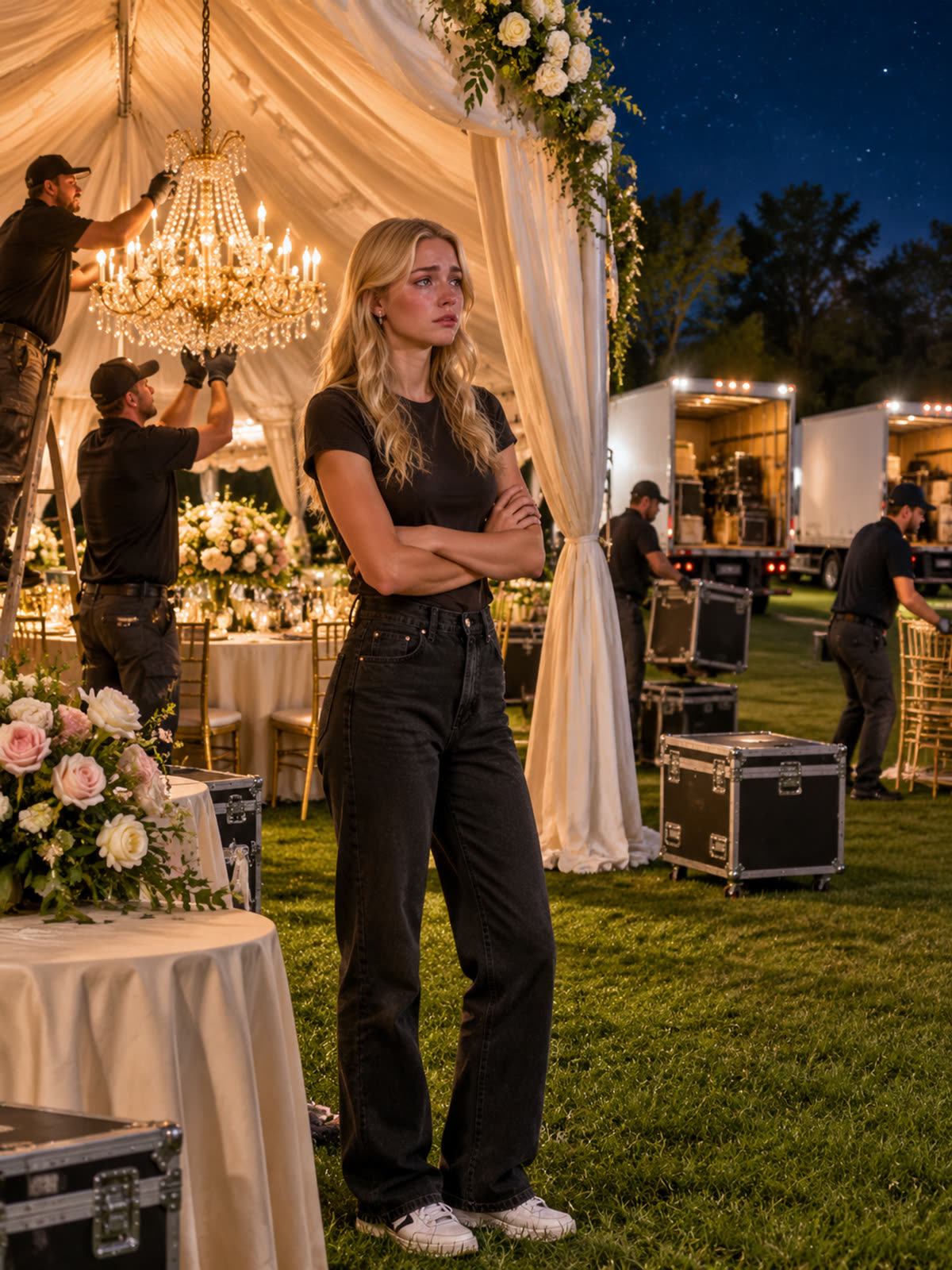
I had pictured entering that tent in a wedding dress. Instead, I stood beneath it while technicians carefully lowered the lighting, folded chairs, packed tableware, and lifted away arrangements. My lawyer had told me to save every communication and avoid an argument with Graham’s family. The vendors recorded their inventory and removed only what fell under my contracts. “Safety first,” Felix reminded everyone. “We’re not dropping a steel frame just to make a deadline.” “Agreed.” We were not taking shortcuts, and we were not taking anything that belonged to the Calders. What I had paid to rent would be used for the celebration I authorized. The rest could stay exactly where it was.
A crew member approached me. “Miss Bellamy?” “Yes?” “We found this backstage.” In the bag was a white satin sash embroidered with Brielle’s initials. Diane had done more than quietly accept the replacement wedding. While I paid for decorations, she had helped prepare accessories for the woman taking my place. I photographed the sash and returned it to its bag. Whatever Graham and his family had done, I had no intention of carrying off their belongings. “Leave it on their porch,” I instructed. The sash stayed behind, a small, unmistakable reminder that their preparations had extended far beyond the conversation Graham claimed had changed everything.
At 2:40 a.m., a porch light came on. “What the hell is going on?” I went toward the property line. “The wedding has been canceled, Mr. Calder. My vendors are retrieving their rented equipment and relocating my catering order.” Graham’s father was plainly unprepared for that answer. “But Graham said you were leaving everything!” “He was mistaken.” “You can’t do this!” I had no reason to raise my voice. The arrangements were documented, the equipment was being handled by its owners, and the access agreement remained in effect. His son’s assumptions did not alter any of those facts.
“You’re welcome to review the contracts. Your signed agreement provides vendor access during our scheduled rental period.” He looked toward the disappearing reception. “My wife is going to lose her mind.” “Then I’d suggest waiting until morning to tell her.” There was nothing else I needed to argue about. The technicians continued their work, methodically packing the celebration Graham had expected me to leave behind. I followed my lawyer’s advice and kept the exchange from becoming a confrontation. The only things we were removing were the rental companies’ equipment, my contracted decorations, and the food I had purchased.
The final truck was loaded at 4:35 a.m. Flattened grass marked where the reception had stood, and a few temporary ground mats remained to protect the surface. Everything expensive was gone: the flowers, the tables, the lighting, and the carefully refrigerated lobster Diane had been so anxious to keep. The empty space no longer resembled the wedding I had spent so long imagining. What had mattered to Graham was having everything waiting when his guests arrived. What mattered to me now was getting it safely to the people who deserved it.
At 5:10, our trucks headed east toward Granville. Uncle Warren was waiting at the community pavilion with the site manager, volunteers, fresh coffee, and a handwritten list containing almost two hundred names. All those people wanted to celebrate Grandma Edith. He hugged me so tightly that my clipboard nearly slipped from my hands. “Your grandma doesn’t know?” “Not a thing.” “Then she’s about to have the birthday of her life.” After a night spent dismantling one celebration, we were ready to build another.
By late morning, the pavilion looked entirely different. Fresh flowers framed the entrance, and ivory linens covered the long banquet tables. In the kitchen, the team began preparing the seafood while volunteers arranged a birthday cake big enough for the crowd. Above the stage, flowers surrounded the number eighty. There were no wedding names anywhere. Nothing announced the marriage that would not happen. The whole space was devoted to a woman who had spent her life giving to other people, a woman whose generosity had touched nearly everyone now coming through the entrance.
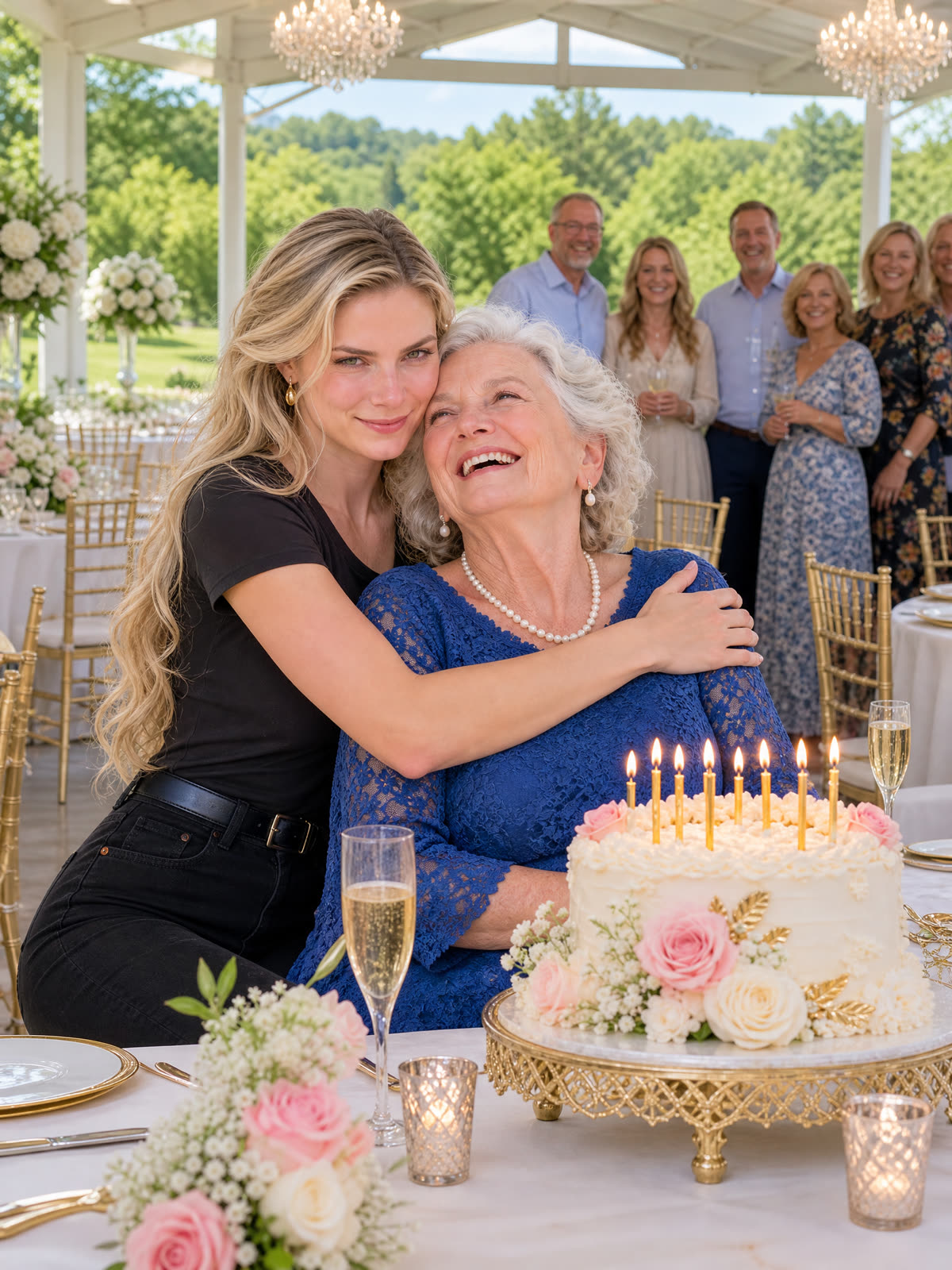
Grandma arrived in my uncle’s sedan at 11:45 a.m. She stepped out in her favorite blue dress and stopped when she saw the pavilion. Her hand rose to her mouth. “Tessa?” “Happy birthday, Grandma.” Her gaze traveled over the flowers, chandeliers, tables, and people gathering to surprise her. She knew these were not the modest birthday plans we had discussed. She also knew what the day had originally been meant to hold.
“Baby, isn’t this supposed to be your wedding?” “No, Grandma.” I looked at the celebration around us and at the woman who had raised me. “This was always supposed to be a celebration of love. I just finally figured out who deserved it.” Then I put my arms around her. Everything that had been assembled for the wrong future was now honoring someone whose love had never depended on what she could take from me.
While I held her, my phone vibrated. A mutual friend had sent a video. On the screen, Graham stood in his parents’ bare backyard in his expensive tuxedo, staring at the place where he expected a luxury reception to be waiting. The tables were gone. The tent was gone. And the woman wearing the wedding dress had just arrived.
PART 2 — THE LIES THEY BROUGHT TO MY DOOR
I didn’t want to play the video. Grandma stood beside me with tears in her eyes, surrounded by people who had come because they loved her. I put my phone into my purse and led her toward the head table. For the moment, that was where I wanted my attention to remain. Twenty minutes later, however, my cousin Natalie found me by the kitchen. “Tessa, you’ve got to see what’s happening at the Calders’.” “Whatever they’re doing, it’s not my problem.” “Normally I’d agree. But they’ve started telling people you stole everything.” She held out her phone, and this time I watched.
A neighbor had recorded the scene outside as Graham’s guests arrived. He stood on the empty grass in a navy tuxedo, wearing an expression I had never seen on him. “Where are the tables? Where are the flowers? Where is the food?” Behind him, Wesley paced along the driveway, yelling about contracts and insisting someone locate the catering company. When a neighbor asked whether the ceremony had been relocated, Diane announced that the event company had made a dreadful mistake. “That’s funny. I watched them load everything into trucks at four this morning.” The speaker was the Calders’ next-door neighbor, Mrs. Elaine Porter. “The bride paid for all that, didn’t she?” Diane had an explanation ready. “That girl is vindictive. She took everything because Graham decided to do the honorable thing.” “What honorable thing?” Mrs. Porter asked.
Brielle appeared in an enormous white wedding gown, holding a bouquet of pale roses. Behind her came her mother, Lorraine Ashford, dressed in silver. There was no wedding arch and no reception. “Graham? Where’s my wedding?” “Babe, there’s been a complication.” “A complication? You promised my daughter a beautiful ceremony!” “We had a tent,” Diane protested. “A magnificent one.” “Then where is it?” “Tessa took it.” Lorraine blinked. “Who’s Tessa?” “His fiancée. The woman he was supposed to marry today.” The answer changed the entire conversation. “You were engaged to another woman?” “Mom, I explained that.” “No, sweetheart. You said their relationship had ended months ago.” Mrs. Porter supplied the detail no one could explain away. “Months? Tessa was here yesterday arranging the wedding flowers.”
Whispers spread among the guests. “Everybody calm down. Tessa agreed to leave the setup. Then she went behind our backs.” One of Graham’s uncles asked the obvious question. “Did she pay for it?” Graham paused. “That’s complicated.” “What’s complicated about who paid?” Diane stepped in again. “She spent the money because she wanted to marry my son. She doesn’t get to punish us because things changed.” The response was blunt. “So you cheated on your fiancée, dumped her the night before the wedding, and expected her to pay for your new bride?” “That’s not fair.” “Neither is what you did to her.” Lorraine had another question. “Tell me something. When you invited my family here, were you planning to pretend your son paid for all this?”
After that, everyone seemed to be demanding answers. Someone wanted the charter bus called back. Brielle began to cry. Lorraine accused the Calders of lying about their finances, and Wesley retreated into the house. I stopped the recording. Natalie studied my face. “Well?” “I hope everyone gets home safely.” “That’s all?” “What else is there to say?” “You’re not even a little happy?” I answered honestly. “I’d be lying if I said I wasn’t relieved they didn’t get my reception. But I’m happier about what’s happening here.” I pointed toward the pavilion. Grandma was laughing with three women she had worked with decades before. The children of former students had come to wish her a happy birthday. Retired teachers, neighbors, firefighters, and families she had helped through hard times sat around the tables. They hadn’t come because someone had promised lobster. They had come for Edith Merritt.
Later, Uncle Warren lifted his glass. “To my mother,” he said, “who taught us that generosity doesn’t mean letting people take advantage of you.” Applause and laughter filled the pavilion, and Grandma squeezed my hand. Then she leaned toward me. “Come outside with me, sweetheart.” Once we were away from the crowd, she said, “You haven’t cried yet.” “I’m fine.” “No, you’re handling things. That’s different.” She held me just as she had after my parents died. “I loved him,” I whispered. “I know.” “I was going to spend my life with him.” “I know, baby.” “How could I be so stupid?” Grandma drew back and looked into my eyes. “Trusting somebody doesn’t make you stupid. Betraying somebody makes them dishonest.” She wiped my face with her handkerchief. “Now come back inside. Your cake is getting cold.” “It’s your cake, Grandma.” “Well, then I definitely shouldn’t miss it.”
That evening, after the guests had gone and the catering staff had arranged for safely packaged extra meals to be distributed through a local community organization, I finally checked my phone. Among the messages was an email from Diane Calder with a formal demand for the return of family property. She said I owed the Calders $3,000 in engagement gifts. She also wanted compensation for the humiliation she claimed I had caused. If I refused, she threatened, they would come to my office and tell my clients exactly what sort of woman I was. Losing access to my reception had not ended their demands. Now they were prepared to threaten the business I had built.
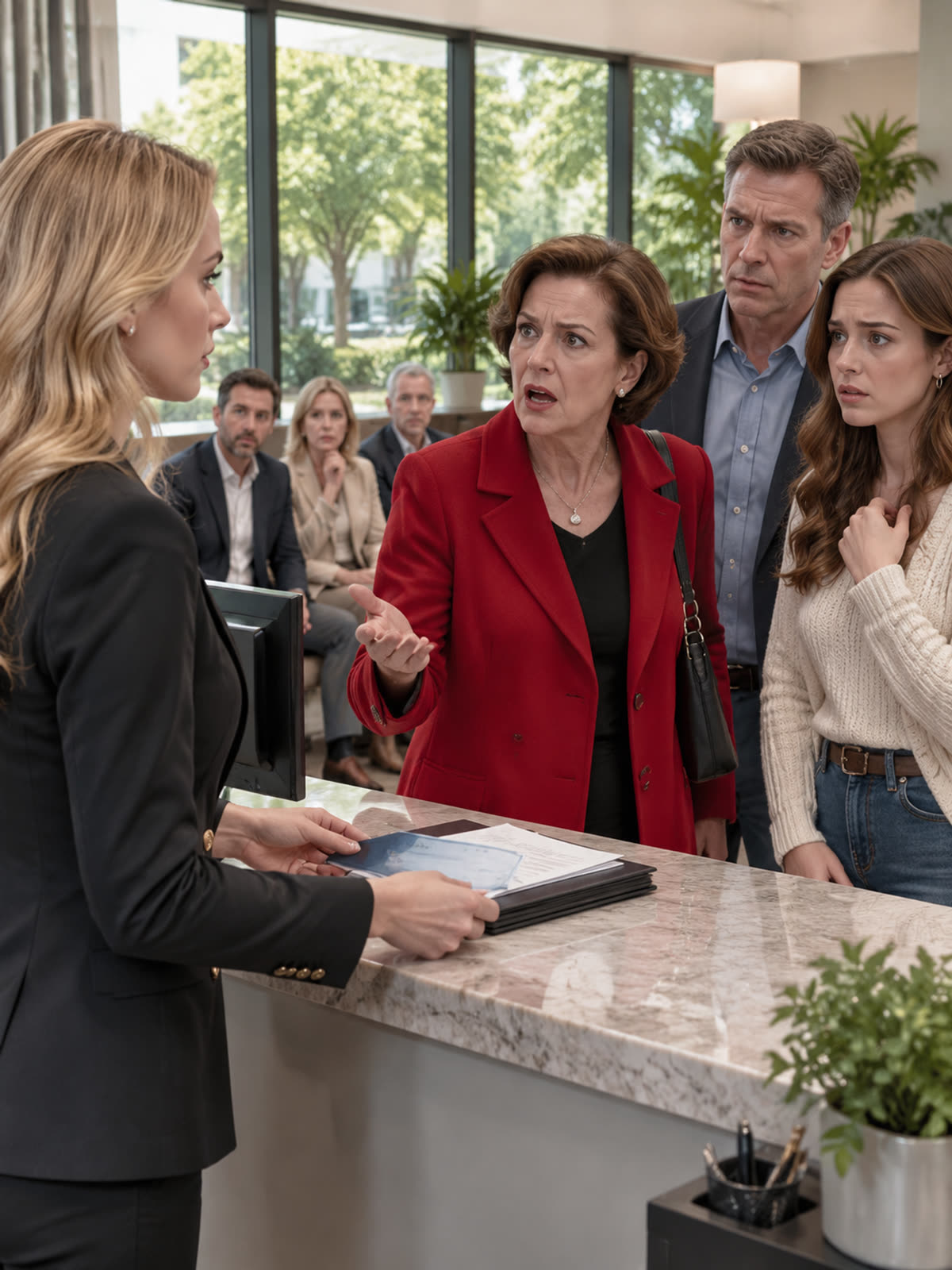
Three mornings later, I was reviewing a proposal for a corporate holiday gala when the receptionist called. “Tessa, there are three people here demanding to see you.” “Graham?” “And two women. One keeps saying she’s your former mother-in-law.” “She never became my mother-in-law.” “They’re making a scene.” I left my office. Diane stood in the middle of reception in a red coat, looking ready to destroy something. Four prospective clients sat by the windows, and several employees were watching from their desks. As soon as she saw me, she raised her voice. “There she is! The woman who stole our family money!” I stopped beside the reception counter. “Good morning, Diane.” “Don’t you good-morning me!”
“Everybody should know what kind of businesswoman they’re dealing with. She accepted $3,000 in engagement gifts from my family, then canceled the wedding and refused to return anything!” Brielle joined in. “Tessa, please. I’m pregnant. We’re trying to prepare for the baby. You have so much money. Why are you doing this to us?” For the first time, I noticed how deliberately she glanced around after each emotional appeal. “Graham canceled our wedding,” I said quietly. Diane smacked the reception desk. “Because you couldn’t give him what Brielle can!” “Are you finished?” “Excuse me?” “Are you finished shouting at my employees?” “You owe us money!” “If you believe there’s a legitimate claim, you can contact my attorney. But you don’t get to disrupt my business.” “See? She’s threatening us with lawyers because she thinks she’s better than everyone!” I turned to my office manager. “Please ask building security to come upstairs.”
Graham tried a different approach. “Tessa, this doesn’t have to get ugly. Just give Mom the three thousand, and we’ll leave.” “You’re asking me to hand over $3,000 because you decided to marry someone else?” “It’s about principle.” “Principle?” “You know what I mean.” I took a folder from beneath the reception counter. The morning after Grandma’s party, I had spoken to my attorney, Iris Benton, who had helped me put the financial records in order. I laid a photocopy of a check on the desk. “Your mother gave me a $2,000 check marked ‘wedding gift.’ I never deposited it.” I let the document speak before continuing. “The original is still in the envelope. Your family also gave me a vintage silver bracelet valued at approximately $1,000.” “Exactly!” Diane cried. “Our property!” “Iris has already offered to arrange a documented return of both items because I want no remaining personal ties to your family.”
For a moment, that stopped them. “You were going to give them back?” “Yes.” “Then why didn’t you?” “Because you ignored my attorney’s email and chose to come here instead.” I had not refused to return the items. They had refused the orderly method already offered and arrived at my workplace to make accusations in front of clients. “Now, since you’re accusing me of canceling the wedding, I also brought the messages.” The records showed Graham telling me that Brielle was carrying his child, that he needed to marry her, and that I should leave the tent and catering for them the next day. The demands were his own, preserved alongside the contracts.
“Is that real?” “Yes,” I replied. “I have the original messages and the contracts.” Graham protested. “Those are private!” “They certainly should have remained private. Unfortunately, you decided to make false accusations in my lobby.” Two building security officers arrived and explained that the three visitors had to leave. Diane refused. She shouted about fraud, police, and lawsuits. Since she would not leave a private office when asked, I called the non-emergency police number and reported the disturbance. What should have been a simple, documented return of two gifts had become exactly the public scene they had threatened to create.
I provided the vendor contracts, proof of payment, and messages showing that Graham had called off the wedding. One officer addressed Diane. “Ma’am, disagreements over gifts or money need to be resolved through the proper civil process. You cannot stay here disrupting a business after being instructed to leave.” She tried again. “We’re just trying to recover our savings.” “Then contact an attorney.” At last, Graham said, “Let’s go.” Before they could leave, I stopped him. “Graham, before you leave, there’s something else.” If his family wanted to discuss money in front of an audience, there was one outstanding matter he had not mentioned.
“Do you remember the $5,000 you borrowed for your construction inventory?” His expression changed. “Tessa, not here.” “And the $8,000 you needed when your business partner supposedly disappeared?” “Stop.” “And the smaller personal loans for your car, overdue credit cards, and emergency expenses?” Brielle looked at him. “What is she talking about?” I handed Graham a sealed envelope bearing his name. “The total is $21,500.” The envelope contained the records he had hoped to postpone discussing. Every sum had left my account for his benefit, and every loan had been documented.
“Every transfer was documented,” I continued. “And I have your messages acknowledging they were loans.” Graham fell back on an old understanding. “You said we’d handle that after the wedding.” “Yes. The wedding you canceled.” Brielle stared at him. “Twenty-one thousand dollars? Graham, what did you do?” He looked at me again. “Tessa, please. Not in front of everyone.” “Then you shouldn’t have brought everyone.” I had not invited this confrontation, and I had not chosen its audience. But I would not allow a demand for gifts I had already offered to return to obscure money he had actually borrowed.
Security escorted the three of them to the elevators. I went back to my office and called Iris. “They came,” I said. “I heard. Your office manager contacted me.” “I gave Graham the loan records.” “Good. We’ll handle everything formally from here.” After the accusations in reception, the prospect of keeping all future communication in legal channels was a relief. I had contracts for the event, records for the gifts, and written acknowledgments for the loans. Their insistence that I was responsible for what had happened did not change the paper trail.
Then Iris told me there was something else. “Tessa, there’s another issue. Your florist forwarded us the original seating-chart invoice.” “I saw the second chart.” The photograph had already shown that their replacement plans existed well before Graham called me. I knew the chart had been printed six days before the wedding. I had thought that was the full extent of what the florist had uncovered. Iris’s next words changed the timeline again.
“That’s not all. The order was placed using a Calder family business account nine days before your wedding.” Nine days. They had started preparing Brielle’s replacement wedding long before Graham said he learned she was pregnant. They had let my spending continue while a different bride’s name was already being worked into the plans. And if the explanation that had supposedly changed everything was a lie, what else had they been hiding?
PART 3 — THE BABY THAT NEVER EXISTED
A week after Graham and his family arrived at my office, the confrontation took on a life I had not expected. One of my clients had filmed part of the argument from the consultation area, and the video began circulating online. It showed Diane accusing me of keeping engagement gifts, Brielle pleading for money, and Graham falling silent while I produced the financial records. Someone shared it with a caption describing a groom who had expected his former fiancée to finance his mistress’s wedding. In forty-eight hours, hundreds of thousands of people had watched it. My marketing director, Paige Sutton, came into my office carrying her tablet. “Tessa, have you seen our inquiries?” “Not yet.” “We’ve received more than four hundred messages since yesterday.” “Complaints?” “Booking requests.”
People wanted to hire the woman who had moved an enormous wedding reception in a single night. The requests were for corporate functions, anniversaries, charity galas, and emergency event-management work. One message said that anyone capable of relocating a wedding while dealing with such a personal crisis was the person they wanted running their company conference. I knew viral attention could damage a reputation as quickly as it could build one. I told Paige not to publish anything making fun of Graham, Brielle, or either family. My only public response was a brief statement confirming the cancellation, explaining that the vendors had acted within their agreements, and saying I regarded the personal matter as closed. The attention might have brought people to us, but the work still had to speak for itself.
Iris soon had an update about the loans. “He’s received the formal repayment demand.” “And?” “He wants to negotiate.” She had assembled documentation for the full $21,500: bank transfers, written acknowledgments, and messages in which Graham promised repayment. The demand gave him thirty days to pay or propose a reasonable written settlement. His offer was $150 a month. “That would take almost twelve years.” “I informed his attorney that the proposal wasn’t acceptable.” “Does he understand this is real?” “I think he’s beginning to.” The man who believed I could simply absorb almost $30,000 in wedding costs now wanted more than a decade to return money he had borrowed. “Tell him I’ll consider a realistic repayment agreement,” I said. “But I won’t erase the debt.” “Understood.”
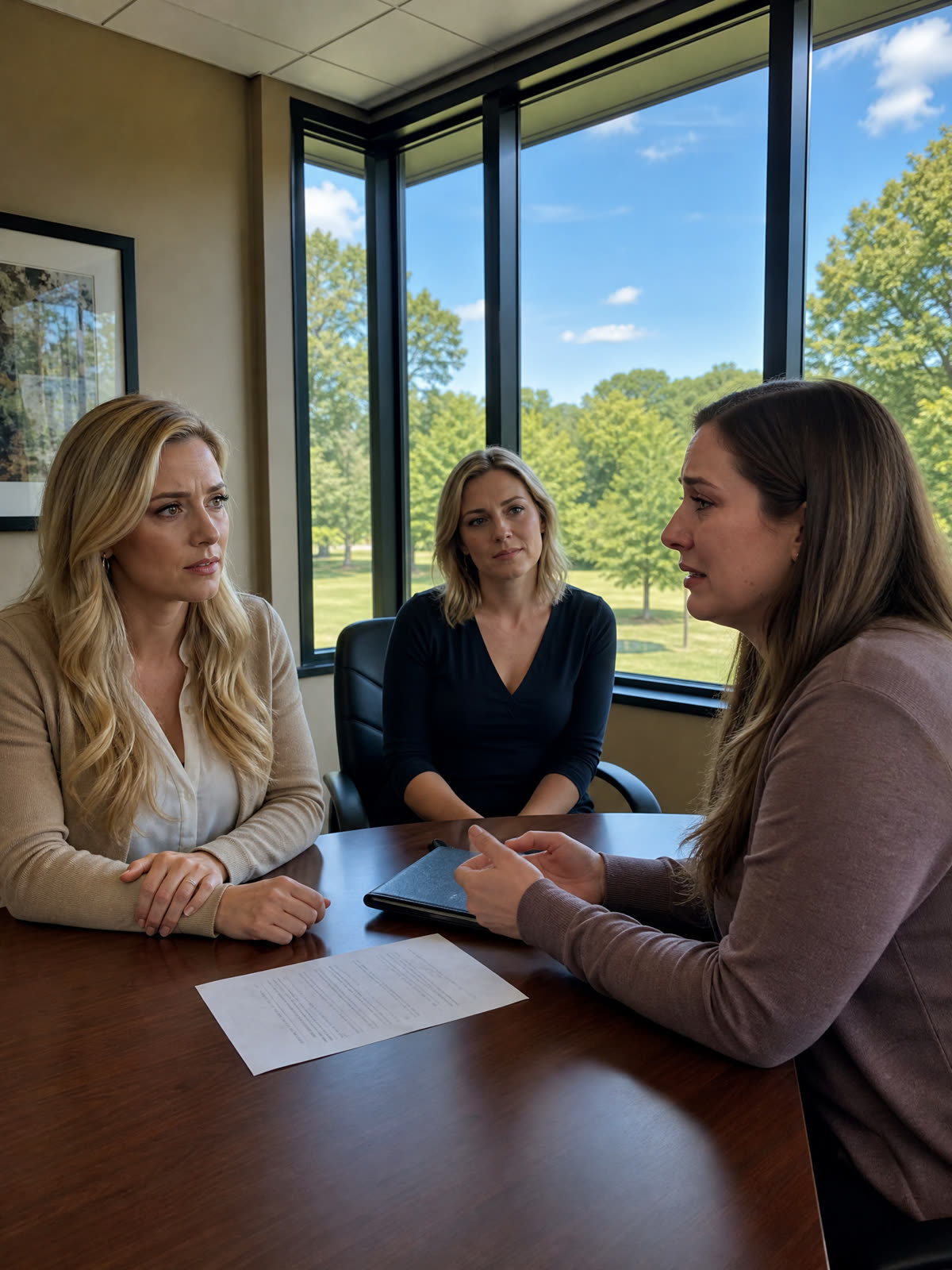
Then my receptionist announced another visitor. “Tessa, Brielle Ashford is here.” “Is she shouting?” “No.” “Is Graham with her?” “She’s alone. And she says she needs to confess something.” I did not meet with her alone. I asked Paige to sit in, notified Iris, and agreed to a short conversation in a private conference room. After the scene in the lobby, I wanted the boundaries clear. Brielle had come without Graham or Diane this time, and she was no longer appealing to an audience of employees and prospective clients. Whatever she intended to say, it would be heard in a quieter room.
She began with the words, “I owe you an apology.” Then she added, “Graham knows now.” I had no idea what she meant. “Knows what?” Brielle swallowed. “I’m not pregnant.” I stared at her. “What?” “There was never a baby.” The supposed pregnancy had been the reason Graham gave for replacing me, the justification Diane had used to describe his actions as honorable, and the basis of Brielle’s plea for money in my office. Now she was saying that the child around whom they had organized all those demands had never existed.
“Explain.” She did. “I found out he was marrying you. He kept saying he loved me, but he wouldn’t leave because the wedding was already paid for and his family expected it.” “So you told him you were pregnant?” “I bought a fake ultrasound image online. I told him I couldn’t raise the baby alone.” I asked the questions that followed. “Did Graham know it was fake?” “No. He believed me.” “Did his parents?” “They knew about our relationship, but they thought the pregnancy was real.” The affair had not been news to the Calders. The baby, according to Brielle, had been a deception even they believed.
She showed us a copy of the purchase confirmation for a customized novelty ultrasound image. Then she explained how the lie had fallen apart. “Last week, Graham insisted on coming with me to a prenatal appointment. I kept making excuses. Finally, I admitted everything.” “What happened?” “He told me to leave his parents’ house.” “Are you married?” “We signed the marriage papers at the courthouse two days after the canceled wedding. Now he’s talking about divorce.” They had gone through with the marriage after the empty-backyard disaster. The wedding reception he tried to take from me had not been the last decision made on the strength of the invented pregnancy.
“I know you hate me.” I did not give her the answer she expected. “I don’t know you well enough to hate you.” Then I added, “But I know exactly what you did.” “I wanted him to choose me.” “And you thought inventing a child would make that happen.” “Yes.” I needed her to understand that the pregnancy was not the only issue. “Do you understand something, Brielle? Even if you’d really been pregnant, he had no right to take my wedding reception. He could have ended our engagement honestly and paid for his own ceremony.” “I know.” Nothing about a real pregnancy would have entitled either of them to use my contracts, my money, or the celebration I had arranged.
“No, I don’t think you do. You didn’t just hurt me. You created a lie that involved two families, hundreds of guests, and thousands of dollars. And Graham chose to participate in the deception by hiding your relationship.” Her confession did not erase his decisions. Neither did it excuse his parents, who had known about the affair while watching me continue with the wedding preparations. Brielle had supplied one lie, but the others had made choices of their own. They had each taken part in keeping me uninformed until nearly everything was in place.
I asked her directly, “Why are you telling me this?” “Because everyone thinks you destroyed his life. His mother keeps saying it was your fault.” “And?” Brielle hesitated until Paige spoke gently. “Brielle?” Then she finally said it without trying to shift the blame. “Because you didn’t. I lied to get him. His family lied to keep the reception. Graham lied to you because he wanted both of us until the last possible moment.” There it was, spoken across the conference table: not one betrayal that had somehow forced all the others, but separate deceptions serving separate people.
The Calders had been making arrangements for Brielle to replace me for nine days. They had waited until the last minute to tell me about the supposed pregnancy because they wanted the tent erected and the food delivered before making their demand. The baby had never been real. Before leaving, Brielle gave Iris permission to contact her about her account of what had happened. I remained in the conference room for a long time afterward. The facts were clearer, but clarity did not make the four years before that phone call disappear. It simply showed me that the future I had lost was not what I had believed it was.
When Graham called, I knew why. “Tessa?” “You know about Brielle.” “Yes.” “She lied to me.” “I heard.” “I lost everything because of her.” “No, Graham.” “Tessa, you don’t understand.” I understood more than he wanted to acknowledge. “I understand perfectly. She lied about being pregnant. You lied about loving me. Those were two separate decisions.” He tried to make the nonexistent baby the deciding factor. “If I’d known there wasn’t a baby, I never would’ve married her.” That was not an answer to what he had done to me.
“Would you still have cheated on me?” He had no answer that changed anything. “Would you still have let me pay for a wedding you were planning to give to another woman?” The distinction mattered. “Then the fake pregnancy isn’t what destroyed our relationship.” “Tessa, please.” “Your choices did.” For once, I understood that I did not have to uncover every remaining lie or stand nearby for every consequence. It was enough to make certain those lies could not direct my future. What he had believed about Brielle did not turn his treatment of me into an accident.
Fourteen months after Graham canceled our wedding, the last repayment arrived. It closed the balance on the $21,500 he had borrowed. Through our attorneys, we had negotiated a formal schedule. He made the initial payment by selling his expensive pickup truck, then paid the rest in monthly installments while working a new sales job. There was no grand confrontation attached to the final transfer. It was simply a debt, finally paid. For months, his presence in my life had been reduced to figures, receipts, agreements, and correspondence between lawyers. According to mutual acquaintances, his marriage to Brielle had ended. She had moved away, and he had left his parents’ house for a small apartment.
I didn’t know whether any of them had learned from what happened. My own life had changed in ways I could not have predicted. Bellamy Event Collective had added twelve employees, opened another office in Cincinnati, and signed several major corporate clients. Annual revenue had risen substantially, partly because of the publicity and partly because we had converted that attention into dependable work. Yet the accomplishment that meant the most to me was not a financial one. It happened on a Saturday evening in early October, when my company organized a charity gala for a regional organization supporting senior citizens facing food insecurity. The proceeds would help community kitchens and meal-delivery programs.
The moment I learned about the organization’s mission, I thought of Grandma Edith. She had spent decades ensuring that children had enough to eat. Through the business I had built, I now had a chance to help older people receive that same kind of care. I asked her to attend as our guest of honor. “Oh, honey. I don’t belong at some fancy fundraiser.” “Grandma, you’re the reason I’m involved.” “I don’t even own an evening gown.” “We can find you one.” “At my age?” “Especially at your age.” She had one last observation. “You’re getting as stubborn as your grandfather.”
On the evening of the gala, I stood in a beautiful hotel ballroom wearing a tailored ivory pantsuit, with a large sparkling floral brooch at my shoulder. White-and-gold arrangements decorated the tables. For an instant, the room reminded me of the wedding I had planned. But this celebration had an entirely different purpose. No one was trying to claim credit for money someone else had spent. Everyone was there for something larger than themselves. Then Grandma entered in a deep emerald dress and pearl earrings, wearing the same delighted expression she had shown at her surprise eightieth birthday. “Look at you,” she said softly. “Look at you.” “This is beautiful.” “Wait until you see the dessert table.” “You know me too well.”
Later, the organizers asked me to speak. I had not intended to bring up my canceled wedding. Then I saw Grandma near the stage, smiling at me with pride, and changed my mind. “Last year,” I began, “I learned something important about the difference between spending money and giving something meaningful.” I looked across the room. “I had planned a large celebration that never happened the way I expected. At the time, I thought losing that day meant losing part of my future.” My gaze returned to Grandma. “But I discovered that sometimes the event you didn’t plan becomes the one that changes your life.” A few people nodded. “I was fortunate enough to turn a canceled celebration into an eightieth birthday party for the woman who raised me.” Grandma lifted her hand to her mouth.
“She taught me that love isn’t measured by the cost of a reception, the size of a diamond, or the number of people watching.” I continued with the lesson she had lived long before I understood it. “It’s measured by what people do when nobody is watching—and by whether they’re willing to show up when things are difficult.” That was why we had gathered. “That’s why tonight matters. There are older people in our communities who spent their lives caring for others and now need someone to show up for them.” I finished with the request that mattered most. “So I hope we give generously, not because we want recognition, but because somebody deserves to know they haven’t been forgotten.” Grandma was crying. This time, I did not mind crying along with her.
By the end of the night, we had surpassed the gala’s fundraising goal. Later, the conversation returned to the emergency that had redirected so much of my life. “Remember the night you called me about the lobster?” “How could I forget?” “Best emergency job I ever worked.” There was still something astonishing about what the team had accomplished. “Still can’t believe we moved that whole setup.” “Neither can I.” Then came an observation I could not dispute. “Funny thing. That night probably saved you a lot more than thirty grand.” I thought about the fake pregnancy, the money I had lent, and the future I had nearly given away. “Yeah,” I said. “It definitely did.”
After the gala, I drove Grandma home. The streets were quiet, and city lights shone across the windshield. She sat beside me holding a small gift bag from the event. After a while, she asked, “Are you happy, sweetheart?” A year before, I had confused happiness with knowing exactly how my future would unfold. I thought a husband, a wedding, and a beautiful home would finish the life I had worked to create. Now I understood that happiness was not something another person could guarantee. It was something I had to nurture and protect through my own decisions. “Yes, Grandma,” I said. “I really am.” “Good.” Then she added, “That’s all I ever wanted for you.”
A few weeks later, we celebrated Grandma’s eighty-first birthday. This time there was no luxury reception—just a backyard potluck under strings of warm lights, with folding chairs, homemade casseroles, pumpkin pie, and relatives all talking at once. Grandma insisted on baking her famous apple cake. Natalie brought an absurd birthday crown, and Grandma kept it on all evening. I laughed harder than I had in years. The celebration was simpler than the one we had assembled overnight, but it held the same thing that had made that unexpected party matter. Everyone was there for her. Nobody had to disguise the reason we had gathered.
Near sunset, Grandma found me standing by the garden. “What are you thinking about?” she asked. “Last year.” “The big party?” “The biggest.” She considered that. “That was quite a birthday gift.” “Honestly, Grandma, I think it was a gift to me.” “How’s that?” I looked toward the family around the picnic tables. “Because the night before my wedding, I thought someone had taken everything from me.” What I could see now had been there all along. “But I still had everything that mattered.” Grandma linked her arm through mine. “Sometimes it takes losing the wrong thing to recognize the right ones.”
When Graham called the year before, he had expected me to beg, break down, or surrender the wedding I had paid for. Instead, I gave the celebration to someone who truly loved me. I learned that the greatest revenge was not watching the man who betrayed me become embarrassed. It was creating a life in which his betrayal no longer mattered. I did not marry Graham Calder. I did not wear the wedding dress hanging in my closet or walk beneath the flowers I had selected. What I had instead was the chance to honor people who had never regarded my love as something they were entitled to take.
That night, Grandma blew out eighty-one candles with the people who loved her gathered around. At last, I understood: Graham had not ruined my wedding. The celebration I created in its place had become the beginning of everything good that followed—and it was only the beginning…
Disclaimer: This story is a work of fiction inspired by real-life themes. Names, characters, places and events are fictionalized, and any resemblance to real persons is purely coincidental. It does not represent any person or organization and does not encourage inappropriate behavior. Images are for illustration purposes only.
