

PART 1 — The Suitcase on the Shoulder
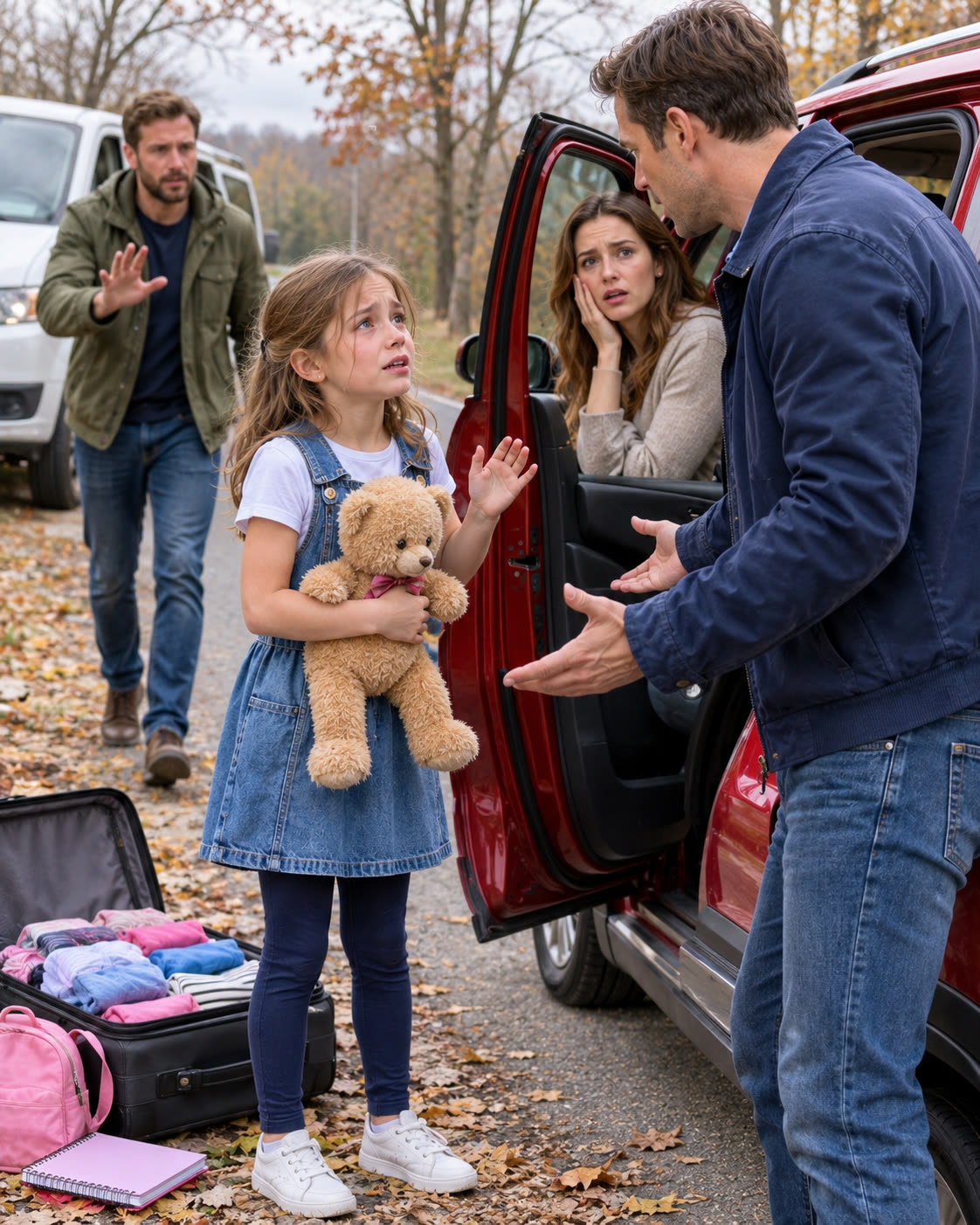
I was thirteen when my father hurled my suitcase onto the gravel beside a country road and set it on fire. We had been driving through an isolated stretch outside Columbus, Ohio, when he abruptly hit the brakes. There were no houses nearby, only fields, roadside weeds, and trees gathering shadows in the fading light. Dad climbed out of the sedan, went around to the trunk, and dragged out my battered luggage. Nothing about the sudden stop made sense to me until he came to my door.
“Get out of the car right now, Abigail,” he ordered in a cold voice that made me shiver. For a moment, I convinced myself that this had to be some particularly cruel joke. I stayed in the backseat with my seat belt fastened, staring at him and waiting for an explanation. Instead, he opened the suitcase, wrenched the zipper apart, and shook my clothing into the dry growth along the shoulder. Then he retrieved a red plastic gasoline can from the back of the car.
I watched him pour fuel over the scattered clothes, unable to understand what I was seeing. “Dad, what on earth are you doing to my things?” I cried out, scrambling from the car in my socks. He offered no answer. He simply struck a wooden match against its box and dropped it onto the soaked fabric. Orange fire sprang up almost immediately, climbing through everything I had packed while I stood helplessly beside him.
“You are no longer a part of this family, and you are never to come back to our house,” he declared, pointing an unsteady finger at my chest. My mother sat rigidly in the front passenger seat with her purse clutched on her lap. She would not turn toward me. Through the back window, my little brother, Lucas, watched without speaking, his face pressed close to the glass. Dad got behind the wheel, put the car into drive, and accelerated down the road.
I remained on the rough shoulder while the sedan disappeared, staring after the family that had just left me there. Dark smoke curled from what remained of my belongings and drifted into the evening sky. I had no phone, no money, and no idea how far we had traveled from our neighborhood in Worthington. The road gave me no answer about where to go. Everything familiar had vanished with their taillights, leaving me beside the burning scraps of my life.
“Please, somebody help me,” I whispered toward the empty trees. The air was getting colder, and the fields were disappearing into darkness. Eventually, a pickup truck approached and slowed near the smoking remains of my suitcase. Its driver pulled over as soon as he saw me. He checked on me and contacted the local sheriff, giving me the first reason to believe I might not have to face that deserted road alone.
When a deputy arrived, he asked where my parents lived. I gave him our address and all the details he requested without hesitation. Part of me still wanted to chase the car, as though catching up with my family could undo what had happened. But another part understood that returning would mean going back to the man who had struck the match. For the first time, I said aloud something I had never previously allowed myself to say.
“I do not want to return to that house, Officer, especially not after what my father just did to me,” I told him, rubbing soot from my cheeks. He looked at me quietly before settling his heavy wool coat around my trembling shoulders. “You do not have to be afraid anymore, kiddo, because you are completely safe here with us,” he assured me gently. Afterward, I spent several months with my aunt and uncle in Cincinnati before eventually entering the foster care system.
I made no attempt to contact my parents or Lucas after that. Closing the door on them seemed like the only way to keep moving, and over the years I built a stable, quiet life in Minneapolis. Then, just last week, a thick, cream-colored wedding invitation appeared in my apartment mailbox. Lucas was getting married at a historic chapel in Madison, Wisconsin. I nearly dropped the card into the recycling without bothering to unfold everything inside it.
Before I let it go, I noticed a smaller envelope tucked behind the reception information. It was slightly creased, and the handwriting across its front stopped me. I recognized my mother’s cursive immediately. Six words stood out against the paper: “Please read this before the wedding.” I slipped a finger beneath the flap and unfolded the lined stationery. Standing in my hallway, I read the first sentence, and my fingers seemed to lose all feeling. “Your father lied to you about everything that night, Abigail,” the letter began.

For twenty years, I had believed the memories of that road were buried as deeply as I could put them. Now a single page was threatening everything I thought I understood. I carried the letter to my kitchen table and read the opening three times under the fluorescent light. “Your father lied to you about everything that night, Abigail,” the ink said. Beneath it, Mom had written October 14, 2006—the precise date my father had left me beside the burning suitcase.
She explained that fear had kept her quiet for two decades. She had been terrified of what Dad would do if she told anyone the truth. Then she described the story he had spread among our Ohio relatives: that I had taken nine hundred dollars from his leather wallet, invented a ridiculous explanation, and become impossible to control. “Every single accusation he made against you was a lie,” Mom wrote. Reading that, I felt my stomach draw into a painful knot.
The money had actually come from a jar of savings she kept hidden in the pantry. After Dad stopped giving her money for household food, she had put the bills in my backpack so I could buy school lunches and groceries. He discovered her savings that afternoon and turned her attempt to feed us into evidence against me. “Why did you let him tell everyone I stole from him?” I murmured into my empty kitchen, feeling tears gather as I continued reading.
Even that lie, however, was not the real explanation for what he had done. Mom’s next paragraph made my hands shake so hard that I laid the letter on the table. “Your father had been secretly withdrawing thousands of dollars from Grandma Doris’s retirement account, and you accidentally discovered the bank statements,” she confessed. A memory I had scarcely thought about in years returned with startling clarity: Dad’s oak desk, its bottom drawer, and several heavy envelopes beneath his tax folders.
I had been looking for a spare stapler for a school assignment. The figures on those pages meant little to me, but I recognized Grandma Doris’s full name at the top. Later, at dinner, I innocently asked Dad why her savings were shrinking so quickly each week. He went pale. According to Mom, he was suddenly frightened that I would expose what he had been doing. He accused her of searching his office, making up damaging stories, and trying to tear the family apart.
That was when he decided I had to be removed before I could repeat what I had seen. Mom admitted that she had sat silently beside him while he drove me into the countryside and burned my belongings. “I was deeply frightened of his temper, Abigail, though I know now that my fear does not excuse my silence,” she wrote. Her admission explained the stillness I remembered in the passenger seat, but it could not change the fact that she had watched him leave me behind.
The letter then explained why Lucas’s wedding invitation had reached me after so many silent years. While clearing the attic of our childhood house in Worthington before the wedding, he had discovered Grandma Doris’s old metal lockbox. Inside were duplicate bank records, dated letters, and a sealed handwritten message with my name on it. Grandma had learned about Dad’s unauthorized withdrawals before her health deteriorated and had intended to confront him in front of the family.
A serious medical emergency had prevented that confrontation. Her instructions in the box said that the financial evidence should go directly to a licensed attorney if I ever came back looking for answers. Then I reached the sentence that frightened me more than everything before it: “Lucas knows your father has been dishonest for years, and your father just found out that Lucas discovered the metal box.” The wedding invitation beside my coffee mug no longer looked like a simple invitation.
A cold sense of dread settled over me. I grabbed my phone and dialed Lucas, listening through six unanswered rings before his voicemail picked up. “Lucas, it is Abigail, please call me back as soon as you get this message,” I said quickly. After hanging up, I remained at the table with Mom’s letter open in front of me. Less than a minute passed before a message from his number appeared on my screen.
“Do not come near the house in Worthington, because Dad knows Mom’s letter reached you.” Only then did I understand the urgency of the words on the smaller envelope. Two people still beneath my father’s roof had reached out through a wedding invitation, and what they had sent was a warning. Somewhere in Grandma Doris’s lockbox was another unopened envelope addressed to me. Dad knew Lucas had found it, and now he knew I was learning the truth.
PART 2 — What Grandma Kept Hidden
I stared at the message until its bright letters blurred. “Do not come near the house in Worthington, because Dad knows Mom’s letter reached you,” Lucas had warned. I took a breath, tried to steady myself, and called him again. This time, he answered after two rings. His voice was so quiet that I had to listen closely. “Abigail, I cannot talk for very long right now because he is standing out in the driveway,” he said.
“Lucas, what is going on over there, and how did Dad find out that Mom sent me that note?” I asked, walking back and forth across my kitchen. “Dad went into the attic yesterday afternoon and realized Grandma Doris’s old lockbox was missing from behind the cedar chest,” he explained. The fact that Dad had noticed its absence made the discovery feel even more dangerous. Those papers were not merely old family records he had forgotten existed.
“He has been tearing the house apart demanding that I hand over the papers, and he saw Mom’s handwriting on a scrap of stationery in the trash can,” Lucas added with a weary sigh. “Then why on earth did you send me an invitation to your wedding if you knew how dangerous he could be?” I demanded softly. I wanted to understand why he had opened this door now, with his wedding approaching and Dad already searching for the evidence.
“Because I cannot stand at an altar and begin my marriage knowing that our family ruined my big sister’s entire childhood while I just stood by and watched,” Lucas replied, his voice breaking. For twenty years, the brother in my mind had remained the little boy looking at me through the rear window. Hearing him now, I understood that he had carried pieces of that night too. He had been too young to grasp them, but not too young to be marked by them.
He told me there was more in the lockbox than financial paperwork. Grandma Doris had written separate personal letters for him, for Mom, and for me before she died. She had hidden the bundle in the attic because she feared Dad would destroy it, just as he had destroyed my suitcase. “I found the lockbox three weeks ago while looking for my baby photos for the reception slideshow,” Lucas explained. What began as a search for childhood pictures had uncovered the records of what happened to mine.
The documents showed that Dad had moved tens of thousands of dollars from Grandma’s savings into a checking account only he controlled. Once he realized I had noticed the statements in his desk, he used the invented nine-hundred-dollar theft to undermine anything I might tell the family. If everyone believed I was a thief who lied to escape punishment, he could make them dismiss the truth before I even spoke. The accusation had not been a misunderstanding. It had served a purpose.
Lucas also told me that Mom had pleaded with Dad in the hallway before that drive. She had cried and begged him not to abandon me. He told her that saving their marriage meant supporting him and never speaking my name again. Afraid of losing both her home and her younger child, she stayed quiet and allowed me to disappear into foster care. Her fear was real, but so was the choice she had made while I was left to live with its consequences.
“Meet me tomorrow morning at nine o’clock at the coffee shop across from Saint Mary’s Church in Madison, and I will bring everything with me,” Lucas whispered. Then the call ended abruptly. That evening, I booked a last-minute flight from Minneapolis and traveled to Wisconsin with my heart hammering. By the next morning, I was sitting in a quiet window booth at the café, watching the entrance and waiting to see the brother I had not spoken to in twenty years.
He came through the glass doors carrying a worn cardboard file box. A neat beard and exhausted shadows beneath his eyes had replaced the small face I remembered from the car window. He put the box between us and sat across from me, struggling to look up. “I am so sorry, Abigail,” he said. “What are you apologizing for, Lucas, when you were only eight years old back then?” I asked gently, touching the edge of the lid.
“I am sorry for taking twenty years to finally look inside that attic and bring you the truth,” he answered, meeting my eyes. I opened the box. Beneath bank statements, Grandma’s notes, and photographs of signed loan documents lay a yellowing white envelope bearing my full name. With trembling fingers, I unfolded her letter. “My dearest Abigail, if you are reading these words, then the truth has finally outlasted your father’s terrible lies,” it began. My throat tightened. Lucas rested his hand over my wrist. “Take all the time you need, sis, because nobody is rushing you today,” he said.
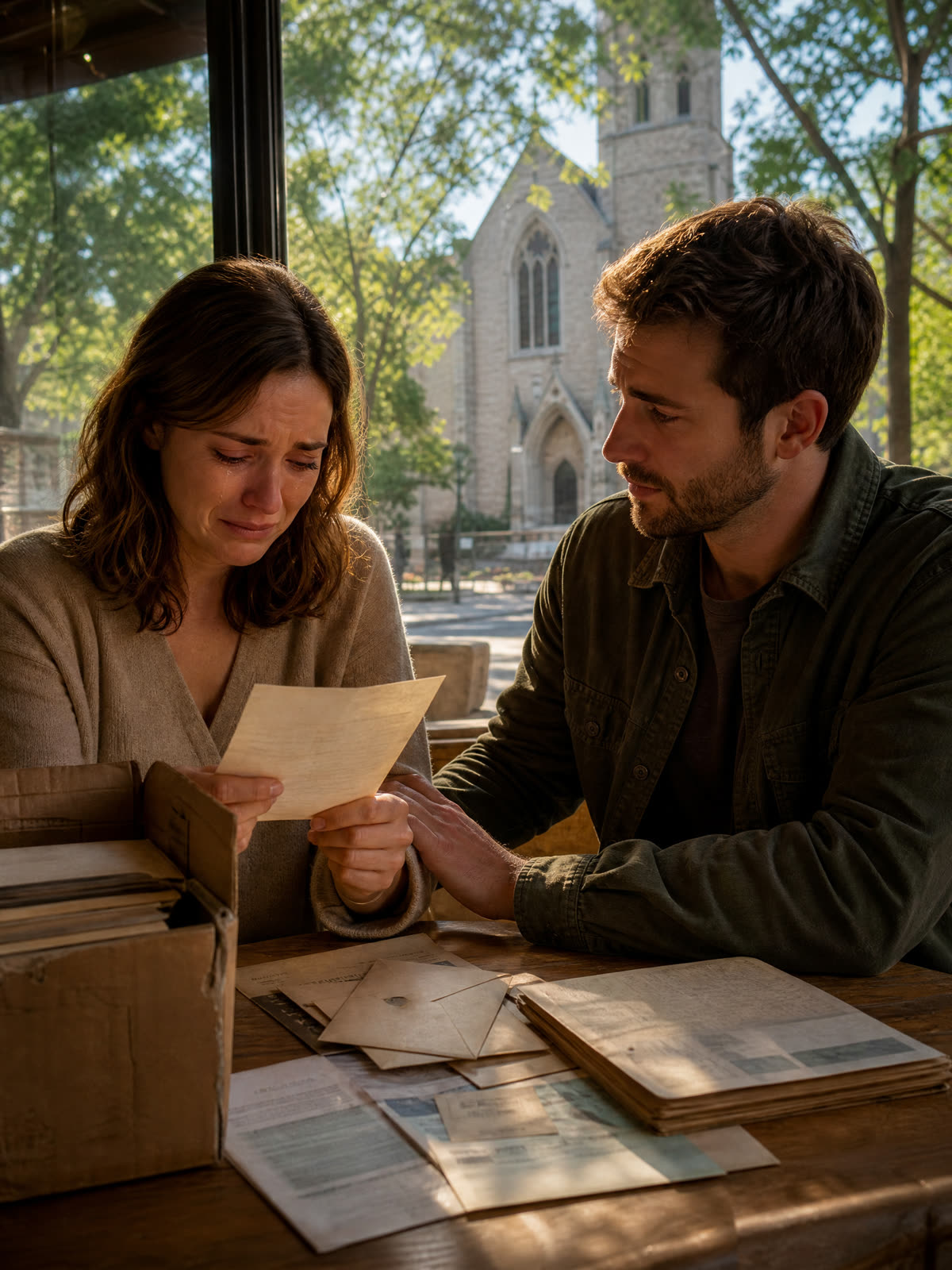
For several seconds, I could not make myself continue. I knew Grandma’s elegant, slanting handwriting, and seeing it felt different from hearing someone describe what she had left behind. When I could read again, I wiped away a tear and worked through the remaining pages. She said she had confronted Dad about the missing retirement money and planned to report him to the Columbus police. Then a debilitating stroke left her struggling to walk or drive, and she realized the evidence needed protection.
Rather than calling officers from her hospital bed, she recorded the transactions carefully and secured copies in the lockbox. She also described Mom coming to her bedside and asking her not to pursue criminal charges because she feared Dad’s reaction. “Mom begged me to keep the peace for Lucas’s sake, so I locked the truth away until you were old enough to claim it,” Grandma wrote. That sentence helped me understand the silence surrounding my teenage years without making the silence any less painful.
The adults had been frightened, and I could finally see what they had been frightened of. But their fear did not absolve them of leaving a child alone beside an empty highway. On the final page, Grandma had underlined one instruction twice in blue ink: “Never allow that man to persuade you that any of this tragedy was your fault.” Tears rose again as I read it. Those were words I had needed long before a letter in a café finally placed them in my hands.
Nothing on those pages could give back the years in foster homes or the holidays I had spent alone. Still, the past finally began to make sense. October 14, 2006 had not been a night of unusually harsh discipline, and it had not been an ordinary family argument that somehow went too far. Dad had abandoned me deliberately to conceal his crimes. The distinction mattered. I had survived what he did, but I had spent twenty years without the truth that explained it.
Later that afternoon, before the wedding rehearsal dinner, Lucas and I took the entire cardboard box to an estate attorney in downtown Madison. Mr. Harrison spent nearly two hours examining what we had brought. We sat opposite his desk while he worked through the statements, handwritten notes, property documents, and loan paperwork. Grandma’s careful records were no longer hidden in an attic or spread across a coffee shop table. They were finally being reviewed by someone who could act on them.
As he compared the paperwork with county property records on his computer, Mr. Harrison found something neither of us had expected. Dad had used Grandma Doris’s former lakefront cottage in Ohio as collateral for a substantial private business loan. He had done so without ever legally owning the deed. The bank withdrawals explained why he had wanted to silence me years earlier, but the cottage revealed that the consequences of his dishonesty had not ended with those old account statements.
“According to your grandmother’s recorded will, this cottage was supposed to be placed into an irrevocable trust for both you and your brother,” Mr. Harrison explained, pointing to a highlighted provision. Lucas and I looked at the documents with a new understanding. Grandma had intended that property for both of us. Dad had already borrowed against something that was not his to pledge, and the paperwork showed why control of the deed mattered to him now.
The wedding was set for two o’clock the next afternoon. Suddenly, the timing became horribly clear. Dad was not preparing to acknowledge what he had done or bring a fractured family back together. He intended to use the confusion of the reception to corner Mom and pressure her into signing fraudulent probate documents. Those papers would put the cottage deed entirely in his name. Even Lucas’s wedding was being treated as an opportunity to secure what Grandma had left to her grandchildren.
“He was going to use my wedding day to steal the last piece of Grandma’s legacy right out from under us,” Lucas said in disgust, getting to his feet. There was no uncertainty left in his voice. He called the wedding coordinator immediately, canceled Dad’s seating arrangements, and quietly changed the security list for the chapel entrance. The brother who had once watched from the backseat was no longer standing silently while our father decided what happened to the rest of us.
The box had given us far more than answers about a road outside Columbus. It had exposed something Dad was still trying to take, with the wedding only hours away. Lucas had removed his place from the celebration, and Mr. Harrison had seen the evidence Grandma had preserved. But the next time I saw my father would not be across twenty years of memory or through someone else’s account of his anger. It would be at the church, with the truth finally between us.
PART 3 — The Man at the Chapel Door
The following afternoon, I dressed in simple navy blue and climbed the stone steps of Saint Mary’s Church beside Rachel, my brother’s fiancée. Dad was already waiting near the heavy oak doors in a dark gray suit, glancing impatiently at his watch. When I reached the top landing, he turned. For the first time in twenty years, my father looked directly into my eyes. He did not seem surprised that I had come, but his jaw tightened as he stepped into my path.
“You have no business being here today, Abigail, so turn around and leave before you embarrass everyone,” he said in a low, harsh whisper. I stayed where I was. The last time he had ordered me away, I had been a child standing beside the destruction of everything I brought with me. Now I could look back at him without flinching. “You told me those exact same words twenty years ago on a dirt road in Ohio, Dad, and they did not work then either,” I replied evenly.
Anger settled across his face as he moved closer. “You are just a bitter girl who still does not understand the sacrifices I had to make for this family,” he hissed. His words no longer had the power of an explanation. I had read the records and Grandma’s letter, and I knew what his sacrifices had actually cost everyone else. “I understand every single thing now, including the money you stole from Grandma Doris and the fake loan you took out on her cottage,” I answered clearly.
Mom stood a few steps behind him in a pale blue dress, pressing a white tissue between her hands as tears ran down her face. Before Dad could raise his voice further, Lucas emerged from the chapel foyer and came to stand at my shoulder. “Dad, this charade stops today, right here on these steps,” he said firmly. His voice carried far enough for the people nearby to hear. He was not allowing this conversation to remain another threat spoken where the family could pretend not to notice.
Dad stared at him, plainly stunned. Red spread across his face. “Are you seriously telling me that you are taking her side over your own father on your wedding day?” he demanded loudly. Lucas shook his head slowly and put a protective hand on my arm. “No, Dad, I am not taking sides at all, because I am simply standing with the truth,” he replied. He did not move away or soften what he had said to make it easier for Dad to hear.
For years, our father’s version of events had occupied the space where the truth belonged. It had traveled among relatives while I was absent, turning the child he abandoned into the problem he claimed to have endured. Now Lucas stood beside me on the day he was beginning his own marriage, refusing to repeat that pattern. There was no accusation he could make against me that would erase the documents Lucas had carried out of the attic.
Then Mr. Harrison approached the church steps with his thick leather briefcase. A county process server walked with him, holding a manila envelope. Their arrival interrupted Dad’s attempt to make the confrontation about loyalty and embarrassment. The matter was no longer only a dispute he could dominate by speaking harshly enough. The evidence had reached an attorney, and the property he had tried to control was now the subject of formal action.
The server handed him the envelope. “Mr. Miller, you have been officially served with an injunction blocking any transfer of the Ohio property, along with a civil demand for full restitution,” he announced politely. Dad looked down at the papers. The arrogance that had filled his face a moment earlier disappeared as he saw the court stamp on the first page. For once, there was something in front of him that he could not change simply by insisting on his own account.
No one began shouting. There was no ugly argument for the arriving wedding guests to watch, and no need to explain two decades of family history on the church steps. Dad stood with the papers in his hands, looking like a man who had finally understood that he could no longer decide what everyone else was permitted to believe. Lucas remained beside me. Mr. Harrison’s presence and the served documents said what another argument could not.
Dad turned stiffly, walked down the stone steps, and headed toward the parking lot without another word to any of us. I watched him leave, but this time I was not the child abandoned at the roadside. He was the one walking away while the rest of us stayed. Near the chapel doorway, Mom finally took a hesitant step toward me, her tissue still in her hand and the tears still bright on her face.
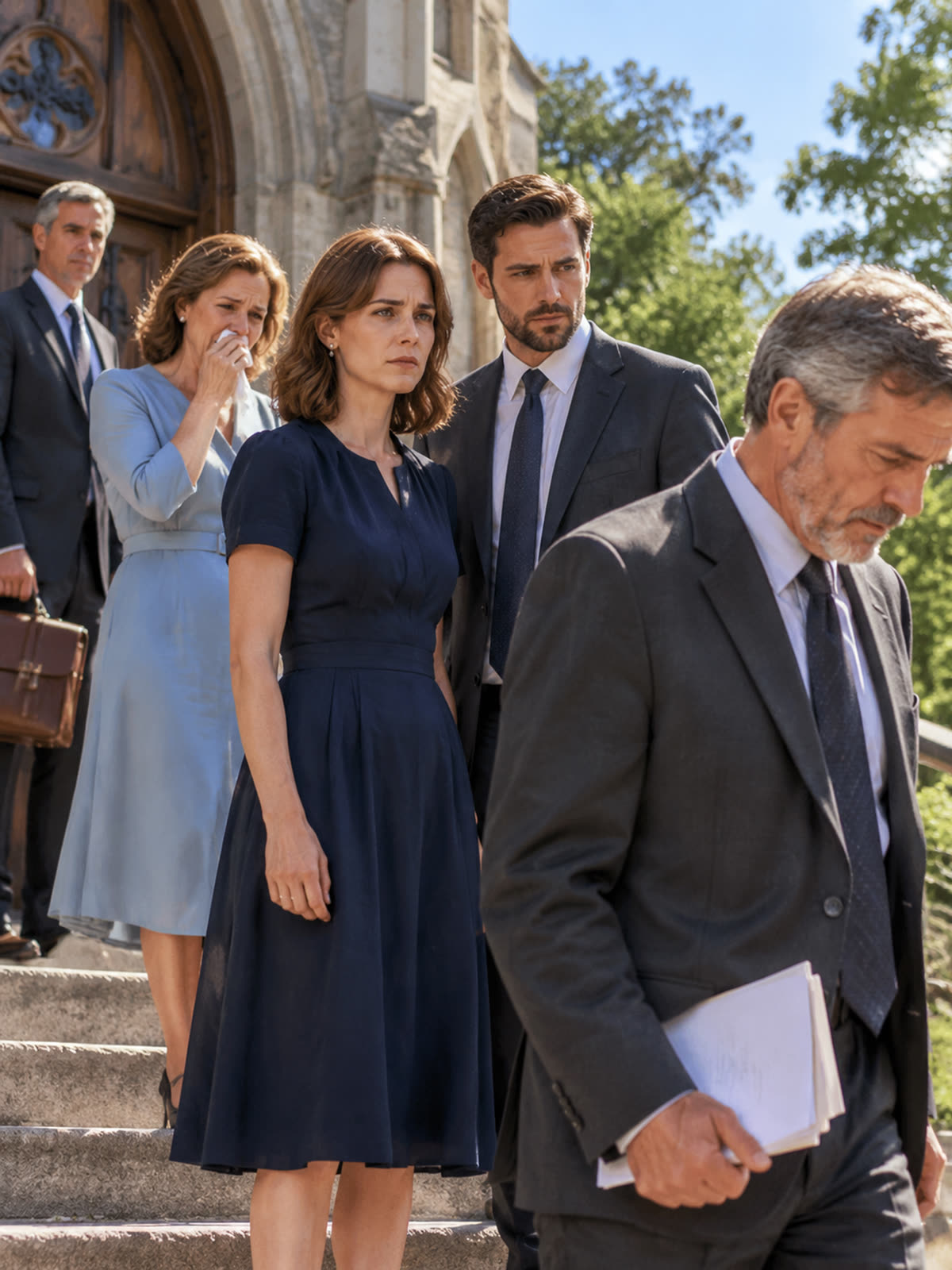
“I should have protected you that night, Abigail, and I have regretted my cowardice every single day since,” she said, her voice shaking. I looked at the woman who had sat motionless while Dad burned my belongings. Sorrow and relief moved through me together. She wiped her cheeks with the back of her hand and met my eyes. “I was terribly wrong, and I am so sorry,” she whispered. There was no excuse attached to the apology.
Hearing those words hurt more than I expected. It was like touching a bruise that had remained tender beneath the passing years. As a teenager, I had spent so many nights imagining her arriving at my foster home, knocking on the door, and finally saying something like that. Now she had said it, but the years between us did not disappear. I did not throw my arms around her or pretend that an apology could return us to the relationship we once had.
Instead, I took a steady breath and gave her a slow, respectful nod. “Thank you for finally telling me the truth in your letter, Mom,” I replied quietly. Then I went inside the sanctuary. Accepting that she had spoken honestly did not require me to offer immediate forgiveness. Her letter had mattered, and so had her apology. Both could be true without erasing the child who had waited for her to come back.
The Ohio legal proceedings continued for almost eight months after the wedding weekend. Mr. Harrison challenged Dad’s fraudulent property transfer in probate court and protected Grandma Doris’s original records throughout the case. Faced with the bank statements and the possibility of formal criminal charges for elder financial abuse, Dad eventually abandoned his claim to the lakefront cottage. He also returned the funds that could be recovered to the estate. The documents Grandma had hidden finally served the purpose she had intended.
But on that afternoon in Madison, there was still a wedding to celebrate. Lucas and Rachel had a peaceful, joyful ceremony, and he never asked me to explain my past to curious guests. Just before the organ began, he pulled me into a close hug in a side hallway. “I am so happy you came today, Abigail, because my family finally feels complete,” he whispered. I smiled through happy tears and held his hand. “I am really glad I came too, little brother,” I answered wholeheartedly.
Over the next year, Mom and I met for coffee several times when I traveled back to the Midwest to see Lucas and Rachel. Those meetings did not become an easy shortcut around what had happened. She spoke openly about the fear that had governed her choices for so long, and I told her gently that understanding her fear was not the same as undoing its consequences. She listened without asking me to make those consequences smaller for her comfort.
She accepted the boundaries I needed. There were no demands for instant forgiveness and no insistence that we act as though twenty years of distance could simply be set aside. Our relationship never returned to the effortless closeness we had known before I turned thirteen. Instead, through patience and honesty, we began learning how to speak to each other as adults. It was a different relationship, shaped by what had happened rather than built on pretending it had not.
Meanwhile, I stopped measuring my worth against the family I had lost on that Ohio road. I earned a promotion at my architectural firm in Minneapolis and bought a cozy brick bungalow with a sunny backyard. Loyal friends filled my life with a kind of belonging that did not depend on my father’s approval. They knew the person I actually was, not the dishonest girl he had described to relatives who never came looking for my side of the story.
I kept Grandma Doris’s last letter in a locked cedar drawer beside my bed, next to a framed photograph from Lucas’s wedding. Her reminder that I had been an innocent child was the reassurance I had needed most. I had not deserved the highway, the flames, or the years that followed. Nor had I been responsible for adults who failed to protect me because they were unwilling to face their fear. Their choices belonged to them, however long I had carried the hurt.
Twenty years after Dad destroyed my suitcase, I finally understood something about the girl who had stood beside it. She had believed her family had erased her from the world. They had not. They had left her to find a future beyond them, and she had survived long enough to build one. The life I made was not proof that the abandonment had been acceptable. It was mine despite the abandonment, not because he had possessed any right to inflict it.
When the cream-colored invitation first arrived, I thought it was asking me to return to people who had rejected me. Instead, it led me to the truth that ended two decades of deception. My father had once looked at a helpless thirteen-year-old and declared, “You are no longer a part of this family.” Standing in the life I had created, I knew he had never taken away my value. His version of my story was finished. What came next, beyond the lies and the family boundaries I was still learning to draw, was finally mine to decide.
Disclaimer: This story is a work of fiction inspired by real-life themes. Names, characters, places and events are fictionalized, and any resemblance to real persons is purely coincidental. It does not represent any person or organization and does not encourage inappropriate behavior. Images are for illustration purposes only.
