

PART 1 — What Was Waiting at Home
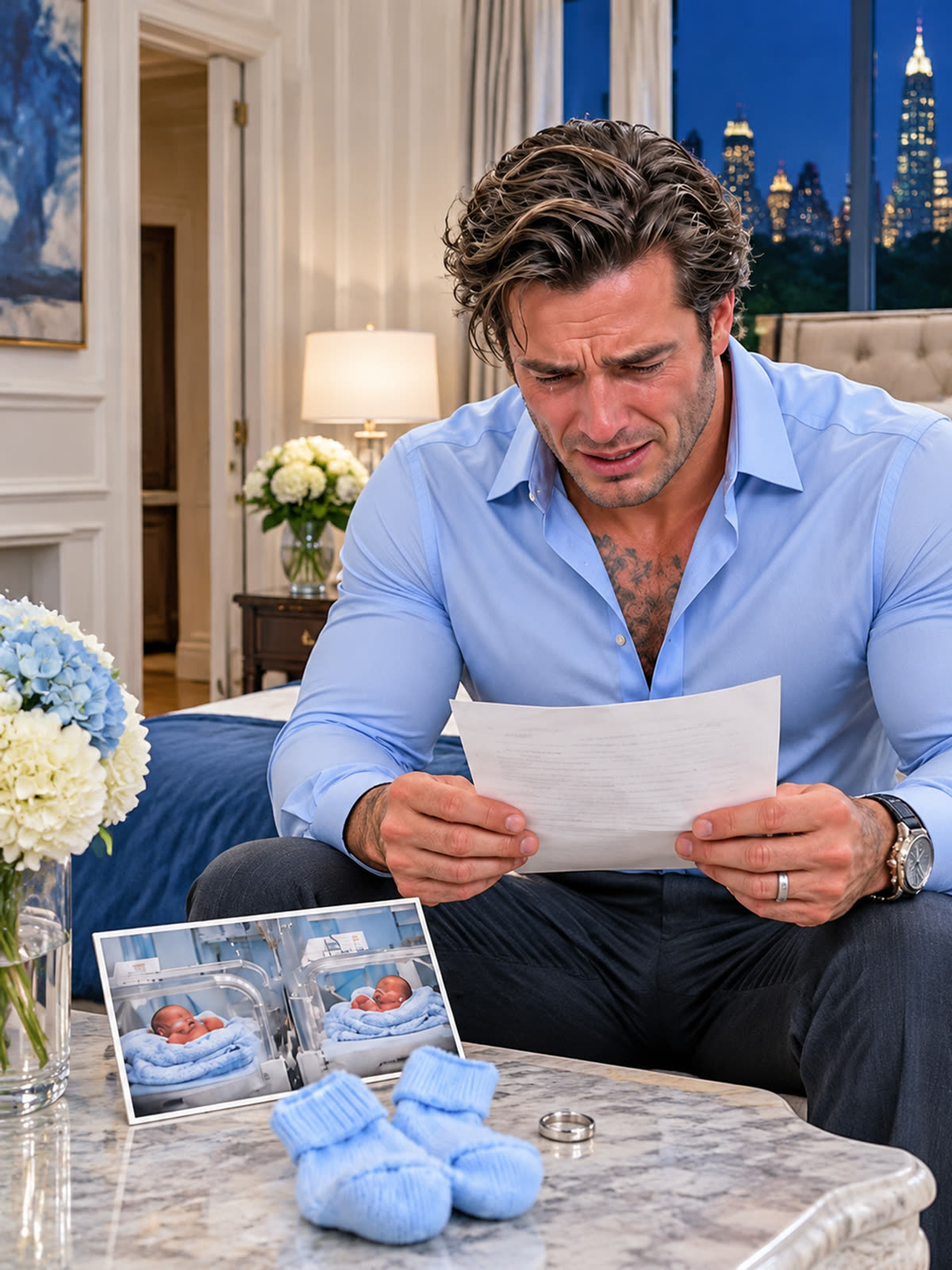
At 3:52 in the morning, I walked into my ninety-two-million-dollar Manhattan mansion after fourteen days in California with my mistress. I had brought back a diamond bracelet I’d purchased for her. What stopped me, however, was something worth almost nothing: two tiny blue socks beside my wife’s wedding ring. Nearby lay a photograph of premature twins attached to breathing equipment. Then I unfolded Amelia’s letter. Its opening sentence nearly brought me to the floor: “I gave birth to the two children we dreamed of while you were holding another woman.” My fortune amounted to seventeen billion dollars. That morning, I finally encountered a loss no amount of money could reverse.
My name is Harrison Cole. I was forty-eight, the founder of an international technology empire, and accustomed to believing that sufficient money could resolve almost anything. Yet the house was empty, and neither my wife nor our newborn children were there. The photograph on our bed showed Caleb and his sister, Grace, in separate hospital incubators. For months, I had pictured holding them. Now a photograph offered my first real introduction to their faces. Amelia’s ring rested beside an explanation of why she had gone. To understand what that meant, though, you have to understand who she had been before I became the man who abandoned her.
We had met twenty years earlier, when my business consisted of six employees crowded above a shabby storefront. Sometimes we barely had enough money to eat properly. Amelia worked at a small publishing company and never treated our circumstances as something to resent. She delivered sandwiches when I stayed late, reviewed presentations with me, and helped restore my confidence after investors turned me away. Once, with less than two hundred dollars remaining in our account, she quietly pawned the gold bracelet her grandmother had given her. Finding the receipt upset me. “You should’ve told me,” I said. She smiled. “You would’ve stopped me.” She knew me well enough to be right.
On a winter evening, we split one sandwich for dinner. She slid the bigger portion toward me. “You need your strength,” she said. “You’re building our future.” I laughed and promised that someday I would buy her every restaurant in New York. Amelia only shook her head. “I don’t need expensive restaurants, Harrison. Just promise we’ll still have dinner together when you’re rich.” I promised. Years later, I had the resources to fulfill my extravagant offer, but I had stopped honoring the simple promise she actually wanted. The six employees became thousands. Our apartment gave way to grander homes, and eventually my wealth reached seventeen billion dollars.
I showered Amelia with jewelry, designer clothes, and a mansion overlooking Manhattan, convincing myself that luxury counted as devotion. Meanwhile, I gave her less and less of my time. She had never wanted another diamond as much as she wanted the husband who once shared his dinner with her. After years of fertility treatments, she finally became pregnant. When the doctors said we were expecting twins, I cried while holding her hand. “Our greatest dream,” I whispered. For several weeks, becoming a father filled me with happiness. Then the pregnancy grew complicated, the appointments multiplied, and doctors warned that our children might arrive too soon. Instead of moving closer to my frightened wife, I began retreating.
That was when Madison Lane became part of my life. Twenty-seven, beautiful, and confident, she worked for a luxury hospitality company and admired everything I had achieved. With her, I felt young, admired, and important. The relationship became an affair. When Amelia reached thirty-two weeks, her doctor again warned of an early delivery. Three days before my California trip, she came into my office. “Please don’t go, Harrison.” I hardly lifted my eyes. “You have excellent doctors.” She persisted. “I’m frightened. Something could happen.” I sighed. “What can I do that the doctors can’t?” Tears gathered in her eyes. “You could be my husband.” I promised to keep my phone close. Then I left with Madison aboard my private jet.
Our fourteen days in California carried us through Napa Valley, Santa Barbara, Beverly Hills, and San Diego. We occupied expensive hotel rooms, drank champagne, and lingered over romantic meals while Amelia’s condition worsened at home. On the fourth day, she called to say she had been admitted for observation. I advised her to do what her doctor recommended, then ended the call because Madison had arranged a wine tasting. Four days afterward, Amelia called again. “Harrison, I’m having contractions.” I stepped away from the pool. “Have you contacted your doctor?” Her answer should have stopped everything. “Yes, but I’m scared. Please stay on the phone.”
Behind me, Madison reminded me that we had a lunch reservation. “I’m busy right now,” I said, and disconnected. The thirty-first call reached me during dinner above the Pacific Ocean. Amelia sounded weak. “They can’t stop the labor.” Uneasiness tightened inside me. “What does that mean?” She answered, “The babies are coming now.” Then she began to cry. What she asked next was so small that remembering my response still hurts. “Please say something to our children, Harrison. I want them to hear their father’s voice.” She wasn’t requesting money or better equipment. She wanted our babies to hear a few words of love.
Madison sat across the table, waiting for my attention. I gave Amelia two words instead. “Another time.” Silence followed. Finally, she whispered, “Okay.” Seventeen minutes later, doctors delivered our children by emergency cesarean section. Caleb weighed roughly three and a half pounds, and Grace weighed even less. Amelia hemorrhaged and needed an emergency transfusion. Both babies went into neonatal intensive care. The next morning, she sent their photograph. I glanced at it before Madison asked where we would travel next. “San Diego,” I answered. I remained in California. My wife had nearly died, our children were fighting through their first days, and I continued my vacation.
When I returned home fourteen days after leaving, the illusion that I controlled my life finally broke. Amelia’s letter described nights beside the incubators, watching Grace struggle for breath while Caleb needed close monitoring. She had been recovering from dangerous complications herself. Her sister, Claire, had stayed through the ordeal. I had not. Her final paragraph said she had waited throughout the pregnancy, waited in the hospital, and waited beside our struggling babies. But she would not teach Caleb and Grace to spend their lives expecting a father who repeatedly chose not to arrive. The words blurred before me. I called her immediately. Her number had been disconnected.

I contacted the hospital and demanded information about my wife and children. Staff members explained that they could not release private medical information without proper authorization. I invoked my connections with the hospital’s investors, as if influence could undo the consequences of my absence. The nurse answered evenly. “Mr. Cole, your wealth doesn’t change patient privacy requirements.” For once, my billions could not open the door in front of me. Then Amelia’s physician, Dr. Evelyn Shaw, called. “Mr. Cole, we’ve been trying to contact you for nearly two weeks.” I asked the only question I could form. “Are my wife and children alive?”
She said that when she last examined the twins, both were alive and receiving treatment, but further information required authorization. Then her tone made everything feel less certain. “There were unusual events during your wife’s hospitalization. Events she asked us to document carefully.” Before I could press her, she directed me to the patient liaison office. I called my chief of staff, Daniel Mercer. He arrived with a folder full of urgent emails. During the trip, he had tried to reach me seven times. Some messages warned of an early delivery; others urged me to return immediately. Looking at the records, I felt sick.
“Why didn’t you come to California yourself?” I demanded. Daniel met my eyes. “Because you instructed me not to interrupt your vacation unless the company was in danger.” I remembered the instruction, though I wished I could deny it. “But my wife was in danger!” His reply left no room for evasion. “I told you that, sir. You refused to listen.” For the first time in eleven years, he openly challenged me. “Amelia nearly died, Harrison. You should’ve answered your phone.” There was no defense I could offer. He had attempted to tell me exactly what I now claimed I would have wanted to know.
At the hospital, patient advocate Rebecca Ellis explained that Amelia had requested strict privacy. I could make the appropriate requests for information and contact, but my influence would not override her wishes. Then Hannah Price, a nurse who had cared for the twins, approached me with tears in her eyes. “Mr. Cole, I was there the night Grace stopped breathing.” Everything seemed to shift beneath me. Before I found a response, she continued. “Your wife tried to tell you what happened afterward, but some of her messages never reached you.” Until then, every revelation had exposed my deliberate neglect. This suggested something else had happened as well.
Back at my office, I asked Marcus Reed, our IT security director, to examine the company’s communication records. By noon, he had identified several urgent hospital emails that had been automatically routed into a low-priority folder. The changes originated through an account carrying delegated executive access, an account connected to travel arrangements I had authorized for Madison. He also recovered a reply sent to the hospital under my name. It claimed I already knew about the emergency and wanted no further calls. “I never wrote that,” I said. Daniel shook his head. “Neither did I.” Then Marcus found an attachment, and the screen revealed something worse.
It was a photograph of Madison and me in our California hotel room. She leaned against my shoulder. I was smiling, with champagne on the bedside table. The picture had been taken while Amelia was undergoing emergency surgery. Someone had forwarded it to Claire with a message presented as mine: “Tell Amelia I’m not coming back.” I stared at the screen. “I didn’t write those words.” Marcus said the message had passed through the delegated account, though its sender still needed to be verified. I wanted to place everything at Madison’s feet. But Amelia herself had told me she was in labor. Whatever anyone else had done, I had known she needed me—and chosen to remain away.
PART 2 — The Truth I Could Not Buy My Way Around
My mother called that afternoon. She had always loved Amelia, and when I explained what had happened, she offered no comfort. “Harrison, your father once risked losing his job because he refused to leave my hospital bedside.” I closed my eyes. “He didn’t have millions of dollars,” she continued. “But he understood what mattered.” I tried to describe what I had done in the smallest possible terms. “Mother, I made a terrible mistake.” She would not let me. “No,” she replied. “You made a series of choices.” Every unanswered call, every broken promise, every additional day in California belonged to that series. None had happened without my participation.
The next morning, I met Amelia’s attorney, Rebecca Hart, with my own lawyer, Thomas Avery, beside me. Rebecca explained that Amelia would neither disclose her location nor accept direct contact. She also wanted me to stop using corporate relationships to pursue private medical information. I agreed. Then Rebecca handed over Amelia’s written account of the delivery. Reading it forced me into moments I had avoided while they were happening: the glare of the operating-room lights, her terror that she might never meet our children, and the nurse who held her hand because I wasn’t there. After surgery, Amelia had awakened and asked whether I had arrived.
Then I reached her account of the hotel photograph. At first, she had refused to believe I would intentionally miss the twins’ birth. She defended me to the doctors and insisted there must be an explanation for my absence. Claire showed her the picture, and those explanations finally fell away. The photograph itself had not ended our marriage. My conduct had done that. The image had merely made the truth impossible to dismiss. Rebecca told me Amelia was considering divorce and needed definite arrangements for the children’s care. The woman who had believed in me before anyone else now felt unable to trust me with her address.
Soon afterward, I learned that Grace had become more seriously ill. Dr. Nathan Brooks, the neonatologist overseeing her treatment, explained that her lungs were severely underdeveloped and that she was experiencing significant cardiovascular complications. The team was considering an intervention that might improve her chances. Amelia had authorized me to participate in the discussion. Despite everything between us, Grace was still my daughter. When I entered the consultation room, Amelia was already seated there. She looked fragile and exhausted. I had not seen her since leaving for California. “Amelia,” I whispered. She did not smile. “Harrison, we’re here to discuss Grace.” I nodded.
The doctors outlined the available treatments and their risks. Instinctively, I wanted to demand the costliest specialists and the best equipment money could obtain. Amelia looked at me before I could turn the discussion into another exercise in authority. “Please listen to them.” This time, I listened. I asked questions and tried to understand the answers rather than search for someone to command. For once, I sat in that room as a frightened father. There was no business strategy that could make the uncertainty disappear. No number I could offer would guarantee the outcome we both wanted for our daughter.
Later, I was permitted to stand beside Grace’s incubator. Through its clear walls, she looked almost impossibly small. Medical equipment helped her chest rise and fall. Following the nurse’s directions, I carefully placed my hand where I was allowed. “Hello, Grace,” I whispered. “It’s Daddy.” My voice broke. “I’m sorry I wasn’t here when you arrived.” There was no way to explain my absence to her, and nothing I could say would return the time I had thrown away. I stayed until the visit ended. Unlike all those days when I had been somewhere else, there was nowhere I wanted to go.
That evening, I instructed Daniel to reduce my executive responsibilities. He seemed surprised. “For how long?” I answered, “As long as my children need me.” For years, I had behaved as though everything would collapse if I stepped away. Yet the company continued to operate. The world did not stop because I was no longer attending every meeting. Seeing that made my earlier excuses harder to bear. I had surrendered irreplaceable moments to obligations other people could manage. Amelia had asked for my presence, not proof of my importance. Only after losing her trust did I begin making room for what I had claimed mattered most.
Meanwhile, Marcus continued examining the communications. He traced the suspicious routing changes to credentials associated with Madison’s travel coordination arrangements. There were also irregular contacts involving hospital administration. Someone had attempted to have Madison recognized as an authorized representative for family-related communications, despite her having no legitimate authority over Amelia’s medical treatment or the twins’ care. Further investigation connected some hospital-related activity to Olivia Grant. Independent attorneys and digital-forensics specialists reviewed the records. The findings mattered, but they did not offer the escape I had initially wanted. Interference could explain missing messages. It could not explain the calls I had personally answered and dismissed.
Another piece of evidence emerged: a recording made in California. I recognized Madison’s voice as she asked whether I planned to leave Amelia after the babies arrived. Then I heard myself making careless promises about our future. Listening was humiliating. I had said whatever would preserve the affair and keep the trip pleasant. Now Madison was using those statements to support her claim that I had intended to abandon my marriage. I could hear my own selfishness without the excuses I had wrapped around it at the time. The man in the recording sounded nothing like the husband Amelia had once trusted.
At a formal meeting attended by our attorneys, the diverted messages, delegated account, and false communications were examined. Madison denied wrongdoing and disputed the accusations. Nevertheless, the investigation established serious interference through communication channels linked to her arrangements. Legal measures followed to address the misuse of information and prevent more interference. Our relationship ended permanently. Later, when Thomas offered to explain the outcome in detail, I asked just one question. “Are Amelia and the children protected?” He assured me that appropriate safeguards were in place. “Then that’s what matters.” Punishing or humiliating Madison could not give Amelia back one of the nights she had faced alone.

I had finally stopped trying to turn another person’s misconduct into an excuse for my betrayal. Even if every diverted message had reached me, the truth remained that I had heard Amelia’s fear directly. I had heard her tell me the babies were coming. She had offered me a chance to speak to them, and I had chosen dinner instead. The legal findings did not change that. Neither did the end of the affair. What mattered now was whether I could remain present without expecting my presence to purchase forgiveness. Grace was still ill, Caleb still needed care, and Amelia still had every reason to protect herself from me.
Grace continued to face serious medical difficulties. Then, one day, her condition deteriorated abruptly. Dr. Brooks explained that complications involving her breathing and circulation had become critical. The medical team recommended an urgent intervention, but the risks were substantial. Amelia sat beside me in the consultation room, working to hold herself together. I wanted someone to promise that our daughter would survive. No one could. The silence around that uncertainty was harder to endure than any answer I had ever received in business. I could not negotiate with it, threaten it, or make it smaller by offering more money.
Eventually, I asked the doctor the question that mattered more than anything I could demand. “What would you recommend if Grace were your daughter?” Dr. Brooks explained why he believed the proposed treatment offered her a meaningful chance. I listened closely, just as Amelia had asked me to do before. Then we agreed to proceed. We were not choosing between certainty and danger. We were deciding how to give our daughter the chance her doctors believed was there. For all my wealth, I was as helpless before the possibility of losing her as any other parent would have been.
Before the procedure, we were allowed to see Grace. She lay under a tiny blanket amid the monitors. I bent toward her. “Sweetheart, I don’t know what happens next,” I whispered. “But I’ll be here.” This was the promise I should have understood from the beginning: not that I could prevent fear or guarantee safety, but that I would not leave her to face either without me. Amelia stood beside me, struggling not to cry. For a moment, our hands touched. Nothing about that brief contact repaired our marriage. It simply joined two parents who were frightened for the same small child.
We were no longer a happy couple awaiting the future we had imagined. We were a mother and father hoping our daughter would live long enough to have one. The medical team began the procedure, and we waited. Minutes dragged past with the weight of hours. I remembered Amelia asking me to speak to our unborn babies. I had answered, “Another time.” Those words had once seemed like an easy postponement. Now I understood how much cruelty could hide inside them. I would have given away every dollar I owned for another chance to hear Grace breathe without struggling.
There was nothing left for me to arrange, purchase, or control. The doctors were working, Amelia was beside me, and our daughter’s chance rested beyond anything I could influence. I had spent years mistaking power for protection. Now all I could do was remain where I had promised to be. We waited for the medical team to return, carrying news that would decide whether our little girl had come through the intervention we had authorized. This time, I had answered when my family needed me. I still did not know whether I had arrived in time.
PART 3 — The Father I Still Had Time to Become
Eventually, the medical team returned with encouraging news. The intervention had gone as hoped, although Grace still needed intensive monitoring. Amelia began to cry, and I covered my face. For the first time in months, relief belonged to both of us at once. But it was not reconciliation, and I knew better than to mistake it for that. We loved our daughter. For that moment, sharing the hope that she might recover was enough. Nothing about the outcome erased the fear Amelia had endured or the choices that had left her facing so much of it alone.
Several weeks later, Amelia asked to meet about our marriage. By then, I already understood what she intended to tell me. We sat opposite one another in her attorney’s office. She looked stronger than she had in the hospital, but strength did not mean she was returning to the life we had shared. “Harrison, I know you’re trying to change.” Tears gathered in my eyes. “Thank you.” Then she said what I had known was coming. “But I can’t go back to being your wife.” I lowered my head. Wanting a different answer did not make her decision unfair.
She continued softly. “I spent too many years waiting for you to choose me. I can’t spend the rest of my life wondering whether you’ll disappear whenever things become difficult.” I wanted to plead with her. I wanted to promise everything, to summon the twenty years behind us as evidence that we deserved another chance. But those years belonged to her too. She had lived through the promises I broke, not simply the ones I remembered making. At last, I understood that loving her did not give me the right to direct her future. “You deserve better,” I whispered. “So do Caleb and Grace,” she replied.
We discussed the practical shape of parenting apart: financial support, medical decisions, care responsibilities, and a gradual schedule suited to the twins’ recovery. Amelia would be their primary residential parent during their early years. I would help support them and take part in their care under the arrangements we established. There was nothing grand or romantic about those discussions. They concerned the dependable work our children needed from us. I had once imagined that being a father would begin with a triumphant moment. Instead, I was learning that it required accepting limits, listening carefully, and respecting the mother whose trust I had destroyed.
Rebecca placed the divorce documents in front of me. I picked up the pen, and my hand trembled. Then I signed. Amelia cried quietly. The impulse to hold her was strong, but reaching for her would have been about what I wanted, not what she had offered. I stayed where I was. “I’m sorry I made this necessary.” She nodded. “I know.” There was no speech that could make the moment less final. Signing did not mean I had stopped loving her. It meant I was finally allowing her decision to matter more than my desire to escape its consequences.
Our divorce became final during the months that followed. Amelia settled into a peaceful home close to her sister, Claire. Eventually, I left the enormous Manhattan mansion and bought a smaller apartment near enough to participate in the twins’ lives. The move did not repair what I had done, and I did not pretend it did. It simply placed me where I could begin meeting the responsibilities I had once avoided. My children did not need an impressive address from me. They needed a father whose presence could become ordinary enough to rely on rather than remarkable because it was so rare.
For the first time, I began learning what caring for children actually demanded. It was not a matter of selecting extravagant presents or paying other people to assume every responsibility. It meant washing bottles, preparing blankets, learning feeding schedules, and attending appointments. It meant showing up under the arrangements Amelia and I had made, not according to whichever moment happened to suit me. The work was simple to describe and impossible to replace with a grand gesture. I had spent years providing things that could be purchased. Now I was learning to provide the one thing I had repeatedly withheld: myself.
Caleb left the hospital first. Grace followed after a longer recovery. I attended visits when invited and respected the boundaries Amelia and I had established. Gradually, both children grew stronger, and I became more involved in their everyday care. Their progress did not erase how their lives had begun. It gave me opportunities to behave differently as those lives continued. I could not claim the nights I had missed or the first moments I had abandoned. I could only stop treating the next ordinary moment as something I would always have another chance to experience.
Six months after the twins were born, Amelia invited me to a family photography session. Claire came, and so did my mother. Caleb and Grace wore matching blue outfits. When the photographer asked us to sit together, Amelia hesitated before moving her chair alongside mine. I held Caleb while she held Grace. For a brief moment, we resembled the family I had once pictured. Yet the resemblance did not change the truth. Our marriage was over. I understood why, and I did not let the photograph become another excuse to imagine that appearances could undo what had happened between us.
Afterward, Amelia came over to me. “You’re doing well with them,” she said. My throat tightened. “I’m trying.” Her answer was quiet. “I know.” I looked at Caleb sleeping in his carrier. “Thank you for allowing me to be part of their lives.” She smiled sadly. “They need their father.” I nodded. “And they need a father who shows up.” Once, I would have treated those words as obvious. Now I knew how much stood behind them. Being their father was not an achievement secured by their birth or by my name. It was a responsibility I had to keep choosing.

A year after the twins were born, I sat on my apartment floor among their toys. Amelia was nearby with Caleb. Grace pulled herself upright beside a small table and looked toward me. “Dada.” I froze. The little girl who had once needed help to breathe released her hold on the table. She took one uncertain step, then another. I opened my arms. “Come here, sweetheart.” She stumbled forward, and I caught her gently against my chest. Then I began to cry. There was no audience to impress and no accomplishment to announce. My daughter had walked toward me, and this time I had been there to receive her.
I held the child whose tiny chest I had watched moving inside an incubator. The distance between those two moments felt enormous, yet neither belonged entirely to me. Amelia had carried our children through the days when I had chosen not to come. Doctors and nurses had fought for them while I remained elsewhere. Grace’s steps were not a reward for my regret. They were part of her life, and I had finally begun living close enough to share it. That distinction mattered. I was not being given back the marriage I had lost. I was being allowed to become a father within the life that remained.
Later that evening, after Amelia collected the twins, I opened the small wooden box beside my desk. Inside were the two tiny blue socks she had left on our bed. Beside them lay the inexpensive silver ring I had bought her when we were young and struggling. I kept those things as reminders of what my choices had cost. The loss was not the mansion, my status, or my fortune. It was the trust of the woman who had loved me before any of those things existed. There had been a time when she needed nothing more from me than dinner together and a promise kept.
My phone vibrated. Amelia had sent a photograph of Caleb and Grace sleeping peacefully. Beneath it, she had written that they had enjoyed a wonderful day with me. I smiled through my tears and replied by thanking her for trusting me with them. A moment later, another message appeared, telling me that they loved me. I looked at those words for a long time. At forty-eight, I had owned seventeen billion dollars and considered myself one of the richest men alive. At forty-nine, surrounded by children’s toys in a modest apartment, I finally understood how badly I had misunderstood wealth.
I had lost my marriage. Amelia’s suffering could not be erased, and no apology could return the years I had wasted. Those truths did not become smaller because I had begun behaving differently. But I had been given an opportunity to become the father Caleb and Grace deserved. That opportunity was not the same as forgiveness, and it did not entitle me to demand more from Amelia. It asked something of me instead: to keep being present after the crisis passed, after the emotional promises faded, and when the work was simply the ordinary work of caring for my children.
The next morning, I rose early to prepare for their visit. I washed bottles, folded blankets, and arranged their clothes. Business notifications appeared on my phone, but I left them unanswered until everything was ready. Once, that choice would have seemed like an interruption to my real responsibilities. Now I recognized the responsibilities in front of me. There would still be work to do, messages to answer, and decisions other people wanted from me. My children’s needs were not less important because they arrived without a title, a balance sheet, or a meeting scheduled on my calendar.
At exactly eight o’clock, someone knocked. When I opened the door, Amelia stood outside holding Caleb. Grace immediately stretched her little arms toward me. “Dada!” I lifted her carefully. “Good morning, sweetheart.” Amelia smiled. “Ready for them?” I looked at our beautiful children, the same babies whose first breaths I had missed because I assumed everything important could wait. This time, there was no hesitation in my answer. “Always.” I could not make that word true by saying it once. I would have to make it true through every ordinary choice that followed.
The greatest lesson of my life had nothing to do with earning billions or building a successful company. Love could not be measured by expensive gifts, magnificent houses, or promises offered when nothing difficult was being asked. It was revealed by presence when the people who needed you were frightened, vulnerable, and waiting. I could never change the man who had chosen California. I could never give Amelia back the husband she had needed beside her in the hospital. But the question of what kind of father I would become was still being answered—and the next time my children reached for me, I had to be there.
Disclaimer: This story is a work of fiction inspired by real-life themes. Names, characters, places and events are fictionalized, and any resemblance to real persons is purely coincidental. It does not represent any person or organization and does not encourage inappropriate behavior. Images are for illustration purposes only.
