

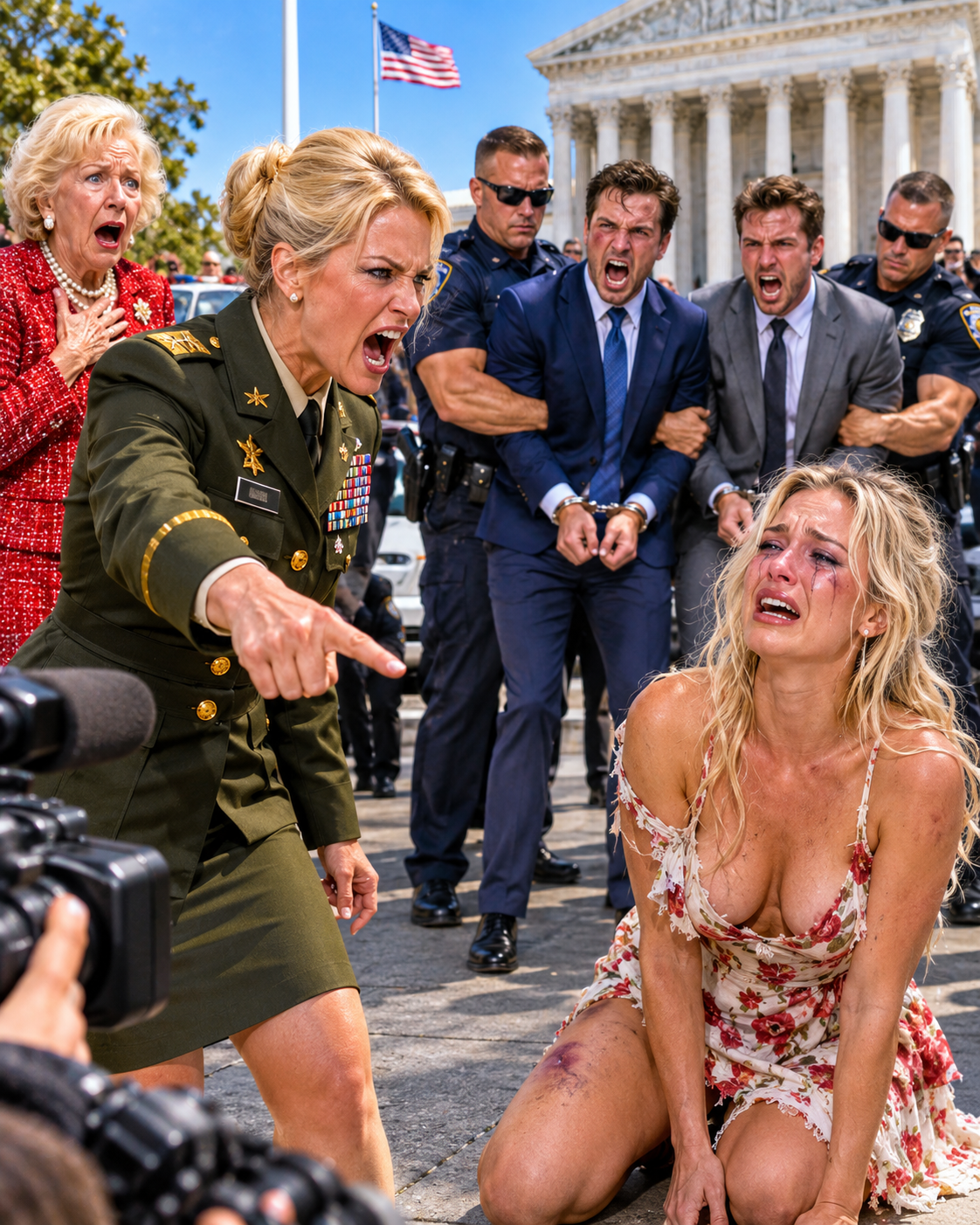
PART 1: The Phone Call That Changed Everything
The fluorescent lights hanging over the operations center at Ramstein Air Base emitted a constant, sterile hum. It was 2:13 a.m. in Central Europe, and the base had settled into the peculiar stillness that comes only in the hours before dawn.
Most senior officers had already withdrawn to their quarters. Only a handful of exhausted analysts and overnight personnel remained, studying information on their illuminated monitors.
I stood beside the briefing area, holding a paper cup of black coffee that had long since gone lukewarm. A logistical map of Eastern Europe occupied the screen in front of me, but my attention had begun to drift.
My name was Lieutenant Colonel Rebecca Hale.
For twenty-two years, military service had taught me how to function when everything around me was collapsing. I understood how to evaluate threats, contain fear, and make decisions when hesitation could cost lives.
The uniform had become more than my profession. It was the structure that held my world together.
Then my phone vibrated.
I glanced at the screen.
Emily.
My daughter almost never contacted me at that hour. Occasionally, she forgot about the time difference between Missouri and Germany, but something about this call immediately unsettled me.
I put my coffee aside and answered.
“Emily?”
At first, I heard nothing resembling a voice.
There was only uneven breathing, interrupted by faint, strangled sounds. She was crying, but not in the ordinary way someone cries after receiving terrible news.
Each breath seemed to require an enormous effort.
“Mom…”
The word was so faint that I almost failed to recognize it.
Every muscle in my body tightened.
“Emily? Where are you? What’s going on?”
For several seconds, she could not answer.
I heard what sounded like an echo surrounding her, as though she were somewhere large and empty.
Then she managed to speak.
“They… they took turns,”
My grip tightened around the phone.
“What are you talking about? Who took turns?”
“Uncle Travis… and Uncle Dean.”
My thoughts stopped.
Travis Mercer and Dean Mercer.

The younger brothers of my deceased ex-husband, Daniel.
“They had a tire iron,” Emily whispered, the words bubbling up through obvious physical agony. “My arm… Mom, I think my arm is shattered. My ribs are burning. It’s so cold here. I can’t see anything. I’m scared.”
The operations room seemed to disappear.
I could no longer hear the conversations taking place behind me or the faint clicking of keyboards.
There was only my daughter’s voice.
I moved quickly toward an unoccupied alcove near the secure communications office.
“Listen to me, sweetheart. I need your location. Tell me exactly where you are.”
“I don’t know,” she sobbed, a fresh wave of pain overtaking her. “Some warehouse… outside Fairmont.”
Fairmont, Missouri.
The town I had spent years trying to escape.
The place where the Mercer family had built a reputation for wealth, influence, and a remarkable ability to avoid consequences.
I was about to ask Emily what she could see when another voice entered the call.
It was male, coarse, and close enough to the phone that every syllable came through clearly.
“Still conscious, little girl?”
Emily gasped.
“Mom—!”
The connection ended.
I stared at the phone.
For one terrible instant, every part of me wanted to scream.
Instead, I forced myself to act.
I contacted emergency services through an international relay, requesting immediate assistance from Missouri authorities. At the same time, I opened my laptop and used the available military liaison channels to report that a service member’s dependent had apparently been kidnapped and severely assaulted.
I supplied Emily’s name, her last known location, and the identities of the two men she had accused.
Then I waited.
Twenty minutes later, a notification appeared.
Fairmont County deputies had found Emily behind an abandoned agricultural supply depot.
She was alive.
I read those words several times before I could absorb anything else.
Approximately an hour later, preliminary information arrived from the hospital.
Fourteen fractures.
Three broken ribs. A shattered wrist. A fractured forearm. A broken collarbone. Two crushed fingers. Several fractures around her eye socket.
The report described injuries that no mother should ever have to imagine, much less read about her own child.
But despite the severity of her condition, Emily had remained conscious enough to speak with the medical staff.
She identified Travis and Dean.
She described the tire iron.
And she repeated the threat Travis had delivered while standing above her.
“Your mom’s overseas. When she finally gets back, she’s next.”
I read that sentence until the words stopped looking like words.
Daniel Mercer had died three years earlier in a highway accident during heavy rain.
Our divorce had been ugly, prolonged, and filled with accusations from his family. Daniel had never possessed the strength to challenge his relatives. After our marriage ended, his emotional decline and drinking became convenient reasons for the Mercers to blame me.
They believed I had destroyed him by leaving.
For years, their hostility had appeared through threatening remarks, bitter phone calls, and deliberate attempts to make me uncomfortable whenever I returned to Missouri.
But this was different.
They had attacked my daughter.
At 4:46 a.m., another notification appeared on my phone.
A voicemail.
The caller was Margaret Mercer, Daniel’s mother.
I pressed play.
Her familiar voice filled the quiet alcove. She sounded neither frightened nor concerned.
She sounded entertained.
“My boys are untouchable, soldier,” she purred.
A low, grating laugh echoed in the background.
“My husband runs this entire county. You should have stayed gone, Rebecca. But… come home if you want. We’ll be waiting.”
The recording ended.
I played it again.
Margaret had just threatened a United States military officer while openly boasting that her family controlled local law enforcement.
She apparently believed those words would frighten me into staying overseas.
Instead, she had given me evidence.
I secured my phone, straightened my uniform, and walked toward Colonel Nathan Cole’s office.
Nathan and I had served together in Kandahar ten years earlier. He knew how I responded under pressure. He had seen me coordinate personnel after attacks and make difficult decisions while others struggled to remain calm.
He also knew I would not come to him in the middle of the night over a minor family disagreement.
I knocked and entered.
Without offering a long explanation, I placed my phone on his desk.
“Listen to this, sir.”
Margaret’s voice played through the speaker.
Cole listened without interrupting.
When the message finished, he leaned back and studied me.
“What exactly does her husband do in this town?”
“He’s a County Commissioner,” I replied, my voice devoid of inflection. “Former Sheriff. Half the current police department either worked under his badge or owes him their mortgage.”
Cole remained silent for a moment.
“You think the local uniforms are going to bury the case?”
“I don’t think it, Nathan. I know they’ll try.”
He reached for his secure telephone.
I frowned.
“Sir?”
Cole began entering a number I recognized as belonging to the Pentagon’s interagency liaison network.
“This isn’t the Korengal Valley, Hale. You don’t need a platoon of Rangers for this,” Cole said, holding the receiver to his ear.
He waited for someone to answer.
“You need hostile witnesses. You need federal warrants. You need interstate jurisdiction, and most importantly, you need people that those arrogant local families cannot fire.”
A voice answered on the other end.
Cole identified himself and provided his credentials.
Then he looked directly at me.
“By tomorrow morning,” Cole said quietly into the receiver, his eyes never leaving mine, “I want that town to realize they have made a catastrophic mistake.”
For the first time since Emily’s call, I felt something other than helpless terror.
I had an ally.
I had a plan.
And I had a way to pursue the people responsible without allowing the Mercer family to control the investigation.
As I prepared to leave his office and arrange emergency travel, my phone vibrated once more.
An unfamiliar number had sent me a message.
There were only two words.
WE’RE WAITING.
I stared at the screen.
The Mercers knew I was coming.
And they wanted me to know they were ready.
The Return to Missouri
Thirty-one exhausting hours passed before I reached Missouri.
My journey involved two commercial flights, a delayed connection in Atlanta, and a three-hour drive in a rental car through the heavy Midwestern humidity.
I barely slept.
Every time I closed my eyes, I imagined Emily lying alone in that warehouse, unable to move, wondering whether anyone would find her.
When I finally arrived in Fairmont, I did not stop at my childhood home or find somewhere to change.
I drove directly to St. Catherine Medical Center.
The hospital corridors smelled of disinfectant, floor polish, and stale air. After identifying myself to security, I made my way to the trauma recovery ward.
Room 412.
I reached the doorway and stopped.
Emily lay almost motionless beneath the white hospital bedding.
Her left arm was encased in a heavy cast and supported by pillows. A brace immobilized her collarbone. Dark bruising covered much of the right side of her face, and the swelling had altered features I had known since the day she was born.
I had prepared myself for the medical report.
I had not prepared myself to see her.
For three seconds, I stood there struggling to breathe.
Then Emily turned her uninjured eye toward the doorway.
“Mom.”
I crossed the room immediately.
Careful not to disturb her injuries, I bent over the bed and kissed the side of her forehead that had escaped the worst of the bruising.
“I’m here, baby,” I whispered fiercely into her hair. “I’ve got you.”
Her eye filled with tears.
“They… they said nobody in town would ever believe me.”
“I believe you.”
“They said Grandpa Walter would make the whole thing disappear before sunrise.”
I pulled a chair beside her bed.
“Look at me, Emily. Nothing is disappearing. Now, take a breath. Tell me exactly what happened. From the beginning.”
She began slowly.
Three nights earlier, Emily had attended a birthday celebration at a downtown bar.
Around midnight, she left the gathering and walked toward the gravel parking area.
Travis Mercer appeared from behind a dumpster.
He smelled strongly of alcohol and cigarettes. He told Emily he wanted to discuss some remaining matters involving Daniel’s estate.
Emily knew better than to trust him.
She refused and tried to leave.
Dean stepped out behind her.
Before she could escape, someone pressed a heavy cloth over her mouth.
Her next clear memory was waking on the floor of Travis’s old F-150 while the truck traveled beyond the town limits.
They took her to an abandoned agricultural warehouse.
Inside, beneath a single harsh utility light, the brothers presented documents on a clipboard.
They demanded that Emily sign away her rights to property Daniel had placed in a blind trust for her.
She refused.
They threatened her.
She continued refusing.
Then Travis picked up the tire iron.
I listened as my daughter described what followed.
Every instinct in me demanded that I stop her from speaking and simply hold her until the memories faded.
But I needed to understand what had happened.
When Emily finished, I squeezed her uninjured hand.
“Did they show you the actual paperwork?”
“Yes. They held it up to my face when I was on the ground.”
“Did you see anything specific? A letterhead? A notary seal?”
She closed her eyes, trying to remember through the medication.
“There was a logo at the top… a law firm.”
I leaned closer.
“What name, Emily?”
“Bennett, Mercer and Shaw.”
I knew the firm immediately.
Margaret Mercer’s nephew was one of its senior partners.
The involvement of that office changed everything.
This was no longer simply an attack committed by two violent relatives.
Someone had prepared legal documents before Emily was kidnapped.
Someone expected those documents to transfer valuable property.
And someone had apparently believed that physical violence would make my daughter sign them.
Before I could ask anything else, the hospital room door opened.
A deputy entered without knocking.
His badge identified him as Aaron Pike.
He moved with the lazy confidence of a man accustomed to having his authority accepted without question.
“Ma’am,” Pike drawled, offering a smile that didn’t reach his flat, predatory eyes. “I’m gonna need to ask little Emily here a few additional questions to finalize my report.”
I rose from my chair and positioned myself between him and the bed.
“You already subjected her to an interview yesterday,” I stated, my voice dangerously calm.
“Just a routine follow-up, ma’am. Need to clarify some inconsistencies.”
“Where is Detective Ramirez? She was the primary investigator assigned to the aggravated assault roster last night.”
His expression shifted.
“Ramirez got reassigned this morning. Administrative shifts.”
“Reassigned. By whom?”
“By the Sheriff.”
There it was.
The first unmistakable indication that someone had begun interfering with the investigation.
I kept my voice controlled.
“Deputy Pike,” I said, my voice dropping an octave, taking on the tone I used to dress down insubordinate lieutenants. “You will leave this room. You may return only when my daughter’s retained legal counsel is present in this room.”
His smile disappeared.
“Now, look here, lady. You’re making this whole situation a lot harder than it needs to be.”
I stepped closer.
“No, Deputy. I am ensuring this situation is properly documented.”
He stared at me, apparently deciding whether intimidation would work.
Eventually, he turned and left, slamming the door behind him.
I returned to Emily’s bedside.
Ten minutes later, my phone received another message from the same unidentified number.
STOP DIGGING, OR SHE WON’T SURVIVE THE NEXT HOSPITAL VISIT.
I read it once.
Then I forwarded it to the federal agent assigned through Colonel Cole’s contacts.
I did not show Emily.
She had already endured enough.
By evening, the FBI’s Kansas City field office had initiated a preliminary inquiry.
The Bureau was interested in more than the assault itself. The possible misuse of estate documents, suspected financial coercion, and indications of corruption within county government created a much broader investigative picture.
But federal investigations take time.
And the Mercer family still had influence over the people physically surrounding my daughter.
I needed evidence from inside Fairmont.
That evening, I received an opportunity.
A county employee had reportedly been submitting encrypted complaints about local corruption to federal tip lines for eight months.
His name was Evan Brooks.
He worked in the municipal records department.
He was precisely the kind of quiet, overlooked employee powerful people rarely noticed.
We arranged to meet at a diner forty miles beyond the county line.
The Man With the Flash Drive
Rain hammered the windows when I arrived.
The diner smelled of frying oil and overbrewed coffee. A jukebox played quietly beneath the rumble of thunder.
Evan Brooks sat in a booth near the back.
He looked exhausted.
His eyes moved repeatedly toward the entrance, and he kept both hands close to his tea.
I sat opposite him.
“You shouldn’t have come back to this state,” Brooks muttered, his eyes darting toward the diner entrance.
“They nearly killed my daughter,” I replied, my voice steady over the diner’s tinny jukebox. “That is precisely why I am here.”
He reached into his jacket and produced a small black flash drive.
He pushed it across the table.
I examined it without immediately touching it.
“What’s the payload?”
“Everything,” he whispered. “Discrepancies in property transfers. Illicit sheriff department budget allocations. County contractor kickbacks.”
He lowered his voice.
“And audio recordings.”
“Recordings of whom?”
“Walter Mercer.”
Walter was the family patriarch.
He had served as county sheriff for twenty-six years before becoming a commissioner, carrying his influence from law enforcement directly into local government.
Brooks gestured toward the drive.
“People in this town are stupid. They think Walter covers up for Travis and Dean just because they share blood. Because they’re family.”
“He doesn’t?”
Brooks offered a bleak, humorless smile.
“He protects those two psychos because they are his attack dogs. They do the dirty work he can’t be seen doing.”
“What kind of work?”
“Intimidation. Off-the-books debt collections. Convincing stubborn locals that it’s in their best interest to sell their land.”
I closed my fingers around the flash drive.
Brooks continued.
“Your daughter’s attack wasn’t a random act of drunken revenge, Colonel.”
“I already suspected that,” I said. “It was about Daniel’s trust.”
He unfolded a county zoning map.
“Daniel owned forty-three acres of undeveloped scrubland just east of the Fairmont city limits,” Brooks explained, pulling a folded, heavily highlighted county zoning map from his jacket. “Most people think it’s a worthless swamp.”
“I know the property. Daniel inherited it. It’s useless.”
“No, you don’t know it,” Brooks corrected, unfurling the map and tracing a bright red line with his trembling finger. “Not anymore. A state-funded highway bypass proposal was quietly finalized in a closed-door session last month. Look where the new interchange is slated to go.”
I followed the red line.
It ran directly beside Daniel’s land.
“The second that bypass project goes public,” Brooks whispered, “the commercial zoning value of that land is going to multiply by a factor of fifty. We’re talking tens of millions in commercial real estate potential.”
I looked from the map to Brooks.
Emily controlled that land through Daniel’s trust.
Suddenly, the reason for the assault became horrifyingly clear.
“They didn’t want to hurt her just to hurt her. They needed her signature on that forfeiture document before the state announcement drove the price up.”
“Exactly,” Brooks breathed. “Walter engineered the whole thing.”
I looked down at the map again.
The Mercers had not acted out of spontaneous anger.
They had planned to steal an asset worth millions.
They had chosen violence because Emily would not surrender it willingly.
Before I could respond, bright headlights swept across the diner windows.
Brooks went rigid.
A black municipal SUV pulled into the parking lot and blocked the main entrance.
A second vehicle stopped beside it.
Brooks stared through the rain.
“Oh god… they found my car. They tracked me.”
The first driver’s door opened.
Deputy Aaron Pike stepped out.
From the second SUV emerged a large man wearing a Stetson.
Sheriff Douglas Mercer.
Walter’s nephew.
Four more deputies accompanied them.
Brooks rose abruptly, spilling his tea.
“There has to be a kitchen exit. A back door—”
I remained seated.
“Sit down, Evan.”
“Are you insane? They’re coming in!”
“Running makes you look like a fugitive,” I said calmly. “It gives them probable cause to shoot you in the back.”
“They control the entire department! They can do whatever they want!”
I placed my phone on the table.
A small red microphone icon pulsed on the display.
Brooks stared at it.
Then he understood.
The federal agent in Kansas City had been listening to our conversation.
The connection had remained active for forty minutes.
Outside, the deputies moved toward the entrance.
The diner door opened, letting in a gust of rain-soaked air.
Sheriff Douglas Mercer stepped inside.
He removed his hat and looked directly at me.
The confrontation I had anticipated was finally beginning.
And this time, I was not facing the Mercer family alone.
PART 2: The Sheriff Who Thought He Owned the County
Sheriff Douglas Mercer moved through the diner with the easy arrogance of someone who had never seriously expected his authority to be challenged.
Rainwater dripped from his hat onto the checkered floor.
The other customers immediately sensed trouble.
A truck driver quietly abandoned his coffee. Two waitresses retreated toward the kitchen, leaving the dining area almost empty.
Douglas stopped beside our booth.
“Lieutenant Colonel Rebecca Hale,” the Sheriff boomed, his voice dripping with faux-southern hospitality. “You’ve been back in my county for what… barely six hours?”
“Give or take,” I replied, not breaking eye contact.
“And you’re already out here causing a hell of a disturbance. Stealing classified municipal records, fraternizing with county employees…”
He glanced at Evan Brooks.
Brooks looked as though he might collapse.
I remained silent.
The sheriff extended his hand.
“Hand me the flash drive, Rebecca.”
“No.”
His expression hardened.
“Colonel, I don’t think you quite understand the chain of command out here. This isn’t one of your little military bases. This is my jurisdiction.”
I glanced toward the deputies standing near the exits.
None appeared to be wearing an active body camera.
“No body cameras,” I observed aloud. “That’s an interesting tactical choice for a routine check-in. Did you leave them in the cruisers, Douglas, or did you just conveniently forget to charge them?”
Douglas leaned over the table.
His breath carried the unpleasant mixture of coffee and chewing tobacco.
“I’m going to tell you how this works. You’re going to hand me that drive. You’re going to go back to the hospital, collect your battered daughter, and you are going to get on the next goddamn plane back to Europe.”
I looked at him steadily.
“That almost sounded like a threat under the color of law, Sheriff.”
“It was friendly advice from a concerned neighbor.”
Then my phone screen went dark.
I glanced down.
The red microphone icon had disappeared.
No Service.
Douglas noticed.
He smiled and removed a small electronic device from his jacket.
A green light blinked on its surface.
“Federal agent on the line?” Mercer mocked, a cruel chuckle vibrating in his chest. “You really think I’m stupid enough to walk into a room without securing the airspace? I own the telecom switches in this county, sweetheart.”
A cellular jammer.
He had deliberately interrupted the connection.
The sheriff clipped the device to his belt and produced a set of handcuffs.
“Rebecca Hale, you are under arrest for the theft of government property, corporate espionage, and resisting a peace officer.”
Brooks jumped to his feet.
“She didn’t steal anything! I gave it to her! I have whistleblower protections!”
Douglas barely acknowledged him.
“That was your first mistake, Evan. Your last one will be resisting arrest.”
He looked at Pike.
“Cuff the rat.”
Pike seized Brooks by his collar and drove him against the glass display case beside the counter.
The glass cracked.
Brooks cried out.
Another deputy approached me.
I watched his hand move toward my arm.
Years of military training supplied a dozen possible responses, each one more dangerous than the last.
But I understood the situation.
A physical confrontation would give these men precisely the excuse they wanted.
I remained still.
Then I noticed movement outside.
A gray government sedan had entered the parking lot behind the sheriff’s vehicles.
A woman stepped out into the rain.
She wore a trench coat and carried a leather briefcase.
I recognized her from the information Colonel Cole had sent before my flight.
Laura Bennett.
Assistant United States Attorney for the Western District of Missouri.
Douglas followed my gaze.
His expression changed.
Behind Bennett’s sedan, three additional unmarked vehicles entered the parking lot.
Federal agents emerged, their jackets marked FBI.
The sheriff’s vehicles were now surrounded.
The diner door opened again.
Laura Bennett walked inside and approached our booth.
“Colonel Hale?”
“Yes, ma’am.”
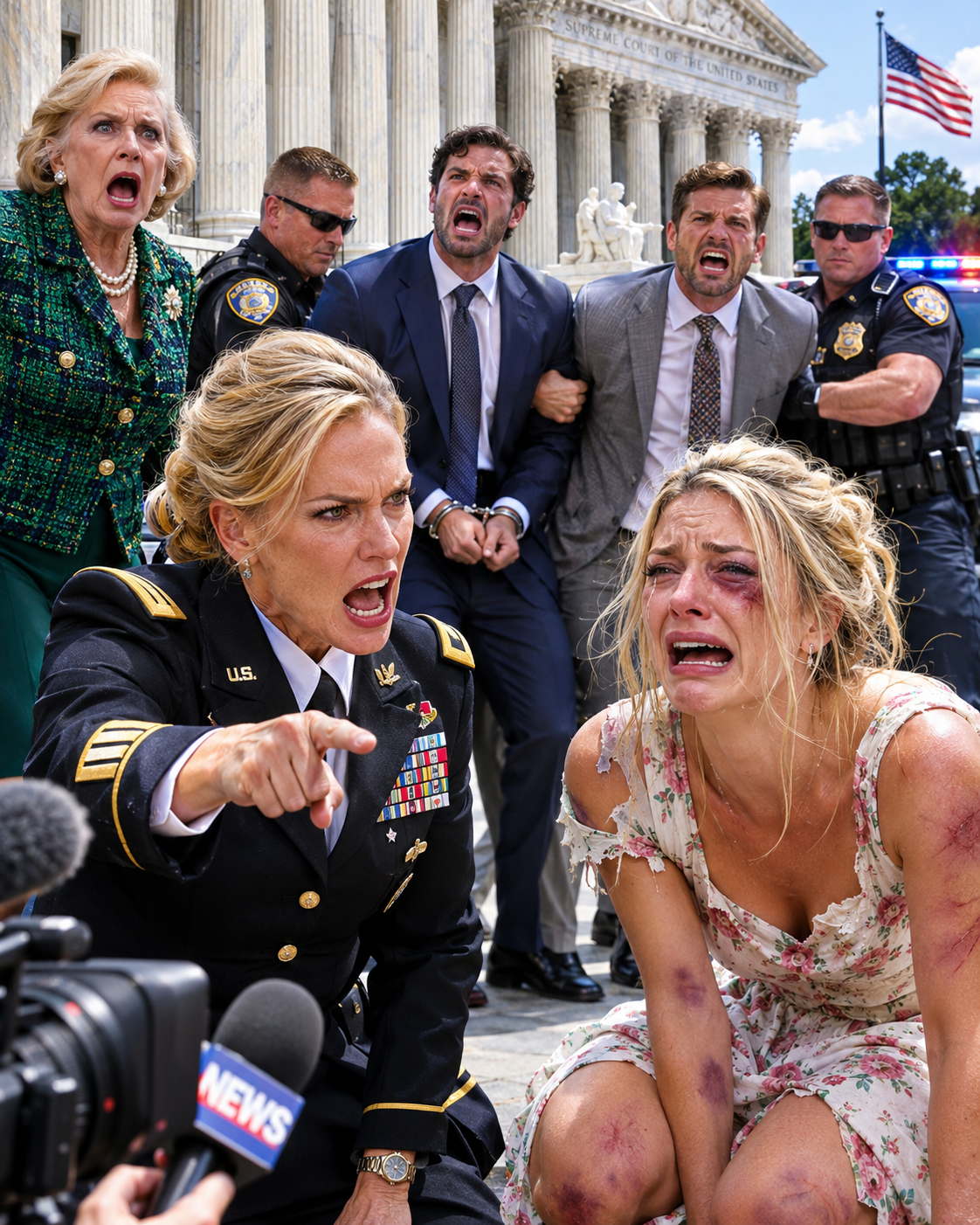
She looked at the handcuffs in Douglas’s hands.
“Sheriff Mercer,” Bennett said, her tone laced with absolute authority. “Is someone attempting to arrest my primary cooperating witness in an ongoing federal racketeering investigation?”
Douglas tried to recover.
“She is in possession of stolen county property. We have local jurisdiction.”
Bennett turned toward Brooks.
“Mr. Brooks voluntarily surrendered those records under the protections of the Federal Whistleblower Act. Records that, I might add, document your department’s complicity in extortion and wire fraud.”
The room became silent.
Two FBI agents entered behind her.
Bennett faced Douglas again.
“Remove the handcuffs, Douglas. Or I will have these agents arrest you for obstruction of justice right here, right now.”
The sheriff lowered his hands.
For the first time since I had returned to Missouri, a Mercer appeared to understand that his surname could no longer guarantee his safety.
But the federal intervention at the diner was only the beginning.
The Evidence Beneath Fairmont
By sunrise, the thunderstorm had passed.
Across Fairmont County, however, another storm was gathering.
Federal investigators began executing coordinated search warrants at six locations.
The operations were simultaneous, designed to prevent suspects from warning one another or destroying evidence.
At five in the morning, agents entered Travis Mercer’s residence.
He was taken into custody and escorted onto his front lawn in his underwear, shouting angrily until an agent reminded him that the arrest was not open to negotiation.
Dean attempted to escape.
Investigators intercepted him near the Missouri-Kansas border, driving an old pickup truck registered to a shell company associated with a county contractor.
Neither brother responded well to federal interrogation.
For years, they had relied on the knowledge that local authorities would protect them.
Now they were sitting across from investigators who had no obligation to obey Walter Mercer.
The evidence collected from the abandoned warehouse was devastating.
Investigators discovered traces of Emily’s blood despite an attempt to clean the scene with bleach.
Forensic specialists recovered fibers consistent with her damaged clothing from Travis’s truck.
A dive team located the tire iron in a drainage pond behind Dean’s property.
The physical evidence corroborated Emily’s account.
But it was the financial investigation that exposed the larger conspiracy.
Federal agents searched the offices of Bennett, Mercer and Shaw.
Inside a locked safe, they discovered draft documents intended to transfer control of Emily’s trust assets.
Several drafts already carried signatures purportedly belonging to Emily.
A handwriting examination indicated that those signatures had been forged.
The documents confirmed that the family had prepared to obtain the land even without her genuine consent.
The assault had been part of a calculated attempt to force the transfer before the public announcement of the highway bypass.
Investigators then traced property transactions across Fairmont County.
Over three years, companies secretly associated with Mercer relatives had purchased land near the proposed highway route.
The purchases had often occurred at remarkably low prices.
Residents who refused to sell had experienced a disturbing pattern of intimidation.
Some were subjected to sudden zoning violations that threatened their businesses.
Others were repeatedly stopped by sheriff’s deputies without clear justification.
Two landowners had been severely beaten, with their cases dismissed locally as ordinary bar fights.
Walter Mercer had built a system in which political influence, law enforcement authority, and private financial interests reinforced one another.
Travis and Dean supplied the violence.
Douglas supplied police protection.
The law firm supplied the paperwork.
And Walter controlled the broader operation.
Evan Brooks had spent months collecting evidence of that system.
He had recognized irregularities in county contracts and property records, then quietly preserved documents before anyone realized he was investigating.
His flash drive gave federal agents a way to connect crimes that had previously appeared unrelated.
Yet another crucial source emerged from inside the sheriff’s department.
Detective Sofia Ramirez.
I finally learned why she had disappeared from Emily’s case.
Ramirez had refused an order from Douglas Mercer to reclassify Emily’s kidnapping and assault as a domestic dispute between estranged relatives.
The sheriff suspended her without pay.
But before losing access to the department’s systems, Ramirez preserved her crime-scene photographs, interview notes, and dispatch recordings.
She also retained a copy of patrol dashcam footage showing Travis’s truck traveling toward the warehouse area at 12:41 a.m. on the night Emily was attacked.
The sheriff’s IT staff had deleted the footage from the main county servers.
Ramirez’s backup survived.
She had sacrificed her position rather than allow the evidence to disappear.
When investigators combined her records with Brooks’s financial documents and the forensic findings from the warehouse, the outline of the Mercer conspiracy became impossible to dismiss.
The Family Begins to Fall
Margaret Mercer was arrested three days later.
She was having lunch at the country club when federal agents approached her table.
The woman who had confidently threatened me across the Atlantic now found herself facing investigators who were entirely unimpressed by her family connections.
Her voicemail became Exhibit A in the federal proceedings.
The recording captured her boasting about her sons’ supposed immunity and inviting me to return to Fairmont.
She attempted to characterize the message as an emotional remark made during a family disagreement.
Prosecutors challenged that explanation with the surrounding evidence of intimidation and the attack on Emily.
The recording no longer sounded like the voice of a powerful woman.
It sounded like someone who had become so accustomed to escaping consequences that she had forgotten threats could be preserved.
Walter Mercer was next.
For decades, he had moved through Fairmont as though every office, road, and government employee existed to serve him.
When federal agents arrived at his commissioner’s office, he demanded that the county prosecutor intervene.
The prosecutor did not.
Walter called the governor’s office.
His calls were declined.
He tried contacting former deputies and political allies.
No one answered.
Eventually, he contacted his defense attorney.
After reviewing the evidence and charges, the attorney advised him to stop talking and consider the possibility of a negotiated plea.
The old networks of loyalty were collapsing.
As investigators expanded their inquiry, they uncovered evidence of bribery, election misconduct, witness intimidation, and laundering through municipal contracts.
Officials who had once protected one another began cooperating with federal prosecutors.
Each new witness supplied additional documents, conversations, and names.
The conspiracy widened far beyond Emily’s assault.
Douglas Mercer resigned as sheriff shortly before his grand jury indictment became public.
Deputy Pike, who had entered Emily’s hospital room to pressure her, agreed to cooperate in exchange for a reduced sentence.
His testimony connected Walter’s instructions to the effort to suppress the investigation.
The Mercer family had spent decades constructing a system designed to silence anyone who challenged them.
Now the same people who had enforced that silence were explaining the system to federal prosecutors.
I watched the developments from Emily’s hospital room whenever I could.
She was recovering slowly.
Her arm remained immobilized. The injuries around her face were still painful, and the fractured ribs made even ordinary movements difficult.
There were moments when she asked me to explain what investigators had found.
Other times, she wanted nothing to do with the case.
I respected both.
The federal investigation mattered.
But Emily’s recovery mattered more.
I had not returned to Missouri to win a political battle.
I had returned because my daughter had called me from a dark warehouse, frightened that she might die.
Every arrest and every recovered document was meaningful only because it helped ensure that the people who hurt her could not do it again.
The evidence continued accumulating.
The Mercer family’s attorneys challenged searches, questioned witnesses, and attempted to separate the financial crimes from the assault.
Federal prosecutors responded with records, testimony, forensic reports, and communications that showed how the pieces fit together.
The case would not be resolved quickly.
But its direction had changed.
For the first time in decades, Walter Mercer could not dictate which witnesses would be heard.
Travis and Dean could no longer intimidate people into silence.
And the people who had risked their livelihoods to preserve the truth were finally being taken seriously.
Yet as the criminal case moved toward trial, Emily faced a different kind of struggle.
The fractures could heal.
The bruises could fade.
But the terror she had experienced in that warehouse would not disappear simply because the men responsible were behind bars.
The battle for accountability was underway.
The harder battle—helping my daughter reclaim the life they had tried to take from her—was only beginning.
PART 3: The End of the Mercer Dynasty
The legal proceedings continued for almost fourteen months.
During that time, my life became divided between military responsibilities overseas and the federal courthouse in Missouri.
Whenever my duties permitted, I traveled back across the Atlantic to attend hearings.
I sat in the gallery, listening as prosecutors presented financial records, forensic findings, and witness testimony.
The courtroom was orderly, quiet, and procedural.
That almost made the evidence more disturbing.
The brutality inflicted on Emily was described in measured language.
The years of intimidation suffered by Fairmont residents appeared in carefully organized exhibits.
The abuse of public office was documented through financial statements, recorded conversations, and official records.
What the Mercer family had once treated as unquestionable authority was gradually reduced to evidence that could be examined and challenged.
Emily attended only when her testimony was required.
She refused to allow the proceedings to become the center of her life.
I admired that decision.
Her recovery demanded more courage than most people would ever understand.
Physical therapy for her damaged arm was exhausting and painful. Some sessions ended with tears.
Sleep remained difficult.
Certain sounds brought back memories she desperately wanted to leave behind.
The metallic impact of an object hitting concrete could make her freeze.
The rumble of a diesel engine outside her window sometimes sent her heart racing before she could remind herself that she was safe.
There were days when she felt strong and hopeful.
There were others when simply getting through the afternoon seemed like an achievement.
But she continued.
Gradually, she returned to her graduate studies.
She moved from her previous residence into a brighter apartment with better security.
Then she adopted a stubborn orange tabby cat with one eye.
She named him Sherman.
Sherman developed the habit of sleeping at the foot of her bed, apparently convinced that the entire apartment belonged to him.
Emily complained about his behavior constantly.
Yet whenever I visited, I noticed that she smiled while doing it.
The first time I heard her laugh without immediately falling silent, I had to turn away for a moment.
I did not want her to see me cry.
The laugh was ordinary.
It was also something I had feared I might never hear again.
The Sentencing
On the morning Walter Mercer was sentenced, Emily and I sat together in the front row of the federal courtroom.
The room was crowded.
Reporters filled the available seating, joined by former county employees, residents who had testified, and people whose lives had been affected by the family’s corruption.
Walter entered wearing an orange prison uniform.
Without his expensive suits and the symbols of authority he had worn for decades, he looked diminished.
His shoulders seemed narrower.
His face appeared older.
He was no longer the imposing patriarch who had ruled Fairmont through intimidation.
He was a defendant awaiting judgment.
The federal judge addressed the conduct revealed during the investigation.
She described the family’s abuse of authority as a “parasitic abuse of public trust built upon a foundation of manufactured fear.”
I listened without moving.
The judge then imposed the sentences.
Walter Mercer received twenty-two years in federal prison, without the possibility of early parole as described in the judgment.
Travis received seventeen years for aggravated kidnapping and assault.
Dean received fifteen.
Margaret Mercer was sentenced to six years for conspiracy to commit fraud and felony witness intimidation.
Douglas Mercer received eight years for obstruction and civil rights violations.
The family that had controlled Fairmont through fear was finally being held accountable.
I looked toward Emily.
She watched quietly.
There was no triumphant smile on her face.
No sudden release of emotion.
She simply listened until the proceedings ended.
For fourteen months, the case had consumed so much of our lives.
Now the sentences were official.
The men who had broken her bones would spend years in prison.
The people who had protected them had lost their positions and influence.
But no sentence could erase what Emily had endured.
As the courtroom emptied, I remained beside her.
We waited until the crowd began moving toward the exits.
Then we stood and walked outside.
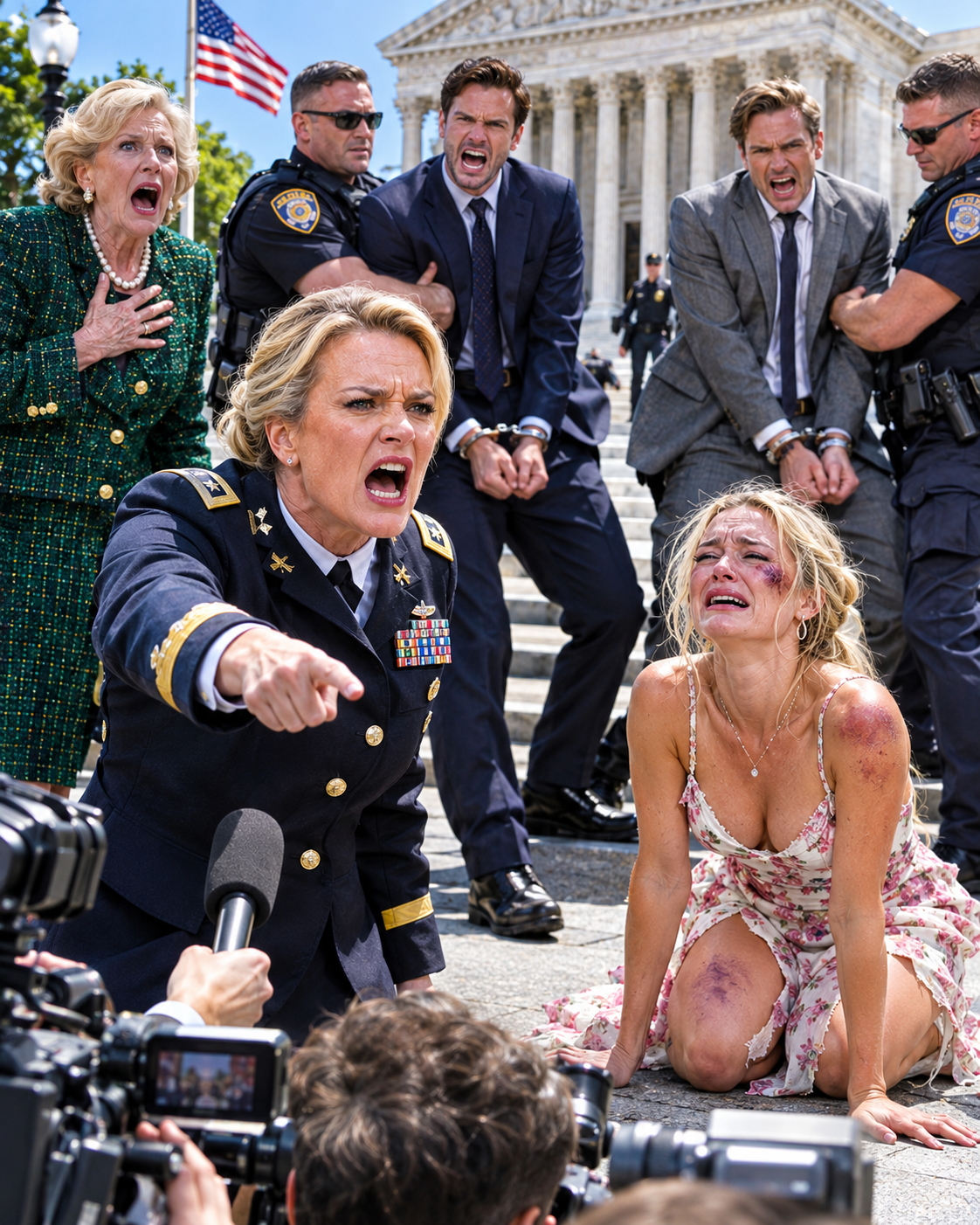
The Courthouse Steps
Reporters gathered on the broad marble staircase.
Cameras turned toward us as soon as we emerged.
Questions came from several directions, but I did not stop.
I kept a protective hand near Emily’s back as we descended.
Halfway down the steps, she paused.
Autumn wind moved through her hair.
“You know what’s weird, Mom?”
I turned toward her.
“What’s that, sweetie?”
“I thought… I thought this moment would feel bigger. Heavier.”
“The sentencing?”
“Yeah.”
She looked back at the courthouse doors.
“They spent my entire childhood acting like they were gods. Acting like every single person in this state should be terrified of them. And now? They just look like sad, old men in ugly orange suits.”
I studied her face.
For years, the Mercer name had represented something enormous in her world.
Their threats had seemed unavoidable.
Their influence had appeared limitless.
Now she had watched them stand before a judge and receive sentences like any other defendants.
Their power had depended on people believing it could never be challenged.
That belief was gone.
A reporter approached with a microphone.
I guided Emily through the remaining crowd without responding.
Near the bottom of the staircase, beside a black town car, stood a familiar figure.
Colonel Nathan Cole.
He wore a gray civilian suit, but his posture was unmistakable.
I had not known he was coming.
“You came all this way for a sentencing hearing, Nathan?”
He shrugged.
“I had some leave accumulated. Figured I’d take in the local Missouri scenery.”
Emily walked directly toward him.
She wrapped her uninjured arm around him in a tight embrace.
“Thank you, Colonel.”
Cole appeared briefly uncertain about what to do.
He patted her back.
“For what, Emily?”
“For making those phone calls. For saving me.”
He gently stepped back and looked at me.
“Emily, I made exactly three phone calls from a comfortable desk in Germany.”
He nodded in my direction.
“Your mother orchestrated the rest. She tore this town down to the studs.”
I shook my head.
I thought of the people whose names would never become headlines.
The frightened county employee who had spent months collecting evidence.
The detective who had refused to falsify a report.
The federal investigators who had followed the records.
The prosecutors who had built the case.
“No, Nathan,” I said softly. “Evan Brooks risked his entire career and his freedom. Detective Ramirez sacrificed her badge to save the evidence. Laura Bennett and the federal investigators followed the trail relentlessly. The prosecutors built an airtight cage.”
I looked at Emily.
“And Emily… Emily survived it. She didn’t break. That’s why we won.”
Cole smiled.
“Spoken like a true officer, Hale. That sounds exactly like the concluding paragraph you’d put in an official After-Action Report.”
I laughed.
It surprised me.
For more than a year, I had carried the weight of the attack, the investigation, and Emily’s recovery.
Now, standing outside the courthouse with my daughter beside me, I felt that weight begin to shift.
It had not disappeared.
But it was no longer crushing me.
Forty-Three Acres
That evening, Emily and I drove beyond the Fairmont city limits.
The sky was changing from gold to violet as the sun sank toward the horizon.
We followed the highway until we reached Daniel’s forty-three acres.
The property had once been considered almost worthless.
It was open, undeveloped land covered in wild grass and scrub, with little to distinguish it from the surrounding countryside.
But the highway bypass changed its future.
After the federal indictments became public, the state officially announced the planned route.
Commercial developers quickly recognized the value of property near the proposed interchange.
Emily began receiving offers.
Some were extraordinarily generous.
Selling the land could have provided her with financial security for the rest of her life.
She refused.
Instead, she arranged to subdivide the property held by the trust.
She selected the most valuable section, the portion bordering the future main road, and donated it to a nonprofit foundation.
We parked along the shoulder and walked toward the chain-link fence.
A new wooden sign had been installed near the road.
I stopped in front of it.
The painted words read:
THE EMILY HALE REGIONAL RESOURCE CENTER: FOR VICTIMS OF DOMESTIC ABUSE & CORRUPTION.
For a moment, neither of us spoke.
I looked across the land, imagining what would eventually stand there.
A place where people facing violence and intimidation could seek assistance.
A place intended to help people who had been made to believe that powerful families could never be challenged.
I turned toward Emily.
“Are you absolutely sure about this, Em?”
I looked at the property again.
“You could have set yourself up for life with the money from this parcel.”
Emily nodded.
“They wanted this land so badly because they thought everything in this world had a price tag. They thought money and fear were the only currencies that mattered.”
She turned toward the highway.
“Let them drive past that sign,” she said, her voice ringing with quiet, absolute victory. “Let them see my name every single morning, and remind them that they lost.”
I pulled her into an embrace.
For so long, the Mercers had tried to define what happened to everyone around them.
They had used money to purchase loyalty.
They had used political influence to silence complaints.
They had used violence against people who refused to surrender.
And when Emily stood in their way, they had tried to break her body and frighten her into submission.
But she was standing beside me now.
The land remained under her control.
The family that had tried to steal it was facing years behind bars.
And the most valuable portion of the property would serve people who needed protection from precisely the kind of abuse the Mercers had inflicted.
I remembered Margaret’s voicemail.
“My boys are untouchable, soldier,” she purred.
I remembered her laughter.
I remembered the moment Colonel Cole had listened to the recording and reached for his secure telephone.
At the time, he had promised that the town would soon understand the magnitude of its mistake.
He had been right about the outcome.
But the process had taken much longer than either of us could have imagined.
It had required months of investigation.
It had required evidence preserved by people who knew they might lose everything if they were discovered.
It had required witnesses to speak despite their fear.
It had required investigators and prosecutors who were willing to follow the facts wherever they led.
Most importantly, it had required Emily to survive the attack and continue living beyond it.
I had spent twenty-two years in uniform believing that discipline and planning could bring order to even the most dangerous situations.
But this experience taught me something that no military assignment ever had.
I could coordinate resources.
I could seek assistance.
I could protect evidence and challenge people who abused their authority.
I could stand beside my daughter through the investigation and the long, painful months of recovery.
What I could not do was live her life for her.
Emily had to make that journey herself.
And she had.
She had returned to her studies.
She had built a home where she felt safe.
She had found small reasons to smile again.
She had taken the land her relatives wanted to steal and transformed part of it into something that could protect others.
As we stood together beside the fence, I understood that her greatest victory was not the prison sentences.
It was the fact that the Mercers had failed to determine the rest of her life.
They had wanted her frightened, silent, and obedient.
Instead, she had chosen what the land would become.
The last light of the evening spread across the fields.
I kept my arm around her shoulders as we looked toward the highway.
Months earlier, Margaret Mercer had laughed into a telephone receiver. My boys are untouchable.
I remembered standing in Colonel Cole’s office in Germany, listening to the hum of the base, hearing him promise that by morning, they would wish they had never touched her.
Cole had been a brilliant tactician, but he had been wrong about one minor detail.
It took much longer than a single morning.
It took an avalanche of undeniable evidence. It took the bravery of terrified witnesses stepping out of the shadows. It took a unified front of uncorrupted law enforcement.
Most of all, it took a daughter who flatly refused to disappear into the dark.
But eventually, the siege ended. In the rusted, broken town that the Mercer family believed belonged exclusively to them, every locked door was finally kicked open.
And for the first time in three decades, when Emily and I walked down Main Street, nobody stepped aside.
