


PART 1: The Family He Called a Burden
On the morning of the wedding, my sixteen-year-old son quietly sent his father a banana box as a present. I knew nothing about its contents. That changed when I heard my sister reading an old letter aloud—and my former husband desperately pleading with her to stop. But everything that led to that moment began one evening in our kitchen, while I was cutting up a pear.
We lived outside Columbus, Ohio. Our youngest had just turned two and remained convinced that a snack and his mother’s attention could put almost anything right. My name is Marissa Keller. For eighteen years, I had been married to Curtis, raising seven sons in a house that was hardly ever silent or orderly. Its familiar disorder belonged to us: children needing help, meals needing preparation, and one ordinary family day running straight into the next.
Curtis arrived a little after six with his familiar leather briefcase. Something in his manner made me turn from the counter before he said anything. He loosened his tie, set his keys beside the fruit bowl, and regarded me with an expression I couldn’t place. “Marissa, I need to tell you something, and I’d appreciate it if we could talk without arguing.” I laid down the knife. I expected trouble at work, perhaps another bill we would need to fit into our strained budget.
Instead, he announced that he was leaving. He wasn’t asking for space to think, and he wasn’t proposing that we repair some neglected part of our marriage. He had fallen in love with someone else. My younger sister, Kelsey. For a few moments, I simply stared. Both of them had shared our Thanksgiving meals and celebrated our children’s birthdays. I had trusted them without hesitation. “You’re talking about my sister?” I finally asked. “Yes, Marissa. Kelsey and I have been seeing each other for a while.”
When I asked how long, he said their relationship had started more than six months before. He explained that neither of them had intended for friendship to become anything else. I couldn’t bear listening to him describe one deliberate decision after another as if neither person had been responsible. Upstairs, our regular evening carried on. Someone was arguing about the shower, someone needed homework help, and Finn was upset because his favorite stuffed rabbit had vanished. At the front window, our golden retriever, Bruno, began to bark.
Curtis shut his eyes and pressed a hand to his forehead. “This is exactly what I’m talking about. I can’t keep living like this.” I looked at him, bewildered. “Living like what?” He motioned toward the floor above us. “The constant noise, the expenses, the laundry, the crying, the schedules. There’s always somebody who needs something. I come home exhausted, and I never get a minute to myself.” I remember looking away from him toward the refrigerator, covered with photographs and uneven drawings.
Little sneakers lay abandoned near the back door. None of those children had appeared in his life unexpectedly. We had welcomed every one of them into the family we chose to build. Yet he spoke as though their needs were burdens someone else had assigned him. Then he said the words that would remain with me long after much of that evening blurred. “Kelsey’s life is different. She doesn’t have children. When I’m with her, everything feels simple.”
Before I found an answer, Tyler appeared in the doorway. Our oldest was sixteen. His gaze moved from his father to me, then toward the suitcase waiting beside the stairs. “Dad, are you going somewhere?” Curtis drew his shoulders back. “Your mother and I are discussing something. We’ll explain later.” I watched something change in Tyler’s face. He wasn’t looking at either of us as though this were merely a business trip or a disagreement about money.
“Is this about Aunt Kelsey?” The silence that followed answered more than any explanation could have. My son had recognized something before I did. I stood there with the awful knowledge that he had been carrying it while I continued trusting the people closest to me. Curtis offered no answer that could undo what Tyler had heard, what I had learned, or what was waiting in that suitcase beside the stairs.
A few minutes later, Curtis lifted his suitcase and left. He didn’t go upstairs to say goodbye to the younger boys. From the kitchen window, I watched his car travel down the street until it disappeared. Behind me, our sons were still calling about dinner. They had no idea that the life they relied on had just shifted beneath them. I remained at the window while the ordinary demands of the evening continued, waiting for the mother who still had to answer them.
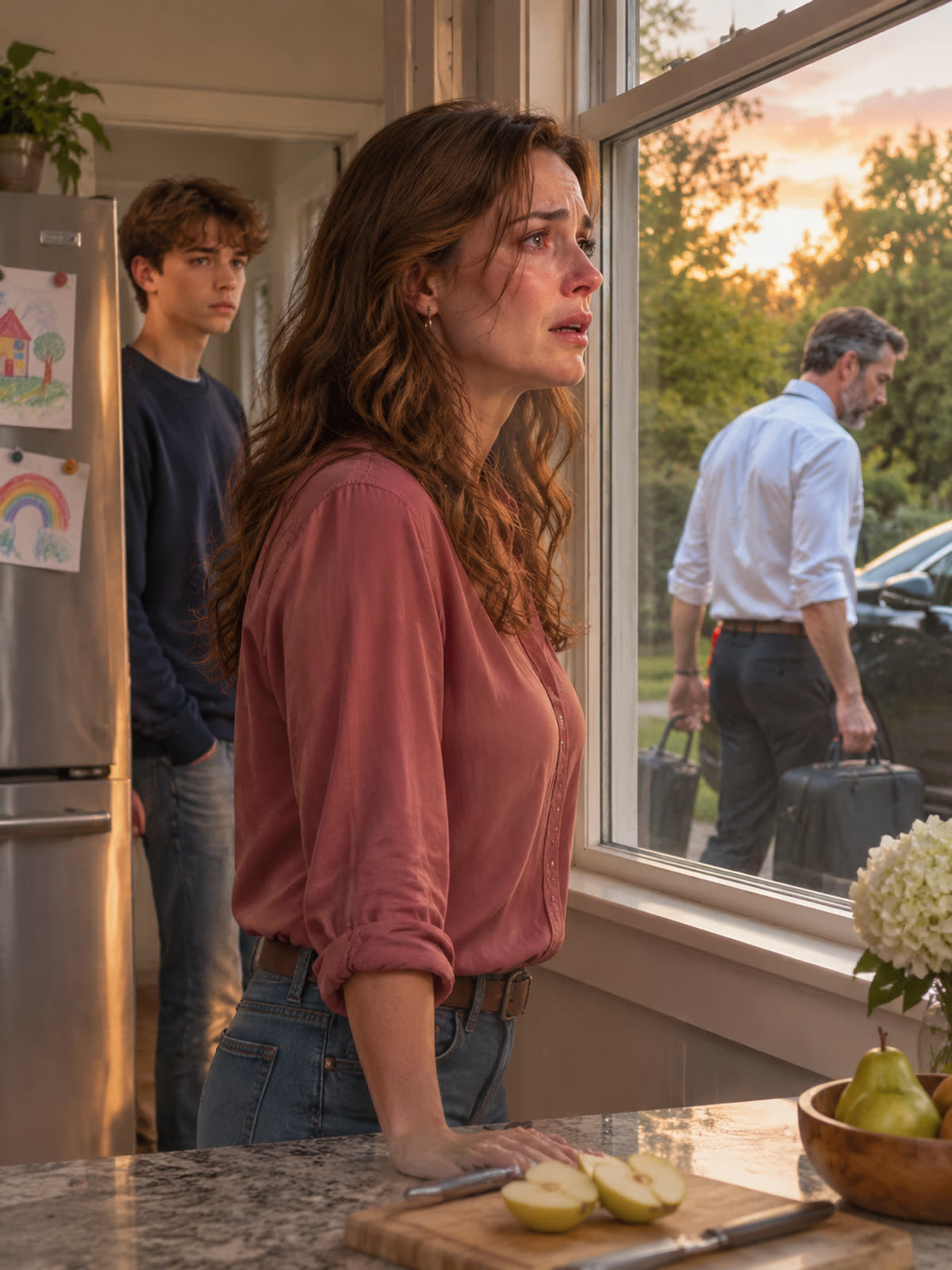
You cannot explain a divorce to seven hungry children, so I made spaghetti. Tyler helped his brothers prepare the table. Fourteen-year-old Brandon poured milk, and Sean, twelve, counted forks. Dylan, ten, searched beneath the couch for Finn’s rabbit. Wyatt and Hudson, eight and six, argued over the seat beside me. Finn kept pointing toward the driveway and asking, “Daddy?” I answered the questions I could manage and avoided the ones I couldn’t yet bear to explain.
Later, while I was putting Hudson to bed, he wrapped his arms around my neck. “Did Dad leave because we’re too loud?” My chest ached. “No, baby. Nothing you did made him go.” He held on to me. “But he always says we’re too loud.” I stayed beside him until his breathing became slow and even. More than anything, I wanted to keep one terrible belief from taking root: that a child becomes difficult to love simply by needing things.
Finn stayed awake the longest. Curtis used to raise him overhead every night, making airplane noises until he dissolved into laughter. Now Finn stretched his arms toward me. “Daddy airplane?” I lifted him and turned in a small circle. He frowned. He understood that it wasn’t the same, even if he couldn’t understand why. Once the house finally settled, I called Kelsey. She answered on the second ring, and I asked how long it had been happening.
After a silence, she said, “Marissa, I never wanted you to find out this way.” “How did you want me to find out?” “I didn’t think it would turn into this.” I couldn’t separate her voice from all the ordinary afternoons she had spent in our home. “You came to every Sunday dinner. You held my baby. You sat at my table while you were sleeping with my husband.” She began crying. I didn’t. I ended the call and sat on the kitchen floor with Bruno’s head against my knee until the sky grew gray.
The following weeks passed in a confusion of packed lunches and legal appointments. Curtis rented an apartment downtown and promptly filed for divorce. His attorney was polished; mine, Patricia Gold, was calm and patient. When the court established child support, Curtis objected to every dollar. At first, he took the boys on alternate weekends. Then the cancellations began. “Work,” he would say. Or, “Kelsey and I have plans.” Eventually, Finn stopped asking for him. That was the part that hurt most.
Tyler grew quieter. He also began taking care of things before anyone asked. He made lunches, read bedtime stories, and repaired the loose porch step. One night, at midnight, I discovered him at the kitchen table working through fractions with Sean. “You don’t have to do all this,” I told him. “Someone has to,” he said, returning his attention to the worksheet. I wanted to cry. Instead, I rested my hand on his shoulder, looking at a boy who was already carrying more than he should.
Four months after Curtis left, a thick cream envelope arrived. Its edges were gold. Inside was a wedding invitation: Curtis Lowell and Kelsey Keller request the honor of your presence. There was no personal note, nothing to soften what they were asking me to accept. Standing at the mailbox, I felt as though the ground had tilted. It didn’t feel like an invitation. It felt like an announcement that they were finished waiting for me to be all right.
I put it away in the junk drawer. I had no intention of attending, and I didn’t want to discuss it. But Tyler saw the invitation. During the week before the wedding, I noticed a banana box sitting in the garage. It was an ordinary cardboard produce box, the kind grocery stores give away, with tape sealing its lid. I assumed it had been left over from when we moved in years earlier. I never opened it.
There was no reason, I thought, to connect that box with the wedding invitation hidden inside the house. I had enough to manage without investigating an old piece of cardboard in the garage. Tyler had said nothing about it, and Brandon hadn’t mentioned it either. As the wedding approached, I continued trying to keep our days ordinary for the younger boys, unaware that something had already been arranged without me.
Then the wedding morning arrived. The banana box was no longer in the garage. I hadn’t moved it, and I had never looked beneath its taped lid. Only later would I understand why Tyler had kept quiet about it. At breakfast, all I knew was that the box I had barely noticed was gone.
PART 2: The Promise Inside the Box
“Tyler,” I said at breakfast, “have you seen that box in the garage?” He kept looking down at his cereal. “I sent it.” I waited for him to explain. “Sent it where?” “To Dad’s wedding. As a gift.” I lowered my coffee. Until then, the box had been nothing more than something missing from the garage. Now it was on its way to a wedding I couldn’t bring myself to attend. “Tyler. What’s in it?”
“Just some of Dad’s stuff.” At last, he looked up. His eyes were steady, carrying a seriousness that seemed older than sixteen. “Nothing mean. Nothing fake. I promise. It’s all true. It’s all stuff Dad wrote or said himself.” I tried to interrupt. “Honey, you can’t just—” “Mom.” He drew a breath. “I’m not trying to hurt anyone. I just think they should have it. They should know what he left.”
A hundred responses crowded my mind, but none became words. I wanted to be angry and tell him to stop. Yet sitting across from me was a boy who had watched his father leave and had been carrying the hurt ever since. “Did you tell anyone else?” “Brandon helped me pack it. He didn’t read it, though.” I closed my eyes. “I need you to understand something. You’re not responsible for fixing what Dad did. That’s not your job.”
“I know,” he said. “I just didn’t want it to disappear.” The wedding was scheduled for three. That afternoon, I took the boys to the park and tried to make it feel like any other day. Dylan scraped a knee. Finn picked a dandelion and called it a “wish.” Wyatt cried after losing a soccer game. Hudson wanted to know whether Daddy was happy. “I hope so,” I answered, surprised to realize that a small part of me meant it.
At ten past four, my phone rang. Curtis’s name appeared on the screen. I nearly let the call go unanswered, but something made me pick up. “Marissa.” His voice trembled with anger. “What did you send us?” “I didn’t send you anything.” Whatever had happened, he was already certain I was responsible. “A banana box! It came to the reception! The coordinator handed it to Kelsey, and she opened it in front of everyone!”
“Curtis—” “Don’t play dumb. You put him up to it. You turned our son against me!” His accusation reached me before I had learned what Tyler had packed. “I didn’t know what was in it. I still don’t.” For a moment, he said nothing. Then another sound came through the call, faint behind him: a woman speaking into a microphone. Her voice was unsteady, as though the words she was reading were becoming harder to say.
I recognized Kelsey. She was reading aloud. I put the call on speaker almost without thinking. Tyler stood in the doorway, his face drained of color, and Brandon edged in behind him. Whatever confidence Tyler had shown at breakfast, he was now listening with the rest of us. We could hear what was happening at the reception, but we couldn’t see what Curtis was doing or what Kelsey held in her hands.
Her voice came through the phone small and uneven. Until that moment, I still had no idea what words my son had sent. He had promised they weren’t invented, that everything belonged to his father. Now the ordinary room around us seemed to narrow to the sound of my sister reading. Tyler remained by the doorway. Brandon stayed behind him. I listened without interrupting, waiting to understand what had made Curtis call in such a fury.
It was a letter. Not something written for the wedding or prepared as an accusation, but words from an earlier night in our family’s life. Kelsey read them where the guests could hear. I had never seen the letter myself. Hearing it in her voice, across a phone connection, was how I discovered the promise Curtis had once put on paper for his sons.
“‘To my sons, whoever you turn out to be. I’m writing this at three in the morning in the hospital parking lot, because your mother is asleep and I can’t. Finn was born tonight. Seven boys. I don’t know how a man gets this lucky. I keep thinking about my own father, who left when I was nine. I promised myself I’d never be him. So here’s a promise in writing, in case I forget when things get hard: I will never walk away from you. I will never call you a burden. If I ever do, it means I’ve become the man I swore I’d never be. And if anyone ever reads this out loud, it means I did.’” For a moment, everything went quiet. Then I heard Curtis, ragged and desperate, speaking away from the phone. “Kelsey, stop. Please stop. Give me that.”
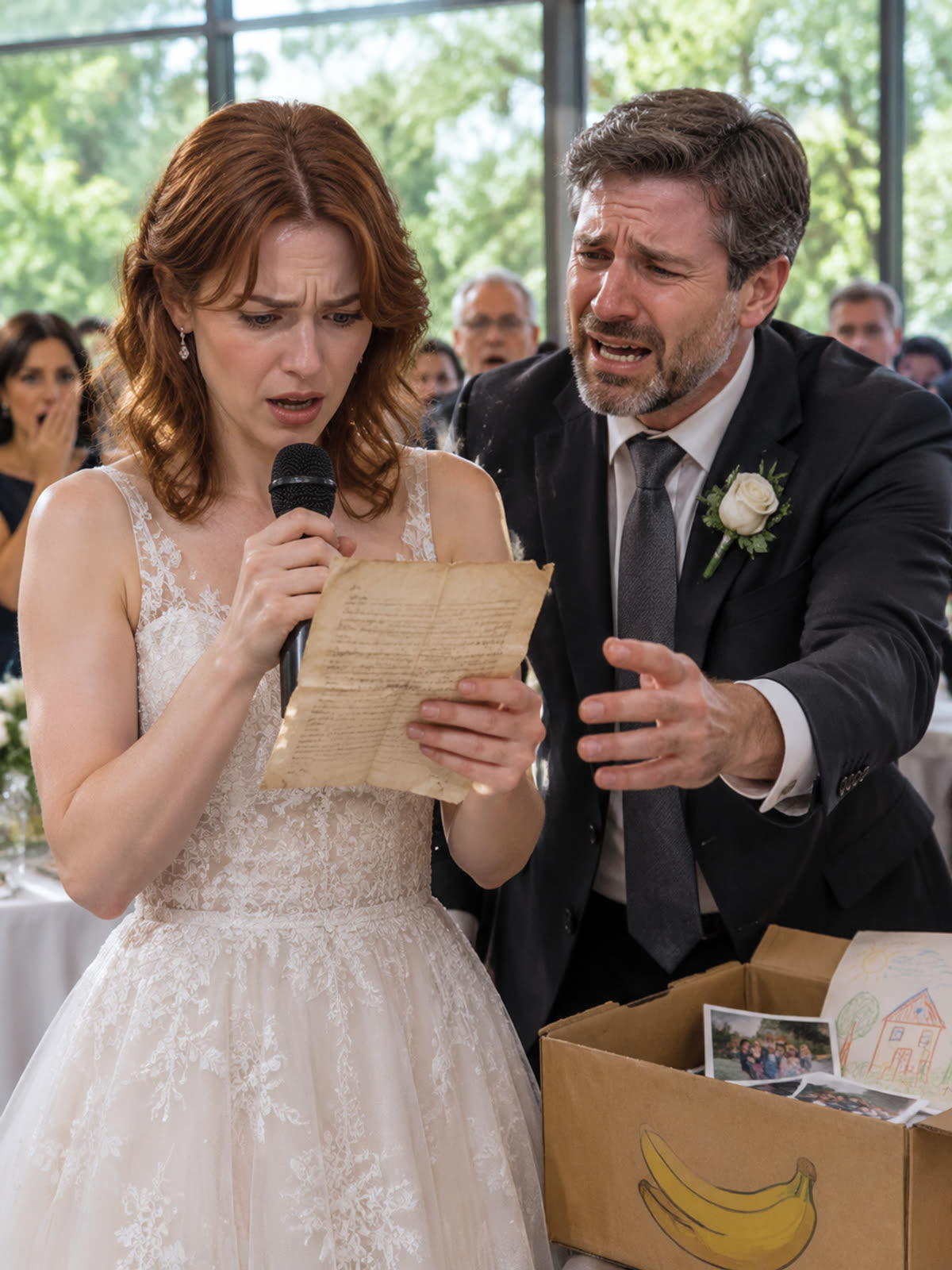
“Curtis,” she said. “Is this your handwriting?” “Please.” Her voice no longer sounded merely uncertain. “You told me you were the one who’d been abandoned. You told me your family held you back. You never said you —” He interrupted her. “Kelsey, please. Put it down. Not here. Not in front of everyone.” I heard the scrape of a chair, then a gasp. Someone said, “Oh my God.” The connection ended.
I stayed motionless at the kitchen table, surrounded by the boys. Nobody said anything. Curtis had called wanting an explanation, but the call had given us one instead. The letter contained words he had written himself, words about the very children whose needs he later resented. I had heard him beg for them not to be read aloud. I still didn’t know what else was in the box, or how Tyler had found that letter.
That evening, Tyler explained everything. There had been four things inside. The first was the letter. Curtis had tucked it into a book and left it in our garage on the night Finn was born. I had never known it existed. Tyler came across it two years earlier while searching for a stapler. He read it once, returned it to its place, and told no one.
For two years, that promise had remained where Curtis left it. Tyler had known what it said while I knew nothing about it. He had heard his father speak of our noisy household and then watched him walk away from it. When he packed the box, he didn’t need to write an account of what his father had done. The letter already held Curtis’s own description of the kind of man he had sworn never to become.
The second thing was a handful of family photographs. In one, Curtis stood with all seven boys at the lake. Others showed him asleep on the couch with babies lying on his chest. Another captured him laughing at Finn’s first birthday. They were pieces of a life he had shared willingly, moments in which the family he later described as exhausting had also been the source of his happiness.
Third came a small pile of drawings, each bearing a crayon signature. To Dad. I love you. From Wyatt. To Dad, from Hudson. They were the kinds of pictures children make because they love someone and expect that love to be understood. Tyler had included them with the photographs and letter. There was nothing fabricated among those things, just as he had promised me at breakfast.
The fourth item was Tyler’s own note, folded in half. I didn’t ask him to let me read it. He told me what he had written anyway. “Dad, I’m not mad. I just wanted you to have these. They’re yours. You wrote the first one. We’ll be okay. Tyler.” That was all. No long accusation, no demand that his father explain himself in front of the wedding guests. He had sent back the things Curtis had left behind.
When Tyler finished, I pulled him close. He had grown taller than me, all elbows and shoulder blades, but he was still my son. He had been helping his brothers, making lunches, and sitting over homework late at night while trying to understand why his father had gone. I held him without asking him to explain any more. For that moment, he didn’t need to carry the conversation, or the household, or anybody else.
“I wasn’t trying to ruin their day,” he said into my hair. “I know.” He stayed against me. “I just didn’t want him to forget.” “I know, honey.” I believed him. The box had contained photographs, drawings, a letter, and a short note. What happened when they were opened was something neither of us had controlled. He had wanted his father to remember the family and the promise, not make either one disappear.
Then Tyler asked the question that had remained after the call ended, after he explained the box, and after I put my arms around him. There was no anger in it, only the need to know whether his father understood what his leaving had done. “Do you think he feels bad?”
PART 3: What an Apology Had to Prove
I remembered Curtis’s voice over the phone, begging my sister not to keep reading words he had written himself. “I think he does,” I told Tyler. “I think he feels it right now more than he ever has.” I couldn’t offer him more than that. Feeling sorry and repairing what had happened were different things. For the moment, all I knew was what I had heard, and how desperately Curtis had wanted the reading to stop.
Kelsey called three days later. I let the phone ring for a long time before answering. “Marissa,” she said. Her voice was hoarse, as though she hadn’t slept. “I’m not calling to defend myself. I just want to tell you what happened.” I said nothing. She had explanations I hadn’t asked for, but I stayed on the line and let her speak.
“After he read the letter, he tried to take it back. He said it was old, that it didn’t mean anything. And I looked at him and thought: this is the man who sat at your table and told you he was a good father. Then I looked around the room. Everyone had stopped. His boss, my friends, his mother. And I realized I didn’t know him at all.”
“What did you do?” I asked. “I took off my ring in the middle of the reception. I handed it back. I walked out in my dress.” A small, broken laugh escaped her. “My own sister’s husband. What was I thinking?” “I don’t know, Kelsey.” There was no answer I could offer that would make her choices easier to understand. I had spent too long trying to understand them myself.
“I don’t either. I told myself it was love. I told myself you two were already finished. But I knew. I knew every time I smiled at your kids. I knew every time you hugged me. I’m so sorry, Marissa. I don’t expect you to forgive me. I just needed you to hear it.” Through the window, I watched Finn running in circles after Bruno. “I’m not ready to forgive you,” I said. “Maybe someday. But thank you for telling me.”
“That’s more than I deserve.” “It might be.” I paused before continuing. “Kelsey, the boys had nothing to do with this. If you ever want to be their aunt again, that’s a long road. But it starts with you being honest, and staying honest.” “I will.” We ended the call. We had not reconciled, and nothing she said erased what had happened. Still, it was something different from excuses, and that mattered.
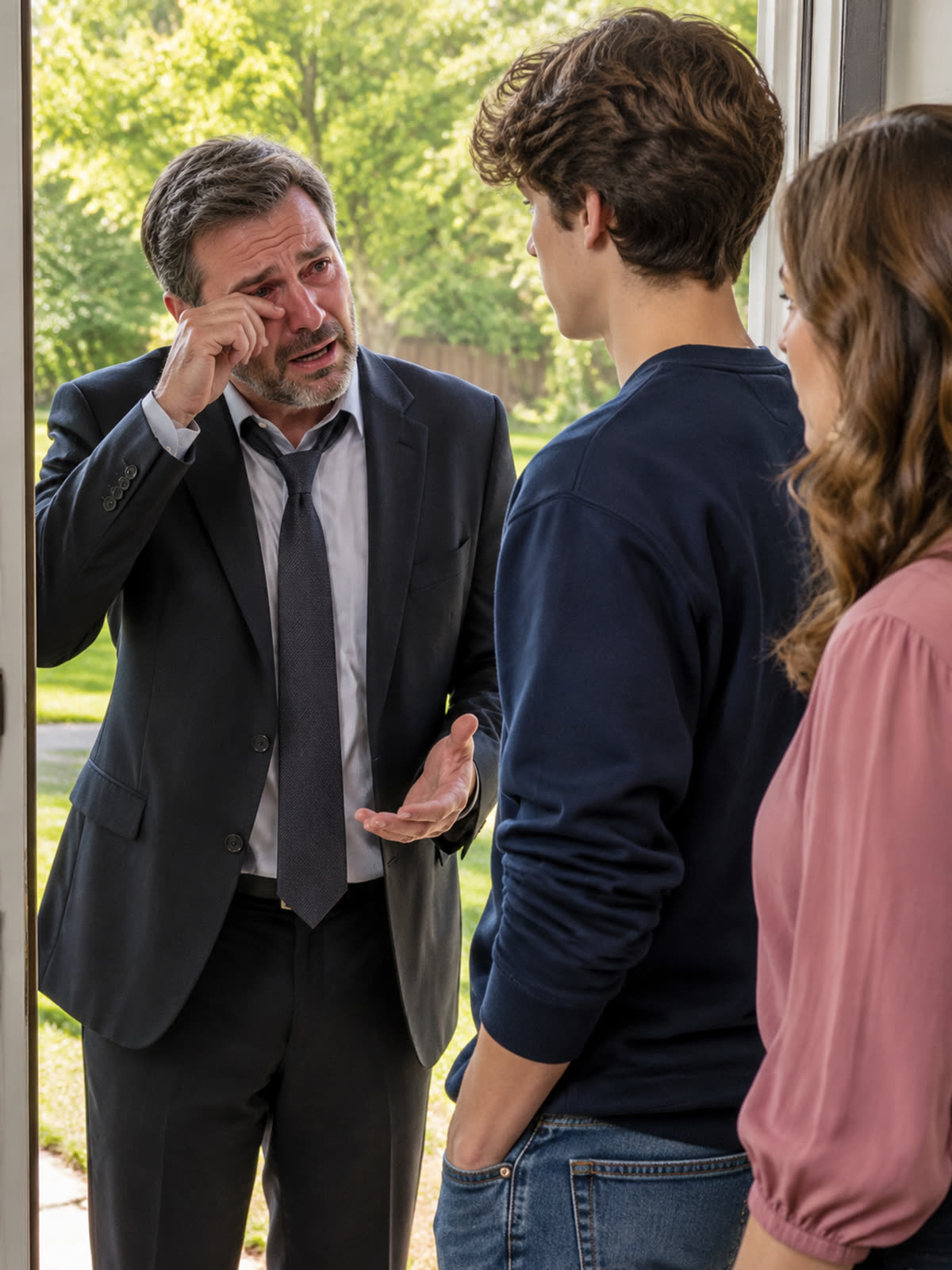
The following Saturday, Curtis appeared at the front door. He looked older. His tie sat crookedly, and his eyes were red. I opened the door without asking him inside. After everything that had passed between us, I wasn’t going to decide on the boys’ behalf what they owed him. He would have to speak to them himself, and they would have to be allowed their own answers.
“I want to see the boys,” he said. “They’re in the backyard.” “I want to talk to Tyler.” “Let me ask him.” I went to get our oldest. He came to the doorway and stood beside me, hands in his pockets, shoulders straight. Curtis looked at him for a long moment. There was no letter between them now and no microphone carrying anyone’s words. There was only the father who had left and the son who had sent his promise back.
“I read your note,” Curtis said. Tyler nodded. “I don’t deserve it.” “No,” Tyler answered gently. “But I wrote it anyway.” Curtis’s expression collapsed. He could no longer hide behind anger about the wedding gift or an accusation that I had turned his son against him. Tyler had given him no argument to fight, only the truth of what he had written and what he had done.
“I’m sorry. I’m so sorry. I was a coward. I wrote that letter, and then I broke every word.” Tyler didn’t turn away from him. “Yeah,” he said. “You did.” Curtis wiped his face. “Can I—” He stopped, then tried again. “Can I try again? Slowly. However you want.” Tyler looked at me, and I looked back. I would not make this decision for him. Whatever happened next between them had to begin with his choice.
“You can try,” Tyler said. “But you can’t just say sorry. You have to show up. Every time. Even when it’s boring. Even when it’s loud.” “I will,” Curtis whispered. “We’ll see.” It was not a joyful reunion. There were no embraces and no tears of forgiveness. Tyler hadn’t promised to forget anything. He had offered his father a chance to prove that this promise would be different from the one folded inside the book.
Curtis went into the backyard and sat on the grass. Finn climbed into his lap as though the question waiting in him had never changed. “Daddy airplane?” With trembling arms, Curtis raised him into the air. Finn laughed. I stood at the kitchen window, watching. What I felt was something I couldn’t name. The sound of that laugh did not erase the evenings Finn had waited, but there it was.
Our divorce became final in the spring. Curtis did not miss another weekend. He didn’t turn into a perfect father. He still lost patience, and the noise still drew complaints from him. But he continued to arrive. When he slipped, he apologized directly to the boys instead of expecting me to do it for him. Their relationship could not be repaired through promises alone, and at last he seemed willing to do the ordinary work.
Patricia helped revise the support agreement so that it was clear and fair. This time, Curtis didn’t argue. Kelsey moved to Denver for a new job. She sent the boys birthday cards with brief, careful messages and no requests attached. By the next Thanksgiving, Wyatt asked whether she could visit. “Not yet,” I told him. “Okay,” he replied. That was enough. I didn’t have to offer forgiveness before I was ready.
I returned to school part-time. Teaching was something I had always wanted to do. I completed my degree the following year, then began teaching second grade that fall. At my first parent night, the boys cheered for me. Finn was nearly four by then. “That’s my mom. She’s the teacher.” He told everyone. After so long answering what our family needed, I was doing something I had wanted for myself, with my sons there to celebrate it.
On the last day of that school year, Tyler and I sat together on the porch. He was seventeen now, taller and steadier, preparing to apply to colleges. The boy who had packed the banana box still had a question about it. “Mom,” he said, “was it wrong? Sending the box?” I took a long time before answering. He deserved more than a quick reassurance just because the truth had finally been heard.
“I think it was brave,” I said. “And I think it was risky. You can’t always control what a message does once it leaves your hands. But you told the truth, and you did it with love. That counts.” He nodded. “I just wanted Dad to remember who he promised to be.” “And he did.” “Yeah.” A small, crooked smile crossed his face. “I guess he did.”
We stayed there quietly. Inside, Hudson and Dylan argued over a video game. Wyatt practiced the guitar badly. Finn sang to Bruno, and Brandon shouted that somebody had taken his charger. The house was noisy and untidy, as it had so often been. Listening from the porch, I thought it was the best sound in the world. Those voices were not an interruption to our life. They were our life.
Curtis had once described this family as a burden. For a time, I had been frightened that perhaps he was right—that I had poured my whole life into something that still wasn’t enough. But with my oldest beside me and the sounds of seven boys coming through the screen door, I finally understood what his leaving had made so difficult to see.
A burden is something you carry because you must. A family is something you carry because you love it. Ours was still loud, still messy, and still full of people who needed things. It was the family we had built, and the family I loved. And I would carry mine anywhere.
Disclaimer: This story is a work of fiction inspired by real-life themes. Names, characters, places and events are fictionalized, and any resemblance to real persons is purely coincidental. It does not represent any person or organization and does not encourage inappropriate behavior. Images are for illustration purposes only.
