

PART 1 — The Promise She Left Behind
My mother once promised that when I got married, she would be easy to find: she would be sitting in the front row wearing a brilliant crimson dress. She died serving in Iraq while I was still a child, and for years that promise belonged to the collection of things I could scarcely bear to remember. Then her fellow soldier appeared at my wedding wearing the very color she had described. I thought his arrival was the surprise. I had no idea that a battered envelope would reveal something she had kept from me all those years. Long before that envelope reached my hands, though, there was a duffle bag on a bed in Boise, Idaho, and a question I was frightened to ask. “Mom, what happens if you do not come back home?” I watched her folding the heavy green uniforms, wishing that if I kept her talking, she might never finish packing. She stopped and looked straight at me. “Why would a sweet girl like you ask such a heavy question tonight?”
“Because soldiers get hurt and die over there all the time,” I answered, my voice shaking. At twelve, I understood enough about Iraq to know that being sent there was dangerous. Understanding that danger was entirely different from being able to picture a life without my mother. She came to the bed and sat beside me, settling an arm around my shoulders. “Feeling scared is completely normal, Hannah, and I will admit that I feel scared sometimes too.” I lowered my eyes to my sneakers. “Then why do you even have to go away?” Nothing about her leaving seemed reasonable to me. People could need her elsewhere, but I needed her here. “Because there are innocent people and fellow soldiers over there who desperately need medical help, and saving lives is simply what I was born to do,” she explained. Rachel, my mother, was a combat medic in the United States Army. Making people feel better was what she did, whether she was treating a scraped knee or listening to everything that had gone wrong at school. That evening, however, there was no way for her to make my fear disappear.
I caught hold of her sleeve. “Please promise me right now that you will come home safe.” She drew me close, holding me firmly with her chin resting against my head. “I promise you with all my heart that I will do everything within my power to return to you.” Then she eased back, kissed my forehead, and gave me a bright smile. “And do not worry so much, sweetheart, because I will be back before you even know it! I still have to be there in the front row for your wedding day, wearing a bright crimson dress so you will spot me right away.” The picture was so unexpected that I laughed despite my tears. “Why on earth would you wear bright crimson?” She winked. “Because every single person in the room will be staring at the bride, so I will need something truly dramatic to steal a little bit of your attention.” “You are going to embarrass me in front of everyone,” I told her. “Making you blush is officially part of my job description as your mother,” she replied. I could not have guessed how often I would return to those words, remembering every part of a conversation that had seemed ordinary enough to survive.
There had never been another parent sharing our apartment or helping Mom raise me. My biological father was someone I knew nothing about. When I asked questions, she explained that becoming a parent was something certain adults were not prepared to do. Once, while we stood washing dishes, I asked, “Were you ready when you had me?” She handed me a towel and smiled as I took a plate from her. “Not even close, sweetie, because I had to learn how to be a grownup on the fly simply because I had you.” That answer never made me feel like an inconvenience. It made our life together feel like something she had learned and chosen, even when it was difficult. We did not have a grand house or an elaborate routine. We had a modest apartment, a little wooden kitchen table, and the certainty that we belonged to each other. Every afternoon, that table became my homework station. However long her shifts at the base hospital lasted, Mom remained the person I wanted to tell everything to when she came through the door.
Friday evenings were ours. We made blueberry pancakes for dinner and watched old comedies on a television that had already seen plenty of use. If I helped stir the batter in the big yellow bowl, I got to choose the movie. I usually tipped in more sugar than the recipe needed, and she usually behaved as though she had noticed nothing at all. Those evenings were not remarkable to anyone outside our home, but they formed the dependable center of my childhood. Mom listened when I worried about school projects, giving me her attention instead of glancing down at her phone. If I quarreled with a classmate, she heard me out without pretending I had automatically done nothing wrong. “Being a loyal friend does not mean always agreeing with everything they say, because sometimes it means being brave enough to tell them the honest truth.” She wanted me to understand that love and honesty belonged together. At the time, I mostly wanted her to agree that whichever classmate had upset me was entirely at fault.
She was not the sort of mother whose life ran without a stumble. Dentist appointments slipped her mind. Toast sometimes stayed in the toaster until the smoke alarm objected. More than once, I discovered that the person who had promised to watch a whole movie with me was asleep before the ending. None of that mattered beside the one thing I never questioned: I came first with her. I knew it in the way she listened and in the way she made room for me after exhausting days. That certainty was why her deployment frightened me so badly. Until then, I had confused being deeply loved with being protected from anything that might take her away. Iraq made it impossible to keep confusing those things. She could love me with everything she had and still have to board that plane. When she left, I went to live with Grandma Ruth, Grandma Evelyn’s sister, whose kindness could soften the change without making it feel natural. Mom was gone from every familiar part of my day, and I felt her absence in places I had never thought to notice before.
Grandma Ruth prepared the comfort food I liked best and put a framed picture of Mom beside my pillow. She did everything she could to help me settle in, yet even the kindest home felt strange without the sounds I expected. I missed Mom’s keys in the front-door lock. I missed perching on the kitchen counter and giving her a needlessly detailed account of school. Calls came whenever she could reach us by satellite phone. Sometimes we had twenty minutes; sometimes the sound of sirens meant our conversation barely lasted two. “How is my absolute favorite girl in the whole wide world?” she always began. “You are only allowed to have one daughter, Mom,” I answered, laughing. “Well then, you are definitely winning the competition by a landslide.” I hurried through everything I wanted to tell her: science lessons, the pot roast Grandma Ruth had made, whatever small disaster had unfolded on the school bus. On those calls, I tried to fit the life we normally shared into whatever time the line allowed us.
When her deployment meant she missed my thirteenth birthday, I finally cried into the telephone instead of trying to sound cheerful. “I know how much it hurts, sweetheart, and I wish more than anything that I could have been there to light your candles,” she said. “Everybody else had their moms cheering at their parties,” I told her through my sniffles. For a moment, there was only static between us. Then she answered, “The very day I step off that plane back in Boise, we are throwing you a massive second birthday party with chocolate cake, balloons, and presents.” I wanted something solid to look forward to. “Even though I will already be much older by then?” “Especially because you will be older and wiser.” I wiped my face and returned to a promise that had somehow become comforting. “Are you still planning on wearing that bright crimson dress to my wedding someday?” She sounded proudly certain. “You can count on it, and I have already decided that I will dance terribly on purpose just to make your guests laugh.” I laughed and protested, “Please do not do that to me.” “I am making zero promises on the dancing front,” she said.
A medic named Lucas began appearing regularly in Mom’s stories. He was several years younger than she was, and, according to her, he had an unfortunate opinion of his own ability to tell jokes. “He told a joke in the mess hall today that was so painfully bad that I almost reported him to our commanding officer,” she told me one Sunday. A man’s deep voice immediately called from somewhere behind her, “Tell Hannah that my joke was pure comedic gold!” Mom laughed into the receiver. “Do you see the kind of nonsense I have to deal with out here?” Then Lucas took the phone himself. “Your mother unfortunately has zero appreciation for high-level comedy, kiddo.” I felt comfortable enough to answer honestly. “She told me that you are actually super annoying.” “That is simply her unique way of expressing deep sisterly affection,” he replied. Afterward, he often spoke to me briefly during her calls. He remembered my history grades and my attempts to teach myself acoustic guitar. Mom said he had become the younger brother she had never had. Even through a telephone, I could hear how easily they made each other laugh.
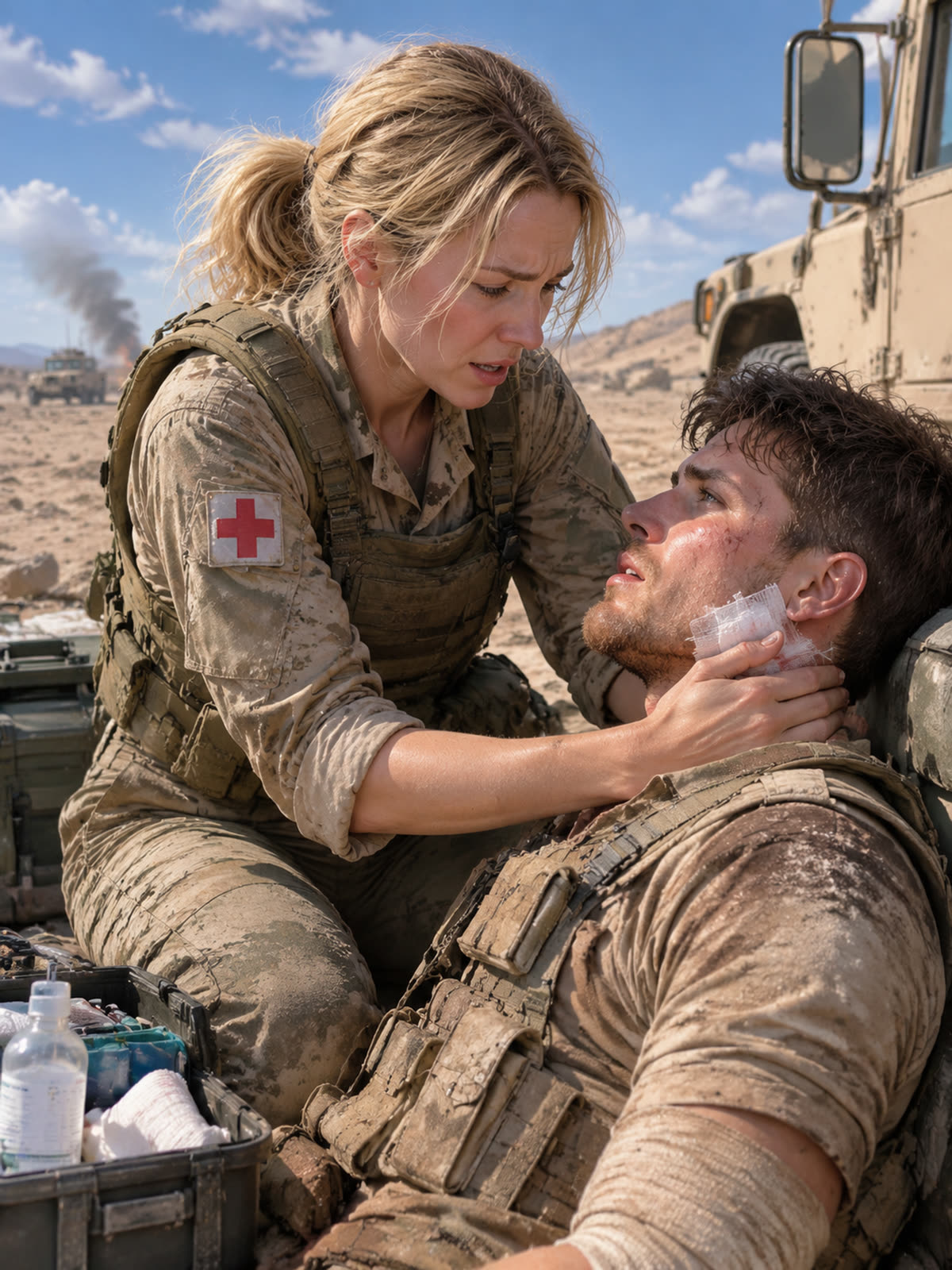
Then a convoy was ambushed near Baghdad, and shrapnel left Lucas badly wounded. Mom ran into the gunfire and helped save him on the roadside. By the time she told me about it, several days had passed, but the distance did nothing to make the account less frightening. “Is Lucas going to be okay?” I asked immediately. “He is battered up pretty badly, but he is going to make a full recovery,” she assured me. I tightened my grip on the receiver. “Are you completely okay, Mom?” She did not pretend to be full of energy. “I am just very tired, sweetheart.” I tried to imagine what she was not describing, then wished I had not. “Was it really scary out there?” Her answer was honest. “Yes, it was the scariest moment of my life.” Then her voice became firmer. “But he is alive, and he is going to be all right.” I held on to that last part. It was what she held on to, too: someone had been terribly hurt, and she had helped keep him alive.
After the ambush, their friendship grew stronger. Knowing that Mom had someone loyal beside her was a relief, even though I could not stop being afraid of where they were. Lucas was no longer simply the voice interrupting her stories with jokes. He was someone she had nearly lost, someone whose survival mattered to both of us. I was glad she did not have to face everything alone. I could not have understood then how much his presence would eventually matter in my own life, or how a connection formed so far away would reach into the ordinary routines of our home in Boise. At the time, my worries remained a child’s mixture of enormous fears and immediate frustrations. I worried about the war, and I worried about school. Sometimes, during a single conversation, those concerns existed side by side. Mom could be calling from Iraq, and I would still be miserable because a test had gone badly. She never made me feel guilty for bringing her the small problems that had always been hers to help me carry.
On our last call, algebra was the problem. “I studied my flashcards for three whole hours last night, and I still got a terrible grade,” I complained. “Take a deep breath, and when I get home we will sit down and figure out what went wrong,” she told me. I was too frustrated to appreciate the reassurance. “You always say that whenever I mess something up.” “Because it is usually the truth, and everything can be fixed with a little patience.” Nearby, Lucas laughed loudly enough for me to hear him. “Tell her that I failed high school algebra twice and still turned out fine!” Mom partly covered the phone to answer him, but not well enough to keep me from hearing. “You are really not helping my parenting speech right now!” Their familiar teasing made me laugh, and the test stopped feeling quite so important. I had no reason to memorize the sound of them together. It was simply Mom and Lucas, turning a bad afternoon into something easier to bear, the way they had done on other calls.
She asked if I had been working on my guitar chords. “Just a little bit after dinner,” I admitted. “Make sure you learn a whole song so you can play me something when I walk through the door.” I could picture exactly how that would happen. “Only if you promise not to sing along loudly,” I warned her. She laughed. “You are making an awful lot of strict rules for a kid who still needs me to buy her new sneakers.” We kept talking about unimportant things until her sergeant called her for a shift change. Before she could go, I hurried to say, “I love you so much, Mom.” “I love you even more, Hannah.” “That is mathematically impossible,” I answered. Her final reply came just before the connection ended. “Do you want to bet your allowance on that?” Those were the last words she ever said to me. Four days later, two officers in immaculate dress uniforms stood outside Grandma Ruth’s front door. Through the living room window, I saw the sorrow on their faces, and before either man spoke, I knew what they had come to tell us.
PART 2 — The Man Who Kept Coming Back
My mother had been killed in a mortar attack while treating wounded soldiers in Iraq. One moment, I had been a child waiting for her mother to come home; the next, I could not understand how I was supposed to keep being a child at all. At the military funeral, people I had never met touched my shoulder and spoke about her courage. They told me she had saved lives. They told me I had every reason to be proud. I was proud, but that feeling existed underneath an anger so overwhelming that I could hardly breathe around it. I did not want a hero whose bravery strangers could describe. I wanted the woman who complained about my untidy bedroom and insisted on math homework before television. I wanted the chance to find her ordinary habits irritating again. Most of all, I wanted Friday evening, blueberry pancakes, and an old comedy playing while we sat together. None of the things people said about sacrifice could give me any of that back.
At the cemetery, I kept looking at the framed photograph near the flowers. My mind returned to the crimson dress, an absurdly cheerful detail in a place where nothing felt cheerful anymore. She had promised to sit in the front row at my wedding. Now she would not even be there when I finished high school. In the months afterward, I shut my guitar away in the hall closet. I would not watch the movies we had loved. When Grandma Ruth tried gently to share a pleasant memory, I changed the subject or left before she could finish. Remembering happy things did not feel comforting. It felt like being reminded of everything that had been taken from me. One wet evening, Grandma Ruth discovered me on the kitchen linoleum with an old, faded Army sweatshirt pressed to my chest. “Sweetheart, what are you doing down there?” I raised my swollen eyes. “She promised me that she would come back home.” Grandma Ruth lowered herself beside me. “I know she did, darling.”
“She never should have made a promise she could not keep,” I sobbed. Grandma Ruth did not argue that Mom had meant well or try to cover my anger with words about bravery. She put her frail arms around me and stayed on the floor while I cried until there seemed to be nothing left. A few weeks after the funeral, Lucas came to Boise. He stood on the wooden porch in jeans and a plaid flannel shirt, looking less like the confident voice on Mom’s calls than I had imagined. “Hannah?” he said through the screen door. I knew his voice immediately. He was thin, and a slight limp interrupted his steps. Near his jaw was a jagged pink scar still healing from the ambush. “I am Lucas,” he said gently. I looked at his boots. “I know who you are.” He shifted his weight and swallowed. “I really wanted to come visit you much sooner, kiddo, right after the doctors cleared me to travel.”
Grandma Ruth invited him inside and offered iced tea. From his backpack, Lucas took a glossy photograph of himself and Mom outside a medical tent. She was smiling, one arm resting protectively around his shoulders. He looked worn out beside her. “She absolutely loved this photograph and kept it taped above her bunk,” he told me as he passed it over. I studied her face before asking the question that had been waiting beneath everything else. “Did she suffer at the end?” Lucas sat next to me and met my eyes. “Your mom was surrounded by people who loved her, Hannah, and she was not alone for a single second.” I folded into tears. He did not tell me to be strong. He did not remind me that I ought to feel proud. He stayed beside me until I could breathe steadily again. Before leaving, he asked Grandma Ruth whether he might visit another time. She assured him that he was welcome. I was not certain I wanted him back. His scar made the war seem close enough to touch.
He returned anyway, not intrusively, but consistently. At first, his visits meant groceries carried into the kitchen or repairs Grandma Ruth had struggled to arrange. He fixed troublesome faucets and took on the household tasks that had become burdensome for her. One afternoon, he spent two hours in the garage straightening the bent wheel of my old pink bicycle. None of those things required me to talk about Mom. He seemed content to help without asking me to become cheerful in return. His presence gradually stopped feeling like an interruption and began fitting into the shape of our weeks. I still did not know what to do with my grief, and I did not suddenly become easy company. There was no afternoon when I decided everything was better. There was simply Lucas returning, carrying something that needed putting away or noticing something that needed fixing. He made himself useful in the ordinary spaces where loss had left Grandma Ruth and me struggling.
One Saturday, he found me sitting near the guitar I had left on the living room rug. “Your mom told me all about how hard you were working to learn how to play,” he said. I turned away. “I quit playing months ago.” He asked, “Why did you decide to give it up?” I shrugged, unwilling to explain what already seemed painfully obvious. He brought over a wooden dining chair and sat nearby. “She used to talk nonstop about how excited she was to hear you play a real song.” My answer came out sharply. “Well, she is not here anymore to listen.” He accepted that without trying to soften it. “No, she is not.” Then he nodded toward the guitar. “Since you are done with it, do you think you could teach me how to play just one basic chord?” Reluctantly, I picked it up and showed him where his fingers belonged. His large, calloused hands were hopeless at first. Strings buzzed, fingers slipped, and the sounds were so bad that I laughed before I could stop myself.
It was the first real laugh I had let out in months. Lucas had not demanded that I enjoy something again or told me that Mom would want me to be happy. He had simply sat down and been terrible at a guitar chord. After that, his weekend visits became part of our routine. He began making blueberry pancakes, although his first attempt was burned so badly that eating them was out of the question. When Grandma Ruth’s arthritis made the auditorium bleachers too much for her, he attended my middle school choir performances. He helped me work through geometry and showed me how to repair a punctured bicycle tire in the driveway. None of it erased what had happened. What changed was that our home no longer felt occupied only by the absence of the person we had lost. There were things to do, exams to prepare for, and somebody willing to return the following weekend whether I had been talkative or silent.
Eventually, while we worked outside, I began asking questions about Mom. Lucas gave me stories that were nothing like the speeches at the funeral. He described her handing over her last clean pair of wool socks to a recruit who was freezing. He remembered the scolding she gave him when he tried to resume work before his wounds had healed. He told me about a joke that had made her laugh hard enough to spill coffee across her clipboard. I could recognize her in those accounts. She was generous and bossy, funny and deeply human, not merely a photograph beside flowers or a name people spoke with solemn respect. Little by little, the mother I remembered returned to me through his stories. I could think about her without seeing only the way she had died. He had known her in a place I would never know, yet what he brought home from that place helped me recognize the woman who had raised me.
As I grew older, Lucas became part of our small family so naturally that I could not point to the moment it happened. He never tried to occupy Mom’s place. He did not ask me to call him Dad or suggest that his care entitled him to a particular name. I began calling him Uncle Lucas, and it suited him. When I graduated from high school, he stood beside Grandma Ruth in the bleachers, cheering more loudly than anyone nearby. When I got my first full-time office job in downtown Boise, he gave up a weekend to help me search dealerships for a dependable used sedan. His care had become woven into the practical details of growing up. Sometimes it meant fixing something; sometimes it meant asking enough questions to keep me from making a poor choice. He was simply there, the same man who had once waited on our porch with a healing scar and a photograph of my mother.
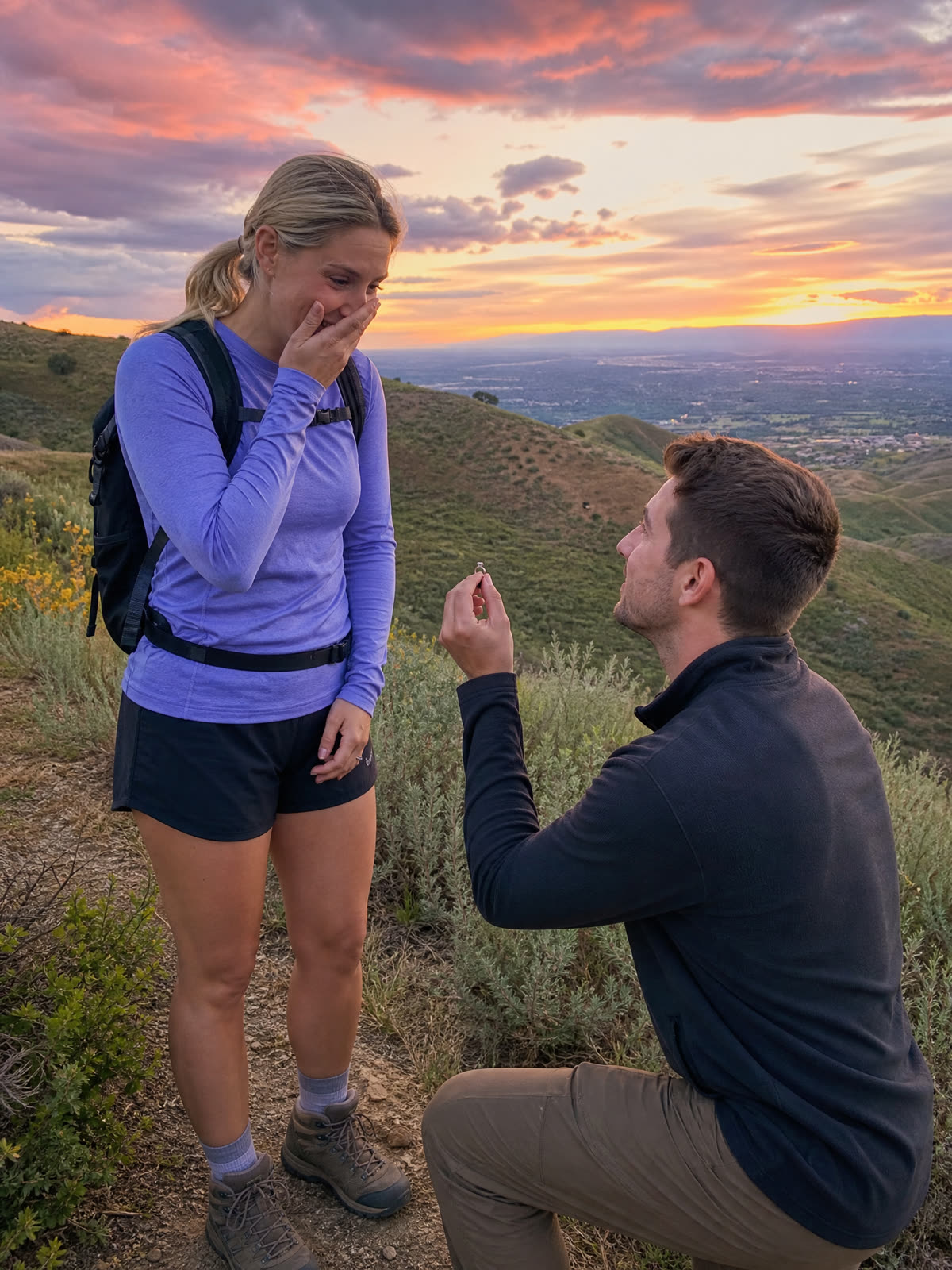
When I introduced him to Daniel, the college boyfriend I was serious about, Lucas gave him a firm handshake and a warning delivered with a perfectly straight face. “I feel obligated to warn you right now that Hannah’s grandmother is actually the scary enforcer in this family.” Grandma Ruth laughed and swatted his arm. “Stop encouraging the poor boy to run away!” Two happy years later, Daniel and I were hiking in the foothills above Boise when he proposed at sunset. I said yes before he had finished asking. We went to show Grandma Ruth the ring, and she cried with joy. Lucas gathered us both into an enormous hug. “Your mom would have adored him from the very first second,” he whispered to me. I believed him. I could picture her liking Daniel, just as I could picture her teasing me about how quickly I had answered. Her absence did not make that happiness less real, but it meant that even the happiest news arrived with someone missing from it.
That night, alone on the edge of my bed, I stared at the ring and felt the hollow place beneath my excitement. For years, I had imagined Mom beside me in bridal shops. I could almost hear the opinions she would have about flowers and the jokes she would make when I took wedding decisions too seriously. I had pictured her embarrassing me on the dance floor exactly as she had threatened. I was thrilled to be marrying Daniel. Nothing about missing her changed that. Yet the wedding I had imagined had always included my mother, and loving the life ahead of me did not make it easy to surrender that picture. Grief had changed as I grew older, but it had not disappeared. It could sit quietly through ordinary days and then rise again when something wonderful happened. The ring on my hand belonged to a future I wanted desperately, and it reminded me of all the things Mom would not be there to see.
Over the following months, planning occupied nearly every spare hour. Grandma Ruth took charge of the invitation envelopes, addressing them in careful calligraphy. Daniel handled the reception music and worked with the caterers. Lucas offered his weekends for airport trips and carried heavy boxes of centerpieces to the venue. Everyone had something to do, and I was grateful for the way they helped turn a complicated collection of arrangements into a wedding. Beneath those arrangements, though, I continued thinking about Mom. I did not always say so. There were cheerful decisions to make, and I wanted to enjoy them. Still, no amount of preparation could answer the quiet wish that she might somehow be included. She was there in the memories I carried into each choice, but memories could not sit beside me in a bridal shop. They could not reach over and straighten something with the casual confidence of a mother who had been doing it all my life.
One sunny afternoon in late spring, Lucas found me looking through a box of family albums in my living room. In my hands was the photograph he had brought on his first visit, the one of Mom standing beside him at the medical tent. He sat down. “Thinking about her today?” “Every single day, especially now,” I admitted. His hand settled reassuringly on my shoulder. “She would be bursting with pride seeing the woman you have become.” I smiled sadly at the picture. “She always promised me that she would wear a bright crimson dress to my wedding day.” Beside me, Lucas went completely still. His reaction was so sudden that I turned to study him. “Did she ever tell you about that silly promise?” He nodded, looking ahead rather than at me. “Yes, she mentioned it to me more than once over there.” I looked down at Mom’s smiling face. “She was completely serious about wearing it, too.” His answer was quiet. “Your mom was always fiercely serious about the most ridiculous things.”
We laughed together, though there was sadness in it. Then Lucas cleared his throat. “Have you decided yet who you want to walk you down the aisle next month?” I hesitated only long enough to put the hope into words. “I was really hoping that you would do it.” He pointed toward himself, plainly startled. “You want me to walk you down the aisle?” There had never been any real doubt in my mind. “Of course I do, because you are my family, Uncle Lucas.” His eyes filled, and when he answered, his voice was unsteady. “I would be honored beyond words, kiddo.” He hugged me tightly, overcome in a way that moved me without making me suspicious. I thought he was feeling what I felt: happiness, grief, and the ache of wishing Mom could share this with us. I had no idea that our conversation had touched a promise he had been carrying for years, or that the crimson dress was more than a memory to him.
On the wedding morning, Grandma Ruth stood behind me in the bridal suite, working carefully along the little pearl buttons on my white gown. “You look absolutely breathtaking, my darling,” she whispered. I tried to smile at our reflection in the tall mirror. Then I noticed Mom’s photograph in its silver frame on the dressing table beside my bouquet, and the tears came before I could stop them. “I just wish so badly that she were standing right here with us.” Grandma Ruth embraced me gently, careful not to disturb the dress. “So do I, sweetheart, every single minute.” With my eyes closed, I imagined the bridal-suite door opening and Mom walking in wearing that impossible crimson outfit. I imagined a joke about my heels, followed by the look she would give me when she told me I was beautiful. Instead, I heard the wall clock marking the silence. A few minutes later, a brisk knock sounded at the door. “Come on in!” I called, touching a tissue beneath my eyes. The heavy door opened, Lucas stepped inside—and for several seconds, I could not speak.
PART 3 — What the Crimson Dress Really Meant
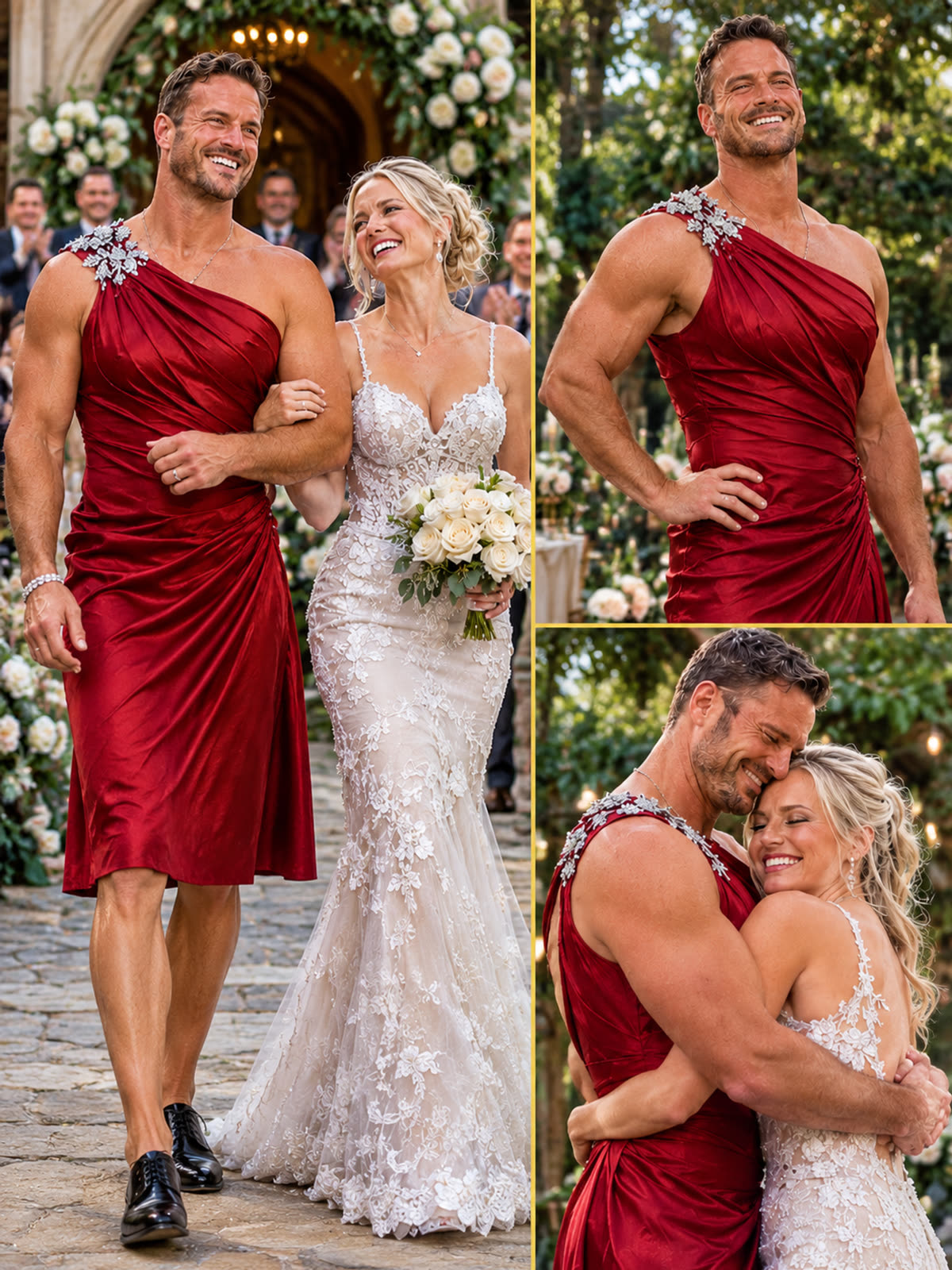
He was wearing a bright crimson dress. My thoughts seemed to stop while I looked at him. The dress had no sleeves, ended at his knees, and was paired with polished black dress shoes. Above that vivid fabric were the broad shoulders and familiar scarred jaw of the man who had spent years repairing bicycles and helping me through school. He looked completely ridiculous, and somehow more right than anything I had imagined for that morning. I could not have explained how those two things could be true together. I only knew that the sight of him made my heart swell until speaking felt difficult. “Uncle Lucas, what on earth are you wearing?” I finally managed. He smiled, tears already moving down his cheeks. “Do you remember how your mom always promised she would wear a bright crimson dress to your wedding? I just wanted to make sure you knew beyond a shadow of a doubt that she is right here walking with you today.”
I broke into tears of joy and crossed the room to throw my arms around his neck. The crimson fabric was beneath my cheek, and for one fleeting moment I could almost hear Mom laughing with us. Nothing about the gesture pretended she was not gone. That was not why it reached me so deeply. Lucas had brought something of her into the room in a way that belonged unmistakably to the woman I remembered: affectionate, dramatic, and determined to make me smile. I had spent the morning imagining a door opening onto the impossible. What had actually walked through it was someone who loved me enough to stand there without hiding his tears or apologizing for his clothes. I clung to him, overwhelmed by the feeling that a promise I had mourned for years had found an unexpected way to reach me. At the time, I believed the idea was his alone. I thought he had remembered a story and decided to turn it into a gift.
When it was time, Lucas offered me his arm and escorted me down the aisle in that brilliant dress. Flowers lined our path. Nobody in the chapel pointed or whispered behind a hand. There was no cruel laughter to interrupt the moment. Most of the people seated there knew about Mom and understood what she had meant to us. They recognized the love in what he was doing. Daniel’s face opened into an enormous smile when he saw us approaching. Then he looked into my eyes, and his own filled with tears. All the feelings I had worried might overwhelm the ceremony were still there, but they were no longer only painful. I missed Mom. I was grateful to Lucas. I loved the man waiting for me. Those feelings did not cancel one another out. They carried me forward together, one step at a time, with the crimson dress moving beside my white gown.
The ceremony was warm and deeply moving. Later, at the reception, I watched Lucas take Grandma Ruth onto the dance floor and turn her gracefully through the music. He also added several deliberately awful moves, the kind Mom had promised she would use to embarrass me. I laughed until my face hurt. That laughter was not something I had to force for the sake of the occasion. It came easily, which made the day feel more precious. Each time I noticed the crimson dress across the room, I thought of Mom’s promise and the extraordinary tenderness of Lucas choosing to honor it. For years, I had thought of that dress as proof of a future she had lost. Now it had become something else as well: a way for the people who loved her to remember her without surrendering the happiness she would have wanted to share. I thought I understood the gesture. I thought the sight of him walking into the bridal suite had already revealed everything there was to know.
I was wrong. Close to the end of the reception, after most of our tired guests had left, Lucas came over to my table. He was still wearing the crimson dress with the same complete lack of embarrassment he had shown all day. “Sweetheart, before the night ends, I have something very important for you,” he said. From his suit jacket pocket, he produced a white envelope, old and slightly crumpled. My full name crossed the front in blue ink. I recognized the shape of those letters before I had fully understood what I was holding. They were Mom’s. My hands started trembling. Until that moment, the day had held reminders of her: a photograph, familiar stories, a color she had promised to wear. This was different. This was something she had addressed to me herself, something that had existed while she was alive and had somehow waited through all the years between us.
“Where on earth did you get this envelope?” I whispered. Lucas answered quietly. “Your mother handed it to me privately right before we left on her very last convoy assignment.” I looked from the handwriting to his face, stunned by the time hidden inside that answer. “You mean you have been holding onto this letter for all these years?” He nodded and rested a hand on my arm. “I made a solemn promise to your mom that I would wait and give this to you on your wedding day, because there is something important she kept secret from you.” I had thought I knew the shape of what Mom had left behind: memories, photographs, the habits I still recognized in myself. Now there was a letter meant for the woman I had become rather than only the child she had known. Lucas had carried it through graduations, birthdays, ordinary weekends, and all the moments when I had wished there were something more of her to find.
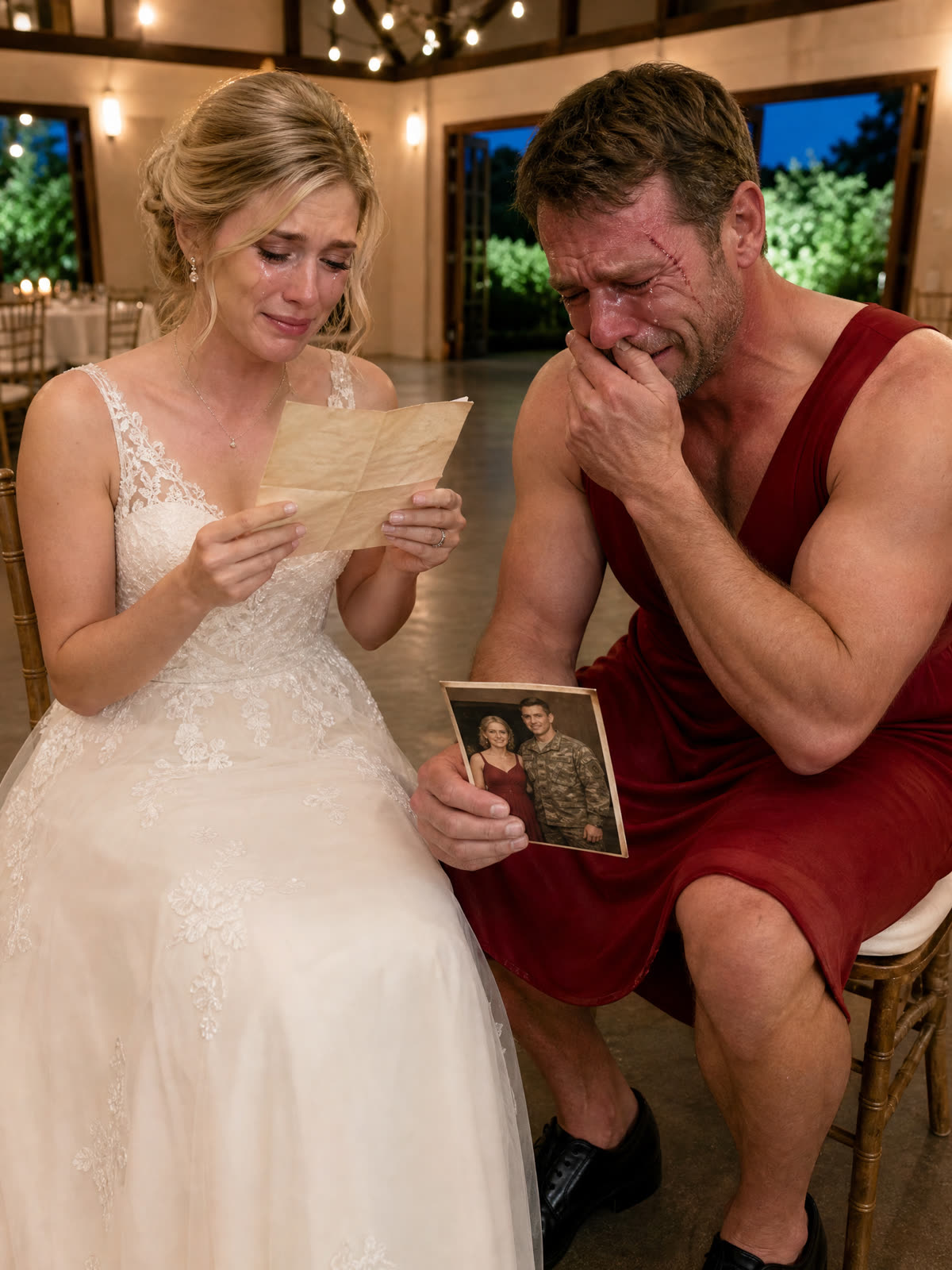
My fingers shook as I lifted the worn flap. Inside were a folded sheet of lined notebook paper and an old photograph whose colors had faded a little. I looked at the photograph first and gasped. Mom stood beside Lucas in a military barracks. She was wearing the same bright crimson dress he had on that evening. For a moment, I could only stare at her, then look at him, then look back again. The dress was not merely the same color. It had been part of this story long before my wedding morning. When I turned the picture over, her handwriting waited on the back: “For my sweet Hannah, when she finally gets married.” I had spent years imagining what she might have looked like wearing crimson on my wedding day. Here she was, having already thought of that day herself. The photograph made the distance between the promise and the woman who had made it feel suddenly, painfully small.
I raised my eyes to Lucas. Tears were running openly down his face now, and he wiped at them with the back of his hand. “Go ahead and read the letter, kiddo,” he whispered. I unfolded the paper carefully. It was strange to hold something so ordinary and feel that it contained a moment I had believed was lost forever. The lines had been written in her hand. The words were meant for me. All afternoon, I had been comforted by other people remembering what she would have said, but now I did not have to imagine her voice from their guesses or even from my own longing. She had left the words herself. I began reading aloud, slowly enough to make my way through the tears. Lucas stayed beside me, still wearing the dress that had started as an impossible promise in a bedroom years earlier and had somehow become the center of an evening neither of us could speak about without crying.
“My beautiful daughter Hannah, if you are reading this letter right now, it means you are finally getting married, and my greatest fear came true because I could not be there in person to see you walk down the aisle. I truly hope with all my heart that you have chosen a wonderful partner who makes you laugh every single day, listens patiently whenever you are upset, and never once makes you feel like you have to earn their love. And I also sincerely hope that Lucas is currently standing beside you wearing the ridiculous crimson dress I forced him to promise he would wear.” I stopped and looked at him in amazement. “You knew about the dress plan all along?” He nodded with a laugh that broke through his tears. “She literally made me swear an oath on it before she would stop nagging me.” I laughed too. Of course she had. Even from the page, she sounded exactly like the mother who had joked about stealing a little of my attention.
I returned to the letter. “There is an important secret about Lucas that I never told you over the phone, sweetheart. After he was badly wounded in that ambush, he struggled emotionally far more than he ever wanted anyone in our unit to know. He had already lost all the family members he cared about back home, and he genuinely believed that he had nobody waiting for him when his tour ended. One quiet night in the medical tent, he confessed to me that he did not even know where he belonged in the world anymore. I looked him right in the eye and told him he was completely wrong about being alone. I told him all about you and Grandma Ruth waiting back in Boise, and I promised him that if he ever needed a real family, he could start right with us.” Tears fell onto the paper as I read. Beside me stood the man I had known for years, and suddenly I was seeing how much of his story I had never understood.
I had known about the shrapnel, the limp, and the scar. I knew that Mom had risked her life to help save his. What I had not known was how alone he had felt afterward, or that she had answered that loneliness by speaking about us. When he first stood on Grandma Ruth’s porch, I had seen a man connected to the war that had taken my mother. I had not seen someone who might also be searching for a place to belong. Through all the years of his steady presence, I had assumed that giving was the direction in which his love moved: from him toward us. Now Mom’s words were showing me something different. She had seen a need in him that matched a need we would come to have. The invitation she had offered was not a duty disguised as kindness. She had meant it. Even before he became Uncle Lucas to me, she had told him there was a place for him in our family.
The letter continued. “If I do not make it back home from this deployment, I want him to know beyond any doubt that my invitation still stands forever. I am certainly not asking him to replace me in your life, Hannah, because nobody on earth could ever do that. Instead, I am asking the two of you to always remember that true family is not just something we are born into by blood. Sometimes, the strongest family is something we intentionally choose to build, one ordinary day at a time. So if he is standing beside you today wearing that bright crimson dress, please do not just thank him for keeping an old soldier’s promise. Look him in the eye and tell him that he truly belongs right there with you. I love you more than anything in this universe, forever and always, Mom.” I reached the end with the paper trembling in my hands. The words had changed nothing about how long I had loved Lucas, yet they changed how I understood the beginning.
For more than a decade, I had assumed that he kept coming back because Mom had saved him and he felt he owed her something he could never repay. I had never doubted his affection, but somewhere beneath my gratitude was that explanation: a rescued soldier honoring the woman who had helped him survive. Mom’s letter showed me that I had mistaken only part of the story for all of it. She had recognized his loneliness. She had offered him a home, not merely assigned him a responsibility. Our ordinary weekends, his seat beside Grandma Ruth at graduations, the burned pancakes and repaired bicycles had not been installments on a debt. They were the way a family had taken shape. I thought about his first visit and the care with which he had asked whether he could return. He had not known what he would be allowed to become to us. We had all learned it together, through the repetition of showing up.
“Why did you never tell me any of this before tonight?” I asked, wiping my face. Lucas dried his own cheeks. “Your mom specifically wanted you to read her letter on your wedding day, and I promised her I would stay quiet and wait until tonight.” I looked down at the pages again. “Did you already know everything she had written inside?” He seemed almost bashful as he glanced at the skirt of the dress. “I knew most of what she wanted to say.” Then he added, “She specifically told me that if I ever put this dress on, I had better wear it proudly and do it properly.” A joyful laugh escaped me. “Did she really say that to you?” He chuckled. “She straight up threatened to come back and haunt me for the rest of my life if I chickened out at the last minute.” I could picture her saying it with complete conviction. “That sounds one hundred percent like my mom,” I answered.
He cleared his throat, and the humor gave way to something more vulnerable. “To be completely honest with you, Hannah, for the first few years I always worried deep down that I was intruding on you and Grandma Ruth.” I stared at him. The idea seemed impossible beside the place he occupied in my memories. “Uncle Lucas, you spent years fixing my broken bicycles, cheering at every single school concert, and risking your life teaching me how to parallel park.” He smiled. “And I nearly lost my sanity trying to survive your driving lessons.” That was the history I knew: not an outsider waiting uncertainly at the edges, but someone standing in the middle of our life. He had belonged so completely that I had stopped imagining he might question it. I had assumed that he understood what his presence meant because it felt obvious to me. Now I could see that loving someone and making sure they knew where they belonged were not always the same thing.
“You have been my real family for years now,” I told him. His expression broke. The man who had always seemed capable of lifting the heaviest box or solving the most practical problem could not steady his trembling chin. I stepped close and put my arms around him, resting my cheek against the crimson dress again. “Mom was completely right about everything, Uncle Lucas, because you belong right here with us.” This time, I understood more of what I was saying. It was not just gratitude for the aisle, the dress, or the envelope he had safeguarded. It was the truth of all those years, spoken plainly enough that he would not have to guess. Mom had asked me to tell him he belonged, but she had not needed to persuade me that he did. The belonging was already there. It had been built out of ordinary Saturdays and school concerts, grocery bags and patient explanations, until his place with us was as familiar as anyone’s.
A few minutes later, Daniel joined us in the quiet corner of the reception hall. He noticed the open letter in my hand and the tears on Lucas’s scarred face. “Is everything okay over here?” he asked. I nodded, smiling through my own tears. “Everything is more than okay, honey.” I held up the barracks photograph so he could see Mom wearing the same dress Lucas had worn beside me that day. It was strange and wonderful to share the picture with the husband she had never met, the man she had hoped would make me laugh and listen when I was upset. Then I turned back to Lucas. There was something I wanted to make certain he heard without any solemnity left for him to hide behind. “You are not planning on disappearing now that you have officially completed your big wedding assignment, are you?” His laugh came out loud and full. “Not a chance in the world, kiddo.”
“Good, because Daniel and I are already planning to have Sunday dinner over at Grandma Ruth’s house next weekend, and you are required to be there,” I told him. He immediately found room for another joke. “Does that mean I am in charge of cooking blueberry pancakes for everybody?” “Absolutely not, because we actually want to enjoy our meal,” I answered. He laughed again, the sound carrying across the nearly empty dance floor. There was such comfort in that ordinary exchange. After the dress and the letter, after everything I had learned, we were still ourselves. He could make a bad cooking suggestion, and I could remind him why it was a bad suggestion. We could make plans for the following weekend because none of us imagined that a wedding promise marked the end of his place in our lives. If anything, Mom’s words had made clear what our life together had been saying for years.
I returned the letter and photograph to the envelope with care. Nothing inside it could change the fact that Mom had not been physically present when I got married. I would always wish she had been there to fasten a button, make a joke, or dance badly on purpose. The dress did not erase that loss, and the letter did not ask me to pretend otherwise. What they gave me was another way to understand what had survived her. Even while she was far from home, she had recognized two kinds of loneliness and helped create a family strong enough to hold them both. Lucas reached over and gently squeezed my hand. I looked at the crimson fabric, the familiar scar, and the face that had appeared at our door so many years earlier. His promise had brought him to my wedding. It had never been the reason we loved him. And as his fingers tightened around mine, I wondered whether he had finally understood the difference…
Disclaimer: This story is a work of fiction inspired by real-life themes. Names, characters, places and events are fictionalized, and any resemblance to real persons is purely coincidental. Images are for illustration purposes only.
