

PART 1 — What I Heard Through the Doorway
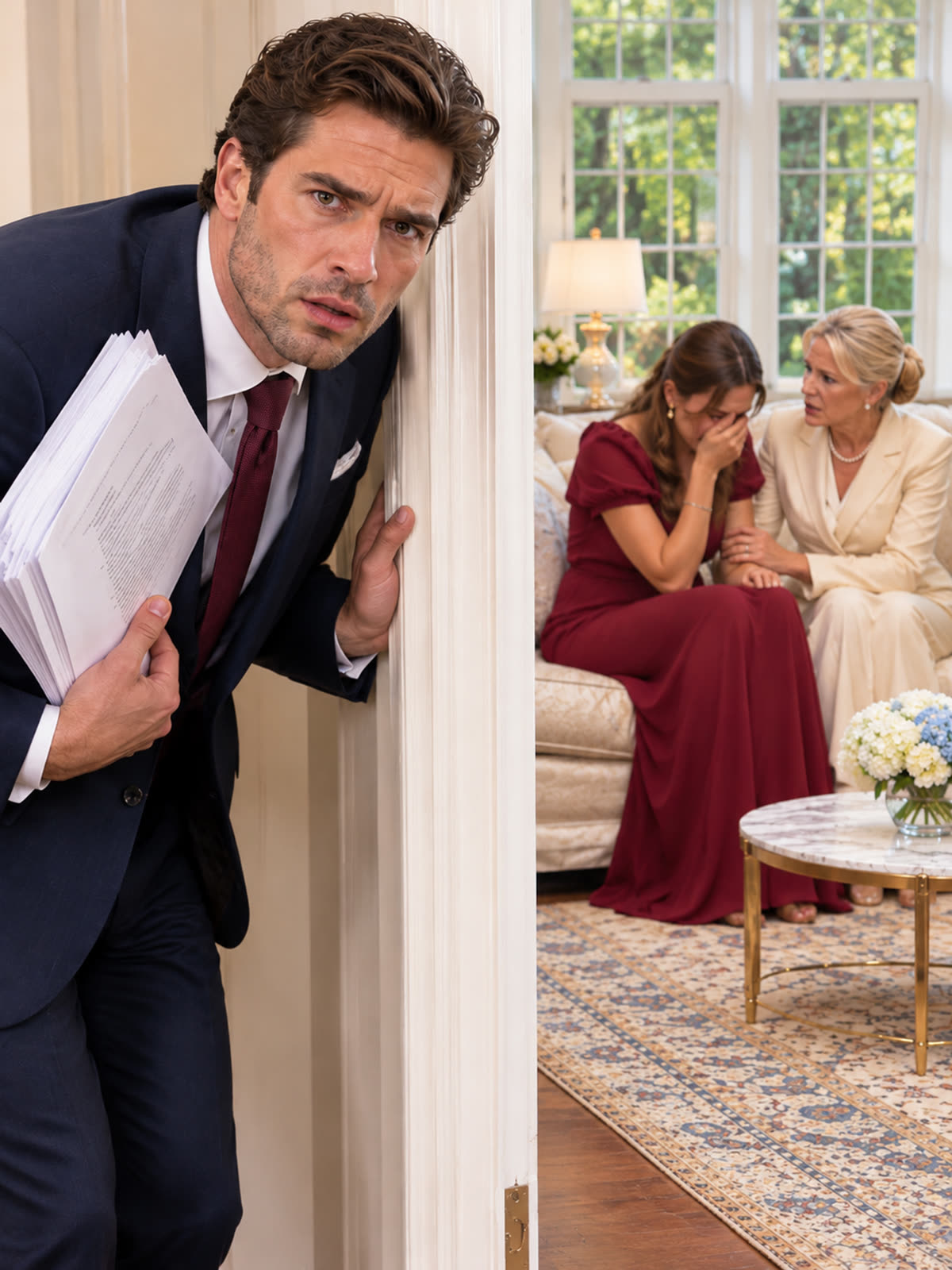
I was meant to bring my marriage to an end the next day. Every arrangement had been made, and the documents were ready. Yet that evening, while passing through our house, I heard my wife weeping in the living room. I stopped in the hallway when I recognized her mother’s presence in the conversation. Meredith’s voice was low and trembling. “Mom… I love him too much to ask him to stay just because he feels obligated,” she said. “If he believes he’ll be happier without me, I have to respect that and let him go.”
I could not move. Nothing had prepared me to hear her say that. I was holding twenty-seven pages of divorce documents, including a settlement of twenty million dollars. The money would spare Meredith any financial uncertainty, and I had persuaded myself that providing it was the most compassionate way to leave. Until that instant, I had believed I was offering her freedom. Standing outside the room, I began to wonder whether I understood anything about the marriage I was preparing to end.
For three years, I had accepted one explanation for our life together: my wife had married me to rescue her family’s business, not because she loved me. Since our relationship had begun as a financial arrangement, I had assumed its foundation had never changed. But she was not asking her mother about the settlement. She was not calculating what she would receive. She was crying because she thought I wanted to leave, and she was prepared to let me if that would make me happy.
My name is Grant Whitcomb. I was forty-four, the founder of Whitcomb Capital Partners, a private investment firm based in Charlotte, North Carolina. Friends and colleagues considered me successful. Financial publications occasionally called me brilliant, usually while discussing an investment that had worked out well. By my early forties, I had accumulated enough money to buy most things without first checking the price. Business decisions rarely intimidated me. I understood negotiations, assessed risks, and knew how to protect what I had built. My marriage was another matter.
Meredith was thirty-five, and we had been married for three years. We had not begun with courtship or declarations of love. We had begun with an agreement that seemed to meet two practical needs. At the time, I believed we both understood its limits. I never seriously questioned whether she might have come to the arrangement with feelings she had chosen not to mention. Until I heard her crying that evening, I did not understand how much could remain unspoken between two people sharing a home.
Her father’s manufacturing company in Greensboro had run into serious trouble after losing several important contracts. Hundreds of employees depended on the business, and Meredith had spent months trying to preserve their jobs. My company could provide the support they needed. Meanwhile, my directors had been urging me to marry. They thought a settled family life would strengthen public confidence in my leadership. Our marriage appeared to offer a practical answer to both situations.
Her family obtained financial help, while I acquired the appearance of stability my board wanted. We treated one another with respect and kept our expectations carefully contained. There were no promises of love—at least none spoken aloud. Yet Meredith never acted like a woman interested primarily in my money. She seldom purchased expensive things and preferred a peaceful dinner at home to an overcrowded charity event. She never sought a place on my business trips merely for the pleasure of staying in luxurious hotels.
What she paid attention to instead were the things almost everyone else overlooked. She remembered that I drank coffee without cream, except on Sunday mornings, when I liked a little cinnamon. She knew gardenias unsettled me because their scent brought back my father’s memorial service. When I arrived home worn down by work, she did not insist on hearing every difficulty I had faced. Sometimes she simply settled beside me on the couch and asked whether I wanted company. I noticed these things, though I did not know what I was allowed to make of them.
One evening, roughly eight months after the wedding, I stayed late in my study. Meredith came in carrying a small plate of food. “You missed dinner again,” she said gently. “I thought you might be hungry.” There was nothing elaborate about the gesture. She had noticed that I had not eaten and brought me something herself. In a life filled with people concerned about my decisions, my schedule, and my money, that quiet attention reached me in a way I had not expected.
She set the plate beside my computer and laid her hand on my shoulder. I looked at her fingers and wanted her to leave them there a little longer. That was when I began to recognize how deeply she mattered to me. It was also when the fear began. I knew the circumstances under which she had agreed to become my wife. Her family had needed help, and I had been able to offer it. I could not stop asking myself whether her tenderness was simply the kindness of someone honoring a bargain.

I decided that my feelings were mine to manage, not hers to answer for. Meredith had fulfilled her part of our agreement with grace. Asking her to give me a heart she had never promised felt like taking something I had no right to claim. So I kept silent. I stayed at the office longer and traveled more often. Without ever openly choosing it, I became the distant husband she might have expected. I told myself that distance was a form of respect.
Meredith withdrew in much the same way. She did not ask me to stay home or complain about my vacant place at Thanksgiving. She smiled through dinners with the board and went quietly to bed afterward. We continued treating one another considerately, but each of us interpreted the other’s restraint as evidence that nothing more was wanted. Every gesture of care became courtesy in my mind. Every silence seemed to confirm the explanation I had already accepted. We lived together while retreating further behind the same misunderstanding.
Then, six weeks before I stood outside the living room holding our divorce papers, we attended an investors’ dinner. A fund manager I scarcely knew, Preston Hale, had drunk too much wine. He leaned toward me, wearing a smirk. “Must be nice,” he said. “Marrying into a deal. No messy feelings.” I brushed the remark aside with a laugh. Then I glanced across the room. Meredith stood near the doorway, motionless, with a glass of water in her hand. She had heard him.
PART 2 — The Truth We Had Both Been Afraid to Say
Neither of us spoke on the drive home. I did not ask what Meredith had heard, and she offered no explanation for her silence. That night I lay awake, convinced that I had made a terrible mistake. The mistake was not marrying her. It was allowing her to remain in a marriage she had entered from a sense of duty. Her father’s company was stable again, and the loan had been repaid with interest. Whatever obligation she might once have felt, she owed me nothing now.
I told myself that I owed her a way out. The following morning, I contacted my attorney. He prepared an agreement so generous that it bordered on absurd: Meredith would receive the house, twenty million dollars, and a guarantee that her family’s company would retain my investment regardless of what happened to our marriage. I believed I was giving her the chance to leave without fear. It seemed like love expressed in the only form I had permitted myself to offer.
That was how I had arrived in the hallway that evening with twenty-seven pages in my hands. I had intended to deliver certainty. Instead, Meredith’s words left me questioning every conclusion behind those pages. She loved me too much to ask me to remain out of obligation. She thought letting me go would be an act of love. I had spent weeks arranging precisely the same sacrifice for her, while neither of us had asked whether the other wanted it.
Then Colleen answered her daughter. “Sweetheart, listen to me. Do you know why your father agreed to the marriage?” Meredith’s reply held no surprise. “For the company, Mom. I know.” I waited in the hallway, still unable to step forward. That was the reason I knew, too—the explanation on which I had built my understanding of our marriage. I had never thought there might be another reason her father had accepted.
“No.” Colleen sounded steady, almost fierce. “Because you asked him to.” Silence followed. I stood with the documents in my hands, listening to a conversation that no longer fit the story I had told myself. Meredith had worked desperately to save the company, but her mother’s answer suggested something beyond that effort. I could not yet see what it meant. I only knew that Colleen had rejected, without hesitation, the explanation I had trusted for three years.
“Three years ago, your father didn’t want to accept Grant’s money. He was too proud. He told you he’d rather close the plant than owe a stranger. And you went to Grant’s office anyway.” Meredith answered, “I went to ask for a loan.” I remembered the practical purpose of that visit. Until this moment, it had belonged entirely to the business side of our history. It was the beginning of the arrangement, not something I had ever considered a confession.
Colleen continued. “You went to ask for a loan, and Grant said he couldn’t structure one that wouldn’t ruin your father’s pride. And then he said the board wanted him married.” She paused before speaking again. “Meredith. You told me that night, in this kitchen, that you’d marry him because you’d already been in love with him for two years.” My knees nearly gave way. Two years before the wedding. Two years before I believed she had agreed to marry a man she did not love.
“Mom, don’t.” Meredith’s protest did not stop her mother. “You never told him. You said an arrangement was the only way he’d ever let you near him. You said if he knew, he’d think you were lying to get at his money.” Meredith began crying harder. “He would have.” Colleen’s reply was gentle. “Would he?” I could not remain outside the room to hear the answer. I had already spent too long allowing assumptions to speak in place of either of us.
I entered the living room with the divorce documents still in my hand. Meredith looked up. Her face was wet, and terror widened her eyes. Colleen rose slowly from the couch. “I’ll give you two a moment,” she said, then left us alone. For a long while, neither Meredith nor I spoke. I had imagined handing her an orderly ending. Instead, I stood before her with papers that represented a misunderstanding I no longer knew how to explain.
“I heard you,” I said finally. “I’m sorry. I didn’t mean to listen. I came to…” My eyes dropped to the documents. “To give you these. Tomorrow.” Meredith stared at them, and her body seemed to collapse inward. “I know. I found the draft in your study last week.” She wiped her face with the heel of her hand. “I wasn’t snooping. I was looking for a stapler.” I almost laughed, but the sound that escaped me was broken.
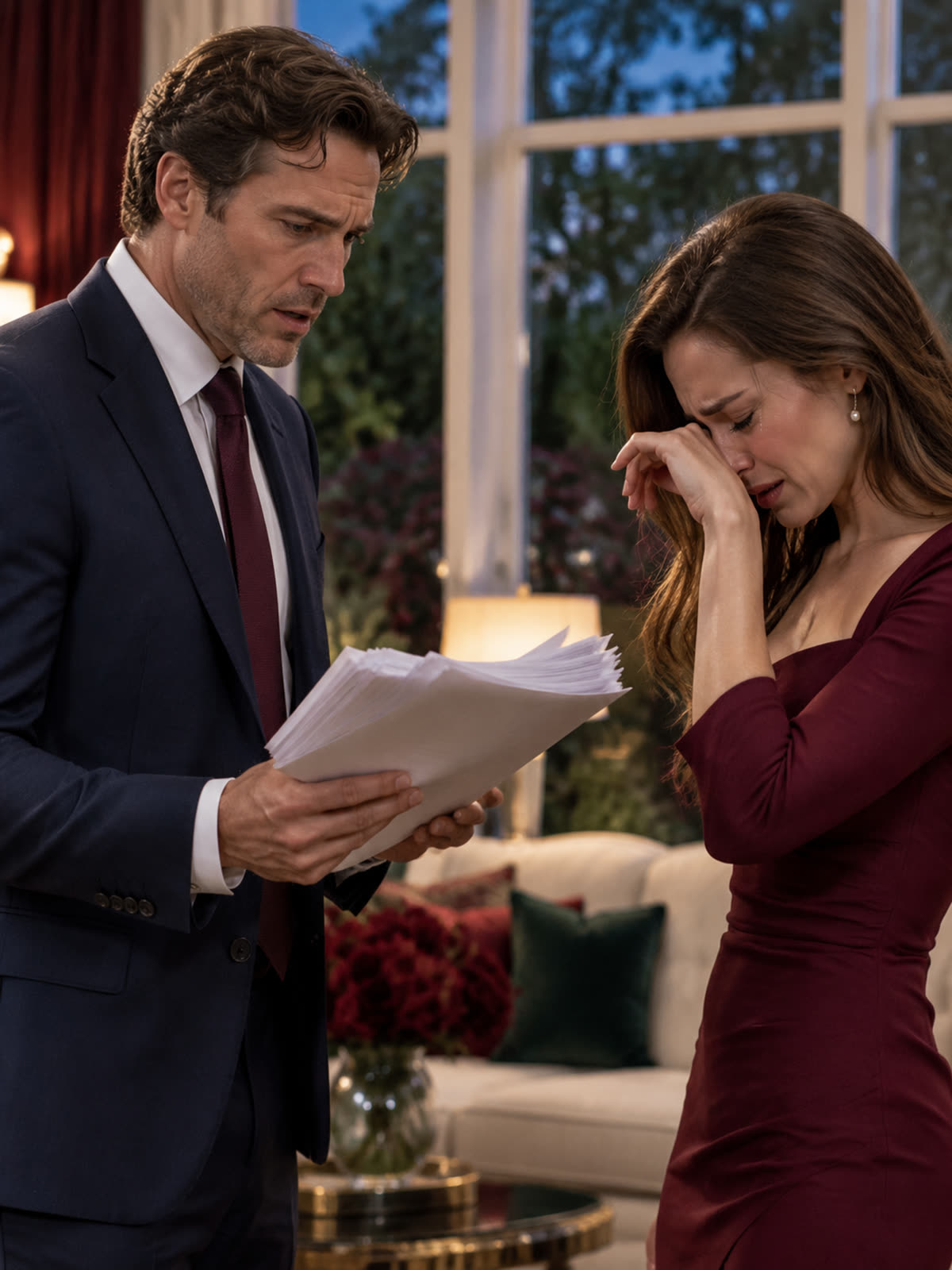
“Is it true?” I asked. “That you loved me when we married?” Her nod was barely visible. “Why didn’t you say anything?” I asked. “Why didn’t you ?” Her voice cracked. “You never said one word, Grant. For three years I sat across from you at dinner and watched you be kind, and I told myself kindness was all there was.” I had thought my restraint protected her. She had been reading that same restraint as the limit of everything I could feel.
“I thought you’d only married me to save the business.” There was no uncertainty in her answer. “I married you because I loved you.” I tried to explain the fear that had governed my silence. “I thought you’d feel trapped if I told you.” Meredith answered, “I felt trapped not knowing.” We stood three feet apart, two intelligent people who had lived like strangers because neither wanted to become a burden to the other. The consideration we had offered so carefully had kept us from the truth.
I placed the documents on the coffee table. “I don’t want to sign these,” I said. “Grant…” I could not let the explanation remain unfinished. “I wrote them because I thought you wanted out. I wanted to give you everything so you could leave without fear.” My voice shook. “I’ve been in love with you since the night you brought me a plate of food and put your hand on my shoulder. I just never thought I was allowed to say it.”
She covered her mouth with her hand. Everything I had hidden behind work, travel, and careful politeness was finally spoken. The documents lay between us, no longer the generous solution I had imagined, but a record of how completely I had misunderstood her. Meredith looked at me and whispered, “Say it again,” and this time I did not retreat behind an explanation. “I love you, Meredith.”
PART 3 — The Letter Waiting Behind the Papers
Meredith crossed the room, and I caught her in my arms. She was shaking, and so was I. The distance we had maintained so carefully was gone. For three years, I had wanted her without believing I had the right to say so. She had loved me while believing that my kindness was everything I could offer. Now the words were finally between us, and neither of us had to keep pretending that courtesy was enough.
Later that night, after Colleen had retired to the guest room, Meredith and I sat on the floor of my study. The twenty-seven pages lay between us. They had been drafted to separate our lives, with every financial concern anticipated and addressed. Yet the one question that mattered had never been settled by any of those provisions. We had answered it ourselves in the living room. I reached for the folder, intending to tear up the agreement.
Before I could destroy it, a small cream-colored envelope slipped from the back. The handwriting on its front was unfamiliar to me. It was addressed: To Grant Whitcomb, to be opened if he ever tries to leave her. I had been ready to reduce the documents to scraps. Instead, I found myself looking at a message written for the very possibility we had come so close to making real.
Meredith frowned as she studied the envelope. “That’s my father’s handwriting.” Inside was one sheet of paper, dated during the week of our wedding. Her father had written it at the beginning of the marriage, long before I drafted an agreement to end it. Neither of us had imagined that another part of our story was waiting there, in his words. I began to read.
Grant,
If you are reading this, then I was right to worry. I don’t know you well, but I know my daughter. She has been in love with you since long before you saw her. I told her not to marry you for my sake. She said it wasn’t for mine.
I can’t make you love her. But I can tell you this: she will never ask you to stay. She will let you walk out the door and smile while she does it, because she’d rather lose you than be a burden. If it comes to that, I’m asking you to stop and ask her one question before you sign anything:
“Do you want me to go?”
She will say yes, to protect you. Ask again. And listen to what she doesn’t say.
I wish I could have been a better father to a girl who loves this carefully.
Frank Dunmore
Meredith was crying again, this time without a sound. “He never told me he wrote this.” I had begun the evening believing that money could make a painful separation merciful. Her father’s letter asked for something far simpler than any provision my attorney could write. Stop. Ask her. Listen beyond the answer she might give to protect me. He had understood how readily his daughter would sacrifice what she wanted rather than ask someone else to carry it.
“He knew,” I said. “He knew both of us.” I took her hand. The letter lay before us, its question no longer something we could leave to implication. “Meredith. Do you want me to go?” She laughed through her tears. It was the most beautiful sound I had heard in three years. The question her father had written at the beginning of our marriage had finally been asked, with both of us able to answer honestly.
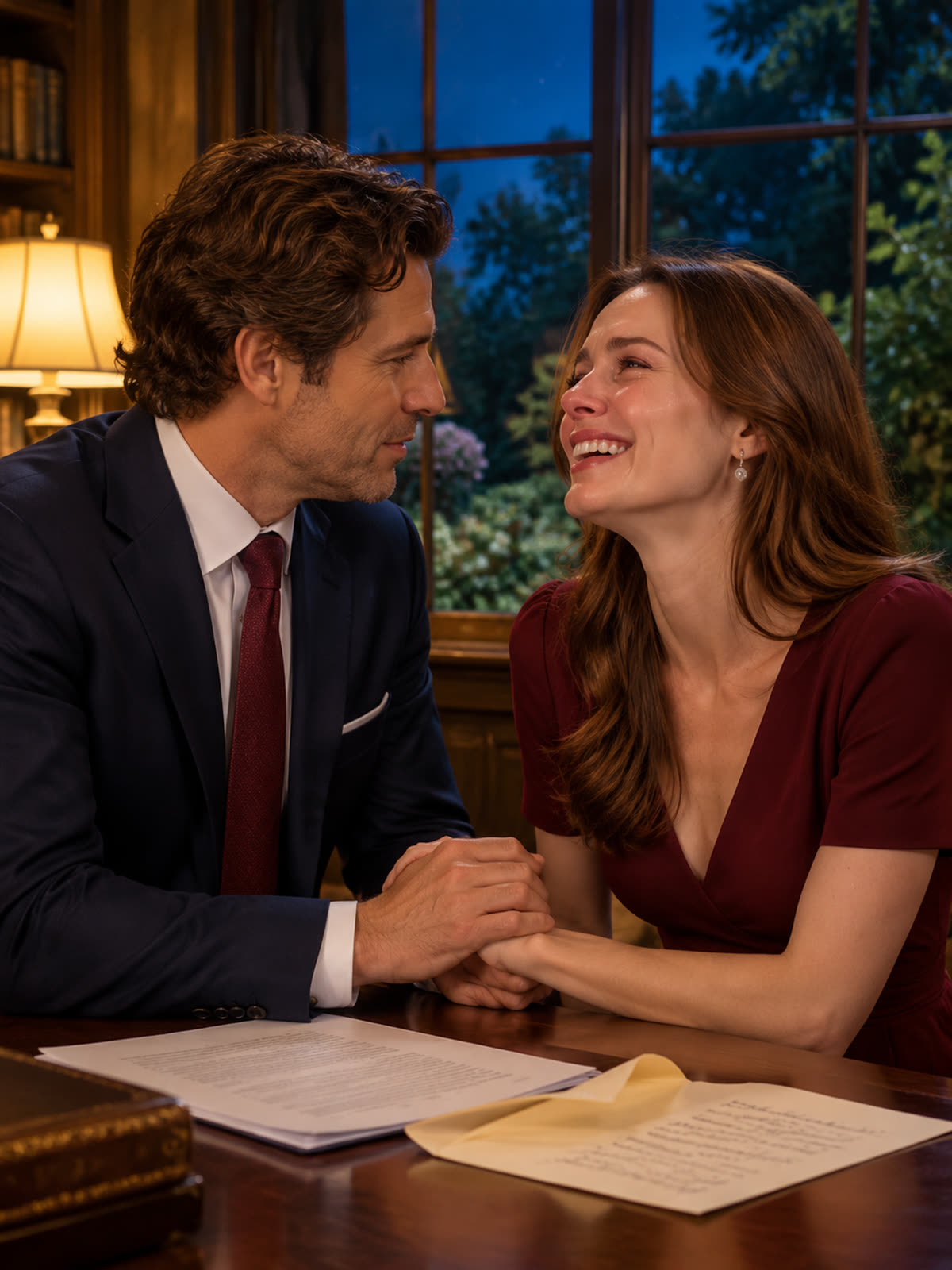
“No,” she said. “Stay. Please. And not out of obligation. Because you want to.” There was no bargain left to interpret in those words. She was not asking me to honor a debt, protect an arrangement, or preserve appearances. She was asking me to remain because I wanted our life together. “I want to,” I said. “I have for a long time.” After all our careful silence, the truth was that simple.
The following evening, we burned the divorce papers in the fireplace, one page after another. Meredith insisted that we save the last one. She framed it with the envelope as a reminder of how close two people could come to losing each other while trying too hard to be kind. We kept a piece of the ending we had nearly chosen, alongside the words that had urged us to stop before choosing it.
Her father joined us for dinner that Sunday. He held my hand in his for a long time without speaking. Then he cleared his throat. “I see you read my letter.” I answered, “I did, sir.” He looked at Meredith before turning back to me. “Good.” Then he added, “Don’t make me write another one.” I did not. There was nothing in his request that required another document or another carefully negotiated promise.
A year later, Meredith and I renewed our vows in the garden behind her family’s old house in Greensboro. There were no directors there, no investors, and no agreement. The marriage had begun as an answer to practical problems. This time, neither of us had to wonder what had brought the other to that garden. We were no longer relying on a bargain to say what we were afraid to speak for ourselves.
Meredith carried gardenias. She had remembered their meaning all along, just as she remembered my coffee and noticed the evenings when I forgot to eat. She wanted, she said, to give their scent a better memory. When I smelled them that day, I did not think of my father’s funeral. I thought of the plate she had brought into my study and the hand she had rested on my shoulder.
I thought of a wife who had loved me carefully through three years in which I had loved her just as quietly. We had spent so much time being polite, so much time mistaking silence for generosity. At last, we were honest. It was the best agreement I had ever made—and now we had the rest of our marriage to discover what it meant to live by it.
Disclaimer: This story is a work of fiction inspired by real-life themes. Names, characters, places and events are fictionalized, and any resemblance to real persons is purely coincidental. It does not represent any person or organization and does not encourage inappropriate behavior. Images are for illustration purposes only.
