

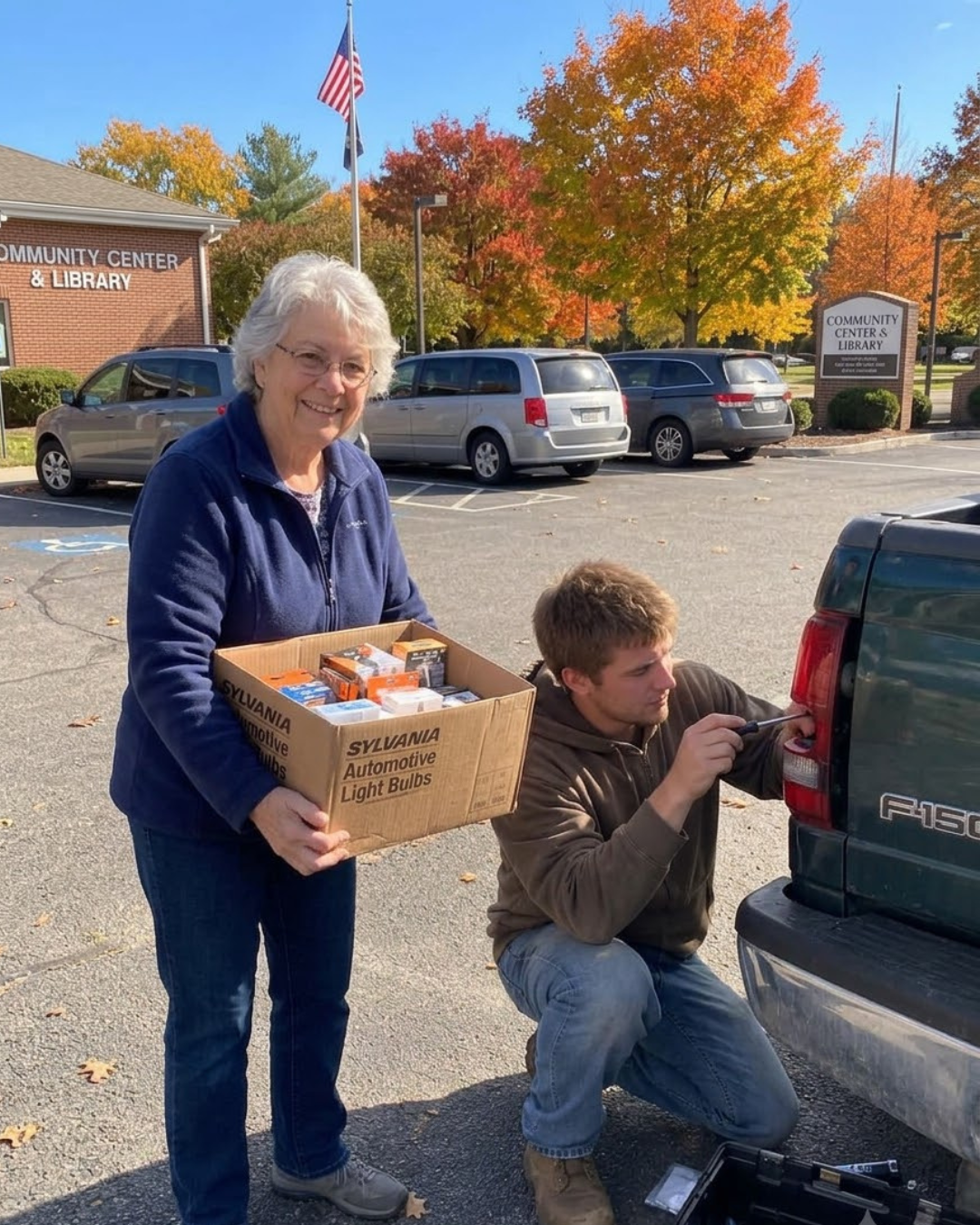
Part 1: The Taillight That Cost My Grandson $410
The tow truck’s yellow warning lights were already flashing before my grandson had finished lowering his car window.
I know exactly how it happened because his girlfriend, Hailey, recorded forty-one seconds of the encounter from the passenger seat and sent the video to me.
My phone vibrated on the kitchen counter while I was cleaning the stove.
I watched the recording standing there, still clutching my dishcloth.
Red and blue emergency lights flashed across the dashboard. Tyler’s hands rested firmly on the steering wheel at ten and two, exactly as I had taught him in the church parking lot when he was fifteen.
Then I heard the officer’s voice through the open window.
“License. Registration. Proof of insurance.”
I recognized it immediately.
The deputy was my son-in-law.
Craig Hanson had been married to my daughter Lisa for four years.
And there he was, standing beside my grandson’s car on Main Street at seven on a Saturday evening.
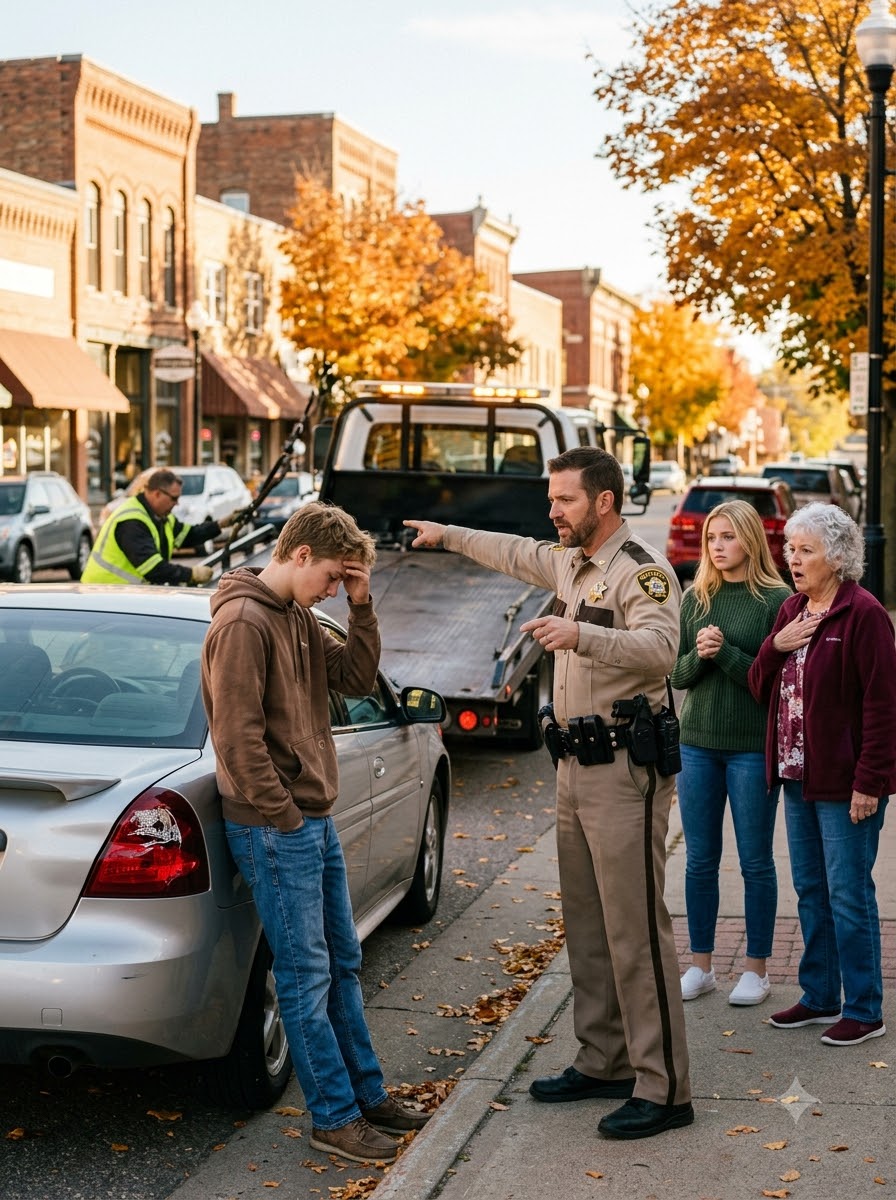
Right outside Dairy Queen.
In full view of half the high school.
Tyler handed him the requested documents.
His voice sounded controlled, but I had known that boy since his first breath. I could hear the tension underneath.
“Craig. It’s me.”
“I know who it is,” Craig said. “Your right taillight is cracked. It’s showing white to the rear. That’s an equipment violation.”
“I know. I ordered the part. The salvage yard in St. Cloud said it’d be here Tuesday.”
“It’s Saturday.”
That was all they said to each other.
The recording ended when Hailey’s thumb covered the camera.
But before it stopped, I heard the tow truck reversing.
That slow, unmistakable beeping sound that everyone in a small town recognizes.
My name is Marge Lindstrom.
I’m sixty-eight, and I live in Pine Haven, Minnesota, a community of roughly three thousand people about an hour north of St. Cloud.
For thirty-one years, I worked as a cook at Pine Haven Elementary School.
And before I explain what happened afterward, you need to understand why that car mattered so much.
It was a silver 2008 Pontiac Grand Prix with 186,000 miles and a dent in the rear quarter panel that looked exactly like the outline of a shopping cart.
Tyler had bought it for $1,800 when he turned sixteen.
He paid every dollar himself.
The money came from two summers bagging groceries at Coborn’s and another summer walking bean fields for the Peterson family along County 4.
He even kept the purchase receipt in the glove compartment.
I’m serious.
That boy protected the receipt as though it were the title to a valuable farm.
During the second week of October, someone backed a pickup into his car in the school parking lot, cracking the taillight before driving away.
Tyler returned home that afternoon unusually quiet.
He barely touched his supper until I finally asked what was troubling him.
“Somebody hit my car,” he said. “Not bad. Just the light.”
“Did they leave a note?”
“No.”
He moved his hotdish around his plate.
“I already called the salvage yard. Forty-five dollars for a used one. It’ll be here Tuesday.”
That was the kind of young man Tyler had become.
He didn’t complain or expect someone else to solve his problem.
He contacted the salvage yard and arranged the repair himself.
He was only seventeen.
Tyler had lived with me since he was fourteen.
People around Pine Haven knew pieces of the story, but not everyone knew what had actually happened.
Lisa had become a mother young.
Tyler’s father worked in the oil fields of western North Dakota and remembered to call on Sundays only occasionally.
My daughter raised her son mostly alone while working night shifts as a nurse at the hospital in Little Falls.
I helped whenever she needed me.
When Tyler turned thirteen, Lisa married Craig.
I want to be fair when I describe my son-in-law.
He didn’t drink excessively or chase other women.
He worked steadily and returned home each evening.
From what I could observe, he treated Lisa well.
But his relationship with Tyler was different.
Craig wasn’t physically abusive.
His strictness came through rules.
A curfew posted on the refrigerator.
A chore schedule requiring initials.
Weekly inspections of Tyler’s grades online.
Once, Craig confiscated Tyler’s phone for seven days because he had left a damp towel on the bathroom floor.
Tyler endured that household for approximately a year.
Then, one snowy March night, he walked a mile and a half to my house carrying his backpack and pillow.
At eleven o’clock, he knocked on my back door.
“Grandma,” he said. “Can I stay here for a while?”
That temporary arrangement became three years.
Lisa cried at first.
Eventually, she accepted it.
Then the tears stopped.
She came for Sunday supper whenever her nursing schedule allowed. Craig accompanied her roughly half the time.
During those meals, Craig and Tyler rarely exchanged more than a handful of words.
I retired from the school kitchen the same year Tyler moved in.
For thirty-one years, I had served elementary school lunches, including Tyler’s from kindergarten through fifth grade.
Thursday was tater tot hotdish day.
He always asked for an extra serving.
Having him live with me never felt like a burden.
It was one of the easiest decisions I had ever made.
And I would make it again.
On Monday morning, I drove Tyler to the county tow yard before school.
The facility sat beyond the fairgrounds, enclosed by chain-link fencing, with a small white office trailer beside the gravel lot.
The county used a private towing contractor, and that company established its own fees.
Tyler had been unusually quiet all weekend.
On Sunday, he attended church beside me, sitting through Pastor Ron’s entire sermon with his arms crossed.
I noticed the pastor glance toward him twice.
Inside the trailer, Deb was working.
I knew her from Tuesday bingo at the Legion.
“Marge,” she said.
Then she noticed Tyler and immediately understood.
By then, practically everyone in town knew what had happened.
“Two-eighty,” Deb said. “Two-twenty for the tow. Sixty for two days of storage.”
“Two days? It’s been a day and a half.”
“Any part of a day counts,” Deb said. She said it kindly. “I’m sorry, Marge. I don’t make the rates.”
I counted out $280 in twenty-dollar bills.
For a retired school cook, that was a considerable amount of money.
Tyler watched me pay, his ears turning red.
“I’ll pay you back,” he said in the car.
“I know you will.”
“I mean it, Grandma. Every dollar.”
“Tyler. I know you will.”
The traffic citation was another $130 after court fees.
Tyler insisted on paying that himself.
He drove the Grand Prix home carefully in daylight, parked it inside my garage, and left it untouched until the replacement arrived.
Later, people asked why I hadn’t simply contacted the sheriff.
I had.
I called him that Monday afternoon.
Sheriff Halvorson had once been a skinny little boy standing in my school lunch line.
He answered personally.
“Marge,” he said. “I heard.”
“Is it your policy to tow a child’s car over a taillight?”
He took a long breath.
“No, ma’am. It is not. Equipment violations get a ticket and a fix-it notice. A deputy can tow if he judges a car unsafe to drive. That’s a judgment call. And I’ll be honest with you, Marge. That was a hard call to justify.”
“So what happens now?”
“I’ll talk to him. That’s what happens. I’ll talk to him, and it’ll go in his file that we talked.”
He paused.
“I can’t give you the money back, Marge. I wish I could.”
“I didn’t call about the money.”
“I know you didn’t.”
I understood that the sheriff couldn’t do much more.
I didn’t want Craig to lose his job.
Nor did I intend to turn our family into the subject of gossip at every gas station and café in the county.
Lisa still had to return home to her husband after every night shift.
But I couldn’t pretend nothing had happened.
I couldn’t allow Tyler to believe that punishment was the only way adults knew how to correct a mistake.
The solution actually came from Tyler.
And I want him to receive the credit.
Tuesday evening, the replacement taillight arrived from the salvage yard.
After supper, we went into the garage to install it.
A Grand Prix taillight is secured by a few nuts accessible through the trunk.
Tyler worked with his socket wrench while I held the flashlight.
Fifteen minutes later, he connected the replacement.
I pressed the brake pedal.
The light glowed bright red.
Tyler stood behind the car studying it.
Then he spoke.
“Half the cars in this town have a light out,” he finally said. “Did you know that? I counted on the way home from school today. Eleven cars. Just between the school and here.”
“Eleven?”
“Mr. Peterson’s truck has had a brake light out since August. Is Craig going to tow Mr. Peterson?”
I handed him a rag.
He continued.
“Most people don’t even know,” he said. “You can’t see your own taillights. You’d have to have somebody stand behind you.”
And suddenly, I understood what we could do.
“Then let’s stand behind them,” I said.
He turned toward me.
“Saturday,” I said. “The church parking lot. We’ll buy a box of bulbs and some red lens tape. Anybody who wants to can drive through. We’ll check their lights and fix whatever we can. For free.”
“Grandma,” he said.
He looked at me as though I had lost my senses.
Then he repeated it, more slowly.
“Grandma.”
“Can you change a bulb on most cars?”
“I can change a bulb on any car,” he said. “I watched about a hundred videos while I was waiting for this part.”
Wednesday morning, I visited Pastor Ron.
St. John’s Lutheran was a white clapboard church with a bell tower where Main Street curved toward the river.
Its parking lot was the largest level paved area in town apart from the school.
Pastor Ron was fifty-eight and had served our congregation for nineteen years.
He had come from Iowa, and some of the older men still teased him about how he pronounced “pop.”
But he had married our children and buried our parents.
He belonged to us.
I explained my plan in his small office while the radiator clicked beside us.
When I finished, he removed his glasses.
“Marge,” he said. “Is this about Craig?”
I considered giving him an easier answer.
But I couldn’t lie to my pastor.
“Some of it is,” I said. “Most of it’s about Tyler. I want him to see a different way to fix a thing.”
“And Craig’s going to hear about it.”
“Everybody’s going to hear about it. It’s a town of three thousand people.”
He thought for a moment.
“I’ll put it in the bulletin,” he said. “And I’ll tell you what. If you get to some kind of number, I’ll ring the bell for you.”
“What kind of number?”
“I don’t know yet,” he said. “You’ll know it when you get there.”
That afternoon, I visited Dale Swenson at the auto parts store.
Dale had sat behind me in confirmation class in 1971.
After hearing what we needed, he brought out a cardboard box filled with bulbs.
“Twenty-five of the 3157s. Twenty of the 1157s. A dozen 7443s. And some little ones for license plates,” he said. “Two rolls of red lens repair tape and one roll of amber. That’ll cover most of what drives around here.”
He entered everything into the register.
“That’s a hundred and ninety. I’ll take a hundred and forty.”
“Dale. You don’t have to do that.”
“I know I don’t.”
He sealed the box.
“My brake light’s been out since Labor Day,” he said. “Put me on the list.”
Hailey made three signs with green markers.
FREE TAILLIGHT CHECK. ST. JOHN’S LUTHERAN. SATURDAY 9 TO DARK.
We posted them at the Cenex, the co-op, and the café beside the Legion pancake breakfast announcement.
Friday evening, Lisa telephoned.
I was making two batches of scotcheroos for Saturday.
After three decades cooking for schoolchildren, I couldn’t organize anything without preparing food.
“Mom,” she said. “What are you doing?”
“Making scotcheroos.”
“You know what I mean.”
She sounded exhausted after working the previous night.
“Craig saw the sign at the Cenex.”
“It’s a free taillight check, honey. At the church.”
“Mom.”
She hesitated.
“Is this to embarrass him?”
I put down my spoon and considered her question.
“No,” I said. “It’s to show Tyler that you can fix a thing without punishing somebody for it. If Craig’s embarrassed by that, then that’s something Craig ought to think about.”
Silence followed.
I could hear a television playing at her house.
“He’s not a bad man, Mom.”
“I never said he was.”
“He’s scared all the time,” she said. “About Tyler. He’s been scared ever since Tyler got his license. He won’t tell me why. He just gets this look.”
“Then maybe he ought to tell somebody why.”
“Maybe,” she said. “Good night, Mom. Save me a bar.”
I stood in my kitchen afterward, thinking about what she had said.
Craig was frightened.
But of what?
And why did that fear always seem to turn into punishment for Tyler?
I didn’t have the answer.
Not yet.
Part 2: Sixty-Four Lights and One Unexpected Visitor
Saturday arrived with beautiful October weather.
At nine, the temperature was fifty-four degrees, the sun was shining, and the maple trees surrounding St. John’s were brilliant shades of red and gold.
Dry leaves spun across the parking lot.
I wore my red flannel shirt, the one Tyler said made me resemble a lumberjack.
I brought two lawn chairs, a folding table, coffee, scotcheroos, and Dale’s box of bulbs.
Tyler brought his toolbox, mechanic’s creeper, headlamp, and the knee pads he had used while walking bean fields.
We arranged everything at the end of the lot closest to Main Street.
Hailey arrived promptly at nine with her mother’s clipboard.
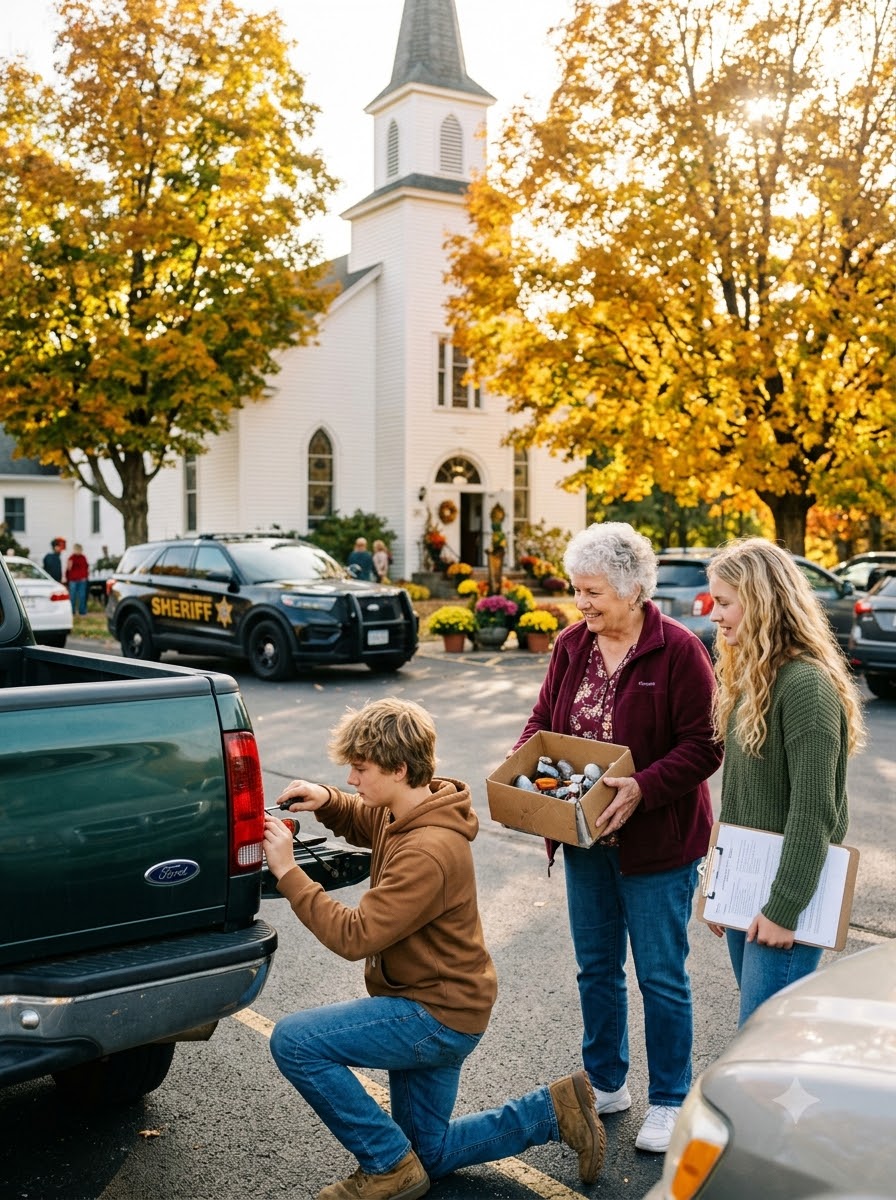
She wrote the date on a sheet of notebook paper and prepared to record each vehicle.
“How many do you think?” she asked me.
“If we get ten, I’ll be happy,” I said.
Our first customer arrived at 9:06.
It was Dale in his Silverado, still driving with the brake light that had been out since Labor Day.
He was smiling broadly.
Tyler replaced the bulb in four minutes.
“One,” Hailey said. And wrote it down.
I could describe every vehicle that came through that day.
Hailey saved all the records, and I still keep them folded inside my Bible.
By ten, six cars were waiting.
By eleven, fourteen had lined up.
Drivers pulled into the lot while Tyler and I stood behind their vehicles.
I would call out the instructions.
“Brakes.”
The driver pressed the pedal.
“Left.”
The left signal flashed.
“Now the other one.”
Most repairs involved burned-out bulbs costing about four dollars.
Many could be replaced with a simple quarter turn of the socket.
And most drivers had no idea anything was wrong until someone checked their lights.
Cracked lenses required more care.
Tyler cleaned the damaged plastic with rubbing alcohol and covered the cracks with red repair tape, making sure white light couldn’t shine through.
He always explained that the tape was temporary.
“That’s a patch. Not a fix. You’ll want a new lens. The salvage yard in St. Cloud has most of them for forty or fifty bucks.”
He gave the same explanation to everyone.
A farmer twice his size.
A young mother with three child seats.
Even the Methodist minister.
Soon, people began arriving with supplies.
Someone delivered a slow cooker full of sloppy joes.
The Legion auxiliary brought coffee and foam cups.
A stranger tucked a twenty-dollar bill beneath my thermos and disappeared before I could return it.
That’s how things sometimes happen in a town like ours.
Around one, an aging red Ford F-150 pulled into the lot.
Its wheel wells were rusty, and a feed store cap rested on the dashboard.
The driver was Walt Lindgren, an eighty-four-year-old farmer who had worked land north of town for sixty years.
He climbed out slowly, bracing himself against the door and side mirror.
“Heard you were doing taillights,” he said.
“Yes, sir,” Tyler said. “Let’s take a look.”
The truck’s left taillight was completely dark.
On that older F-150, removing the housing required lowering the tailgate and loosening two screws.
Tyler knelt on his padded knees and had the assembly out almost immediately.
Walt watched with his hands tucked into his jacket pockets.
“I used to do that myself,” Walt said. “Can’t get down there anymore.”
He shook his head.
“Can’t get back up, is the trouble.”
“That’s what I’m here for,” Tyler said.
I held out the bulb box.
Tyler selected the correct replacement, reassembled the housing, and asked Walt to press the brake.
Both lights glowed red.
Walt studied them for a moment.
Then he opened his wallet and offered Tyler five dollars.
“No, sir,” Tyler said. “It’s free today.”
“Take it.”
“No, sir. Really.”
Walt considered him quietly.
Then he folded the bill, slipped it into Tyler’s hoodie pocket, and patted the pocket twice.
“You’re Marge’s boy,” Walt said.
“Yes, sir.”
“Good,” Walt said.
He returned to his truck and drove away.
Tyler stood silently with his hand over the pocket.
Then he removed the money, unfolded it, and placed it into the collection envelope Pastor Ron had left for the food shelf.
I turned toward the box of bulbs.
I needed a moment before I could trust myself to speak.
By three, the waiting vehicles stretched beyond the parsonage and around the corner onto Main Street.
Hailey had started her third sheet of records.
Someone contacted the radio station in Little Falls.
Our free repair event was mentioned during the afternoon farm report, between the corn prices and obituaries.
Tyler had worked continuously since nine.
His hands were black with grease, and a license plate bracket on a Buick had scraped his knuckles.
When I suggested a break, he refused.
“There’s people waiting, Grandma.”
I brought him a sloppy joe and held it while he ate three quick bites between repairs.
At four, Pastor Ron came outside.
He stood beside me, watching the line.
“How many?” he asked.
“Hailey?”
She checked her clipboard.
“Fifty-eight lights. Thirty-nine cars.”
Pastor Ron whistled softly.
“Fifty-eight.”
He looked toward the remaining vehicles.
“You know what? I think I know the number now.”
“What number?”
“You’ll see,” he said.
Then he returned inside.
By 5:30, the sun had dropped low behind the church tower.
Long shadows stretched across the pavement.
Only a few vehicles remained.
Hailey’s mother arrived to collect her daughter but decided to stay.
Dale returned with another box of bulbs and settled into my spare lawn chair with a scotcheroo.
Tyler was kneeling behind a Ford Taurus when Hailey updated the count.
“Sixty-two.”
Next came a minivan with a faulty turn signal.
“Sixty-three.”
Then I noticed another vehicle turning slowly from Main Street.
Its blinker was flashing.
It was a county sheriff’s vehicle.
The older white Ford Explorer used for night patrol, with a green stripe along its side and a gold star on the door.
It stopped behind the minivan and idled.
Tyler rose from behind the Taurus.
He looked toward me.
I stared at the squad car.
When the minivan departed, the Explorer moved forward.
Craig shifted into park.
The entire parking lot seemed to fall silent.
Dale stopped chewing.
Hailey’s mother rested a hand on her daughter’s shoulder.
Craig stepped out in his tan uniform and duty belt.
His hat remained on the seat.
He looked at Tyler, then at me.
Finally, he studied the empty stretch of curb where dozens of cars had waited throughout the day.
“My left brake light’s out,” he said. “On the squad. Sarge noticed it this morning.”
Tyler stood motionless.
“I was going to have the county garage do it Monday,” Craig said. “But I saw the sign.”
The only sound was the flagpole rope tapping against the metal.
Then Tyler walked to the rear of the Explorer.
He lifted the hatch and opened the access panel.
Without asking, he reached toward me.
I placed the correct bulb in his hand.
After an entire day assisting him, I already knew which one he needed.
Craig watched quietly.
Tyler removed the socket, twisted out the burned-out bulb, and held it toward the fading light so Craig could see the broken filament.
Then he installed the replacement.
“Step on the brake,” Tyler said.
Craig climbed into the driver’s seat and pressed the pedal.
Both rear lights shone red.
“Sixty-four,” Hailey said quietly.
Craig stepped out again.
Instead of returning to the driver’s door, he walked directly toward Tyler.
He stopped in front of him.
I could see his jaw moving as though he were struggling to find the right words.
“I owe you an apology,” Craig said. “And I owe your grandma two hundred and eighty dollars.”
Tyler said nothing.
The burned-out bulb remained clenched in his hand.
Craig inhaled, glanced toward the bell tower, and continued.
“My dad was a deputy in this county,” he said. “Twenty-six years. You probably heard that.”
“Yeah,” Tyler said.
“What you probably didn’t hear,” Craig said, “is that when I was seventeen, I rolled my dad’s pickup into the ditch on County 10. I was going about seventy on gravel. I’d been drinking beer at a field party.”
He swallowed.
“My buddy Jeff Anderson was in the passenger seat. He broke his pelvis in two places.”
I recognized the name.
Jeff Anderson managed the paint counter at the hardware store.
He walked with a cane and had done so for as long as I could remember.
I had never known the reason.
“My dad was the deputy who came out to the ditch that night,” Craig said. “He wrote it up as a deer. He drove me home. He never said one word to me about it. Not that night. Not ever.”
Craig lowered his eyes.
“Nobody made me learn anything. Jeff spent three months in a hospital bed. And I went to the homecoming dance.”
His voice didn’t crack.
It simply grew quieter.
“I’ve been scared every day since you got your license,” he said to Tyler. “Every single day. Every time a call comes over the radio for a car in a ditch, I think it’s you. And I don’t know any way to be about that except hard.”
He shook his head.
“I thought if I was hard enough on you, you’d never end up like me.”
Then he looked at the ground.
“So I towed your car. Over a taillight. That you’d already ordered the part for. With your girl sitting right there next to you.”
Tyler remained still.
But his fist gradually opened, revealing the burned-out bulb resting in his palm.
“That’s not teaching,” Craig said. “That’s just me being scared out loud. I know it. The sheriff knows it too. He made sure of it.”
A faint smile crossed his face.
“And then I drove past here three times today. And I watched you fix half the town.”
I stayed silent.
This conversation belonged to them.
Tyler studied Craig for a long moment.
Then he finally spoke.
“You still have to pay the ticket on this, you know.”
Craig blinked.
“What?”
“Equipment violation,” Tyler said. “Brake light out. Showing no red to the rear.”
For a second, Craig could only stare.
Then he laughed.
Not politely.
Not nervously.
He laughed like a man finally releasing a breath he had held for years.
“Yeah,” he said. “Yeah. I guess I do.”
“I paid mine,” Tyler said. “I didn’t want you to tear it up.”
Craig lowered his hand.
He looked at Tyler as though he were seeing him properly for the first time.
A tall seventeen-year-old with grease on his arms and a scrape across his knuckles.
“I wouldn’t have,” Craig said. “That’s the one thing my dad did that I’m never going to do. I would never tear up your ticket.”
He slowly shook his head.
“Pay your own tickets. Fix your own lights. That’s all I ever wanted you to know, Tyler. I just didn’t know how to say it.”
And then the church bell began ringing.
Part 3: The Bell That Changed Our Family
I turned toward the church tower.
The door stood open, and I could see Pastor Ron pulling the bell rope with all his strength.
His arm rose and fell.
His body leaned into each pull.
That bell had been cast in 1912.
On quiet days, its sound could travel four miles across the surrounding countryside.
Now it rang over the parking lot, the river, and the streets of Pine Haven.
People stepped outside the café across the road.
A man standing at the corner removed his cap without knowing what was happening.
Hailey began counting each ring beneath her breath.
I watched her lips move.
Sixty-two.
Sixty-three.
Sixty-four.
Then the bell stopped.
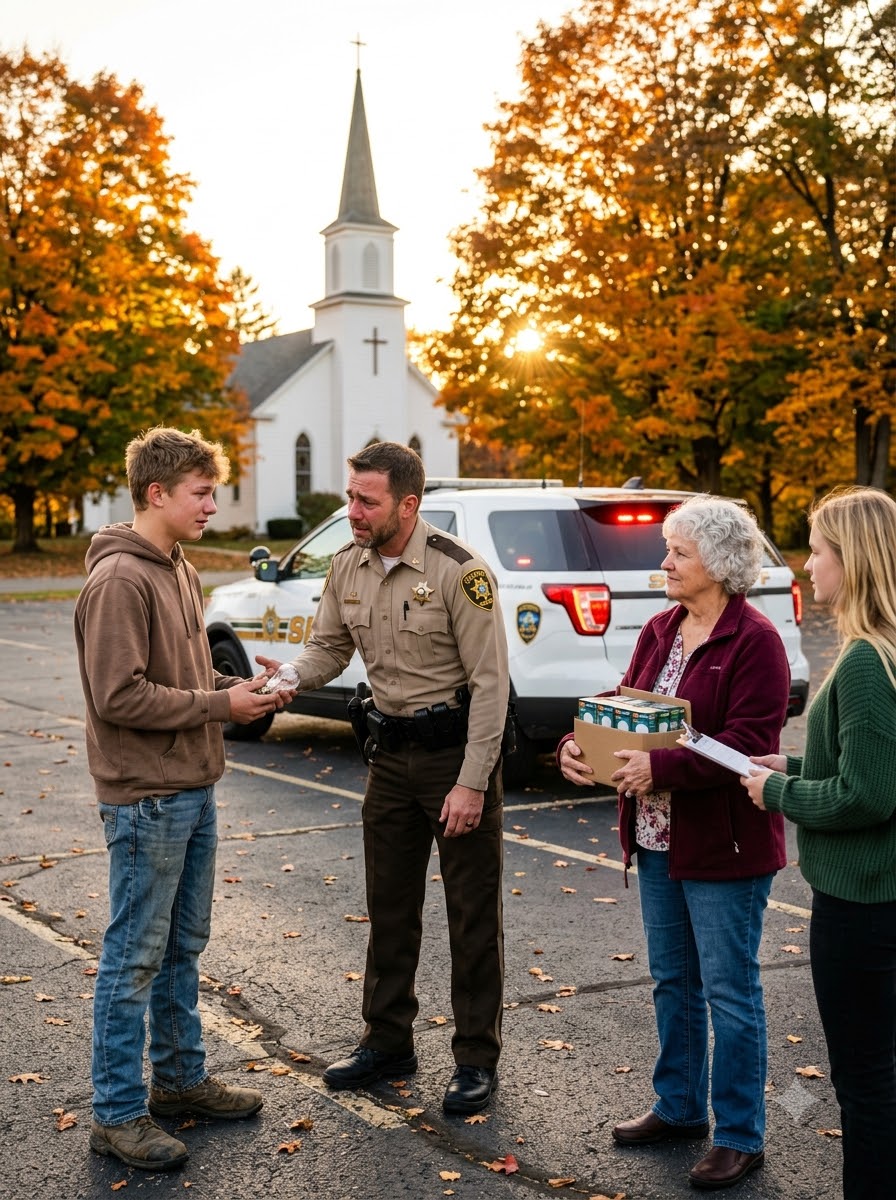
Its final note lingered over the town before fading into silence.
Pastor Ron emerged from the tower a minute later, his face flushed and his forehead damp.
“Told you you’d know the number,” he said to me.
I couldn’t answer.
My hand was covering my mouth.
Hailey’s mother was crying.
Dale was wiping his nose with a shop rag.
Tyler stood behind the squad car with his eyes closed.
And Craig remained beside him, holding his uniform hat.
I hadn’t noticed him retrieve it.
I expected Craig to leave afterward.
Instead, he removed his duty belt and locked it inside the Explorer.
Then he approached Tyler’s open toolbox, picked up a Phillips screwdriver, and examined it.
“Is there anything else that needs doing?” he asked.
Tyler glanced around the nearly empty parking lot.
“Nobody’s checked ours yet,” Tyler said. “Grandma’s. Hailey’s mom’s. Pastor Ron’s. Dale’s second truck.”
“Then let’s check them,” Craig said.
So they continued working.
Together, they moved from one remaining vehicle to another beneath the fading October sunlight.
Tyler called for the brakes.
Craig stood beside him and watched the lights.
They didn’t talk much.
But once, Craig asked how Tyler knew which direction to turn a socket on Hailey’s mother’s Malibu.
Tyler demonstrated.
Craig responded with a quiet “huh,” the sound of a man discovering something he hadn’t known.
Pastor Ron’s old Buick needed a license plate bulb.
The Malibu had a loose turn-signal socket.
Craig held the flashlight while Tyler adjusted it.
I sat in my lawn chair and watched.
I was afraid my voice would betray me if I tried to speak.
My Impala was the last vehicle they inspected.
Both taillights worked.
I already knew that because Tyler checked them every Sunday.
But Craig stood behind the car anyway while I pressed the brake.
Through the rearview mirror, I saw him give me a small nod.
By then, darkness had settled.
Tyler switched on his headlamp.
The parking lot was empty except for the three of us.
Craig approached my chair and removed his wallet.
He counted out $280 in twenties, exactly as I had done at the towing office.
Then he offered me the money.
For a moment, I considered refusing.
But Tyler was watching.
“Thank you, Craig,” I said. And I took it.
“Thank you, Marge,” he said. “For not calling it what it was. In front of all of them.”
“I didn’t need to,” I said. “You did.”
He nodded.
Then he climbed into the squad car and drove home to Lisa.
Both brake lights glowed red as he disappeared along Main Street.
I wish I could say our family changed completely that evening.
It didn’t.
People rarely transform overnight.
Tyler remained with me throughout his senior year.
I was pleased about that, and I believe Lisa was too.
But our Sunday dinners began to feel different.
Craig attended every week instead of appearing only occasionally.
He and Tyler spoke much more than the eleven or so words they had once exchanged across my table.
Usually, they discussed cars.
Craig asked about the Grand Prix.
Tyler mentioned a worrying noise from the transmission.
Craig suggested visiting his father’s former mechanic near Lake Alexander.
They went twice.
Afterward, Tyler returned home without telling me much.
But I noticed him whistling when he came through the door.
One evening in January, Lisa called.
“Mom,” she said. “He told me. About Jeff Anderson. About the whole thing.”
“I’m glad, honey.”
“Twenty-five years,” she said. “He’s been carrying that around for twenty-five years and he never told one single person.”
“Well,” I said. “Now he’s told a whole parking lot.”
She laughed, cried briefly, and then laughed again.
In February, Craig visited Jeff Anderson at the hardware store.
I learned about it from Jeff’s wife at church.
She told me the two men had stood near the paint-mixing machine for nearly an hour.
After Craig left, Jeff went home early.
His wife found him sitting alone in his truck in their driveway for a long time before coming inside.
She didn’t know what they discussed.
I didn’t ask.
That winter, the radio station contacted us about repeating the free taillight checks in spring.
Pastor Ron agreed before I could respond.
Dale offered to donate every bulb this time.
Meanwhile, Tyler continued paying back the $280 I had spent retrieving his car.
He gave me twenty dollars from each grocery-store paycheck.
By Christmas, he had repaid every cent.
I accepted each payment because keeping his word mattered to him.
What Tyler didn’t know was that Craig’s $280 had already gone into a savings account under Tyler’s name.
I intended to give it to him at graduation.
One Sunday in April, Craig and Lisa came for dinner after church.
Snow still lay in the roadside ditches, but the sunshine had grown warmer, and the roads were clear.
I served roast beef, mashed potatoes, and green beans I had canned the previous August.
For the first time since October, I left the kitchen window slightly open.
A gentle breeze moved the curtain.
After pie, Craig put down his fork.
He cleared his throat.
“Tyler,” he said. “I’ve got a question for you.”
Tyler looked up.
He was eighteen now, an inch taller than Craig.
A small shaving nick marked his chin.
“My truck’s due for an oil change,” Craig said. “I’ve always just taken it to the shop. I never learned to do it myself. My dad never showed me how.”
He slowly rotated his coffee cup.
“I was wondering if you’d teach me.”
Lisa placed her hand flat against the table.
I saw how firmly she pressed it down, trying to keep herself composed.
Tyler leaned back.
He crossed his arms, frowned, and looked toward the ceiling as though considering an extremely difficult proposal.
“Hmm,” he said.
Craig waited.
“Well,” Tyler said slowly. “I’d have to check my schedule.”
“Tyler,” Lisa said.
“I’m pretty busy,” Tyler said. “Senior year. Lot going on.”
Craig began smiling.
Finally, Tyler answered.
“Saturday morning,” Tyler finally said. “Nine o’clock. Bring a drain pan and a filter wrench.”
He pointed at Craig.
“And don’t bring coffee. You’ll spill it.”
“Yes, sir,” Craig said.
My grandson burst into laughter.
It was the first time I had heard him laugh directly with Craig rather than merely around him.
Craig laughed too.
I immediately stood to refill the coffee pot.
After thirty-one years as a school cook, I needed something to occupy my hands.
The following Saturday, they changed the oil in my garage.
I watched through the kitchen window.
Tyler showed Craig the drain plug.
Craig slid beneath the truck on Tyler’s creeper while Tyler crouched beside him, explaining how to turn the wrench.
The first attempt sent oil spilling everywhere.
Craig emerged with black oil running down his forearm and staining his good flannel shirt.
Tyler laughed so hard he had to sit on an overturned bucket.
Craig examined his ruined shirt.
Then he started laughing too.
They remained outside for almost two hours.
When they finally came inside, both were covered in oil and talking at once.
The second free taillight event took place in May, on the first Saturday after the snow had completely melted.
We repaired eighty-one lights that day.
Craig took the day off.
He spent the entire event kneeling beside Tyler on borrowed knee pads, holding a flashlight and passing him bulbs.
At four in the afternoon, Jeff Anderson arrived.
He drove an old blue Ford Ranger, with his cane resting on the passenger seat.
His right brake light wasn’t working.
Craig immediately stood when he recognized the truck.
Before Tyler could approach, Craig walked over.
He replaced Jeff’s bulb himself.
Afterward, the two men remained behind the Ranger, speaking quietly.
Jeff leaned on his cane.
Craig stood with his hands in his pockets.
I never learned what they said.
And I didn’t ask.
When Jeff drove away, Craig returned to Tyler and knelt beside him.
His eyes were red.
Tyler simply handed him the next bulb.
No words were necessary.
At six, Pastor Ron rang the church bell eighty-one times.
It took considerable effort.
He stopped twice to rest.
Tyler graduated from Pine Haven High School on the first Sunday in June.
When his name was announced, Craig stood in the bleachers and applauded louder than anyone else in the gymnasium.
That evening, we celebrated in my backyard.
I handed Tyler an envelope.
Inside was the bankbook showing $280 plus accumulated interest.
“What’s this?” he said.
“That’s the money Craig paid me back,” I said. “In the church parking lot. It was always yours.”
Tyler studied the bankbook.
Then he looked across the yard.
Craig stood beside the grill, turning hamburgers and laughing at something Lisa had said.
Tyler crossed the grass and handed him the bankbook.
I couldn’t hear their conversation.
But I saw Craig rest his hand against the back of Tyler’s neck.
They stood together like that for a long time.
I still keep Hailey’s original tally sheets folded into thirds inside my Bible.
All sixty-four entries from that first October Saturday are there.
Sometimes, during Sunday services, I unfold them and read the names.
Dale.
Walt Lindgren.
The Methodist minister.
The young mother with three car seats.
And at the bottom, written carefully in Hailey’s green marker, is the final entry.
- County squad car. Left brake light. Craig.
Pastor Ron has caught me reading those pages more than once.
He has never said a word.
