

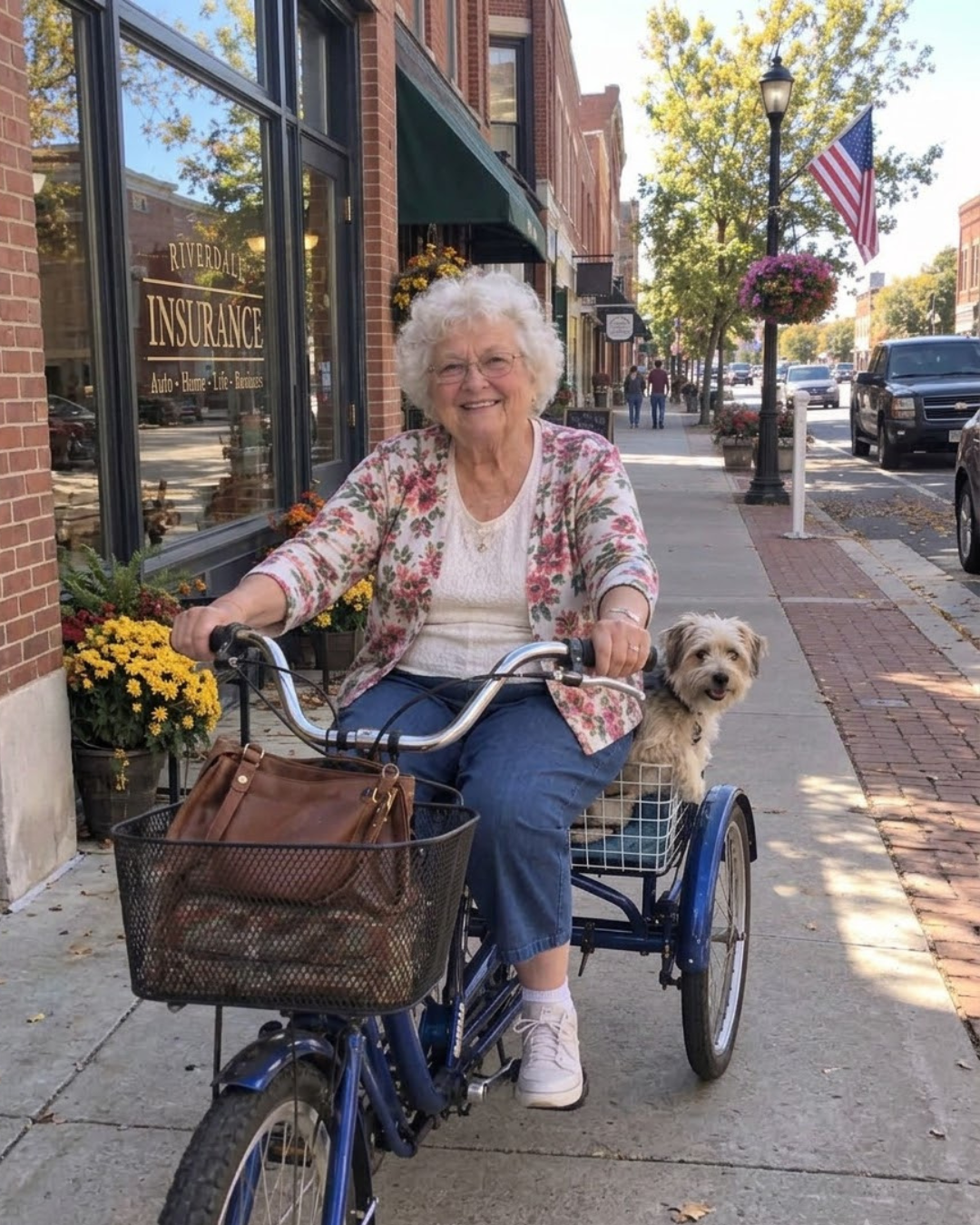
Part 1: The Birthday Gift I Never Asked For
My son stretched his hand across my birthday cake, holding his palm upward as though he were asking a small child to surrender something dangerous.
“Mom,” Brian said. “I need the keys.”
We were celebrating at the supper club beside the highway, the place with relish trays on every table and a lake painting hanging behind the bar.
It was the third Sunday in May.
I had turned seventy-six at exactly 6:10 that morning. My mother had always remembered the precise minute of my birth.
Across the table, my daughter-in-law Kim was concentrating intensely on her coffee.
“The keys to what?” I said.
I already understood. I simply wanted him to say it aloud.
“The Buick.”
“You drove me here, Brian. The Buick is in my carport.”
He offered no explanation. His open hand remained suspended above my cake.
I noticed a slight tremor in his fingers.
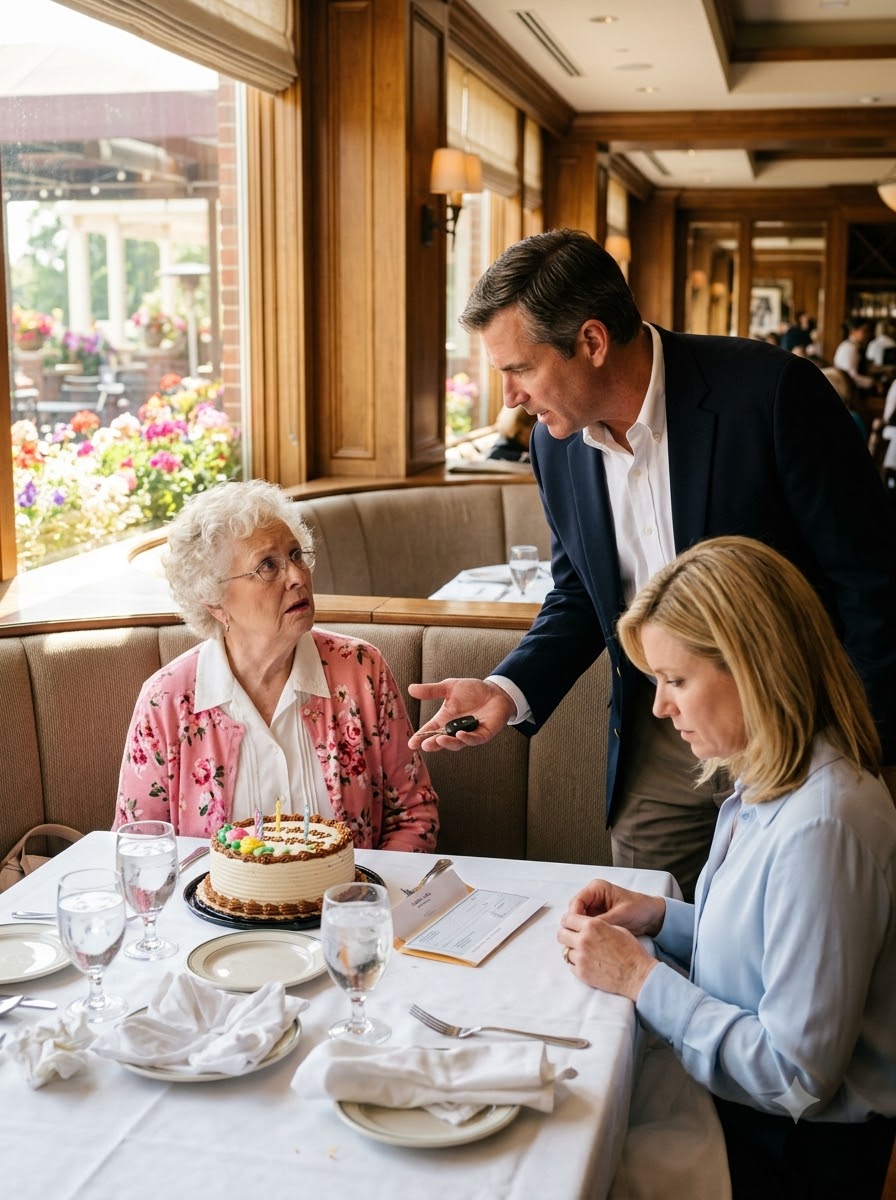
After thirty-one years working a telephone switchboard and directory assistance, I had learned to recognize small signs of uneasiness. I remembered that tremor.
“It’s for your own good,” he said. “After the mailbox.”
Two weeks earlier, during heavy rain, I had maneuvered around a delivery truck on Cedar Street and accidentally caught the Hendersons’ mailbox with my right fender.
The mailbox tilted afterward like an elderly gentleman with a troublesome hip.
That afternoon, I bought a replacement for thirty-eight dollars. I stood in the drizzle while Jeff Henderson installed it and assured me there was nothing more to worry about.
Then I called Brian and told him myself.
I had never hidden anything from my son.
Looking back, telling him had been my mistake.
“One mailbox,” I said.
“This time it was a mailbox.”
“In fifty-eight years of driving.”
“Mom.”
His voice dropped. The Schmidts were sitting nearby with their grandchildren.
“It’s done,” he said. “I didn’t want to do this here. But I didn’t know how else to do it. The Buick’s already sold.”
I carefully placed my fork beside my plate.
The tiny sound seemed unusually sharp.
“Sold,” I said.
“A man from Janesville. He came at four-thirty this afternoon. Kim let him into the carport with the spare key.”
Brian took an envelope from his jacket and placed it beside my cake.
“Forty-two hundred dollars. Cashier’s check. Made out to you. Every cent of it’s yours.”
You may wonder how my son could legally sell a vehicle belonging to his mother.
Unfortunately, I had made that possible myself.
Eleven years earlier, after Walter died, Brian had helped arrange my affairs. Sitting at my kitchen table, he added his name beside mine on the house, accounts, and car.
He explained that doing so would make everything easier when my time eventually came.
The Buick’s title read Dorothy Hale or Brian Hale.
Not and.
Or.
Either signature was sufficient.
At the time, I had thanked him for being considerate.
The Buick was a tan 2005 LeSabre with seventy-one thousand miles. Walter had personally selected it at the dealership.
He drove it for ten years.
I drove it for another eleven.
In the center console, there was still a roll of his wintergreen mints, hardened with age. I had never been able to throw them away.
I wondered whether the stranger from Janesville had discovered them.
“Say something, Mom,” Brian said.
There were countless things I wanted to say.
But I recognized the voice of someone who had already decided everything before beginning the conversation.
Arguing would accomplish nothing.
Besides, a seventy-six-year-old woman shouting about car keys in a restaurant would only confirm what her son already believed.
So I opened my purse.
I carefully separated the Buick key and black remote from my key ring.
My hands were perfectly steady.
I want that understood.
I placed both beside the envelope.
“There,” I said. “Now. Is somebody going to cut this cake? Or do I have to do that myself as well?”
Kim cut the cake.
Her hands shook more than Brian’s.
He drove me home in his truck. We barely spoke.
Lilacs were blooming along Cedar Street, their fragrance drifting through the vents.
When we reached my house, the carport was empty.
Only the familiar oil stain remained on the concrete.
My garden hose still hung from its hook, and the coffee can filled with winter sand stood beside the step.
Everything was where it belonged.
Except Walter’s Buick.
Brian accompanied me to the front door.
At fifty years old and six feet one inch tall, he somehow looked like a frightened nine-year-old beneath the porch light.
“I’ll take you anywhere you need to go,” he said. “Groceries. Church. The doctor. You call me, or you call the office and Mandy will find me. Any time. Day or night. I mean that.”
“I know you do.”
“You’re not mad?”
I studied his face.
“Thank you for the ride home, Brian,” I said.
Then I stepped inside and quietly closed the door.
I made certain not to slam it.
I didn’t want him later claiming that I had.
I didn’t cry.
That matters, too.
Instead, I sat at my kitchen table with the envelope before me and the clock ticking above the stove.
I began calculating.
I had enough savings to purchase another car immediately.
For ten minutes, I seriously considered doing exactly that.
But buying another car would turn everything into a continuing argument about driving.
Every parking-lot scratch in Wisconsin would become evidence against me.
Every holiday would bring another confrontation.
Because Brian hadn’t merely taken my vehicle.
He had decided what kind of person I was.
And another car wouldn’t change that judgment.
He needed to see me differently.
At 8:15 that evening, I telephoned Wilma.
We had shared the same pew at First Lutheran since 1974. She was seventy-eight, widowed like me, and drove her aging Ford only around town.
I explained what had happened.
“He did what?” Wilma said.
“I need a ride at nine o’clock tomorrow morning.”
“Where to? The lawyer?”
“The bike shop.”
Silence followed.
During my working years, I had heard every variety of telephone silence imaginable.
This one was especially satisfying.
“Dorothy Hale,” Wilma said finally. “I will be there at ten till.”
The bicycle shop occupied the old railway depot near the beginning of the town’s recreational trail.
Its owner, Eli, was a young man who couldn’t have been thirty.
He emerged from the back room wiping his hands on a cloth and found two elderly women standing among expensive racing bicycles.
To his credit, he didn’t assume we had wandered into the wrong shop.
“Morning, ladies. What can I do for you?”
“I saw a three-wheeler in your window at Christmastime,” I said. “A red one. With a basket.”
“The trike. Yes ma’am. I’ve still got her.”
He brought it out from behind the helmets.
It was bright red, with a broad black seat, protective fenders, a chain guard, and a large wire basket between the rear wheels.
The basket could hold four bags of groceries.
I thought it was magnificent.
“Three speeds,” Eli said. “Hand brake up front. And she’ll stop if you pedal backward, same as when you were a kid. Is it for you?”
“It is for me.”
“Have you ridden one before?”
“I’ve ridden a two-wheeler. Not since Kennedy was president.”
He accepted that answer without hesitation.
“Then I’m going to tell you the one thing,” Eli said. “And it’s the opposite of everything you remember.”
“All right.”
“Don’t lean. On a two-wheeler, you lean into a turn. If you lean on this, you’ll tip her right over. Sit up straight, like you’re in church. And steer her like a grocery cart.”
“I can sit up straight,” I said.
He adjusted the seat twice after checking how my knees bent.
Then he accompanied me into the gravel parking area behind the depot.
As I practiced, he walked beside me, keeping one hand close to the handlebar without touching it.
It reminded me of walking alongside six-year-old Brian on Cedar Street when Walter first removed his training wheels.
I circled the lot four times.
During the first turn, I leaned instinctively, lifting one inside wheel slightly off the ground.
“Grocery cart,” Eli said. Very calmly.
I straightened.
By the fourth circuit, the steering felt natural.
Wilma watched from the depot doorway, clutching her purse.
“Well?” she called.
“Well,” I said. “I believe I’m a natural.”
The tricycle cost $389.
With tax, the total was $410.40.
I wrote a check, realizing every penny came from the money Brian had given me for Walter’s Buick.
For the first time since my birthday dinner, I felt genuinely cheerful.
“Hold on a second,” Eli said.
He retrieved a little chrome bell from the wall and fastened it beside my handlebar grip.
“How much is that?” I said.
“That’s a birthday present.”
“I never told you it was my birthday.”
“Your friend did. While you were out back.”
He tightened the attachment and tested it.
The bell made a lovely, clear ringing sound.
“Somebody ought to give you something,” he said.
I looked away toward the water bottles until my emotions settled.
Sometimes the proper response to kindness is simply to accept it.
The trail from the depot to Main Street was two miles long.
I put my purse into the basket, fastened my cardigan, and prepared to leave.
The morning was bright, the air cool beneath the trees.
Green fields stretched beside the trail, and red-winged blackbirds called from the fence posts.
“Follow me,” I told Wilma. “In case I end up in a ditch.”
“I’m going to follow you with my flashers on,” she said. “Like a funeral.”
“Like a parade,” I said.
Then I began pedaling.
I had forgotten what moving through the world on a bicycle felt like.
Inside a car, everything passes behind glass.
On that tricycle, I could feel the breeze against my cheeks and smell grass, manure, and someone’s breakfast cooking.
I heard the tires rolling beneath me.
During the first half mile, my legs protested.
During the second, they found their rhythm.
I had tended my own vegetable garden for decades and walked to my mailbox twice daily.
Apparently, my body was capable of far more than Brian imagined.
At Depot Street, I left the trail and entered the roadway.
Wilma followed in her Ford, hazard lights flashing, traveling about six miles an hour.
A worker at the feed mill stopped loading his pickup to stare.
Then he removed his cap.
I rang my new bell.
By the time I reached the bank, my thighs ached.
I was also grinning.
And I remembered not to lean.
Hale Insurance stood on Main Street between the former dime store, now an antique mall, and the bakery.
Brian’s name appeared in gold lettering across the window.
Walter and I had paid for those letters when our son opened his business.
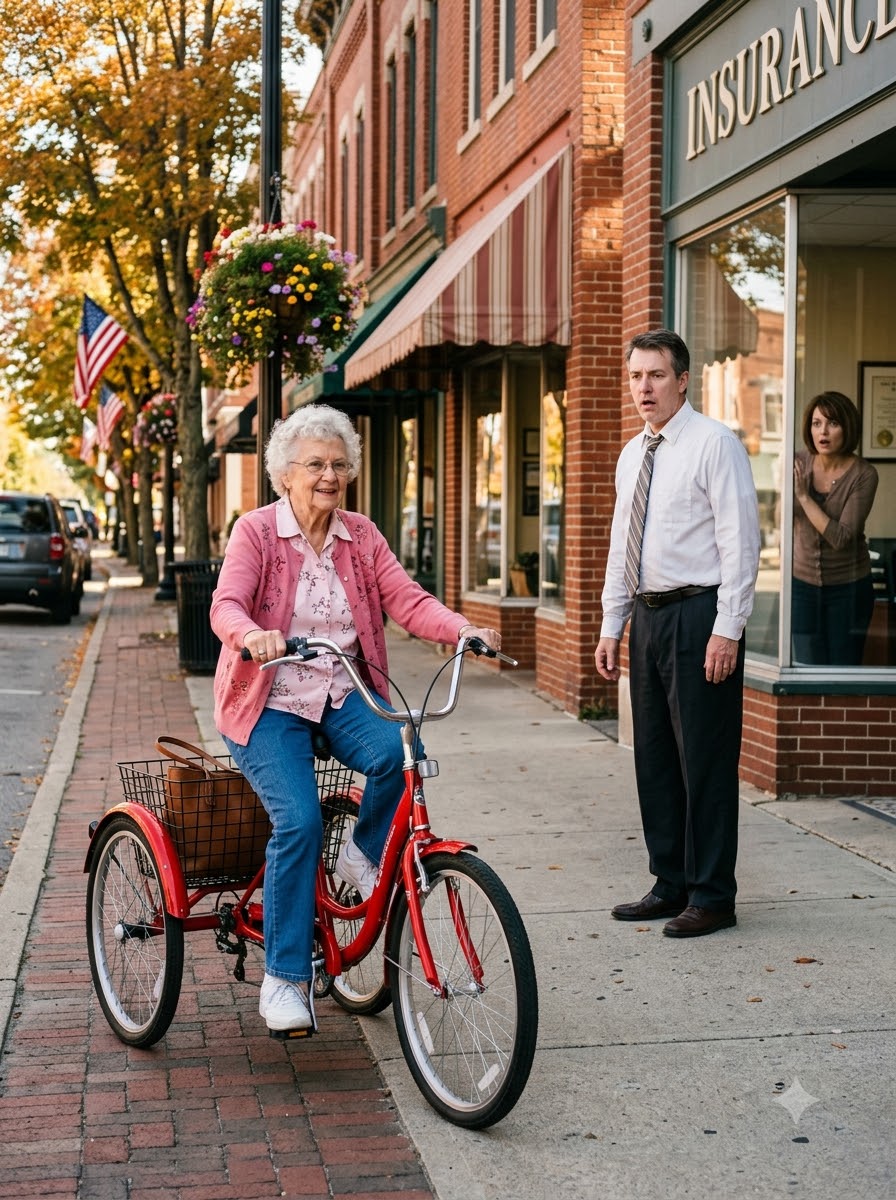
I guided the red tricycle onto the sidewalk and stopped directly outside his office.
One foot rested firmly on the pavement.
Through the window, I watched Mandy, his receptionist, rise abruptly from her chair.
She covered her mouth.
I couldn’t tell whether she was trying not to laugh.
Then Brian emerged from his back office to see what had caught her attention.
His eyes moved from the bright red wheels to the basket holding my purse.
Finally, he looked at me.
And all the color drained from his face.
Part 2: Four Miles an Hour Changed Everything
I had prepared myself for Brian’s anger during the entire ride.
But anger wasn’t what I saw.
He looked the way he had eleven years earlier at Walter’s funeral, standing beside his father’s grave in a coat far too light for November.
He hurried outside wearing his shirt and tie.
“Mom.” His voice sounded strained. “What is that?”
“It’s a tricycle, Brian. I bought it this morning.”
“You rode that here? On Main Street?”
“On the trail, mostly. Then Depot Street. Then Main. Wilma followed me.”
He glanced along the street.
Wilma was parked near the bakery, her hazard lights still blinking. She acknowledged him with two raised fingers.
“You could’ve been killed,” Brian said.
“By what? I was going slower than the mail.”
“There are trucks out there. There’s the grain trucks, there’s—”
He stopped and rubbed the back of his neck.
“Mom. This is exactly what I’m talking about. This right here.”
People walking past were beginning to notice us.
I didn’t want to embarrass my son outside the business where he earned his living.
“I didn’t come here to argue with you,” I said.
I kept my voice as controlled as it had been when handling difficult telephone callers.
“I’m not asking for the car back. You’ll never hear me ask for it. I came to ask you one question. And then I’ll be on my way to the Piggly Wiggly.”
He waited.
“When you decided I wasn’t fit to drive,” I said, “who did you ask?”
“What do you mean, who did I ask?”
“Did you call Dr. Keller? Did you call my eye doctor? Did you ride with me, even once around the block, to see how I did?”
He remained silent.
“Did you ask one single person who would know?”
After a long pause, he finally answered.
“No,” he said.
“Then what did you go on, Brian?”
His lips parted.
For an instant, I thought he was about to explain.
But Mandy tapped the window and held up the telephone receiver.
Whatever Brian had nearly said disappeared.
“I’ve got a ten-thirty,” he said.
“Then I’ll let you get to it.”
I rang my bell once and pedaled away.
At Piggly Wiggly, I bought milk, bread, butter, and a small ham.
All of it fit comfortably into my rear basket.
I rode the six blocks home without a single grocery bag shifting.
That happened Monday.
By Wednesday, practically everyone in our town of four thousand had heard about the red tricycle.
News of an elderly woman riding through town traveled remarkably quickly.
I took it to the library, the bank, and prayer circle at church.
Eleven women came outside to inspect it.
Three insisted on sitting on the seat.
Thursday, I rode toward the cemetery.
Cemetery Hill was steep enough that I had to push the tricycle for the final hundred yards.
I wasn’t embarrassed.
I sat beside Walter’s headstone, my purse resting on my lap, and told him what Brian had done with our Buick.
“Don’t be too hard on him,” I said. Out loud. “He’s got something stuck in him. I just don’t know what it is yet.”
During the second week, Wilma bought a tricycle.
After following me in her Ford three times, she had stopped beside me at a Cedar Street intersection.
“I feel like a fool in this car,” she said.
She initially purchased a used blue trike for seventy-five dollars at a rummage sale.
Unfortunately, it was built for someone much taller, leaving her knees nearly touching her chin.
So she visited Eli and purchased a new green one.
She kept the blue tricycle in her garage.
“For company,” she said.
Soon Shirley bought one.
At eighty-one, she had voluntarily stopped driving two winters earlier.
Since then, she had depended on her daughter’s Saturday visits whenever she needed to go anywhere.
Donna joined us next.
She was only seventy, and her knees were stronger than the rest of ours combined.
Eli told me he sold more tricycles that May than during the previous three years.
He began keeping a red one permanently displayed in his window.
Wilma decided our little group needed a name.
Standing in my kitchen with a pencil behind her ear, she announced her plan.
“Wednesdays. Ten o’clock. From your carport. The library, then the Piggly Wiggly, then the Dairy Queen. We are the Wednesday Riders. And I’m having that put on a sign.”
“You are not having it put on a sign.”
“A small sign,” Wilma said.
On our second Wednesday together, Shirley requested an additional stop.
The cemetery.
We pushed our tricycles up the hill in a line, pausing twice to catch our breath.
At the entrance, Shirley removed a pot of red geraniums from her basket.
“You go on,” Wilma told her. “We’ll wait right here.”
We watched Shirley cross the grass in her blue windbreaker.
She reached her husband’s headstone and stood quietly.
Then her voice carried back toward us.
“Don,” she said. “I came by myself.”
Wilma took my hand.
Donna turned toward the fields.
None of us spoke.
Since surrendering her driver’s license, Shirley hadn’t visited her husband’s grave without someone waiting impatiently in a nearby vehicle.
Now she could stay as long as she wanted.
She remained there twenty minutes, arranging the geraniums twice.
When she returned, tears covered her cheeks.
But she was smiling.
“Well,” she said. “Who’s buying the ice cream?”
That was what traveling four miles an hour had given us.
Not speed.
Freedom to take our time.
Throughout those weeks, Brian kept his promise.
He called every evening at six.
He repeatedly offered to drive me wherever I needed.
Every Saturday, he came to mow my lawn, just as he had since Walter died.
He always noticed the red tricycle occupying the spot where the Buick once stood.
But he never mentioned it.
What troubled me was his appearance.
He looked exhausted, with dark circles beneath his eyes.
He seemed thinner.
One evening, Kim called while Brian was away.
“He thinks you’re going to get hit,” she said. “Dorothy, he’s worse now than he was before. He’s up at four in the morning most days. Sitting in the kitchen in the dark.”
After a pause, she continued.
“I told him not to do it that way. I told him to talk to you first. I want you to know I said that.”
“I know you did, honey,” I said. “You’re the one who cut the cake.”
I thought about her words afterward.
A man who takes away his mother’s car simply because he enjoys controlling her would probably sleep quite comfortably.
Brian wasn’t sleeping.
Whatever motivated him was more complicated than stubbornness.
And I still didn’t know what it was.
I decided to gather evidence of my own.
During the first week of June, I rode to the clinic and requested Dr. Keller’s longest available appointment.
He had been my physician for twenty-two years.
“Jeff,” I said, sitting on the examination table. “I want you to examine me exactly as if you were deciding whether to take my driver’s license away. Do not be nice about it.”
He took the request seriously.
He tested my reflexes, balance, mobility, memory, and thinking.
He timed how quickly I could rise from a chair, walk ten feet, turn, and sit again.
He asked me to remember three words, draw a clock showing ten past eleven, and subtract seven repeatedly from one hundred.
That last exercise was easy.
During my years as a telephone operator, I had memorized half the county’s telephone numbers.
When he finished, he lowered his clipboard.
“Dorothy,” he said, “you’re in better shape than I am.”
“Put it in writing.”
He did.
On official clinic letterhead, he confirmed that I had no medical condition preventing safe operation of a vehicle.
The following week, I visited my eye doctor.
I had undergone cataract surgery four years earlier.
She checked my vision, peripheral awareness, and response to glare.
With my glasses, I measured twenty over twenty-five in both eyes and had full peripheral vision.
She provided written confirmation.
But I knew Brian.
He worked in insurance.
He would reasonably point out that neither doctor had actually watched me drive.
So I contacted the driving school in the county seat.
For eighty-five dollars, I booked an hour with an instructor whose vehicle had a second brake pedal.
His name was Gus, a retired shop teacher.
We drove through town, onto the highway, and around the courthouse square twice.
He even made me parallel park, something I had avoided since 1971.
He never touched his brake pedal.
Not once.
On his evaluation form, he wrote that I checked my mirrors more frequently than his teenage students.
He added that he would gladly ride with me again.
My driver’s license, incidentally, had remained valid throughout this entire ordeal.
It was still in my purse.
It wouldn’t expire for another five years.
Nobody had taken away my legal right to drive.
Brian had only taken away my car.
I collected the three evaluations in a manila folder.
On the final Tuesday in June, I rode to Hale Insurance at eight in the morning.
Mandy was unlocking the front entrance.
She noticed the folder in my basket.
“He’s been here since before six,” she said quietly. “He’s been here before six every single day since that mailbox, Mrs. Hale. I find him sitting back there in his office with the lights off.”
She hesitated.
“I don’t think it’s about a mailbox.”
“No,” I said. “I don’t either. Thank you, Mandy.”
Brian’s office door stood open.
He sat behind his desk, wearing a tie, with an untouched cup of coffee beside him.
His desk lamp was off.
On the shelf behind him was a photograph of Brian and Walter holding a string of bluegills from a fishing trip when Brian was twelve.
He rose when I entered.
I didn’t greet him.
I simply placed the folder on his desk, opened it, and turned the pages toward him.
Then I sat in the customer chair with my purse on my knees.
And waited.
He read Dr. Keller’s letter.
Then the eye doctor’s findings.
Finally, he studied Gus’s driving evaluation.
His eyes stopped at the comment about my mirrors.
He read everything again.
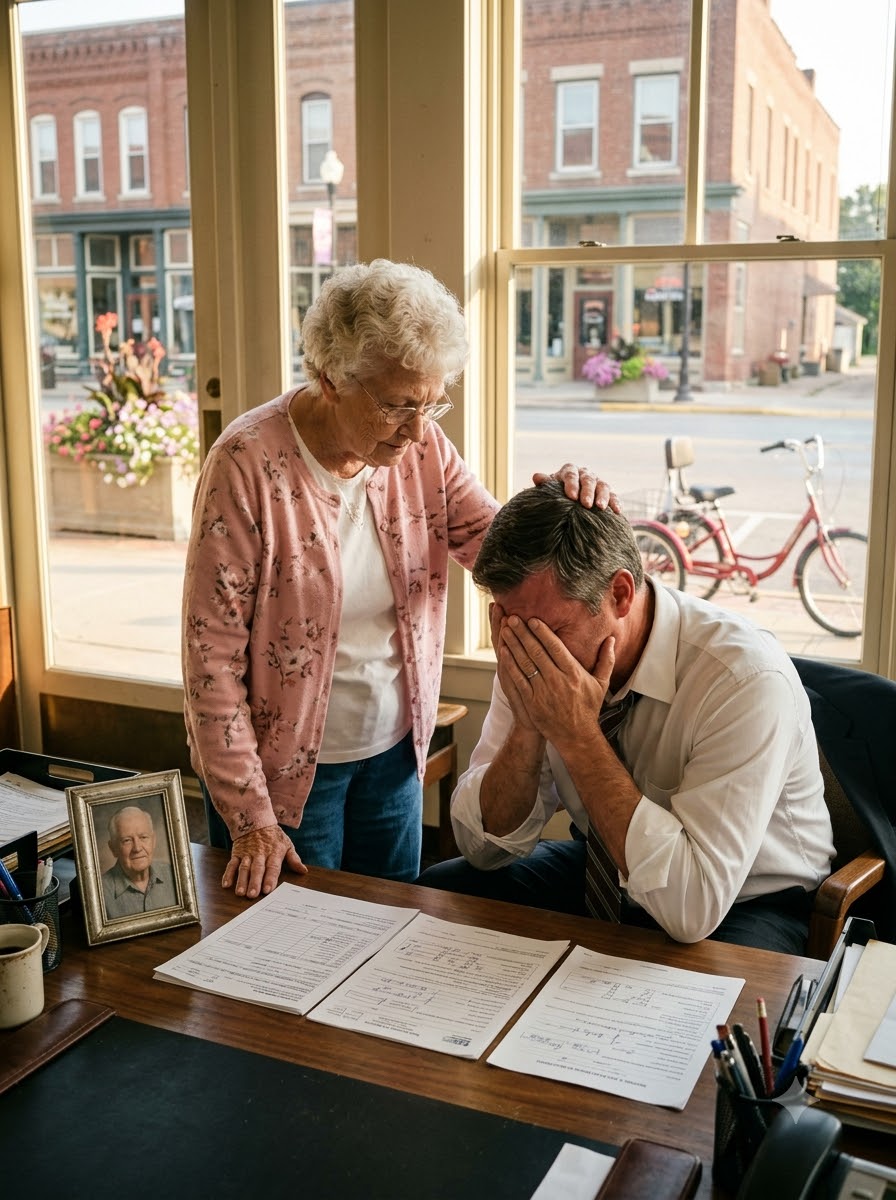
Then he slowly lowered himself into his chair, pressed both hands against his eyes, and began crying.
His shoulders shook.
I hadn’t seen my son cry since childhood.
Not even at Walter’s funeral.
That November, he had stood in his thin coat, greeted two hundred mourners, arranged transportation, and carried food into the church basement.
He hadn’t shed a tear.
Now he couldn’t stop.
I rose and quietly closed his office door.
Then I walked around the desk and rested my hand against the back of his head, where his hair was beginning to thin just like Walter’s.
“All right,” I said. “All right. Now tell me what you went on.”
He struggled to catch his breath.
Then, finally, he began telling me about the Sunday before his father died.
And within minutes, I understood why my son had been living in fear for eleven years.
Part 3: What My Son Had Been Carrying for Eleven Years
“The Sunday before Dad died,” he said. “I rode with him out to the Millers’ place to look at that boat. You remember. He was going to buy that boat.”
“I remember.”
“He drifted over the center line twice, Mom. Twice in four miles. The second time, there was a milk truck coming. And I reached over and grabbed the wheel. And he laughed at me. He said the road had moved.”
Brian wiped his face.
“I was going to say something. I was going to talk to you about it. His eyes. I had it all worked out, how I’d bring it up. I thought I’d wait until after Thanksgiving. So I wouldn’t spoil it.”
Walter died on November nineteenth.
At 6:40 that morning, he was traveling along County N toward the cheese plant where he had managed maintenance for thirty-four years.
His car left the road at the curve near the Miller farm.
“The deputy called me,” Brian said. “Not you. You were at the church setting up for the bazaar and nobody could get ahold of you. So he called me. And I drove out there.”
He lifted his eyes toward mine.
“I saw the car, Mom. I saw the car before they had him out of it.”
I had never known that.
Eleven years had passed without Brian mentioning what he saw.
“Oh, Brian.”
“I said nothing. And he died.”
His voice broke.
“And then you called me about that mailbox. So cheerful about it. Laughing. And all I could see was that curve. I haven’t slept right since. I’d lie there and think, I said nothing once. I’m not going to say nothing twice.”
He shook his head.
“But I couldn’t do the talking part. I knew if I talked to you first, you’d talk me out of it. And then you’d be out on some road somewhere. And I’d get another call.”
Tears streamed down his face.
“So I just did it. I did it all at once. So it would be over.”
I brought another chair close to him until our knees nearly touched.
“Listen to me,” I said. “I’m going to tell you two things. And I need you to hear both of them.”
He nodded.
“The first one is this. It was ice.”
He immediately began shaking his head.
“It was ice, Brian. I read that deputy’s report. Which is more than you ever did. There was black ice on that curve, from the creek. A boy of twenty-six went off that exact same curve forty minutes before your father did. He only walked away because he was in a big pickup. The deputy told me to my face that a man of thirty would’ve gone off that road.”
I held his hand.
“Your father’s eyes did not kill him. You did not kill him. November did.”
He cried harder.
“Maybe he should’ve had his eyes looked at. I’ll grant you that. Maybe you should’ve said something. Maybe I should’ve noticed. I was the one sleeping right next to him.”
I squeezed his fingers.
“If that silence belongs to anybody, we carry it together. You do not get to carry it all by yourself for eleven years. And then set it down on me.”
He made a broken sound that I couldn’t describe.
“And here’s the second thing.”
I waited until he met my eyes.
“Fear is not a reason to take away a person’s legs, Brian. I don’t care how much you love her. That car was my legs. You were afraid. So you made me smaller, so you could sleep.”
I held his gaze.
“And you didn’t sleep anyway. Did you?”
“No,” he whispered.
“No. Because that’s not how fear works. You feed it, and it just wants more. Next it would’ve been the stove. Then the stairs. Then the whole house.”
He remained silent for a long time.
Beyond the office door, Mandy answered the telephone in an unusually cheerful voice.
Finally, Brian spoke.
“I’m sorry,” he said finally. “Mom. I’m so sorry. I’ll get it back. I’ll get the Buick back. I’ll call that man right now.”
“You don’t have to do that.”
“I do, though.”
He found the buyer’s number in his desk and called on speakerphone.
The man answered after four rings.
He explained that he had purchased the LeSabre for his granddaughter, who would begin college in Platteville that fall.
He had already installed four new tires.
And the girl had given the car a name.
“She calls it Walter,” the man said.
I stopped moving.
“There was a roll of mints in the console,” the man said. “With a little note rubber-banded around it. It said Walter’s. Do not throw out. She thought that was the sweetest thing she ever saw. She left them right where they were.”
I had completely forgotten writing that note.
Brian looked ready to offer more money to recover the car.
I gently touched his arm and shook my head.
“You tell her,” I said toward the telephone, “that it likes to be warmed up a full two minutes in the winter. And the mints stay.”
“Yes ma’am,” the man said. “I surely will.”
And just like that, I accepted that the Buick was gone.
An eighteen-year-old girl would take it to college, carrying Walter’s name and his wintergreen mints.
I could imagine far worse futures for a beloved old car.
After Brian ended the call, he looked down at his hands.
“Then I’m buying you another one,” he said. “And it’s not a discussion.”
“I have the forty-two hundred. Less a tricycle.”
“You keep that.”
He swallowed.
“This one’s mine to do. Let me do it all the way through, Mom.”
I remembered Eli insisting on giving me the birthday bell.
“All right,” I said.
That same week, Brian found a silver 2015 Toyota Corolla at a dealership in the county seat.
It had eighty-two thousand miles and a tidy little back seat.
He wanted something newer.
I reminded him that a woman my age didn’t need a vehicle that might outlive her by thirty years.
He paid $9,600.
When the employee preparing the title asked which names should appear, Brian answered immediately.
“One name. Dorothy M. Hale. Just hers.”
He personally arranged the insurance and applied the safe-driver discount.
After all, I had the paperwork proving I qualified.
I allowed him to think the matter was settled.
But I wasn’t quite finished.
In the dealership parking lot, with the new keys in my hand, I turned toward him.
“There’s one more thing,” I told him. “Wednesday. Ten o’clock. My carport.”
“What’s Wednesday?”
“You said I could’ve been killed. I want you to see exactly what you were so afraid of. You’re going to ride the route.”
“Mom, I’ve got appointments.”
“Mandy already moved them. I called her this morning.”
He arrived Wednesday directly from work.
That was how my fifty-year-old son ended up wearing a white dress shirt and striped tie while sitting on Wilma’s spare blue tricycle.
It was the oversized one.
His knees rose almost to his chest.
Wilma inspected him.
“Don’t lean,” she told him.
“I know how to ride a bike, Wilma.”
“That’s exactly what’s going to tip you over,” she said.
She rang her bell.
And off we went.
Five riders traveled along Cedar Street at approximately four miles an hour.
At the first corner, Brian leaned instinctively.
One wheel lifted from the pavement.
Shirley, who was eighty-one, called back without even turning around.
“Grocery cart, dear!”
He immediately straightened.
At the library, Brian carried everyone’s books inside.
At Piggly Wiggly, the manager came outside to shake his hand.
My son’s face turned almost as red as my tricycle.
Neighbors waved from their porches.
Then, on Depot Street, a grain truck approached from behind.
I watched Brian’s shoulders tighten.
The truck slowed and followed us patiently for an entire block.
When we turned, the driver sounded two brief taps on his horn.
Donna answered with two rings of her bell.
“He’s my nephew,” Donna said. “They all know us now. They watch for the little orange flags.”
Brian said nothing.
But his shoulders relaxed.
At Cemetery Hill, we dismounted and pushed our tricycles.
Brian reached toward my handlebar.
“Push your own,” I said.
At the gate, our companions stopped.
“You two go on,” Wilma said. “We’ll wait.”
Brian and I walked across the grass together.
His sleeves were rolled up, and his tie hung loose.
He hadn’t visited since the previous year’s Memorial Day, when he had briefly placed a flag at the grave.
We stood before Walter’s headstone.
Walter James Hale.
The dates.
Beloved husband and father.
Wind moved through the oat fields below the hill.
For a long time, Brian simply stood there.
Then he crouched and rested his palm against the granite, as gently as if touching his father’s shoulder.
“It was ice, Dad,” he said. “Mom says it was ice.”
I turned toward the fields, giving him that moment alone.
Eventually, he stood and wiped his eyes with the end of his tie.
I pretended not to notice.
“She passed every test there is,” he told the stone. “She parallel parked. You’d never believe it.”
“He would not,” I agreed. “He used to get out of the car and do it for me.”
We walked back toward the gate.
Wilma was thoughtfully examining a cloud.
At Dairy Queen, Brian purchased five vanilla cones.
Then he sat on the curb in his good trousers beside four elderly women.
A man who had purchased farm insurance from him drove past, slowed to stare, and continued on.
Brian raised his ice cream cone in greeting.
“I’m never going to hear the end of this,” he said.
“No,” said Wilma comfortably. “You will not.”
That night, Brian finally slept.
Kim telephoned the following morning to tell me.
He had slept from ten until six without waking.
It was his first complete night’s rest since May second.
I still have my Corolla.
I drive to church every Sunday and visit my granddaughter in Madison once a month.
I make those trips during daylight because that is what I prefer.
And I check my mirrors more frequently than any sixteen-year-old in the county.
Sometimes Brian rides along.
He no longer reaches for the steering wheel.
But my red tricycle remains in the carport beside the Corolla.
For errands around town, I usually choose the trike.
The library.
The bank.
Piggly Wiggly.
The cemetery, where I visit Walter.
There are seven Wednesday Riders now.
Wilma eventually got her sign.
It hangs from a nail near the front of my carport.
It really is a small sign.
Shirley visits her husband’s grave every Wednesday.
She no longer returns to the gate crying.
Instead, she smiles and asks who is buying ice cream.
Eli continues maintaining my bicycle bell without charging me.
I bring him homemade banana bread, and he accepts it without argument.
Last month, a seventy-nine-year-old woman from two towns away called me.
Her son had recently taken her car.
A cousin had told her about our riding group.
“How do I start?” she asked me.
I told her to visit Eli at the bicycle shop in the old depot.
I explained that she should sit upright as though she were in church.
And I reminded her not to lean.
Every so often, on a pleasant morning, I pedal along Main Street past the gold lettering on the window of Hale Insurance.
When I reach my son’s office, I ring my bell.
Only once.
Brian looks up from his desk.
Every single time.
And he waves.
