

Part 1: The Suitcase Waiting by the Front Door
My wife called me at work on a Friday afternoon and accused my twelve-year-old daughter of stealing $1,200 from our bedroom.
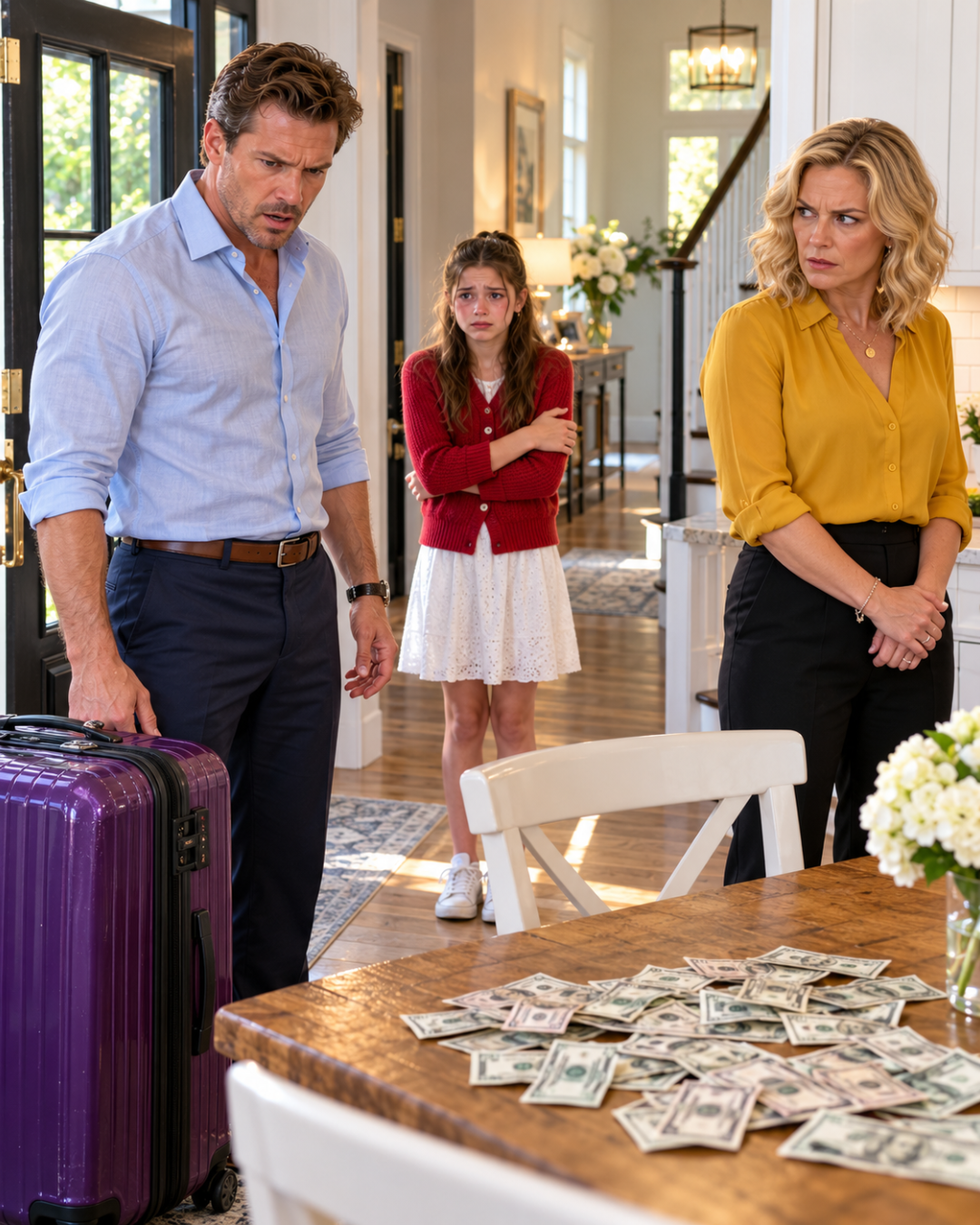
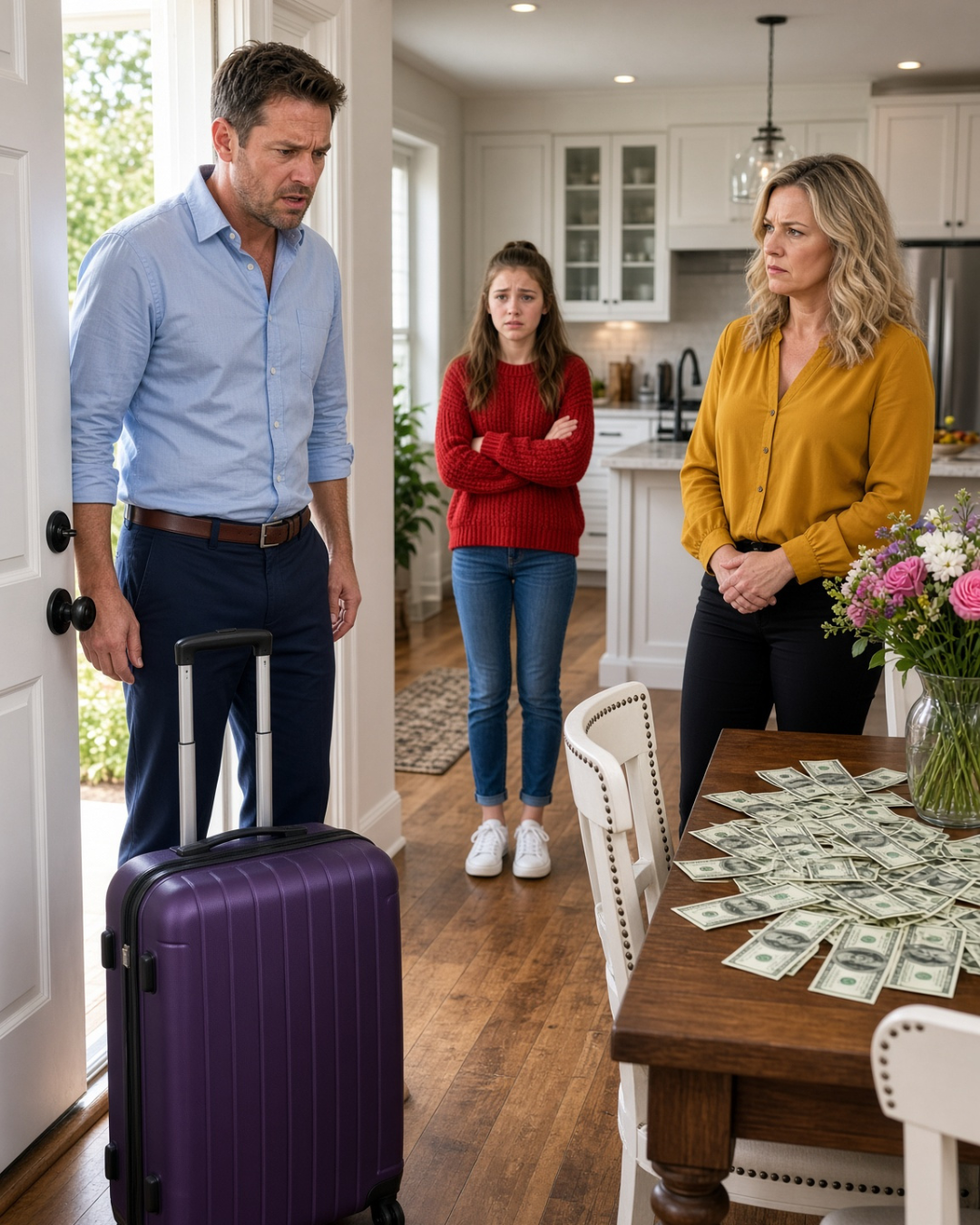
By the time I got home, she had already searched Molly’s backpack, discovered $300 inside it, and packed my daughter’s purple suitcase.
It was standing beside the front door.
But before I could decide what had happened, Molly looked at me with frightened eyes and whispered something that changed everything.
“Dad, before you believe her, please call Grandma.”
I knew immediately that something was wrong.
What I didn’t realize was how carefully the situation had been arranged before I ever received that phone call.
It began at exactly 4:17 p.m.
I was standing on a ladder inside an office building, working on an HVAC system, when my phone started vibrating.
My wife, Tara, almost never called during my working hours.
“Scott, you need to come home.”
Her voice sounded unsteady.
“What happened?”
“It’s Molly.”
I climbed down immediately.
“Is she okay?”
“Yes. But she’s done something terrible.”
I heard a cabinet close in the background.
“Tara, tell me.”
“Twelve hundred dollars is missing from our bedroom. And I found three hundred in Molly’s backpack.”
For several seconds, I couldn’t make sense of what she was saying.
“What?”
“She stole from me, Scott.”
“Are you certain?”
“Why else would she hide that much money in her schoolbag?”
I leaned against the wall.
Molly was twelve. She was quiet, responsible, and sometimes stubborn in the ordinary way children her age could be.
But stealing?
I had never known her to take anything that didn’t belong to her.
“Where is she?”
“In her room. She refuses to confess.”
“Wait until I get home.”
Tara gave a bitter laugh.
“I’ve already tried handling this without involving the police.”
“Nobody’s calling the police. I’m coming.”
I told my supervisor there was a family emergency and left immediately.
The drive usually took twenty-five minutes. That afternoon, every traffic light seemed determined to hold me there.
We weren’t wealthy.
I repaired heating and cooling systems, and Tara worked at a dental office. Between the mortgage, utilities, groceries, and expenses for two children, $1,200 represented a considerable amount of money.
We had been putting money aside for a new washing machine. The old one had begun making alarming noises, although it still managed smaller loads.
But I wasn’t thinking primarily about the appliance.
I was thinking about Molly.
Her mother had died six years earlier.
For four years afterward, it had been just the two of us.
Then Tara came into our lives.
She had a son named Cole, two years younger than Molly. We dated for a year before getting married, convinced we could build a happy family together.
Tara was organized and dependable. She managed school calendars, appointments, and household schedules while I worked long days.
I believed we were sharing the responsibilities of raising our children.
When I finally pulled into the driveway, Tara’s car was already there.
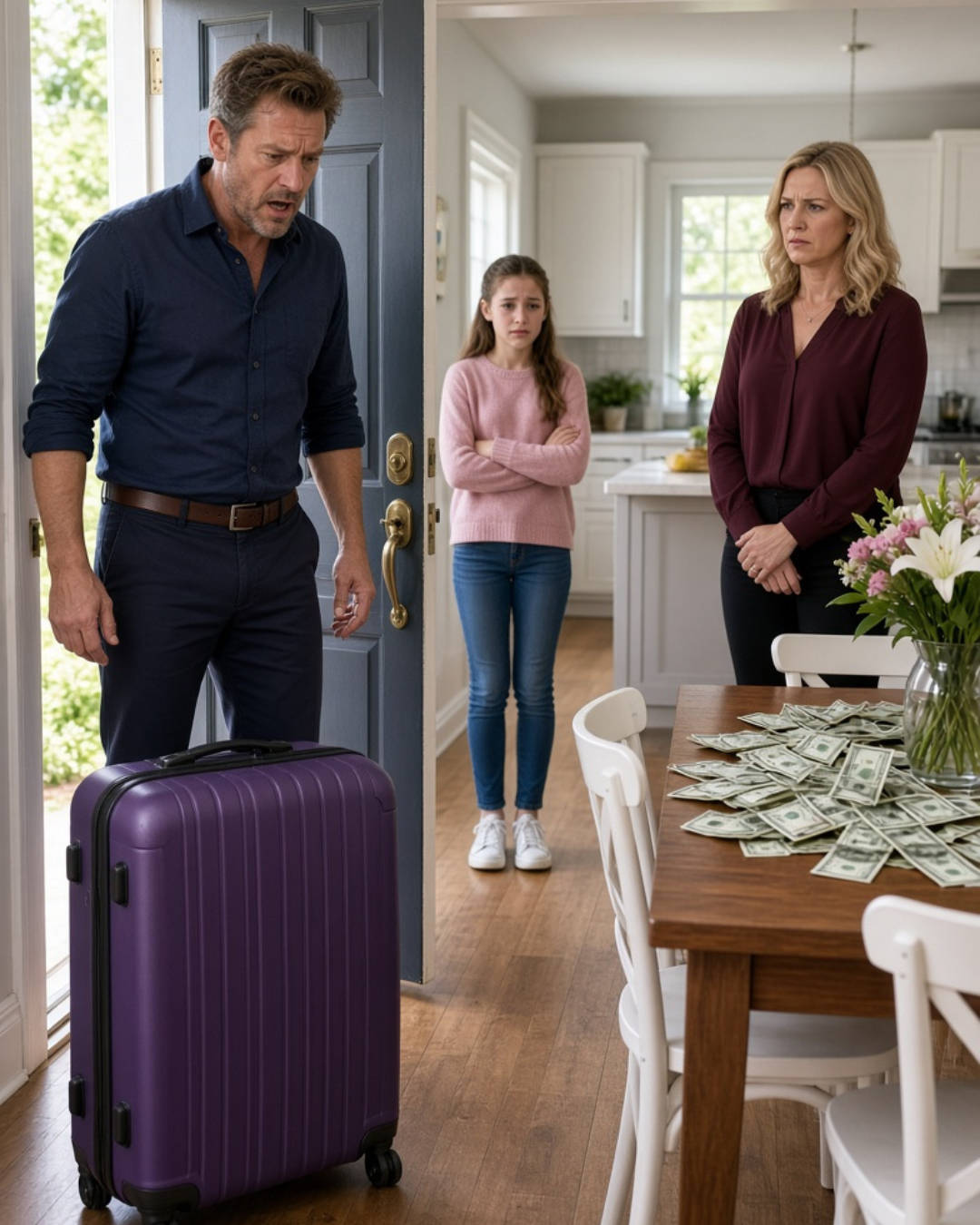
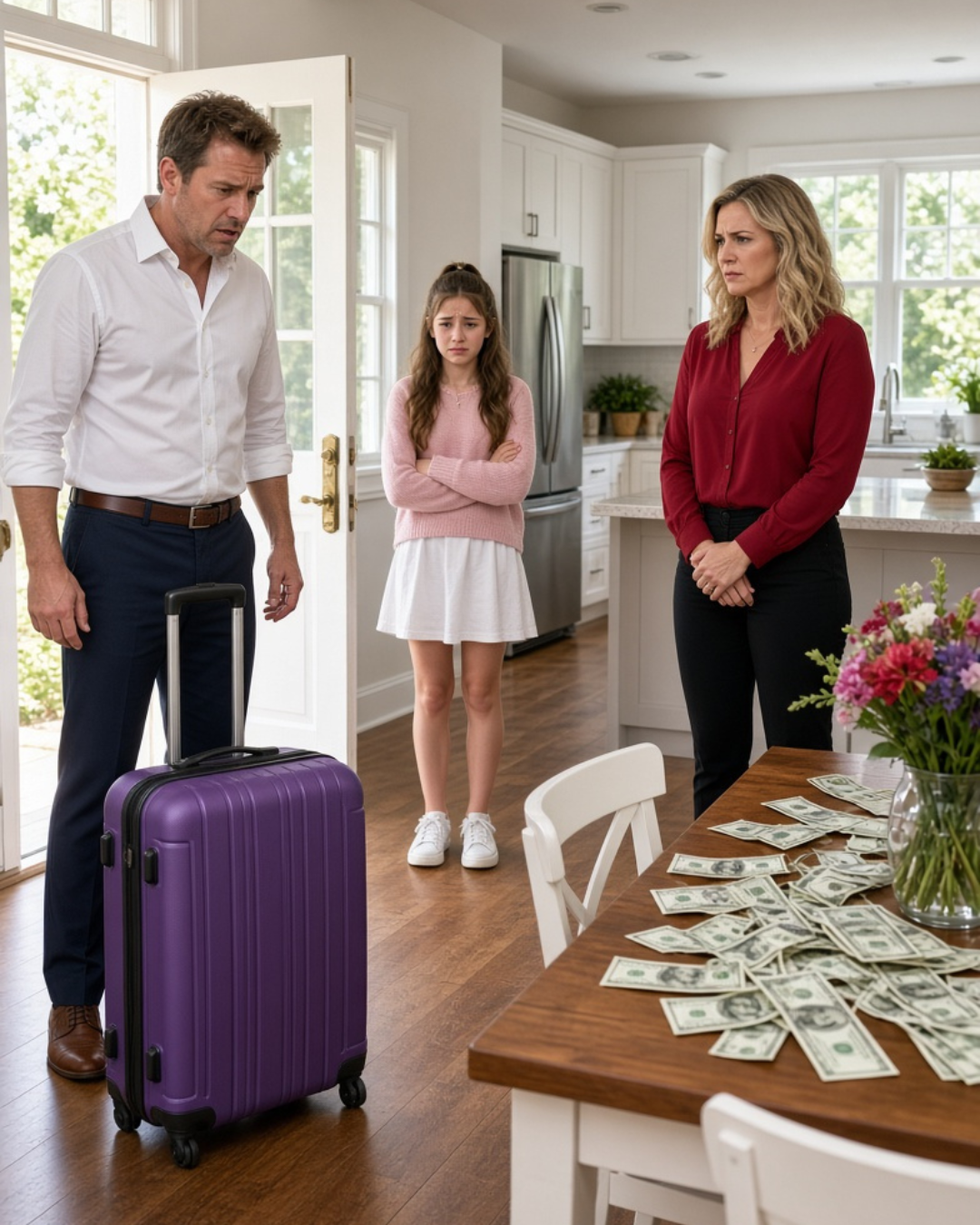
I entered the house and immediately saw Molly’s purple suitcase beside the coat closet.
Its handle was extended.
It was the same suitcase Molly had taken to Grandma Jean’s house since she was eight.
Tara sat at the kitchen table with several bills arranged in front of her.
Her eyes looked red, but her voice was surprisingly controlled.
“Thank God you’re home.”
I pointed toward the suitcase.
“Why is that there?”
She rose from her chair.
“Scott, we can’t keep pretending everything’s fine.”
“Why did you pack Molly’s belongings?”
“She should stay with Jean temporarily.”
Jean was my late wife’s mother. She lived about twenty-five minutes away and had always been an important part of Molly’s life.
“Have you spoken to her?”
Tara hesitated.
“We discussed some options.”
“What options?”
“Maybe Molly would be happier living somewhere else for a while.”
I couldn’t believe what I was hearing.
“You’re accusing my daughter of stealing, and you’ve already decided she should leave?”
“Your daughter?” Tara repeated. “I’m her stepmother.”
“And I’m her father.”
“Then act like one.”
Her expression tightened.
“I’ve tried being patient, Scott. I’ve given her space. But I shouldn’t have to worry about my belongings disappearing.”
I looked at the money on the table.
Four fifty-dollar bills.
Five twenty-dollar bills.
Exactly $300.
“Where was this?”
“Inside her backpack.”
“Did she explain?”
“She claimed Grandma gave it to her.”
“Jean sometimes gives her money.”
“Three hundred dollars?”
I paused.
Jean had given Molly a birthday card in July, but I couldn’t immediately remember how much money had been inside.
Tara folded her arms.
“What about the missing nine hundred?”
“What about it?”
“She probably hid it somewhere else. Or spent it.”
“On what?”
“Ask your daughter.”
A door opened down the hallway.
Molly appeared, wearing jeans and a faded green sweatshirt. Her brown hair was pulled back, and her face was pale.
“Hey, sweetheart.”
She didn’t answer.
Tara turned toward her.
“Your father’s home. Ready to tell him the truth?”
Molly looked at the money, then at me.
“That money belongs to me.”
Tara sighed.
“We’ve already discussed this.”
“I didn’t steal anything.”
“Then why was it in your backpack?”
“I didn’t put it there.”
Tara gave me a pointed look.
“See?”
I lifted my hand.
“Enough. Both of you.”
Molly flinched slightly.
I approached her.
“Sweetheart, tell me what happened.”
She swallowed.
“Will you believe me?”
“I’ll listen.”
“That’s different.”
I didn’t have an answer ready.
Behind me, Tara sighed again.
“See, Scott? She always makes everything about whether we trust her.”
Molly’s eyes filled with tears.
Then she looked directly at me.
“Dad, before you believe her, please call Grandma.”
“Why?”
“Because Grandma knows something you don’t.”
I asked Tara to give us a few minutes alone.
She objected immediately.
“She’ll only tell you what you want to hear.”
“Then I’ll listen.”
I followed Molly into her bedroom.
Her notebooks and pencils were spread across the desk beside an unfinished model of the solar system. A photograph of her mother stood on the dresser.
It had been taken at the county fair the summer before my first wife became ill.
Molly sat on her bed while I pulled up the desk chair.
“Tell me about the money.”
She rubbed her palms against her jeans.
“Grandma gave me two hundred dollars for my birthday.”
I remembered the birthday dinner. I remembered Jean handing her the card and Molly hugging her afterward.
“And the other hundred?”
“Mrs. Bell paid me for taking care of Peanut and Oliver.”
Mrs. Bell lived three houses away.
Peanut and Oliver were her cats, and Molly looked after them whenever Mrs. Bell went to visit her sister.
“She paid you a hundred dollars?”
“Twenty dollars each time. I helped five times.”
That sounded entirely believable.
Mrs. Bell had praised Molly more than once for being more reliable than the teenage helper she’d previously hired.
“Then why was it in your backpack?”
“It wasn’t.”
“How did it get there?”
“I don’t know.”
“Molly—”
“Dad, I really don’t know.”
Her fear was unmistakable.
“I kept everything in a white envelope inside my desk drawer. It had blue tape.”
She pointed toward the drawer.
“It was there yesterday morning. I checked because I wanted to see how much more I needed.”
“For what?”
She hesitated.
“Something at school.”
“What something?”
“It doesn’t matter now.”
I leaned toward her.
“It matters to me.”
She lowered her gaze.
“Science camp.”
“The school trip?”
She nodded.
Her sixth-grade class had organized an overnight science trip outside the city.
Tara had mentioned it several weeks earlier, telling me Molly would rather spend that weekend with Jean.
“Your stepmom said you didn’t want to go.”
“That’s not true.”
“Why didn’t you?”
“She said we couldn’t afford it.”
I frowned.
“How much?”
“One hundred eighty-five dollars.”
“But you had enough.”
“I know.”
“Did you tell Tara?”
“Yes.”
“What happened?”
Molly picked at the edge of her blanket.
“She said we needed a washing machine and I shouldn’t think only about myself.”
I sat back.
That was nothing like the conversation Tara had described to me.
“Why didn’t you come to me?”
Molly looked genuinely confused.
“Because she said you’d already agreed.”
I felt my stomach tighten.
“She told you I’d said no?”
“She said you thought it cost too much.”
I remembered working overtime around the time the permission slip came home.
Tara had told me Molly wasn’t interested.
And I had accepted it without asking my daughter.
I glanced at the desk.
“Did Tara know where you kept your money?”
“Yes.”
“How?”
“After my birthday, she made me show her. She said she wanted to make sure it was safe.”
I watched Molly carefully.
“Did you touch it today?”
“No.”
“When did you last see it?”
“Yesterday morning.”
“When did Tara search your backpack?”
“After school. She made me bring it into the kitchen.”
“Why?”
“She said money was missing.”
“Did you know what money?”
“No.”
Her voice shook.
“She emptied my backpack, opened the inside pocket, and found the bills. Then she accused me of stealing.”
I imagined Molly standing in the kitchen while Tara emptied her schoolbag.
Money Molly insisted had been somewhere else.
“What did you tell her?”
“That it was mine.”
“And?”
“She said I was lucky she hadn’t called the police.”
Molly lowered her head.
“Then she brought my suitcase.”
“Did you pack it?”
She shook her head.
“She told me to pack. I refused to leave, so she packed it herself.”
I realized I was gripping the chair.
“Molly, look at me.”
She raised her eyes.
“You’re staying here tonight.”
“Really?”
“Absolutely.”
She wiped her cheeks.
Then I returned to the question that had been troubling me since I arrived.
“Why did you ask me to call Grandma?”
Molly pulled her knees toward her chest.
“Because she called yesterday.”
“What did she say?”
“She asked if I wanted to stay with her.”
“That’s normal. You visit her often.”
“Not like this.”
Molly looked up.
“She asked if I wanted to live there.”
I went still.
“Live there?”
“She sounded worried and asked if things were okay at home.”
“What did you say?”
“That I didn’t understand.”
“And Grandma?”
“She said we’d talk after she spoke to you.”
Molly hesitated before asking another question.
“Dad, did you tell Grandma I had to move out?”
“No.”
“Did you discuss it with Tara?”
“No.”
She stared down at her hands.
“Then why does everyone keep talking about where I’m supposed to live?”
I stood.
“I’m calling Grandma.”
Molly followed me into the hallway.
Tara was still in the kitchen when I took out my phone.
“Who are you calling?” she asked.
“Jean.”
Her face changed.
“Scott, there’s no reason to involve her.”
“Why?”
“This is a family matter.”
“Then why is Molly’s suitcase packed for Jean’s house?”
Tara didn’t answer.
I pressed the call button.
Jean picked up almost immediately.
“Scott?”
“Hi, Jean. I need to ask you something.”
She interrupted before I could explain.
“Thank goodness. I’ve been waiting for your call.”
I stepped onto the back porch.
Through the glass door, I could see Tara standing beside the kitchen counter.
“Jean, did Tara contact you about Molly moving in?”
There was a brief silence.
“Yes.”
“When?”
“Yesterday afternoon.”
I looked through the window again.
Tara had turned her back.
“What did she tell you?”
Jean sighed.
“She said things were difficult at home and that you thought Molly might be better off living here for the rest of the school year.”
My grip tightened around the phone.
“She said I wanted that?”
“She said you were both considering it.”
“Jean, I never agreed to anything.”
“I suspected that.”
“Why?”
“Because when I asked why you hadn’t contacted me, she kept saying you were busy.”
Jean’s voice softened.
“Scott, I know you work hard. But you’d never arrange for Molly to move here without speaking to me.”
I closed my eyes.
“Did you agree?”
“I said Molly was always welcome, but I wouldn’t discuss anything permanent without hearing from you.”
“Did Tara explain why?”
“She said Molly was becoming disrespectful and causing problems with Cole.”
“Did she mention missing money?”
“No.”
I felt a chill.
Tara had contacted Jean about moving Molly out before the alleged theft had even happened.
Jean continued explaining that Tara had later asked whether Molly could come that weekend.
Jean had refused to make arrangements without speaking to me.
“Can you forward those messages?”
“Of course.”
I asked why she’d called Molly.
“I wanted to check on her. She sounded confused when I mentioned living here.”
“I was confused too.”
Jean paused.
“Scott, what happened?”
“Tara accused Molly of stealing twelve hundred dollars today.”
“What?”
“She claims she found three hundred in her backpack.”
Jean answered immediately.
“That’s Molly’s birthday money.”
“I know.”
“I gave her two hundred in cash. She told me she was saving for something special.”
“She earned another hundred caring for Mrs. Bell’s cats.”
“That sounds like Molly.”
Jean fell quiet before adding that Molly had seemed unusually withdrawn recently.
“Scott, she’s been unusually quiet lately.”
“What do you mean?”
“She rarely talks about home anymore. I assumed it was her age.”
I leaned against the porch railing.
“I hadn’t noticed.”
“You’ve been busy.”
“That’s no excuse.”
Jean didn’t disagree.
“Is Molly staying with you tonight?”
“Yes.”
“Good.”
A message arrived while we were speaking.
Jean had forwarded her conversation with Tara.
The first message was timestamped Thursday at 2:38 p.m.
Scott and I have been discussing whether Molly needs a fresh start. Could you take her this weekend if we decide that’s best?
Jean had replied:
I can help, but I want to speak with Scott before making arrangements.
Eleven minutes later, Tara had written:
He’s working long hours. I’ll ask him to call tomorrow.
Thursday.
More than twenty-four hours before Molly was accused of taking money.
I thanked Jean and returned to the kitchen.
Tara looked up.
“Well?”
“Why did you tell Jean we wanted Molly to move out?”
She began folding a dish towel.
“Because things haven’t been going well.”
“That wasn’t my question.”
“I thought a different environment might help.”
“Did you say I’d agreed?”
“I said we’d discussed it.”
“We hadn’t.”
Tara frowned.
“Scott, I’ve repeatedly told you Molly has an attitude problem.”
“You complained about dishes in the sink and her messy bedroom.”
“There’s more.”
“Then tell me specifically.”
“She argues. She questions everything. She behaves as though I owe her an explanation for every decision.”
“Because she asks questions?”
Tara glared at me.
“You’re doing it again.”
“What?”
“Making me the villain.”
Molly had come into the hallway.
I asked her to return to her room, but she stopped.
“Dad, can I tell you something?”
Tara sighed sharply.
“Of course. There’s always another complaint.”
I ignored her.
“What is it, Molly?”
My daughter glanced nervously at Tara.
“It’s about Cole’s baseball.”
Tara immediately straightened.
“That’s completely unrelated.”
Molly shook her head.
“No, it isn’t.”
I crouched so we were closer to eye level.
“Go ahead.”
“Yesterday, I saw a paper on the dining table. It said Cole made the travel team.”
I remembered Cole’s tryouts.
Tara had told me the competitive travel program was too expensive and that he would join the neighborhood league instead.
“Okay,” I said.
“There was a receipt attached.”
Tara stepped forward.
“Molly, those are private documents.”
“Let her speak,” I said.
Molly drew a breath.
“I asked why Cole could join when we couldn’t afford my science trip.”
I looked toward Tara.
Her expression had hardened.
“What did she say?” I asked.
Molly stared at the carpet.
“She told me not to question how she spent money.”
“Anything else?”
“She said I’d cause trouble for myself if I kept looking through things.”
Molly raised her eyes.
“I wasn’t looking through anything. I was searching for my homework.”
“What happened next?”
“She sent me to my room.”
“And?”
Her eyes filled again.
“I said I’d ask you about it when you came home.”
Tara said nothing.
I asked Molly one final question.
“How much was the receipt?”
She answered without hesitation.
“Twelve hundred dollars.”
I slowly stood.
It was exactly the amount Tara claimed had disappeared from our bedroom.
And suddenly, I was no longer wondering whether my daughter had stolen anything.
I was wondering why my wife had been preparing to send her away before the money was supposedly missing.
Part 2: The Money That Was Never Stolen
“That’s enough,” Tara said sharply.
She pointed toward Molly’s bedroom.
“Go.”
Molly didn’t move.
I stepped between them.
“Thank you for telling me, sweetheart. Please wait in your room.”
This time, Molly obeyed.
I waited for her door to close before turning back to Tara.
“What baseball team?”
She sighed.
“Cole made a competitive travel team after his tryout.”
“You told me we couldn’t afford it.”
“At first, I thought we couldn’t.”
“Then where did the money come from?”
“I found a solution.”
“What solution?”
Tara folded her arms.
“Do I really have to explain every dollar I spend?”
“When you’re accusing Molly of stealing twelve hundred dollars, yes.”
Her cheeks flushed.
“That’s unfair.”
“Neither is making a twelve-year-old leave home before knowing what happened.”
I went into the living room and opened our banking app.
Tara and I shared a checking account for household expenses, although we also had separate accounts.
The mortgage, groceries, and utilities generally came out of the joint account.
Three weeks earlier, we’d agreed to save enough for a replacement washing machine.
We had reached $1,200.
Then I saw the withdrawal.
Tuesday.
Exactly $1,200.
I remembered Tara telling me she’d found a used washer-and-dryer set. The seller wanted cash, and I’d asked her to inspect the appliances before paying.
“Tuesday,” I said.
Tara appeared in the doorway.
“What?”
“You withdrew twelve hundred dollars on Tuesday.”
“For the washing machine.”
“Where is it?”
“The seller changed his mind.”
“Why didn’t you deposit the money again?”
“I planned to find another one.”
“Where did you keep it?”
“In my dresser.”
“Which drawer?”
“The second.”
I looked toward our bedroom.
“Show me.”
She laughed briefly.
“Scott, it’s missing. That’s the problem.”
“I’m trying to understand.”
“I’ve already explained.”
“Did you put the money directly into your dresser after leaving the bank?”
“Yes.”
“And never touched it afterward?”
“No.”
“You’re certain?”
Her eyes narrowed.
“What are you suggesting?”
“Nothing. I’m asking.”
“You’re treating me like a criminal because Molly mentioned baseball.”
“I haven’t accused you.”
“Not yet.”
She walked away.
I looked at the withdrawal again.
The bank record proved Tara had taken out the money on Tuesday.
It didn’t prove where the cash had gone.
For that, I needed the baseball paperwork.
I found Cole’s folder beside the family calendar.
Inside were his registration forms, medical paperwork, practice schedule, and a receipt from a youth travel baseball organization outside Columbus.
The details were clear.
Player: Cole Foster.
Registration and seasonal fees: $1,200.
Payment method: Cash.
Date: Wednesday.
Status: Paid in full.
The payment had been recorded at 3:42 p.m.
One day after Tara withdrew our savings.
I sat down.
There were possible explanations.
Tara had her own income. She could have used separate savings or borrowed the money.
But she had insisted that our $1,200 remained untouched in her dresser until someone stole it.
I checked our family email account.
There was a registration confirmation from Wednesday evening.
Cole’s registration is complete. Your balance is paid in full.
I printed it and returned to the kitchen.
Tara was loading the dishwasher.
I placed the documents on the table.
“What’s this?”
She glanced down.
“Cole’s registration.”
“I know.”
“Then why ask?”
“You withdrew twelve hundred dollars Tuesday.”
“Yes.”
“And Cole’s team received twelve hundred in cash Wednesday.”
She shut the dishwasher.
“Scott, I don’t like where you’re going.”
“Where did his registration money come from?”
She stared at the paperwork.
“That’s separate.”
“Then explain it.”
She pulled out a chair.
“I found a way to pay.”
“How?”
Her expression hardened.
“My sister helped.”
“Morgan gave you twelve hundred dollars?”
“She offered to help.”
“Did she actually give you cash?”
Tara glanced toward the hallway.
“I’m not discussing this in front of the children.”
“They’re in their rooms.”
“They can still hear us.”
I lowered my voice.
“Then we’ll talk privately. But we need answers.”
I gathered the papers.
Tara reached toward the receipt, but I kept it on the table.
“Understand something,” I said. “One receipt doesn’t prove what happened. But I’m not sending Molly away over money she can account for.”
Tara stared at me.
Then she said something that troubled me more than the numbers.
“You have no idea what living with that girl has been like.”
That girl.
Not Molly.
Not our daughter.
I went over the timeline in my head.
On Tuesday, Tara withdrew $1,200.
On Wednesday, Cole’s baseball registration was paid in cash for the same amount.
On Thursday, Tara contacted Jean about taking Molly.
On Friday, Tara accused Molly of stealing and packed her suitcase.
I pushed the receipt toward my wife.
“You said the cash was still in your dresser Thursday night.”
“It was.”
“Then whose twelve hundred dollars paid for Cole’s registration Wednesday?”
Tara opened her mouth.
Nothing came out.
For the first time that evening, she couldn’t offer an explanation.
Eventually, she sat down.
“You’re turning this into something it isn’t.”
“Then explain.”
She studied the receipt.
“Cole made an excellent team. His coach said this opportunity might not come again.”
“Okay.”
“I didn’t want him missing out because we needed a washing machine.”
I stared at her.
“The appliance isn’t the issue.”
“Then what is?”
“You claimed the money was stolen.”
“It was.”
“So you paid twelve hundred for baseball while another twelve hundred sat in your dresser?”
Tara rubbed her forehead.
“I told you Morgan helped.”
“Did she give you cash?”
“She offered to help cover it.”
“That’s different.”
She stood abruptly.
“I’m not spending the entire evening answering accusations from my husband.”
Then she walked toward our bedroom.
I remained in the kitchen, looking at the $300 that had been taken from Molly’s backpack.
I remembered Jean’s birthday card.
I remembered Molly giving up summer afternoons to care for Mrs. Bell’s cats.
And I remembered how quickly I’d wondered whether my daughter might have stolen the money.
I called Mrs. Bell.
“Scott! Everything okay?”
“Hi, Mrs. Bell. Could I ask about Molly?”
“Of course.”
“Did she care for Peanut and Oliver five times this summer?”
“Yes.”
“And you paid her?”
“Twenty dollars each visit. Why?”
“I’m checking something about her savings.”
She sounded surprised.
“Wasn’t she saving for a school trip? She said she wanted something meaningful instead of spending money on little things.”
My throat tightened.
“Yes. That’s right.”
“She earned every penny.”
I thanked her and called Jean again.
Jean confirmed that she’d given Molly $200 in cash for her birthday.
Four fifty-dollar bills.
Everything matched.
Molly’s money had a clear, innocent explanation.
Someone had moved it from her desk drawer into her backpack.
I returned to her room.
She was sitting at her desk, pretending to study.
“Hey.”
She looked up.
“Am I in trouble?”
“No.”
Her shoulders relaxed slightly.
“I spoke with Mrs. Bell.”
Molly put down her pencil.
“She confirmed everything.”
“Okay.”
“Grandma confirmed her gift too.”
She nodded.
“Can I have my money back?”
The question was so simple that it hurt.
“Of course.”
I placed the bills on her desk.
She counted them carefully, then opened her drawer.
The white envelope was missing.
“Want another envelope?” I asked.
She shook her head.
“I’ll keep it somewhere different.”
“Why?”
She shrugged.
I waited.
Finally, she whispered, “Because Tara knows where I keep things.”
I sat on the edge of her bed.
“Molly, can we discuss science camp?”
She looked uncomfortable.
“It’s too late. The deadline passed.”
“Why didn’t you tell me Tara said we couldn’t afford it?”
“I tried.”
“When?”
“A couple of weeks ago. During dinner, I asked if you could look at the form.”
Then I remembered.
I’d come home exhausted after an eleven-hour shift.
Tara had made chicken and rice.
Cole was talking about baseball tryouts.
Molly had been holding a yellow permission slip.
“What happened?”
Molly watched my face.
“Tara said you’d already discussed it.”
I remembered Tara saying exactly that.
I’d nodded and told Molly we couldn’t always have everything we wanted.
I’d even said there would be other school trips.
“I thought you agreed with her,” I whispered.
“I know.”
“Why didn’t you tell me you wanted to go?”
“I was trying to.”
Those four words hurt.
I looked down.
“Has anything else like this happened?”
Molly hesitated.
Then she told me about her winter boots.
Their soles were separating, but Tara had insisted they could last another year.
Cole, meanwhile, had received new baseball cleats because his old ones felt uncomfortable.
Molly told me Tara complained about the cost of her school lunches whenever she asked for yogurt and strawberries.
Each incident might have sounded insignificant on its own.
Together, they suggested that Cole’s needs were treated as essential while Molly’s were treated as inconveniences.
I remembered Molly once complaining that Tara wouldn’t take her to buy poster board for a school project.
I’d told her Tara did a lot for our family and deserved appreciation.
“Why didn’t you keep telling me?” I asked.
Molly studied me.
“Because whenever I tell you something Tara does, you ask what I did to upset her.”
My face grew warm.
“Molly—”
“You always think she has a reason.”
I wanted to defend myself.
Instead, I listened.
“When I said she wouldn’t let me go on the trip, you thought I misunderstood. When she got upset about Cole’s markers, you asked if I’d taken them without permission. When she called me rude, you made me apologize.”
Tears gathered in her eyes.
“So I stopped telling you.”
I couldn’t claim I hadn’t noticed anything.
I’d noticed she seemed less happy.
I’d noticed she spent more time alone.
I’d simply accepted the explanation that was easiest for me.
“I’m sorry,” I whispered.
Molly looked away.
“Okay.”
It sounded like the kind of answer a child gives when she expects the conversation to end.
But I needed her to understand something.
“You’re right. I kept asking you to get along with Tara instead of listening.”
Molly didn’t respond.
“And I should’ve listened about science camp.”
She touched the corner of her notebook.
“I could’ve paid myself.”
“I know.”
“She only needed to sign.”
That was the part I couldn’t stop thinking about.
Molly hadn’t needed us to give her $185.
She’d earned enough herself.
All she needed was an adult willing to sign the permission slip.
I glanced toward the photograph of her mother.
Then Molly spoke.
“Dad?”
“Yeah?”
“Do I still have to go to Grandma’s?”
“No.”
“Even if Tara wants me to?”
“Even then.”
She searched my face.
I stood.
“I need to finish talking to Tara.”
Molly gripped the edge of her desk.
“Please don’t tell her everything I said.”
I stopped.
“Why?”
“She’ll say I made you turn against her.”
My daughter was afraid that telling me the truth would create another reason for her to be blamed.
“I won’t let that happen,” I promised.
I went into our bedroom.
Tara was sitting on the bed, looking at her phone.
“Are we finished?” she asked.
“No.”
She lowered it.
“Scott, I’m exhausted.”
“So am I.”
“Then can we stop arguing?”
I closed the door.
“This isn’t about the washing machine anymore.”
She frowned.
“What does that mean?”
“I confirmed the three hundred dollars belongs to Molly. Jean verified her gift, and Mrs. Bell confirmed her payments.”
“That doesn’t prove she didn’t take my money.”
“It proves you shouldn’t have treated her savings as evidence of theft.”
Tara shook her head.
“She’s manipulating you.”
“A twelve-year-old who’s been saving that money for months?”
“Children lie, Scott.”
“So do adults.”
She went silent.
I sat opposite her.
“Where did the twelve hundred dollars go?”
“I explained.”
“You claimed it was stolen. Then Morgan supposedly helped pay for baseball. Then you said she only offered.”
“What’s your point?”
“Your explanations contradict each other.”
Tara turned toward the window.
I continued.
“You withdrew our savings Tuesday. Cole’s registration was paid Wednesday. You contacted Jean Thursday. Today, you accused Molly and packed her suitcase.”
“You’re making it sound deliberate.”
“Was it?”
No answer.
“Tara.”
“What?”
“Did you spend our washing-machine money on Cole’s baseball?”
She pressed her lips together.
Finally, she spoke.
“I planned to replace it.”
I stared at her.
“What?”
“I was going to return the money after payday. I thought I could replace most of it before we bought the washer.”
I leaned forward.
“So there wasn’t any cash in your dresser Thursday?”
She looked away.
“No.”
The air conditioner hummed in the silence.
There had been no missing cash in the dresser.
There had been nothing for Molly to steal.
“You accused my daughter of stealing twelve hundred dollars.”
Tara rubbed her forehead.
“I panicked.”
“Why?”
“Because I knew you’d be upset about baseball.”
“Maybe. We needed a washing machine.”
“And Cole needed that team.”
“He didn’t need you to lie.”
Tara looked sharply at me.
“You don’t understand what it’s like fighting for my child.”
I stared at her.
“Your child?”
“Yes.”
“Cole has everything he needs.”
“Because I make sure of it.”
“What about Molly?”
Tara folded her arms.
“There it is.”
“What?”
“Everything always comes back to Molly.”
“Because she’s my daughter.”
“She’s your daughter whenever we disagree, but I’m the one dealing with her attitude every day.”
It was becoming clear that the money was only part of the problem.
Tara seemed to believe Cole’s opportunities were worth protecting at any cost.
Molly was expected to make sacrifices without complaint.
“Why did you contact Jean?” I asked.
Tara looked at her hands.
“I thought Molly would be happier there.”
“Did you ask Molly?”
“No.”
“Did you ask me?”
“I knew your answer.”
“So you decided alone.”
“I wanted to solve the problem.”
“What problem?”
“The constant tension.”
I waited.
Tara looked up.
“As Molly gets older, she questions everything. What I buy Cole, how I spend money, every decision I make.”
“Maybe she wonders why the rules aren’t equal.”
“They are equal.”
“You told me she didn’t want science camp.”
Tara’s expression hardened.
“So she’s been telling stories.”
“She’d saved enough to pay.”
“We couldn’t waste money on every little activity.”
“But twelve hundred dollars for baseball was fine?”
“That’s different.”
“Why?”
“Cole worked hard for that opportunity.”
“Molly works hard too. She studies, saves, and follows the rules.”
“Scott—”
“And you still refused.”
Tara looked away.
I asked the question I’d been holding back.
“Did you take Molly’s three hundred dollars from her desk?”
She didn’t answer.
“Tara, did you?”
“She shouldn’t hide money in her bedroom.”
“Answer me.”
Her jaw tightened.
“I knew where she kept it.”
“Did you put it in her backpack?”
She closed her eyes.
Then she whispered, “Yes.”
I felt sick.
Molly had told the truth from the beginning.
Tara had taken her savings, hidden the money in her schoolbag, and then presented it as proof that she’d stolen from us.
“Why?” I asked.
Tara looked frustrated.
“Because she threatened to tell you about Cole.”
“So?”
“I knew you’d be angry about the money. You’d accuse me of favoring him, and we’d argue because Molly couldn’t stay out of it.”
“So you accused her of stealing?”
“I wasn’t thinking clearly.”
“You searched her backpack and threatened to involve the police.”
“But I never called them.”
“That doesn’t excuse it.”
She stood.
“I only wanted her to stay with Jean temporarily.”
“Why didn’t you discuss that with me?”
“Because you’d refuse.”
And there it was.
Tara hadn’t been asking me to investigate missing money.
She had been trying to make me believe Molly was the problem.
If I accepted the accusation, I might agree to send my daughter away.
“Did you really think I’d agree?” I asked.
Tara looked uncomfortable.
“I thought if you understood how serious things were, you’d realize some distance might help everyone.”
“Everyone except Molly.”
“She loves Jean.”
“That’s not the point.”
“Scott, you’re acting like I wanted to hurt her.”
“You accused her of stealing money she never touched.”
“I was upset.”
“You planted her savings in her backpack.”
“I wasn’t thinking clearly.”
“You packed her suitcase.”
Tara began crying.
“I’ve spent two years trying to make this family work.”
I looked at her.
“And Molly has spent two years trying not to upset anyone.”
Tara wiped her cheeks.
“What happens now?”
I hesitated.
We’d been married for two years. We’d celebrated birthdays, taken camping trips, and made plans for the future.
There had been genuinely happy moments.
Tara had helped Molly with homework. We’d laughed together over breakfast.
Those memories existed.
But so did the packed suitcase.
And the planted money.
“I think you and Cole should stay with Morgan temporarily,” I said.
Tara stared at me.
“You’re throwing us out?”
“I’m asking you to stay with your sister while we decide what comes next.”
“This is my home too.”
“I know.”
“You can’t decide that alone.”
“I’m asking because Molly needs some space right now. If you disagree, we’ll need another arrangement.”
Tara sat down.
After a long silence, she whispered, “You’re choosing her over me.”
I looked toward Molly’s bedroom.
My daughter had lost her mother at six.
For two years, she’d been wondering whether she still belonged in her father’s home.
“No,” I answered. “I’m refusing to punish my daughter for something she didn’t do.”
Tara cried and said I was destroying our marriage over one mistake.
I told her spending money without discussing it would have been a mistake.
What she’d done to Molly was something else.
Eventually, Tara called Morgan.
Cole was staying with a teammate that Friday night, so Tara arranged to pick him up before going to her sister’s house.
I insisted that neither child should be blamed for what had happened.
Tara packed a bag.
She left without saying goodbye to Molly.
At 9:23 p.m., I watched her car disappear down the street.
Then I went to Molly’s bedroom.
She was sitting beside her bed with a book.
“Where’s Tara?” she asked.
“She’s staying with Morgan for now.”
“With Cole?”
“Yes.”
She lowered the book.
“Is she angry with me?”
“She’s upset, but you haven’t done anything wrong.”
Molly examined her hands.
“Did she explain the money?”
“Yes.”
“What happened?”
I sat beside her.
“She spent it on Cole’s baseball registration.”
Molly nodded.
“So I was right.”
“Yes.”
“And she put my money in my backpack?”
“Yes.”
She pressed her lips together.
Then she asked a question I wasn’t prepared to answer.
“Dad, if I hadn’t seen that baseball receipt, would you have sent me to Grandma’s?”
I wanted to say no.
I wanted to tell her there was absolutely no possibility I would ever have agreed.
But I remembered coming home.
The bills on the kitchen table.
Tara’s accusation.
The suitcase waiting by the door.
And the fact that my first concern had been where the money came from, rather than whether my daughter was frightened.
I looked at Molly.
For the first time that night, I had no answer.
Part 3: The Home She Never Had to Earn
“I don’t know,” I admitted.
Molly lowered her eyes.
I could see how much that answer hurt.
“I wish I could promise I never would’ve sent you away,” I continued. “But I didn’t listen properly, and I won’t pretend otherwise.”
She stayed quiet.
I moved a little closer.
“What I can promise is that I’ll handle things differently.”
Molly picked at the carpet.
“You always want everyone to get along.”
“I know.”
“And I always have to apologize.”
I nodded.
“You’re right.”
“Even when I haven’t done anything.”
“I know.”
Her eyes filled.
“That’s why I stopped telling you.”
I reached for her hand.
This time, she let me hold it.
“You’re not responsible for making adults happy, Molly. And fixing my marriage isn’t your job.”
She began crying softly.
I put my arm around her, and she leaned against me.
“I’m sorry,” I whispered.
She shook her head.
“Why are you apologizing?” I asked.
“Because Tara’s leaving.”
“You didn’t make her leave.”
“But if I hadn’t told you—”
“Then you would’ve continued being blamed for something you didn’t do.”
Molly wiped her face.
“What about Cole?”
“What about him?”
“Will he think I made his mom leave?”
“I’ll make sure he understands.”
That seemed to relieve her.
Molly and Cole weren’t particularly close, but they had lived together for two years.
They watched movies sometimes and argued about the remote control or whose turn it was to empty the dishwasher.
Cole was ten years old and loved baseball.
He hadn’t asked his mother to treat Molly unfairly.
I didn’t want either child to carry the burden of decisions made by adults.
We sat together for a long time.
Later, Molly asked whether she could sleep with her light on.
I said yes.
At bedtime, I stopped beside her door.
“Everything okay?” I asked.
She nodded.
I turned to leave.
“Dad?”
“Yeah?”
“Could you leave my door open?”
“Of course.”
I left it halfway open, just as she had preferred when she was younger.
I barely slept that night.
I kept remembering things I’d dismissed.
Molly asking me to pack her lunches instead of Tara.
Molly wanting to spend extra nights at Jean’s.
Molly asking whether we could spend her birthday together, just the two of us.
I’d told myself these were ordinary adjustments in a blended family.
Perhaps some had been.
But I hadn’t taken the time to find out.
The next morning, I walked into the kitchen and found Molly making toast.
She froze when she saw me.
“Can I use the strawberry jam?”
I stared at her.
“Of course.”
She reached for the jar.
“Tara said it’s for Cole’s lunches.”
I opened the pantry, took out another jar, and set it beside hers.
“Molly, you’re allowed to eat the food in your own home.”
She nodded.
“I know.”
But I could tell she hadn’t always believed it.
Later that morning, I called Jean and explained everything.
She listened without interrupting.
Then she asked, “How’s Molly?”
“She’s upset.”
“And you?”
I glanced toward the school calendar.
“I think I’ve overlooked more than I realized.”
Jean didn’t rush to comfort me.
She simply said, “Then start paying attention now.”
That afternoon, our washing machine finally stopped working.
Molly and I took the laundry to a laundromat.
We sat beside the dryers, sharing a bag of pretzels while the machines turned.
For twenty minutes, she told me about a classmate who had accidentally brought her little brother’s dinosaur lunchbox to school.
It was a completely ordinary story.
Nobody was angry.
Nobody was accusing anyone.
Nothing needed fixing.
I listened to every word.
On Monday morning, I emailed Molly’s teacher.
I asked to receive school announcements and permission slips directly instead of relying on Tara to pass them along.
I also asked whether there was any way Molly could still attend science camp.
The teacher was kind, but the registration deadline had passed.
Every place was filled.
I stared at the reply for a long time.
I couldn’t repair that particular mistake.
Offering more money wouldn’t create another place.
Arguing wouldn’t change the deadline.
Molly had missed an opportunity she’d worked hard to afford because I hadn’t checked what she was being told.
That evening, I explained what the teacher had said.
Molly shrugged.
“It’s okay.”
“I know you wanted to go.”
“Yeah.”
“I’m sorry I didn’t help.”
She looked at me.
“You don’t have to keep apologizing.”
“You’re right.”
I pulled out a chair.
“How about visiting the science museum together next Saturday?”
Molly considered it.
“Just us?”
“Just us.”
“Can we visit the space exhibit?”
“Absolutely.”
“And stay as long as I want?”
I smiled.
“Within reason.”
She gave me a look.
I laughed.
“Fine. A very generous amount of reason.”
For the first time since Friday, Molly smiled.
It wasn’t a solution to everything.
But it was a beginning.
Over the following days, I made practical changes.
I scheduled a meeting with a family counselor, initially for myself, because I wanted to understand how I’d allowed things to reach this point.
I contacted our bank about separating our finances responsibly while Tara and I considered what would happen next.
I also spoke with an attorney about formal separation.
We were married, we shared property, and two children were involved.
I didn’t want emotional decisions to create unnecessary legal or financial problems.
Tara called repeatedly.
She apologized for moving the money and insisted she’d never intended for things to go so far.
But she continued saying Molly had never respected her authority.
Whenever I asked whether she understood why falsely accusing a child was wrong, Tara told me I wasn’t considering her side.
I listened.
And with every conversation, I became less convinced that returning to our previous arrangement would help anyone.
One evening, Tara asked whether Molly was going to apologize for looking at Cole’s baseball paperwork.
I stared at the phone.
“For what?”
“For snooping.”
“She saw a receipt on the dining table.”
“She shouldn’t have questioned me.”
I paused.
“Tara, I’m not making Molly apologize for discovering you’d lied about the money and falsely accused her of stealing.”
Tara began crying.
Eventually, I ended the call because we were going in circles.
That evening, Molly was building a science project at the kitchen table.
She looked up.
“Was that Tara?”
“Yes.”
“Is she coming back?”
“Not right now.”
Molly nodded and returned to her work.
A few minutes later, she asked, “Can I leave this here until tomorrow?”
Colored paper, cardboard, and glue covered half the table.
“Sure.”
“Even if it’s messy?”
I looked at the little cardboard planets.
“Even if it’s messy.”
She smiled and continued working.
I left everything exactly where it was.
Five weeks later, Tara and I were still separated.
There had been no dramatic public announcement.
Just difficult conversations, paperwork, and decisions about finances and belongings.
Tara came to collect more of her things while Molly was visiting Jean.
We arranged it that way because Molly didn’t want to be there.
I respected that.
Tara still believed I was overreacting.
She said I’d sacrificed our marriage instead of accepting that blended families could be complicated.
Maybe they could.
But accusing a child of stealing money you knew wasn’t missing wasn’t a complicated parenting decision.
It was a deliberate lie.
And I couldn’t ask Molly to live with someone who continued defending it.
From the updates I received, Cole was adjusting well.
He continued attending baseball practices and settling into his new routine.
Whenever we spoke, I reminded him that adult disagreements weren’t his responsibility.
I didn’t encourage Molly to blame him.
She had no interest in doing so.
One afternoon, Cole sent her a photograph of a lopsided cake he’d made with his aunt.
Molly laughed.
“That looks like a melted basketball.”
“Going to tell him?”
“No. He’ll get mad.”
Instead, she sent him a picture of our cat sleeping upside down.
That was enough.
The children didn’t have to become enemies because the adults had made mistakes.
Meanwhile, Molly and I began rebuilding our daily routines.
At first, it felt strange.
Not because we’d forgotten how to live together, but because I’d forgotten how much I enjoyed the little things we did.
We made spaghetti on Wednesdays.
We argued about the proper way to load the dishwasher.
She complained about homework.
I complained about grocery prices.
Sometimes we made pancakes on Saturday mornings.
When I burned the first batch, Molly took a picture and sent it to Jean.
Jean replied:
Should I send breakfast?
Molly laughed so hard she nearly dropped her phone.
But some moments were harder.
One afternoon, I reminded her to clean her bedroom.
She suddenly went quiet.
When I asked what was wrong, she admitted she was afraid I would get angry the way Tara sometimes had.
I explained that asking her to tidy her room didn’t mean I was upset or wanted her gone.
She nodded.
But I could tell she wasn’t completely reassured.
Trust wouldn’t return just because I wanted it to.
I had to earn it.
I started coming home earlier twice a week.
Whenever work kept me late, I called Molly directly.
If she complained about something, I listened before deciding whether she was right.
Sometimes she wasn’t.
Sometimes she was stubborn.
Sometimes she argued because she was twelve.
Those were ordinary parts of growing up.
They didn’t make her a bad daughter.
And they certainly didn’t mean she deserved to feel unwelcome.
One Saturday, we finally went to the science museum.
Molly spent nearly an hour exploring the space exhibit.
She explained facts about Mars that I couldn’t remember five minutes later.
I listened anyway.
During lunch, she asked whether we could come back.
“Sure.”
“Even if nothing changes?”
“Even then.”
She smiled.
Then her expression became serious.
“Dad?”
“Yeah?”
“Can I ask something?”
“Always.”
She looked down at her sandwich.
“Did Tara actually believe I stole her money?”
I lowered my drink.
“No.”
Molly looked up.
“She didn’t?”
“No, sweetheart. I don’t believe she ever thought you took it.”
“Then why accuse me?”
I considered my answer carefully.
“Because she wanted to hide how she’d spent the money. And she thought I’d be more likely to send you to Grandma if I believed you’d done something wrong.”
Molly fell silent.
“That’s really mean.”
“Yes,” I admitted. “It is.”
She picked up a french fry.
“Do you still love her?”
The question caught me off guard.
“I still care what happens to her,” I answered. “We shared good memories and built a life together. But what she did was serious. Caring about someone doesn’t mean ignoring how they’ve treated another person.”
Molly thought about that.
“Are you getting divorced?”
“I’m taking steps to separate our lives. Some decisions still need time.”
She nodded.
“Okay.”
I waited.
Then she asked, “Does Tara think this is my fault?”
“I can’t know everything she thinks.”
“But do you?”
“No.”
I leaned closer.
“Molly, our marriage is struggling because of choices Tara made, not because of you. And I made mistakes too, especially when I failed to listen.”
She studied me.
“Okay.”
This time, the word sounded different.
It didn’t sound like she was trying to end the conversation.
It sounded like she might finally believe me.
We finished lunch.
Afterward, Molly spent twenty minutes browsing the museum gift shop.
She considered buying a solar system model before choosing a package of glow-in-the-dark stars.
She paid for them with her savings.
I didn’t question her decision.
That evening, she attached the stars to her bedroom ceiling.
I helped her reach the corners.
One fell almost immediately.
Molly laughed.
“That one’s probably Pluto.”
“Because it got kicked out?”
“Because nobody respects it.”
I shook my head.
“Poor Pluto.”
She laughed again.
It was an ordinary moment.
A plastic star falling from the ceiling.
A ridiculous joke about a planet.
Yet I’d almost forgotten how wonderful it could feel to spend a peaceful evening with my daughter.
On Monday morning, I was making breakfast when Molly came downstairs dressed for school.
“Can you sign this?”
She handed me a permission slip.
I read it carefully.
It was for an after-school science club with a small participation fee.
“Do you want to join?”
“Yeah.”
“Then let’s do it.”
She watched me sign.
“That’s it?”
“That’s it.”
“No big discussion?”
“Do we need one?”
Molly grinned.
“Nope.”
She grabbed some toast and headed toward the front door.
A moment later, the school bus approached.
“Dad! Bus!”
“Go, go!”
She opened the door.
Then I noticed her backpack sitting on a kitchen chair.
“Molly!”
She peeked back inside.
“What?”
“Forgot something.”
I held it up.
She hurried back, grabbed it, and rolled her eyes.
“Wow. I’m incredibly responsible.”
“Obviously.”
She laughed.
Then she unexpectedly wrapped her arms around me.
“Bye, Dad.”
I hugged her tightly.
“Have a great day, kiddo.”
She ran down the walkway and climbed aboard the bus.
I stayed on the porch until it disappeared.
For years, I’d believed being a good father meant working hard, paying the bills, and making sure Molly had everything she needed.
I’d mistaken a quiet house for a happy one.
I’d assumed fewer complaints meant fewer problems.
But children don’t always stop complaining because things are getting better.
Sometimes they stop because they’ve learned nobody is listening.
I couldn’t give Molly back the school trip she’d missed.
I couldn’t erase the afternoon she’d been accused of stealing while her suitcase waited beside the door.
And I couldn’t undo every time I’d asked her to apologize instead of finding out what had really happened.
But I could decide what happened next.
I went back inside.
Her school papers were still spread across the kitchen table.
The glow-in-the-dark stars were probably already falling from her ceiling.
There were dishes in the sink, laundry waiting to be folded, and a grocery list hanging on the refrigerator.
It was an ordinary Monday morning.
And when Molly came home from school that afternoon, she wouldn’t have to wonder whether someone had packed her suitcase.
She wouldn’t have to prove she deserved to stay.
She wouldn’t need anyone’s permission to belong.
Because this was her home.
It always had been.
And it always would be.
