

PART 1 — The Girl I Never Expected to See Again
I thought life had allowed me one last chance at happiness, even if I could hold on to it only briefly. After Margaret died, I believed the final page of our story had turned. Then her son approached me outside the church, carrying something she had left behind. “Mom warned me you might faint when you read this.”
Wade stood there holding a sealed envelope. We had just buried his mother, the woman who had been my wife for only eight days. I looked down at what he carried. “What is it?” He drew an uncomfortable breath. “Tom, there’s something you need to know. You don’t know the whole truth about Mom. She left this for you and asked me to give it to you only after she was gone.”
I opened the envelope and unfolded the letter inside. The handwriting was hers. Before I could get beyond the opening line, my legs weakened, and I caught the church railing. “Good Lord!” Wade reached out to support me. “Are you okay?” I looked at him, unable to believe what I had read. “Your mother did WHAT?” His nervous smile appeared. “She thought you’d say something like that.”
Margaret had somehow found a way to surprise me even after her death. That was no small achievement, considering I was a 63-year-old pastor who thought he understood what she had given him. But the envelope makes little sense without the story of how, after 45 years, I found her again.
For 23 years, I had led a small neighborhood church. Hospital visits were a familiar part of my ministry, and several times a week I spent time with people facing terminal illnesses. Sometimes we prayed. Sometimes we talked. Sometimes all they needed was another person willing to sit beside them and listen.
One Tuesday, a nurse named Helen told me about a woman who had recently arrived with stage-four cancer. “She’s quite a character,” Helen said. “Yesterday, she told the doctor his handwriting looked like a spider had fallen into an ink bottle!” I laughed. “Sounds like someone I should meet.”
The moment I stepped into the room, I stopped. Illness and the passing years had changed the woman in the bed, but neither had hidden the smile or the eyes I remembered. There was no mistaking her. “Margaret?”
She studied me through narrowed eyes. Then recognition broke across her face, and she laughed with delight. “Wow! Tommy?! Is that you?! This can’t be real!” For a moment, I remained rooted where I stood, trying to connect the girl I remembered with the woman before me.
Margaret had never been one to tolerate unnecessary awkwardness, and apparently that had not changed. “Well, don’t just stand there! Come hug me before I start charging admission.”
I laughed and bent to embrace the girl I had loved 45 years earlier. For those few moments, the long stretch of time between us seemed to fall away. The hospital, her illness, and the years we had spent apart could not erase the simple recognition of holding someone who had once meant so much.

Margaret had been my high-school sweetheart. We went to prom together, split milkshakes, and spoke about the future as though we already knew how it would unfold. I promised I would marry her. She teased that she might think about it when we were older.
Then we left for different colleges. Our telephone calls grew farther apart until, eventually, they stopped. There had been no betrayal, no terrible argument, and no dramatic ending to explain. We simply followed separate roads until we no longer knew where to find each other.
I married Susan, a wonderful woman, and we had 30 happy years together before she died six years before my hospital reunion with Margaret. Margaret had married Kade, a man she loved deeply. They raised their son, Wade, together. Kade had died four years earlier. We had both lived full lives and known good marriages. Still, seeing her felt like recovering a chapter I had thought was lost.
After that first visit, I returned every day. We could spend hours looking back, and her humor remained as sharp as ever. The intravenous lines and the seriousness of her illness did not stop her from finding something to smile about. One day, she asked whether I still ruined toast. “I’ve improved,” I told her. “Tommy, the last time you cooked for me, the smoke alarm begged for mercy.”
Wade often joined us. He was 42, worked as an accountant, and had inherited his mother’s mischievous grin. During one visit, I asked what work Margaret had done over the years. “Oh, I kept myself busy,” she answered. Wade snorted. She immediately gave him a warning look. “Don’t start.”
I glanced between them. “What’s funny?” Margaret answered before her son could. “Nothing,” she said. “Tommy, remember when you fell into the punch bowl at prom?” “I didn’t fall into it!” “You wore enough punch home to prove otherwise!” Wade laughed with us. Only much later did I understand how neatly she had steered me away from my question.
A few weeks after we found each other again, Margaret told me her doctors thought she might have only a week left. I sat beside her, unable to find words. The thought of losing her a second time left me struggling to speak. She tightened her fingers around mine. “Oh, don’t look so sad, Tommy!” “Margaret…”
“Remember how you promised to marry me when we were 17?” I nodded, trying not to cry. “Well, you’re 45 years late, mister. How about we finally do it?” A laugh escaped through my grief. “Margaret, are you joking? You want us to get married?”
Her face grew gentle. “Yes. It would mean everything to me. Maybe it sounds strange, but Tommy, I would really love that. Would you do that for me?” My heart ached, but I thought of the happiness we had once shared and everything our reunion had meant. “Yes, Margaret! Absolutely!”
That evening, I knelt in the hospital chapel. I did not pray for a miraculous recovery. I asked for the strength to value whatever time we still had. Finding her again and knowing I would soon lose her frightened me more than I could easily admit. When I returned to her room, she examined my face. “You’ve been crying.” “A little.” “Good! I was worried I’d lost my charm!”
Planning a wedding with only days to spare took some doing. I called the county clerk, dealt with the marriage-license paperwork, and worked with the hospital staff to arrange a small ceremony. My friend Pastor George agreed to conduct the service. There would be no elaborate celebration, only the chance to make the promise we had once imagined keeping.
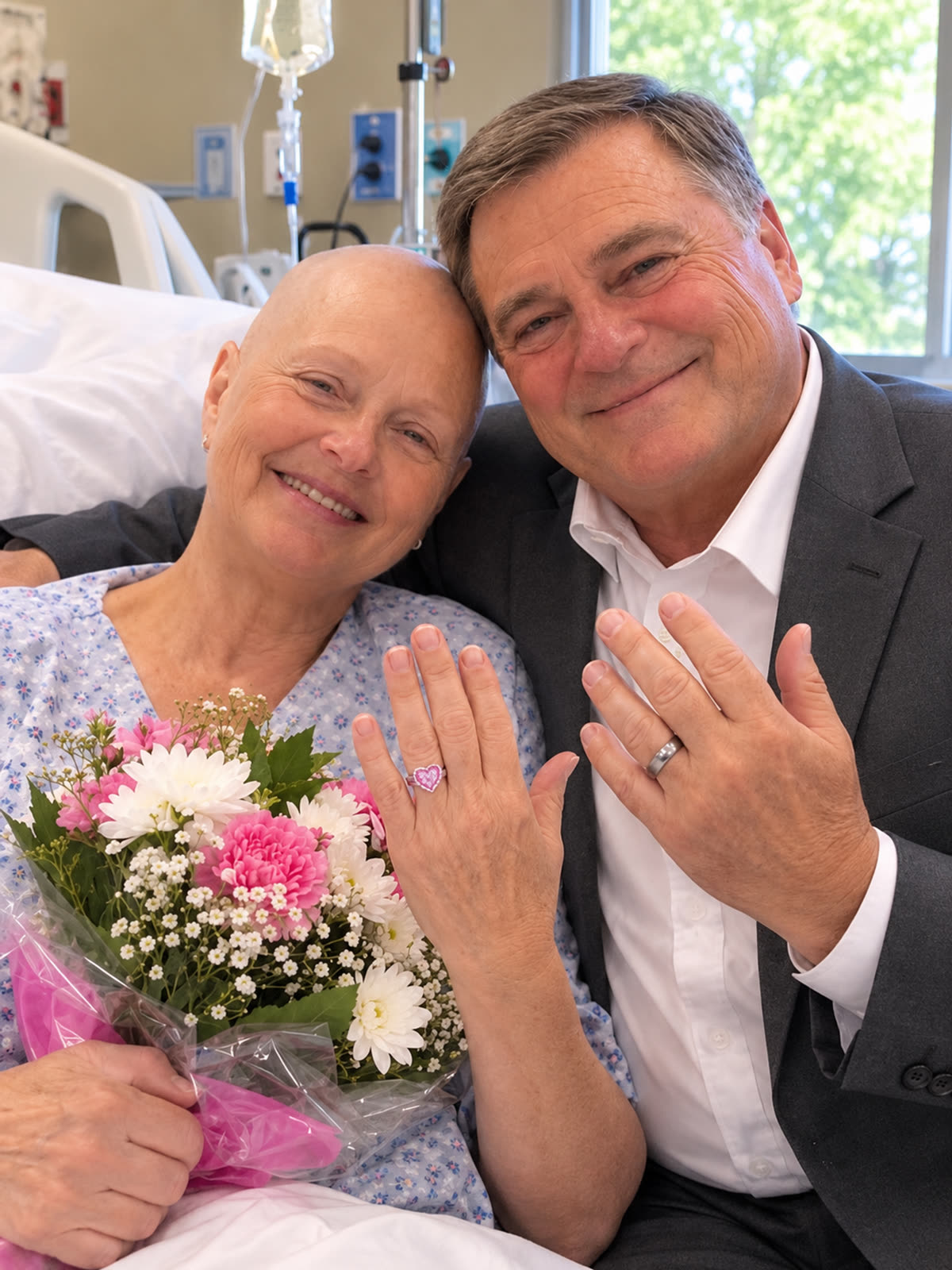
I chose my usual church suit, the only respectable suit I owned, and bought two plain rings at a flea market. Margaret’s had a little pink heart. When she saw it, she laughed so loudly that Helen came to see what was happening. “Tommy! A flea-market wedding ring?” “It was the nicest one I could find!”
Margaret held up her hand to admire it. “It’s perfect and my favorite ring in the world! If anyone asks, tell them it’s a rare Italian design.” “Is it?” “No, you fool! But nobody needs to know!”
Three days after she asked me to marry her, we gathered in her hospital room. Wade remained close to his mother while George began the ceremony. I stood beside the woman I had promised to marry so long ago, with our remaining time already slipping away. Then George asked whether I would take Margaret as my wife.
PART 2 — The Secret Behind Her Letter
Before I could get through that moment without interruption, Margaret spoke up. “Make him promise to wash the dishes too!” Laughter filled the hospital room. Even at her own wedding, with so little time left, she could still turn a solemn moment into something unmistakably hers.
Then George asked for her answer. Margaret turned toward me. “I do, Tommy.” I could not have explained how much those three words meant. After all the years that had taken us in different directions, she was my wife.
During the days that followed, we held hands, prayed together, and returned to the memories of our youth. There was no way to stretch those days into the life we might once have shared. All we could do was treasure the time we had been given.
Five days after the ceremony, Margaret died with her hand in mine. The ring with its little pink heart was still on her finger. I was devastated, yet beneath the grief was a gratitude I could not separate from it. I had found her again. For those few precious days, I had truly been her husband.
Then came the funeral, Wade waiting outside the church, and the envelope his mother had instructed him to give me. The first line of her letter was the one that nearly brought me to my knees: “Tommy, congratulations! You’re now the owner of the business I spent 30 years building. Please sit down before you embarrass yourself.”
She had anticipated my reaction perfectly. “What business?” I murmured. Wade helped me sit on a bench. “Keep reading.” I lowered my eyes to the page, still trying to understand how a business had become part of a farewell I had barely found the strength to face.
The next sentence did nothing to steady me. “You’re now the proud owner of my bakery. And before you panic, the muffins are already trained.” I looked up at Wade. “Your mother owned that bakery?” He nodded.
I knew the place she had named. It was one of the busiest bakeries in the county, famous for cinnamon rolls that brought people out to stand in line on Saturdays. I had eaten there dozens of times. Never once had I connected it with Margaret.
“She never told me!” Wade had an explanation ready. “Mom said she wanted you to marry her, not her cinnamon rolls.” I laughed, despite everything, and looked down at the letter again.
There I sat outside the church, with my wife’s handwriting in my hands and her son beside me, discovering that the woman I had found again had kept an enormous part of her life hidden. The questions about her work, Wade’s snort, her quick change of subject—all of it suddenly made sense.
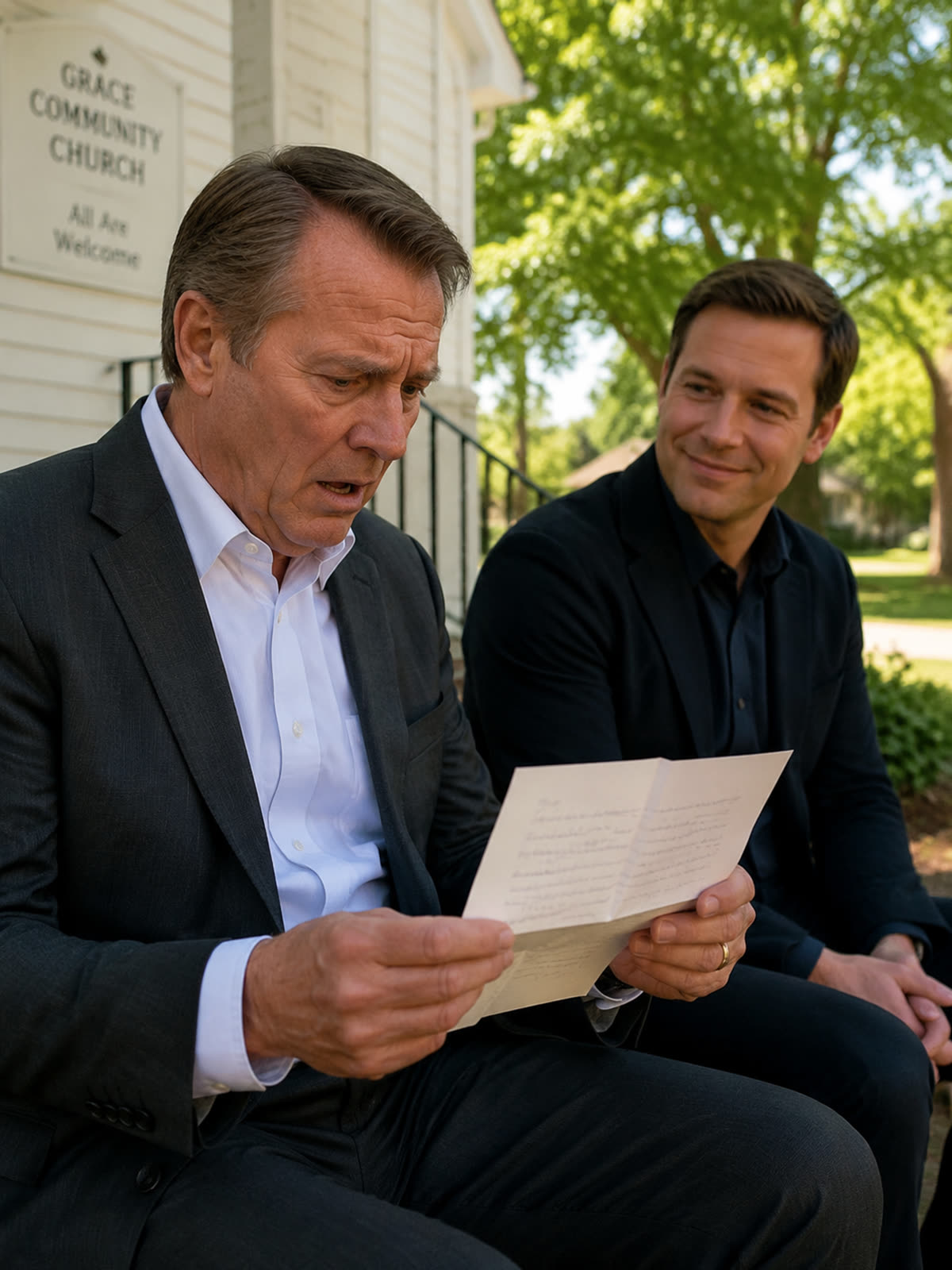
Her letter continued: “Kade helped me start the bakery. Wade has his own career, and Denise, our manager, knows the business better than anyone. I’ve arranged everything with my son. He’ll explain the details.” Even with that explanation in front of me, I could scarcely take it in. “Why would she leave me a bakery?”
Wade pointed me toward the last instruction she had written. “Tommy, there’s something waiting for you at the bakery. Ask Denise about the toast.” I looked at him. “The toast?” He broke into laughter. “Oh, you’re going to love this.”
Two days later, I arrived at the bakery. The manager met me at the entrance. “So you’re Tommy.” “That’s me.” Denise looked carefully at my face, then began to laugh. “Margaret wasn’t exaggerating about your ears.” I sighed. “Wonderful. My reputation arrived before I did.”
Customers were ordering coffee while employees moved about with freshly baked pastries. Denise led me behind the counter and directed my attention to the menu. About halfway down, in bold letters, was a name I had never expected to find in any business I might own: “TOMMY’S TERRIBLE TOAST.”
I stared. “What on earth?” Denise smiled at my expression. “It’s one of our bestsellers.” Beneath the name, the description explained everything: “Sweet cinnamon toast inspired by the only boy who could burn bread and still convince Maggie to kiss him.”
My cheeks warmed. “She named a pastry after me?” “Years ago.” Denise brought me a serving. It tasted wonderful, and nothing about it resembled the burned bread of my younger days. “Margaret invented this?” “Yes. She said the original was considerably less edible.”
I laughed until tears came. Then Denise showed me a framed photograph behind the counter. Margaret and I were 17 in the picture. Beneath it, she had written: “Some people are worth waiting for. Others should stay away from the stove.”
I stood looking at our young faces. Across more than four decades apart, she had remembered the boy who could not make toast properly. While I had been buying pastries without the slightest idea who owned the place, that small piece of our shared history had been there.
Of course, owning a bakery required more than eating something delicious and admiring an old photograph. I had no experience running a business. My first meeting with Wade and Denise introduced me to wages, suppliers, equipment repairs, and taxes. The paperwork alone seemed more than I knew how to handle.
“Would it help if I prayed over these?” I asked. Wade grinned. “Only if your prayers include bookkeeping.” I joined in the joking, but my worry was real. Margaret and Kade had spent years building this business together. The thought that I might be the one to ruin it weighed on me.
A congregation was familiar ground. This was not. There were employees to pay, supplies to order, repairs to consider, and figures that had to make sense whether or not I understood them yet. Denise knew the daily work, and Wade understood the accounts, but the responsibility Margaret had placed in my hands still frightened me.
For several days, I thought selling the bakery might be the safest decision. Keeping it simply because it had belonged to Margaret did not seem enough if I could not protect what she and Kade had created. I did not want my gratitude to become the reason their years of effort were lost.
Then I picked up her letter again. I had already read the surprising announcement, her joke about the muffins, and the directions that had led me to Denise and the toast. This time, I noticed that she had also written on the other side.
There was another message waiting for me, one that seemed to answer the very question I had been struggling with. “Tommy, don’t let fear make your decisions. You’ve always been braver than you think.”
PART 3 — What Margaret Left Me to Do
I decided not to make a hurried choice. Wade began walking me through the finances, and Denise taught me how the bakery worked from day to day. I introduced myself to every employee and learned their names. The more I understood, the less the business felt like something I could only fear.
I also discovered something about Margaret that mattered far more than the busy counter or the popular cinnamon rolls. For years, she had quietly given leftover bread to a nearby community center. Generosity had already been part of what she and Kade built. I wanted to honor that, not merely keep her name attached to a shop.
At church, we had talked about serving community meals, but we had never found a practical way to do it. Now I wondered whether the bakery kitchen could offer the answer. One morning, I put the question to Denise. “What if we prepared meals for older people living alone?”
She considered what it would require. “We could use the kitchen during quieter hours. But we’d need volunteers, supplies, and a proper budget.” It was not a simple matter of deciding we wanted to help. If we were going to do it, we had to find a way that the kitchen, the bakery, and the people doing the work could manage.
I approached the church board and began finding volunteers. Wade worked out the costs, while Denise developed a menu we could handle. Very quickly, we discovered how much planning stood between a generous idea and a meal someone could actually sit down to eat.
Volunteers were not always available when we needed them. The first meals we planned were too expensive. Feeding 30 people proved far more difficult than organizing a casual potluck. Still, none of us gave up. We kept working through the problems rather than treating them as reasons to stop.
Our congregation raised money for ingredients. Denise arranged the use of the kitchen, and I organized deliveries. We named the project “Margaret’s Table” and chose what would have been her 64th birthday for the first lunch.
On opening day, I arrived wearing an apron. Denise took one look and appeared alarmed. “You’re not cooking, are you?” “Absolutely not.” “Thank goodness! We don’t have enough insurance.” We laughed, and the volunteers got to work serving.
That afternoon, we provided 32 meals. Frank, an older gentleman, told me he had not shared lunch with anyone for three weeks. Dorothy said conversation was the main reason she had come, although the cinnamon rolls were certainly a reason to return.
Wade helped hand out meals and clear trays. Around us were the people who had come for food and company, and the volunteers who had helped turn an uncertain plan into something real. The bakery I had been afraid to keep was now helping our church offer what we had struggled to provide.

After lunch, I found Wade looking at his mother’s photograph. “You okay?” I asked. He nodded. “Mom would’ve loved this.” “She would’ve complained about my apron.” He laughed. “Definitely.”
Then Denise approached carrying a small wooden box. “Margaret asked me to give you this when the time was right.” I looked at it. “Another surprise?” “She said you’d probably complain.”
There was another letter inside. Apparently, my wife had never intended to leave everything she wanted to say in a single envelope. I opened it and found that familiar mixture of teasing and affection waiting for me again.
“Dear Tommy,
If you’re reading this, congratulations. You’ve finally done something useful with my bakery. I knew you’d worry about running it. You worry about everything, including whether your sermons are too long. They are, by the way.
But I also knew you’d find a way to help people with it. Kade and I built it together. He was a good man, and he would’ve liked you. Mostly because you’d make him look like a better cook.
I loved my life with him. And I loved finding you again. Being your wife was a gift I never expected. Don’t spend the rest of your life wishing we’d had more time. Be grateful we found each other at all.
Love isn’t something you finish giving, Tommy.
Keep going.
Your loving wife,
Margaret.
P.S. If you ever change the name of Tommy’s Terrible Toast, I’ll haunt you.”
I carefully folded the letter. Tears filled my eyes, but I was smiling. Since the funeral, loneliness had seemed to accompany me wherever I went. Standing in the bakery after that first lunch, holding her words, I felt it loosen its hold.
Margaret had understood my worry before I had ever sat down with the accounts. She had known I would be afraid of taking responsibility for something so unfamiliar. She had also trusted that I might find a way to make it useful to other people, even when I could not yet see how.
Six months later, Margaret’s Table was serving meals twice a week. Denise continued managing the bakery, Wade helped with the accounts, and I remained the pastor of my church. I had not needed to become someone else to keep what Margaret had left me. I had needed to learn, accept help, and continue.
Every Saturday, I stopped in for coffee and Tommy’s Terrible Toast. Sometimes I brought flowers to place beside Margaret’s photograph. Other times, I simply sat and remembered her laugh. The bakery had become a place where I could miss her without feeling only the emptiness of her absence.
One morning, Wade sat down with me. “Think Mom knew we’d end up doing this together?” I smiled. “Your mother knew more than she ever admitted.” He glanced toward my breakfast. “Another piece of toast?” “Of course.”
I looked at her photograph. “After 45 years apart, she finally got me back. Then, she left me a bakery with a dish named after my greatest cooking failure.” Wade burst out laughing, and I laughed with him.
Margaret and I never had the lifetime we had pictured as teenagers. We could not recover those decades or turn our brief marriage into years. But what she left behind reached beyond the little time we had shared: a bond with family, a renewed purpose, and a place where people who felt alone could gather.
My flea-market wedding band is still on my hand. Whenever someone orders Tommy’s Terrible Toast, I smile at the thought that my first love somehow taught me to feed people decades after our prom. This time, nothing gets burned.
And whenever I think of the name on that menu, I remember the final warning she left me: “P.S. If you ever change the name of Tommy’s Terrible Toast, I’ll haunt you.”
Disclaimer: This story is a work of fiction inspired by real-life themes. Names, characters, places and events are fictionalized, and any resemblance to real persons is purely coincidental. It does not represent any person or organization and does not encourage inappropriate behavior. Images are for illustration purposes only.
