

PART 1: THE DANCE THAT SILENCED THE BALLROOM
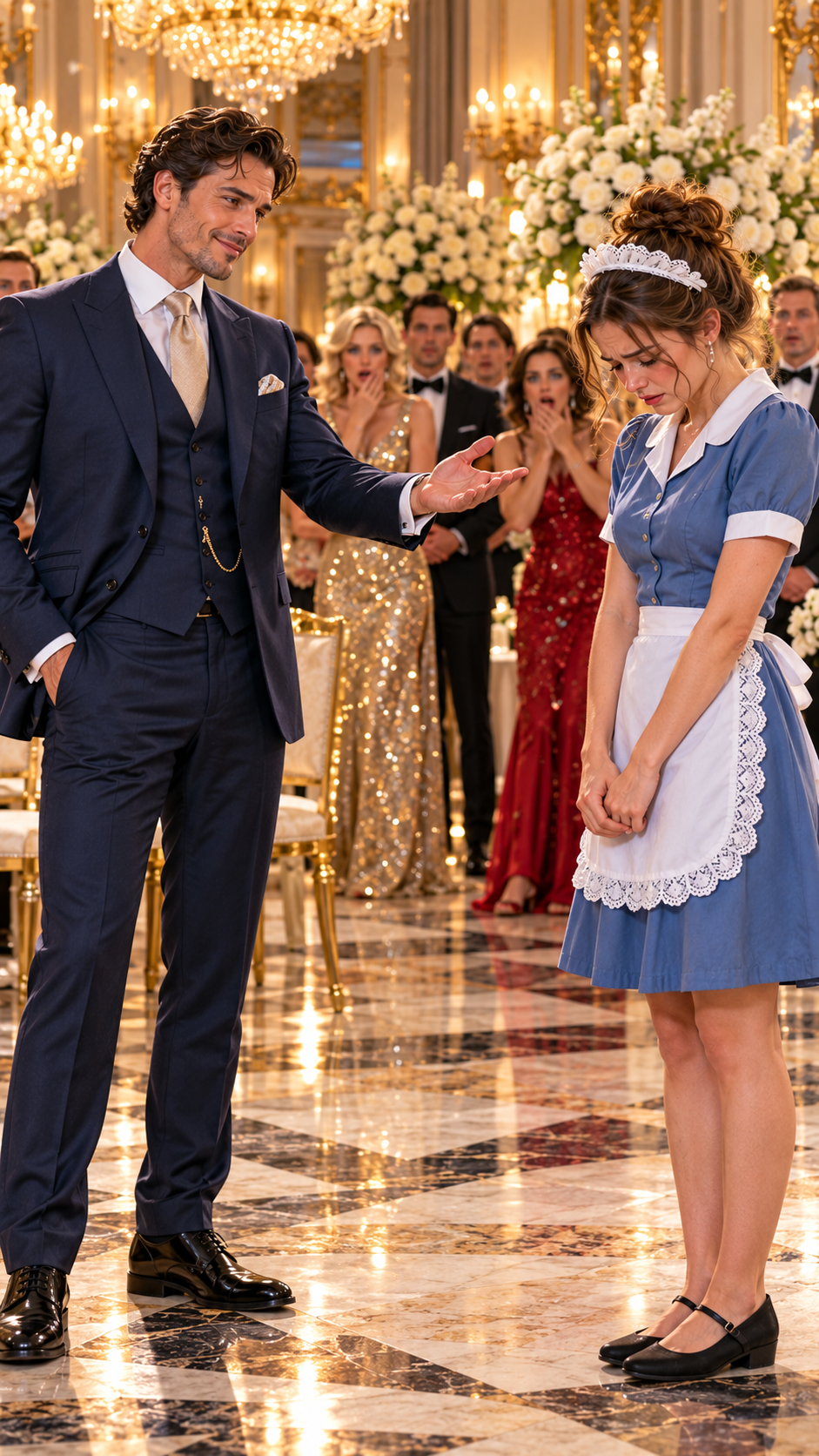
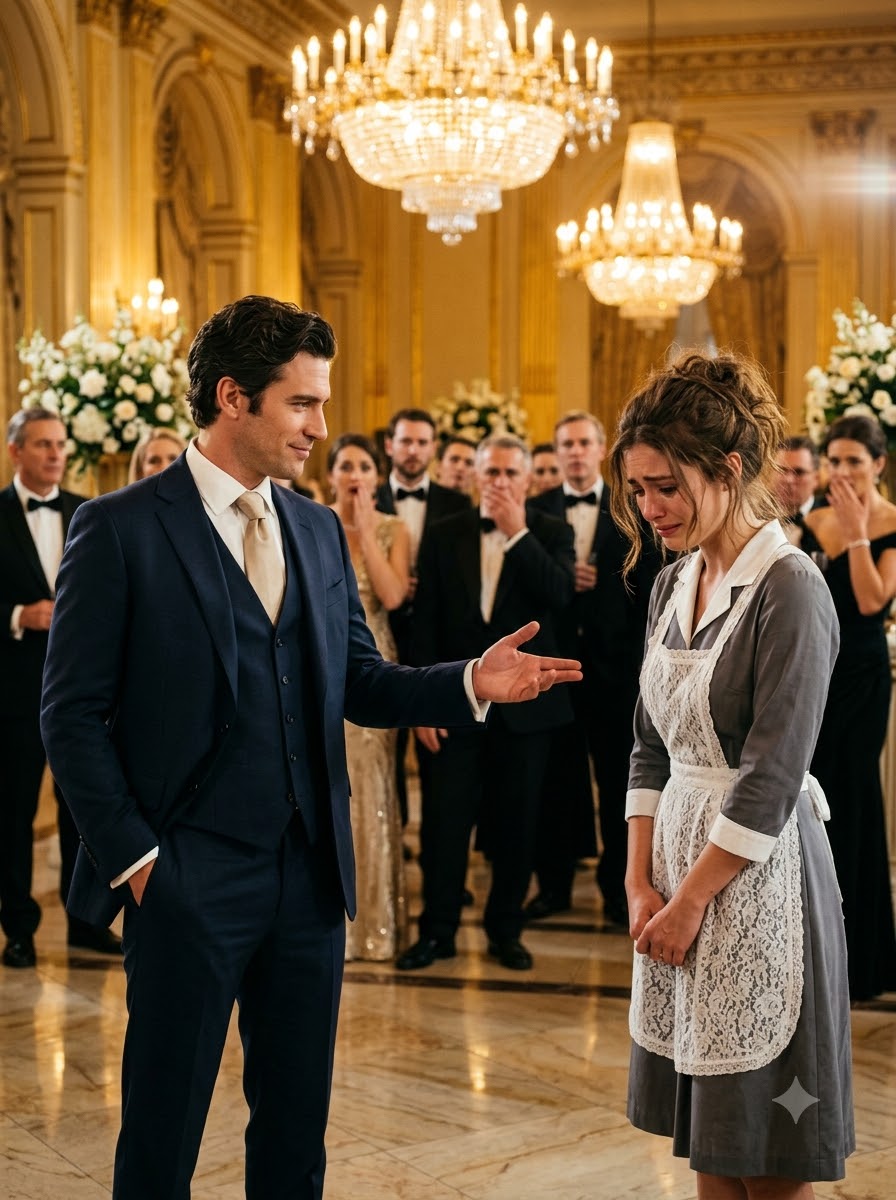
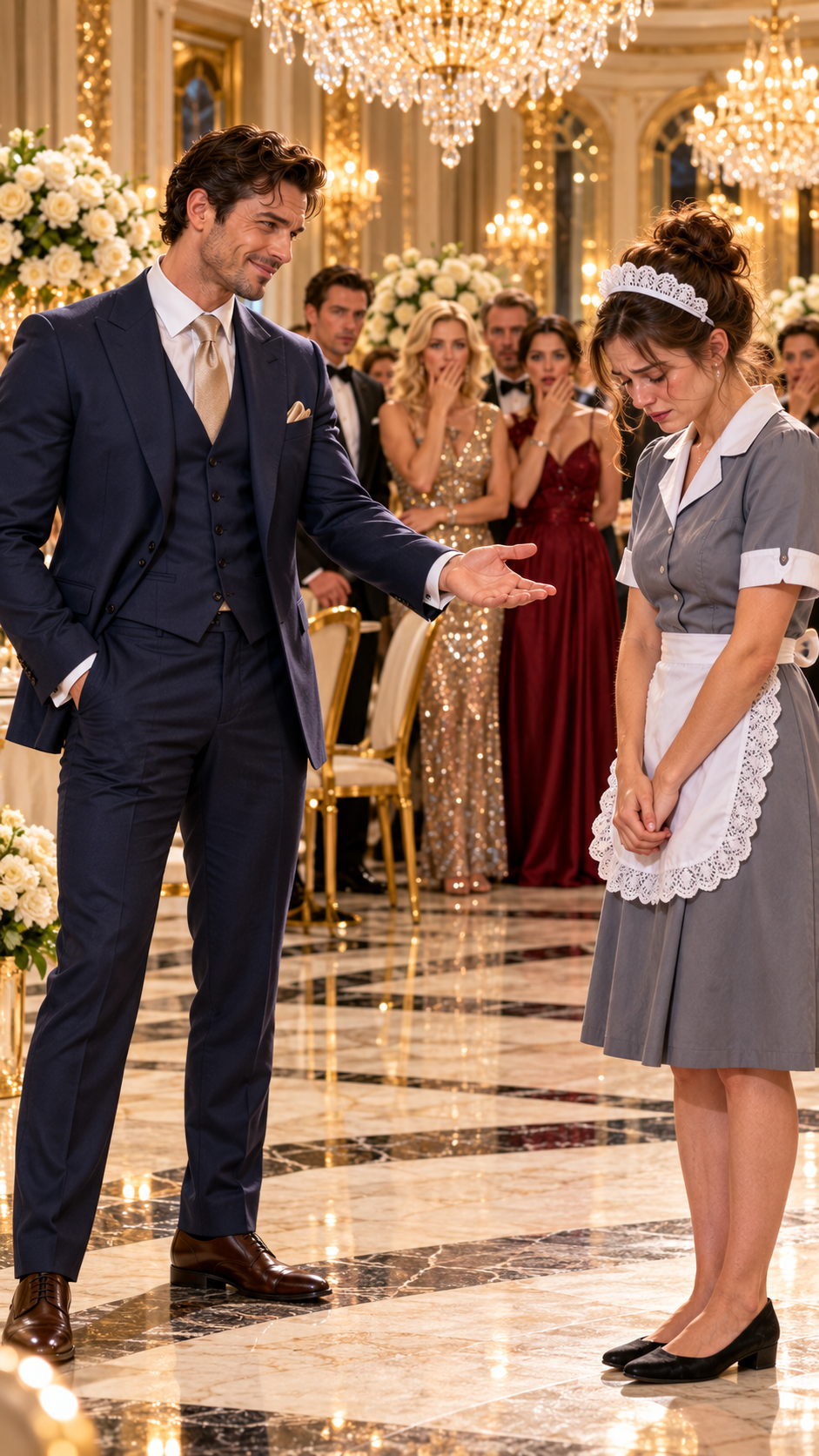
“If you can dance this tango with me without making a fool of yourself, I’ll marry you,” Sebastián Arriaga said, raising his glass in front of more than 200 guests.
Laughter erupted around me before I could even understand what had happened.
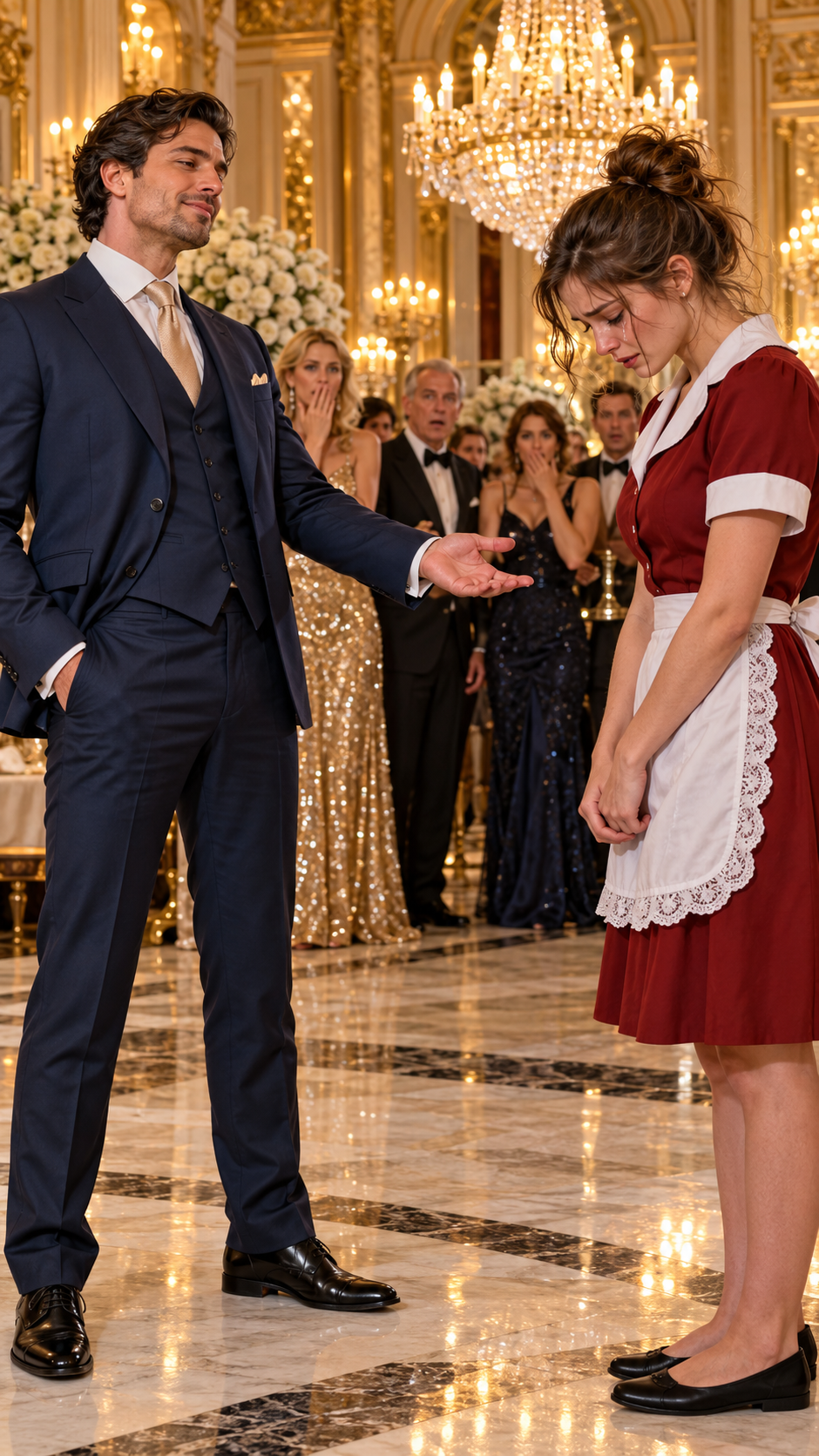
I stood in the middle of the magnificent ballroom, still clutching a mop. My apron was stained with red wine, and the back of my uniform was damp.
Only minutes earlier, Regina Salcedo, Sebastián’s fiancée, had deliberately poured her drink down my back while pretending she had stumbled.
Nobody had challenged her.
Some guests had even laughed.
For two years, I had worked as a maid in the Arriaga mansion in Guadalajara. I understood the rules of that house better than anyone.
Clean everything.
Serve everyone.
And never answer back.
I needed the salary too desperately to risk losing it.
Every two weeks, I sent half my wages to Zapopan, where my sister Rosa was struggling to raise her two children alone.
I had learned to swallow insults because those children needed food, school supplies, and a roof over their heads.
But what Sebastián did that evening was different.
He was not merely humiliating me.
He was turning me into entertainment for more than two hundred people.
“Come on, Valeria,” Sebastián insisted with a mocking smile. “Weren’t you supposed to be such a great dancer?”
The orchestra continued playing.
I recognized the tango immediately.
It was a melody I had known since childhood, one that carried memories of polished wooden floors, morning sunlight, and my father’s voice.
Aurelio Montiel had owned a small dance academy in Santa Tere.
Every morning, he played that same tango while preparing the studio for his students.
And every time I became frustrated with my steps, he reminded me of the lesson he considered most important.
“You don’t dance tango with your feet, sweetheart. You dance it with dignity.”
I had not danced in six years.
Six years of avoiding music that reminded me of what my family had lost.
Six years of pretending that the young woman who once dreamed of dancing professionally no longer existed.
Now the melody surrounded me again.
I looked toward Doña Amparo, Sebastián’s grandmother.
She was the only person in the mansion who regularly asked how I was feeling and addressed employees by their names.
Unlike the other guests, she was not laughing.
Leaning on her cane, she looked directly into my eyes.
Then she gave a barely perceptible nod.
I placed the mop aside.
Untied my stained apron.
Folded it carefully.
And extended my hand toward Sebastián.
“But have them start the piece from the beginning.”
The conductor raised his baton.
A murmur traveled through the ballroom.
Sebastián looked amused, apparently convinced that I was about to embarrass myself.
But when the first notes began, I remembered everything my father had taught me.
My posture straightened.
My shoulders relaxed.
My feet found the rhythm.
Sebastián attempted to lead with unnecessary force, as though dancing were another opportunity to command someone.
I leaned closer and whispered:
“Relax your shoulders. Don’t push me. Listen.”
His smile disappeared.
He tried to regain control, but his movements were stiff and rushed.
I adjusted my steps without interrupting the flow.
The guests gradually stopped laughing.
I turned with the precision my father had demanded during countless hours of practice.
When Sebastián missed the rhythm, I steadied him so the audience would not notice.
He looked at me in confusion.
“Why are you helping me?” he asked, bewildered.
“Because in tango, if one person falls, both fall.”
Something shifted in his expression.
For the first time that evening, he stopped treating me like an object of amusement.
He began following the music.
The orchestra carried us through the final sequence.
I finished the last turn exactly as my father had taught me.
Then the music ended.
Silence filled the ballroom.
More than two hundred people stared at us.
Doña Amparo slowly rose from her chair.
Tears glistened in her eyes.
She began applauding.
One by one, the other guests joined her until the room echoed with applause.
Sebastián appeared stunned.
Then, realizing everyone was watching him, he tried to recover his usual arrogance.
“Well, it was a joke.”
I picked up my apron and tied it around my waist again.
“I know. And I wouldn’t have accepted anyway. I would never marry a man who mocks someone who serves him at his table.”
His expression changed.
I did not wait for an answer.
I returned to the kitchen, my legs trembling so badly that I had to grip the counter.
I had spent years learning to remain invisible.
For a few minutes, I had allowed everyone to see me.
And I was terrified of what that might cost.
Several hours later, Doña Amparo sent someone to find me.
When I entered her private sitting room, I noticed that her eyes were red.
She asked me to sit.
Then she studied my face with an intensity that made me uncomfortable.
“That way you finish your turns… I’ve only ever known one person who danced like that. Tell me your full name.”
“Valeria Montiel Ruiz.”
The cup slipped from her hands.
It struck the floor and shattered.
“Montiel… Was your father Aurelio Montiel?”
My breath caught.
“Yes. Did you know him?”
Doña Amparo covered her face.
She began sobbing.
“My God… Rodrigo, my son… what have you done?”
I stood frozen.
Rodrigo Arriaga had been Sebastián’s father.
He had died years earlier.
I had never imagined that his name could have anything to do with my family.
Before I could ask another question, Doña Amparo became visibly unwell.
Her breathing grew uneven, and her hands trembled.
We called for help.
The following morning, a doctor examined her after a sudden increase in her blood pressure.
Before he arrived, she made me promise not to reveal that Aurelio Montiel was my father.
I agreed, although I did not understand why the truth frightened her so much.
By then, the video of our tango had spread everywhere.
Guests had uploaded recordings of the millionaire dancing with his maid.
Some praised my performance.
Others mocked Sebastián.
I barely slept.
I kept remembering Doña Amparo’s reaction.
Especially the words she had spoken about her son.
The next morning, while passing the dining room, I overheard the family lawyer speaking.
His name was Ernesto Vidal.
He had worked with the Arriaga family for years and was treated almost like a relative.
He suggested giving me severance pay and sending me “far away from Guadalajara.”
Regina demanded that I be dismissed immediately.
Then Sebastián spoke.
“Nobody is firing her. I’m the one who crossed the line.”
I stopped walking.
It was the first time I had heard him acknowledge his behavior without laughing.
Vidal appeared displeased.
As he gathered his documents, I noticed a folder pressed against his chest.
One word was written on its tab.
MONTIEL.
My surname.
The sight made my stomach tighten.
Why would the Arriaga family’s lawyer have a file bearing my father’s name?
The following morning, Sebastián entered the kitchen at six o’clock.
He wore sweatpants instead of his usual expensive suit.
There was no watch on his wrist.
“I came to apologize.”
I looked at him cautiously.
An apology could not erase two years of being treated as though I were beneath the family.
But Sebastián did not try to defend his behavior.
He admitted that he had acted like a scoundrel.
Afterward, he began coming downstairs each morning for Mexican cinnamon coffee.
At first, our conversations were brief.
We discussed the weather, household routines, and ordinary things.
Gradually, he began asking questions about my life.
I remained careful.
Then one morning, he mentioned something his father used to say.
“A signature can be forged; a person’s word cannot.”
My hands turned cold.
My father had spent his final years repeating almost the same idea.
He had lost his dance academy and his home because of a promissory note he insisted he had never signed.
Nobody believed him.
The debt destroyed everything he had built.
That afternoon, Doña Amparo asked me to visit her room.
She showed me an old photograph.
Two young men were dancing together.
One was Rodrigo Arriaga.
The other was my father.
Aurelio Montiel.
On the back, someone had written:
“To Aurelio, the brother life gave me. Without you, none of this would exist.”
Doña Amparo explained that my father had helped Rodrigo when nobody else believed in his dream of establishing a tequila distillery.
They had once been inseparable.
But years later, Ernesto Vidal joined the company.
After that, the friendship began falling apart.
Before Rodrigo died, he had asked someone to “settle the matter with Aurelio.”
Vidal assured him everything had been resolved.
Yet two years later, my father lost his academy and home because of the disputed promissory note.
I stared at the photograph.
The pieces did not fit.
Why would two men who had considered themselves brothers become enemies?
Why had Vidal handled their affairs?
And why did he still possess a file bearing my father’s surname?
That night, I carried tea upstairs.
As I passed Vidal’s office, I heard Regina crying inside.
“Godfather, Sebastián is going to cancel the wedding because of her.”
I stopped.
Then Vidal answered.
“This isn’t about jealousy anymore. That woman is Aurelio Montiel’s daughter. If she discovers the truth about the promissory note, we’re both finished.”
The cup shook against its saucer.
I could barely breathe.
My father’s ruin had not been an unfortunate financial dispute.
Someone in that house knew exactly what had happened.
And they were terrified I might discover it.
Suddenly, the conversation stopped.
Footsteps approached the door.
The handle began to turn.
PART 2: THE BETRAYAL THAT DESTROYED MY FATHER
I forced myself to move before the office door opened completely.
Holding the tray steady, I stepped forward as though I had only just reached the hallway.
“Good evening, sir. Doña Amparo asked if you wanted some tea.”
Ernesto Vidal stared at me.
His expression remained controlled, but his eyes searched my face.
“How long have you been here?”
“I just came upstairs.”
He continued watching me.
I knew he did not believe my answer.
But I refused to look away.
Eventually, he dismissed me.
I returned downstairs with my heart pounding.
That night, I told Doña Amparo everything.
I wanted to confront Sebastián immediately.
Surely he deserved to know what Vidal had said.
But Doña Amparo stopped me.
“He loves Ernesto like a father. You have words; Ernesto has documents. First, we need evidence.”
She was right.
Sebastián had trusted Vidal his entire life.
A conversation overheard outside an office would not be enough to dismantle that relationship.
We needed proof.
Unfortunately, we were not given time to find it.
Two days later, the family hosted a birthday dinner for Regina.
The mansion filled with elegantly dressed guests, expensive flowers, and trays of champagne.
During dinner, Regina proudly displayed a diamond necklace she had inherited from her grandmother.
Later, she went upstairs to put it away.
Shortly after midnight, a scream echoed through the house.
The necklace was missing.
Within minutes, the celebration turned into an investigation.
Regina accused the household staff of stealing it.
Vidal suggested searching the employees’ rooms.
Sebastián initially objected.
But the guests began whispering.
Eventually, he agreed.
I stood in the hallway, watching the butler disappear toward the servants’ quarters.
When he returned, he carried my old shoebox.
My stomach dropped.
Inside was Regina’s necklace.
For a moment, I could not move.
“I didn’t put that there.”
Regina pointed directly at me.
“Thief!”
Her accusation echoed through the room.
I barely heard the guests murmuring.
I looked for Sebastián.
For weeks, we had shared cinnamon coffee at six in the morning.
We had talked about our childhoods and our families.
He had asked me to teach him tango in the evenings because he wanted to learn how to listen rather than command.
Against my better judgment, I had begun falling in love with him.
Now, with everyone watching, I searched his face.
And I saw doubt.
Only for a second.
But I saw it.
The police arrived with suspicious speed.
They handcuffed me in front of the guests.
Doña Amparo protested, insisting that I was innocent.
Sebastián stepped forward.
He opened his mouth.
But he did not speak quickly enough.
I was taken away.
That night, sitting inside a cell, I remembered my father.
He had also insisted that he was innocent.
He had also watched people choose documents and accusations over his word.
And nobody had believed him.
At six the following morning, Sebastián came to see me.
“I came because I know you didn’t…”
I interrupted him.
“You did doubt me,” I interrupted. “I saw it. Everyone else could doubt me, Mr. Sebastián. But not you.”
He lowered his head.
“It was only a second.”
“Sometimes one second is enough to break something.”
I turned away.
I did not want another apology.
I wanted my freedom.
Doña Amparo hired an attorney for me.
Two days later, I was released on bail.
I immediately resigned from the Arriaga household and went to stay with Rosa in Zapopan.
I began planning a move to Mérida.
I wanted to start again somewhere nobody knew my name.
Somewhere my father’s history would not follow me.
But while I was preparing to leave, Sebastián was finally beginning to question the people he had trusted.
For the first time, he stopped accepting Vidal’s explanations without evidence.
He hired a private investigator named Tomás Rentería.
Together, they visited Santa Tere.
A former neighbor remembered Aurelio Montiel clearly.
My father had offered free dance lessons to neighborhood children who could not afford tuition.
Even after losing the academy, he continued insisting that someone had deliberately ruined him.
He never accepted that the promissory note was genuine.
Meanwhile, Doña Amparo searched through an old wooden box that had belonged to Rodrigo.
She had kept it for years.
Beneath a false bottom, she discovered a sealed envelope.
It had been hidden for a decade.
At dawn, Sebastián arrived at Rosa’s house.
He held that envelope in his hands.
My suitcase stood beside the front door.
“I asked you not to look for me.”
“I know. I haven’t come to ask you to forgive me. I’ve come to give you the truth.”
I hesitated.
Then I allowed him inside.
We sat at Rosa’s kitchen table.
She poured coffee into two chipped mugs before taking her children into another room.
Sebastián placed the envelope in front of me.
I opened it carefully.
The letter was written by Rodrigo Arriaga.
He confessed that in 1986, when nobody would lend him money, Aurelio Montiel had sold the house he inherited and given Rodrigo everything to establish the tequila distillery.
They never signed a formal contract.
My father had told him:
“A brother doesn’t charge another brother.”
Years later, Vidal presented Rodrigo with documents supposedly proving that Aurelio intended to take control of the company.
Rodrigo believed them.
He ended the friendship.
Only shortly before his death did he discover that the documents were fraudulent.
Realizing what had happened, he tried to repair the damage.
He legally recognized Aurelio’s right to ten percent of the distillery.
I struggled to continue reading.
Tears blurred the words.
“My dad was telling the truth.”
“Always,” Sebastián replied. “And the promissory note was a trap too.”
Rentería had traced the debt collection to a company connected to Regina’s family.
The money ultimately reached an account linked to Vidal.
Suddenly, the story of my father’s ruin became clear.
He had not lost everything because of a legitimate debt.
He had been targeted through a carefully constructed deception.
The forged documents had destroyed his friendship with Rodrigo.
The promissory note had taken his home and academy.
And the people responsible had relied on his poverty to ensure nobody believed him.
I looked toward the ticket to Mérida resting beside my suitcase.
Then I placed it on the table.
“I’m staying. But not for you. I’m staying for my dad.”
Sebastián nodded.
“That’s enough for me.”
Yet finding Rodrigo’s letter was only the beginning.
My own name still needed to be cleared.
And the people who had framed me were still free.
The first witness to come forward was Don Fermín, the gardener.
On the night of Regina’s birthday dinner, he had seen her enter my room carrying something shiny.
He had remained silent because he feared losing his job.
“When you’re poor, Miss Valeria,” he told me afterward, “sometimes you believe your word carries no weight against the word of people with money.”
His testimony was important.
But an even stronger piece of evidence emerged.
The hallway security cameras had appeared disconnected.
However, investigators discovered that the system had retained an automatic backup outside the house.
The footage showed Regina walking toward my room with the necklace in her hand.
Seconds later, she emerged without it.
The evidence was undeniable.
The charges against me were dropped.
When Sebastián called with the news, I remained silent.
“Your name has been cleared, Valeria.”
“Mine has. My father’s still hasn’t.”
“Then let’s finish this.”
Sebastián decided to organize another gala at the mansion.
He invited the same society guests who had laughed when he humiliated me.
The same people who had watched me being taken away in handcuffs.
When he asked me to attend, I nearly refused.
I could still remember their expressions.
Their whispers.
The humiliation of standing before them while everyone assumed I was guilty.
Sebastián understood my hesitation.
“This time, you won’t be alone,” he assured me. “And I won’t speak for you.”
I agreed.
Not because I trusted him completely.
Not because I had forgiven him.
I agreed because my father deserved to have his story told.
On the evening of the gala, I wore a simple black dress.
Doña Amparo approached and gently tucked a loose strand of hair behind my ear.
“Stand up straight, sweetheart.”
I closed my eyes.
My father had said those exact words before every dance competition.
When I opened them again, I felt steadier.
Sebastián stepped onto the stage.
“The first time we gathered here, I mocked a woman who was doing her job. Later, when she was accused, I doubted her. Today, I haven’t come to announce a wedding. I’ve come to apologize and let the person who should have been heard from the beginning speak for herself.”
Then he said my name.
I crossed the ballroom with my shoulders straight.
This time, I was not carrying a mop.
I was carrying evidence.
I told the guests who Aurelio Montiel had been.
I showed them the photograph of my father dancing with Rodrigo.
I read the dedication written on the back.
I explained how the academy had been taken from us and how my father had spent his final years trying to convince people that the signature on the promissory note was not his.
I told them Rodrigo had eventually discovered that both men had been deceived.
The room was silent.
Then Vidal stood.
He held a leather folder.
“This is a circus! I have a resignation signed by Aurelio Montiel. That woman is taking advantage of an elderly lady and a gullible man.”
Several guests exchanged uncertain glances.
I recognized their expressions immediately.
The same doubt.
The same readiness to believe the powerful man holding a document.
For one terrible moment, I felt as though I were standing in that ballroom on the night of Regina’s accusation.
But this time, I had come prepared.
I opened my handbag.
Inside was the old diploma my father had given me after I won a tango competition.
I lifted it.
“Let me see that signature.”
Sebastián took Vidal’s document.
He placed it beside my diploma so both signatures could be projected onto the large screen.
I pointed toward my father’s name.
“My dad signed hundreds of diplomas. After his surname, he always drew a little musical note. He used to say that even a signature should dance. Yours doesn’t have it. Neither does the one on the promissory note.”
The guests leaned forward.
The difference was visible.
Then Tomás Rentería approached with a forensic document examiner’s report.
Both disputed signatures had been forged.
Doña Amparo slowly rose, leaning heavily on her cane.
She looked at Vidal.
“For years, you ate at my table, Ernesto. We believed you were family. And you used that trust to turn two men who loved each other like brothers against one another.”
Vidal tried to answer.
But before he could finish, the ballroom doors opened.
Officers from the prosecutor’s office entered.
For the first time since I had known him, Ernesto Vidal lost his calm expression.
Regina attempted to leave unnoticed.
One of the officers stopped her and asked about the hallway recording.
She panicked.
“It was my godfather’s idea!” she shouted. “I only wanted that woman gone!”
She covered her mouth.
Too late.
The guests who had once laughed at my humiliation now watched in silence as Vidal and Regina were escorted from the mansion.
I stood motionless.
I had imagined this moment so many times.
I thought I would feel victorious.
Instead, I felt an enormous weight beginning to lift from my chest.
There was no joy in watching them leave.
Only relief.
My father had been telling the truth.
And finally, the people who had destroyed his life could no longer hide behind their wealth.
But even after the truth was revealed, one question remained.
Could I ever trust the man who had humiliated me before two hundred guests and then doubted my innocence when I needed him most?
PART 3: THE TANGO THAT BROUGHT OUR FATHERS’ LEGACY HOME
The weeks following the gala changed everything.
The investigation into Ernesto Vidal and Regina Salcedo continued.
The forged documents, financial transfers, and security footage exposed the deception that had destroyed my father’s reputation.
For years, Aurelio Montiel had been remembered by some people as a failed businessman who had borrowed money he could not repay.
Now the evidence told a different story.
He had been a generous man who sacrificed his inheritance to help a friend build a company.
He had trusted Rodrigo Arriaga without demanding a contract.
And that trust had been exploited by someone who understood exactly how to turn friendship into suspicion.
Eventually, Rodrigo’s final wishes received legal recognition.
Rosa and I obtained the share of the distillery that rightfully belonged to our father.
For the first time in our adult lives, we no longer had to worry constantly about money.
Rosa could provide for her children without waiting for the wages I sent every two weeks.
I no longer had to remain in a job where people believed they could humiliate me simply because they paid my salary.
We could have purchased an enormous house.
We could have bought expensive cars or moved into one of Guadalajara’s most exclusive neighborhoods.
But neither of us wanted that.
I knew exactly what I wanted to do with the money.
I returned to Santa Tere.
The neighborhood had changed over the years, but I still recognized the streets where I had grown up.
I remembered walking beside my father before sunrise while he carried the keys to his academy.
I remembered the smell of polished wood and the sound of music drifting through open windows.
I remembered the children who arrived without enough money for lessons.
My father never turned them away.
The academy had been more than his business.
It had been his life’s work.
And losing it had broken something inside him that no one had managed to repair.
I purchased the property where the Montiel Academy had once stood.
Then I began restoring it.
The floors were repaired and polished.
The walls were painted.
The mirrors were installed.
And the old practice rooms slowly began to resemble the place I remembered from childhood.
On the day we reopened, I hung two objects near the entrance.
The first was the photograph of Aurelio and Rodrigo dancing together.
The second was my old competition diploma.
My father’s signature remained visible at the bottom.
And beside his surname was the tiny musical note he always drew.
The mark that had helped expose the forged documents.
The mark that proved his handwriting had carried the same personality as his dancing.
Rosa took responsibility for the academy’s accounts.
I returned to teaching.
Our students came from every part of the neighborhood.
There were retired women who had always dreamed of learning tango.
Couples preparing for their weddings.
Young people who entered the studio embarrassed by their lack of experience.
And children whose families could not afford expensive lessons.
Whenever I watched a nervous student take their first step, I remembered my father.
I heard his voice telling me that tango was not about perfection.
It was about dignity.
For the first time in years, I felt as though I had returned to the person I had been before everything fell apart.
Sebastián continued visiting.
But I made it clear that reclaiming my father’s legacy did not mean our relationship could simply return to the way it had been.
He had hurt me.
Not only when he mocked me before the guests.
But when he allowed doubt to enter his eyes as I was accused of stealing Regina’s necklace.
He could not repair that wound with money or apologies.
And to his credit, he stopped trying to.
Instead, I began noticing changes in his behavior.
Not dramatic gestures made for an audience.
Ordinary decisions made when nobody was watching.
He started meeting directly with workers at the distillery.
He listened when employees raised concerns.
He learned the names of the people working inside his house.
When someone served him coffee, he looked up and thanked them.
And when he did not understand something, he asked questions rather than issuing commands.
It was not an immediate transformation.
He still made mistakes.
Sometimes he became impatient.
Sometimes his old arrogance appeared before he realized what he was doing.
But I watched what happened afterward.
He admitted when he was wrong.
He apologized without expecting instant forgiveness.
And he tried again.
That mattered more to me than any expensive gift.
I had once seen him believe that his wealth entitled him to treat other people as entertainment.
Now I saw him learning that respect had to exist regardless of a person’s position.
I didn’t forgive him because he asked me to.
I forgave him little by little, watching how he picked himself up after making mistakes.
As the months passed, we began spending more time together.
Sometimes he came to the academy after work.
He sat quietly while I taught the children.
Other evenings, he helped Rosa carry supplies or move chairs.
And occasionally, when the studio was empty, he asked me to practice tango with him.
He still tried to lead too quickly.
I still had to remind him to listen.
But he was learning.
More importantly, he wanted to learn.
Our relationship grew slowly.
There was no sudden declaration that erased everything that had happened.
Trust returned through repeated actions.
One conversation.
One promise kept.
One mistake acknowledged.
One ordinary day after another.
Eventually, I realized that the man standing beside me was no longer the same person who had raised his glass and challenged his maid to dance before two hundred guests.
And I was no longer the woman who believed she had to remain silent to keep her job.
We had both changed.
Months later, Sebastián and I decided to marry.
Not in the Arriaga mansion.
Not beneath chandeliers surrounded by wealthy society guests.
We chose the Montiel Academy.
The same building where my father had swept the floors before opening each morning.
The same place where I had first learned to dance.
There was no extravagant society wedding.
Doña Chela prepared the pozole.
Don Fermín brought flowers.
Rosa began crying before the ceremony even started.
Doña Amparo sat in the front row with her cane resting between her hands.
Her eyes filled with tears as she looked at the photograph of Aurelio and Rodrigo.
I knew she was thinking about the two friends who had once trusted each other like brothers.
Their friendship had been destroyed by lies.
But the truth had finally returned to the place where it belonged.
When the ceremony ended, Sebastián approached me.
He extended his hand.
I recognized the gesture immediately.
It was the same hand he had offered me in the ballroom on the night he tried to humiliate me.
But the man standing before me had changed.
He smiled.
“Teacher, may I have this tango?”
I tilted my head.
“On one condition.”
“Anything you want.”
“You’re still the student.”
He burst out laughing.
“Deal.”
I placed my hand in his.
The music began.
This time, there were no mocking guests.
No spilled wine.
No stained apron.
No challenge designed to make me look foolish.
There were only people who loved us, a polished wooden floor, and the melody my father had played so many mornings.
Sebastián followed the rhythm carefully.
He did not pull me forward.
He did not force the steps.
When he hesitated, he looked toward me.
And together, we continued.
The next morning, we returned to the academy at six o’clock.
Sebastián prepared Mexican cinnamon coffee while I opened the windows.
The streets outside were still quiet.
Morning sunlight spread across the polished floor.
I placed my father’s old tango on the music player.
The familiar melody filled the room.
I looked toward the photograph of Aurelio and Rodrigo dancing together.
Beside it hung the diploma with the little musical note.
For years, I had believed that losing the academy meant losing the last piece of my father that truly belonged to me.
Now I understood that his legacy had survived in more than a building.
It had survived in the lessons he taught.
In the children he helped.
In the dignity he refused to surrender, even when others accused him of dishonesty.
And in the way he taught me to dance.
Sebastián approached and offered his hand.
We began moving together.
He tried to take the first step before the music was ready.
I gently squeezed his fingers.
“Listen.”
He stopped.
This time, he did not push.
He did not give orders.
He did not rush to prove he was in control.
He waited for the rhythm.
Then we danced.
And beneath the photograph of our fathers, I finally understood something that had taken years of suffering to learn.
Reclaiming my dignity had never meant humiliating the people who humiliated me.
It had never meant becoming wealthy enough to make others afraid of me.
And it had never meant forcing the world to applaud.
It meant finding the courage to stand again after being brought to my knees.
It meant telling the truth even when powerful people tried to silence me.
It meant honoring the father who had lost everything because he trusted the wrong person.
And it meant having the freedom to decide, for myself, whose hand I wanted to hold.
That morning, as sunlight filled the Montiel Academy and the tango carried us across the floor, I no longer felt like the maid who had once been mocked before two hundred guests.
I felt like Aurelio Montiel’s daughter.
And that was the greatest inheritance he could ever have left me.
