

PART 1
Someone kept covering my freshly painted garage door with black paint, just days before the most important neighborhood competition of the year.
When I finally discovered who was responsible, I decided the judges deserved a performance they would remember for the rest of their lives.
It all began on a Friday morning.
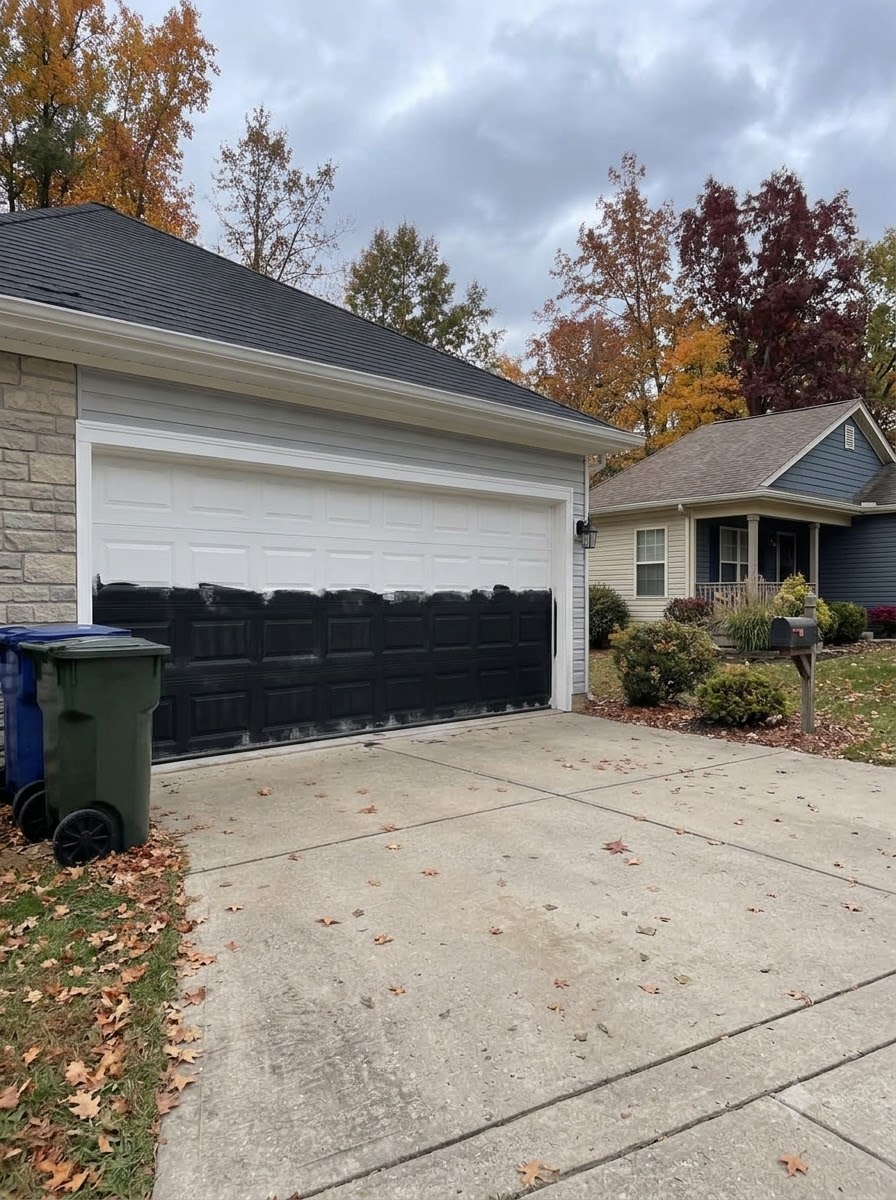
The lower half of my beautiful white garage door had been smeared with black paint.
I discovered it while carrying the trash outside before leaving for work. I had a garbage bag in one hand and a cup of coffee in the other. I was already halfway down the driveway before my mind fully registered what I was looking at.
For a second, I wondered whether the early morning light was playing tricks on me.
Perhaps it was a shadow.
Perhaps I wasn’t completely awake.
Then I stepped closer.
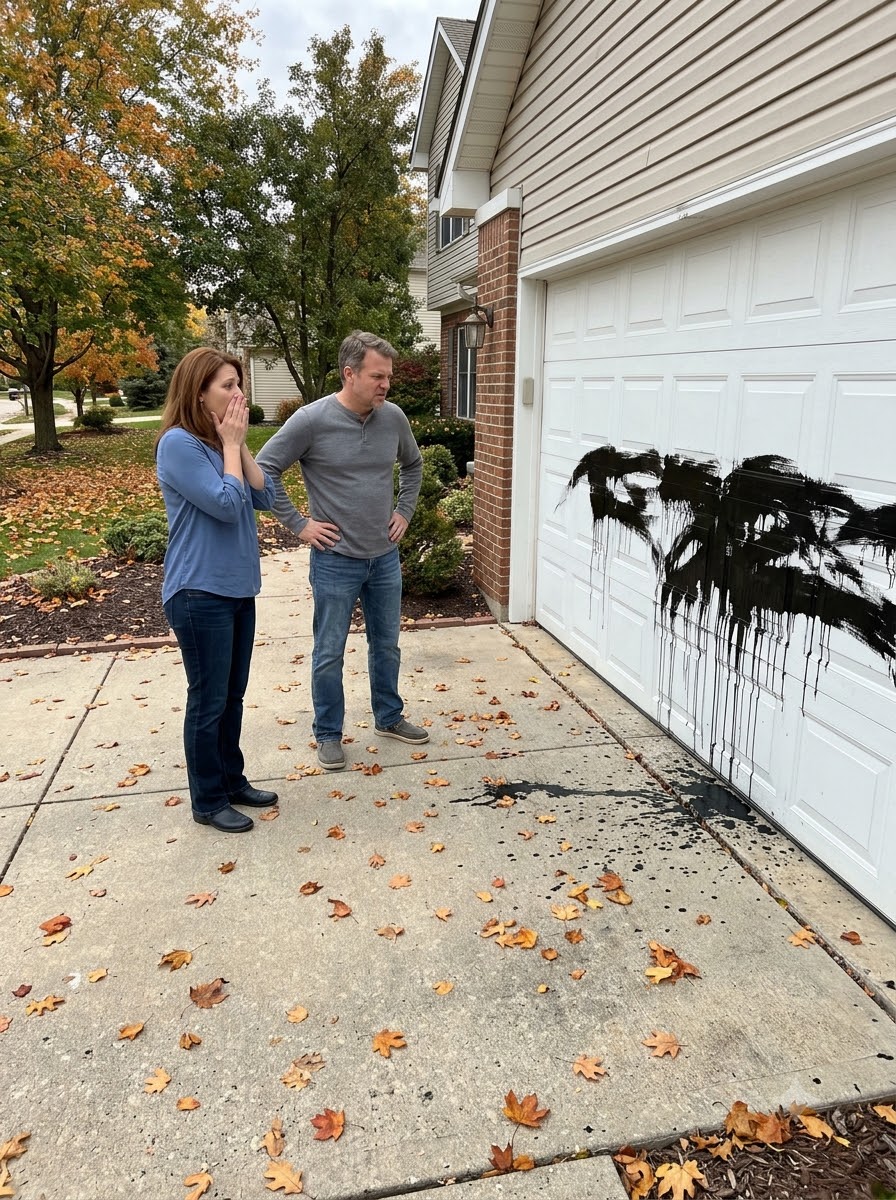
Thick, uneven black streaks stretched across the garage panels. They were broad, careless strokes, as though someone had taken a paint roller and deliberately made the biggest mess possible.
Black droplets had trickled down the door and hardened on the concrete beneath it.
I let the garbage bag fall onto the driveway.
“Toby!” I shouted toward the house.
My husband appeared on the porch wearing his work shirt and socks, with his morning coffee still in his hand.
“What happened?”
I pointed at the garage.
“Who the hell would do something like this?”
Toby walked down the steps and examined the damage.
He remained quiet for several seconds before releasing the familiar sigh he usually reserved for broken appliances and disappointing Cowboys games.
“Probably teenagers. You know how those kids from the high school get.”
I couldn’t completely dismiss the possibility.
The high school was only a few blocks away. We’d occasionally discovered toilet paper hanging from our trees and empty soda cans scattered across the lawn.
The previous Halloween, someone had smashed nearly every pumpkin on the street.
But this didn’t feel like an ordinary teenage prank.
Someone had entered our driveway during the night, brought black paint, and spent time deliberately ruining something we’d worked hard to make beautiful.
It wasn’t funny.
It was calculated.
And it had destroyed our garage door.
To understand why I was so upset, you need to know how much that house meant to me.
I’d spent months making our property look its best.
I wasn’t a professional gardener or landscape designer. My regular job involved handling billing at a dental office.
But every spring, gardening became practically an obsession.
I’d planted roses in three different colors along our front walkway.
Beneath the windows, I grew hydrangeas that I carefully fed coffee grounds to encourage their beautiful blue color.
I trimmed our hedges until they were almost perfectly symmetrical.
Once, Toby caught me outside measuring them with a tape measure and asked whether I needed professional help.
Our porch was decorated with hanging flower baskets.
I watered those baskets every evening, even when it rained, because rainwater didn’t always reach them properly.
And just three weeks before the vandalism, Toby had repainted the garage door.
He’d spent two entire Saturdays sanding, priming, and painting it a brilliant, clean white.
He complained almost constantly while working.
But when he finally finished, he stepped back, admired the result, and announced, “Okay. That’s the best thing I’ve ever painted.”
Admittedly, that wasn’t an especially impressive achievement.
The only other thing he’d painted was our bathroom, which still had a blue streak across the ceiling.
Nevertheless, the garage looked wonderful.
Until someone destroyed it.
And the timing couldn’t have been worse.
The annual Maple Grove neighborhood beautification competition was only a few days away.
I’d won the previous year.
I wanted desperately to win again.
The first-place prize was a thousand-dollar gift certificate to Greenleaf, the garden center on Route 9.
But the money wasn’t what mattered most.
The previous year, when the judges announced my name at the neighborhood block party and presented me with a small wooden plaque reading BEST IN MAPLE GROVE, I’d actually hidden behind the snow cone table so nobody would see me crying.
For years, I’d simply been the woman with the nice yard.
That plaque meant somebody had noticed how much effort I put into it.
Toby squeezed my shoulder.
“Don’t worry,” Toby said, squeezing my shoulder. “We’ll fix it Saturday.”
“We shouldn’t have to fix it.”
“I know. But we will.”
And that’s exactly what we did.
We spent almost the entire following afternoon repairing the damage.
Toby scraped and sanded the worst sections while I carefully taped around the edges.
The weather was hot.
The paint fumes gave me a headache.
At one point, Toby managed to get white paint in his eyebrow and walked around like that for nearly an hour.
I didn’t tell him.
It was the only amusing thing that happened all day.
Around three o’clock, our next-door neighbor, Kelsie, came over.
Kelsie was in her fifties, divorced, and had short silver-blonde hair that always looked perfectly styled.
Her garden was almost as attractive as mine.
Almost.
She’d finished second in the beautification competition the previous year.
And the year before that.
At every block party, she offered the same cheerful response.
“Well, there’s always next year!”
She always said it with a big smile.
That afternoon, she was wearing her familiar quilted green jacket.
She wore that jacket everywhere: gardening, grocery shopping, even church.
I’d seen it so often I could have identified it among a hundred identical coats.
She approached our driveway with one hand pressed against her chest.
“Oh my gosh,” she said, walking up the driveway with her hand over her heart. “That’s awful.”
“Tell me about it.”
“Who would do something like this?”
“I wish I knew.”
“And right before the judges come! Can you imagine if they’d seen it?” She shook her head. “Some people have no respect.”
She appeared genuinely sympathetic.
I thanked her for checking on us.
She even went home and returned with two bottles of cold water from her refrigerator.
I appreciated the gesture enormously.
I remember thinking that this was exactly why I loved living on our street.
By evening, the garage looked perfect again.
Toby and I sat on the porch steps, eating pizza and admiring our work in the sunset.
“See?” he said. “Good as new.”
“Better than new.”
“Don’t say that. You’ll jinx it.”
The following morning, I opened the curtains.
And my stomach dropped.
The black paint had returned.
The same ugly strokes covered the garage.
The same thick drips ran down the panels.
This time, the damage was even worse.
The paint reached almost to the handle.
I stood motionless, staring through the window.
“You have got to be kidding me!”
Toby came rushing downstairs wearing only his boxers.
When he saw the garage, his face darkened.
This time, there was no weary sigh.
He simply stared with his jaw clenched.
“Okay,” he said. “This isn’t some stupid teenage prank anymore.”
“Teenagers don’t come back the next night.”
“No,” he agreed. “They don’t.”
I went outside in my robe.
The black paint was already dry.
Whoever had done it must have come hours before sunrise.
As I examined the damage, something caught my attention.
A piece of white fabric was tangled in the hedge beside the garage.
I pulled it free.
It was a loose cotton button-up shirt, the kind someone might wear while gardening.
Black paint covered the front and one sleeve.
“Toby, look at this.”
He came over and held it up. “Gross. Probably what they wiped their hands on.”
“It’s a woman’s shirt.”
“Or a skinny guy’s.” He shrugged. “Or they stole it off a clothesline. I don’t know, hon. Throw it out.”
But I couldn’t bring myself to discard it.
I couldn’t explain why.
I stuffed it into a plastic grocery bag and placed it on a shelf inside the garage.
Something told me it might matter later.
That morning, we started asking our neighbors whether they’d noticed anything unusual.
Kelsie was outside removing dead flowers from her petunias.
She straightened up when we approached.
“Sorry, honey. I didn’t hear a thing. I sleep like a rock. I wish I could help.”
Three houses down, John was washing his truck.
John was a broad-shouldered man in his sixties, retired from the power company, with a gray mustache and a pair of enormous brown work boots he seemed to wear everywhere.
He wore those boots while mowing the lawn.
He even wore them to weddings.
His late wife, Marian, had won the beautification competition four consecutive years before she died.
Her roses still grew in their front yard.
John kept them alive, although just barely.
“Sorry, honey,” he said, wiping his hands on a rag. “Slept straight through. I take those sleeping pills now. Could’ve been a marching band out there.”
Across the street, Joyce was outraged on our behalf.
Joyce was a small, energetic woman with a short gray bob and enough determination to run three households.
She managed the neighborhood Facebook group with the authority of a military commander.
“You should call the police!” she said, so loud people two houses away could probably hear her. “People can’t just go around destroying someone’s property! I’m going to post about it. Somebody saw something. Somebody always sees something.”
“Thanks, Joyce.”
“I mean it! This is Maple Grove, not some—some city.”
Everyone seemed concerned.
Everyone expressed sympathy.
Everyone agreed the vandalism was terrible.
Yet nobody had witnessed anything.
Toby and I repainted the garage again that Sunday afternoon.
We worked faster because we’d already done it twice.
But neither of us had much to say.
There were no jokes.
No laughter.
Just scraping, sanding, and another exhausting coat of white paint.
Monday morning brought the same nightmare.
For the third time, someone had covered our garage door in black.
I didn’t even scream.
I stood silently at the window, holding the curtain.
Toby came up behind me.
He looked outside and muttered a word I won’t repeat.
“They’re watching us,” I said.
“What?”
“They’re watching us,” I told him again. “They wait until we fix it, then come back. Every time. They know exactly when we’re done.”
Toby rubbed the back of his neck. “That’s creepy.”
“It’s not creepy. It’s personal.”
Then I noticed something lying near the edge of our lawn.
A dark object was partly buried in the mulch beside my flowers.
I went outside and picked it up.
It was a large brown leather work boot.
At least a size thirteen.
Black paint was splattered across it, and mud from my flower bed clung to the sole.
It looked as though someone had been running through the hydrangeas and lost it in the process.
I held it up.
“Do teenagers wear these?” I asked Toby.
He looked at it. “Not any teenager I’ve ever met.”
I placed the boot in another grocery bag.
Then I put it on the garage shelf beside the paint-covered white shirt.
That afternoon, I ordered two security cameras with same-day delivery.
We already had a doorbell camera.
Toby had installed it two years earlier after a package disappeared.
Unfortunately, it was a cheap model, and after a few months, it stopped sending notifications.
Toby had always assumed it was broken.
We’d even joked about it during our Fourth of July barbecue.
“It’s basically a decoration,” Toby told everyone, laughing. “A very expensive decoration.”
“So it’s fake,” Kelsie had said.
“Might as well be.”
Everyone laughed.
At the time, I thought nothing of that conversation.
Later, I would remember every word.
The new cameras arrived around five o’clock.
We waited until dark to install them.
Toby climbed a ladder and concealed one camera beneath the roofline, pointing toward the garage.
We hid the second near the porch, behind a hanging flower basket, where it could record the front yard and street.
We told absolutely nobody.
Not my sister.
Not Toby’s brother.
Not Joyce or her Facebook group.
Nobody.
And for the first time in three days, we deliberately left the garage black.
“What if they don’t come back because it’s already painted?” Toby asked.
“They’ll come back,” I said. “They want it to look worse. It’s not enough to ruin it once. They want it ruined when the judges come.”
Toby stepped down from the ladder and brushed off his hands.
“Tomorrow morning we’ll finally meet our little artist,” he joked.
At 2:30 that morning, my phone vibrated.
Motion detected.
I sat bolt upright in bed.
Toby was snoring beside me.
With trembling fingers, I opened the live camera feed.
The image was grainy, rendered in the strange gray-green tones of night vision.
But I could see what was happening.
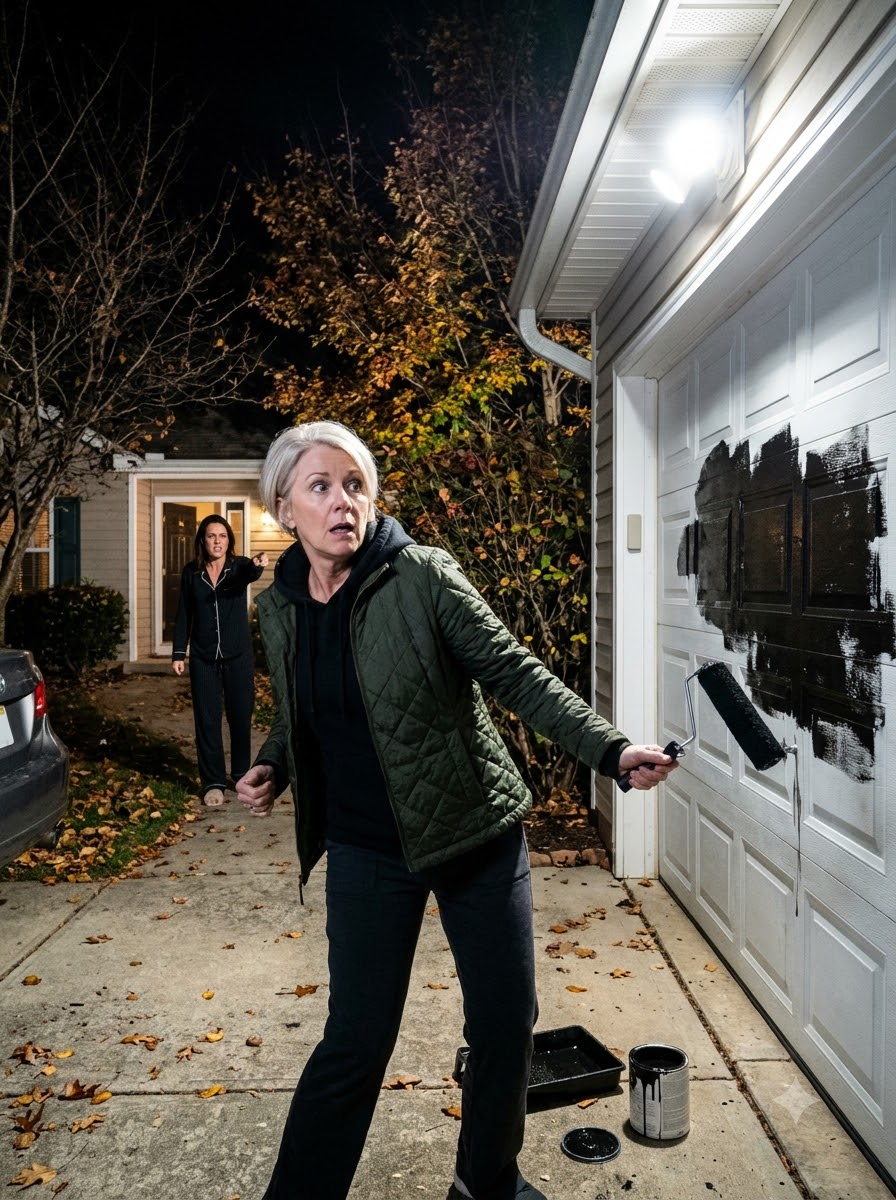
A person wearing a dark hoodie stood in front of our garage, slowly rolling black paint across the door.
The strokes were careful.
Deliberate.
The person moved from one side to the other as though they had all night.
I watched, unable to move.
Then the figure stepped backward to admire the damage.
They turned slightly.
And pulled down the hood.
The picture wasn’t clear enough to show every detail.
But I recognized the hair.
Short.
Light-colored.
Perfectly styled, even at two-thirty in the morning.
And beneath the open hoodie, I recognized something else.
A quilted jacket.
The same distinctive jacket I’d seen almost every day for years.
I couldn’t tell its true color in night vision.
But I didn’t need to.
“No way…” I whispered.
I sprang from bed and raced downstairs.
I must have put on my slippers because I later found them abandoned in the hallway.
I nearly fell on the stairs.
Then I yanked open the front door just as the figure dropped the paint roller.
“Hey! Stop right there!”
The woman bolted between the houses.
By the time I reached the driveway, she’d disappeared into the darkness.
I heard a gate creak.
Then silence.
I stood barefoot on the freezing concrete, struggling to catch my breath.
“I saw you!” I yelled into the dark.
A dog barked somewhere down the street.
Nobody answered.
Toby appeared behind me, half asleep, barefoot, with his hair sticking up on one side.
“What happened? Did you catch someone?”
I turned toward him.
“It was Kelsie.”
He blinked.
“Kelsie? Our Kelsie?”
“Yes! I saw her on the camera!”
Toby looked toward the house next door.
Every window was dark.
Not even the porch light was on.
“But she’s always been so nice to us.”
“Apparently,” I said, “she’s been nice enough to compliment our house while secretly destroying it!”
We hurried inside and replayed the footage on the laptop.
The figure appeared.
The paint roller moved.
The woman stepped backward and turned.
But on the larger screen, her face was nothing more than a blurry smear.
The image was far less convincing than it had seemed on my phone.
I could make out light hair.
I could see the quilted jacket.
But her face was almost impossible to distinguish.
I replayed it several times.
“You can’t really see her face,” Toby admitted.
He was right.
“I know what I saw.”
“I believe you, honey. I do. I’ve seen that jacket a hundred times.” He rubbed his eyes. “But she’ll just deny it. She’ll say a hundred women have that jacket. She’ll say you’re imagining it. And then she’ll go tell everyone on the street you accused her of vandalism with a blurry video.”
I hated admitting it, but he was right again.
I considered marching next door and pounding on Kelsie’s door.
I imagined her answering in a bathrobe, pretending she’d been asleep.
I imagined showing her the footage.
And I imagined her looking at me with innocent confusion.
“Honey, what are you talking about?”
I’d be standing there in my nightgown, looking completely unreasonable.
So instead of confronting her, I decided to find evidence she couldn’t explain away.
Toby and I returned to the driveway with a flashlight.
The paint tray and roller lay where the woman had dropped them.
I examined the thick, glossy black paint.
It looked expensive.
Heavy-duty.
The kind designed to survive years of bad weather.
Then a thought occurred to me.
“If someone keeps buying this stuff,” I said, “somebody must remember selling it.”
The following morning, I called in sick to work for the first time in three years.
I photographed the paint, the roller, and the partially scraped label on the can.
Then I drove to Kowalski Hardware.
I expected to find proof that Kelsie was responsible.
Instead, I was about to uncover something far worse.
PART 2
Kowalski Hardware stood about five minutes from our house.
It was an old brick building with a bell above the entrance and bins of nails sold by the pound.
I’d shopped there for years.
Almost every gardening glove, bag of potting soil, and replacement hose nozzle I’d purchased had come from that store.
The owner, Frank, knew nearly everyone in Maple Grove.
He was in his seventies, wore suspenders, and had the remarkable ability to remember the names of customers’ dogs.
“Morning!” he greeted me as the bell jingled. “Need more gardening supplies? I got that bone meal you wanted.”
“Actually, Frank, I need your help with something strange.”
I explained what had happened.
Three nights of vandalism.
Repeated repainting.
Someone deliberately covering our garage with black enamel.
I didn’t mention Kelsie.
Not yet.
I wanted to be absolutely certain before accusing anyone.
Then I showed him the photograph.
Frank put on his reading glasses and examined my phone.
He moved it close to his face, then held it farther away.
“Looks like heavy-duty exterior enamel,” he said. “Oil-based. That stuff’s a nightmare to get off. We carry that exact kind.”
“Has anyone bought it recently?”
He scratched his chin.
“Not a lot of people buy black. It’s mostly for railings, mailboxes, that sort of thing.” He thought for a moment. “Come to think of it, John bought a can just a few days ago.”
I stared at him.
“John? From Maple Street?”
“That’s the one. Big fella, mustache. Lives a few houses down from you, right?”
My stomach tightened.
John.
The retired power-company worker.
The man who wore enormous brown boots.
The neighbor who’d assured us he’d slept through everything because of his sleeping medication.
“He said it was for his mailbox,” Frank added. “I didn’t think anything of it.”
Except John’s mailbox was silver.
It had been silver for as long as I’d lived there.
“Anyone else?” I asked.
Even to me, my voice sounded unfamiliar.
Frank thought again.
“Well, Joyce came in with him earlier this week. Joyce from across the street from you? They spent ages looking at paint samples. Arguing about something. I figured they were working on some neighborhood project.” He chuckled. “Joyce is always working on some neighborhood project.”
I thanked him.
Then I bought the bone meal he’d mentioned because I suddenly had no idea what to do with my hands.
I left the store barely noticing the bell above the door.
Once inside my car, I sat in the parking lot for several minutes.
Kelsie.
John.
Joyce.
Three neighbors who had stood in my driveway offering sympathy.
Three people who’d acted shocked by the damage.
Three people who’d wondered aloud who could possibly do such a thing.
Joyce had even insisted I contact the police.
When I got home, I didn’t bother removing my coat.
I sat at the kitchen table and opened my laptop.
Then I remembered something.
Our old doorbell camera.
The one Toby had called a decoration.
He’d always said it stopped sending alerts.
But had it actually stopped recording?
It took twenty minutes to remember the password.
Toby had used our wedding anniversary combined with his favorite football player’s number.
When I finally logged in, my heart almost stopped.
The camera wasn’t broken.
Toby had accidentally disabled its notifications two years earlier.
The device had continued recording motion near our porch and front yard, quietly saving footage to the cloud.
Friday night.
Saturday night.
Sunday night.
The recordings were all there.
The camera quality was terrible.
Its main focus was the porch steps, leaving the garage small and blurry at the edge of the picture.
Identifying faces would be impossible.
But this time, I paid attention to everything else.
Friday, 1:47 a.m.
A tall, broad-shouldered figure walked up our driveway.
Their movements were slow and stiff, almost as though they had a painful back.
Heavy work boots struck the concrete with each step.
Saturday, 3:12 a.m.
The next person was shorter and smaller.
Their movements were quick and nervous.
They wore sneakers and a loose white shirt that appeared bright under the night-vision camera.
And the most recent visitor wore Kelsie’s familiar quilted jacket.
Then I discovered something even more revealing.
The Friday recording continued after the vandal finished painting.
Headlights suddenly appeared around the corner at the end of the street.
The tall figure panicked.
They ran directly through my flower bed toward the side of the house.
One foot sank into the soft mulch.
The boot stayed behind.
The person continued running with one boot and one sock, hopping awkwardly before disappearing.
I stared at the screen.
Then I opened Saturday’s recording.
The smaller figure had somehow covered the white shirt in black paint.
They stopped near the hedge, struggled to pull the shirt over their head, and shoved it into the branches.
Then they fled wearing only a T-shirt.
I watched the recordings again.
And again.
Then I went into the garage and retrieved the two grocery bags.
I placed the enormous brown boot and the paint-stained white shirt beside my laptop.
Suddenly, everything fit together.
These weren’t teenagers.
They weren’t random vandals.
My neighbors had taken turns destroying our garage.
One person each night.
Almost like they’d organized a schedule.
Like people signing up to bring food to a neighborhood potluck.
The question was no longer who’d done it.
The question was why three people who had always treated us like friends wanted to ruin our home.
I sat staring at the evidence.
We’d invited these people into our house.
Joyce had cared for our cat when we attended Toby’s mother’s funeral.
John had helped jump-start our car during a snowstorm.
Kelsie had brought me soup when I was sick with the flu.
Why would they do this?
Then I remembered a conversation with Kelsie several weeks earlier.
We’d been standing near the property line.
She was watering her impatiens while I trimmed the hedge between our yards.
“Your roses look incredible this year,” she’d said.
“Thanks. I’ve been babying them.”
“Winning twice in a row must be difficult,” she’d said. “People might start thinking nobody else has a chance.”
I’d laughed because I assumed she was joking.
I said something about her petunias destroying my chances.
But she hadn’t laughed.
She’d simply continued watering.
Then I remembered something John had said during our Fourth of July barbecue.
He’d been holding a hot dog when he suggested that perhaps I should allow someone else a turn at winning.
“Marian used to say that competition was about the neighborhood,” he’d said, holding a hot dog. “Not about one person.”
He’d smiled.
But he hadn’t looked directly at me.
And then there was Joyce.
At that same barbecue, she’d approached me near the potato salad.
She’d casually asked whether judges deducted points for damaged paint.
“Like what kind of damage?” I’d asked.
“Oh, you know. Peeling. Graffiti. Whatever.” She waved her hand. “I’m just curious how strict they are.”
I’d explained that I believed presentation was an important part of the scoring.
Joyce had nodded thoughtfully.
“Interesting.”
Now I understood why she’d been interested.
My face grew hot.
“Oh, you’ve got to be kidding me,” I said out loud to nobody.
I opened the competition rules on my laptop.
I’d studied them countless times the previous year.
The judges would arrive in two days.
Exterior appearance, maintenance, and overall presentation all contributed to the final score.
The rules specifically penalized “visible neglect, damage, or disrepair.”
A garage covered in black paint would certainly damage my chances.
“They’re trying to make me lose,” I whispered.
Toby returned from work at five-thirty.
He walked into the kitchen, loosening his tie.
“Hey. How was the hardware store? Did Frank—”
He stopped.
His eyes moved from the boot to the shirt, then to my face.
“Who’s trying to make you lose?” he asked.
Apparently, I’d spoken aloud again.
I explained everything.
I showed him the old camera recordings.
I repeated Frank’s comments about John buying black enamel and Joyce examining paint samples.
I reminded him of the barbecue.
Kelsie’s strange remarks.
John’s comments about Marian.
Joyce’s questions about damaged paint.
Toby watched each video with his arms folded.
When the tall figure lost a boot in my hydrangeas, he picked up the brown boot from the table.
“Size thirteen,” he said quietly. “John’s got feet like canoes.”
By the time I finished explaining, Toby was furious.
I’d seen him angry before.
But this was different.
His ears had turned red.
His hands were clenched.
“I’m going over there right now.”
He started toward the front door.
I caught his arm.
“No.”
“They’ve been destroying our property! Three nights! Do you know how many hours we spent on that door? Do you know how much that paint cost?”
“I know.”
“Then why are you stopping me?”
“Because they’ve already wasted three days of our lives,” I said. “I’m not giving them the satisfaction of watching us beg them to stop.”
Toby frowned, one hand still resting on the doorknob.
“So what are we supposed to do? Just let them?”
I glanced out the window.
The garage looked dreadful.
Half white.
Half black.
Like a huge bruise on the front of our house.
Then an idea began forming.
I smiled.
“I think we’re finally going to let them finish their masterpiece.”
Toby stared at me.
“You’re joking.”
“Not even a little.”
I closed the laptop.
“We’re not repainting that garage again.”
“Honey.”
“We’re leaving it exactly the way it is. For the judges.”
He slowly released the doorknob and sat across from me.
“Okay,” he said. “I’m scared. Tell me what you’re thinking.”
I already knew exactly what I wanted to do.
That evening, shortly after six, I stepped outside.
The timing couldn’t have been better.
Kelsie was watering her flowers in her green jacket.
John was bent over a lawn mower near his driveway.
Joyce stood beside her mailbox, flipping through catalogs.
All three were within earshot.
I walked to the end of my driveway and stopped directly in front of the black garage.
I put my hands on my hips.
“Well,” I announced, loud enough for everyone to hear, “Toby and I decided we’re done repainting the garage.”
Kelsie immediately turned off her hose.
“Oh, honey,” she said, walking over. “That’s such a shame. Especially with the competition coming up.”
I released an exaggerated sigh.
I wasn’t much of an actress.
But after watching Toby’s mother for years, I’d learned how to make a sigh sound truly tragic.
“I suppose there’s no point trying to win anymore. Every time we fix it, they just come back. We’ll just leave it the way it is.”
John straightened up.
“Probably for the best,” he called over. “These competitions aren’t worth getting upset over.”
“There’s always next year,” Joyce added cheerfully from across the street.
I watched their expressions.
Kelsie looked almost delighted.
She attempted to hide it behind a sympathetic frown, but her eyes were shining.
John suddenly became fascinated with a wrench.
Joyce couldn’t stop the corners of her mouth from lifting.
Every time she suppressed a smile, another appeared.
They were terrible actors.
After three nights of sneaking around our property, they couldn’t even pretend to be disappointed for thirty seconds.
“Well, if there’s anything I can do,” Kelsie offered, putting a hand on my arm. “I could bring over some cookies. Help you feel better.”
“Actually,” I said, “I was thinking of inviting everyone over half an hour before the judging starts on Thursday. Just a little get-together to celebrate the neighborhood. Sandwiches. Lemonade. Who cares about the competition, right? It’s about community.”
I nearly choked on the word community.
The three neighbors exchanged surprised glances.
John looked toward Joyce.
Joyce looked at Kelsie.
Kelsie looked at me.
Then Kelsie beamed.
“What a wonderful idea!”
“I’ll bring fruit salad,” Joyce said quickly.
“I can bring lemonade,” John said. “Marian’s recipe.”
“Perfect,” I said. “Ten-thirty on Thursday. Don’t be late.”
I smiled and returned inside.
Toby was watching through the kitchen blinds like a secret agent.
“You’re really throwing a party for the people who vandalized our garage?”
“Not exactly,” I replied, slipping off my shoes. “I’m giving them front-row seats.”
For the next two days, I was extremely busy.
Toby repeatedly asked what I was planning.
I kept answering, “You’ll see.”
It drove him absolutely crazy.
On Tuesday evening, I called my nineteen-year-old nephew, Marcus.
He worked part-time providing audiovisual equipment for weddings.
I asked whether I could borrow a projector and portable screen.
“For what, Aunt Jen?”
I should mention that my name is Jen.
Nobody on Maple Street ever seemed to use it.
To my neighbors, I was always honey.
“For a presentation,” I told him.
“What kind of presentation?”
“The kind where people find out what they did.”
There was a pause.
“Okay. I’m in. Do you need me to set it up?”
“I need you to set it up in my neighbor’s front yard at ten-fifty Thursday morning while she’s at my house eating sandwiches.”
Another pause.
“Is this legal?”
“It’s a sidewalk,” I said. “It’s public. You’ll be fine.”
“Cool,” Marcus said. “Can I watch?”
On Wednesday morning, I spent two hours editing the camera footage.
I combined the old doorbell recordings with the new security-camera clips.
Friday.
Saturday.
Sunday.
Monday.
I arranged everything chronologically and added large white dates and timestamps, making the video resemble a true-crime documentary.
Toby looked over my shoulder.
“You’re scaring me a little bit.”
“Good.”
That afternoon, I visited the craft store.
I purchased a pumpkin, straw, a wooden stake, and a package of zip ties.
That evening, I retrieved the brown boot and white shirt from their grocery bags.
“What are you going to do with those?” Toby asked.
“Decorate.”
On Thursday morning, Toby found me in the kitchen at seven.
I was already dressed and watching the microwave clock.
“Remind me why we’re inviting these people over again?”
“Because I need them all in one place.”
“That sounds like something a movie villain would say.”
I laughed and handed him a plate of turkey-and-cheese sandwiches cut into triangles.
I’d even removed the crusts.
“Just keep everyone entertained for a while once they get here,” I said. “I have a few things to take care of.”
“What things?”
“You’ll see.”
Toby narrowed his eyes.
“I’ve been married to you for fifteen years,” he said. “That answer usually means trouble.”
“Then you know better than to ask questions.”
He studied me for a moment.
Then he kissed my forehead.
“I married a lunatic,” he said fondly.
“You married a woman with very nice hydrangeas.”
“Same thing.”
What Toby didn’t know was that I’d already been outside at six that morning, before most of the neighborhood was awake.
I’d worked quietly.
Very quietly.
And the zip ties had been extremely useful.
Half an hour before the judges were scheduled to arrive, our doorbell rang.
The supposedly broken doorbell.
The expensive decoration.
I smiled as I opened the door.
Kelsie arrived first with chocolate chip cookies wrapped in plastic.
She wore a floral sundress.
Notably, there was no green jacket.
John followed, carrying a large glass pitcher of lemonade with floating lemon slices.
He was wearing sneakers instead of his usual work boots.
Joyce appeared with fruit salad and an enormous smile.
“Come in, come in!” I said. “Thank you all so much for coming.”
“Wouldn’t miss it,” Kelsie said.
I welcomed them inside.
I arranged the cookies on a plate and set out cups for the lemonade.
We talked about the lovely weather.
Joyce mentioned her grandson, who’d recently started kindergarten.
John complained about his troublesome knee.
“Your knee’s bothering you?” I asked John.
“Little bit,” he said. “Must’ve twisted it.”
“Running?” I asked.
He looked at me.
“What?”
“Do you run? For exercise?”
“No,” he said slowly. “No, I don’t run.”
“Huh,” I said.
Then I checked my watch.
“Excuse me. I just need to finish some preparations.”
I caught Toby’s eye before slipping away.
He knew what he had to do.
“So!” Toby announced, clapping his hands together loudly as I walked toward the back door. “Who wants to place bets on how many points we’ll lose for our garage?”
Kelsie laughed nervously.
“Oh, Toby, don’t be ridiculous.”
“I’m serious. Personally, I’m hoping they’ll appreciate the modern art. Very bold. Very mysterious. Black and white. Like a tuxedo.”
John chuckled.
“Maybe you’ll start a trend.”
“Wonderful,” Toby replied. “Next year, I’ll paint the whole house black. Save everyone the trouble of judging.”
Joyce nearly choked on her lemonade.
I slipped through the back door, crossed the side yard, and sent Marcus a text.
Go.
He replied with a thumbs-up and a skull emoji.
Inside, Toby continued entertaining our guests.
He later told me he’d suggested installing a moat around our house.
Then a giant inflatable gorilla on the roof.
Then a fountain shaped like his own face.
When I returned through the back door, slightly out of breath, Kelsie was laughing at his latest idea.
Replacing our entire lawn with artificial grass and plastic flamingos.
“Fifty flamingos,” Toby was saying. “Minimum. Pink ones. And one black one. In honor of the garage.”
Kelsie’s laughter became noticeably strained.
Then a car pulled up outside.
I glanced through the window.
The silver sedan had arrived.
“Perfect timing,” I said. “The judges are here.”
And everything I’d spent two days preparing was finally about to begin.
PART 3
Three judges stepped out of the silver sedan carrying clipboards.
Two were women.
The third was Mr. Patterson, the head judge.
I recognized him from the previous year.
He was a tall, gray-haired retired high school principal whose voice could probably make an entire classroom sit up straight without him raising it.
“Welcome!” I called, walking down the driveway.
Kelsie, John, and Joyce followed us outside, still holding their lemonade cups and discussing Toby’s ridiculous flamingos.
The judges began with my flower beds.
They admired the roses I’d spent months tending.
Then they stopped beside the hydrangeas.
“These are beautiful,” one of the women said, bending down to look at the hydrangeas. “Such a deep blue. How do you get them like that?”
“Coffee grounds,” I said. “And a lot of talking to them.”
“And your hedges are remarkably neat.”
“Thank you. My husband says I spend more time with them than I do with him.”
“Because they listen better!” Toby added.
Everyone laughed.
Even Kelsie.
The judges wrote notes on their clipboards.
They complimented the hanging flower baskets and the carefully maintained walkway.
One woman even photographed my roses.
Then we reached the garage.
All three judges stopped.
The lower half was still covered in thick, glossy black paint.
Ugly drips stretched toward the driveway.
The clean white panels above made the damage look even more dramatic.
For several seconds, nobody spoke.
Finally, Mr. Patterson raised an eyebrow.
“That’s certainly an interesting design choice.”
Behind him, Kelsie pressed her lips together.
She was clearly struggling not to smile.
John suddenly bent down to examine my roses, as though he’d never seen a flower before.
Joyce exchanged a knowing glance with Kelsie.
I saw it.
That tiny look of satisfaction.
Like two children congratulating themselves for getting away with something.
I smiled.
“Thank you. It’s actually part of a larger neighborhood art project.”
The judges looked interested.
“An art project?” one of the women asked.
“Oh, yes. Quite a few people contributed.”
I glanced toward my neighbors.
Kelsie’s smile faltered.
“It’s very collaborative,” I said. “You’ll understand when you see the rest.”
Then I gestured down the street.
“Shall we continue? There’s something I’d love to show you at John’s house.”
John stopped smiling.
We walked along the sidewalk together.
The judges carried their clipboards.
Toby carried a plate of cookies for reasons known only to him.
Kelsie, John, and Joyce trailed behind.
I led the way.
As we approached John’s property, one of the judges suddenly stopped.
“What’s that?”
Near the sidewalk stood John’s decorative weather vane.
It was a little iron rooster mounted on a pole, with the letters N, S, E, and W pointing in different directions.
Marian had purchased it years earlier at a craft fair.
Now something unusual hung from the rooster’s beak.
A large brown work boot.
Size thirteen.
Covered in black paint.
It dangled by its laces and swayed gently in the breeze.
Mr. Patterson chuckled.
“Well,” Mr. Patterson chuckled. “That’s certainly creative.”
John turned pale.
Not slightly pale.
His face looked almost white.
I smiled sweetly.
“John, would you like to explain the inspiration?”
“I…” John stared at the boot. “I don’t know where that came from!”
“Really?” I said. “How strange. It looks just like your boots. The ones you wear everywhere. The ones you’re not wearing today.”
“Lots of people have boots like that.”
“Size thirteen?”
He said nothing.
“Well,” I said brightly. “Let’s keep going.”
At Joyce’s house, another surprise waited.
A scarecrow stood beside her vegetable garden.
It was supported by a wooden stake.
A carved pumpkin with a wide grin served as its head.
Straw protruded from its sleeves.
And it wore a loose white shirt covered in black paint.
Joyce gasped.
“That’s my shirt!”
The instant she said it, she slapped a hand over her mouth.
But everyone had heard.
I raised my eyebrows.
“Really? How interesting.”
“Why does it have my clothes?” Joyce said.
Her voice had become unusually high.
“Oh, I found that shirt near my garage,” I said. “Stuffed in my hedge on Sunday morning. I figured it deserved a proper display.”
Joyce opened her mouth.
Closed it.
Then opened it again.
The judges exchanged confused looks.
One woman stopped writing and held her pen in midair.
She looked from Joyce to me and back again, as though watching a tennis match.
Kelsie was no longer smiling.
She stood at the back of the group, gripping her lemonade cup so tightly that the plastic had begun to collapse.
“One more stop,” I said cheerfully.
Finally, we arrived at Kelsie’s house.
Marcus had done exactly what I’d asked.
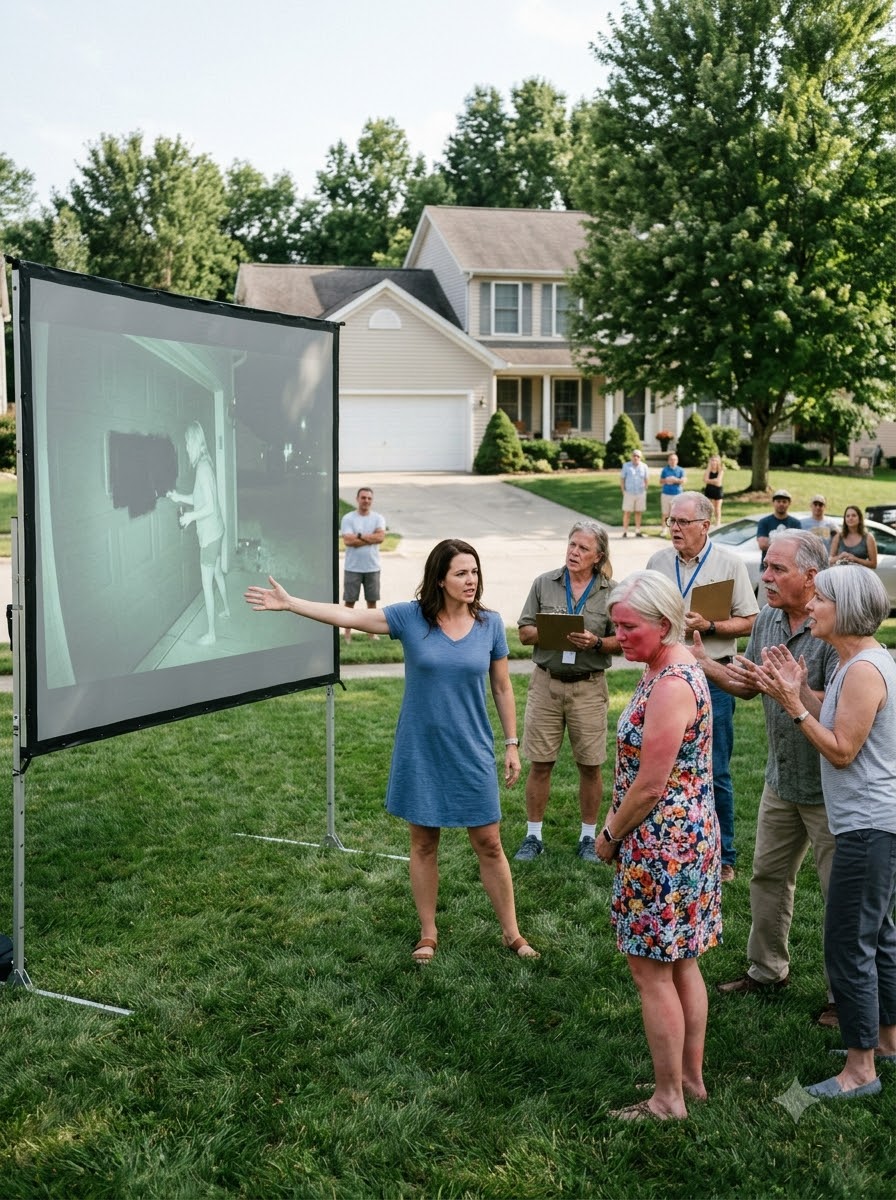
A projector rested on a folding table beside the sidewalk.
A long orange extension cord stretched back toward our garage.
A portable white screen stood in the middle of Kelsie’s immaculate front lawn.
Directly in front of her prized petunias.
Second-place petunias, technically.
Marcus leaned against a tree nearby, eating one of my turkey sandwiches.
When he saw me, he gave a little salute.
“What is going on?” Kelsie demanded.
Her voice had lost every trace of sweetness.
“I thought the judges deserved to see the full neighborhood collaboration,” I said.
Then I pressed play.
The first recording appeared.
FRIDAY, 1:47 A.M.
A tall, broad-shouldered figure entered our driveway wearing heavy work boots.
The person carried a roller and began covering our garage in black paint.
Their movements were slow and stiff.
Then headlights appeared.
The figure panicked and ran through my hydrangeas.
One boot became stuck in the mulch.
The person continued running with one boot and one sock, hopping awkwardly into the darkness.
Someone laughed.
I think it was one of the judges.
She quickly disguised it as a cough.
The second recording began.
SATURDAY, 3:12 A.M.
A smaller figure appeared wearing sneakers and a loose white shirt.
Their movements were nervous and hurried.
Black paint splattered everywhere.
Then the person struggled to remove the shirt.
For several seconds, it became stuck over their head.
Finally, they pulled it free, shoved it into my hedge, and ran away wearing a T-shirt.
Joyce made a faint noise.
It sounded like air escaping from a balloon.
Then the final recording appeared.
MONDAY, 2:30 A.M.
This footage came from the new security camera.
The picture was noticeably clearer.
There was Kelsie.
Rolling black paint across our garage in long, careful strokes.
Stepping backward to admire the damage.
Turning toward the camera.
Pulling down her hood.
Her short, carefully styled hair was visible.
So was the familiar quilted jacket.
And the distinctive way she stood with one hip slightly extended.
Exactly how she was standing in front of us.
I paused the recording.
Kelsie’s face filled the screen behind her.
Nobody spoke.
“For three nights,” I said, “these people worked very hard to make sure my house wouldn’t look its best today.”
Kelsie folded her arms.
“That proves absolutely nothing!” she said. “That could be anybody! It’s blurry! You can’t even—”
John interrupted.
“You said the cameras were fake!”
Everyone turned toward him.
He immediately looked horrified by what he’d said.
“You said,” he said to Kelsie, quieter, “Toby said the camera was fake. At the barbecue. You said it didn’t record.”
“John,” Kelsie hissed.
Joyce threw both hands into the air.
“Kelsie told us nobody would ever find out!” she said. “She said it was harmless! She said it was just to even the playing field! She said—”
“Will you two shut up?” Kelsie snapped.
But the damage was done.
Once they started talking, the accusations poured out.
John blamed Joyce.
Joyce insisted she’d only participated once.
She complained that the shirt had exposed her.
Then she blamed John for losing his boot.
John said Joyce had selected the black paint.
Joyce argued that black was the obvious choice.
John demanded to know why they hadn’t used red.
Joyce replied that red would have made the garage look like a crime scene.
John shouted, “It is a crime scene, Joyce!”
And through all their bickering, they kept repeating the same accusation.
The entire scheme had been Kelsie’s idea.
“She said you’d win again!” Joyce said, pointing at me. “She said if you won three years in a row, they’d probably make you a judge, and then none of us would ever have a chance!”
“That’s not true!” I said. “Nobody makes you a judge.”
“Well, she said it!”
The judges stood listening in disbelief as all three neighbors practically confessed.
One woman pressed her hand over her mouth.
The other was writing rapidly on her clipboard.
Marcus was filming everything with his phone.
I would have a conversation with him about that later.
Kelsie stood motionless on her lawn, her face blotchy red.
Behind her, the projector displayed the paused image of her own face.
Finally, Mr. Patterson raised one hand.
He didn’t speak immediately.
He simply held it up, like a principal silencing a noisy cafeteria.
All three neighbors stopped arguing.
“That’s enough,” he said.
Silence followed.
“Deliberately sabotaging another contestant is unacceptable,” he said. “In twenty-two years of this competition, I have never seen anything like it. All three of you are disqualified.”
Kelsie opened her mouth.
Mr. Patterson continued.
“Unless,” he added, very calmly, “you’d prefer we discuss this with the police.”
For once, Kelsie had nothing to say.
The judges continued their rounds.
They still had six houses to inspect.
Before leaving, Mr. Patterson shook my hand.
“Mrs. Harmon,” he said, “I want you to know that the damage to your garage door will not be counted against you. Under the circumstances.”
“Thank you.”
“Also,” he said, and for the first time, he smiled, “that was the most entertaining judging I’ve done in twenty-two years.”
Back at our house, Toby and I sat on the porch steps eating leftover sandwiches.
Down the street, John stood on a step stool trying to untie his boot from Marian’s iron rooster.
The knot was too tight.
Eventually, he cut the laces with a pocketknife and carried the boot inside without looking up.
Across the street, Joyce’s scarecrow had disappeared.
So had the shirt.
Kelsie’s curtains were closed.
“Well,” Toby said.
He took another bite.
“That happened.”
“That happened.”
“Mr. Patterson said ‘police.’”
“I know.”
“Are you going to call them?”
I considered the question for a long time.
A bee crawled through one of my roses.
“I don’t know,” I said.
“They’d deserve it.”
“I know they would.”
“But?”
“But I have to live next to them,” I said. “For a long time, probably. And I don’t want to be the woman who called the cops on a sixty-five-year-old widower over a garage door.”
“They didn’t think twice about being the people who painted it.”
“I know.” I sighed. “That’s sort of the point. I don’t want to be like them.”
Toby wrapped an arm around my shoulders.
“Okay,” he said. “Then what do you want?”
I looked toward our damaged garage.
Half black.
Half white.
Absolutely hideous.
“I want them to fix it,” I said.
That evening, I visited John first.
He answered the door wearing socks.
He looked older than he had that morning.
Somehow smaller.
“I’m not here to yell,” I said.
“You could,” he said. “I’d deserve it.”
“I know.”
He stood in the doorway for a moment.
Then he stepped aside and invited me in.
His living room looked exactly as it had when Marian was alive.
The same doilies.
The same family photographs on the mantel.
And on a bookshelf stood four wooden plaques.
BEST IN MAPLE GROVE.
Four consecutive years.
All bearing Marian’s name.
John noticed me looking.
“She’d be ashamed of me,” he said quietly. “She would have marched me over to your house by my ear.”
“Why did you do it, John?”
He lowered himself into his recliner and rubbed his painful knee.
“Kelsie came over in August,” he said. “She’d been crying. She said her ex-husband had gotten remarried and moved his new wife into their old house. The one she had the garden at. She said the yard was the only thing she had left that was hers. And she said you’d win again, and then again, and nobody would ever remember anyone else.”
He shook his head.
“And I thought about Marian’s plaques. And how nobody talks about her roses anymore. Everyone just talks about yours.”
I didn’t know how to respond.
“It sounded like a little thing,” he said. “A little paint. A little mischief. Like we were kids again.”
He looked toward the black-stained boot beside his door.
“Then I lost my boot in your flower bed and I lay awake all night thinking, What am I doing? I’m sixty-six years old.”
“Then why’d you keep going?”
“Because Joyce had already bought the shirt,” he said, and he almost laughed. “And Kelsie said if we stopped now, we’d just be the ones who did it once. Somehow that sounded worse.”
Joyce began crying the moment she opened her door.
“I’m so sorry,” she said. “I’m so sorry. I don’t know what happened to me. I’ve never done anything like that in my life. I got a parking ticket in 1994 and I paid it the same day.”
“Joyce.”
“I run the Facebook group! I’m supposed to be the one who catches people!”
“Joyce.”
She finally stopped and sniffled.
“You told me to call the police,” I said. “Standing in my driveway. You looked me right in the face.”
Her cheeks turned bright red.
“I panicked,” she said. “I thought if I acted angry enough, nobody would ever suspect me. I watch a lot of those murder shows.”
“This wasn’t a murder, Joyce.”
“I know! But the principle is the same!”
I didn’t stay long.
But I told her the same thing I’d told John.
Kelsie didn’t answer when I knocked.
I tried three times.
Her car was parked outside.
I could see the television flickering through the curtains.
Finally, I spoke through the closed door.
“Kelsie. I know you’re there. I’m not calling the police.”
Nothing.
“But you, John, and Joyce are going to repaint my garage door. Saturday morning. Eight a.m. All three of you. You can bring your own paint, or I’ll give you some. White. Not black.”
There was another long silence.
Then a quiet voice answered from inside.
“Fine.”
That was all.
I walked home.
Saturday morning, all three neighbors arrived.
John wore new boots and carried a toolbox.
Joyce arrived in an old sweatshirt and baseball cap, holding a paint scraper as though she was afraid of it.
Kelsie appeared last.
At 8:07.
She wore jeans and a plain gray T-shirt.
No green jacket.
Toby settled onto the porch with a lawn chair and a pitcher of lemonade.
He appointed himself supervisor.
And enjoyed the responsibility far too much.
“You missed a spot,” he called to John at one point.
“I haven’t started yet.”
“Just getting ahead of it.”
Removing oil-based enamel was miserable work.
Frank had warned me.
He’d been right.
They scraped.
They sanded.
They used paint thinner strong enough to make everyone’s eyes water.
Joyce spilled thinner onto her sneakers and eventually had to throw them away.
John stopped twice to rest his injured knee.
Kelsie barely spoke.
She simply worked.
Scraping.
Sanding.
Wiping.
She worked harder than the other two.
Around noon, I brought sandwiches outside.
I placed the plate at the edge of the driveway and returned indoors without saying anything.
When I checked later, the plate was empty.
By two o’clock, the garage door was white again.
Clean.
Smooth.
Almost as though nothing had happened.
John gathered his tools and went home.
He nodded before leaving.
Joyce gave me a small wave.
“I’ll bring you a casserole,” she said.
I assumed that was Joyce’s way of apologizing.
Kelsie remained behind, rinsing paintbrushes with our garden hose.
I walked over.
For a while, neither of us spoke.
We listened to the water.
“He got married again,” she said finally, without looking up. “Did John tell you?”
“He told me.”
“She’s twenty-nine. She posts pictures of my roses on Instagram. The ones I planted. She calls them ‘my garden.’”
“I’m sorry, Kelsie.”
“Don’t,” she said sharply.
Then her voice softened.
“Don’t be nice to me. I can’t take that right now.”
She turned off the hose.
“Every year,” she said, “I come in second. Every year, I smile and say there’s always next year. And this year I looked at my yard and I thought, there isn’t. There’s never a next year. There’s just you, winning, and me, smiling.”
She shook water from a brush.
“That’s not an excuse. I know it’s not an excuse. I’m just telling you why.”
“You could have told me,” I said. “Any time. You could have come over and said, ‘I’m having a terrible year.’ I’d have made you soup. You made me soup.”
She looked at me for a long moment.
“I know,” she said. “That’s the worst part.”
Then she handed me the clean brushes and walked back to her yard.
The competition results were announced the following weekend.
As usual, the block party filled the end of our street.
Folding tables.
Hot dogs.
A bounce house for children.
And the snow cone machine that never seemed to work properly.
Mr. Patterson climbed onto a milk crate with a squealing microphone.
By then, nearly everyone on Maple Street had heard what happened.
Joyce’s Facebook group had become unusually quiet.
But Marcus’s video had already circulated.
I’d made him remove it from his account, although approximately two hundred people had seen it.
Someone had even turned part of the argument into a meme.
Especially the moment John shouted, “It is a crime scene, Joyce!”
When I arrived, people kept approaching to pat my shoulder.
A woman I’d never met asked me to autograph her paper plate.
John attended.
He stood at the edge of the crowd with his hands in his pockets.
Joyce stood beside him wearing sunglasses, even though the sky was cloudy.
Kelsie didn’t come.
Mr. Patterson stepped onto the milk crate.
“This year,” he said, “has been a very unusual year for the Maple Grove beautification competition.”
The crowd laughed.
“But I’m pleased to say that, after careful consideration, our winner is the same as last year.”
He looked toward me.
“Mrs. Jennifer Harmon, for her roses, her hydrangeas, her remarkable hedges, and for one of the most memorable garage doors in the history of this competition.”
Everyone applauded.
Toby whistled loudly using two fingers, which he knew I hated.
I stepped forward and accepted the wooden plaque and the envelope containing my gift certificate.
I thanked the judges.
This time, I didn’t cry.
I’m not entirely sure why.
When I returned to our table, Toby hugged me.
“Two in a row,” he said. “You’re officially unstoppable.”
“I know,” I said.
Then I looked down the street.
Kelsie’s curtains were still closed.
The following week, I spent most of my thousand-dollar gift certificate at Greenleaf.
I bought mulch.
Fertilizer.
And a climbing rose I’d wanted for years.
I also bought a flat of petunias.
Deep purple ones.
The exact shade Kelsie had always complained she could never find.
I left them on her porch with a note.
There’s always next year. I mean it this time.
I didn’t sign my name.
I didn’t need to.
Two days later, I noticed the petunias planted along the front of Kelsie’s house.
Right where the projector screen had stood.
She never mentioned the flowers.
Neither did I.
But that Sunday, while I was trimming the hedge between our yards, Kelsie came outside to water her garden.
“Your roses look good,” she said.
“Your petunias look better,” I answered.
She almost smiled.
We weren’t friends again.
Not yet.
Perhaps we never would be.
But it was something.
And lately, I’ve found myself thinking about what really happened.
For three days, I believed the worst possible outcome was losing a gardening competition.
Each morning, I stared at the black paint and felt as though someone had reached inside my chest.
But the paint itself wasn’t what hurt most.
Paint can be removed.
Toby and I proved that repeatedly.
And John, Joyce, and Kelsie eventually proved it too.
The painful part was realizing that people I’d trusted were capable of smiling at me while secretly destroying something I loved.
It was remembering Kelsie handing me cold water while pretending to be horrified.
It was remembering Joyce demanding that I call the police.
It was realizing that I’d thanked the very people responsible for my misery.
I don’t know whether I’ll ever see my neighbors quite the same way again.
I still wave to John in the mornings.
Joyce eventually brought the casserole she promised.
It was terrible.
I ate it anyway.
Kelsie and I sometimes talk about flowers over the hedge.
But now I understand that the people who smile at you across a fence are still human.
They have difficult years.
They become jealous.
They make foolish decisions.
Sometimes they put on borrowed hoodies and sneak around at two-thirty in the morning.
And sometimes, when given the opportunity, they arrive at eight on a Saturday with paint scrapers and spend hours repairing what they’ve broken.
Our garage door is still white.
Almost.
Near the bottom corner, where the door meets the driveway, there’s a tiny black streak Joyce missed.
It’s approximately the size of my thumb.
Toby has offered twice to paint over it.
Both times, I’ve told him to leave it.
Every morning, when I carry the trash outside, I notice that little mark.
It reminds me of John’s boot swinging from Marian’s rooster.
Of Joyce’s shirt hanging from a scarecrow.
Of Kelsie standing on her lawn with her own face projected behind her.
And it reminds me that I could have called the police.
But I chose not to.
Yes, I won the competition.
I brought home another plaque.
And I received another thousand-dollar gift certificate.
But when I think about everything that happened, those aren’t the things that make me proudest.
I’m proud that I made them face what they’d done.
I’m proud that they repaired the damage themselves.
And I’m proud that I didn’t allow their jealousy to turn me into someone I didn’t want to become.
The garage door is white again.
The little black streak remains.
And I intend to leave it exactly where it is.
