

PART 1 — Twelve Yellow Roses
The lock made a faint clicking sound.
It was barely noticeable in the silence of Mr. Feldman’s law office that gray Tuesday afternoon in March.
Yet my brother reacted as though the sound had struck him.
“Don’t,” Glenn pleaded, his voice breaking. “Please. Don’t open that.”
Ethan paid him no attention.
He sat opposite the attorney in a leather chair, wearing a borrowed navy jacket that hung loosely from his thin shoulders. His battered green backpack rested between his shoes, while an old wooden box sat across his knees.
He raised the lid.
Then he reached inside.
But to understand what happened in that office, I have to go back to my mother, a broken grocery bag, and an encounter outside a pharmacy.
My name is Susan Albright. I’m fifty-two, a middle school librarian in Lancaster, Pennsylvania. My husband, Tom, and I have been married twenty-six years. Our daughter, Claire, is twenty-three and teaches third grade in Philadelphia.
My mother, Iris Kemper, was born in 1945 near Strasburg. She married my father, Edwin, at nineteen, raised my brother and me in a brick rowhouse on Chestnut Street, and spent thirty-one years teaching home economics at McCaskey High School.
She could sew a wedding dress in two weeks, make perfect pie crust without looking at a recipe, and persuade a troublesome teenager to apologize with nothing more than a glance.
Dad died fourteen years earlier, suffering a heart attack among his beloved tomato plants.
Mom never remarried. She stayed in their house, surrounded by memories.
Then, at eighty, she invited a homeless young man to dinner.
His name was Ethan.
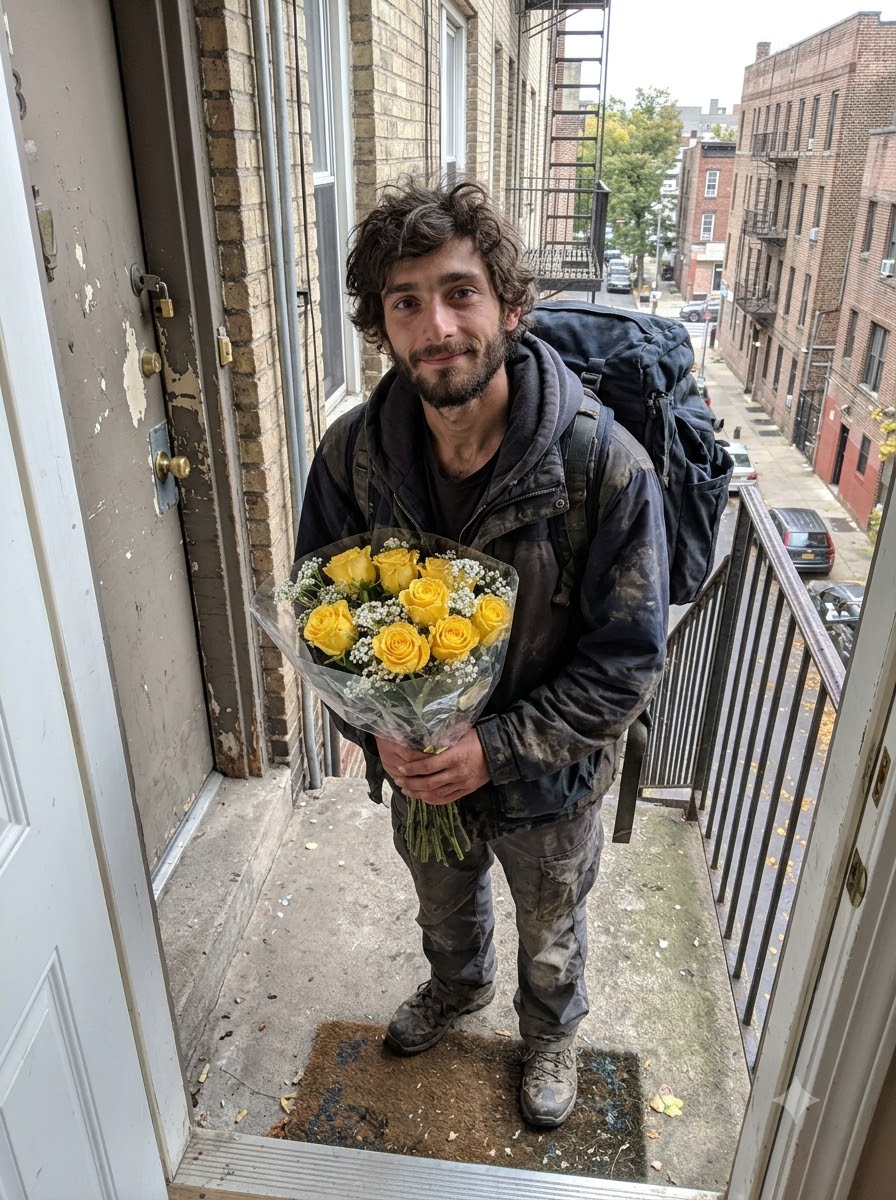
He was twenty-four, thin, dark-haired, and living behind an abandoned bookstore called Chapter Two on Queen Street. The shop had closed during the pandemic, leaving a sheltered doorway where he’d slept for nearly a year.
Everything he owned fit inside a faded green canvas backpack, patched with duct tape.
They met in October, outside the CVS on Duke Street.
Mom had walked six blocks to buy milk, eggs, bread, blood pressure medication, Earl Grey tea, and Folgers coffee for my visits.
As she crossed the parking lot, one grocery bag split.
Eggs shattered. Milk rolled beneath a parked car. Tea bags scattered across wet asphalt, and her medicine bottle landed in a puddle.
Four people walked past.
A businessman talking on his phone, a mother pushing a stroller, and two teenagers.
None stopped.
Then Ethan approached.
Without a word, he knelt on the wet pavement and collected her groceries. He retrieved the milk, gathered every tea bag, and wiped her medication bottle against his hoodie.
He examined the broken eggs.
“I’m sorry,” he said. “These are done for.”
“Oh, that’s all right,” Mom replied.
He glanced at her ruined bag.
“Where do you live, ma’am?”
“Chestnut Street. Just up the way.”
Ethan emptied enough space in his backpack to carry her groceries.
“I’ll walk you home,” he offered.
He accompanied her through the rain, carried everything into her kitchen, accepted a cup of tea, washed his own cup, and left.
That evening, Mom called me.
“Susan, he was the nicest young man.”
“Mom. You let a stranger walk you home?”
“He carried my groceries. Six blocks. In the rain.”
“Did you let him in the house?”
“Of course I let him in the house. He was soaking wet. I made him tea.”
“Mom.”
She continued enthusiastically, explaining that he was twenty-four, polite, and called her ma’am.
I warned her he might have robbed her.
“He could have,” Mom said. “He didn’t. He drank his tea and washed his own cup and thanked me and left.”
Then she paused.
“He’s homeless, Susan.”
She explained where he slept, adding that he’d described his circumstances without embarrassment.
After that, Ethan began visiting every Thursday at two.
They shopped together. He pushed the cart, carried the bags, and helped around the house.
He repaired the bottom two porch steps, which had been rotting for three years.
I’d intended to hire someone. Tom had planned to inspect them. My brother Glenn, who owned a construction company in Lititz, had promised to fix them for two summers.
Ethan simply did the work.
He found lumber in Dad’s garage and used the tools still hanging exactly where my father had left them.
Three Thursdays later, both steps were repaired, sanded, and painted white.
Mom sat on the bottom step and cried.
“Edwin used to say he’d fix these,” she told him. “He said it every spring for ten years.”
But the repairs weren’t what she valued most.
Ethan listened.
Every Thursday, they sat at the kitchen table while Mom remembered Dad: their first meeting at a church picnic in 1963, his proposal in a canoe on the Conestoga River, his tomatoes, and the time he drove through a snowstorm to comfort me at college.
Ethan remembered every detail.
“He’s a good listener, Susan,” Mom said. “Do you know how rare that is? At my age? Everybody’s in a hurry. Everybody’s looking at their phones. He just sits there and listens. Like it matters.”
I finally met him in December.
I deliberately arrived without warning.
I’d read too many stories about lonely elderly people being exploited. I wanted to know what this stranger expected from my mother.
Ethan was washing dishes when I entered.
His gray hoodie had a hole at the elbow. He looked younger than twenty-four, painfully thin, with tired brown eyes and a narrow scar cutting through his left eyebrow.
Something about his face seemed familiar.
I couldn’t identify it.
“You must be Susan,” he said, offering his hand. “Ethan. Your mom talks about you all the time.”
He mentioned how I’d supposedly read every children’s book in the Lancaster County Library before fifteen.
Mom laughed and corrected him.
I remained suspicious.
“What do you want from my mother?” I demanded.
The room fell silent.
“Nothing,” Ethan answered. “I don’t want anything from her.”
“Then why are you here every Thursday?”
He glanced toward Mom.
“Because she asked me to come back,” he said. “And nobody’s asked me to come back to anything in a long time.”
His answer unsettled me, but it didn’t eliminate my doubts.
For months, I watched him.
I examined Mom’s bank statements, contacted her bank, and repeatedly asked whether he’d requested money.
He hadn’t.
She’d offered twenty dollars for the porch repairs. He refused.
She’d given him Dad’s wool peacoat during the winter, but he’d insisted it was a loan.
In April, he returned it dry-cleaned.
Then came Mom’s eightieth birthday, March nineteenth.
Our family gathered at her house: Tom, Claire, Glenn, his wife Patricia, and their two sons.
Mom wanted Ethan invited.
Glenn objected.
“A homeless guy, Mom? At your birthday party?”
“He’s my friend, Glenn.”
“He’s a stranger. You met him in a parking lot.”
“I met your father at a church picnic,” Mom replied. “That’s not much better.”
Ethan declined the invitation, saying the celebration belonged to family.
But at four that afternoon, while we were eating cake, someone rang the doorbell.
Ethan stood on the porch he’d repaired.
His hoodie was clean, his hair neatly combed, and his face freshly shaved.
In his hands was a bouquet of twelve yellow roses, wrapped in cellophane and tied with a white ribbon.
The grocery-store price tag remained attached.
$11.99.
“I’m sorry to interrupt,” he said. “I just wanted to give her these. I won’t stay.”
Mom appeared behind me.
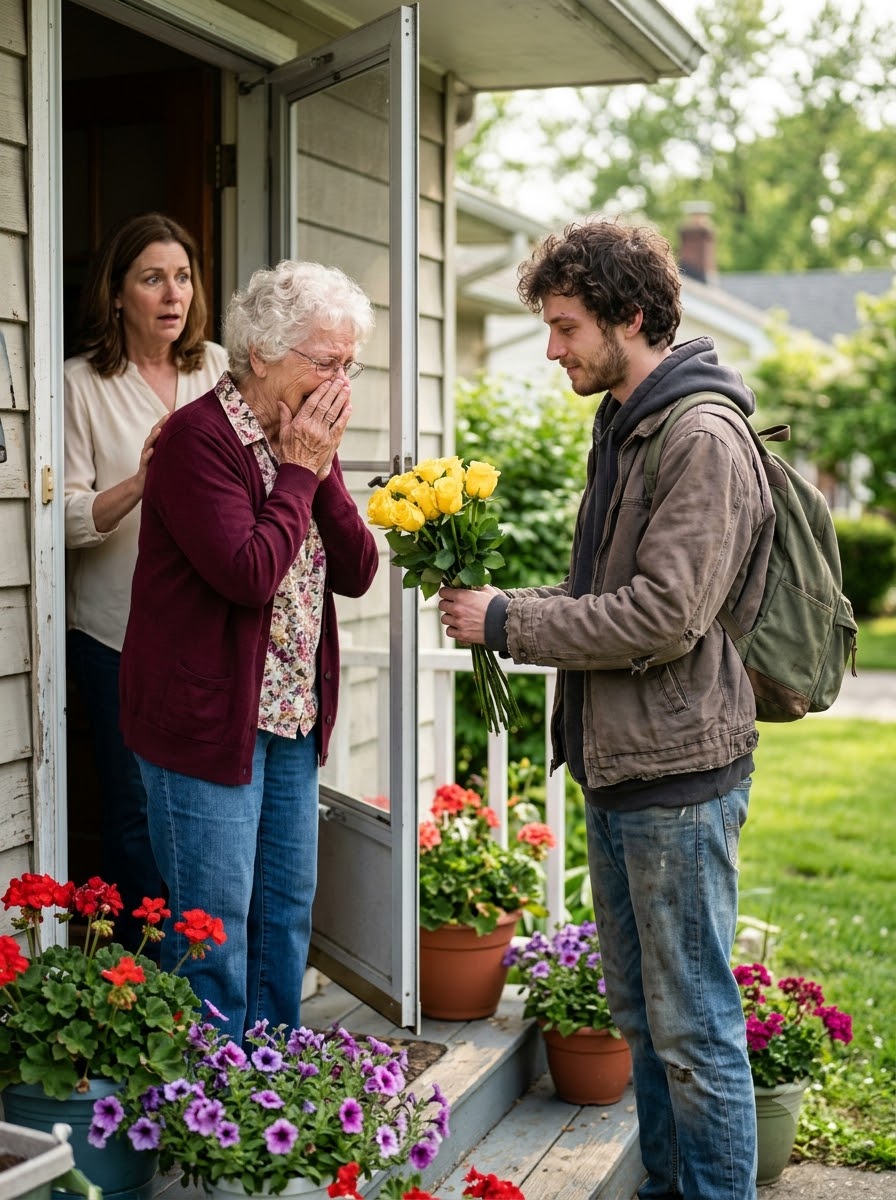
When she saw the flowers, she covered her mouth.
“Yellow,” she whispered. “Edwin always got me yellow.”
“I know,” Ethan replied. “You told me. In November. You said he got you yellow roses every birthday for forty-six years. You said nobody’s gotten you flowers since he died.”
He offered her the bouquet.
“Happy birthday, Mrs. Kemper.”
Mom burst into tears.
She held the roses against her chest, then embraced him. At first, Ethan stood rigidly, uncertain what to do. Slowly, he returned her hug.
She insisted he come inside for cake.
He reluctantly accepted, sitting quietly at the end of the table while Glenn watched him with obvious hostility.
Two weeks later, I discovered what those flowers had cost him.
I was driving along Queen Street when I spotted Ethan sitting on cardboard behind the shuttered bookstore, counting coins.
I stopped.
“Ethan,” I asked. “Those roses. On her birthday. How much money did you have?”
He avoided my eyes.
“Twelve dollars,” he admitted. “And forty cents.”
It was all he had left from a car-wash job he’d lost in February.
“Why would you do that?” I asked.
I genuinely couldn’t understand why someone without shelter or savings would spend everything on flowers for a woman who already had a house, a pension, and a family.
Ethan shrugged.
“She deserved flowers on her birthday.”
I drove home and sat in my driveway, ashamed.
For six months, I’d waited for Ethan to take something from Mom.
Instead, he’d given her everything he had.
When I told Tom, he considered it quietly.
“Maybe,” he finally said, “he’s exactly who he looks like.”
Over the following months, Ethan became increasingly important to Mom.
She anticipated Thursdays like holidays.
She knitted him a navy scarf. She taught him to bake pie crust, laughing when he repeatedly failed. When she discovered he’d left high school at seventeen, she began tutoring him for his GED.
He passed in August.
Mom framed his certificate and hung it beside our family’s diplomas.
“Mom,” I protested. “That’s his. Not ours.”
“I know,” she answered. “He doesn’t have a wall.”
Then, one September Sunday, after church, Mom made an announcement that nearly caused me to spill my coffee.
“Susan,” she said. “I need to tell you something.”
“I asked Ethan to marry me.”
I stared at her.
“Mom! He’s fifty-six years younger!”
She smiled sadly.
“I know.”
She explained that she wanted him to have a home, someone to care for him, and financial security after her death.
He’d refused her offers of a bedroom because he wouldn’t accept charity.
Marriage, she reasoned, could provide the house, pension benefits, health insurance, and other financial support.
I could barely believe what I was hearing.
“What did he say?”
At first, she explained, Ethan laughed.
Then he realized she was serious.
“And he got very quiet,” Mom recalled. “And he looked at me for a long time. And he said no.”
“Thank God.”
Mom continued.
“He said, Mrs. Kemper, I wouldn’t marry you for a roof over my head. Not you. Not anybody.”
Then she hesitated.
“And then he said something I didn’t understand.”
“What?”
“He said, Especially not you.”
At the time, I assumed Ethan meant her age.
I couldn’t have been more mistaken.
After that conversation, Mom treated him with unusual tenderness.
She began calling him sweetheart, a name she’d previously reserved for Claire.
Three months later, on Thursday, December fourteenth, Mom died peacefully in her sleep.
Ethan found her.
He arrived at two, knocked, and used the key she’d given him when nobody answered.
She was lying beneath the wedding-ring quilt she’d sewn in 1964, reading glasses on her face and Little Women resting open on her chest.
She’d read that novel every December since childhood.
Ethan called me at 2:11.
“Susan,” he whispered. “I’m so sorry. I’m so sorry. She’s gone.”
He’d already contacted emergency services, her physician, and Father Michael.
When I arrived, he was sitting beside her bed, holding her hand and crying.
He’d removed her glasses, closed the book, and placed a dried yellow rose between her folded hands.
It was one of the twelve she’d received for her birthday.
She’d preserved them all.
When he saw me, Ethan stood.
“I’ll go,” he said. “You should be with her.”
“Ethan—”
“It’s okay,” he replied. “She was your mom.”
He collected his backpack and left.
I didn’t stop him.
I wish I had.
While preparing Mom’s funeral, I found an envelope addressed to me in her desk.
Inside was a handwritten note:
Susan,
When Mr. Feldman reads my will, please make sure Ethan is there.
He won’t want to come. Make him.
Tell him I said so. Use my teacher voice. You know the one.
Love,
Mom
P.S. Don’t let Glenn talk you out of it.
I read those words repeatedly.
Why would Glenn object?
I assumed she’d left Ethan a little money, perhaps Dad’s tools or his old coat.
Finding Ethan took three days.
The bookstore alcove had been boarded up. The shelter hadn’t seen him. A soup-kitchen volunteer said he’d recently appeared for lunch, looking miserable.
Finally, I found him at the public library.
He sat alone in the reference section, wearing Mom’s navy scarf.
He was reading Little Women.
He told me he’d been sleeping beneath the King Street bridge.
When I mentioned Mom’s will, he refused to attend.
“That’s for family.”
“She asked for you,” I insisted.
I showed him her note.
He read it, covered his mouth, and almost laughed through his grief.
“Use my teacher voice,” he whispered.
Eventually, he agreed.
“Do I have to wear a tie?” he asked.
On Tuesday, Ethan arrived at Mr. Feldman’s office in a borrowed navy jacket, wearing Mom’s scarf and carrying his green backpack.
Glenn was furious.
“Why is he here?”
“Because Mom wanted him here,” I answered.
“This is a family matter,” Glenn snapped. “He’s not family.”
Ethan flinched.
Then Mr. Feldman intervened.
“Mr. Kemper,” he said, “Your mother was very specific. She asked that Mr. Lowell be present.”
I looked up.
Lowell?
I’d never heard Ethan’s surname.
But Glenn’s reaction was immediate.
His face drained of color.
“What did you say?”
“Mr. Lowell,” the lawyer repeated. “Ethan Lowell. Your mother asked that he be here.”
My brother slowly lowered himself into his chair.
His hands trembled against the table.
And suddenly, I realized he knew something about Ethan that the rest of us didn’t.
PART 2 — The Secret Inside My Father’s Box
Mr. Feldman began reading Mom’s will.
Her savings would be divided between Glenn and me. Claire would receive the Buick, sewing machine, and fabric collection. Mom’s jewelry belonged to me. Dad’s watch and fishing rods were left to Glenn’s sons.
She’d also made modest donations to St. Anthony’s, the Lancaster Public Library, and the soup kitchen.
Everything seemed ordinary.
Except Glenn.
He sat motionless, staring at the table.
Then Mr. Feldman removed his glasses.
“The house,” he announced.
He explained that Mom had revised her will on October third.
Previously, the Chestnut Street property was to be sold, with the proceeds divided between her children.
Now, the house and its remaining contents belonged to Ethan Lowell.
Mr. Feldman read her exact words:
“I leave my home at 418 Chestnut Street, Lancaster, Pennsylvania, together with all furnishings and contents not otherwise bequeathed, including my husband Edwin’s tools, to Ethan Lowell. So he will always have somewhere to come home to.”
Patricia gasped.
I looked toward Ethan.
He seemed stunned, staring at his folded hands.
But Glenn said nothing.
The lawyer continued.
“There’s one final instruction,” he explained. “Concerning Ethan.”
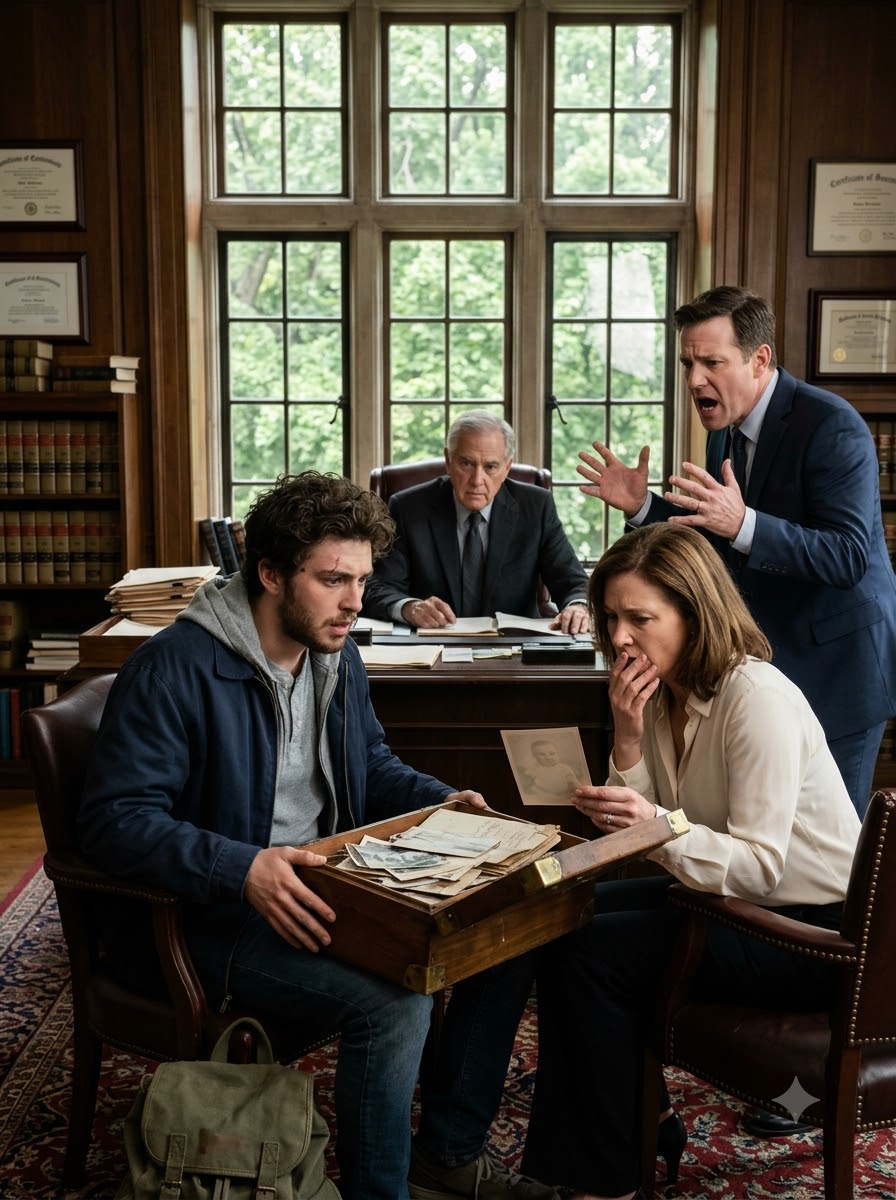
He reached beneath his desk and lifted out a small walnut-colored wooden box with brass corners and a tiny lock.
I recognized it immediately.
Dad’s important-things box.
It had spent my childhood on the highest shelf of his closet, hidden behind his hats.
We’d never been allowed to touch it.
Glenn abruptly jumped to his feet.
“Wait,” he demanded. “What box?”
He recognized it too.
“That’s Dad’s box. Where did you get that? Mom said—Mom told me she got rid of it—”
Mr. Feldman explained that Mom had entrusted it to him when she changed her will.
Then he gave Ethan a small brass key attached to a faded red ribbon.
Ethan’s fingers trembled.
Glenn began moving toward him.
“Don’t open that!”
His chair overturned.
Tom caught his arm before he reached the table.
Glenn struggled, shouting that Ethan had no right to Dad’s belongings.
I reminded him Mom had specifically left them to Ethan.
But my brother looked terrified.
“You don’t understand,” he pleaded. “Susan, you don’t understand. Please. Don’t let him open it.”
Ethan inserted the key.
The lock clicked.
Glenn stopped struggling.
The lid opened.
Inside lay a faded photograph.
Ethan lifted it carefully, studied it, and placed it on the table.
I leaned closer.
It showed my father, Edwin Kemper, sitting on a bench at Long’s Park, wearing his old green cardigan.
He held a tiny baby wrapped in a blue blanket.
Dad was gazing at the child with unmistakable tenderness.
On the back, in his handwriting, were the words:
E.J. — 3 weeks — Long’s Park — April 2002.
“Who is that?” I whispered.
Ethan reached for a bundle of yellowed envelopes.
The first had been mailed from T. Lowell at an apartment on Rockland Street.
It was addressed to Dad in March 2002.
Ethan unfolded the letter, read it, and covered his face.
I picked it up.
It was from a young woman named Tammy.
She thanked Dad for visiting her at the hospital and explained that Glenn hadn’t contacted her since learning she was pregnant.
He’d sent two thousand dollars with a message:
“Take care of it.”
Tammy had given birth to a boy named Ethan James, weighing seven pounds four ounces.
She described his dark hair and Glenn’s chin.
She thanked Dad for diapers, formula, and a blanket.
She promised not to trouble Glenn, knowing he was getting married in June.
But she welcomed Dad’s offer to visit the baby.
Her own father had died the previous year.
The letter ended with gratitude for his kindness.
I lowered the page.
Patricia was staring at Glenn.
“Glenn,” she asked quietly. “Who is Tammy?”
He struggled to answer.
Finally, he admitted Tammy had been a nineteen-year-old waitress at Rocky Springs diner in 2001.
He was twenty-five, engaged to Patricia, and she’d been away in Pittsburgh for an internship.
Tammy became pregnant.
Glenn gave her money and told her to handle it.
“I didn’t know she kept it,” he whispered.
Ethan raised his head.
“Her,” he corrected.
Glenn stared.
“Not it. Her. My mother. Tammy. She kept me.”
Suddenly, everything became clear.
Ethan’s dark hair. His deep brown eyes. The stubborn square chin with its slight indentation.
Glenn had the same chin.
So had Dad.
That was what I’d recognized in Mom’s kitchen.
My brother had a son.
And my father had known.
Ethan took more photographs from the box.
Dad holding a toddler at Dutch Wonderland in 2004.
Dad with a little boy wearing a Phillies cap at a Lancaster Barnstormers game in 2007.
Dad standing beside an eight-year-old and a tomato plant behind an apartment building in 2010.
The caption read:
E.J. — first tomatoes!
Ethan explained that Grandpa Edwin had visited every month.
He took him to parks, baseball games, and libraries. He delivered groceries and helped Tammy pay rent.
He even taught Ethan to grow Better Boy tomatoes in a tiny patch of soil near the dumpsters behind their apartment.
Dad had told Ethan he was his grandfather when the boy was six.
But he’d never revealed who his father was.
He’d insisted that one day Ethan’s father would come when he was ready.
Glenn sank onto the floor beside his overturned chair, sobbing.
I gently asked what had happened after Dad died.
Ethan was ten.
When Grandpa Edwin stopped visiting, Tammy eventually learned he’d passed away.
The groceries and rent assistance stopped too.
She worked nights at Sheetz, but her wages weren’t enough.
They were evicted when Ethan was eleven.
Tammy began drinking and taking pills. She tried rehabilitation twice.
Ethan entered foster care at thirteen, returned home, and eventually went back into care.
His mother died from an overdose in a motel on Lincoln Highway when he was seventeen.
He left school, aged out of foster care at eighteen, and had survived alone ever since.
I could barely breathe.
Ethan reached into the box again.
This time, he found a newer white envelope.
His name was written on the front in Mom’s handwriting.
His hands shook too badly to open it.
I offered to help.
He nodded.
Inside was a letter from my mother.
She explained that she’d discovered Dad’s box after his death and spent six hours sitting on their closet floor, reading the letters and examining photographs.
She’d learned that her husband had secretly supported their grandson for ten years.
She’d been furious with Edwin, Glenn, and herself.
She’d tried to locate Ethan, visiting the Rockland Street apartment, calling disconnected numbers, and even hiring someone to search.
But she’d failed.
She returned the box to the shelf and told Glenn she’d discarded it.
Then, fourteen years later, she dropped her groceries outside CVS.
I couldn’t continue reading.
Tom took the letter.
Mom described how Ethan had gathered her belongings and walked her home.
She hadn’t recognized him.
Not until he repaired the porch.
He’d gone directly to Dad’s pegboard and selected the correct tools without asking where anything was.
Then he’d repeated something Edwin always said:
“He always kept the level on the left. He said it was the most important tool, so it gets the first hook.”
Dad’s familiar saying was:
“The level gets the first hook.”
That evening, Mom examined the photographs.
She noticed the scar above the little boy’s left eyebrow.
Dad had recorded that Ethan received two stitches after falling at Dutch Wonderland.
The young man repairing her porch had the identical scar.
Ethan touched his eyebrow.
“Two stitches,” he whispered. “He held my hand the whole time.”
Tom continued reading.
Mom had watched Ethan carefully for weeks.
Then she’d proposed marriage.
She hadn’t lost her mind.
She wanted to know whether Ethan would accept marriage to an eighty-year-old widow in exchange for a home and financial security.
He refused.
And when he said, “Especially not you,” she understood that he already knew who she was.
She confronted him at her kitchen table.
“Ethan. Who are you?”
He told her everything.
About Grandpa Edwin, the ballgames, the tomatoes, Tammy, and the motel.
He explained that he’d found Mom’s address in one of his mother’s old letters.
For weeks, he’d walked past her home and watched her from a bench across the street.
He’d wanted to see where his grandfather had lived and meet the woman Edwin loved.
But he’d been afraid she’d think he wanted money.
On the day they met, he’d followed her to CVS, hoping to find the courage to introduce himself.
Then her grocery bag broke.
He finally had a reason to approach.
Tom stopped reading, overwhelmed.
I took the final page.
Mom confessed that she’d made Ethan promise not to tell Glenn or me.
She regretted protecting Glenn, just as Edwin had protected him.
Their silence had allowed Ethan to suffer.
She explained that the house belonged to Ethan because he was Edwin’s grandson and hers.
She apologized for having only fourteen months to be his grandmother.
Then she addressed Glenn.
She reminded him that he had a twenty-four-year-old son with his chin, Edwin’s hands, and extraordinary kindness.
A son who’d spent his final twelve dollars buying her yellow roses.
A son who’d slept behind a bookstore while Glenn built houses in Lititz.
She didn’t know whether he could repair the damage.
But Edwin had preserved that box, waiting for him to become ready.
Her final instruction was unmistakable:
“Be ready, Glenn.”
And for Ethan, she added one last request.
Plant Better Boy tomatoes in spring.
Edwin would want them growing again.
I folded the letter and placed it before Ethan.
Glenn slowly stood.
He faced his son across the table.
“I didn’t know,” he whispered. “I swear to God. I didn’t know she kept you. I gave her the money. I told her to take care of it. And I never asked. I never called. I never—”
His voice failed.
He spoke about marrying Patricia, raising their sons, and building his company.
Then he asked whether Dad had known all along.
Ethan nodded.
“He said it was your job,” Ethan replied. “He said you’d come when you were ready.”
Glenn covered his mouth.
“And then he died,” Ethan continued. “And you never came.”
Then Glenn confessed something even worse.
He’d found the box after Dad’s funeral.
He’d opened it, read the first letter, and seen the baby’s photograph.
He knew.
Ethan was ten.
Glenn had seen the Rockland Street address and could have driven there in fifteen minutes.
Instead, terrified of losing Patricia, his children, his reputation, and his company, he’d returned the box to the closet.
He’d even told Mom to throw it away, claiming it contained old tax documents.
Patricia silently walked out.
The elevator sounded down the hallway.
Glenn remained beside the table, crying.
He apologized to Ethan, acknowledging that twenty-four years of abandonment couldn’t be repaired by words.
Ethan listened without speaking.
Then he opened his backpack.
From a paper towel, he carefully unwrapped a dried yellow rose.
It was the last flower from Mom’s birthday bouquet, the one he’d placed in her hands when she died.
He offered it to me.
“She’d want you to have this,” he said. “You’re her daughter.”
I accepted it, trembling.
“Ethan,” I whispered. “You’re her grandson.”
He looked down.
“I know. I know that now. But I only got fourteen months.”
Then he faced Glenn.
“I didn’t come here for the house,” he said. “I didn’t know about the house. I didn’t know about the box. I came because Susan said Grandma used her teacher voice.”
He paused.
“I don’t want anything from you. I never did. I just wanted to know who my father was.”
He lifted his backpack.
“Now I know.”
Then he walked out.
He left behind the house keys, the photographs, the letters, and Dad’s wooden box.
Nobody followed.
Glenn eventually picked up the photograph of Edwin holding three-week-old Ethan.
After staring at it, he asked me one question.
“Where does he sleep? Now. Tonight. Where will he sleep?”
“Under the King Street bridge,” I answered.
My brother closed his eyes.
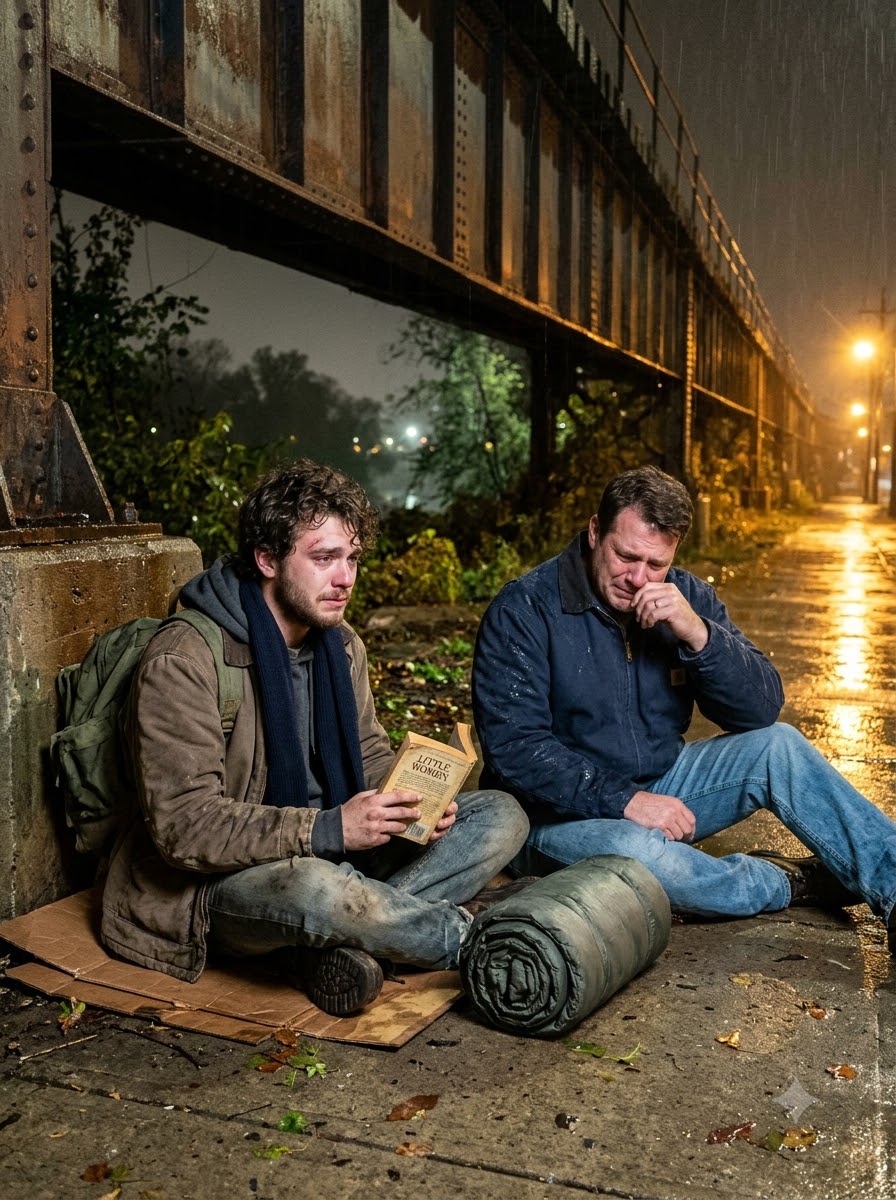
That night, at ten o’clock, he drove to the bridge in the rain, carrying a sleeping bag from his garage.
He found Ethan sitting on cardboard, wearing Mom’s scarf and reading Little Women beneath a streetlamp.
Glenn stood silently in the rain for ten minutes.
Then he sat beside his son on the wet concrete and placed the sleeping bag between them.
They remained there until three in the morning.
Neither spoke much.
Eventually, Ethan closed his book.
“Beth dies,” he said.
“I know,” Glenn answered. “Mom read it to us every December. Susan cried every year.”
“Grandma cried too,” Ethan replied. “She couldn’t finish it. When she read it to me.”
After a silence, Ethan added:
“I finished it for her. At the library. After she died.”
He looked at Glenn.
“I wanted to know how it ends.”
And for the first time in twenty-four years, father and son sat together without either one walking away.
PART 3 — The House Where He Finally Belonged
Ethan refused to move into the Chestnut Street house.
For three weeks, he continued sleeping beneath the bridge.
He insisted the property wasn’t truly his and that he hadn’t done anything to deserve it.
Every day, I visited with food, coffee, and Mom’s letter.
I tried reasoning with him.
Eventually, I remembered her instructions.
Use my teacher voice.
On the twenty-first day, standing beneath the bridge in the snow, I reminded Ethan that Mom had legally left him the house.
She’d changed her will, written him a letter, and asked him to grow tomatoes.
He remained silent.
So I told him it was January.
If he wanted ripe Better Boys by August, he’d need to start the seeds indoors in March, in the same kitchen window where Dad had started them for forty years.
Ethan looked up.
“You need a kitchen window,” I told him.
He studied my face.
Then he gathered his backpack.
On January sixth, Ethan finally moved into the house on Chestnut Street.
I placed the keys in his palm.
He stood on the porch steps he’d repaired, staring at the front door.
He couldn’t bring himself to unlock it.
“What’s wrong?” I asked.
He looked at the keys.
“I’ve never had a key to anything,” he said. “Not a house. Not an apartment. Not a car. Nothing. My whole life.”
He swallowed.
“I don’t know how to be somebody who has keys.”
I rested my hand on his shoulder.
“You learn,” I told him. “One day at a time.”
He opened the door.
Then he walked directly to the garage.
Dad’s tools still hung on the pegboard, their outlines marked in black.
The level remained on the first hook.
Ethan touched it gently.
“The level gets the first hook,” he whispered.
That was fourteen months ago.
Today, Ethan is twenty-six and still lives in Mom’s house.
He works as an apprentice carpenter for Kemper Construction.
Glenn first offered him the job in February.
Ethan refused three times.
Finally, Glenn explained that the offer wasn’t charity or an attempt to purchase forgiveness.
He wanted Ethan because he’d repaired Mom’s porch steps using Edwin’s old tools, and those steps were still perfectly level two years later.
Some of Glenn’s experienced employees couldn’t manage that.
Ethan accepted.
He earns twenty-two dollars an hour and has become an excellent carpenter.
His foreman says he measures everything twice.
Ethan says Grandpa taught him that.
Glenn and Patricia separated in April.
They’re attending counseling and trying to rebuild their marriage.
Patricia told me at Easter that she could understand a mistake made when someone was young.
What she couldn’t accept was Glenn’s decision to ignore his ten-year-old son after discovering the truth.
For fourteen years, he’d known Ethan existed.
And he’d done nothing.
She told me it wasn’t the original mistake that hurt most.
It was the silence.
Glenn now visits the Chestnut Street house every Thursday at two o’clock.
Ethan suggested the arrangement.
“Grandma always said Thursdays,” he explained. “So. Thursdays.”
They usually work together in the garage.
They’ve built a bookshelf, a bird feeder, and a railing for the back porch.
They don’t talk much.
Ethan still doesn’t fully trust Glenn, and Glenn understands why.
My brother told me Ethan calls him Glenn, never Dad.
“He calls me Glenn,” he said. “That’s okay. I haven’t earned Dad.”
I asked whether he thought he ever would.
After a long silence, he answered:
“I don’t know. But I’m going to show up every Thursday. Until I do. Or until I die trying.”
In March, Ethan planted tomato seeds in little peat pots on the kitchen windowsill.
Exactly where Dad had started his seedlings each spring.
In May, he transferred twelve Better Boy plants into the garden behind the house.
Glenn helped him.
It was the first time tomatoes had grown there since Dad’s death.
The first ripe tomato appeared in August.
Ethan picked it on a Thursday afternoon and carried it into the kitchen with both hands.
Glenn and I were sitting at the table.
The tomato was bright red, perfectly ripe, and warm from the sun.
Ethan sliced it using Mom’s old paring knife, added a little salt, and divided it between three plates.
We ate the slices standing at the counter.
Nobody spoke.
Then Glenn set down his plate and went to his truck.
He returned carrying a framed photograph.
It showed Dad standing beside an eight-year-old Ethan and a tomato plant behind the Rockland Street apartment building.
The handwritten caption said:
E.J. — first tomatoes!
Glenn had taken the photograph from the wooden box and had it framed.
He hung it on the kitchen wall, beside the window where the seedlings had started.
Ethan stared at it.
“He’d be glad,” he finally said. “That they’re back in his garden.”
Glenn looked at him.
“He’d be glad you’re back in his garden.”
Ethan didn’t answer.
Instead, he picked up the final slice of tomato and offered it to his father.
It was a small gesture.
But I knew what it meant.
On March nineteenth, Mom’s birthday, I visited Holy Cross Cemetery, where she rests beside Dad.
I brought twelve yellow roses from the grocery store, still wrapped in cellophane with the price tag attached.
When I reached their grave, I discovered another dozen yellow roses already there.
Glenn stood beside the headstone in his work jacket.
Ethan was kneeling, carefully arranging the flowers.
They looked up as I approached.
“We had the same idea,” Ethan said.
“Great minds,” Glenn replied.
I knelt beside them and placed my bouquet next to theirs.
Twenty-four yellow roses rested before my parents’ headstone.
We stayed for an hour.
Ethan brought Little Women and read the final chapter aloud.
The same chapter Mom had been unable to finish because she cried too hard.
When he reached the ending, he closed the book.
“She would’ve cried,” he said.
“She would’ve,” I agreed.
Glenn smiled sadly.
“Grandpa would’ve told her it was just a story,” he said. “And then he would’ve cried too.”
Ethan laughed through his tears.
It was the first time I’d heard him laugh at something his father said.
As we walked back toward our cars, Ethan stopped.
He turned and looked at the twenty-four roses.
“Susan,” he asked. “Can I ask you something?”
“Of course.”
“Do you think she knew? When she proposed? Do you think she already knew who I was?”
I remembered that September afternoon at Mom’s kitchen table.
Her quiet determination to give Ethan a home.
Her sad smile when I reminded her of their age difference.
“Yes,” I answered. “I think she knew.”
“Then why ask?”
“Because she wanted to see who you were,” I explained. “She wanted to see if you’d take the easy way. The roof. The pension. The house.”
“I said no.”
“You said no. Because you wanted a family. Not a roof.”
Ethan looked back toward the flowers.
“She gave me both anyway,” he whispered.
Sometimes people ask how I discovered the truth about my brother, my father, and the nephew whose existence had been hidden from me.
I tell them about the wooden box.
The walnut box with brass corners and a small key tied to a faded red ribbon.
Dad kept it hidden for ten years, filled with letters, photographs, and memories of a little boy learning to grow tomatoes.
He was waiting for Glenn to accept responsibility.
After Dad died, Glenn discovered the box.
He read the letter.
He saw the photograph.
Then he returned everything to the shelf and remained silent for fourteen years.
Mom eventually found it too.
She searched for Ethan but couldn’t locate him.
So the box stayed hidden.
Until one October afternoon, when an elderly widow dropped her groceries outside CVS.
Four strangers passed her without helping.
But a homeless young man with everything he owned in a green backpack knelt on the wet pavement and collected her scattered tea bags.
He wasn’t simply being kind to a stranger.
He’d been watching his grandfather’s house from across the street, wanting desperately to meet the woman who lived there.
He’d been too ashamed to knock.
When her bag broke, he finally had a reason to approach.
My father never told me he had another grandson.
Yet in many ways, he raised Ethan.
One Saturday every month for ten years.
He took him to baseball games and parks.
He taught him to grow tomatoes in a tiny garden beside an apartment building’s dumpsters.
He held his hand while a doctor stitched his eyebrow.
He taught him to keep the level on the first hook.
And most importantly, he taught him kindness.
The kind that makes someone stop when everyone else walks past.
The kind that inspires a homeless young man to spend his last twelve dollars on yellow roses.
The kind that refuses to exchange affection for money or shelter.
The kind that allows a son to sit beside the father who abandoned him, beneath a bridge in the rain, and listen while that father cries.
The wooden box now rests on the mantel in the Chestnut Street house.
Ethan keeps it there, surrounded by the memories Grandpa Edwin preserved.
It isn’t locked anymore.
The small brass key, still attached to its faded red ribbon, hangs in the garage.
On the pegboard.
On the first hook.
Right next to the level.
