

The cold had stopped hurting about an hour ago. That was the dangerous part. Caleb knew when you stopped feeling the cold, when the shivering slowed and your thoughts grew fuzzy, that meant your body was shutting down. That meant you were running out of time.
He’d been sitting on this park bench since sunset, watching the snow fall through the amber glow of the street lamps. Twenty-one years old, and this was where life had brought him. No family, no home, no money for a shelter bed tonight. Just this bench, this thin jacket, and the stubborn determination to survive until morning.
His stomach had given up growling hours ago. Now it was only a hollow ache, a constant reminder that he hadn’t eaten since yesterday morning when he’d found half a sandwich in a trash can outside a coffee shop. He’d learned not to be proud about things like that. Pride was a luxury for people who had options.
Caleb kept his head down, his hood pulled up. Eye contact was dangerous when you were homeless. It invited questions from concerned citizens who’d call the cops, or worse, from other people on the streets who saw you as competition for resources. Better to stay invisible, stay quiet, stay alive.
He didn’t notice him at first. Didn’t hear his shuffling footsteps or see his thin figure emerging from the darkness beyond the lamplight. It wasn’t until he spoke that Caleb realized he wasn’t alone anymore. “Daniel.” The voice was elderly, trembling with cold and something else. Confusion, maybe fear.
Caleb looked up and saw him. An old man, maybe seventy or seventy-five, standing a few feet away in nothing but a thin cardigan and slacks, no coat, no hat, no gloves. His white hair was dusted with snow and his face was wet with tears that were freezing on his cheeks. “Daniel, is that you?”
Before Caleb could answer, before he could even process what was happening, he rushed forward and threw his arms around him. His embrace was desperate, his whole body shaking as he sobbed into his shoulder. “Oh, Daniel, I found you. I found you. Thank God I found you.”
Caleb’s muscles tensed, his first instinct pure survival mode. Was this a setup? Some kind of scam? People didn’t just hug strangers in parks at night. His heart hammered against his ribs as he tried to think, tried to figure out the angle, but then he felt the weight of him, the genuine trembling, the ice-cold touch of his skin through his thin jacket. This wasn’t an act. Whatever was happening here, this old man really believed he was someone named Daniel.
“Sir,” Caleb said carefully, his voice rough from not speaking all day. “Sir, I think you got the wrong person.” He pulled back just enough to look at his face, his weathered hands coming up to cup his cheeks. His eyes searched his features with a desperate intensity, but there was something wrong with his gaze. It was unfocused, sliding past him and then back again like he was seeing him through water.
“Daniel, you’re so cold. Why are you out here? Why didn’t you come home?” “I’m not Daniel,” Caleb said gently. “My name is Caleb. I don’t know who Daniel is.” But he wasn’t listening. Or maybe he couldn’t hear him. He just kept holding his face, kept crying, kept looking at him like he was the most important person in the world.
Caleb had seen this before. Near the end, before his mother died, she’d gotten confused like this, would think Caleb was his father or her own brother or sometimes people Caleb had never heard of. The doctors had called it Alzheimer’s disease. A slow theft of memory, of recognition, of self.
“Sir, are you okay? Are you hurt?” The old man swayed on his feet, and Caleb caught him by the elbows to keep him upright. He was so light, so fragile, like a bird made of paper and glass, and he was freezing, even colder than Caleb, which meant he’d been out here longer. “How do you know my name?” Caleb tried again, still half convinced this had to be some kind of trick. “Sir, how do you know who I am?”
“Of course I know you,” he murmured, his voice fading. “You’re my boy, my Daniel, my sweet boy.” His knees buckled and Caleb had to wrap his arms around him to keep him from falling. He leaned into him, his head resting against his chest, and he could feel how violently he was shaking. This was bad. This was really bad.
Caleb looked around the empty park at the snow falling heavier now at the complete absence of any other people. No one was coming to help. No one even knew they were here. He should call 911. That was the smart thing to do. But Caleb didn’t have a phone. Hadn’t been able to afford one in over a year. And leaving him here while he ran to find help felt wrong, dangerous. In his condition, in this cold, he might not have that kind of time.
“Okay,” Caleb said, making a decision. “Okay, let’s get you sitting down. Come on, easy does it.” He guided him to the bench, moving slowly so he wouldn’t fall. He clung to him the whole way, trusting him completely with his weight, with his safety. Something about that trust made Caleb’s chest tighten with an emotion he couldn’t quite name.
He got him seated and crouched in front of him, looking up into his face. The street lamp cast harsh shadows under his eyes, making him look even more exhausted and lost than he probably was. “Sir, what’s your name? Can you tell me your name?” He blinked at him, his lips moving soundlessly for a moment, then with visible effort, he focused on his face. “Martin,” he whispered. “Martin Reynolds.”
“Okay, Martin, that’s good. Do you know where you live? Can you tell me your address?” But he was already drifting again, his eyes losing focus. He reached out and touched Caleb’s face with fingers that felt like ice. “You look so tired,” he said. “Have you been working too hard again? I tell you not to work so hard.”
Caleb didn’t correct him this time. He just took his freezing hands in his and tried to rub some warmth into them. Tried to think of what to do next. He couldn’t leave him here. That much was clear. But he couldn’t carry him to safety either. Not in his condition. He was already weak from hunger and exposure. Already operating on the last reserves of his strength. And where would he even take him? He didn’t know where he lived. Didn’t have a phone to call for help. Didn’t have any resources at all, but he also couldn’t just sit here and watch him freeze to death.
Martin leaned into him, seeking his warmth, and Caleb made a choice. He sat down beside him on the bench and put his arm around his shoulders, pulling him close. It wasn’t much. It wouldn’t save either of them if they stayed here too long, but maybe it would buy them some time. Keep him a little warmer while he figured out what to do.
“It’s okay,” he said softly, not sure if he was talking to him or to himself. “We’re going to figure this out. I promise.” Martin sighed and closed his eyes. And Caleb felt the full weight of his life settling into his hands. A stranger who thought he was his son. A man who needed help he wasn’t sure he could give. But he couldn’t walk away.
Despite everything, despite his own desperate situation, despite the voice in his head screaming that he needed to focus on his own survival, Caleb couldn’t leave him alone in the cold. His mother’s voice echoed in his memory. Words she’d spoken in one of her last lucid moments before the Alzheimer’s took her completely. “Baby, listen to me. The world is going to be hard on you, harder than it should be. And when it gets hard, you’re going to want to become hard too, to protect yourself. But don’t. Don’t let it take your kindness. That’s the only thing that really belongs to you. The only thing they can’t take unless you give it away. As long as you have that, you’re never truly empty.”
Caleb held Martin Reynolds a little tighter and decided that tonight at least he’d hold on to his kindness, even if it killed him. The wind picked up, driving snow into their faces. Caleb pulled Martin closer, trying to shield him with his body. He’d stopped shivering, which he knew was a bad sign.
“Mr. Reynolds,” Caleb said, patting his cheek gently. “Mr. Reynolds, you need to stay awake. Can you hear me?” His eyes fluttered open, unfocused and glassy. “Richard,” he murmured. “Who’s Richard?” “My husband. He’ll be so worried. We just had dinner. I just… Where am I?”
His face crumpled with confusion and fear, and fresh tears spilled down his cheeks. Caleb had seen this too with his mother. The way the present and past would blend together, creating a reality that only existed in the fractured landscape of a damaged mind. “You’re in the park,” Caleb said. “But we’re going to get you home soon. I promise.”
“Daniel should be home by now,” Martin said, his voice getting stronger for a moment. “He works too much. I tell him all the time, ‘You work too much. You need to rest.’ But he doesn’t listen. Never listens to his father.” He patted Caleb’s hand with his frozen fingers, a paternal gesture that made his throat tight. “Are you hungry, sweetheart? You look so thin. Are you eating enough?”
The question hit Caleb like a physical blow. When was the last time someone had asked him that? When was the last time anyone had looked at him with concern instead of suspicion or pity or disgust? “I’m okay,” he lied. “Don’t worry about me.”
But Martin was already fumbling with his purse, his numb fingers struggling with the clasp. After several attempts, he managed to get it open and pulled out a worn leather wallet. He opened it and removed all the cash inside. A thick fold of bills that Caleb couldn’t make himself count, couldn’t let himself think about. “Here,” he said, pressing the money into his hands. “Take it, please, Daniel, take it.”
Caleb stared down at the bills in his palm. In the dim light, he could see they were mostly 20s, maybe some 50s. Enough money to buy a hot meal, maybe two. Enough for a night in a cheap motel where he could sleep without fear of freezing or being robbed or worse. Enough to change everything, at least for a little while. His stomach clenched with hunger so intense it was almost painful. His fingers, the ones that could still feel, curled around the bills automatically, his body making the decision before his mind could catch up.
“I don’t need it,” Martin continued, tears streaming down his face. “You need it more. Please, son. Take it. Make your father happy.” Caleb looked at his face at the desperate love there. The paternal instinct that even Alzheimer’s couldn’t completely erase. He thought he was his son. He thought he was taking care of his boy.
And Caleb thought about his own mother. About the last time she’d been lucid enough to recognize him. She’d been in the hospital dying slowly from the same disease that had already taken her mind. But she’d grabbed his hand with surprising strength and made him promise something. “Promise me you won’t let the world make you cruel,” she’d said. “Promise me that no matter how hard it gets, you’ll keep your kindness. That’s the only thing that makes you rich, baby. Not money, not success, kindness. If you still have that, you still have everything that matters.”
Caleb closed his eyes and felt the war raging inside him. He was starving. He was freezing. He was so tired of struggling, of surviving on scraps and charity and luck. This money could help him. This money could save him. But taking it would mean becoming someone else, someone his mother wouldn’t recognize.
Slowly, with hands that shook from more than just cold, Caleb opened Martin’s purse and put the money back inside his wallet. He tucked the wallet carefully into the purse and closed the clasp, then placed the purse in Martin’s lap. “No, sir,” he said quietly. “You keep that. I don’t need it.”
Martin stared at him and something shifted in his expression. The fog lifted just for a heartbeat and he looked at him with sudden startling clarity. He saw him. Not Daniel. Him. Caleb. “What’s your name?” he asked, his voice different now, stronger. “Caleb.” “Caleb. Right. Why are you here, Caleb? In this park in the middle of the night in the middle of winter?”
The question was so direct, so unexpected that Caleb found himself answering honestly. “I don’t have anywhere else to go. No family.” He shook his head. “My mom died a few years back. Cancer first, then Alzheimer’s. Toward the end, she was like you. Couldn’t remember things. Couldn’t remember me sometimes. It was hard to watch.”
Martin’s cold hand found his and squeezed gently. “I’m so sorry, son.” “It’s okay. At least she’s not suffering anymore.” “And your father?” “Never knew him. It was just me and my mom, and now it’s just me.” “Where do you sleep?”
Caleb gestured vaguely at the park around them. “Wherever I can. Sometimes shelters if there’s space, but usually not. Most places want ID, want proof of address, want things I don’t have. So I sleep outside mostly. Under bridges, in parks, in doorways. You learn to make it work.” “But tonight you have nowhere.” “Tonight I have this bench,” Caleb said with a weak smile. “I’ve had worse spots.”
Martin was quiet for a moment. Studying his face with those suddenly clear eyes. Then he said something that made Caleb’s chest tighten. “You could have taken that money. You were hungry enough to take it. I could see it in your face. In your eyes. You wanted to take it.” “Yes, sir.” “But you didn’t.” “No, sir.” “Why not?”
Caleb looked down at their joined hands, his so pale and wrinkled, his so young. “Because my mom taught me that kindness is the only thing I own that nobody can take away from me. She said that as long as I have that, I’m never really empty, never really poor. And she was right. That’s all I have left of her now. Her lessons, her love, her belief that I could be better than my circumstances.”
“She sounds like she was a remarkable woman.” “She was the best person I ever knew.” Martin squeezed his hand again. “She raised a good son.” The fog was descending again. Caleb could see it. Martin’s eyes were losing focus, his grip on his hand loosening. He swayed slightly, and Caleb had to steady him. “Mr. Reynolds, Martin.” “So tired,” he mumbled. “So very tired.”
“I know, but you can’t fall asleep. Not out here. Martin, listen to me. You need to stay awake.” But his eyes were already closing, his body going limp against his side. Caleb’s heart began to race. This was it. This was the decision point. He could try to flag down a passing car, but no cars had passed in over an hour. He could leave him here and run for help, but he might not survive the time it took him to find a phone and get someone to come back. Or he could do the only thing that made sense, even though it might kill them both.
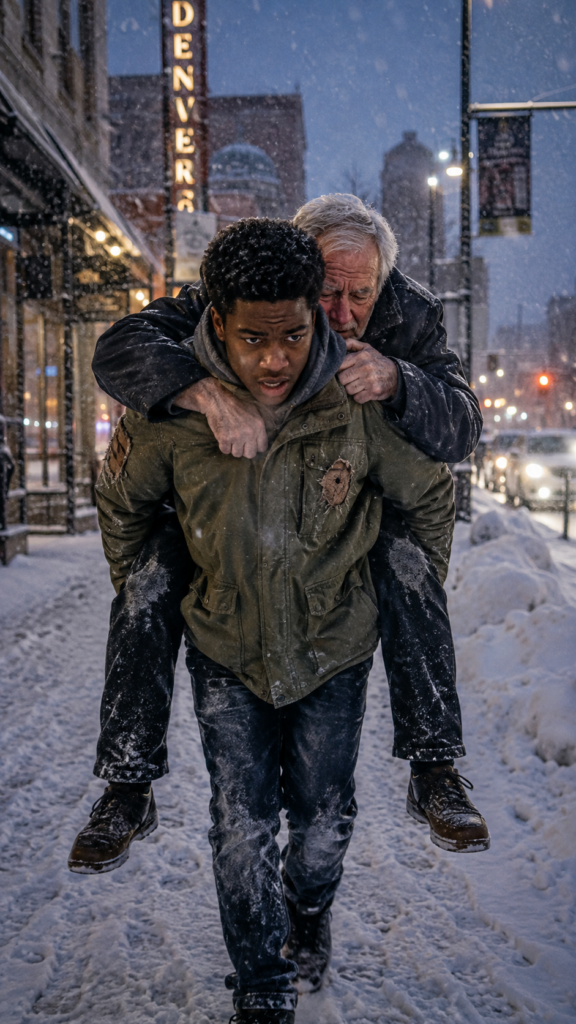
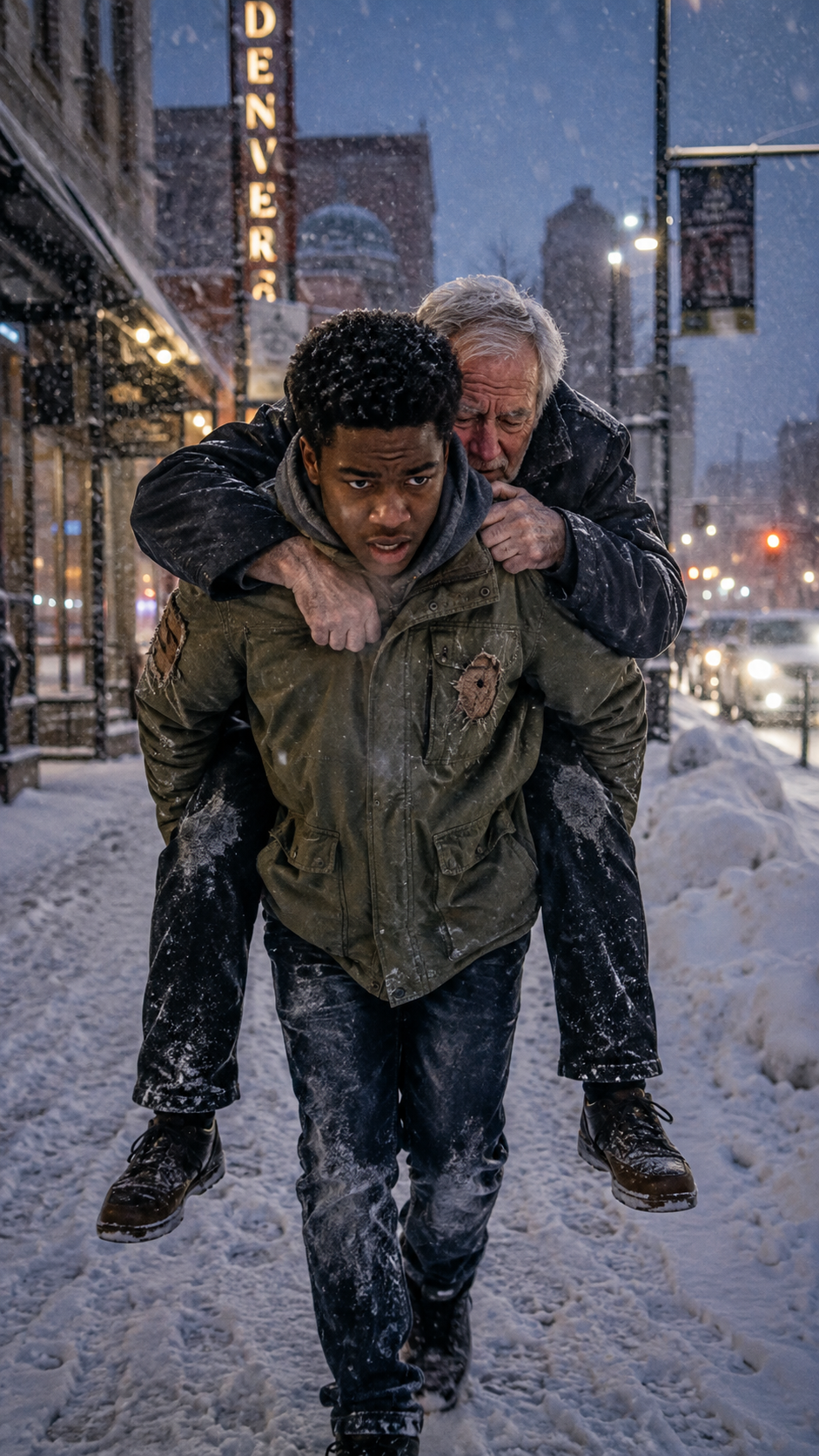
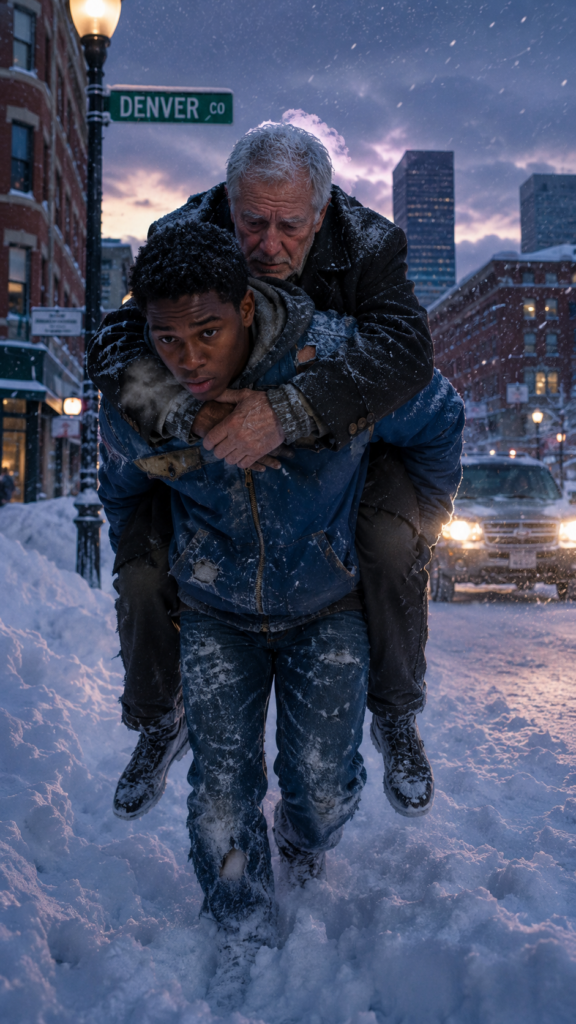
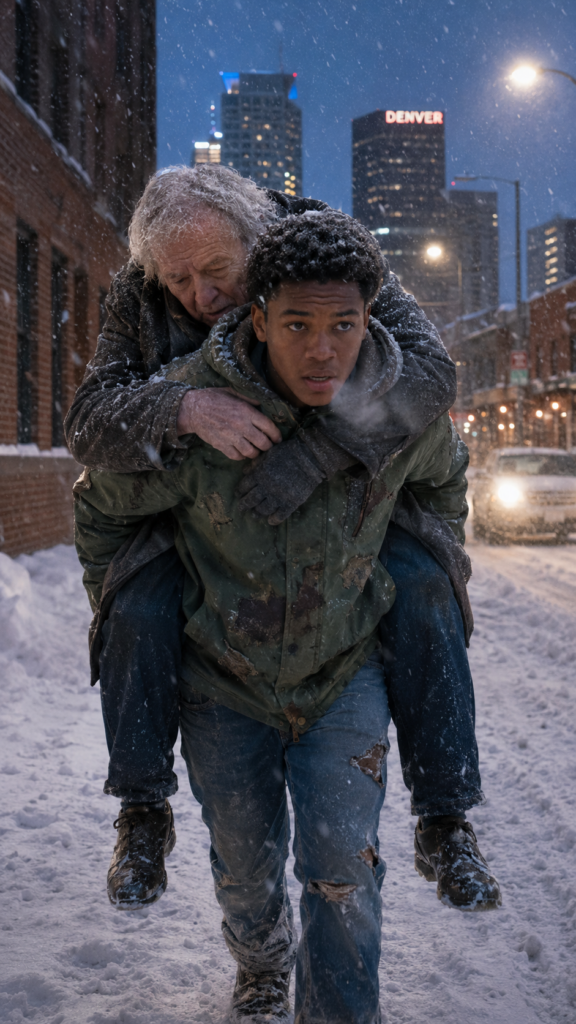
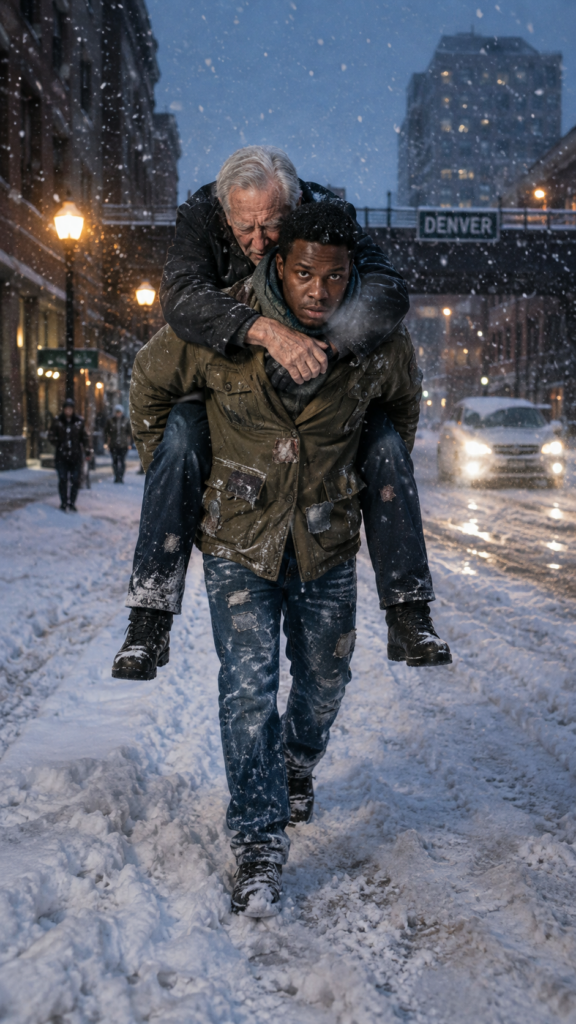
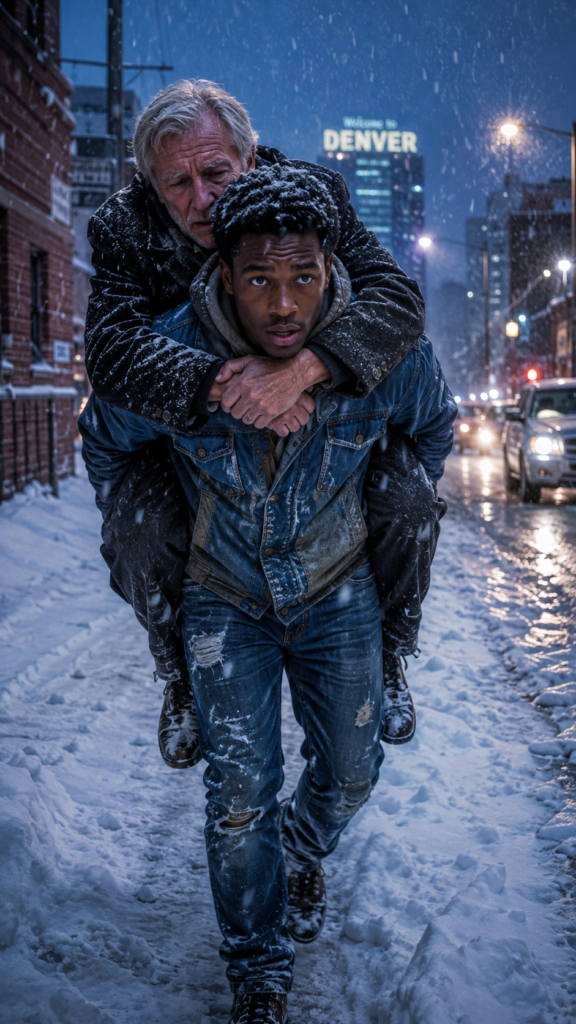
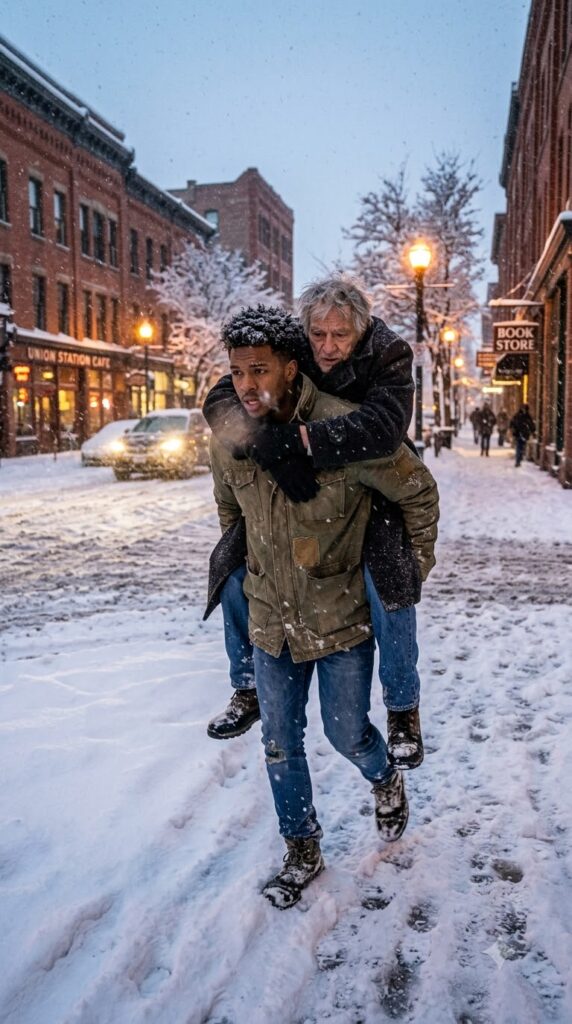
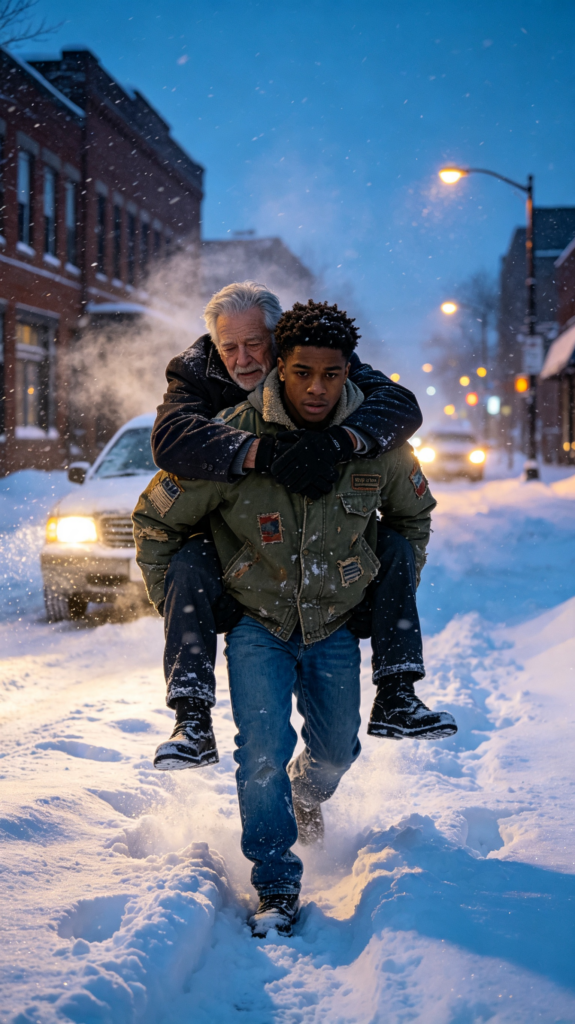
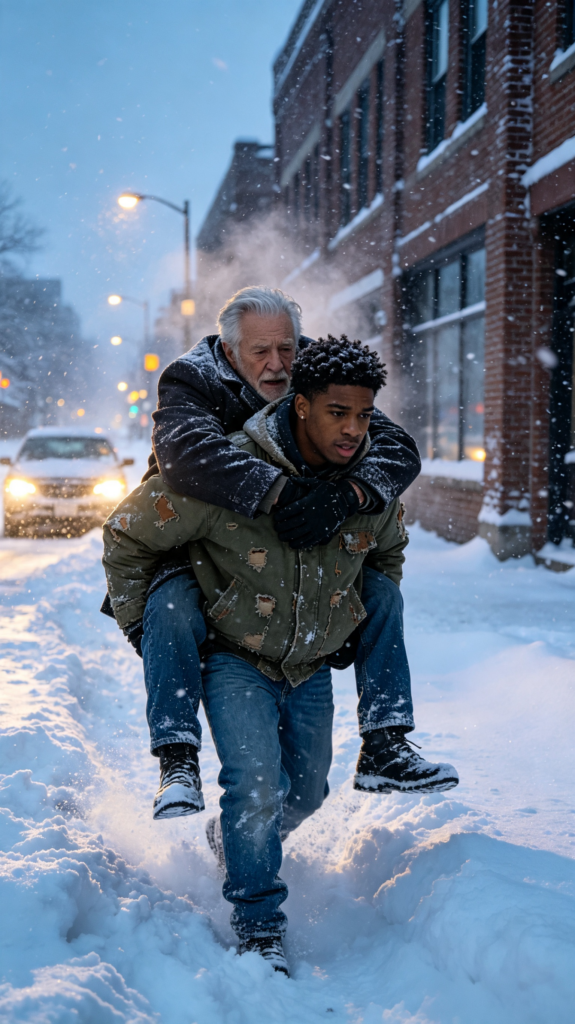
Caleb stood up, his legs protesting after sitting in the cold for so long. He bent down and carefully lifted Martin into his arms, then shifted his weight onto his back in a piggyback carry. His arms draped loosely over his shoulders, his head lolling against his neck. “Hold on,” he told him, even though he wasn’t sure he could hear him anymore. “Just hold on, Mr. Reynolds. We’re going to get you help.”
The hospital was about fifteen blocks away. Caleb had walked past it before, had even thought about going to the emergency room once when he’d been sick with a fever that wouldn’t break. But he’d been too afraid of the questions, too worried about being arrested for not having insurance or ID. But Martin needed help now, and Caleb was the only person who could get him there.
He started walking into the blizzard, carrying a man he just met, risking his life for a stranger who thought he was his son. And with every step, he heard his mother’s voice telling him that this was what it meant to be human. This was what it meant to be good. Even if nobody ever knew, even if nobody ever cared, even if it cost him everything.
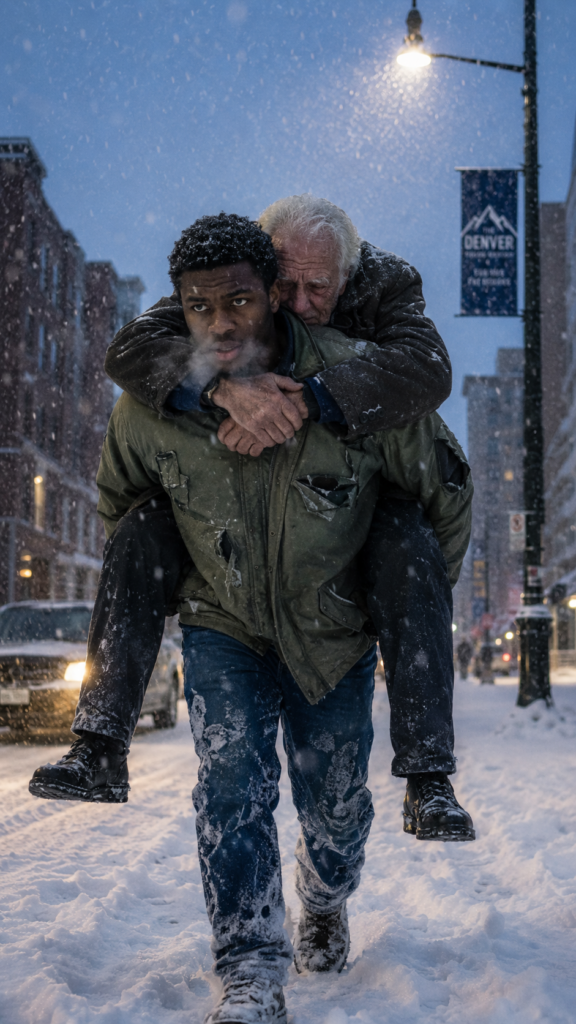
The first block was the hardest. Caleb’s legs were already weak from hunger and cold. And Martin’s weight, light as he was, felt like carrying a boulder. Every step was a negotiation with his body. A battle between what he knew he had to do and what his failing muscles could actually accomplish. The snow had turned vicious, driven by wind that cut through his thin jacket like it wasn’t even there. Ice formed on his eyelashes, making it hard to see. His feet, already numb, slipped on the icy sidewalk with every other step.
He fell to one knee in the second block, caught himself with one hand while keeping Martin secure with the other, forced himself back up. “Stay with me,” he muttered, not sure if he was talking to Martin or to himself. “Just stay with me.” Martin stirred slightly on his back, his breath warm against his frozen neck. “Daniel.” “Yeah,” Caleb gasped. “Yeah, it’s Daniel. I’m here. I’ve got you.”
“Where are we going?” “Getting you help. Just hold on.” “I’m scared.” “I know. Me, too. But we’re going to make it.” By the fourth block, Caleb’s vision was starting to blur. The edges of the world seemed to pulse and fade like someone was turning the lights up and down. His breathing had become labored. Each inhale burning in his lungs. Each exhale a cloud of white that was immediately torn away by the wind.
He stumbled again, this time going down on both knees. Pain shot through his legs, but he barely felt it. Everything was distant now, muffled like he was watching himself from somewhere far away. Get up, he told himself. Come on, get up. His body didn’t want to obey. It wanted to stay down, to rest, to give in to the cold that was no longer uncomfortable, but almost pleasant now, almost warm. That was the dangerous part. That was how people died in the snow. They stopped hurting and started feeling peaceful. And then they just never got up again.
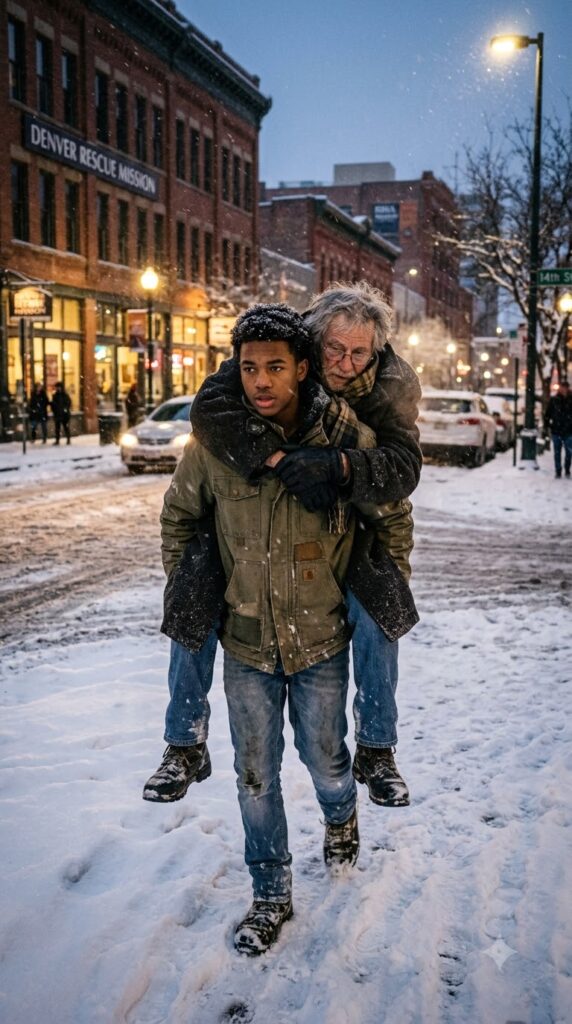
Caleb thought about his mother. Thought about the promise he’d made her. Thought about Martin Reynolds trusting him with his life because his broken mind had decided he was his son. He got up. Sixth block, seventh block. Each one an eternity. Each step a victory.
Caleb’s mind was starting to play tricks on him, showing him things that weren’t there. He saw his mother standing on a corner, smiling at him, telling him to keep going. He saw warm lights that turned out to be just reflections in ice. He saw the hospital entrance a dozen times only to blink and find he was still blocks away. “Almost there,” he said, his voice barely a whisper now. “Almost there, Mr. Reynolds.”
Martin had gone silent on his back, his weight dead and heavy. Caleb couldn’t tell if he was unconscious or worse, and he couldn’t let himself think about it. He just had to keep moving, just had to keep putting one foot in front of the other. Eighth block. Ninth block. His legs were going to give out. Caleb could feel it. Could feel the way his muscles were beginning to fail. The way each step was becoming more of a controlled fall than actual walking. He was running on nothing now, on fumes, on pure stubborn will, but it wasn’t enough.
In the tenth block, his knee buckled completely. And this time, he couldn’t catch himself. He went down hard, twisting at the last second to take the impact on his shoulder instead of letting Martin hit the ground. Pain exploded through his body, but he kept his arms locked around his legs, kept him safe even as he lay there in the snow, unable to move. “Help!” he tried to call out, but his voice was gone. “Please, somebody help us!”
No one answered. The street was empty, the world reduced to nothing but wind and snow and darkness. Caleb tried to push himself up, but his arms wouldn’t support his weight anymore. He tried again, managed to get to his knees, then collapsed once more. Martin slid partially off his back, and he scrambled to keep hold of him to keep his head out of the snow. This was it. This was as far as he could go. He tried. He’d given everything he had, but it wasn’t enough.
“I’m sorry,” he whispered to Martin, to his mother, to whoever might be listening. “I’m so sorry.” And then he saw them. Lights, real lights, not a hallucination this time. Bright lights cutting through the snow, growing larger, getting closer. A car was coming down the street, moving slowly through the storm.
Caleb raised one arm, waving weakly. “Help! Please help!” The car slowed, stopped, a door opened. Caleb heard shouting, heard running footsteps crunching through the snow. “Dad! Oh my god, Dad!” Strong hands were on him, rolling him over, checking Martin. A man’s face, wild with fear and relief, looked down at him. “Who are you? What happened?”
Caleb tried to answer, but the words wouldn’t come. The world was spinning now, tilting sideways, turning dark around the edges. “Hospital,” he managed to whisper. “He needs hospital.” “We’re going right now, both of you.” Caleb felt himself being lifted. Felt Martin being taken from his arms. He tried to hold on to him to make sure he was okay, but his body had nothing left to give.
“It’s okay,” the man’s voice said from somewhere far away. “I’ve got him. I’ve got both of you. You saved him. Do you understand me? You saved my father’s life.” Caleb felt himself being loaded into a car, felt warmth beginning to seep into his frozen body, and then he felt nothing at all as consciousness finally, mercifully slipped away.
Daniel Reynolds had been in meetings all evening, his phone silenced, his mind focused on quarterly projections and market analysis. It wasn’t until he’d walked out of the conference room after 9:00 p.m. that he saw the missed calls, twelve of them, all from his father’s home number. His stomach had dropped like a stone. Something was wrong.
The voicemail from his father’s neighbor, Mrs. Chen, confirmed his worst fears. “Daniel, it’s Patricia. Your father walked out about an hour ago. He was confused. Said he needed to find someone. I tried to stop him, but he got past me. I’ve called the police. Please call me back.” Patricia, the caregiver he’d hired six months ago. The woman he trusted to watch his father while he built his career, climbed the corporate ladder, made the money that paid for the big house and the medical care and all the things he thought mattered.
Daniel had left work immediately, calling Patricia back as he ran to his car. “Where is he? Have they found him?” “Not yet. The police are looking. I’m so sorry, Mr. Reynolds. I only looked away for a minute.” Daniel’s hands shook as he started the car. Outside, a blizzard was raging. His father, who couldn’t remember what year it was half the time, was out there somewhere in that storm.
He drove slowly through his father’s neighborhood, peering through the snow at every shape, every shadow. He checked the grocery store he used to walk to, the park where he liked to feed birds, the church he’d attended for forty years. Nothing. “Please,” he whispered to the empty car, to God, to anyone who might be listening. “Please let him be okay.”
He expanded his search, driving in wider circles, calling out the window when he saw anyone on the streets. Other drivers honked at him for going too slow, for stopping in the middle of the road, but Daniel didn’t care. Nothing mattered except finding his father. It was nearly midnight when he saw them. At first, it was just a shape in his headlights. A person hunched over, moving slowly through the snow.
Daniel’s heart leaped, but as he got closer, he realized it wasn’t just one person. Someone was carrying someone else on their back. Daniel leaned forward, squinting through the windshield, and his breath caught in his throat. The clothing, the white hair visible even through the snow. The way the person being carried held themselves, that distinctive slump of his father’s shoulders. “Dad!”
He slammed the car into park and threw open his door, running through the snow without feeling the cold, without feeling anything except the desperate need to reach him. The young man carrying his father turned at Daniel’s shout. He was maybe early twenties, thin to the point of gaunt. His face was drawn with exhaustion and pain. His eyes hollow and barely focused.
As Daniel watched, the young man’s legs gave out, and he collapsed to his knees, then forward, twisting at the last second to protect Daniel’s father from the fall. “Dad!” Daniel dropped beside them, his hands going to his father’s face. His skin was ice cold, his eyes closed, his breathing shallow, but he was alive. He was alive.
“Who are you?” Daniel demanded, looking at the young man who was now lying in the snow, barely conscious. “What happened? What did you do?” The young man’s eyes struggled to focus on Daniel’s face. His lips moved and Daniel had to lean close to hear the words. “Hospital. He needs hospital.”
“What happened to him? Where did you find him?” “Park. He was lost, confused, too cold. Had to… had to get him help.” The young man’s eyes were closing. His body going limp. Daniel looked between him and his father, his mind racing. This kid had been carrying his father through a blizzard, carrying him toward help. He’d been saving him.
“Okay,” Daniel said, making a decision. “Okay, I’m getting you both to the hospital right now.” He lifted his father as gently as he could, carrying him to his car and laying him across the back seat. Then he ran back for the young man who was trying and failing to get up. “Come on,” Daniel said, putting his arm around the kid’s shoulders and helping him stand. “I’ve got you.”
“Is he okay?” the young man mumbled. “He’s going to be. Thanks to you.” Daniel got him into the front passenger seat, then ran around to the driver’s side. The hospital was only three blocks away. Three blocks that felt like three hundred as Daniel navigated the icy roads, constantly glancing at his father in the rearview mirror at the young man slumped against the passenger window. “Stay with me,” Daniel said. “Both of you. Just stay with me.”
He pulled up to the emergency entrance and laid on the horn. Medical staff came running out and Daniel was shouting before they even reached the car. “Hypothermia. Both of them. My father has Alzheimer’s. He was lost in the storm.” The next minutes were controlled chaos. His father being lifted onto a gurney, wheeled away under bright lights. The young man being helped out of the car, supported by two nurses. As his legs gave out again.
“He carried him,” Daniel told the doctor who appeared at his side. “I don’t know how far, but he carried my father through that storm to get him help.” The doctor looked at the young man with new respect. “We’ll take care of him. Both of them are in good hands now.”
Daniel watched them wheel the young man away, watched him disappear through the emergency room doors, and then alone in the bright lights of the ambulance bay, Daniel Reynolds broke down and cried. A stranger had saved his father’s life. A kid who looked like he’d been living on the streets, who’d been out in that storm himself with nowhere to go, had carried his confused elderly father toward safety, even though it nearly killed him.
Daniel had spent years telling himself that hiring good caregivers was enough, that writing checks and setting up systems was the same thing as being present, that his father understood he was busy, that he knew he loved him, even if he rarely visited. But tonight, when it mattered most, he hadn’t been there. A homeless kid had done what Daniel should have done, had been the son Daniel should have been.
“I’m sorry, Dad,” Daniel whispered into the cold night air. “I’m so sorry.” Inside, alarms were going off. Voices were calling urgently. Daniel ran toward the emergency room entrance, toward his father, toward the young man who’d saved his life, and made a promise to himself. This was going to change. Everything was going to change starting right now.
Three hours later, Daniel sat in the hospital waiting room, his expensive suit rumpled, his hair a mess from running his hands through it repeatedly. A doctor had come out once to tell him that his father was stable, warming slowly, responding well to treatment, but there was no word yet on the young man. Daniel didn’t even know his name.
Patricia, the caregiver, had arrived about an hour ago, full of apologies and explanations. Daniel had barely been able to look at her. His father had walked out of his own home, confused and lost, and Patricia hadn’t noticed for over an hour. Over an hour. Anything could have happened in that time.
“Mr. Reynolds,” a nurse called from the doorway. “You can see your father now. He’s awake.” Daniel followed the nurse through a maze of hallways to a private room where his father lay in a hospital bed covered in heated blankets. His eyes were open, clearer than they’d been in months, and he smiled when he saw him. “Daniel,” he said softly.
“What are you doing here?” “Dad, this is Caleb. He’s the young man who helped you that night in the park.” Martin studied Caleb’s face and something flickered in his eyes. Recognition maybe, or just a sense of familiarity. “I remember you,” he said. “You were so cold. I gave you my coat.” He hadn’t given him his coat. He’d tried to give him money, but Caleb understood that memories could shift and blur, especially with Alzheimer’s.
“You did,” Caleb said gently. “You were very kind.” “Would you like some tea? I was just about to make tea.” “That would be nice.” And that became the pattern. Caleb would visit the main house most afternoons, would sit with Martin in the sun room or the garden, would listen to his stories that repeated and changed, and sometimes made no sense at all. He never corrected him, never pointed out inconsistencies. He just listened.
On good days, Martin was sharp and present, asking Caleb about his life, encouraging him to pursue his education, telling him about his own youth. On bad days, he’d call him Daniel or Richard, or sometimes names Caleb didn’t recognize, but he was always happy to see him, always smiled when he walked in. “You’re good with him,” Daniel said one evening after Caleb had spent two hours helping Martin organize photographs. “Patient, kind. That’s not easy when someone has Alzheimer’s.”
“I learned with my mom. You can’t fight it. Can’t try to force them into reality. You just have to meet them where they are.” “How long was your mother sick?” “About three years from diagnosis to… to the end. The last year was the hardest. She didn’t know me anymore. Would sometimes get scared of me, but I stayed anyway because she was still my mom, even if she didn’t remember being my mom.”
Daniel was quiet for a moment. “I’m sorry you went through that alone.” “I wasn’t alone. I had her and that was enough.” As weeks passed, Caleb slowly began to relax. He started eating normal portions. Started unpacking his backpack and putting his few clothes in drawers. Started to believe just a little bit that maybe this was real, that maybe he could stay.
Daniel kept his promises. He helped Caleb get a new ID and social security card, helped him enroll in GED classes at the local community college. He never made Caleb feel like a project or a charity case. He just treated him like a person who deserved help. One evening, Daniel and Caleb were both in the main house, sitting with Martin as he dozed in his favorite chair. The sun was setting, painting the room in gold and amber light.
“Thank you,” Caleb said quietly. “For what?” “For this. For believing in me. For not giving up.” “I should be thanking you. You saved my father’s life and you saved mine.” Daniel looked at him. “We saved each other. I think you taught me what really matters. Not money or success or any of that. Just being there, just staying.”
“My mom used to say that family is the people who don’t leave.” “Your mother was right.” “And Caleb, you’re family now. For as long as you want to be.” Caleb felt tears prick his eyes, but smiled through them. “I’d like that.”
The months passed in a rhythm of quiet routines and small victories. Caleb passed his GED with scores high enough to qualify for college scholarships. He gained weight, his gaunt frame filling out with regular meals and the absence of constant stress. The shadows under his eyes faded, replaced by a clarity and peace he hadn’t felt in years. But Martin’s condition continued its slow, inevitable decline.
There were still good days, moments of startling clarity when he’d look at Caleb and really see him, would thank him for his kindness, would squeeze his hand with surprising strength. But those moments came less and less frequently, replaced by longer stretches of confusion and distance. Daniel hired a proper caregiver, carefully vetted this time, but he never delegated again. He was there for every doctor’s appointment, every meal, every moment his father needed him. He’d cut back his work hours to almost nothing, focusing instead on being present.
“I used to think success meant building an empire,” Daniel told Caleb one evening as they prepared dinner together. “Making partner, growing the business, accumulating wealth. But watching my father fade, seeing how little time we actually have, it changed my perspective.” “What matters now?” Caleb asked. “This. Being here. Making sure the people I love know they’re loved while they can still understand it.”
Caleb had started volunteering at a local homeless shelter, using his own experiences to connect with people living on the streets. He knew what it felt like to be invisible, to be judged, to be dismissed as worthless, and he knew what it meant when someone saw you as human, as worthy of care and dignity.
“You’re going to do important work,” Martin told him during one of his lucid moments. They were sitting in the garden, Caleb reading to him from one of his favorite books. “You have kindness in you. Real kindness. That’s rare.” “You helped me see that,” Caleb said. “That night in the park, even though you were confused, you treated me like I mattered.”
“You do matter,” Martin took his hand. “Don’t ever forget that. You matter.” Winter came again, bringing snow that reminded Caleb of that night a year ago. He stood at the window of his guest house, watching the flakes fall, remembering how close he’d come to dying in the cold. How close they both had come. Everything had changed that night. Everything.
Daniel found him there, brought him a cup of hot chocolate without being asked. “Thinking about last year?” “Yeah. It’s hard to believe it’s been a year. Sometimes it feels like it happened yesterday. Sometimes it feels like a lifetime ago.” “You’ve come a long way.” “We both have.”
They stood together in comfortable silence, watching the snow blanket the world in white. “My father’s doctor says we’re approaching the final stage,” Daniel said quietly. “He’s declining faster now. Probably has a few months, maybe less.” “I’m sorry.” “Me, too. But I’m also grateful. Grateful I got this time with him. Grateful he’s not in pain. Grateful you were there that night to make sure I didn’t lose him before I had a chance to really be his son again.”
Martin passed away on a quiet morning in early spring. He simply didn’t wake up, slipping away peacefully in his sleep. The doctor said it was the best way, that he hadn’t suffered. The funeral was small and intimate. Caleb spoke, telling the story of how Martin had found him in the park, had mistaken him for his son, had treated him with love and acceptance, even in his confusion.
“He saved me,” Caleb said to the small gathering, “just as much as I saved him. Maybe more. He reminded me that I was worth saving, that I deserved kindness and care, and that changed everything.” After the funeral, Daniel and Caleb sat in the empty house, surrounded by Martin’s things, his photographs, his life.
“What happens now?” Caleb asked. “Now we figure out how to honor his memory,” Daniel said. “How to make his life mean something beyond just our grief.” The idea came to Daniel in the middle of the night, three weeks after his father’s funeral. He’d been lying awake thinking about Caleb’s story, about all the other young people out there who were one bad break away from homelessness, who had no safety net, no support system, no one who believed in them.
The next morning, he called Caleb to the main house. “I want to start a foundation,” Daniel said. “The Martin Reynolds Foundation. To help young people experiencing homelessness, ages 18 to 24. The ones who age out of foster care or lose their families and have nowhere to turn.” “That’s a beautiful idea.” “But I can’t do it alone. I need someone who understands what these kids are going through, who can connect with them in a way I never could.”
Daniel looked at Caleb. “I need you.” “Me?” “Daniel, I don’t have any qualifications. I barely finished high school.” “You have the most important qualification. You’ve been there. You know what it’s like to sleep in the cold, to not know where your next meal is coming from, to be treated like you’re invisible. And you know what it takes to accept help. To trust someone when trust feels impossible.”
Caleb was quiet, considering. “What would I do?” “Outreach. Building relationships with kids on the streets. Being the bridge between them and the services we provide. Housing, education, job training, mental health support, all of it. But none of that matters if they don’t trust us enough to walk through the door. You can make them trust us.” “Because I’ve been where they are.” “Exactly.”
Caleb thought about the night in the park, about Martin’s kindness, about Daniel’s faith in him, about all the ways his life had changed because someone had chosen to stay, to care, to believe. “Okay,” he said. “Yes. I’ll help you build it.”
They worked tirelessly over the next months. Daniel handling the legal and financial aspects while Caleb helped design the programs, drawing from his own experiences to identify what would actually help versus what just sounded good on paper. The foundation started small. One apartment building converted into transitional housing, one full-time counselor, one job training program, but it grew quickly as word spread. As young people found a place that treated them with dignity and respect, that saw potential instead of problems.
Caleb was there for all of it. He met with every new participant, heard their stories, helped them navigate the systems designed to help but often felt designed to exclude. He knew the frustration of being asked for documents you didn’t have, the shame of filling out forms that assumed you had things you’d never had.
“You’re making a real difference,” Daniel told him six months in as they reviewed the foundation’s progress. “Seventy percent of our participants are still housed after a year. Eighty percent are in school or employed. Those are incredible numbers.” “It’s not me. It’s the program. It’s what we’re providing.” “It’s you, too. Don’t sell yourself short.”
On the one-year anniversary of Martin’s death, they held a memorial service at the foundation’s office. Former participants spoke about how the organization had changed their lives, how it had given them hope when they had none. “Mr. Reynolds never got to see this,” one young woman said, tears streaming down her face. “But I think he’d be proud. This foundation is helping people the way he helped Caleb. By seeing them, by caring.”
After everyone left, Daniel and Caleb stood alone in the office, surrounded by photographs of Martin, of the participants they’d helped, of the work still to be done. “He would be proud,” Caleb said. “Of you. Of this. Of everything we’re building in his name.” “Of us,” Daniel corrected. “This is both of our work. Our family’s work.”
“Family,” Caleb repeated softly, testing the word. It had been so long since he’d had a family, since he belonged somewhere, to someone. “You’re my brother,” Daniel said. “Not by blood, but by choice, by everything that matters.” Caleb felt tears on his face, but didn’t try to hide them. “He’d like that. Your dad. He’d like knowing we became family.” “He already knew. Even with Alzheimer’s, even in his confusion, he knew the important things. He knew love when he saw it.”
Three years after that night in the park, Caleb walked through the same space where he’d once sat freezing and alone. But this time, he wore a warm coat and carried a bag of supplies. This time, he was there with purpose. The Martin Reynolds Foundation’s outreach program visited this park twice a week, bringing food, warm clothes, and information about services to people living on the streets. Caleb had insisted on this location specifically. It felt right, closing the circle, returning to where it all began.
He spotted the young man on a bench near the back, hunched against the cold, nineteen, maybe twenty, trying to be invisible. Caleb recognized that posture, that desperate attempt to take up no space, to draw no attention. “Hey,” Caleb said, approaching slowly. “Cold night. You need anything? We’ve got hot food, warm clothes, information about housing.”
The young man looked up, his eyes wary and tired. “Who are you?” “My name’s Caleb Wright. I work with the Martin Reynolds Foundation. We help people find housing, get back on their feet.” “I don’t need help.” Caleb heard the defensive pride in those words. Remembered using the same tone himself. “Okay. But if you change your mind, here’s my card. We’re available anytime, day or night. No judgment, no strings.”
“Why do you even care?” the young man asked. “You don’t know me. Why does it matter to you?” Caleb sat down on the other end of the bench, keeping respectful distance, keeping it casual. “Because three years ago, I was sitting right here, same bench, actually. I was hungry, freezing, had nowhere to go, and someone didn’t walk away. Someone stayed. Someone saw me as a person worth saving.”
The young man was listening now, really listening. “I’m not going to force anything on you, but I want you to know that you matter. That you deserve help. And that accepting help isn’t weakness. Sometimes it’s the bravest thing you can do.” He stood up, pulled a warm jacket from his bag, and set it on the bench. “Just in case you get cold. No pressure.”
As Caleb started to walk away, he heard the young man call after him. Caleb turned back. “That person who stayed for you. What happened?” Caleb smiled. “They changed my life. Helped me see that family isn’t always blood. Sometimes it’s the people who choose not to walk away. And if I called that number, you’d really answer?” “I’d really answer. Whenever you’re ready.”
Caleb continued his rounds through the park, stopping to talk with other people, distributing supplies, building trust. His phone rang as he was finishing up. It was the young man from the bench. “I’m ready,” the voice said, scared but hopeful. “I’m ready to try.” “Good,” Caleb said, already heading back toward the bench. “I’m coming to get you right now. And hey, you’re going to be okay. I promise.”
He meant it because he knew it was true. Because someone had once made him the same promise, and they’d been right. Because kindness didn’t end with one act. It multiplied. It spread. It came back around. As Caleb walked through the park, the same park where his life had changed three years ago. He thought about Martin, about his confusion that night, how he’d mistaken him for his son, about how in a way he’d been right because he’d given him a family, given him a home, given him a purpose. And now he got to pass that forward. One person at a time, one cold night at a time.
The young man was waiting when Caleb got there, the jacket wrapped around his shoulders, his face a mixture of fear and hope. “Come on,” Caleb said gently. “Let’s get you somewhere warm.” As they walked together toward Caleb’s car, toward warmth and safety, and a chance at something better, Caleb remembered his mother’s words. “As long as you keep your kindness, you’re never truly empty.”
She’d been right. Kindness was the only thing that really mattered. Kindness was what saved lives. Kindness was what built families. And kindness was what kept the circle going, turning strangers into family, turning despair into hope, turning one cold night into a lifetime of changed lives.
