

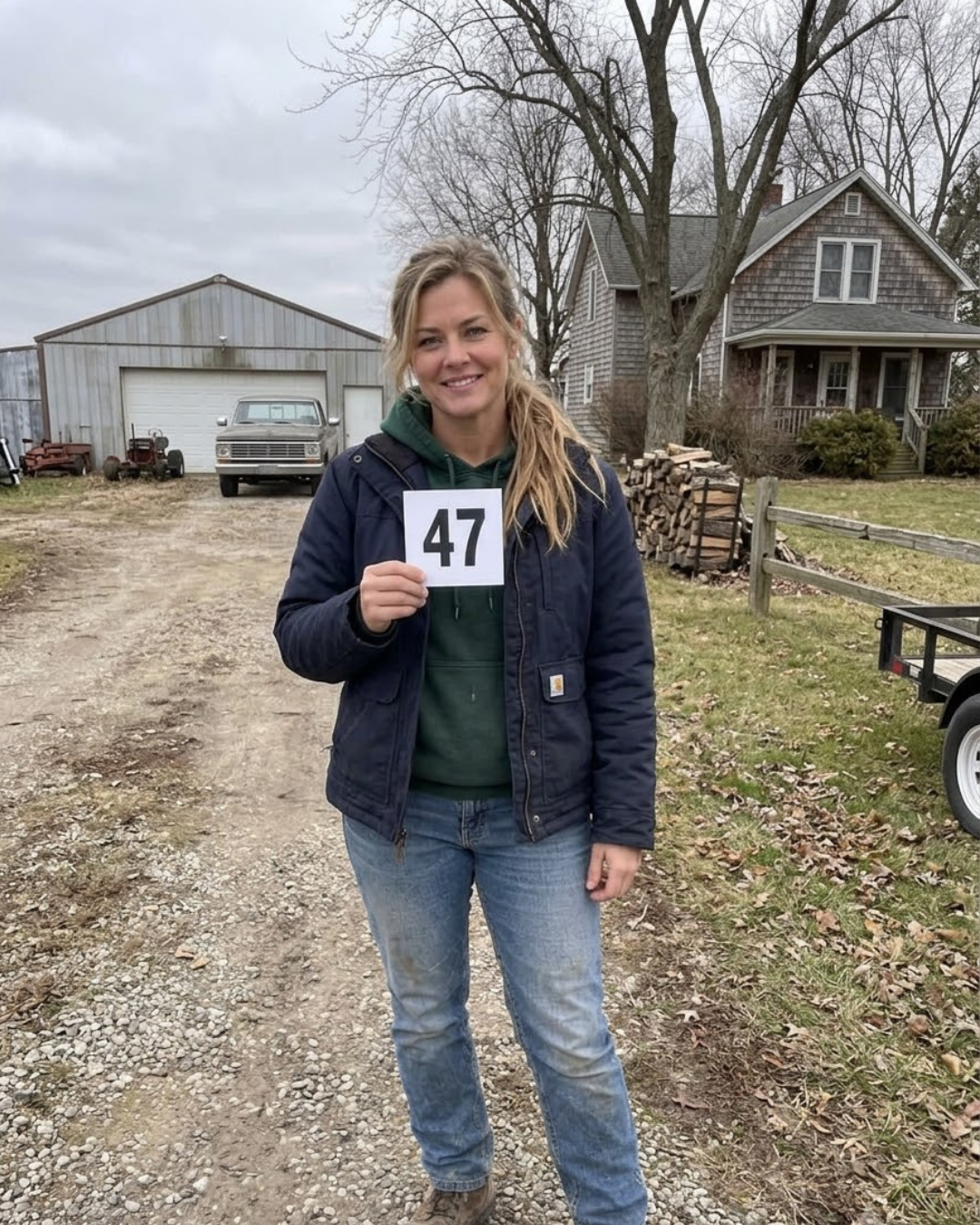
PART 1 — The Farm He Refused to Sell Us
“Your father-in-law’s been talking at the co-op.”
Merle Hansen told me that the moment I removed the suction tube from his mouth.
There was no malice in his voice. He delivered the news gently, as though he were letting me know I’d forgotten to close my car door.
I was holding a dental scaler, with his chart displayed on the monitor. I carefully placed the instrument on the tray.
“Talking about what, Merle?”
He stared at the ceiling for several seconds before answering.
Merle was eighty-one, a retired corn and cattle farmer from near Gibbon. He’d been coming to my dental office every six months for nine years.
He believed a woman deserved to know what men were saying about her when she wasn’t around.
“Walt says he wasn’t about to sell the place to his boy,” Merle explained. “Says the boy married a town girl. And she’d have it chopped up into lots by Christmas.”
A gospel program was playing softly on the radio.
I remember that clearly.
I also remember noticing that one clip on Merle’s disposable bib had slipped loose. I reached over and fastened it again before responding.
“Thank you for telling me, Merle.”
“For what it’s worth, I didn’t believe it,” he replied. “I’ve known you since you had braces.”
And he had.
My father operated a gas station on Second Avenue in Kearney, Nebraska, for three decades. Farmers throughout Buffalo County bought fuel there, often finding me behind the counter doing homework beside the beef jerky display.
I really was a town girl.
I’d grown up near the high school, with a sidewalk in front of our house and a streetlamp outside my bedroom.
Until I turned nineteen, I couldn’t have explained the difference between a heifer and a steer.
I completed Merle’s cleaning with the same care I always gave my patients.
Then I escorted him to reception, marked his next appointment for six months later, and walked into the supply closet.
I closed the door and stood alone in the darkness between boxes of gloves and fluoride.
I stayed there until I could trust my expression again.
My name is Amy Brandt. I was thirty-six that spring, working as a dental hygienist in Kearney.
And the reason Merle’s words hurt so deeply began with an eighty-acre farm eleven miles north of town.
My husband, Luke, had grown up there.
The Brandt homeplace stood along a gravel county road. It had a white two-story farmhouse, a covered porch, a red barn built by Luke’s grandfather, a machine shed, and cottonwoods planted as a windbreak.
The property had belonged to the Brandt family since 1938.
Luke’s father, Walt, had spent his life farming it. During the previous decade, he’d rented the cropland to a neighbor and kept about twelve cows in the pasture near the creek.
Then Luke’s mother, June, died in January.
Her heart failed suddenly.
June was the sort of woman who kept peppermints beside the back door for the mail carrier and remembered every grandchild’s shoe size.
After her funeral, Walt seemed lost in his own home.
He was sixty-eight, and grief made him look older.
In February, he informed Luke that he intended to sell the farm.
We visited him one Sunday afternoon and sat at the familiar kitchen table, covered with the same oilcloth I’d seen at fifteen years of family dinners.
Luke spoke first.
“Dad, we’d like to buy it,” he said. “On a contract. Payments to you. The same way Grandpa sold it to you. We’d keep it just like it is.”
Walt slowly rotated his chipped brown coffee cup on the table.
“I’ll think on it.”
That was his entire response.
He never looked at me.
At the time, I attributed his distance to losing June.
Then, on a Tuesday morning in April, Walt called Luke while he was working at the county road department.
Luke operated a motor grader for Buffalo County. He answered beside his machine, its engine still cooling.
His father told him the farm had already been sold.
The buyer was Grant Ostrander, a man from Denver who wanted the property for pheasant hunting.
The price was $286,000.
Closing would take place in May.
The conversation lasted less than two minutes.
That evening, Luke told me over supper.
Afterward, he disappeared into the garage and sharpened every mower blade we owned, including two that were already sharp.
Two weeks later, Merle repeated what Walt had said at the co-op.
I waited until our children were asleep before telling Luke.
Hailey was eight, and Cody was five. They were still grieving their grandmother, and I didn’t want them hearing their grandfather criticized.
Luke stood at the kitchen counter with both palms resting flat against it.
When I finished, he was silent.
“He said that at the co-op,” he finally murmured. “At the coffee table.”
“That’s what Merle told me.”
The co-op coffee table was a folding table near the seed counter, surrounded by the same handful of farmers every morning at six-thirty.
They discussed weather, crop prices, Nebraska football, and everyone else’s affairs.
By lunchtime, anything said there could reach half the county.
Luke rubbed his face.
“Amy. He just buried Mom. I’m not going to drive over there and fight him over a sentence.”
“I’m not asking you to.”
“I know he’s wrong about you,” Luke said. “I know that. I just don’t know how to tell my dad he’s wrong right now. I don’t think he’d hear it from anybody.”
I understood.
Luke was thirty-seven, and his mother had been gone only fourteen weeks.
He loved his father, even while recognizing how unfairly he’d treated us.
So I didn’t argue.
That night, I lay awake listening to the furnace cycle on and off.
Around two in the morning, I made a decision.
Grant Ostrander wanted a place to hunt pheasants for a few weeks each year.
Someday, he might sell it.
Whether that happened in two years or twenty, I wanted us ready.
We would save enough money to buy the Brandt homeplace back.
And I refused to spend those years consumed by resentment.
Anger cost too much.
We needed every dollar.
At Easter, our family gathered at Luke’s sister Karen’s house in Gibbon.
Fourteen people squeezed around the dining table and two card tables, sharing ham, scalloped potatoes, and the familiar green Jell-O salad nobody particularly liked.
Karen had placed June’s glass deviled-egg platter, shaped like a hen, on the table.
For a moment, everyone avoided looking at it.
Then Cody asked for the egg in the center, and the moment passed.
Walt sat at the head of the table in his gray church coat.
Before Karen’s husband, Jeff, began the prayer, I stood.
Luke looked surprised.
“Walt,” I said. “I want to thank you for something.”
The room became quiet.
“Thank you for giving Luke that farm to grow up on. For teaching him to drive a tractor before he could see over the dash. For the barn, and the creek, and every Sunday dinner at that table.”
I kept my voice steady.
“Whatever happens to that place, Luke had it. Our kids had it. Nobody can sell that part.”
Walt lowered his eyes.
His jaw moved as though he were trying to form an answer.
Finally, he nodded.
Jeff said grace, and dinner continued.
Later, driving home with the children asleep behind us, Luke asked why I’d thanked his father.
“Because I’m going to buy it back,” I answered. “And I didn’t want to do it angry.”
He drove another mile in silence.
Then he reached across the seat and rested his hand on my knee.
He kept it there until we reached Kearney.
The following Monday, I called Dr. Reinke, a dentist in Hastings.
His Saturday hygienist was retiring, and nobody wanted the position.
“It’s eight to four,” he explained. “Every single Saturday. Most of my farm families can’t get in during the week, so the book’s always full. Are you sure?”
“I’m sure.”
For the next four years, I left home at six-thirty every Saturday morning.
During winter, I drove forty minutes to Hastings in darkness.
I cleaned teeth for eight hours, drove home, and deposited every paycheck into a separate savings account at our bank on Central Avenue.
We never withdrew a dollar.
Not when the furnace broke.
Not when our minivan’s transmission failed during the second winter.
Luke contributed his snowplow overtime.
When heavy storms hit, he worked through the night, sometimes returning home at four in the morning to eat cereal standing at the counter before sleeping a few hours and heading back.
We took no vacations.
We drove our minivan until its odometer reached 214,000 miles.
Hailey wore clothes from the church rummage sale without ever complaining.
The children knew why we were saving.
That first summer, five-year-old Cody asked whether he’d someday get his old Sunday-nap bedroom at Grandma’s house again.
I told him we’d see.
Hailey made a savings thermometer on poster board and taped it inside the pantry door.
Every month, she colored the red line a little higher.
I also found Grant Ostrander’s Denver address in the county property records.
I wrote him a short letter explaining that Luke had grown up on the farm and June had planted the lilacs beside the front porch.
I asked whether we could water them.
He called a week later.
“Sure,” he said. “Water whatever you want. I’m only out there in November.”
So from May through September, we drove out once a month with buckets and a garden hose.
Luke mowed the roadside ditch from the mailbox to the culvert.
June had always kept that stretch tidy.
When a county snowplow knocked over the mailbox during our second winter, Luke replaced the post himself with a post-hole digger and Quikrete.
We also collected shingles blown from the machine shed roof.
But we never entered the farmhouse or barn.
We cared for what we could, then drove home.
Throughout those years, Walt attended Cody’s baseball games and Hailey’s band concerts.
He joined us for holidays and birthdays.
We treated each other politely.
Neither of us mentioned the farm.
It remained between us like an untouched dish at every family meal.
Then, in February of the fourth year, an auction notice appeared in the Kearney Hub.
The same announcement was pinned to the co-op bulletin board.
The Brandt homeplace was being sold at public auction on the final Saturday in March.
Eighty acres, farmhouse, barn, and machine shed.
Eleven in the morning.
Kruse Auction Service.
Grant Ostrander had purchased a larger hunting property in South Dakota.
He was leaving Nebraska behind.
I read the notice in our kitchen without even removing my coat.
Before Luke returned from work, I called Mr. Ostrander.
I introduced myself as the woman who’d watered his lilacs.
He remembered me.
I asked whether he’d consider a fair offer before the auction.
He apologized.
He’d already signed with the auction company and wanted an open sale so nobody could accuse him of favoritism.
We were welcome to bid.
I thanked him.
The auction terms required a ten-percent deposit on sale day, with the remaining balance due by April thirtieth.
There would be no contingencies.
Every bidder needed a bank letter.
The next morning, I sat across from agricultural loan officer Tom Riley with four years of savings statements in a manila folder.
We’d saved $71,400.
He reviewed our finances twice.
He examined Luke’s county employment, my income from both dental offices, our credit, and local land appraisals.
Finally, he wrote a figure on a yellow sticky note.
$305,000.
“That’s your bid,” he warned. “Not one dollar over. I mean it, Amy.”
He signed the bank letter.
I folded the sticky note into my coat pocket.
And I kept it there until auction day.
PART 2 — Bidder Card 47
The final Saturday in March arrived cold and miserable.
Gray clouds hung over the farm. A twenty-mile-an-hour north wind swept across the gravel, carrying intermittent sleet.
By ten forty-five, more than sixty people had gathered in the yard.
Farmers wore seed caps and insulated coveralls. Women held travel mugs. A young couple had brought their baby.
Some intended to bid.
Others came simply because the sale of an old family farm was a community event, much like a wedding or funeral.
Auctioneer Denny Kruse had positioned his flatbed hay rack in front of the machine shed.
His wife handled registration inside, sheltered from the wind, while his nephew Brad worked among the bidders.
Denny had known Walt since school. They’d competed with calves at the Buffalo County fair in 1966.
I showed my driver’s license and Tom Riley’s bank letter.
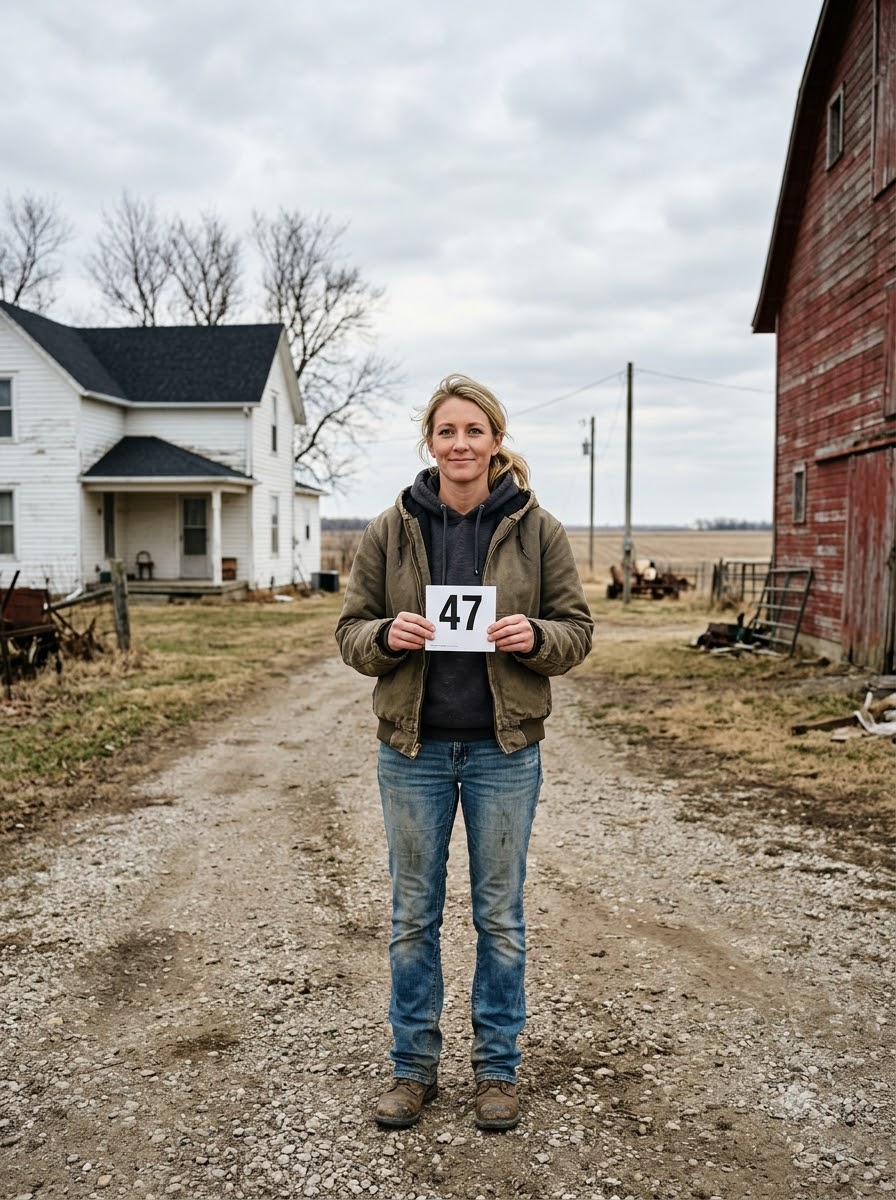
Denny’s wife entered my name into her ledger and handed me a white bidder card.
The number was printed in bold black ink.
Luke stood beside me, his hands buried in his coat pockets.
We’d agreed that he would raise the card.
This was his family’s farm.
It seemed right that he should make the bids.
Hailey and Cody waited near the pickups with Karen and Jeff.
Hailey carried her rolled-up savings chart under one arm.
Then I noticed a stranger standing near the cottonwoods.
He wore a quilted vest, fleece jacket, and unusually clean boots.
Word spread that he represented a Grand Island company purchasing farmland for out-of-state investors.
The company had reportedly bought three quarter sections in Buffalo County that winter.
People kept their distance.
At eleven, Denny climbed onto the hay rack and switched on his microphone.
“Folks, thank you for coming out on a day like this,” he began. “Most of you know this place. Eighty acres. House, barn, machine shed. Well and septic. Possession at closing. Terms are on your sale bill. Let’s sell it.”
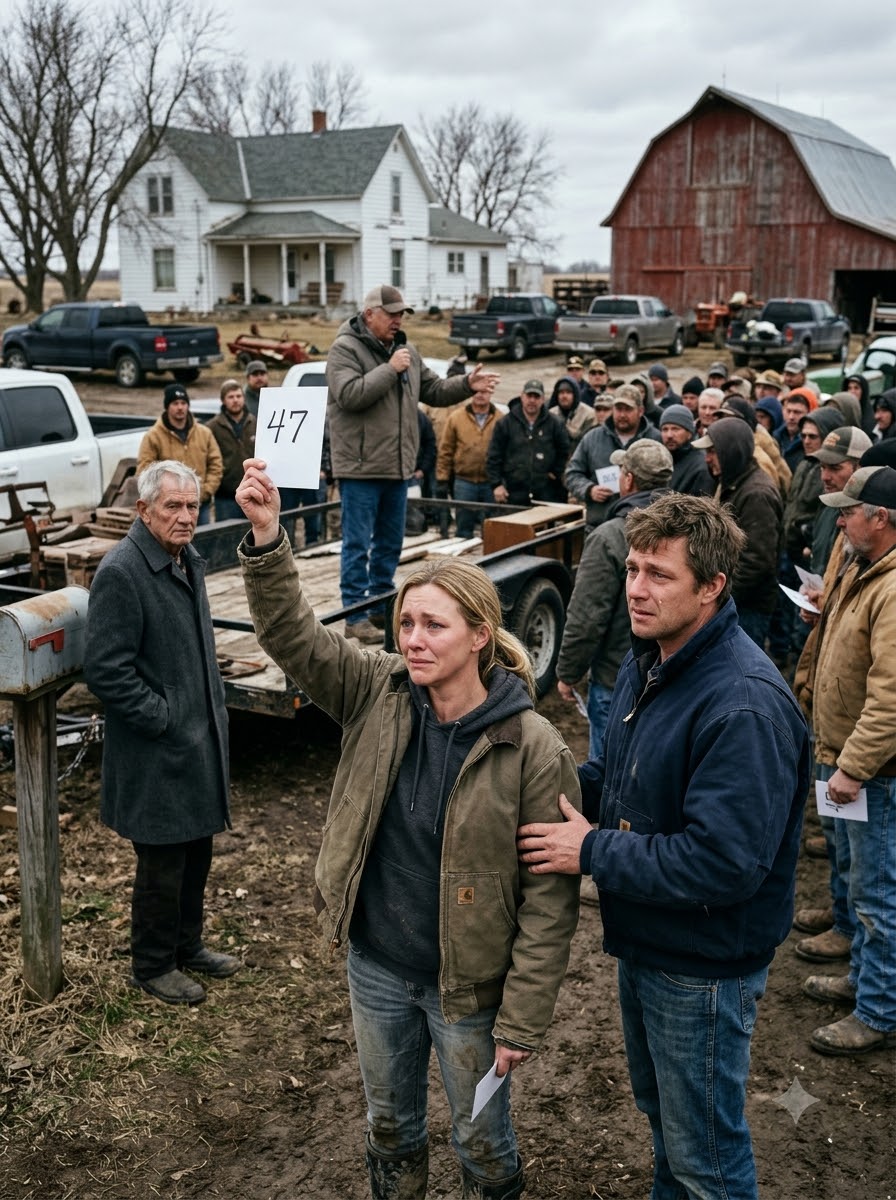
He requested an opening bid of $300,000.
Nobody responded.
He lowered it to $250,000.
Still nothing.
At $200,000, Dale Wiese, the neighbor who’d rented the cropland for years, raised his card.
The auction suddenly came alive.
Brad shouted from the crowd while Denny’s rhythmic chant carried across the gravel.
Bids climbed through $210,000, $220,000, and $230,000.
The young couple entered at $240,000 but dropped out at $260,000.
Dale continued to $270,000 before shaking his head and putting his card away.
The land company representative hadn’t raised a card.
He simply nodded whenever Denny looked toward him.
By $270,000, only he and we remained.
I turned toward Luke.
His hands were still in his pockets.
He wasn’t watching the auctioneer.
He was staring at the farmhouse porch, toward the back doorway where June had once stood ringing the dinner bell.
“Luke,” I whispered.
He didn’t answer.
His jaw was clenched, and tears filled his eyes.
He couldn’t bring himself to raise his hand.
I’d been married to him for sixteen years.
I knew the difference between unwillingness and being overwhelmed.
“Two-seventy-five,” Denny called. “Who’ll give me two-seventy-five. Two-seventy-five. Folks, I’m about to sell it.”
I raised card 47.
Brad pointed.
Denny noticed me immediately.
“Two-seventy-five. Now eighty.”
The investor nodded.
“Eighty. Now eighty-five.”
I raised my card again.
This time, I kept it raised against the cold wind.
Luke finally removed his hand from his pocket.
He didn’t bid.
He placed it gently against my lower back.
At $285,000, I was still standing there with card 47.
The investor took it to $290,000.
I bid $295,000.
My arm trembled so badly that I supported my elbow with my other hand.
Then I saw Walt.
He stood near the end of the driveway, beside the mailbox Luke had repaired.
His gray church coat moved in the wind.
He wasn’t bidding.
He wasn’t watching the auctioneer.
He was looking directly at me.
Denny reduced the increments to $2,500.
The investor bid $297,500.
I raised us to $300,000.
The sticky note in my pocket said $305,000.
“Three hundred,” Denny announced. “Now three-oh-one. Who’ll give me three-oh-one.”
The investor studied me, then nodded.
“Three-oh-one.”
Denny turned toward me.
“Three-oh-two, ma’am?”
My mouth went dry.
We could afford $302,000.
But I remembered Tom Riley’s warning.
I remembered four years of Saturday shifts, snowplow overtime, and our daughter’s red savings thermometer.
I wanted to be careful.
“Half,” I whispered.
Then I repeated it loudly enough to be heard.
“Will you take a half?”
“I’ll take a half,” Denny replied. “Three-oh-one-five. Now three-oh-two.”
He turned to the investor.
The man looked at me.
Then at Luke’s hand resting against my back.
Then at the farmhouse.
Finally, he shook his head and slipped both hands into his vest pockets.
Denny didn’t immediately close the bidding.
He stood silently on the hay rack, surveying the crowd.
His gaze passed Dale Wiese, the young family, and the investor.
Then he looked toward the driveway, where Walt stood alone.
Denny raised the microphone.
“It’s the Brandt place, folks,” he said.
His voice sounded rough.
“Three hundred and one thousand, five hundred. Going once.”
The wind howled.
“Going twice.”
He struck the folding table with his palm.
“Sold. Bidder 47.”
For a moment, nobody reacted.
Then the young mother holding her baby began clapping.
Karen joined her.
Dale crossed the yard and silently shook Luke’s hand.
Hailey ran toward me and wrapped her arms around my waist so fiercely I nearly lost my balance.
Even the investor approached.
“Good luck to you,” he said, shaking my hand.
He seemed sincere.
Then he drove away.
I looked toward the mailbox.
Walt was gone.
Inside the machine shed, I signed the purchase agreement.
Denny’s wife explained every line.
I wrote a check for $30,150, the required deposit.
To my surprise, my hand didn’t shake.
When I stepped outside, Denny was winding up his microphone cable.
He motioned me closer.
“Amy,” he said. “I’m going to tell you something. And then I’m not ever going to say it again. Because it isn’t mine to say.”
I listened.
Denny explained that Walt had driven to the farm once a month for four years.
He would park near the driveway and sit in his pickup.
Afterward, he’d stop at Denny’s house for coffee.
He’d describe what he’d seen.
The mowed ditch.
The repaired mailbox.
June’s lilacs watered throughout summer.
The fallen shingles cleared from the lawn.
“He knew whose pickup it was, Amy,” Denny said. “He saw it out here more than once. And he drove on by.”
I couldn’t answer.
“He never told you, did he?”
“No.”
Denny shook his head.
“No. He wouldn’t. He didn’t know how.”
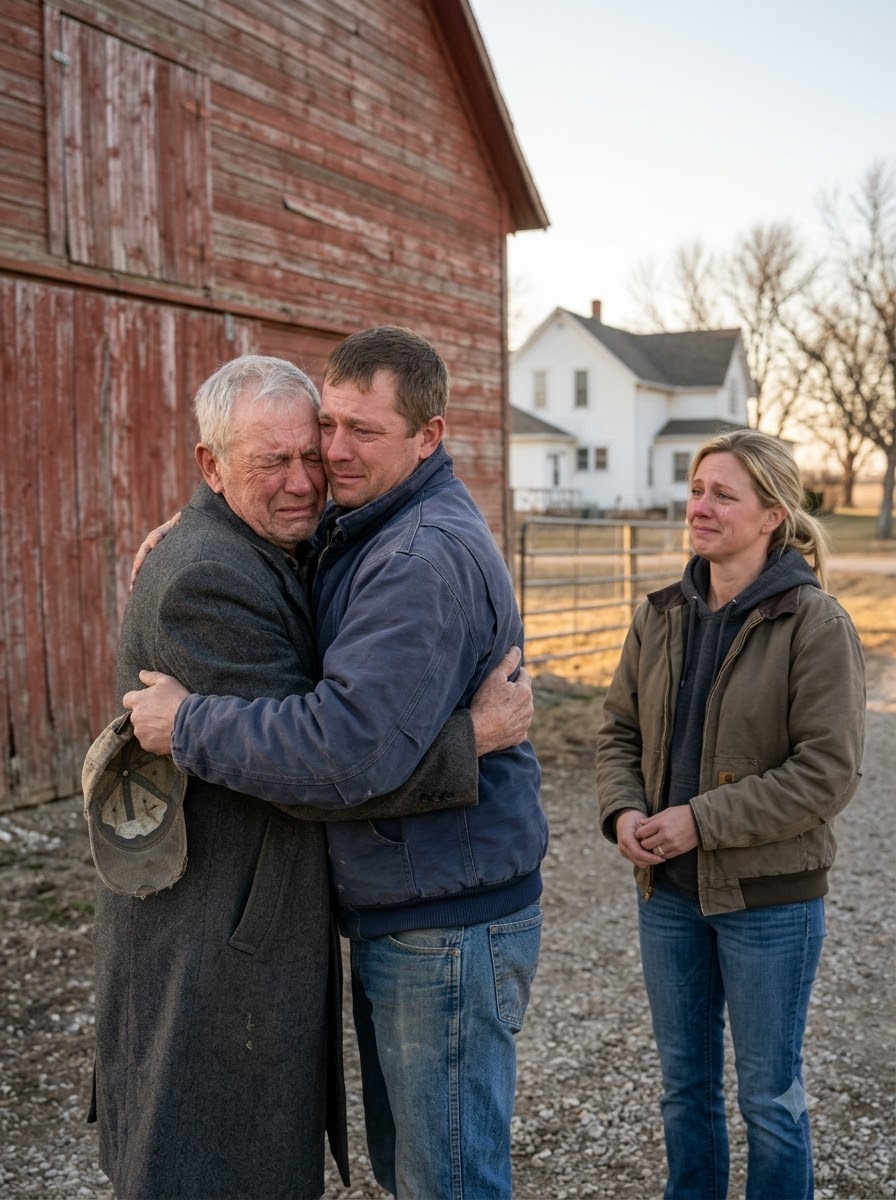
Then he told me Walt was waiting behind the barn.
I found my father-in-law on its sheltered south side, where June used to hang laundry.
He held his seed cap in both hands, turning it slowly by the brim.
Luke appeared a few steps behind me.
Walt looked from his son to me.
“You bought it.”
“We bought it,” I corrected.
He nodded.
For a while, he studied the barn siding instead of our faces.
Then he began speaking.
He explained that he and June had carried a mortgage on the farm for thirty-one years.
Every November, the corn check went directly to the bank.
Some years, it wasn’t enough.
He’d refinanced the loan more times than he could remember.
June had recorded every payment in a green ledger, using her careful handwriting.
When she died, they still owed $11,000.
He’d buried his wife while still owing the bank.
And sitting alone at the kitchen table afterward, looking at her handwriting, had been unbearable.
When Luke proposed buying the farm through a family contract, Walt imagined his son spending another thirty years making payments.
He pictured our two small children and Luke’s county paycheck.
He couldn’t stand the idea of passing the burden to another generation.
“I wasn’t going to hand my boy the same note I carried,” he said. “I’d rather sell it to a stranger and pay the bank off clean.”
Luke moved closer.
“Dad,” he said. “You could’ve told us that.”
“I know it.”
Walt’s voice cracked.
“I didn’t know how. Your mother was the one who knew how to say things.”
Then he finally faced me.
He explained that the men at the co-op had asked why he hadn’t sold the property to Luke.
He couldn’t bring himself to say that he believed his son couldn’t afford it.
Not in front of those men.
“So I said it was you.”
The wind pulled at his coat.
“That was the worst thing I ever said about anybody,” he admitted. “And I said it about the girl who stood up at Easter and thanked me.”
His eyes filled with tears.
“I’m sorry, Amy. I don’t expect that to fix it.”
I remembered the supply closet where I’d hidden after Merle’s appointment.
I remembered leaving for Hastings every Saturday morning, Luke’s exhausting snowplow shifts, and Hailey’s red chart.
Then I imagined Walt sitting in his pickup at the end of the driveway, watching us care for June’s lilacs without knowing how to speak to us.
“It doesn’t need fixing, Walt,” I said. “You told me. That’s the part I needed.”
He put on his cap.
Then removed it again.
Luke stepped forward and wrapped his arms around his father.
Walt held him tightly, crushing the cap in one hand.
They stood together beside the barn where June had once hung her laundry.
I quietly returned to the yard.
Some moments belong only to a father and son.
But I had no idea that the most meaningful part of buying back the homeplace was still waiting inside its kitchen.
PART 3 — The Marks That Could Never Be Sold
We completed the purchase on April twenty-second at the title company in Kearney.
Tom Riley shook my hand afterward.
He said he’d attended countless land auctions, but he’d never seen someone deliberately slow the bidding to a half-thousand-dollar increment the way I had.
That afternoon, Luke, the children, and I drove to the farm with our new keys.
Walt followed in his pickup.
I’d invited him.
He initially agreed, then called an hour later to ask whether I was certain.
I told him I was.
Grant Ostrander had left the farmhouse clean and empty.
During his ownership, he’d painted the downstairs walls a uniform white.
He’d done a careful job.
But he hadn’t known what those walls held.
In the kitchen, the doorframe leading to the back porch had been painted completely smooth.
Before the sale, that frame had carried nearly two decades of pencil marks.
Every April twelfth, on Luke’s birthday, June had made him stand against the doorframe.
She’d placed a book flat on his head, marked his height, and written the date beside it in her small, slanted handwriting.
She continued the tradition from the time he could stand until he finished high school.
During the week of June’s funeral, while relatives gathered in the living room with casseroles, I’d slipped into the kitchen alone.
I photographed every mark with my phone.
I held a ruler beside each one to record the exact measurements.
At the time, I didn’t know why I was doing it.
I simply couldn’t bear the thought of losing them.
I’d never mentioned the photographs to anyone.
Now, standing in that freshly painted kitchen, I opened them on my phone.
I handed it to Walt.
He studied the screen.
Then he removed his reading glasses from his shirt pocket and leaned closer.
I’d brought a carpenter’s pencil and tape measure from Luke’s toolbox.
Luke stood silently in the dining room doorway.
“Read them to me,” I asked Walt.
He cleared his throat.
“Luke. Third birthday. April twelfth, 1988. Thirty-five and a half inches.”
I measured carefully from the floor.
Then I drew a short pencil line and wrote the date beside it, doing my best to imitate June’s handwriting.
“Fourth birthday,” Walt continued. “Thirty-eight inches.”
His voice remained steady.
We worked our way up the doorframe, year by year.
At six, June had added a note about Luke losing a tooth.
At nine, she’d written “cheater” because he’d tried standing on his toes.
She’d made him lower his heels and measured him again.
When we reached his eleventh birthday, Walt stopped.
He removed his glasses and wiped them against his shirt.
I waited without speaking.
Hailey came beside me and held the tape measure so I could work with both hands.
Eventually, Walt continued.
The final measurement was from Luke’s eighteenth birthday.
Six feet one inch.
I climbed onto a kitchen chair to restore it.
When the last mark was finished, Walt returned his glasses to his pocket.
Then he held out his hand for the pencil.
“Come here, Hailey.”
Our daughter stood against the doorframe, heels flat.
Walt placed the tape measure on top of her head, just as June had done for Luke.
He drew a line and wrote the date in his own large, square handwriting.
Then Cody stepped forward.
He pressed his back against the frame and immediately rose onto his toes.
Walt looked down over his glasses.
“Cheater.”
He made Cody lower his heels before measuring again.
Luke laughed.
Not a polite chuckle.
A full, genuine laugh that I hadn’t heard from him in a very long time.
Then he quietly stepped onto the back porch.
Nobody followed.
We understood.
At the end of May, Merle Hansen returned for his cleaning.
He was eighty-five now and needed a little longer to settle into the dental chair.
Before I could fasten his bib, he spoke.
“Your father-in-law’s been talking at the co-op again.”
My hand stopped.
Merle explained that Walt had arrived at the coffee table one Monday during the first week of April.
He hadn’t sat down.
Instead, he’d stood at the end of the table, holding his coffee, and addressed every man there.
He admitted that what he’d said about me four years earlier was a lie.
He told them he was ashamed.
And he declared that his son had married the best woman in Buffalo County.
Then he sat down and began discussing the markets as though nothing unusual had happened.
But Merle assured me nobody present would ever forget it.
“Thought you ought to know,” he said, “what’s being said about you.”
I finished fastening his bib.
My eyes burned with tears.
This time, I didn’t hide them.
“Thank you for telling me, Merle.”
We moved into the farmhouse during the second week of May.
June’s lilacs were blooming beside the porch, filling the yard with the fragrance that had always reminded me of her kitchen in spring.
Cody reclaimed the little bedroom where he’d taken Sunday naps at his grandparents’ house.
Hailey chose the upstairs room overlooking the red barn.
She hung her savings thermometer inside her closet.
The red marker now reached the very top.
On our first Sunday there, I prepared a roast.
I set the kitchen table for five.
At twelve-fifteen, someone knocked on the back door.
I knew immediately who it was.
Only one person would come to that entrance.
Walt stood on the porch wearing his gray church coat, his seed cap held in one hand.
For fifty years, he’d entered that kitchen without knocking.
Now he waited on the mat, uncertain whether he was welcome.
I opened the screen door.
“Walt,” I said. “This door has never needed a knock.”
He hesitated.
Then he wiped his boots twice and stepped inside.
Four years earlier, when Walt emptied the house, he’d packed much of June’s kitchen into boxes destined for the church rummage sale.
Before those boxes were taken away, I’d looked through one of them.
And I’d saved something.
For four years, it had remained hidden at the back of a cupboard in our house in town, behind the good gravy boat.
I’d kept it without knowing whether I’d ever have a reason to bring it home.
Now I poured the coffee.
And in front of Walt’s place at the oilcloth-covered table, I set down his old brown stoneware cup.
The one with the chip in its handle.
The same cup he’d used every morning for as long as I’d known him.
He stared at it.
Then he lifted it carefully.
He turned it once against the oilcloth.
And he drank.
