

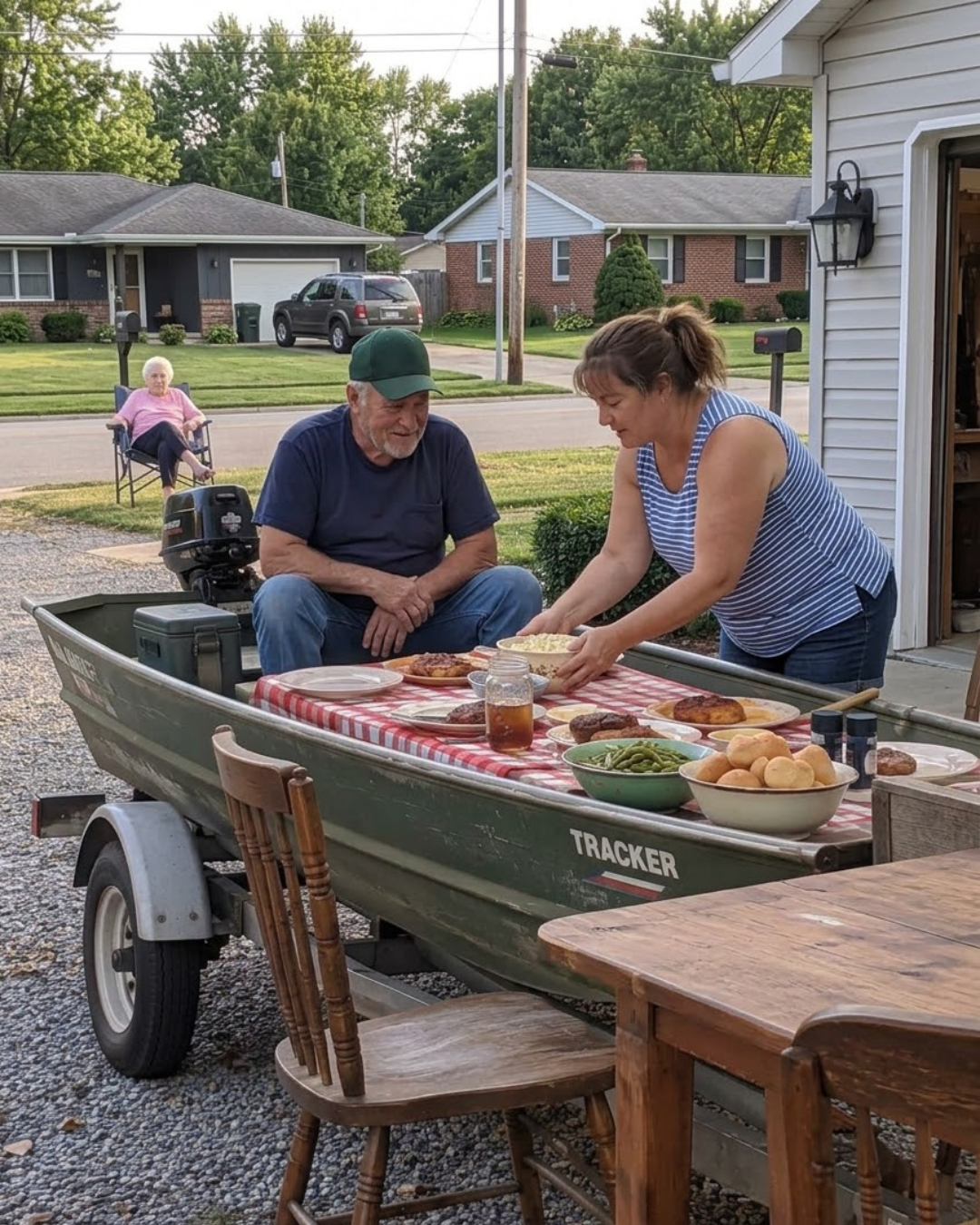
PART 1 — The Boat That Cost Me Six Years
“It still works fine, Karen.”
My husband said those words in our driveway on a Saturday afternoon near the end of April.
His palm rested against a bass boat that hadn’t been there when I drove away to buy groceries.
The boat was green with silver metallic flakes, sparkling like a bowling ball beneath the lights of a bowling alley. A 150-horsepower Mercury motor hung off the back, and the trailer beneath it had one tire that looked noticeably softer than the other.
I stood beside my car holding a gallon of milk and a ten-pound bag of potatoes.
For several seconds, I couldn’t think of anywhere to set them down.
“What works fine?” I asked.
“The kitchen.”
Rick kept his eyes on the boat.
“The cabinets close. The stove heats. My mother cooked on worse for forty years.”
And suddenly, I understood how he’d paid for it.
I’m Karen Schmitz. I was fifty-three years old, and I’d spent twenty-two years working as a teller at First State Bank in Cambridge, Iowa.
For six years, I’d been putting forty dollars from every Friday paycheck into a savings account we called our kitchen fund.
Forty dollars, week after week.
I’d arranged an automatic transfer because I knew how easy it would be to find something else to spend the money on.
There were times I had to borrow from those savings.
When Tyler was twenty and his transmission failed, we needed help paying for repairs. Another winter, our water heater flooded the basement.
But I always replaced whatever I’d taken.
By that April, the account held $11,012.
I knew the balance precisely.
Counting money was my profession, and every Friday during lunch, I sat in my car in the bank parking lot with a ham sandwich and checked our savings on my phone.
Our contractor’s estimate hung on the refrigerator beneath a corn-shaped magnet.
The total was exactly $11,000.
That covered new oak cabinets, laminate countertops, a range with four functioning burners, and the labor to install everything.
Our kitchen hadn’t been remodeled since the house was built in 1978.
The dark cabinets sagged on their hinges. Doors refused to stay closed. Our stove had only one working burner, and its only temperature was high.
For thirty-two years, whenever I made gravy, I’d stood over that burner stirring continuously with a wooden spoon to keep it from scorching.
Now the money I’d saved to change all that was sitting in our driveway.
“Where did you get the money, Rick?”
I knew the answer before he spoke.
“I got a cashier’s check yesterday,” he replied. “At the branch over in Nevada.”
He finally turned toward me.
“I knew better than to do it at your window.”
At least he admitted that.
The account belonged to both of us. Legally, he could withdraw the money, and the employee at the Nevada branch had no reason to refuse him.
“Who sold it to you?”
“Fella from Story City. He’s moving down by his daughter in Missouri. He had the papers all ready.”
Rick rubbed the back of his neck.
“He’s gone already, Karen. He left this morning.”
There was nothing left to negotiate.
The seller had already departed. I couldn’t return the boat to a dealership or call someone to reverse the purchase.
Our $11,000 was somewhere along Interstate 35, traveling south toward Kansas City.
I placed the milk on my car’s hood and set the potatoes beside it.
“Well,” I said. “Thank you for telling me.”
Rick stared at me in disbelief.
I think he’d expected tears, shouting, or perhaps the sound of our screen door slamming behind me.
Instead, I gathered my groceries, went inside, and began preparing dinner.
It was Saturday, which meant pot roast.
I arranged carrots and potatoes around the meat, tucked onions beneath it, and made gravy on the burner that wouldn’t turn down.
At 5:50, I opened the hall closet and removed a tablecloth.
Not our ordinary tablecloth.
The good red-and-white checked one my mother had given us for our wedding in 1994.
Normally, it came out only at Thanksgiving and Easter.
Rick was in the garage sorting through the life jackets he’d purchased with his boat.
He didn’t notice when I carried our first kitchen chair outside.
He noticed the second.
“What are you doing?”
“Setting the table.”
He watched me struggle to maneuver our heavy maple kitchen table through the front doorway.
I had to turn it sideways to fit.
Rick came over and lifted the other end without asking why.
That’s how my husband has always been. If something needs carrying, he’ll help carry it, even when he doesn’t understand the reason.
Together, we placed the table on the driveway beside the boat.
Then I fetched my mother’s tablecloth.
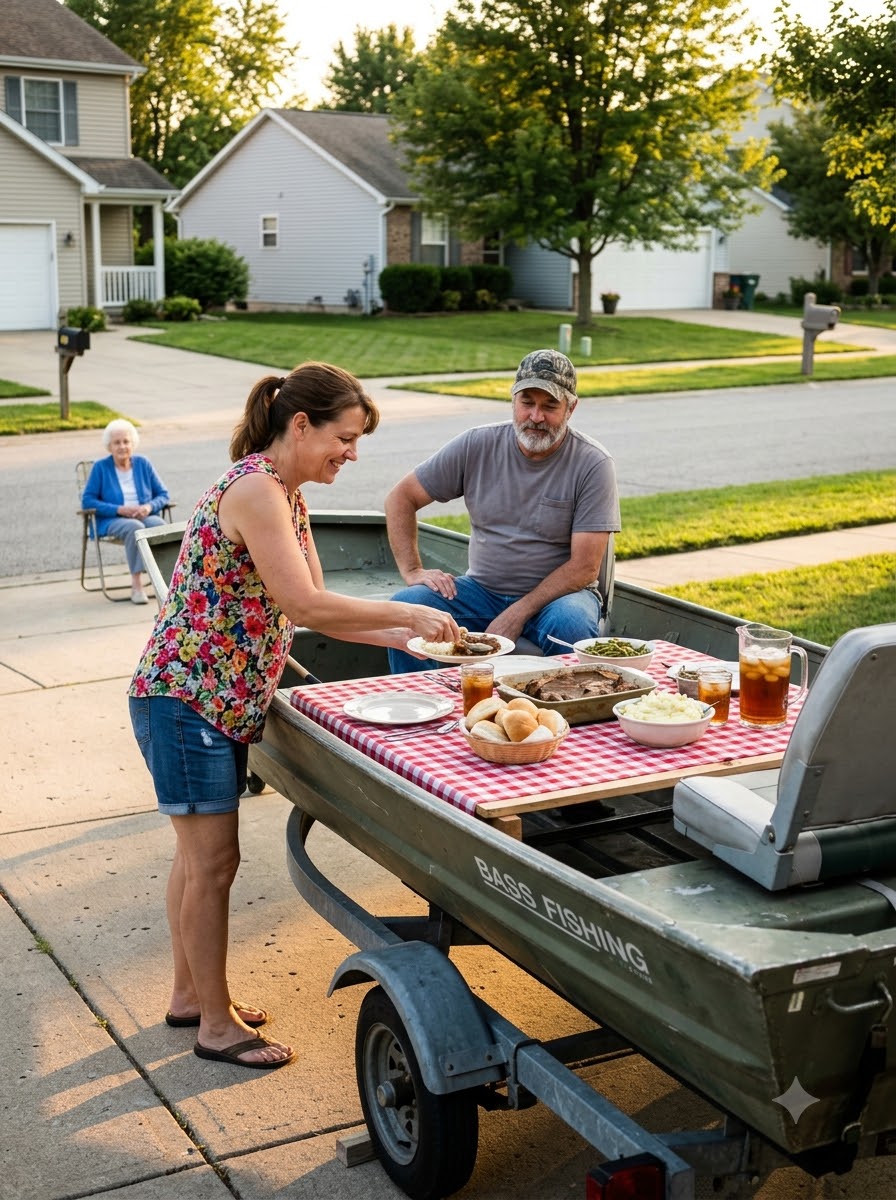
But instead of covering the maple table, I brought our laundry-room step stool outside and climbed into the bass boat.
I spread the cloth across the padded bench between the two consoles.
It was nearly the perfect size.
I tucked its corners beneath the cushions, then carried out two plates, two forks, two knives, two glasses of iced tea, and the roasting pan.
Everything went onto the bench, over my mother’s tablecloth.
“Karen,” Rick called from below. “What is this?”
“Supper,” I replied. “Come eat before it gets cold.”
He stood motionless for a long time.
I settled into the passenger seat and unfolded a paper napkin across my lap.
Eventually, he climbed the step stool, swung himself into the boat, and took the driver’s seat opposite me.
“The table’s right there,” he pointed out.
“I know. I needed somewhere to put the bread.”
And I did use the maple table.
I put the gravy boat, dinner rolls, and a saucer of butter on it, reaching over the boat’s side whenever we needed something.
Then we ate.
Neither of us spoke much.
A robin crossed our lawn. Someone down the street was mowing for the first time that spring, filling the air with the smell of freshly cut grass.
That scent mingled with our pot roast.
After dinner, I took the dishes inside and washed them.
The cabinet door beside my hip kept swinging open, as it had since around 2009.
I nudged it shut with my knee three times while rinsing plates.
Rick joined me, picked up a dish towel, and began drying.
He didn’t mention the boat.
Neither did I.
Across the street lived Marlys Henning.
Marlys was seventy-four and had occupied her small white ranch house since long before Rick and I bought ours.
She’d spent fifty years observing everything that happened on our street, and she wasn’t about to start missing things now.
At exactly six o’clock on our second evening, Marlys emerged carrying a folding lawn chair and a cup of coffee.
She arranged the chair on her front step, sat down, and crossed her ankles.
She didn’t wave or call to us.
She simply watched, with the concentration of someone following a Hawkeyes game she’d bet money on.
That evening, I served meatloaf, baked potatoes, and frozen green beans.
I also lit a small vanilla candle inside a pint Mason jar and placed it in the cup holder near the boat’s steering wheel.
Rick stared at the candle.
Then he glanced across the street.
“She’s watching us.”
“She’s watching the boat,” I answered. “It’s a pretty boat.”
He made a noise that almost sounded like a laugh.
He ate two portions of meatloaf and wiped his mustache with his napkin.
“That was good, Karen.”
“Thank you.”
I meant it.
The meatloaf hadn’t done anything wrong.
By the third evening, Marlys had added a sweater to her viewing arrangements.
She brought her own supper outside and ate it on her front step while we dined in the boat.
Afterward, I carried a slice of rhubarb pie across the street.
She accepted the plate with both hands.
“Honey,” she asked, “How long are you going to do this?”
“Until it’s done.”
“Until what’s done?”
“I’ll know it when I see it.”
That was the only honest answer I had.
Before I tell you what happened next, you need to understand something about Rick.
People who later heard about those dinners thought they knew exactly what kind of husband he was.
They didn’t.
Rick had worked as a lineman for the rural electric cooperative for thirty years.
He started at twenty-five as a groundman, completed his apprenticeships, and became a journeyman.
For most of his career, he climbed wooden utility poles using steel hooks strapped to his boots and a leather safety belt around the pole.
When ice storms damaged the power lines, Rick went out.
Sometimes that meant Christmas Eve.
Sometimes it meant Tyler’s birthday.
One winter, he worked eleven consecutive days. He came home with frostbite on two fingers and slept on the couch for a day and a half, still wearing his boots.
During the summer derecho, he worked sixteen-hour shifts for three weeks, replacing poles in fields where the corn had been flattened.
He returned home so exhausted that he’d eat standing at the kitchen counter before going straight to bed.
In thirty-two years of marriage, Rick had never requested anything extravagant for himself.
No new truck.
No Montana hunting trip with his friends.
Not even a replacement recliner when the old one leaned sideways whenever he sat back.
Much of that came from his father.
Walt Schmitz farmed two hundred acres south of town and believed a man who wanted something purely for himself was becoming weak.
At fourteen, Rick spent an entire summer detasseling corn to save $200 for a used red Honda minibike.
The following spring, Walt sold it at the farm sale without consulting him.
Rick returned from school and discovered it was gone.
He told me that story once, during our first year of marriage, while we sat on his parents’ porch steps after Sunday dinner.
He never brought it up again.
But I never forgot.
On our fourth evening eating in the driveway, two visitors arrived.
Duane Becker and Lyle Ostrander had been fishing with Rick since high school.
They’d heard about the boat at the co-op and about our unusual dinners at Casey’s gas station.
At 6:15, Duane’s pickup pulled up.
Both men stood at the foot of our driveway, holding their seed caps as though attending a funeral visitation.
“Evening, Karen,” Duane greeted me.
“Evening, Duane. Lyle. Have you two eaten?”
They exchanged a glance.
“There’s plenty. It’s chicken and noodles.”
I fetched two more plates.
Duane sat on the front casting deck, balancing his dinner on his knees.
Lyle settled onto the rear deck with his feet dangling over the motor.
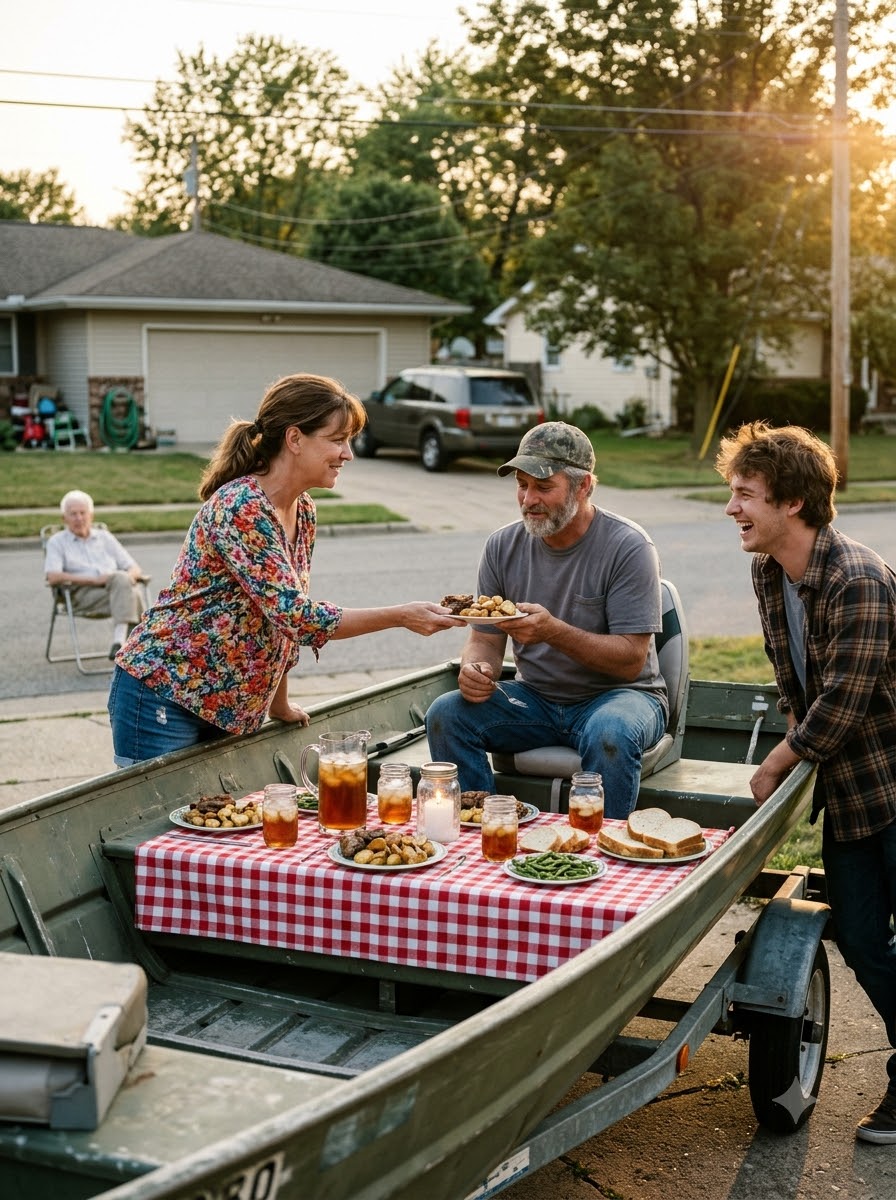
There we were, four adults eating chicken and noodles inside a bass boat parked in an Iowa driveway.
Marlys watched from her lawn chair, coffee in hand.
Our Mason jar candle flickered in the cup holder.
Duane declared it the finest boat he’d ever eaten in.
Lyle requested another serving.
The men discussed walleye at Saylorville Lake and whether the crappies would soon move into shallow water.
Rick laughed.
A genuine laugh.
Then his eyes met mine, and his expression changed.
After our friends left, Rick remained in the boat.
I began gathering dishes, but he gently caught my wrist.
“Sit down a minute, Karen.”
I sat.
The candle had burned down to about an inch.
A semi passed on the highway, setting off the dog two houses away.
“I turned fifty-five in March,” Rick said.
“I know. I made the cake.”
“A letter came from the co-op in February. About my pension. What it’s going to be when I retire.”
He studied his hands.
“I sat in the truck in the co-op parking lot and read it four times.”
“Was it bad?”
“No. It’s fine. It’s fair.”
He rotated his wedding ring.
“That’s what got me. It was fine. Thirty years of climbing poles in ice storms, and that’s what I had to show for it. A fair letter.”
I stayed quiet.
Over the years, I’d learned that Rick needed silence before he could find the words he wanted.
“Dad never let me have one thing,” he continued. “You know that. And I never asked him. I never asked you either.”
He shook his head.
“And then I’m sitting in the truck with that letter. And I thought, I’m going to be dead someday. And I never had one single thing that was just mine.”
“So you bought a boat.”
“So I bought a boat.”
He paused.
“With your kitchen,” he admitted. “I know it. I knew it when I signed the check. And I did it anyway. And then I told you the kitchen works fine, because I couldn’t think of one other thing to say.”
“It doesn’t work fine, Rick.”
“I know it doesn’t.”
He stared at the tablecloth.
Then he finally said it.
“I’m sorry, Karen.”
The words sounded strained, as though they’d been lodged inside him for days.
“I know you are.”
I didn’t tell him everything was fine.
Because it wasn’t.
But I placed my hand over his, there on the padded bench beneath my mother’s tablecloth.
We sat together until the candle burned out.
And the following evening, I served dinner in the boat again.
PART 2 — Nine Dinners and One Decision
Our fifth dinner brought another pair of unexpected guests.
Our son Tyler arrived with his wife, Amber.
Tyler was twenty-four and worked at the local grain elevator. He and Amber rented a small house near the elementary school.
He’d heard about our dinners from Amber, who’d heard from her mother, who’d learned about it at Bible study.
Tyler stood at the end of the driveway with both hands shoved into his jacket pockets.
Amber carried a foil-covered pan of brownies.
“Mom,” Tyler asked. “What are you doing?”
“Eating supper with your father. You hungry? It’s tater tot casserole.”
Tyler looked at Rick.
His father sat in the boat’s driver’s seat with a fork in his hand and his co-op cap pushed back.
“Don’t look at me,” Rick said. “I’m just a guest here.”
Amber burst out laughing, then quickly covered her mouth.
She climbed the step stool and settled onto the front deck.
Having grown up on a hog farm outside Maxwell, Amber wasn’t easily intimidated.
Tyler remained on the driveway for another moment.
Then he pulled one of our kitchen chairs beside the boat and ate at the maple table, looking like an adult relegated to the children’s table at Thanksgiving.
When Rick went inside for more iced tea, Tyler leaned toward me.
“Mom. Are you okay?”
“I’m fine, honey.”
“Do you want me to talk to him?”
I studied my son.
He had Rick’s broad shoulders and the same habit of resting most of his weight on one foot.
In twenty-four years, he’d never raised his voice at his father.
“No,” I told him. “Your dad’s talking to himself just fine. Let him.”
The sixth evening, Rick’s coworkers made an appearance.
Two bucket trucks and a large digger derrick rolled down our street after a job near the county line.
Our road wasn’t a shortcut to anywhere.
They’d deliberately driven that way.
The first truck sounded its horn twice.
The second honked three times.
The driver of the digger leaned out his window and shouted, “Save me a plate, Schmitzy!”
Rick covered his face with both hands.
His ears turned scarlet.
But when he lowered his hands, he was smiling.
“They are never going to let me live this down.”
“No. I don’t suppose they are.”
Marlys raised her coffee cup in acknowledgment.
One of the linemen waved back.
By then, our dinners had become a neighborhood curiosity.
Cars slowed as they passed.
The Lutheran pastor’s wife walked her dog by our house twice in one evening.
A boy on a bicycle circled the cul-de-sac three times before asking whether he could sit inside the boat once we’d finished.
I let him.
I never snapped at our spectators.
And I never snapped at Rick.
Each evening, I prepared a proper meal, covered the bench with my mother’s tablecloth, lit the Mason jar candle, and climbed aboard.
That night, my sister Deb called from Marshalltown.
“Karen Ann,” she said. “Half of Marshall County knows you’re eating supper in a fishing boat.”
“Only half?”
“Are you trying to embarrass him?”
I considered her question carefully.
She deserved an honest answer.
“No. I’m trying to show him. If I’d yelled at him, he’d have yelled back. And then the boat would still be sitting in the driveway, and we’d both be mad. This way, he has to sit in it.”
“And look at it.”
“And look at me. Across that bench seat. Every single night.”
Deb fell quiet.
“You always were the smart one.”
“I’m not smart. I’m just tired of making gravy on high.”
What happened before our seventh dinner was something I didn’t learn until much later.
Rick told me afterward, when our kitchen table was finally back where it belonged.
Duane arrived around four that afternoon, while I was still working at the bank.
Rick was in the garage inflating the trailer’s low tire.
Duane owned a twenty-year-old aluminum fishing boat, stored in his pole shed.
He, Rick, and Lyle had taken it fishing more times than any of them could count.
His wife, Joanne, had died of cancer three winters earlier.
I’d known her since our children attended grade school and we served together on the PTA.
She was cheerful and kind, famous for her scotcheroos, and rarely complained.
Duane sat on an upside-down five-gallon bucket and watched Rick work.
Then he spoke.
“Joanne wanted a new kitchen.”
Rick stopped pumping air.
“Twenty years she wanted it,” Duane continued. “Had a picture out of a magazine taped up inside the cupboard door. Right by the coffee filters. A white kitchen with blue tile.”
He turned his cap in his hands.
“Every spring, I said next year. There was always something. A combine part. A new pickup. A new motor for the boat.”
He stared at the concrete.
“She cooked on that old stove right up until she couldn’t stand up at it anymore.”
Rick later admitted he hadn’t known what to say.
“I took that picture down after the funeral,” Duane told him. “I’ve still got it. It’s in my billfold.”
Then he stood.
“That’s all I came to say, Rick. I’ll see you at supper.”
Duane joined us that evening and ate ham with scalloped potatoes in the boat.
He talked about the Cubs as though nothing unusual had occurred.
Rick, however, barely spoke.
He kept looking at me across the checked tablecloth.
On the eighth evening, rain arrived.
It rolled in from the west around five o’clock, a gentle but persistent May rain.
I watched droplets collect on the boat’s glittering green finish through our living-room window.
Rick stood beside me.
“We can’t eat out there in this.”
“Sure we can.”
I fetched the oversized golf umbrella I’d received at the bank’s customer appreciation day.
I also brought out our plastic tablecloth to protect the good one.
We ate beef stew beneath the umbrella.
Rain rattled overhead and dripped onto my shoulders.
The Mason jar candle went out within five minutes.
I didn’t relight it.
Across the street, Marlys occupied her usual lawn chair beneath her porch roof.
She’d wrapped herself in a crocheted afghan and was drinking coffee.
“That woman,” Rick said, “has no life of her own.”
“She has ours.”
He laughed.
Then the laughter faded.
He placed his spoon inside his bowl.
“Karen,” he asked. “What do you want me to do?”
It was the first time in eight nights he’d asked that question.
I looked at him across the bench.
Water dripped from the bill of his cap.
He looked fifty-five and fourteen at the same time.
“I don’t want you to do anything just because I want you to,” I told him. “That’s not how this works, Rick. You know that. I’m not your daddy. And I’m not selling anything at a farm sale.”
He flinched.
I hadn’t planned to mention his father.
The words escaped before I could stop them.
But I didn’t retract them.
“I’m going to make supper tomorrow night. Pot roast. Because it’s Saturday. And I’m going to serve it right here. Whatever you decide, I’ll be sitting on this seat at six o’clock.”
We finished our stew while the rain continued falling.
Saturday arrived.
I prepared another pot roast, arranging potatoes and carrots around it with onions beneath.
I stirred gravy over the single burner that worked only on high.
At ten minutes to six, I spread my mother’s tablecloth across the boat’s bench.
I lit the candle.
I arranged two place settings and brought out the roast.
Marlys was already watching from her chair.
Duane and Lyle had parked along the curb.
Tyler and Amber approached on foot after leaving their car around the corner.
Three other vehicles had stopped across the street.
The pastor’s wife was walking her dog again.
But Rick wasn’t in the garage.
I couldn’t see him anywhere.
At precisely six, our front door opened.
My husband stepped outside wearing the light-blue button-down shirt he’d worn to Tyler’s wedding.
He’d shaved and combed his hair while it was still wet.
He carried a folded sheet of paper.
Instead of climbing into the boat, he walked past it toward the end of our driveway.
He stopped where everyone could see him.
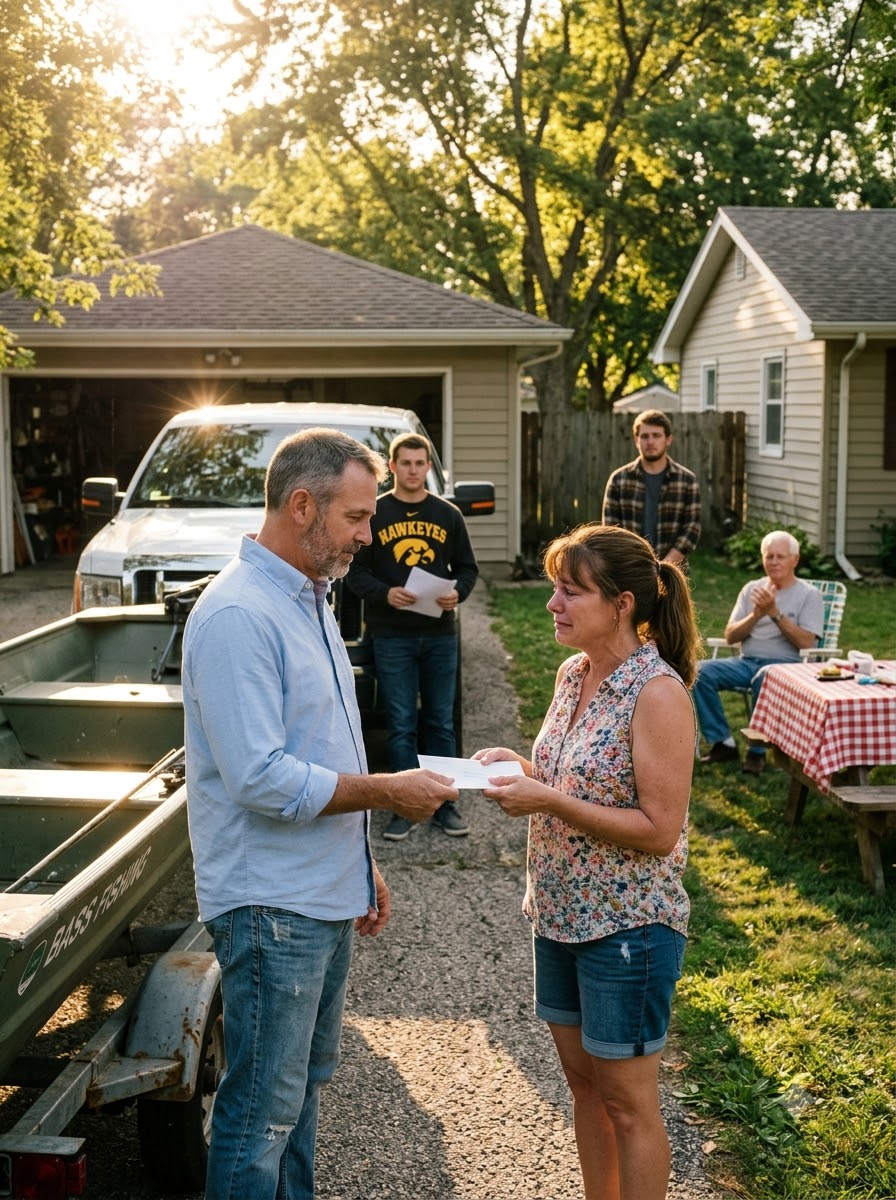
A white pickup pulled up behind Duane’s truck.
A young man, perhaps thirty, stepped out wearing a Hawkeyes sweatshirt and carrying an envelope.
“This is Jeff,” Rick announced loudly enough for the neighbors to hear. “He’s from Ames. He’s buying a boat.”
Marlys lowered her coffee cup onto the step.
Rick unfolded the paper.
“Karen. Come stand by me before I sign this.”
I climbed down from the boat and joined him.
The document was the boat’s title.
Rick spread it across the hood of Jeff’s pickup and removed a pen from his shirt pocket.
Then, with the entire street watching, he signed over ownership.
Jeff handed him the envelope.
Rick didn’t open it.
He turned and placed it in my hands.
“It’s a cashier’s check,” he said. “Ten thousand two hundred dollars. I lost eight hundred on it, Karen. That part’s on me.”
I looked down.
My vision had become blurry.
“I’m sorry,” Rick said.
This apology sounded different from the one he’d given me after our fourth dinner.
His voice was steady and clear.
“You saved for six years for that kitchen. Forty dollars at a time. And I took it for something to prove I was still somebody. I was wrong. Whatever’s left, I’ll make up with overtime.”
Nobody spoke.
Then Marlys began clapping from across the street.
Slowly at first.
Duane joined her.
Then Amber, Lyle, the people beside their cars, and the pastor’s wife holding her dog’s leash.
Tyler didn’t clap.
He walked toward his father and wrapped him in a hug.
Rick held him for a long time.
Then my husband turned to Jeff.
“One thing. Would you mind if we ate supper in her one last time first? My wife made pot roast.”
Jeff laughed and agreed.
So our boat’s new owner joined us for dinner.
He sat on the rear deck with his plate balanced on his knees and declared that he’d never tasted better pot roast.
I believed him.
After we’d eaten, Jeff backed his pickup toward the trailer.
Rick and Duane helped attach the hitch, cross the safety chains, and test the trailer lights.
Then Rick rested his hand against the green-and-silver hull one final time.
He stood there for a moment.
Then he let go.
Jeff drove away toward Highway 65.
The driveway was left with nothing but our maple kitchen table, two chairs, and my mother’s folded red-and-white tablecloth.
I thought that was the end of our boat story.
But a few days later, while tearing out our old kitchen cabinets, we found something neither my son nor I had expected.
And it changed how I understood the man I’d been married to for thirty-two years.
PART 3 — The Secret Inside the Coffee Can
On Monday morning, Rick began a week’s vacation.
He’d originally saved those days for deer season.
Instead, he and Tyler started removing our kitchen cabinets, which had been there since 1978.
Rick insisted there was no point paying a contractor to swing a pry bar when he had two working arms and a son willing to help.
The contractor agreed.
He reduced the estimate by $1,000 because we were handling the demolition ourselves.
The old brown cabinets came out one by one.
Rick and Tyler stacked them on the driveway in the exact spot where the bass boat had stood.
Duane arrived with his flatbed trailer to haul the debris to the county dump.
Lyle brought a cooler filled with soda.
Marlys contributed her lawn chair.
By Tuesday afternoon, Tyler had reached the final upper cabinet.
It was the one above the refrigerator, so high that nobody ever opened it without a step stool.
When he removed it, he found something inside.
He handed it down to me.
My coffee can.
The kitchen can.
It was a large red Folgers container with a narrow slot cut into the plastic lid.
I’d made that slot with a paring knife six years earlier, during the same week I arranged the automatic bank transfers.
The can was supposed to hold money for little extras once we finally remodeled.
Loose coins.
Occasional dollar bills.
Maybe enough for new kitchen canisters or a rug to place in front of the sink.
I’d planned to leave it unopened until the kitchen was finished.
A small surprise for myself.
But when Tyler handed it to me, the can felt much heavier than I remembered.
I sat down on the floor of our stripped kitchen, leaning against the bare wall.
Then I pulled off the lid.
There were quarters and dimes near the top.
Beneath them, the can was packed tightly with twenty-dollar bills.
Each bill had been folded in half, then folded again until it was small enough to pass through the slot.
There were hundreds.
I began counting.
After twenty-two years as a bank teller, counting money was something my hands could do almost without my thinking.
Tyler sat beside me and helped arrange the bills into neat stacks.
When we finished, we had counted 312 twenties.
Six thousand, two hundred and forty dollars.
Rick stood in the kitchen doorway holding his pry bar.
He didn’t step inside.
“Every Friday,” he said quietly. “Since the week you cut that slot. I’d stop in here on the way out to the truck in the morning.”
I stared at him.
“For six years?”
“Storm pay, mostly. A little out of my lunch money.”
He looked down.
“I never said anything because I didn’t know how to. You’d have told me we couldn’t afford it.”
“We couldn’t.”
“I know.”
Then he raised his eyes.
“I just figured someday you’d open it. And it’d be a good day.”
I sat on that dusty kitchen floor, surrounded by stacks of folded twenty-dollar bills.
And I cried.
I cried harder than I had during all nine dinners.
Harder than I had when I first discovered the boat.
Because the man standing in the doorway was the same man who’d taken our kitchen savings to buy a bass boat.
And he was also the man who’d quietly slipped a twenty-dollar bill into my coffee can every Friday for six years.
Without asking for credit.
Without telling me.
Without once mentioning what he was doing.
I’d been married to both sides of that man for thirty-two years.
Rick leaned the pry bar against the wall.
He came over and lowered himself onto the floor beside me.
Tyler quietly stood and went outside.
“I’m sorry I said it works fine,” Rick told me.
“I’m sorry I made you eat supper in a boat for nine days.”
“No, you’re not.”
“No. I’m not.”
He wrapped his arm around me.
We stayed there on the bare floor, surrounded by all those twenties, until Tyler called from outside that Duane had returned with the trailer.
When we added the boat-sale money to the coffee-can savings, we had more than enough to cover the contractor’s original estimate.
The total exceeded $16,500, including my final two Friday transfers and the quarters and dimes from the can.
So I called our contractor again.
I asked whether we could add a breakfast nook.
There was an unused corner near the back window where we’d always kept the mop bucket.
He said it could be done.
Rick asked whether he could build the benches himself.
And that’s exactly what he did.
He spent three weekends working on them in the garage.
Duane helped by handing him boards.
Lyle sat on an overturned bucket, explaining everything Rick was supposedly doing wrong.
Rick used solid oak to match our new cabinets.
He built two facing benches with a small table between them, directly beneath the back window.
From that window, I could see Marlys’s front step.
The new kitchen cabinets were installed during the first week of June.
Light oak.
Doors that shut completely.
Doors that stayed shut.
Our new range had four burners.
Every one of them could be turned down to low.
The first time I made gravy on that stove, I stood watching the saucepan.
I didn’t have to stir continuously.
Not once.
The gravy simmered gently, evenly, exactly the way gravy was supposed to.
I laughed out loud.
There I was, alone in my newly remodeled kitchen, laughing at a pot of gravy.
On our first Saturday with the new kitchen, I prepared pot roast.
I put carrots and potatoes around the meat, with onions beneath it.
And for the first time, we ate Saturday dinner in our new breakfast nook.
Marlys joined us.
So did Duane and Lyle.
Tyler and Amber came too.
We squeezed ourselves onto the two oak benches, bumping elbows and passing plates.
Nobody complained about the lack of space.
My mother’s red-and-white checked tablecloth covered the little table.
It had traveled from our wedding in 1994 to holiday dinners, then through nine evenings in a bass boat parked on our driveway.
Now it belonged in our new kitchen.
Marlys settled onto one of the benches.
She ran her palm across the cushion beneath her.
Then she looked at me.
“Karen,” she asked. “Isn’t this the blue vinyl off that boat?”
It was.
When Rick sold the bass boat to Jeff, he’d asked to keep exactly one thing.
The blue vinyl bench cushions from between the two consoles.
The very cushions I’d covered with my mother’s tablecloth for nine consecutive dinners.
Jeff hadn’t minded.
He’d planned to replace them anyway.
So Rick brought those cushions into his garage.
He cut the foam to the proper dimensions and stretched the original blue vinyl over it again, fitting it to the oak benches he’d built.
They were now the softest seats anywhere in our house.
“He asked to keep one thing,” I told Marlys.
Rick stood at the stove, carving the pot roast with his back toward us.
He didn’t turn around.
But I could see the tips of his ears growing red beneath his co-op cap.
And I could see that he was smiling.
