

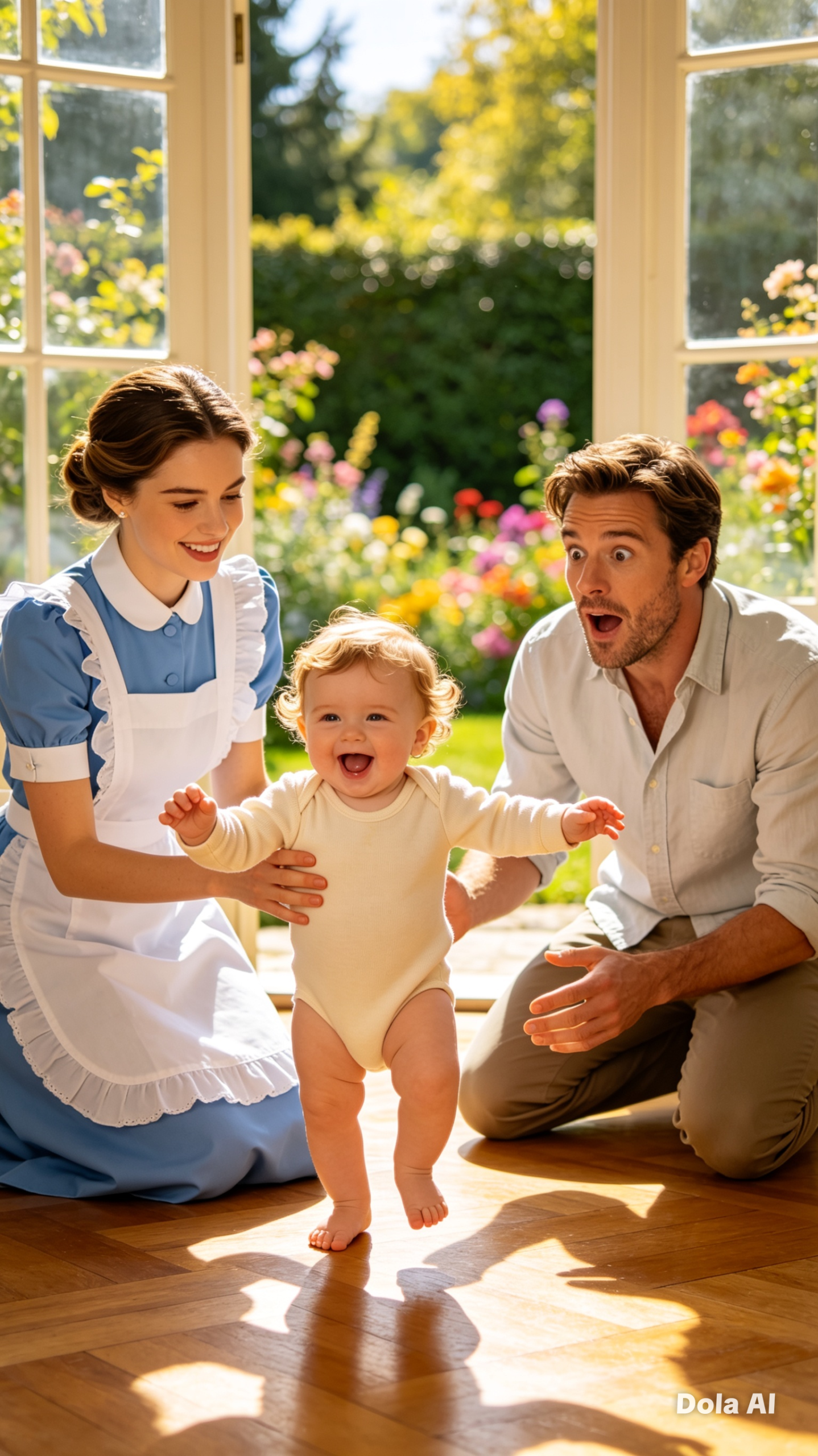
Soft morning light filtered through the white curtains, turning the room into something almost sacred.
Dust floated gently in the air, and the silence was so complete it felt deliberate, as if the house itself was holding its breath.
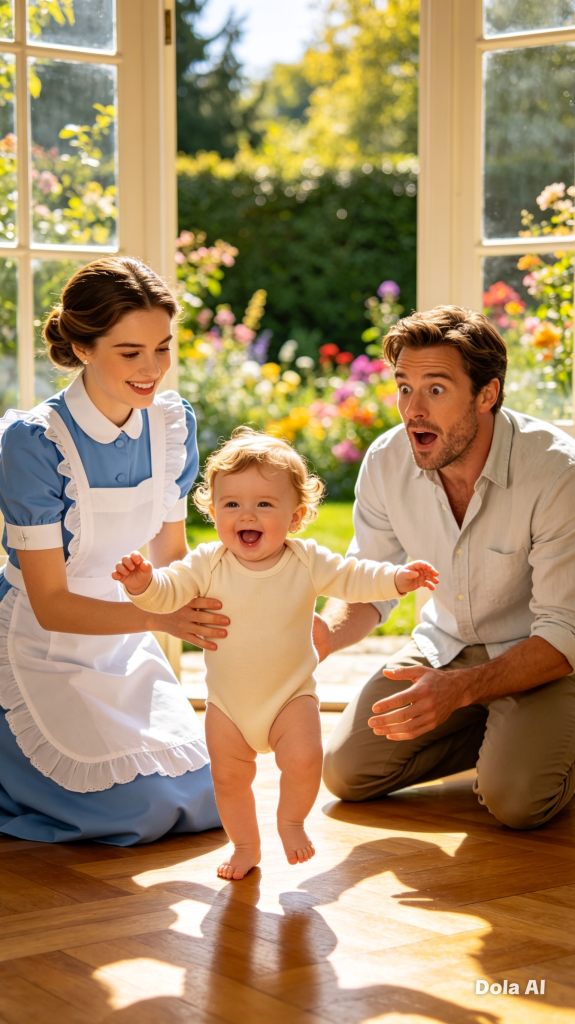
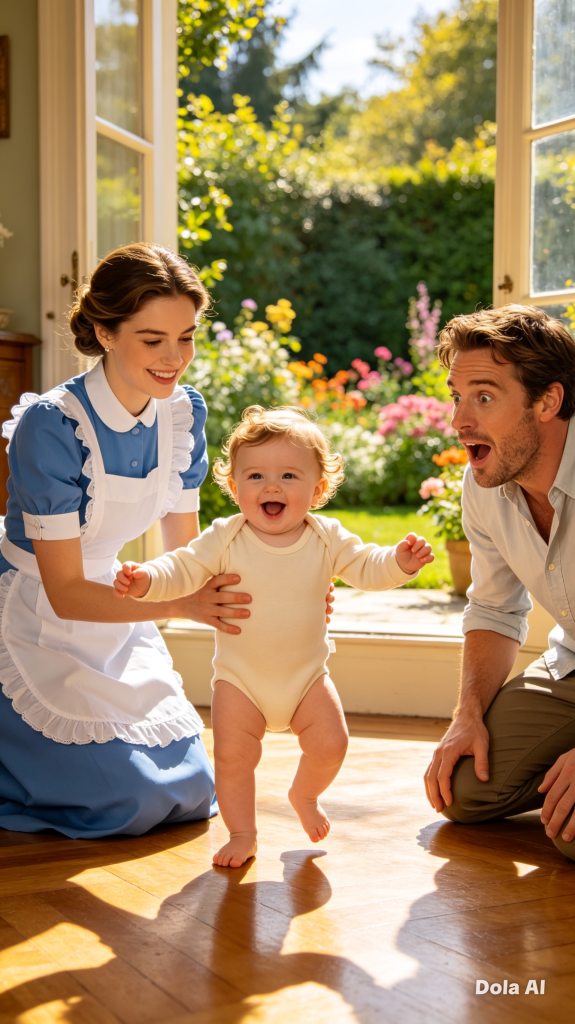
At the center of the nursery, a young maid knelt on the polished oak floor.
Her name was Elena Reyes.
She wore the pale blue uniform Mrs. Whitmore, the housekeeper, had chosen for her on her first day, with white cuffs pressed flat and a narrow apron tied at her waist. Yellow gloves covered her hands, though she had removed them at the fingertips so the baby could feel skin instead of rubber.
“Slowly,” she whispered.
The baby stared at her as if she had just asked him to climb a mountain.
He was eighteen months old, with dark curls, solemn gray eyes, and legs that trembled whenever the world asked too much of him. Behind him stood the small medical wheelchair his father had ordered from Switzerland, custom-made, padded in cream leather, absurdly expensive, heartbreakingly unnecessary in Elena’s opinion.
Not because the child did not need help.
Because no one had dared to ask if he might need hope more.
“Come on, little lion,” Elena murmured. “One foot.”
Lucas Whitmore made a small sound in his throat. Not quite a cry. Not quite a protest. His fingers tightened around hers.
Elena did not pull.
She waited.
That was the first thing she had learned about pain: it hated being rushed.
From the doorway, Nathaniel Whitmore watched without breathing.
He stood in a tailored navy suit, cufflinks catching the morning light, shoes polished enough to reflect the room beneath him. He was thirty-eight years old, owner of five hotels, three private investment firms, and a reputation so cold that newspapers called him “the man who could bankrupt a smile.”

But in that doorway, he was nothing more than a father afraid to blink.
“Miss Reyes,” he said, voice low.
Elena did not turn. “Not yet.”
His jaw tightened. No one in that house spoke to him that way. No one interrupted him. No one ignored the warning beneath his tone.
Especially not a maid he had hired six weeks ago.
Lucas’s left knee buckled.
Nathaniel stepped forward.
Elena lifted one finger.
“Don’t.”
The word landed softly, but it stopped him like a locked gate.
Nathaniel’s face hardened. “If he falls—”
“He won’t.”
“You don’t know that.”
“No,” Elena whispered, eyes still on the baby. “But he needs to know we believe he can try.”
Something flickered in Nathaniel’s expression.
Anger, maybe.
Fear, certainly.
Lucas whimpered. His tiny face twisted with effort, cheeks flushed, mouth open as though the air itself had weight.
“Elena,” Nathaniel said sharply.
The maid finally looked back.
Her eyes were calm.
Not obedient. Not defiant.
Calm.
And somehow that was worse.
“Mr. Whitmore,” she said, “your son has spent a year being protected from the floor. Let him meet it.”
The room went still.
Outside, somewhere beyond the tall windows, the estate gardeners trimmed hedges with mechanical precision. A fountain whispered in the courtyard. Somewhere below, a silver breakfast tray cooled untouched on a dining table large enough for twelve people who never came.
Nathaniel stared at the woman kneeling before his child.
She was young, perhaps twenty-four. Too young to carry that kind of steadiness. Too quiet to be arrogant. Too gentle to be careless.
And yet there she was, asking him to allow the one thing he had sworn never to permit again.
Risk.
Lucas leaned forward.
His right foot pressed into the floor.
Elena’s hands held his.
Not lifting.
Not dragging.
Just there.
Then, with a sound so small it barely existed, Lucas took one step.
Nathaniel’s chest seized.
For one wild second, the world disappeared.
No mansion.
No doctors.
No accident.
No grave.
Just his son’s foot on the floor.
The second step came uglier. Crooked. Shaking. Lucas’s ankle rolled inward, and his face crumpled with panic.
Elena moved instantly, not catching him exactly, but widening her hands around him like a net.
“Yes,” she breathed. “That’s it. You found it. Again.”
Lucas sobbed once.
Nathaniel felt the sound slice through him.
He remembered another cry.
Rain hammering against glass.
Metal bent like paper.
His wife’s blood on his white shirt.
Lucas silent in his car seat until the paramedic pulled him free and he screamed as if the sky had cracked open.
The doctor afterward had worn thin glasses and a voice trained for devastation.
Spinal trauma. Neurological uncertainty. Developmental delay. Possibility of limited mobility.
Possibility.
That word had destroyed Nathaniel more than any certainty could have.
So he had done what rich men do when life reveals its teeth.
He bought things.
Specialists. Machines. Private nurses. Imported braces. Soft floors. Rounded furniture. Emergency call buttons. Therapies approved by the finest clinics in Europe.
Then, when Lucas cried through every session, Nathaniel fired the therapists.
One by one.
“He has suffered enough,” he told them.
But suffering did not leave just because no one spoke its name.
It simply moved into the walls.
The nursery became a museum of caution. Lucas was lifted before he reached, soothed before he struggled, carried before he crawled. Everyone loved him carefully. Everyone feared his bones, his spine, his tears.
Everyone except Elena.
Lucas took another step.
This time Nathaniel made a sound.
It was not dignified.
It was not controlled.
It escaped him before pride could stop it.
Elena smiled, but only at the child. “There. See? Your legs remember.”
“Again,” Lucas breathed.
Nathaniel froze.
It was not the word itself. Lucas had words. Small ones. Milk. No. Papa. Light.
But this word had force behind it.
Again.
Elena’s eyes shone.
“Yes,” she whispered. “Again.”
Lucas’s legs trembled harder now. His whole body shook with exhaustion. But he leaned forward, trusting the woman kneeling before him as if she were gravity, and took a fourth step.
Then a fifth.
By the sixth, Nathaniel’s vision blurred.
He gripped the doorframe so hard his knuckles whitened.
His son was walking.
Not perfectly.
Not safely.
Not the way Nathaniel had imagined in the arrogant days before tragedy, when he thought childhood milestones arrived like scheduled payments.
But Lucas was moving toward the window, toward the light, toward a world that had been kept too far from him.
And Elena was laughing softly through tears.
“There you are,” she whispered. “There you are, little lion.”
Lucas collapsed against her.
This time she caught him fully, wrapping him in both arms as he cried into her shoulder. She rocked him once, twice, pressing her cheek to his curls.
Nathaniel stepped inside.
The floor creaked beneath his shoe.
Elena looked up.
For a long moment, neither spoke.
Then Nathaniel lowered himself to his knees.
It was awkward. His suit pulled at the shoulders. His polished shoes slid on the floor. He looked, for once, like a man using a body he had forgotten was human.
Lucas turned his tear-streaked face.
“Papa,” he said.
Nathaniel reached for him, then stopped, as if asking permission from the child.
Lucas leaned.
That small lean shattered him.
Nathaniel gathered his son into his arms and bowed over him, breathing against his hair.
The scent of baby shampoo and milk and warm skin struck him so hard he nearly broke apart.
“I saw you,” he whispered. “I saw you, my brave boy.”
Lucas patted his father’s cheek clumsily. “Again.”
Nathaniel laughed.
It came out broken.
“Yes,” he said. “Again. As many times as you want.”
Elena sat back on her heels, wiping her face quickly with the back of her wrist.
That was when Mrs. Whitmore appeared in the doorway.
The old housekeeper’s expression was pale.
“Sir,” she said carefully. “Dr. Halden is downstairs.”
Nathaniel did not look away from his son. “Cancel.”
“He says it is urgent.”
“Everything has always been urgent.” Nathaniel kissed Lucas’s forehead. “For once, he can wait.”
Mrs. Whitmore hesitated. “It concerns Miss Reyes.”
Elena went very still.
Nathaniel noticed.
A thin unease entered the room.
He turned. “What does he want with her?”
Mrs. Whitmore’s eyes shifted to Elena, then back. “He says he knows her.”
Elena stood too quickly.
Lucas reached for her. “Lena.”
Her face softened with pain at the sound.
“I’m here,” she said. “I’m not going anywhere.”
But Nathaniel heard the lie before he understood it.
Downstairs, Dr. Halden stood in the marble foyer with his gray coat still damp from the morning fog. He was the neurologist Nathaniel trusted least and paid most. A brilliant man with tired eyes and hands that never shook.
When Elena entered behind Nathaniel, the doctor’s face changed.
Not surprise.
Recognition.
Grief.
“Elena,” he said quietly.
Nathaniel turned toward her. “You told me your name was Elena Reyes.”
“It is.”
Dr. Halden removed his glasses. “I did not expect to see you here.”
Elena’s chin lifted. “No. I imagine not.”
Nathaniel’s voice dropped. “Explain.”
The doctor looked at him. “Mr. Whitmore, perhaps this should be private.”
“No,” Elena said.
Her hands were folded in front of her apron. Her fingers pressed so tightly together the knuckles blanched.
“No more private rooms,” she said. “That’s where people with money bury things.”
Nathaniel flinched.
He did not know why.
The foyer seemed suddenly too large. Sunlight flashed off the chandelier. Somewhere, Lucas laughed upstairs, the bright sound tumbling down the stairwell like something innocent wandering into a trial.
Dr. Halden swallowed.
“Elena Reyes was present the night of the accident,” he said.
Nathaniel stared at her.
The words made no sense at first. They moved toward him slowly, like shapes beneath dark water.
Elena’s face did not change.
Nathaniel’s voice became dangerous. “Present how?”
Dr. Halden answered softly. “She was in the other car.”
The chandelier light fractured.
Nathaniel took one step back.
The other car.
The old sedan that had spun across the rain-slick road. The vehicle police reports had described with clinical emptiness. The driver had died at the scene. A woman passenger survived with severe injuries and disappeared before Nathaniel could decide whether to hate her.
His wife, Camille, had died before dawn.
Lucas had lived.
Nathaniel had never asked about the other survivor.
He had been too busy burning inside his own grief.
Elena looked at him now with eyes that held no defense.
“My brother was driving,” she said.
Nathaniel’s throat closed.
The room sharpened around him. The marble. The stairs. The smell of lilies in the foyer vase. His heartbeat in his ears.
“Your brother killed my wife.”
The sentence came out flat.
Elena closed her eyes.
Dr. Halden spoke quickly. “The investigation found weather and road failure were primary factors—”
Nathaniel snapped, “Be quiet.”
The doctor did.
Elena opened her eyes again. “Mateo was nineteen.”
Nathaniel laughed once, without humor. “Am I supposed to mourn him?”
“No,” she said. “You already had too much to mourn.”
The answer struck him harder than anger would have.
She reached into the pocket of her apron.
Nathaniel’s whole body tightened.
But she withdrew only a folded envelope, worn soft at the creases.
“I didn’t come here to hurt you,” she said. “At first, I came because I wanted to hate you properly.”
His eyes narrowed.
“You applied to work in my house under false pretenses.”
“Yes.”
“You lied.”
“Yes.”
“You touched my son.”
Her face broke then.
Just for one second.
“I held him before you did.”
Silence crashed through the foyer.
Nathaniel stared.
Dr. Halden lowered his head.
Elena’s voice trembled, but she did not look away.
“After the crash, your car door was jammed. Your wife was unconscious. The baby was screaming. I was bleeding from here”—she touched her side—“and my brother was already gone. I crawled out through the windshield because I heard Lucas. I didn’t know his name then. I only knew he was crying.”
Nathaniel’s mouth parted.
Memory rose, jagged and merciless.
Rain.
Sirens.
A paramedic shouting.
Camille’s hand slipping from his.
Someone kneeling in the road, soaked in blood, holding his son wrapped in a torn yellow coat.
He had forgotten the coat.
No.
He had buried it.
Elena unfolded the envelope and pulled out a small photograph, its edges bent.
She held it toward him.
Nathaniel did not take it.
So Dr. Halden did, then passed it to him with a gentleness that felt like pity.
The picture had been taken by a traffic camera, grainy and dim. Emergency lights blurred red across rain. In the center of the frame, a young woman knelt on the asphalt with Lucas pressed to her chest. Her face was turned downward. Her hair hung wet around both of them.
Wrapped around the baby was a yellow raincoat.
The same color as Elena’s gloves.
Nathaniel’s knees weakened.
Elena whispered, “He stopped crying when I sang to him.”
Lucas’s laugh came again from upstairs.
Nathaniel gripped the photograph.
“You saved him.”
Elena shook her head. “No. He was alive. I just held on.”
“That is saving.”
Her eyes filled.
“My brother died with both hands on the wheel trying not to hit your car head-on. The police said if he had not turned when he did, none of you would have survived.”
Nathaniel’s face drained.
Dr. Halden said, “That is true.”
Nathaniel turned on him. “You knew?”
“I knew the medical record. I did not know Miss Reyes had entered your household.”
Nathaniel looked back at Elena.
The world he had built out of blame began to crack.
He had told himself the accident had an author. A villain. A single point where he could place all the agony and leave it there.
A reckless driver.
A stranger.
A boy who had taken Camille away.
But grief had lied to him.
Grief had simplified what life had shattered.
Elena held out the envelope.
“There’s more.”
Nathaniel did not want more.
He knew that before she spoke.
But she gave it to him anyway.
“Your wife was conscious for a few seconds before the ambulance came.”
His breath stopped.
Elena’s voice became almost inaudible.
“She asked me if the baby was alive. I told her yes. She asked me to tell you something, but then you woke up and started calling her name, and everything became chaos. I tried to give this to you afterward, through the hospital, through your office, through your lawyers.”
Nathaniel remembered envelopes returned unopened.
Letters discarded.
Names blacklisted because pain had made him cruel and efficient.
Elena said, “You sent everything back.”
He looked down.
Inside the envelope was a page, wrinkled and stained at the corner.
Not blood.
Rain.
The handwriting was not Camille’s. It was Elena’s.
But the words—
The words were Camille.
Nathaniel knew before he read them.
My love, if I don’t get to say this with my own mouth, forgive me for leaving it in another woman’s hands.
Do not make Lucas afraid of the world because the world took me.
Let him fall.
Let him run.
Let him scrape his knees and curse the floor and try again.
Promise me you won’t turn love into a cage.
And Nathaniel—
Tell him about his mother when he walks.
Not when he is perfect.
When he is brave.
Nathaniel could not see the page anymore.
The foyer blurred.
His body folded before his pride could catch it.
He sat on the bottom stair, one hand covering his mouth, the other clutching the letter as if the paper might dissolve.
For years, he had thought he was honoring Camille by keeping Lucas safe from every edge.
But he had been disobeying her final wish.
Elena stood a few feet away, silent.
She did not comfort him.
That mercy, too, was deliberate.
At last Nathaniel looked up.
“Why become a maid?”
Her lips trembled.
“Because no one would let me near him otherwise.”
“You could have told me.”
“I tried.”
His shame was so clean it hurt worse than anger.
“I was not kind,” he said.
“No.”
The honesty landed softly.
“I blamed your brother.”
“I know.”
“I blamed you.”
“I know.”
He pressed the heel of his hand against his eyes. “And still you came here.”
Elena’s face crumpled—not dramatically, not beautifully, but like someone finally too tired to keep a wound neat.
“My brother died thinking he had killed a baby,” she whispered. “The last thing he said to me was, ‘The child, Lena. Check the child.’ I heard those words every night for two years. When I found out Lucas was alive but couldn’t walk, I thought maybe…” She breathed in shakily. “Maybe if I helped him take one step, Mateo could rest.”
Nathaniel bowed his head.
Upstairs, Lucas called, “Lena!”
The sound broke all three adults in different ways.
Elena wiped her cheeks and turned toward the stairs automatically.
Nathaniel caught her wrist.
Not hard.
Barely a touch.
She looked down at his hand.
He released her immediately.
“Please,” he said.
The word was unfamiliar in his mouth.
Elena waited.
Nathaniel stood slowly.
“I don’t know how to ask for forgiveness from someone I have already punished without knowing it.”
Her eyes searched his.
“I’m not the only one you need forgiveness from.”
He nodded.
Then he turned and climbed the stairs.
Every step felt like walking through the wreckage of the man he had been.
In the nursery, Lucas sat on the rug beside his wheelchair, cheeks flushed, curls wild, babbling to Mrs. Whitmore about his triumph. When Nathaniel entered, the child lit up.
“Papa! Step!”
Nathaniel knelt before him.
“Yes,” he whispered. “I saw.”
Lucas patted the floor. “Again?”
Nathaniel looked toward Elena, who had stopped in the doorway.
She was holding herself like someone ready to leave.
Like someone who had already given the house back its soul and expected nothing in return.
Nathaniel turned back to his son.
“There’s something I have to tell you,” he said, voice breaking. “About your mother.”
Lucas blinked.
Too young to understand death. Old enough to understand tenderness.
Nathaniel brushed a curl from his son’s forehead.
“Your mother was brave,” he said. “And she loved you so much that even when she couldn’t stay, she asked me to let you live. Not hide. Not just be safe. Live.”
Elena covered her mouth.
Mrs. Whitmore wept openly.
Lucas leaned forward, bored by grief, hungry for motion.
“Lena,” he demanded. “Again.”
Elena laughed through tears.
Nathaniel looked at her.
Not as a servant.
Not as the ghost of a tragedy.
As the woman who had carried his wife’s final words through years of rejection and still knelt in front of his son with open hands.
“Miss Reyes,” he said, and his voice shook, “would you help him?”
Elena stepped into the room.
“Yes,” she whispered.
Lucas took her fingers.
Nathaniel moved behind him, close enough to catch, far enough not to steal the struggle.
Elena noticed.
Something like forgiveness passed across her face.
Lucas pushed himself upright.
His legs trembled.
His mouth tightened.
The wheelchair waited behind him, polished and silent, no longer a prison, only a tool.
“One foot,” Elena said.
Lucas stepped.
Nathaniel inhaled sharply.
“Good,” he whispered. “Good, my brave boy.”
Another step.
Then another.
The sunlight widened across the floor, spilling gold beneath Lucas’s bare feet.
He laughed then—a bright, startled laugh, as if walking had been hiding inside him all along and had finally opened its eyes.
Nathaniel laughed with him.
Elena did too.
For one suspended moment, grief loosened its grip on the room.
For one moment, the dead were not absent.
They were present in every breath.
Camille in the light.
Mateo in the courage.
Elena in the waiting.
Lucas in the step.
And Nathaniel, who had mistaken control for love, finally understood that love was not the locked door, not the padded floor, not the hand that prevented every fall.
Love was the trembling space between fear and trust.
Love was staying near.
Love was letting go just enough.
Months later, people would say Nathaniel Whitmore changed after that morning.
They would say he opened the east wing as a rehabilitation center for children whose parents could not afford private care. They would say he sold two hotels and named the foundation after Camille and Mateo. They would say he stopped firing people for telling him the truth.
They would say Elena Reyes became director of pediatric mobility there, though she still knelt on floors more often than she sat behind desks.
They would say Lucas learned to walk first, then run badly, then run better, then fall so often his knees became a map of boyhood.
But they would not know about the small frame Nathaniel kept beside his bed.
Not the awards.
Not the magazine covers.
Not the portrait of him shaking hands with presidents.
A grainy traffic-camera photograph.
A young woman in the rain.
A baby wrapped in yellow.
A dead boy’s last wish living in a child’s first step.
And every morning, before the house woke, Nathaniel would stand in the nursery doorway and watch his son sleep with one hand curled open, as if still holding the fingers of the woman who had taught them both how to begin again.
