

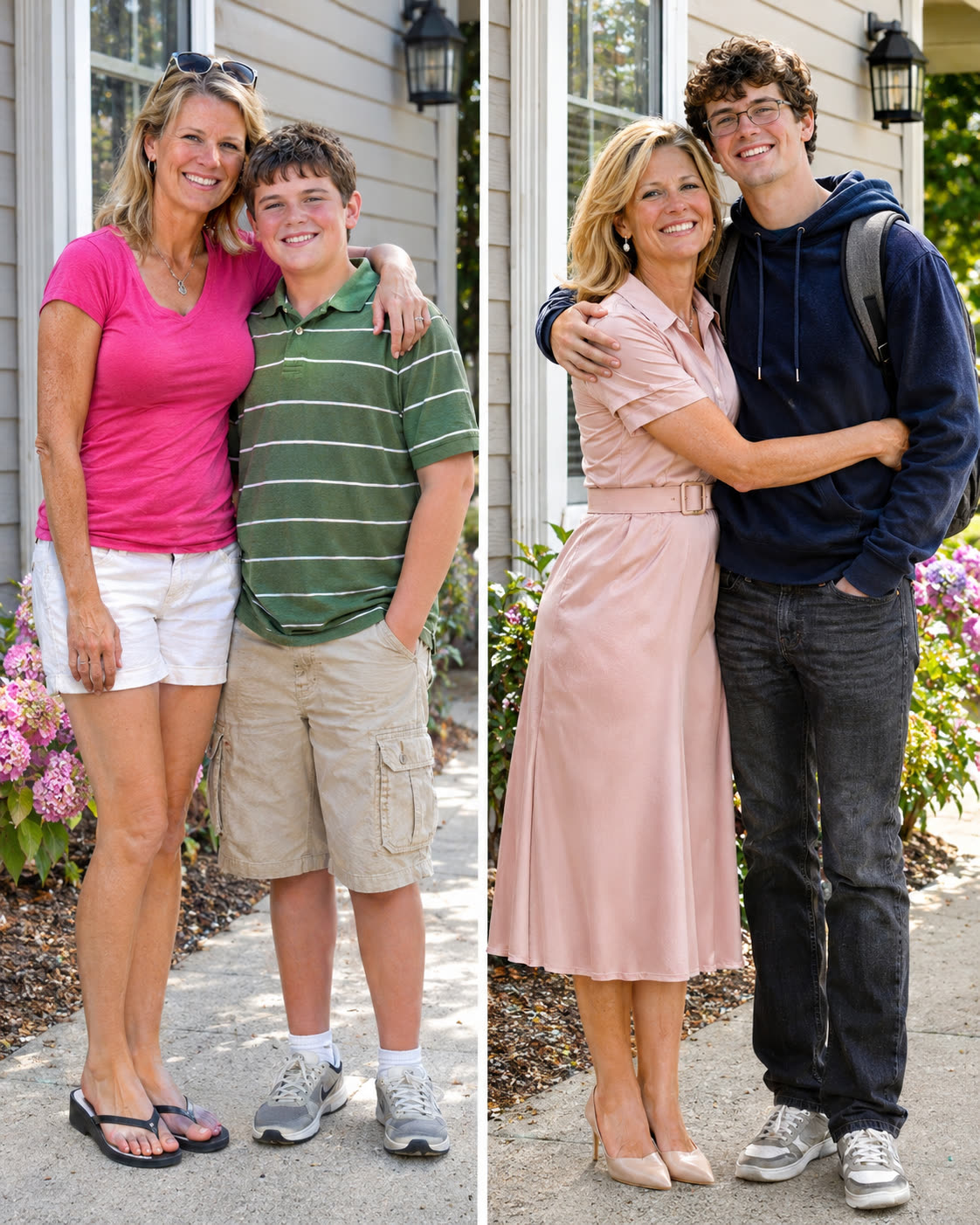
PART 1 — THE BOY THEY TRIED TO MAKE INVISIBLE
“Your son wasn’t invited, Mrs. Walker. Maybe he should’ve learned to fit in back in high school.” Tyler Vance made no attempt to lower his voice. The people standing behind us could hear every word. Beside me stood my twenty-eight-year-old son, yet looking at Tyler brought back the years when Evan had been a boy with nowhere to hide. “You bullied my son for four years, Tyler,” I said. “Wasn’t that enough?” Tyler let out a small laugh. “Come on, Brenda. We were kids. Evan was just too sensitive.” Evan dropped his gaze, and ten years seemed to disappear.
I remembered him at sixteen, sitting on his bed in the clothes he had worn to school, trying to convince me he had not been crying. I remembered the cafeteria he avoided and the lunches that came home uneaten. Most of all, I remembered his question: “Mom, if I just stay quiet, do you think they’ll forget about me?” Now he said, “Let’s go, Mom,” and Tyler answered with a smirk. “Still need your mommy to protect you?” Before I could respond, Evan rested his hand on my arm. “It’s okay. I didn’t come back for him.” Then he faced Tyler. “Enjoy your evening. I think you’ll find out soon enough why I’m here.”
He took my hand and guided me away, leaving me with questions he had not yet answered. I did not know that only two hours earlier he had finished a business transaction involving several properties once owned by Tyler’s father. Nor did I understand what his return would mean before that evening ended. My name is Brenda Walker. I am sixty-two, and Oak Ridge, Ohio, has been my home for almost forty years. Long before that reunion, my life had centered on my husband, Robert, and our son. Robert was an electrician, a gentle, patient man who could usually discover why something had stopped working.
When Evan was small, he and Robert sat together at the kitchen table dismantling old radios. Robert explained each piece while Evan watched with complete attention. Our son adored him. Losing Robert when Evan was twelve changed everything about our household. I worked days at the public library and cleaned offices three evenings each week. We had little to spare, but I managed to keep our house, cover the bills, and provide what Evan needed for school. He was intelligent and quiet, with a particular love for computers. Every Saturday, I drove him to the Maple Avenue Community Center, where a retired engineer, Mr. Franklin, offered programming lessons without charging families.
Those Saturdays gave Evan something to anticipate. High school gave him something to dread. Tyler Vance, whose father Donald owned a large share of the town’s commercial property, singled him out for reasons I never understood. Tyler had costly clothes, a new truck, and the apparent belief that his father’s wealth placed him above other people. At first, my son concealed what was happening. He simply withdrew. Friends stopped coming over. He carried his dinner upstairs. Some mornings he remained before the bathroom mirror so long that I had to warn him he would miss the bus. I saw the changes without yet knowing what was behind them.
Then I reached school early one afternoon and saw Tyler near the parking lot with three boys. Evan was heading toward the bus stop. “Hey, Walker! Did your mom find that jacket in the donation bin?” Tyler called. His friends laughed, but Evan continued walking. Tyler went after him. “Come on, say something. Or are you saving your voice for when you get home to Mommy?” I got out of the car. “Evan!” He turned, and the relief on his face hurt more than Tyler’s words. Tyler straightened immediately. “Afternoon, Mrs. Walker. We were just joking around.” I met his eyes. “Then find a joke that doesn’t involve my son.” He shrugged and left.
Evan settled into the passenger seat without speaking. On the way home, I asked how long this had been going on. Looking through the window, he said, “It’s not a big deal, Mom.” “Evan, I saw what he was doing.” “Please don’t go to the school.” “Honey, I can’t just ignore it.” His voice broke. “It gets worse when you complain.” I turned into an empty parking lot because I could not continue driving through that conversation. “Look at me, sweetheart.” Reluctantly, he did. “You haven’t done anything wrong.” Tears gathered in his eyes. “Then why do they hate me?” That question never left me, not because I answered it well, but because I could not answer it at all.
The following morning, his homeroom teacher received me sympathetically. “Evan is a wonderful student, Mrs. Walker. He’s just very reserved.” “He’s reserved because other students make fun of him every day.” She sighed. “Teenagers can be unkind. We encourage students to work through minor disagreements.” “This isn’t a disagreement. My son is afraid to eat lunch in the cafeteria.” She agreed to speak with the boys. For two days, there was some improvement. On the third, Evan brought his lunch home untouched. “What happened?” I asked. He shook his head. “Nothing.” I waited until he finally whispered, “Tyler told everyone I ran crying to my mother.” My attempt to help had become another weapon against him.
That night, I sat beside him while he pretended to study. “You can tell me anything, honey.” He kept his eyes down. “I know.” “You don’t have to face this alone.” After a long silence, he said, “Mom, I think it would be easier if nobody noticed me.” Later, behind the closed bathroom door, I cried. I could take another shift, mend a backpack, and put dinner on the table, but I could not accompany him through every hallway or persuade his classmates to be kind. The adults responsible for protecting him continued calling it teasing. By junior year, he rarely cried or explained. He came home, closed his bedroom door, and disappeared into his computer.
There was still one place where he seemed able to breathe freely: the community center. Mr. Franklin had taught him since he was thirteen and treated him as a young engineer, not as a boy who struggled socially. During senior year, Evan spent six months developing a scheduling program for small businesses. Our kitchen table filled with notebooks, diagrams, and handwritten code. He talked eagerly about algorithms, asked me to test features, and laughed whenever I uncovered a problem by accident. His computer science teacher entered the program in a statewide business competition. Then Donald Vance sponsored the travel expenses, and a week before the event, the principal named Tyler lead presenter. Evan would be identified as a technical assistant.

I went directly to the principal. “My son created that program,” I told him. Folding his hands, he replied, “Mrs. Walker, Tyler is a confident speaker. The judges respond well to that.” “Then let him help present. But don’t take Evan’s work away from him.” “This is a team competition.” “Then treat them like a team.” He promised proper recognition for everyone. Instead, Tyler accepted the award, stood for the photographs, and told the local newspaper about the program he had helped develop. Evan received a participation certificate. His name appeared only once near the bottom of the article. The work that had brought him back to life had become another occasion for someone else to push him aside.
That evening, I found him on his bedroom floor. The certificate was in the wastebasket beside four spiral notebooks packed with code. “Honey, what are you doing?” He gave no answer. I picked up the certificate. “You worked so hard for this.” He looked at me. “I thought if I made something good enough, they’d finally stop treating me like I was nobody.” I lowered myself beside him. “Evan—” “But Tyler still got everything.” The flatness in his voice frightened me more than tears. “You built that program,” I said. “Nobody can change that.” He offered a small, unhappy smile. “Then why does everybody think he did?” I held him while he cried.
After he fell asleep, I placed the notebooks and certificate in a gray cardboard box. I wanted him to have evidence of what he had achieved, even if others would not acknowledge it. Two months later, he left for college in Chicago. Watching his bus depart, I felt pride and relief together. He had earned the opportunity ahead of him, and he was finally leaving the people who had made school unbearable. In Chicago, he completed his degree, joined an investment firm, and eventually became a partner. He found friends, a comfortable apartment, and work he enjoyed. During my visits, I saw an assured young man who scarcely resembled the teenager who had tried to disappear.
He seldom came back to Oak Ridge. Whenever I suggested spending a holiday at home, he generally proposed that I visit Chicago instead. I did not press him. Then, one October afternoon, he called. “Mom, how would you feel about having me home for a few weeks?” I almost dropped the phone. “I’d love that. What’s the occasion?” “Some business in town. And I thought I might attend the ten-year reunion.” That surprised me. “Are you sure?” He paused before answering. “I think it’s time.” The next Thursday, he arrived with a small suitcase and a brown leather folder. For several days he seemed at ease. Then his conversations with bankers and attorneys began filling the house.
He attended meetings downtown and examined documents at our dining table. One morning, a newspaper article lay beside his coffee. Vance Development was in financial trouble following a failed commercial project, and its lenders were selling several downtown buildings. “Are you working with Donald Vance?” I asked. “Not exactly.” “You know that’s Tyler’s father.” “I know.” I sat opposite him. “Honey, is this about what happened in high school?” He appeared genuinely surprised. “No, Mom.” “Because you don’t have to prove anything to those people.” He reached across the table and squeezed my hand. “I know that now.” I wanted to trust that answer, but the memory of his sixteen-year-old voice remained stubbornly clear.
A week before the reunion, I visited the library. Clara, an old coworker, showed me a stack of blue alumni directories. “The reunion committee dropped these off. Isn’t Evan home?” “He is.” I opened a copy and looked for him. Other graduates had photographs and brief accounts of their lives. Evan was absent altogether. “Who put this together?” I asked. “Tyler and Gwen Vance. Donald’s company paid for the printing.” My hands grew cold. A decade had passed, yet Tyler was still determining whether my son would be acknowledged. I took a directory home and put it before Evan. “They left you out.” He glanced at it. “I heard.” “And you didn’t tell me?” “I didn’t want you upset.”
I sat beside him. “Honey, do you remember what you told me when you were sixteen? That you wished nobody would notice you?” “Mom…” “I remember every word. I remember the lunches you brought home untouched. I remember you sitting in your room because you were afraid of what those boys would say the next day.” His face softened. “I know.” “I couldn’t protect you then. And now they’re doing it again.” He took my hand. “You did protect me. You kept believing in me when I didn’t believe in myself.” I shook my head. “It never felt like enough.” “It was more than enough.” The certainty in his answer only made my old helplessness harder to explain.
Looking down at the directory, I asked, “Why would you even want to go?” He considered his answer. “Because I spent too many years believing Tyler had the right to decide whether I belonged somewhere.” He closed the book. “He doesn’t.” For the first time, I began to understand his decision to return, although his plans remained a mystery. Three days before the reunion, Donald Vance’s lawyer arrived at our house carrying a black briefcase. His name was Martin Cole. Evan brought him into the living room, and I served coffee. As I turned toward the kitchen, Martin asked me to stay. “Mrs. Walker, perhaps you can help us find some common ground.”
Evan’s expression changed immediately. “My mother isn’t part of this negotiation.” Martin lifted his hands. “Of course. I simply thought she might appreciate what this means to a family that’s been in Oak Ridge for generations.” “Then Donald should speak to the lenders,” Evan replied. Opening his briefcase, Martin said, “He’s asking for another thirty days before the sale closes.” “The lenders have already given him six weeks.” “There are people depending on this company.” “And there are creditors waiting to be paid.” Martin turned toward me. “Mrs. Walker, surely you understand that families sometimes need a second chance.” I thought of every school office where I had asked for something much smaller: a fair chance for my son.
“I understand that very well,” I said. Martin smiled. “Then perhaps you could persuade Evan—” “But I also understand that my son is a grown man, and I won’t interfere in his work.” His smile vanished. Evan rose. “The closing remains Friday at five.” When the lawyer had gone, I asked, “What exactly are you buying?” Evan hesitated. “An investment group I manage is purchasing several properties from Vance Development’s lenders.” “Including the old community center?” Surprise crossed his face. “How did you know?” “I drove past it last week. I saw the sale notice.” He nodded. “Yes. That’s one of them.”
I saw again the boy who used to hurry up those steps on Saturday mornings, eager for Mr. Franklin’s class. That building belonged to some of the few happy memories Evan carried from those years. I could not bear the possibility that it had become entangled in the hurt he had brought home from school. “Honey, please tell me you aren’t doing this to hurt Tyler.” He looked straight at me. “I’m doing it because there’s something worth saving.” His answer did not sound angry, but it left the most important part unexplained. “What?” I asked. A faint smile crossed his face. “You’ll see.”
PART 2 — THE DOOR THEY COULD NOT KEEP CLOSED
The following afternoon, Gwen Vance telephoned. Her voice carried a sweetness I did not trust. “Brenda, I’ve been thinking about Evan. We’d love to have him at the reunion.” I nearly laughed at the sudden warmth. “That’s interesting. You didn’t even put his name in the directory.” “There was a misunderstanding.” “Then correct it.” She paused, and the silence made her next words unsurprising. “We certainly can. But perhaps you could speak to Evan about Donald’s situation first.” There was the condition beneath the invitation. My son’s place among his classmates was apparently something she considered useful in a business negotiation. “My son doesn’t need me to negotiate his business decisions.”
Her pleasant tone sharpened. “Brenda, Tyler was only joking around back in high school. Evan always took things too personally.” My fingers tightened around the phone. “My son used to come home afraid to go to school. That’s not a joke.” “That was years ago.” “Then why are you still treating him the same way?” She hung up. I remained seated for a long time, staring at the phone. Nothing in that conversation suggested that she understood what had happened, much less regretted it. Time had passed, but the excuse had survived untouched. Once again, my son’s distress was being described as the problem instead of the behavior that had caused it.
Eventually, I went to the hall closet and brought out the gray cardboard box. Inside were the notebooks, the participation certificate, and a photograph of Evan beside his computer project. I had saved them so he would not lose the record of something he had built himself. Looking through them now, I remembered the kitchen table covered with his work and the excitement that had returned to his voice before the competition. For ten years, I had wanted someone to acknowledge what had been done to him. I had no idea that the acknowledgment I had waited for was only two days away, or that it would arrive in a room I already dreaded entering.
Friday dawned cold and clear. Evan came downstairs in a charcoal-gray suit, looking as though rest had been difficult to find. “Did you sleep?” I asked. “A little.” “You look nervous.” “It’s an important day.” I adjusted his tie as I had before school concerts. He was a grown man with responsibilities I only partly understood, but the familiar gesture came naturally. “Whatever happens, don’t let those people make you feel small again.” He smiled at me. “They can’t, Mom.” I wanted that confidence to be as solid as it sounded. The old memories had a way of making me cautious, even when the person standing before me had changed.
He left for a meeting at noon. At four thirty, he called. “We’re waiting on the final signatures.” “Are you all right?” “I will be.” At five twelve, the phone rang again. “It’s done.” “The sale?” “Yes.” I shut my eyes for a moment. “And Donald?” “His attorney has been notified.” The transaction that had brought lawyers to our living room and kept Evan bent over documents was finished. Still, I did not know how it connected to that evening. “What happens now?” I asked. “We go to the reunion.” His answer was so direct that I stared at the phone, wondering whether I had heard him correctly.
“After everything Tyler and Gwen said?” “I have a reason to be there.” I wanted to ask what could possibly make returning to that room worthwhile. Instead, I answered, “Then I’m coming with you.” We reached the Oak Ridge Grand Ballroom shortly before seven. Blue and silver balloons framed the entrance. A banner welcomed the Class of 2014, and a photographer stood near a display of yearbook pictures. It looked like an ordinary reunion, the kind of evening when people should have been allowed to remember their youth without having to defend their right to attend. Gwen sat at the registration table. The moment she saw us, her expression changed.
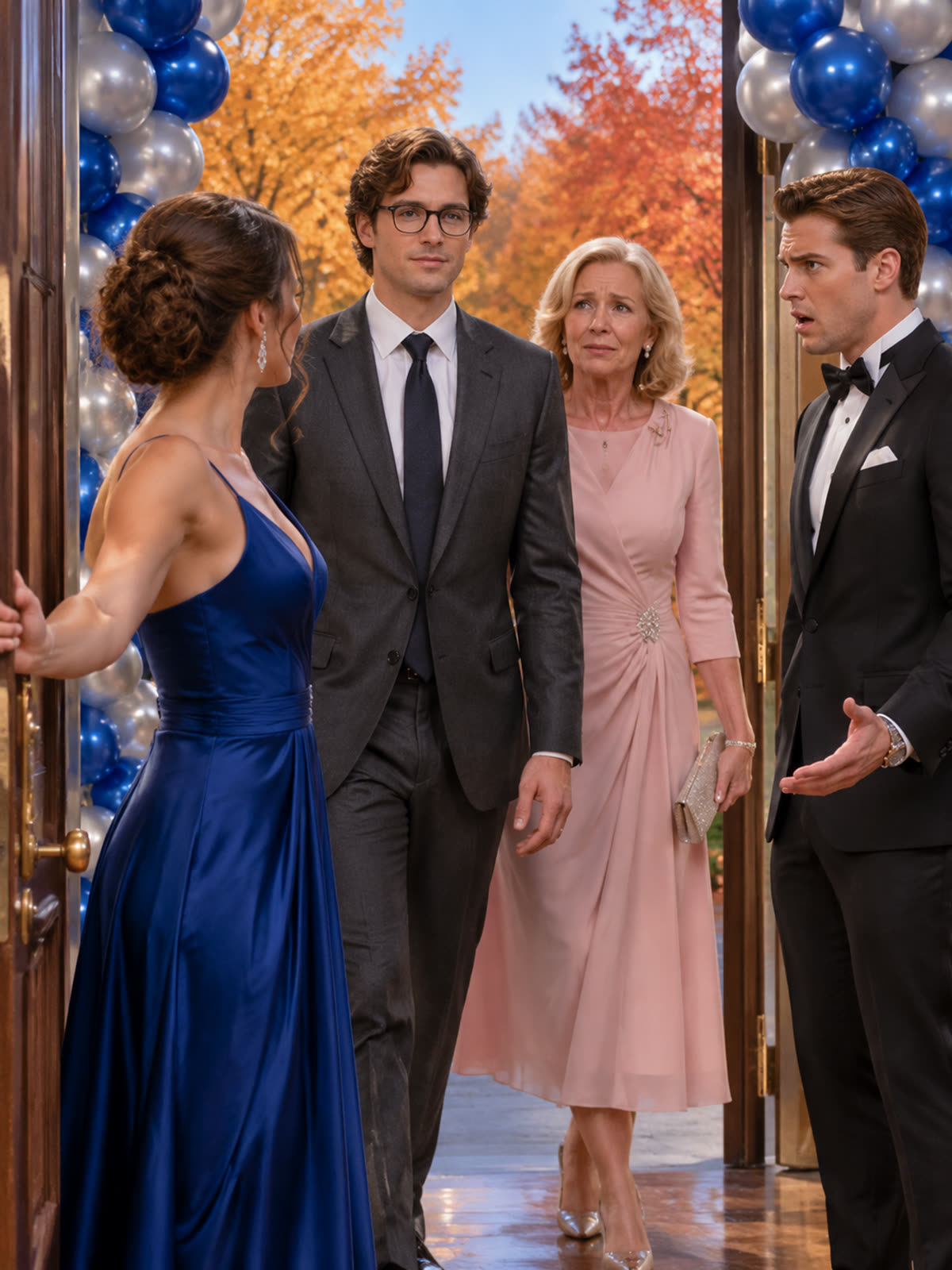
“Evan. Brenda. I wasn’t expecting you.” “We’re here for the reunion,” I said. She looked down at her list. “I’m afraid we haven’t confirmed Evan’s registration.” Before I could respond, Tyler came over. His gaze traveled from Evan’s suit to me, and then he said the words that had opened every old wound. “Your son wasn’t invited, Mrs. Walker. Maybe he should’ve learned to fit in back in high school.” I looked at him, unable to mistake the intention. “You bullied my son for four years, Tyler. Wasn’t that enough?” He gave that little laugh again. “Come on, Brenda. We were kids. Evan was just too sensitive.”
Evan lowered his eyes. For an instant, the assured man from Chicago seemed to stand in the same place as the boy I had once driven home from school. “Let’s go, Mom,” he said gently. Tyler smirked. “Still need your mommy to protect you?” I started to speak, but Evan touched my arm. “It’s okay. I didn’t come back for him.” Then he looked at Tyler. “Enjoy your evening. I think you’ll find out soon enough why I’m here.” He led me away by the hand. I followed with my heart pounding, still unsure whether we were leaving altogether or whether there was more to the evening than he had told me.
We had gone halfway toward the parking lot when a woman called out. “Evan! Wait!” Rachel Bennett, one of his former classmates, hurried after us. “Why are you leaving?” I folded my arms. “Tyler says Evan isn’t on the guest list.” She stared in disbelief. “That’s ridiculous. We graduated together.” She took out her phone and called the ballroom manager. Within minutes, Denise Harper came outside. “Mr. Walker, I’m sorry about the confusion. Your attendance was cleared with our management team earlier this week.” Her words made me turn toward my son. Whatever he had arranged, it had begun before we reached the registration table.
Tyler had followed Rachel outside. “Excuse me?” he demanded. “I’m running this reunion.” Denise’s manner remained professional. “And the venue has confirmed Mr. Walker’s attendance under the arrangements made for tonight’s program.” Tyler looked between her and Evan. “What arrangements?” My son put his phone away. “You’ll find out soon enough.” Denise opened the ballroom door. “Please come in, Mr. Walker. Mrs. Walker, you’re welcome as his guest.” I walked inside beside Evan, still shaken by the exchange. Yet something important had become clear as I watched him. He was not depending on Tyler’s permission, and he was not waiting to be accepted. Unlike the teenager I remembered, he was not afraid.
Inside, people were laughing, embracing, and showing one another pictures of their children. Rachel brought us to her table. For a while, the evening felt unexpectedly pleasant. Several classmates greeted Evan with genuine warmth. One remembered how he had helped with math homework; another thanked him for repairing her laptop during senior year. These were memories of the same boy I had known, the capable, generous one who had been reduced to a target in so many other people’s company. Hearing them mattered. For a little while, I could sit beside my son without bracing myself for the next unkind remark, and he could speak with people who remembered more than Tyler’s version of their school years.
Then Tyler approached our table. “Well, Evan, I see you found a way in after all.” Evan placed his water glass down. “Good evening, Tyler.” Turning his smile toward the others, Tyler said, “You know, Evan was always good at getting people to help him. Especially his mother.” Rachel frowned. “Tyler, that’s enough.” He paid her no attention. “So tell us, Evan. What exactly do you do in Chicago? I hear you’re in finance now.” “That’s right.” “Funny. I always figured you’d spend your life fixing computers in somebody’s basement.” Around the table, people looked uncomfortable. Evan remained composed. “I still enjoy working with computers.”
Tyler laughed. “Remember that school competition? That project really helped launch my career.” My grip tightened around my napkin. Ten years later, he could still speak about that award as though there were nothing to explain. Before I could answer, Rachel spoke. “Wasn’t Evan the one who built the program?” Tyler’s smile narrowed. “It was a team effort.” Rachel did not retreat. “I remember Evan working on it for months,” she replied. Then someone behind us added, “So do I.” I turned and saw Mrs. Collins, Evan’s former computer science teacher, standing there with a glass of water. The conversation that had once been settled without my son was no longer going entirely Tyler’s way.
“Evan brought that program to me before Tyler was even involved,” Mrs. Collins said. Tyler seemed startled. “Mrs. Collins, it was a long time ago.” “It was,” she replied. “And I should’ve spoken up more clearly then.” Evan looked at her without speaking. She turned to him. “I’m sorry, Evan. You deserved better.” For a moment, he seemed unable to answer. Then he nodded. “Thank you.” Tears rose in my eyes. The apology was brief, but its simplicity did not make it small. Someone who had been there was finally naming what had happened. Someone was telling my son, in front of other people, that his memory of being treated unfairly was not an exaggeration.
I had imagined recognition in many forms during the years I kept that gray box. I had wanted the newspaper account corrected, the work credited, and the adults involved to understand what their decisions had cost him. Now a teacher stood beside our table and admitted that she should have done more. She could not give him those school years back, but she was no longer asking him to accept the false account of them. I watched him absorb her words. For years, I had been the person telling him that he deserved better. Hearing it from someone else seemed to reach a place that my reassurances, however sincere, had never quite been able to reach.
Tyler cleared his throat. “Well, ancient history. Anyway, some of us stayed in Oak Ridge and helped build the community. Others moved away and forgot where they came from.” He looked directly at Evan. “No offense.” My son met his gaze. “None taken.” Tyler left the table. I leaned toward Evan. “Are you all right?” He looked at Mrs. Collins, who had begun speaking quietly with Rachel. “I think I am.” He did not sound as though he were merely trying to spare me worry. The apology had not erased what happened, but the room was no longer allowing Tyler to describe it without contradiction. For once, Evan had not been left to carry the truth alone.
After dinner, Gwen went to the stage. She thanked the sponsors and praised the people who had organized the reunion. Then she introduced Tyler as a man who had remained deeply devoted to Oak Ridge. Listening from our table, I wondered whether he would allow the evening to move on. He stepped to the microphone and began, “Ten years ago, we left high school with big dreams.” He paused before continuing. “Some of us stayed here and helped this town grow. Others went off to bigger cities and forgot the people who gave them their start.” His eyes moved toward us. I felt the heat rise in my face.
It was the same accusation he had made at the table, only now he had a microphone and an entire ballroom listening. Leaving Oak Ridge had given Evan the chance to build a life beyond the people who had hurt him. Tyler was presenting that departure as something shameful. “But tonight is about loyalty,” he continued. “It’s about remembering where you belong.” The applause that followed was polite. Beside me, Evan checked his watch. I could not tell whether he was waiting for the speech to finish or for something else to begin. He had remained calm through every attempt to provoke him, but his attention had shifted toward the next part of the evening.
I thought of Gwen’s phone call and the invitation that had suddenly become available when her family wanted something. I thought of Martin Cole sitting in our living room, asking whether I understood second chances. The same people who now spoke so easily about belonging had omitted Evan from their directory and tried to stop him at the door. He had told me Tyler no longer had the right to decide where he belonged. Until that night, I had understood those words as a private declaration, something he needed to believe for himself. Watching him sit quietly beneath Tyler’s speech, I began to suspect that he was about to make them visible to everyone else.
When Tyler finished, Denise Harper approached our table. “Mr. Walker, we’re ready whenever you are.” Evan rose. Only then did I see the small wooden box he had kept beneath his chair. He picked it up with care, and my eyes moved from the box to his face. He had told me there was something worth saving. He had told me he had a reason to be here. Now the moment behind those answers had arrived, and I still did not know what waited inside that box. He turned toward me and said, “Come with me, Mom.”
PART 3 — THE NAME HE CHOSE TO PUT ON THE DOOR
I followed Evan toward the stage while Gwen hurried to intercept us. “What’s happening?” Before my son could answer, Denise spoke. “Mr. Walker arranged a short community announcement with the venue’s management. It’s been approved as part of tonight’s program.” Gwen looked furious. “Nobody told me.” Denise remained steady. “The arrangements were confirmed with the venue,” she replied. “We also notified the reunion committee’s designated contact.” There was nothing more for Gwen to stop. Evan stepped up to the microphone with the wooden box, and I stood beside him, wondering how the evening had carried us from being turned away at the entrance to standing before the entire room.
“Good evening. My name is Evan Walker, and I graduated from Oak Ridge High School in 2014.” A few people laughed. “I realize that might surprise anyone who checked the alumni directory.” The laughter grew, and Gwen lowered her eyes. Evan did not linger over the omission. “I haven’t lived here for ten years,” he continued, “but Oak Ridge is still my hometown. It’s where my father taught me to repair broken radios, where my mother worked two jobs to keep a roof over our heads, and where a retired engineer named Mr. Franklin taught me how to write my first computer program.” My throat tightened as he described the people and places that had formed him.
“Mr. Franklin taught free classes at the Maple Avenue Community Center. He didn’t care how much money our parents made. If we wanted to learn, he found us a chair.” Several older guests nodded. “That center closed nearly six years ago. Every time I’ve visited Oak Ridge, I’ve driven past it and wished somebody would reopen it.” Evan paused. I remembered asking whether he was buying the building because of Tyler, and I began to understand how far my question had been from the answer. The community center had not simply been another property connected with the Vances. It had been the place where someone had looked at my son and seen what he could become.
“Today, an investment group I manage completed the purchase of several downtown properties previously owned by Vance Development. One of those properties is the old community center.” The room fell quiet. Near the front, Donald Vance sat straighter. Evan continued without turning the announcement into an account of Donald’s troubles. “Our investors have approved transferring the center to a nonprofit foundation. We’re going to renovate it and reopen it as a free learning center for local families.” Someone gasped. “We’ll offer computer classes, tutoring, career workshops, and a reading room. The first phase of renovation is funded, and we’ve already begun working with local educators and volunteers.” Applause spread through the ballroom.
I pressed a hand against my chest. At last, the meetings, documents, and calls made sense. Evan had not returned to arrange Tyler’s humiliation. He had been working to restore the place that once gave him a chance. While I worried that the past was pulling him backward, he had been planning something for children who had not yet walked through those doors. The relief was almost as overwhelming as the pride. He had carried those difficult years with him, but he had not allowed the people who hurt him to decide what he would build from them. The announcement was not about making someone else smaller. It was about making room.
“There’s one more thing,” he said. He opened the wooden box. Inside lay a brass plaque bearing the words Robert Walker Technology Lab. My knees weakened. “My father passed away when I was twelve,” Evan said. “He was an electrician, and he taught me that if something stopped working, you didn’t throw it away before trying to understand what was wrong.” His voice softened. “My mother worked long hours after he died. She drove me to the community center every Saturday, even when she was exhausted. She never once made me feel that my dreams were too expensive or too difficult.” Through my tears, the plaque became difficult to see.
“This center is for children who need somebody to believe in them. Children who have ability but not always opportunity. Children who deserve to be seen for what they can do, not for who their parents are.” Then he looked at me. “And it’s for the parents who keep showing up, even when nobody notices.” Rachel stood first. Her husband followed, then several teachers. Within moments, the entire ballroom was on its feet. I stood beside my son and cried while people applauded him. A decade earlier, he had watched Tyler receive an award for the work Evan had done. This time, no one could separate him from what he had accomplished.
Yet the applause was not what moved me most. I remembered the lonely boy on his bedroom floor, the certificate in the wastebasket, and the notebooks I had gathered after he fell asleep. That boy had grown into a man who wanted other children to have the opportunities he had nearly lost. When the announcement ended, people gathered around him. Teachers offered their time. Former classmates asked about donations. A local business owner offered desks for the reading room. I stepped into the hallway to collect myself. After a few minutes, Evan joined me. “Are you all right, Mom?” I laughed through my tears. “You could’ve warned me.” He smiled. “I wanted it to be a surprise.” “Well, you succeeded.”
Before I could say anything else, Tyler appeared with Gwen and Donald. His face was flushed. “You planned that whole thing to embarrass my family.” Evan turned toward him. “I planned to announce the community center.” “You waited until tonight. You knew everyone would be here.” “Yes. It’s a good place to reach people who care about Oak Ridge.” Tyler gave a bitter laugh. “Don’t pretend this wasn’t about getting back at me.” My son looked at him steadily. “No, Tyler. You weren’t part of my plan.” Tyler’s expression shifted. “Then why come to our reunion?” “Because I graduated here, too. You seem to have forgotten that.” For a moment, no one answered.
Tyler moved closer. “You think you’re better than me now because you have money?” Evan shook his head. “I don’t think I’m better than you. I just don’t need you to decide what I’m worth anymore.” Donald cleared his throat. “Evan, perhaps we should discuss the property situation privately.” “The sale is complete, Donald. Your attorney has the documents.” “My family has supported this town for decades.” “I know. And I hope the properties continue to benefit the community under their new owners.” The plaque remained in Evan’s hands. He was not brandishing it or asking anyone to admire him. He was simply refusing to let this conversation become something other than what it was.
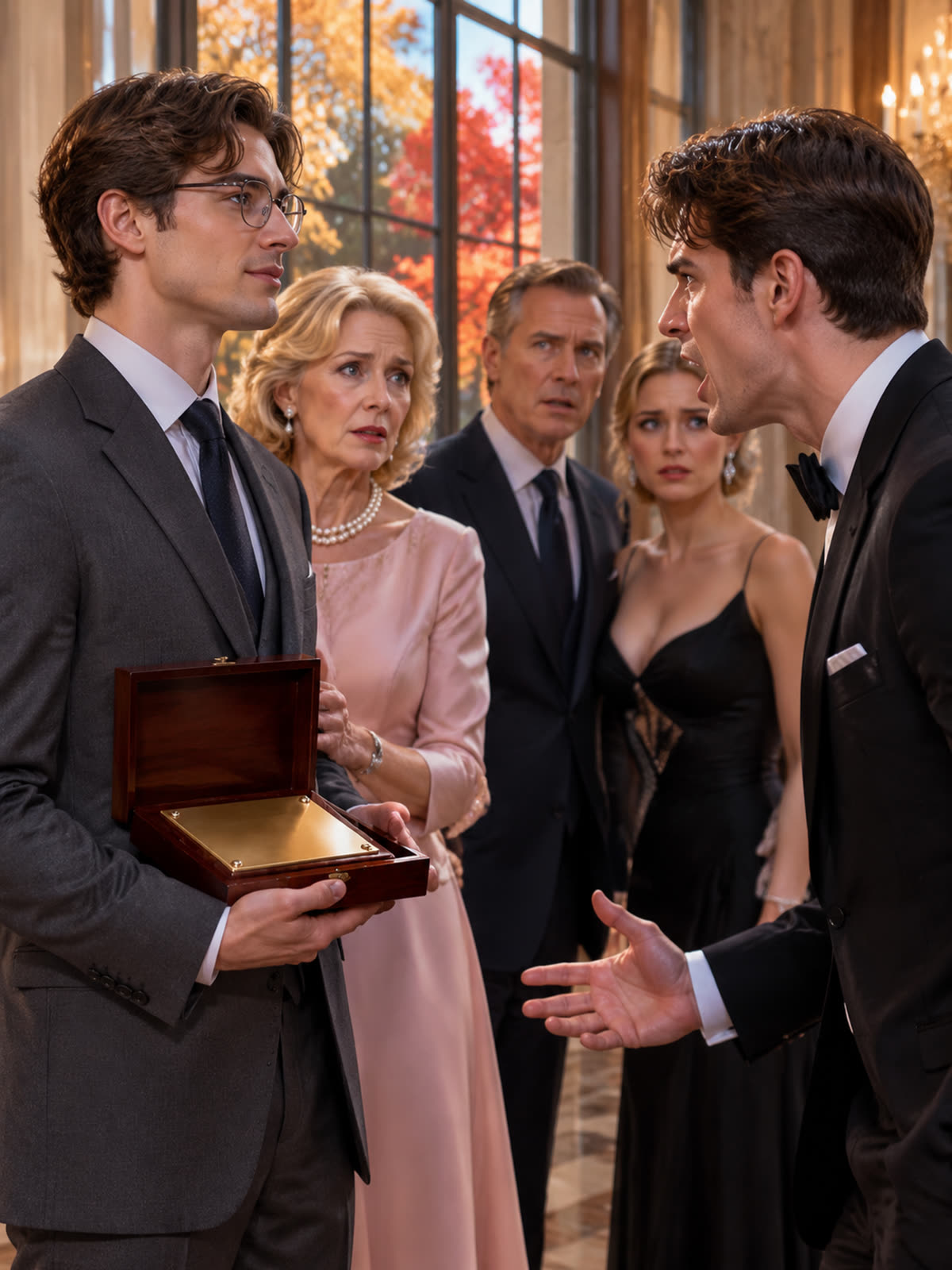
Tyler looked at the plaque. “So you get to put your father’s name on a building while mine loses his properties?” Evan’s face grew serious. “My father never owned a building. He worked hard, helped his neighbors, and taught me everything he knew. I wanted to honor him.” He paused. “That has nothing to do with your father.” I stepped beside my son. Tyler turned to me. “Mrs. Walker, surely you can see what he’s doing.” “I can,” I said. “He’s giving children a place to learn.” “After everything my father did for him—” “Your father paid for a school trip,” I interrupted. “My son wrote the program. And for ten years, you let people believe otherwise.”
Tyler went still. “That was a team project.” “Then why did Evan’s name barely appear when you accepted the award?” He offered no answer. “You were seventeen,” I continued. “I could’ve forgiven you for being thoughtless then. But last month, you left him out of the reunion directory. Tonight, you tried to turn him away at the door and mocked him in front of his classmates.” Gwen looked away. “You had ten years to grow up, Tyler. Why are you still treating him like the boy you could push aside?” He stared at the floor. For the first time in all the years I had known him, there was no quick remark waiting to make the moment someone else’s fault.
Evan touched my arm. “Come on, Mom. Let’s go home.” We turned, but Tyler called after him. “Evan.” My son stopped. Tyler swallowed. “I didn’t know you were doing all that for the community center.” Evan nodded. “You didn’t ask.” Then we left. During the quiet drive home, I watched Oak Ridge pass beyond the window and thought about how much had changed since Evan was a boy. The streets were familiar, but the evening had altered the memories I carried through them. The past had not disappeared. It simply no longer seemed to hold the only account of who my son was, or what coming home could mean.
At the house, Evan brought the wooden box into the kitchen and placed it beside the gray cardboard box I had saved. “I have something for you,” he said. From his pocket, he took a small brass key. “This is one of the keys to the community center. We’ll replace the locks during renovations, but I wanted you to have the first one.” I stared at it. “Why me?” He smiled. “Because you were the one who took me there every Saturday.” “Honey, that’s what mothers do.” He shook his head. “You worked all week. You were tired. But every Saturday morning, you got up early, packed me a lunch, and drove me across town because you knew how much I loved those classes.”
My eyes filled again. “You remember that?” “Every Saturday.” He placed the key in my palm. “I also want you to help us set up the reading room. Books, study tables, a quiet place for kids who need one. You spent thirty years working at the library. I can’t think of anyone better.” I laughed. “I thought I was retired.” “You are. I’m asking, not assigning.” Closing my fingers around the key, I answered, “Then I’d love to.” He hugged me, and I held him as I had when he was little, before he grew too tall for me to reach his shoulders easily. “I’m proud of you,” I whispered. He smiled. “I know, Mom. You’ve been telling me that my whole life.” “And I’m not stopping now.”
The center opened the following spring. Renovation had taken longer than anticipated, but the computer lab was finished, donated books filled the reading room, and volunteers had committed to teaching. Rachel arranged a fundraiser. Retired teachers offered tutoring. Mr. Franklin’s granddaughter contributed his old programming books. Even classmates who had not spoken with Evan for years came forward to help. Tyler did not attend the opening. A week beforehand, however, he sent Evan a short letter. In it, he admitted that leaving Evan out of the directory had been intentional and unfair. He also acknowledged that Evan had completed most of the work on the competition project during senior year.
Evan let me read the letter. “Are you going to answer?” I asked. “Maybe someday.” “Do you forgive him?” He thought before replying. “I’m not spending any more time being angry with him. I don’t know if that’s the same thing.” I nodded. By my age, I understood that forgiveness did not always arrive in a tidy exchange of apologies and kind words. Sometimes it meant refusing to let another person’s behavior continue determining the shape of your life. Evan did not need to make a declaration for my benefit. He had already shown me, in what he chose to build and whom he chose to help, how much of his life no longer belonged to Tyler.
On opening day, I stood near the reading room as children hurried by with notebooks and backpacks. Evan was helping a little boy sign onto a computer. The child looked anxious. “What if I break it?” Evan smiled. “Then we’ll figure out how to fix it.” I had to turn away. Robert had said those exact words. A few minutes later, Evan came to stand beside me. “What do you think?” I looked at children reading, parents speaking with volunteers, and sunlight entering windows that had been boarded up for years. “I think your father would’ve loved this.” Evan smiled. “I hope so.” Together, we walked toward the computer lab.
The brass plaque had been mounted beside the entrance. Robert Walker Technology Lab. Underneath, smaller lettering read: In honor of those who make room for others. I touched its edge. For years, I had wanted someone to give Evan the recognition he should have received in high school. Standing there, I understood that he had found something more lasting than a corrected account of an old competition. He had created a place where other children could discover what they were capable of doing. He had not forgotten the boy who needed a chair in Mr. Franklin’s classroom. He had made certain there would be more chairs, and more children welcomed into them.
That evening, I opened the gray box one last time. I kept the notebooks, the certificate, and the photograph of Evan smiling beside his project display in his crooked tie. Then I took out the blue reunion directory. I had held onto it as evidence of how they had treated him. Opening the alphabetical list, I saw that his name was still absent. For a moment, the old anger returned. Then I remembered the children at the center, Robert’s name beside the lab, and the little brass key in my pocket. I closed the directory and put it in the recycling. Its missing name no longer seemed like the most important thing I had to preserve.
The following Saturday, while I was working at the center, a girl approached the front desk. She could not have been older than nine. Two uneven braids framed her face, and she held a registration form with both hands. “Excuse me, ma’am,” she said. “Is this where kids can learn computers for free?” “It sure is, sweetheart.” Her eyes moved toward the classroom. Before she entered, I would smile and tell her, “No, honey. You don’t need an invitation.” I would open the door and add, “There’s a place for you here.” Watching her hurry inside would make me understand that this, rather than any applause at the reunion, was the homecoming I had wanted for my son.
Tyler had once made certain Evan’s name was missing from a list. Evan had put his father’s name beside a classroom and opened the building to children who would never have to search a directory to find out whether they belonged. But in that small pause at the front desk, before I gave the answer and before the classroom door opened, I was still looking at a little girl holding her form. I remembered my son, the years he had spent feeling unwelcome, and the question no child should have needed to ask. She looked from the classroom back to me. “Do I need an invitation?”
Disclaimer: This story is a work of fiction inspired by real-life themes. Names, characters, places and events are fictionalized, and any resemblance to real persons is purely coincidental. It does not represent any person or organization and does not encourage inappropriate behavior. Images are for illustration purposes only.
