


PART 1: What He Left in the Garage
My name is Kaitlyn Coles, and I’m a respiratory therapist at a hospital in Wichita, Kansas. Eight months earlier, my husband, Jaxon, had lost his job. Since then, keeping a roof over our heads and providing for our four-month-old daughter, Esme, had become my financial responsibility. We had agreed that he would look after her while applying for work. I believed that arrangement would help us through a difficult stretch, even as the burden of supporting our household grew heavier.
I accepted almost every double shift available at the hospital. The hours were exhausting, but our rent and expenses couldn’t wait for Jaxon to find another position. Meanwhile, he appeared to devote far more time to video games than to job applications. I kept working because somebody had to, trusting that, whatever else was going wrong between us, our daughter was being cared for while I was away. That trust was the one thing that allowed me to leave for those long shifts.
One night, I came home at 12:40 a.m. after sixteen hours at the hospital. The house was dark apart from the shifting colors spilling out of the living room. Jaxon was at his desk, wearing a headset and yelling into its microphone. A new gaming computer stood in front of him, surrounded by three monitors and elaborate colored lights. I had no idea how he had afforded any of it. Too drained to begin an argument, I went straight to Esme’s nursery.
The instant I stepped inside, I knew something was wrong. Her crib was gone. So was the changing table. The car seat we usually left near the entrance had disappeared as well. Exhaustion gave way to alarm as I tried to make sense of the missing furniture and the empty place where my daughter should have been. “Jaxon! Where’s Esme?” He hardly looked away from his game. Without taking off his headset, he pointed toward the garage door.
I rushed into the garage and found Esme asleep in a plastic laundry basket on the concrete floor. A beach towel had been wrapped around her, and a portable space heater was running about two feet away. I picked her up immediately. One side of her little body felt cold; the side nearest the heater was much too warm. Holding her against me, I went back into the house, shaking with fear and anger. “What have you done, Jaxon?”
At last, he pulled off the headset and faced me. “Calm down. I sold some things on Marketplace. The crib, car seat, stroller, and your mother’s old sewing machine.” My mother had been dead for two years. That sewing machine was the only possession of hers I still had, and he had sold it without even speaking to me. Alongside my terror for Esme came the pain of that separate betrayal. “You sold my mother’s sewing machine? Where’s the money?”
He gestured toward the computer as though its presence explained everything. “I combined it with the rent money to buy this setup. If I’m going to become a streamer, I need proper equipment. It’s an investment in our future.” I stared at the screens, struggling to absorb what he was telling me. He had sold our daughter’s necessities and my mother’s machine for $340, then added the money we needed for rent to pay for his gaming equipment.
“You used the money we need to keep this house?” I asked. His answer came without any acknowledgment of what he had taken from us. “I’m the man of this house, Kaitlyn. I decide how our money gets spent.” I reminded him that I was currently the only one earning anything. His face turned red. Rather than explain how we were supposed to manage, he accused me of leaving him with a crying infant while I supposedly enjoyed myself at the hospital.
“I’m a respiratory therapist, Jaxon, and I’m working those shifts because somebody has to pay our bills.” I was still holding Esme as he finally explained why she had been put in the garage: her crying had interrupted his game. “She’s a baby. She doesn’t care where she sleeps.” He spoke as if moving an infant out of his way were a perfectly reasonable solution, as if the concrete floor and the running heater were details too insignificant to concern him.
I told him the heater could have overheated the towel and placed Esme in danger. He brushed that aside because, in his view, nothing had happened. If I objected so strongly, he said, I could sleep in the garage with her. Then he slipped his headset back on and returned to the game. I stood there with our daughter in my arms, frightened and furious, understanding that he had no intention of listening. Continuing the argument would not make her safer.

So I gave him one quiet answer. “Okay.” I carried Esme into our bedroom and placed her on the bed temporarily, remaining beside her. There was no crib to put her in, and I wasn’t going to leave her again. With my phone in my hand, I opened the baby monitor application. The camera I had bought after her birth saved recordings for the previous twenty-four hours. Jaxon had never shown any interest in that feature, but I knew it was there.
I expected the footage to show him removing the nursery furniture. I needed to understand what he had done while I was working, and the recordings seemed like the clearest place to start. At 2:15 p.m., a man and a woman came into our home and took away Esme’s crib. Watching them carry it out confirmed that he had sold it during my shift. Then I continued through the recordings, unaware that the missing furniture was only the beginning.
At 3:02 p.m., Jaxon put Esme into the plastic laundry basket. Eight minutes later, he collected his keys and walked out through the front door. I kept watching, expecting him to reappear. Instead, the footage continued without him. The house remained empty of anyone who could care for our daughter. I watched the time advance, waiting for the moment when he would come back and make what I was seeing at least a little less terrible.
He did not return until 6:31 p.m. For three hours and twenty-one minutes, our four-month-old daughter had been alone. She had spent that time in a basket on the garage floor, next to a running space heater, while Jaxon drove across town to pick up his computer. The truth was worse than the explanation he had offered in the living room. He hadn’t simply chosen an unsafe place for her to sleep. He had left her there with nobody at home.
I felt sick as I went through the recordings again. There had been no one to feed her, comfort her, or protect her during those hours. His careless response when I confronted him now carried an even more frightening meaning. He knew he had left the property. He knew how long he had been gone. Yet he had let me stand there believing that putting her in the garage while he played was the full extent of what had happened.
I saved every relevant clip: the buyers carrying away the crib, Jaxon placing Esme in the basket, and the footage establishing when he left and when he returned. Then I made another backup. I couldn’t risk losing the only clear record of those missing hours. The recordings gave me something more certain than an argument between us. They showed what he had done, regardless of how little danger he was willing to admit our daughter had faced.
I barely slept that night. I stayed beside Esme, checking her breathing and picking her up whenever she stirred. My exhaustion had not disappeared, but neither had the knowledge of where she had been while I worked. I kept returning to the same facts: the concrete floor, the towel, the heater, and more than three hours without anyone there. I had trusted her father to care for her. Now I had to face what that trust had allowed me not to see.
At 7:05 the next morning, somebody knocked at the front door. Jaxon was asleep on the living room couch, surrounded by the equipment he had placed above our daughter’s needs. With Esme in my arms, I opened the door. A woman in her fifties stood on the porch. A minivan was parked behind her, and through its rear window I could see two things I recognized immediately: Esme’s crib and my mother’s sewing machine.
“Are you Kaitlyn Coles?” she asked. “Yes, I am.” She introduced herself. “My name is Lenora Prentice. I purchased these items from your husband yesterday.” Her eyes shifted toward the living room before she continued. “When I returned around four o’clock to collect the car seat, nobody answered the door. But I could hear a baby crying inside, and the crying continued for a long time.” I drew Esme closer. Someone had heard her during those hours when Jaxon was gone.
Until that moment, the recordings had been the only account I had of what happened while I was at work. Now a stranger stood at my door describing my daughter’s unanswered crying. The crib and sewing machine were behind her, but she had plainly returned for more than a discussion about the sale. Mrs. Prentice took out an identification badge. Still holding Esme, I looked at it, about to discover why the woman who had bought our belongings had come back.
PART 2: Three Hours He Could Not Explain
“I’m a caseworker with Child Protective Services. May I come inside?” Fear tightened around the exhaustion I was already carrying, but I invited Mrs. Prentice into the house immediately. Whatever her visit might mean, she needed to know the truth. I led her into the kitchen and prepared coffee with unsteady hands while she sat at the table. Esme’s safety mattered more than my fear of having a child protection caseworker sitting in our home that morning.
Mrs. Prentice explained that she had been shopping for her granddaughter when she answered Jaxon’s listing. She had not bought the crib as part of her work. “I was buying a used crib for my daughter, but I’ve worked in child protection for twenty-six years. When I hear an infant crying for twenty minutes without anyone responding, I can’t simply forget about it.” Her explanation made clear why the unanswered crying had stayed with her after she left.
I told her I had been at the hospital throughout the afternoon. I explained that I hadn’t come home until after midnight and had only then discovered where Jaxon had put our daughter. There was no way to make the account less frightening without concealing what had happened. I told her what I knew, including the fact that I had checked the monitor recordings afterward. “Then show me everything you know,” she replied. I unlocked my phone and opened the clips I had saved.
She watched without interrupting. On the screen were the basket, the nearby heater, and the evidence of the hours Esme had spent without an adult in the house. I had already watched those recordings more than once, yet showing them to somebody else made their meaning no easier to bear. Mrs. Prentice could see the difference between Jaxon’s dismissive explanation and what had actually occurred. The timestamps established an absence he had not mentioned when I confronted him.
When the clips ended, she looked directly at me. “Did you preserve these recordings?” I answered at once. “Yes. I saved two copies.” Her response was the first clear reassurance I had received since coming home. “Good. That was exactly the right thing to do.” I had saved them because I was terrified of losing the truth beneath whatever Jaxon might say afterward. Hearing her confirm that decision mattered, even though it did nothing to erase what the footage showed.
Before our conversation could go further, Jaxon woke and came into the kitchen, rubbing his eyes. He appeared to expect an ordinary morning until he noticed the unfamiliar woman at the table. Then he stopped. “Who’s this, Kaitlyn?” I kept my voice steady. “This is Mrs. Prentice, the woman who bought Esme’s crib yesterday. She works for Child Protective Services.” His face went pale as he looked between us and understood why her visit had nothing to do with collecting furniture.
“Wait a minute. Kaitlyn, tell her the baby was fine. Nothing happened to Esme.” Once again, he focused on the fact that no harm had become visible rather than on the danger he had created. Mrs. Prentice turned my phone so he could see the recordings she had just watched. “Mr. Coles, these recordings show that you left a four-month-old infant alone beside a space heater for three hours and twenty-one minutes.” This time, his explanation had to confront evidence.
He shook his head and tried to dispute what she had seen. “I was only gone for about an hour.” Mrs. Prentice did not argue with his tone or become distracted by his denial. “The camera records the times you left and returned,” she explained. The departure and return were both there. He could minimize the danger, and he could insist that Esme had been fine, but he could not change the length of his absence by saying it had been shorter.
His attention swung toward me, outrage replacing the color that had drained from his face. “You were recording me in my own house?” He sounded as though keeping the footage were the betrayal that mattered. “It’s a baby monitor, Jaxon. It records what happens around Esme, including the fact that you left her alone.” I had bought it after her birth to help watch over her. Now it had shown me what happened when the person responsible for her chose to leave.
Jaxon became more agitated. He accused me of trying to take his daughter from him and claimed I had deliberately arranged things to make him appear irresponsible. He insisted that nobody could establish that he had meant to endanger Esme. Mrs. Prentice remained composed while he argued. The phone and its recordings lay between his accusations and the facts. What he intended did not alter where our daughter had been, how long she had been alone, or why nobody had answered her crying.

Eventually, Mrs. Prentice stood. “Mr. Coles, I’m going to contact the appropriate authorities now. I strongly recommend that you stop arguing.” She was not persuaded by his attempts to turn the conversation toward me. I had come home from work to find our child in the garage, and the footage explained what had happened before I arrived. There was nothing I could say that would make those hours disappear, and I no longer wanted an explanation that softened them.
By noon, a police officer and another child protection caseworker were at the house. I gave them the recordings, described my work schedule, and explained how I had found Esme after finishing my double shift. I told them about the laundry basket, the concrete floor, and the heater running nearby. They reviewed the evidence and questioned Jaxon about his choices. The account was no longer confined to the two of us, with him dismissing my concerns whenever I raised them.
Jaxon was subsequently charged with child endangerment. That afternoon, a judge granted me an emergency protective order requiring him to leave the house immediately. He protested the decision, but the police officer made it clear that remaining was not an option. The order did not resolve everything that lay ahead. It did, however, mean I could focus on our daughter without continuing the same confrontation under our roof, or wondering whether he would again brush aside the danger he had created.
While collecting his belongings, Jaxon insisted that he was taking the gaming computer. The officer let him remove it, and I did not object. Earlier, those screens had represented our missing rent money and the things he had sold without permission. By then, I wanted the confrontation finished. His equipment and his ambition to become a streamer were no longer what mattered most to me. I wanted to know that Esme would never again be left in a situation like the one I had discovered.
After he was gone, Mrs. Prentice walked back to her minivan. I assumed she was getting ready to leave too. Instead, she began bringing our belongings inside. First came Esme’s crib, then the car seat. After that, she returned with my mother’s sewing machine. I watched, surprised, as the things Jaxon had treated as a way to finance his computer came back into the house. Their return was not something I had expected when she showed me her badge that morning.
“Mrs. Prentice, I can’t accept these. You paid for them.” She answered with a gentle smile. “Honey, I’m not going to put my granddaughter in a crib that was purchased using your rent money.” She set the sewing machine carefully on the kitchen table and looked at its familiar shape. “A Singer from 1962. My mother owned one just like this.” She recognized something in it beyond an old household item, just as I did.
That was when I finally began to cry. I had somehow kept myself together through the recordings, the questions, and Jaxon’s departure. Seeing my mother’s machine on the table brought the grief and exhaustion forward all at once. I couldn’t stop the tears. Mrs. Prentice had come because she was concerned about a child, but she had also returned something I believed was gone for good. The machine connected me to my mother in a way no replacement ever could.
My mother had died two years before, and I hadn’t kept the Singer because I used it often. I kept it because it was hers. It was one of the few tangible connections I still had to her, and Jaxon had dismissed it as worthless junk. Mrs. Prentice had understood its history and importance without requiring a long explanation. In the middle of everything frightening that had happened, that understanding felt like a kindness I could hardly take in.
Having the crib and car seat back also removed an immediate worry. I could begin restoring some stability without first replacing essential equipment after our rent money had already been spent. The protective order gave me room to concentrate on Esme. Still, my thoughts kept returning to the monitor. Without its saved recordings, I might never have learned that Jaxon had left the house at all. I might have known about the basket and heater without knowing the full extent of his absence.
I had trusted him to care for our daughter while I supported the household. He had treated that responsibility as an interruption, then blamed me for objecting to the choices he made. Asking him to become responsible was no longer enough. I had to make decisions based on what his actions had already shown me. The immediate danger had been addressed, but the criminal proceedings and the end of our marriage still lay ahead. What would happen when protecting Esme required more than getting through that first day?
PART 3: What Came Back With the Sewing Machine
In the months that followed, the legal proceedings continued while I adjusted to caring for Esme without Jaxon living in the house. The recordings remained important evidence, and the emergency protective order had established boundaries when we needed them most. I still thought about the hours she had spent alone, but I also had the daily responsibility of giving her something different: care, attention, and a home where her needs were not treated as an inconvenience. Those priorities had to guide what I did next.
Our divorce was finalized in April. Ending the marriage hurt, but relief came with it. I no longer had to build our lives around promises Jaxon repeatedly failed to keep. I had wanted our arrangement to work: I would earn the money while he searched for employment and looked after our daughter. Instead, I had returned from a sixteen-hour shift to discover how completely that arrangement had failed her. Accepting the truth was painful, but continuing to depend on him was no longer an answer.
The court arranged supervised visits at a family center. Jaxon could see Esme for two hours every other Saturday, allowing contact while someone else supervised. Even with those limits clearly established, he did not become consistent. He missed four scheduled visits, saying he was too occupied with his streaming career. His channel had only eleven followers, yet he continued to place it above dependable time with his daughter. The pattern was painfully familiar, even though he no longer lived in our home.
I could not make him understand what he was missing. Reminding him of his responsibilities would not turn him into the reliable father I had once hoped he would be. I stopped expecting that change to arrive simply because Esme deserved it. Whatever decisions he made about his own future, mine had to center on her. She needed stability and affection, not a childhood shaped by waiting for him to decide that showing up was more important than whatever he wanted to do instead.
Life slowly became calmer. I was still a respiratory therapist, still working exhausting shifts, and still responsible for raising my daughter. The work itself had not become easy. What changed was the fear attached to coming home. I no longer had to wonder whether my husband had neglected Esme while spending his day playing games. The memory of the garage remained painful, but our home was safer, and that difference gave me room to begin experiencing something other than the aftermath of that night.
One of the most unexpected changes was my friendship with Mrs. Prentice. She continued to check on us, but those visits were no longer part of her professional responsibilities. She came because she cared about how Esme and I were doing. The woman whose badge had frightened me on the porch became someone I was glad to see. Her place in our lives gradually grew beyond the circumstances that had brought her to our door, without either of us forgetting why she first returned.
Most Sundays, she came over and we sewed together using my mother’s old Singer. The machine Jaxon had sold as though it meant nothing was working in our home again. Mrs. Prentice understood why that mattered. Her mother had owned the same model, and using it connected both of us to people we loved. We chose fabric, prepared patterns, and worked on small projects while we talked. Those afternoons became a source of comfort I had not known to expect.
For a long time after my mother died, I had kept the machine mainly because I couldn’t bear to let it go. Now it was doing more than preserving an old connection. It was helping create new memories. Each Sunday added something to its history, and the friendship growing around it made its return feel even more meaningful. Mrs. Prentice never approached me as someone who needed pity. She saw a working mother trying to provide for her child and offered companionship rather than judgment.
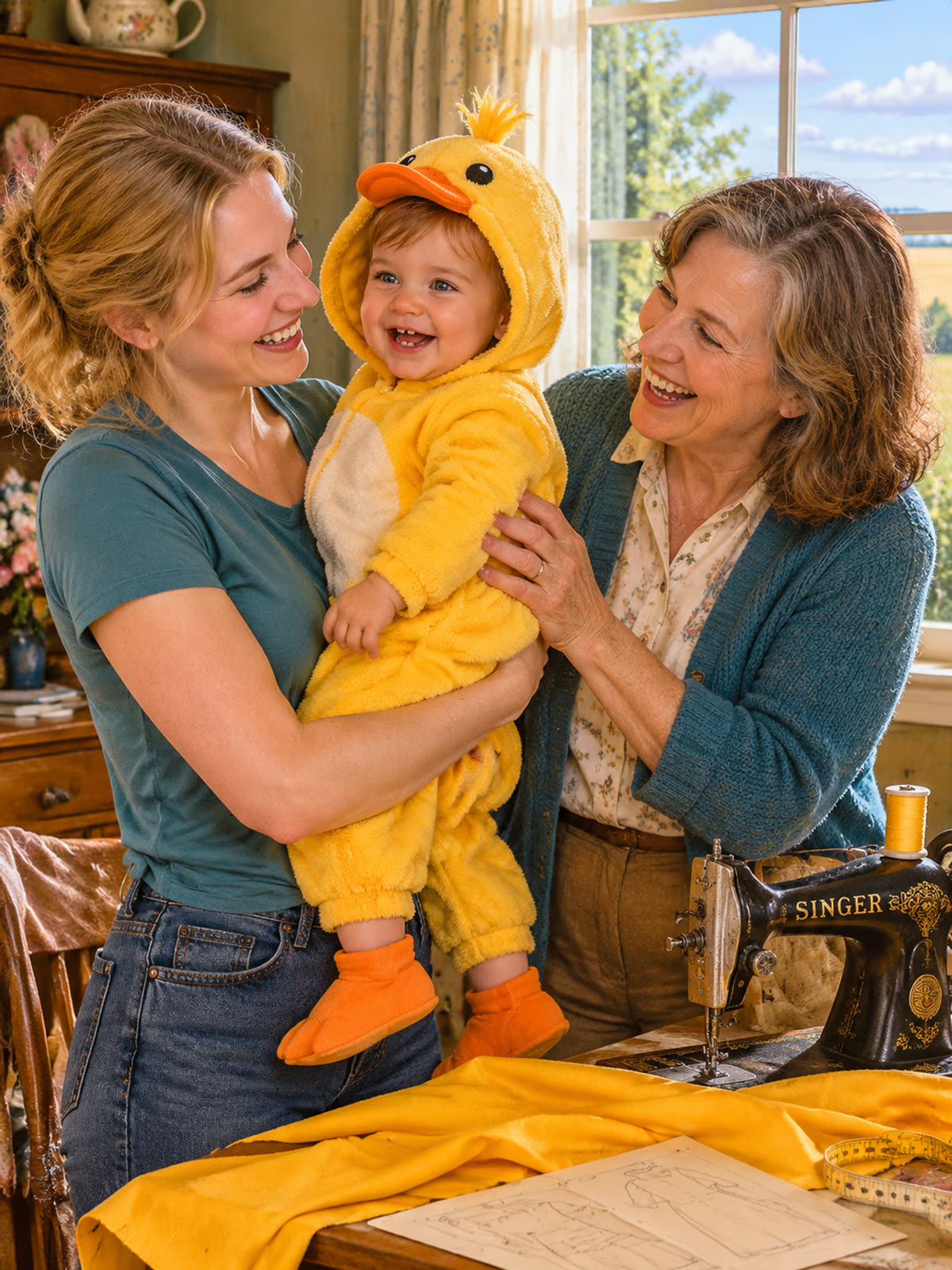
Last month, we decided to make Esme’s first Halloween costume together. We chose a little yellow duck and spent one of our Sunday afternoons working on it. The fabric was bright and cheerful, and we carefully sewed the small details into place. Making something for my daughter on my mother’s machine gave me another reason to be thankful it had come home. What Jaxon had dismissed as junk was helping us prepare an ordinary, happy moment I would be able to remember.
When we dressed Esme in the finished costume, she looked absolutely adorable. The bright yellow duck outfit fit beautifully, and I couldn’t stop smiling at what we had made. Mrs. Prentice was just as delighted. Watching her share that moment with us brought home how much had changed since she first stood outside my door. Then, I had been frightened and exhausted, uncertain what would happen to my family. Now we were admiring my daughter together, connected by far more than the return of a crib.
I often thought about the coincidence that brought Mrs. Prentice into our lives. She had only been trying to buy a secondhand crib for her granddaughter. She could not have known, when she answered the listing, how Jaxon had decided to spend the money or what he would do with Esme afterward. Then she returned to collect the car seat, heard a baby crying, and found that nobody answered the door. Her ordinary purchase had placed her close enough to notice something was wrong.
Her twenty-six years in child protection meant she understood why that prolonged crying mattered. More importantly, she did not dismiss the concern after leaving. She came back the next morning to find out whether my daughter was safe. I could not think about that choice without remembering what the monitor had shown: Esme alone, with nobody there to respond. Mrs. Prentice had heard the crying I had been miles away from, and she had cared enough not to let the question rest.
Her return helped expose the full truth of Jaxon’s actions. It also brought back the crib, the car seat, and the sewing machine I believed I would never see again. Those were different kinds of losses, but each had mattered. Esme needed her belongings, and I needed the connection to my mother that Jaxon had so casually sold. Mrs. Prentice had recognized both. What began with concern for an infant became an act of generosity whose meaning continued well beyond that morning.
I knew that painful experiences do not always end with somebody offering such unexpected kindness. Nothing about her help made the danger Esme had faced acceptable, and nothing could return those hours. Still, her willingness to intervene changed the direction our lives took afterward. I had evidence, support, and a way to begin rebuilding. Later, I had Sunday afternoons at the Singer and a friend who understood why an old sewing machine could mean so much more than its price.
The night in the garage would always be part of our story. I could still remember finding Esme in the basket, feeling one side of her body cold and the other too warm. I remembered Jaxon returning to his game while I stood there holding her. But those memories no longer filled every part of our lives. They existed alongside the quieter experiences that followed: sewing together, watching Esme grow, and learning that an ordinary afternoon could feel peaceful again.
Jaxon had sold our daughter’s belongings for $340 and used the money, along with our rent, to pursue his streaming plans. In doing so, he had shown how little he understood the obligations of being a parent. The supervised visits offered him opportunities to spend time with Esme, yet his attendance remained inconsistent. I could acknowledge that disappointment without allowing it to determine everything else. His priorities were his choices. Giving our daughter reliable care remained mine.
Mrs. Prentice had bought the same belongings for her granddaughter and then returned them when she understood what had happened. That contrast stayed with me. One person had taken what our daughter needed to obtain something for himself. Another had willingly given back what she had paid for because she could see our need. Her kindness wasn’t measured simply by the money involved. It was present in the attention she paid, the action she took, and the friendship she continued to offer.
My mother’s sewing machine now had a permanent place in our home. Every project added another memory without taking away the ones that had made me keep it in the first place. The yellow duck costume felt especially precious because it belonged to Esme’s first Halloween and to the friendship that helped us rebuild. I could look at it and see something created together, rather than something taken away. That was a different way to carry the machine’s history forward.
When I looked at Esme in her costume, I wasn’t thinking about Jaxon’s computer or the money he had wasted. I was thinking about the woman who had noticed her crying and returned. My daughter looked perfect in bright yellow, and I could enjoy being there with her without worrying about what might be happening elsewhere in the house. Our lives had not become effortless, but they had become safer and more peaceful. That was worth more than anything he had sold.
I could not erase the night that changed our family, and I could not make Jaxon choose a different relationship with his daughter. What I could do was protect the life we were rebuilding and make room for the good that had followed us out of those frightening hours. Beside my mother’s machine, with Esme in the costume we had made, the future no longer looked like something I could only fear. But the question of what we would make of it was still waiting.
Disclaimer: This story is a work of fiction inspired by real-life themes. Names, characters, places and events are fictionalized, and any resemblance to real persons is purely coincidental. It does not represent any person or organization and does not encourage inappropriate behavior. Images are for illustration purposes only.
