

PART 1: The Boy Who Was Still Waiting
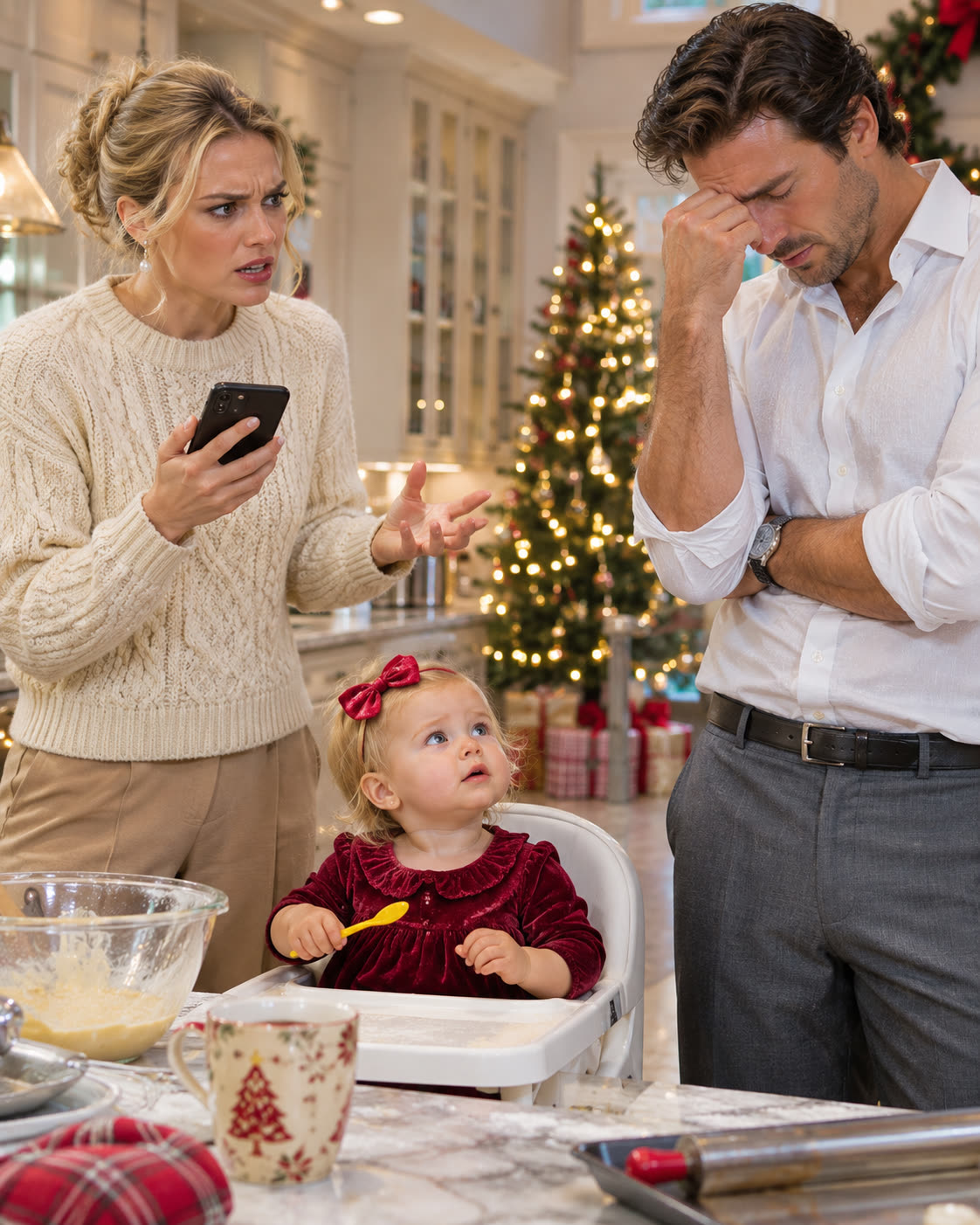
At 5:47 p.m. on Christmas Eve, my fourteen-year-old stepson’s boarding school phoned to say he was the last student waiting to be collected. Caleb had been beside his suitcase since noon, expecting the father who had promised to bring him home. For the previous two weeks, my husband, Derek, had assured me that Caleb wanted to spend Christmas at school. I was getting dinner ready while our nine-month-old daughter, Sadie, entertained herself in her high chair. Derek was hanging decorations on the tree when Hawthorne Academy’s name appeared on my screen. “Mrs. Sloan, this is Dr. Alan Mercer, the headmaster,” a man explained. “Is Caleb okay?” I asked immediately. “He’s perfectly safe, but his holiday pickup hasn’t arrived. We’ve been unable to reach his father.” Bewildered, I told him Derek had said Caleb would be participating in the school’s Christmas activities. Dr. Mercer fell briefly silent. “Our holiday program ended at noon. Every other student has gone home.” “Where’s Caleb?” “He’s here with me. He’s been waiting since twelve.” I checked the time. Almost six hours. “Did Derek know?” “He confirmed the pickup yesterday. We have it in writing.” The headmaster explained that Caleb had been fed and remained under supervision.
I crossed into the living room, where Derek stood with an ornament in his hand. “Caleb’s school called,” I said. “He’s still there.” For a second, Derek went motionless. Then irritation settled over his face. “Why would he be waiting for me?” “Because you confirmed you’d pick him up.” He wouldn’t meet my eyes. “Nora, it’s complicated.” “What’s complicated?” “Caleb and I discussed Christmas. He’s fourteen. He can manage one holiday away.” I looked at him, struggling to understand what I was hearing. “He’s fourteen, Derek. Not twenty-four.” “Don’t make this into something it isn’t.” I returned to the hallway and told Dr. Mercer I would leave immediately. After ending the call, I reached for my coat. “Where are you going?” Derek demanded. “To get your son.” “It’s Christmas Eve. The school is ninety minutes away.” “Then I’d better leave.” He positioned himself in front of the closet. “Can’t they keep him until tomorrow?” This was the same man who worried over every small thing involving Sadie, yet he was proposing that his son spend the night at an almost deserted school. “Move, Derek.” At last, he stepped out of my way.
I changed Sadie, passed her to Derek with a bottle, and told him where to find her pajamas. “Dinner’s in the oven. Turn it off in twenty minutes.” He stared at me. “You’re seriously leaving me alone with the baby?” “She’s your daughter.” Before walking out, I stopped for one last question. “Did you know Caleb was waiting?” Derek dropped his gaze. “Please don’t go, Nora. You’ll only make this worse.” “Worse for who?” He gave me no answer. Outside, lights glittered along the neighboring houses. Everything looked like an ordinary Christmas Eve, but that familiar view suddenly felt disconnected from my own life. I started the car. Derek called over and over before sending a message: Please come back so we can discuss this like adults. I pulled over briefly to answer: Your son has been waiting for six hours. There is nothing to discuss until he is safe at home. Then I put the phone down and continued toward Hawthorne.
On the drive, my thoughts returned to Caleb’s Thanksgiving visit. Tall and quiet, he could be awkward when expressing affection, and he had inherited Derek’s serious gray eyes. But when Sadie held out her hands toward him, his whole face changed. He had spent twenty minutes stacking wooden blocks into towers so she could knock them down. Eventually, Derek told him to stop encouraging the mess. Caleb put every block away without protesting. At the time, I hadn’t questioned it. Now that small memory looked different. I began wondering how many other moments I had accepted without really seeing them. My phone rang again, this time with Dr. Mercer’s number. “Caleb knows you’re coming,” he said. “But he asked whether you’re coming alone.” “Yes. Why?” “I think you should discuss that with him.” “Is he upset?” “He’s very quiet.” Then the headmaster said something that altered the meaning of the entire evening. “He asked me not to tell his father we’d contacted you.” “Why?” “He said his father would be angry if you discovered he was still here.” My hands tightened around the wheel. Caleb wasn’t merely a child whose ride had failed to arrive. He was afraid of what would happen because I had found out.
I reached Hawthorne Academy at 7:26 p.m. Beneath the winter sky, most of the stone buildings were dark. Wreaths and electric candles brightened the entrance, but the grounds were otherwise still. Dr. Mercer greeted me inside. “Thank you for coming, Mrs. Sloan.” “Where is Caleb?” “In my office.” I followed him along the silent corridor. When we entered, Caleb rose from his chair. He was wearing jeans and the navy sweatshirt I had bought before the school year began. His black suitcase waited beside him, his backpack balanced on top. Before saying anything, he looked past my shoulder. “Where’s Dad?” “He’s home with Sadie.” His eyes fell. “Oh.” I moved toward him carefully. “Hi, sweetheart.” “Hi, Nora.” I had been part of Caleb’s life for four years and had never expected him to call me Mom. His mother lived several states away, and respecting that bond had always mattered to me. Still, I made the pancakes he loved, showed up for science fairs, and remembered his birthdays. I had thought he understood how much he mattered to me.
“I’m sorry I’m late,” I told him. “It’s okay.” “No, it isn’t.” He glanced at the headmaster rather than at me. “Did you think nobody was coming?” I asked. Caleb studied the floor. “I didn’t know you knew.” “Why wouldn’t I know?” “Dad said you were busy.” “With what?” “The baby. And Christmas.” I drew a slow breath before answering. “Caleb, I was making dinner when the school called. I’d have come much earlier if I’d known.” “Okay.” Somehow, his immediate, quiet acceptance hurt more than an angry response would have. There was no accusation, no demand to know why he had waited so long. He simply accepted another explanation from an adult. Dr. Mercer brought over the release paperwork, and I looked through it before signing. Attached to the documents was the confirmation: Caleb Sloan — December 24, 12:00 p.m. Authorized pickup: Derek Sloan. Confirmed December 23, 4:18 p.m.
“Did my husband personally confirm this?” I asked. “Yes. He specifically said the arrangement wouldn’t change.” I remembered breakfast the day before. Derek had casually discussed wrapping paper while telling me how excited Caleb was about a Christmas ski trip. He hadn’t been mistaken about the arrangements. He had known exactly what they were. After thanking Dr. Mercer, I picked up Caleb’s suitcase and walked outside with him. Snow moved gently across the parking lot. “Is Sadie okay?” he asked. “She’s wonderful. Almost crawling.” A small smile appeared. “She still throws food?” “Even more than before.” For a few moments, we sounded like ourselves again. He was asking about his little sister, and I was bringing him home. Then we reached the car, and he stopped. “Nora, can I ask something?” “Anything.” His eyes remained on the windshield. “Did you know I wasn’t supposed to come home?” I turned toward him. “What do you mean?”
Caleb stood beside the car without looking at me. “Dad said you didn’t want me there this Christmas.” My chest tightened. “He said Sadie’s first Christmas was special, and you wanted it to be just the three of you.” For a moment, I couldn’t find words. “He told me not to take it personally. That I’d understand when I was older.” Derek had spent two weeks telling me Caleb wanted to stay at Hawthorne. At the same time, he had told Caleb that I wanted a holiday without him. I thought about every conversation in which I had asked when he would arrive, every time Derek had explained away his absence. “Caleb, look at me.” He finally lifted his eyes. “I never said that.” “Never?” “Never. I wanted you home. I bought everything for your favorite cinnamon rolls, wrapped your presents, and kept asking your father when you were coming.” Tears gathered in his eyes. “But Dad said—” “I know. And it wasn’t true.”
He turned his face away and wiped at it with the sleeve of his sweatshirt. I didn’t want to reach for him without asking. “Can I hug you?” I said. He nodded. At first, his body remained rigid against mine. Then he leaned into my coat, and his shoulders began to shake. “I’m sorry,” he whispered. “For what?” “For making everything difficult.” I held him more tightly. Somehow, this child had been led to believe that wanting to spend Christmas with his own family created a problem. He had spent hours waiting, and now he was apologizing to me. I couldn’t undo the afternoon or give him a different explanation for his father’s absence. All I could do in that moment was hold him and make certain he knew I had come because I wanted him with us.
Once we were inside the car, I turned on the heater. Caleb opened his backpack and took out a little package wrapped in blue paper patterned with silver stars. “I made this for Sadie.” “She’ll love it.” He slowly turned the present in his hands. “I wasn’t sure whether I should bring it.” “Of course you should.” After a hesitation, he added, “Dad told me not to give it to her because it would just confuse things.” I looked at the carefully wrapped gift. He had made something for his baby sister, yet even that simple act of affection had become something he was supposed to question. I wondered how many times he had been encouraged to doubt his place in our family, and how many of those moments had passed without my knowing. His suitcase was finally in the car. He was finally leaving school. But collecting him, I was beginning to understand, had only brought me to the edge of what had been happening.
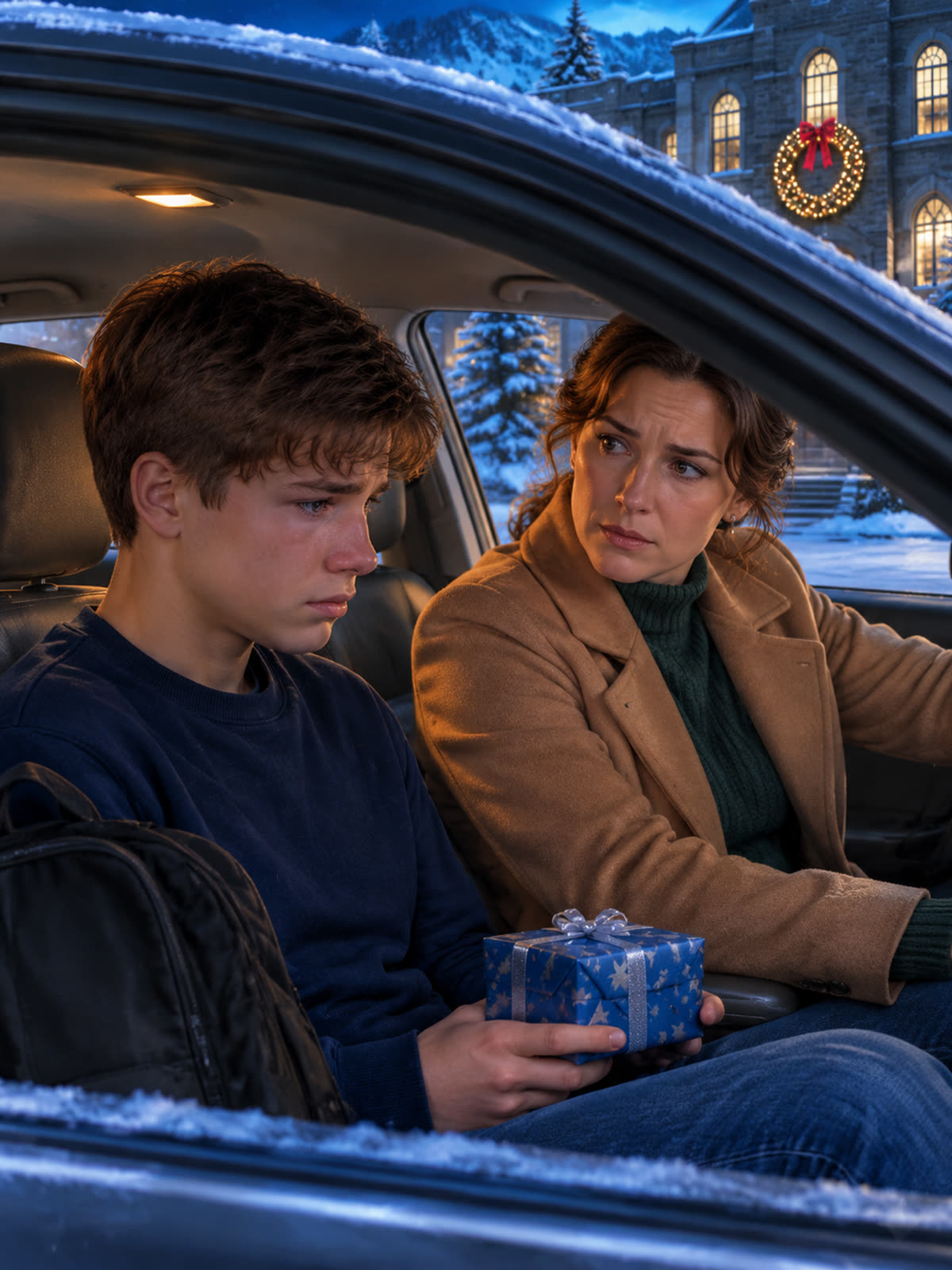
We were halfway down the mountain road when Caleb began explaining more. Light snow brushed the windshield, and instrumental Christmas music played softly through the speakers. He sat beside me, checking his phone from time to time without opening any messages. “Nora?” “Yeah?” “Can we not talk about this when we get home?” “Which part?” “All of it. I don’t want Dad to be mad.” I thought carefully before answering. “I can’t promise your father and I won’t have a difficult conversation. But none of this is your responsibility.” He stared at the dashboard. “He’ll say I told you things I wasn’t supposed to.” “What things?” He waited before replying. “Dad said adults needed to make certain decisions without involving me.” “Like Christmas?” “Yeah.” “Anything else?” “School.” I kept my voice steady. “What about school?” “He said I needed to stop complaining about being there.” “Have you been unhappy at Hawthorne?” “Sometimes.” “Why didn’t you tell me?” He looked genuinely confused. “I did.”
“When?” I asked. “On Thanksgiving.” I remembered how withdrawn he had seemed during that visit. He had spent much of Saturday in his bedroom. Derek said school had exhausted him. When Caleb asked to stay an extra night, Derek refused, saying he had to be back before lunch. “What did you tell me?” I asked. “That I missed home. You said you missed me too.” “I meant that.” “I thought so. But Dad said you were just being nice.” Again, I felt that tightness in my chest. “What exactly did he say?” “That things had changed since Sadie was born. That it wasn’t fair for you to look after a baby and a teenager.” Caleb glanced toward me. “I’m not saying he was wrong. I can take care of myself. I make breakfast, do laundry, and manage school.” “I know you can.” His voice became quieter. “I just wanted to come home.” “Wanting to be home doesn’t mean you’re incapable of looking after yourself.”
For several miles, neither of us said anything. Then I asked about Derek’s promise to collect him. “He called yesterday,” Caleb explained. “He said he’d changed his mind and would bring me home for Christmas.” “What happened today?” “I packed and went downstairs at eleven thirty. Dad didn’t come.” “Did you call him?” “At twelve fifteen. He said he was running late.” “And afterward?” “He stopped answering.” Caleb held out his phone. Between 12:15 and 4:03 p.m., there were seven calls. Only the first had connected. Next, he opened the messages. Dad, are you almost here? It’s okay if you’re late. Dr. Mercer needs to know when you’re coming. Should I tell them you’re not coming? Please answer. The last message had been sent at 4:41. I don’t want to get you in trouble. Please just tell me what to do.
“Did he respond?” I asked. Caleb shook his head. “He read the first two.” I pictured Derek at home, casually working on the Christmas tree while his son kept trying to reach him. He hadn’t simply lost track of the time. He knew Caleb was there. “Nora?” I glanced at him. “I’m okay.” I wasn’t, but it wasn’t Caleb’s job to carry what I was feeling. “Why didn’t you call me?” I asked. “Dad said you wanted a peaceful Christmas.” I thought of the stocking waiting for him, his wrapped gifts, and the cinnamon rolls I had planned. I had bought the electronics kit he wanted and the astronomy book he had mentioned back in October. While I had been anticipating his visit, he had been imagining a house where nobody wanted him. “Caleb, listen carefully. You’re family, not a guest. You never need an invitation to come home.” He searched my face. “Does Dad think that?” For the first time, I couldn’t give him an answer I believed.
We pulled into a roadside diner. Caleb said he wasn’t hungry, but I ordered fries and hot chocolate anyway. Without much conversation, he ate almost everything. While he was in the restroom, another message arrived from Derek. I hope you’re happy. Now Caleb thinks something is wrong when we had everything handled. Then came a second: Don’t promise him he’s staying. We need to discuss what happens next. I read that one twice. This was no longer simply a father trying to avoid a Christmas pickup. Derek was questioning whether his son should be coming home at all. When Caleb returned, he lingered before sitting down. “If I come home tonight, do I have to leave tomorrow?” “Why would you?” “Dad said if I made trouble, Christmas might only be a one-night visit.” I put my hand on the table beside his. “You’re not causing trouble. And nobody is making decisions about your future while you’re frightened and exhausted.” Some of the tension left his face.
Then his phone vibrated. Derek was calling. Caleb declined it and opened the message that came afterward. His expression changed immediately. “Everything okay?” I asked. He nodded at first. Eventually, in a voice barely above a whisper, he said, “Dad says I shouldn’t have told you about the phone calls.” Even now, with Caleb collected and on his way home, Derek was still trying to control what he told me. I had driven to Hawthorne believing I needed to solve a missed pickup. Now I was bringing home a boy who had been taught to fear telling the truth—and the man who had taught him that was waiting at our front door.
PART 2: The Place He Was Supposed to Have
We pulled into the driveway at 9:38 p.m. Christmas lights shone through the windows. Inside, Derek stood with his phone pressed to his ear; when our headlights crossed the house, he lowered it. Caleb’s body went tense. “You don’t need to explain anything tonight,” I told him. “I’ll handle any difficult conversations.” “He’s going to be mad.” “That’s his responsibility.” Caleb brought his suitcase toward the front door. Derek opened it before we reached the steps. “Well. You’re back.” “Hi, Dad,” Caleb said softly. Derek looked down at the luggage. “Did you need to bring all that?” “It’s just my clothes.” Once inside, I made sure Sadie was asleep and had taken her bottle. Derek waited with his arms crossed. “We need to talk.” “Tomorrow,” I replied. “Caleb needs rest.” “You don’t get to decide that.” I turned to Caleb. “Your room is ready. Fresh sheets and a clean towel are waiting upstairs.” “Thanks, Nora.”
He had just started toward the stairs when Derek stopped him. “Caleb. Come here,” he ordered. “Tomorrow, Derek.” “I’m talking to my son.” “He’s exhausted.” Caleb paused. “It’s okay. I can talk.” “You don’t have to,” I assured him. Derek gave a bitter laugh. “See? You’re making him think I’m some kind of monster.” The color drained from Caleb’s face. “Go upstairs, sweetheart.” He carried his suitcase up without another word. I waited until his bedroom door closed, then faced my husband. “What have you been telling him about me?” Derek frowned. “What?” “That I didn’t want him here. That Christmas would be better without him. That he was making things difficult.” “You’re taking his words out of context.” “Then explain.” He walked into the kitchen, and I followed. “Everything has changed since Sadie was born. We’re exhausted, money is tight, and Caleb has an excellent school.” “Except he doesn’t have his family there.” “He’s fourteen. He can manage independently.” “That doesn’t mean he doesn’t need his father.”
Derek shook his head. “You’re making this emotional.” “It is emotional. Your son waited six hours for you.” “He was with school staff.” I looked at him, trying to understand how that could be his answer. “Did you actually intend to pick him up?” He hesitated. “I figured Hawthorne would arrange something if I couldn’t make it.” “They did. They called me.” “Exactly.” He said it as though the outcome proved there had never been a problem. “What kept you from collecting him?” I asked. “Christmas preparations.” I glanced at the decorations and unfinished cookies. “You were decorating our tree while Caleb waited for you.” His face hardened. “You don’t understand my relationship with him.” “You’re right. Because you’ve been misleading both of us.” “I’m trying to make the best decision for this family.” “Which family?” He stared. “Does Caleb count?” “Of course.” “Then why wasn’t he welcome home?”
Derek let out a long breath. “Things aren’t like they used to be. Before Sadie, Caleb had more attention and freedom. Now everything revolves around the baby.” “That’s normal when there’s an infant in the house.” “You wanted another child.” “We both wanted Sadie.” He looked away. “I thought boarding school would give everyone some breathing room.” “Did Caleb actually want to go?” “He agreed.” “That’s not what I asked.” After another pause, Derek said, “He wasn’t thrilled initially, but it was the best option.” “For whom?” “For everyone.” I remembered the discussion we’d had in July. Derek had described Hawthorne’s robotics lab, advanced science classes, and exceptional facilities. Caleb had been enthusiastic about the equipment, but he had grown noticeably quieter when he understood he would be living away from home. I had suggested commuting or considering other schools. Derek rejected both, insisting this was the strongest opportunity. At the time, his reasoning had sounded sensible.
“Did you send Caleb away because you didn’t want him living here?” I asked. Derek looked offended. “That’s an awful accusation.” “Then tell me I’m wrong.” He didn’t. Instead, he spoke about the strain of supporting a teenager, a baby, and a wife who apparently demanded perfection. “No one ever asks what I need,” he said. I glanced toward the staircase. On Thanksgiving, Caleb had asked whether we could make cinnamon rolls together at Christmas. I had promised we would. Later that same afternoon, Derek announced that Caleb preferred spending the holiday at school. I had accepted his explanation. Now I understood the disappointment I had seen on Caleb’s face. “Don’t start making promises to him,” Derek warned. “What promises?” “That he can come back whenever he wants.” “This is his home.” “That’s not what I mean.” “Then explain what you mean.” He watched me for a moment before answering. “I don’t think Caleb should live here full-time anymore.”
The kitchen went still. Looking at my husband, I finally understood the arrangement he had been working toward. Christmas was only part of it. He wanted his son to become an occasional guest in the home where he had grown up. I slept very little that night. Shortly after ten, Derek went upstairs, saying I was too emotional to have a useful discussion. This time, I let him leave. For the first time in our marriage, I didn’t follow him to smooth things over. I stayed downstairs, cleaned the kitchen, washed Sadie’s bottles, and watched snow gather along the backyard fence. For months, Derek had been calling Caleb difficult. Yet the boy I knew was thoughtful and quiet, sometimes uncomfortable socially, and deeply interested in the things he loved. Astronomy, programming, peanut butter waffles. He remembered other people’s birthdays while disliking attention on his own. None of that matched the version of him Derek had been presenting.
I remembered the day Sadie was born and Caleb held her with trembling arms. “She’s really small,” he had whispered before smiling. “She’s my sister.” The pride in his voice had stayed with me. Derek had told him not to get too attached because babies changed so quickly. I had treated the remark as an awkward attempt at humor. Now I was reconsidering it, along with everything else. At 11:14 p.m., Caleb came downstairs in his pajamas, his hair damp from a shower. “Can’t sleep?” I asked. He shook his head. I made hot chocolate, and he sat at the island while I worked. “Is Dad mad?” “Your father and I disagree about some decisions.” “Because of me?” “Because of choices he made. That’s different.” He curled his hands around the mug. After a while, he asked, “Did you really buy me presents?” “Of course.” “Dad said it might be awkward if everyone had only planned for Sadie.”
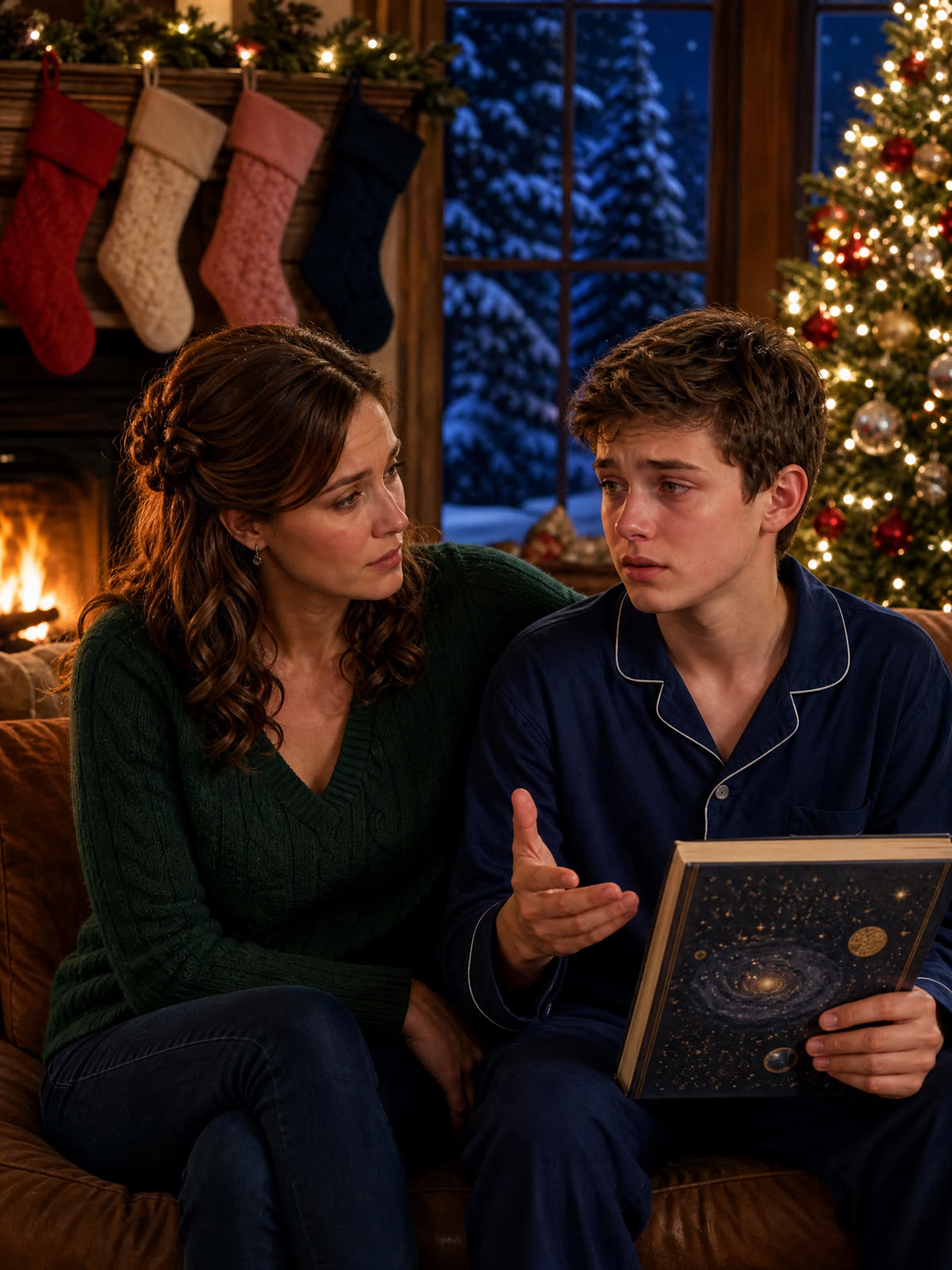
I swallowed before answering. “Your stocking is hanging beside ours.” “Really?” I led him into the living room. Above the fireplace hung four stockings: Derek’s red one, my cream one, Sadie’s pink one, and Caleb’s navy stocking with his name stitched in white. He reached out and touched it gently. “I thought you’d put it away because I’m hardly here.” “Being away doesn’t mean you stop belonging.” He stood there quietly for a moment, then asked whether he could open one small present. I chose the astronomy book he had wanted and handed it over. As he uncovered it, he looked at me. “I thought you forgot.” “I didn’t.” He held the book against his chest. The presents had been there all along, just as his stocking had been. What hurt was realizing that he had needed to see them before he could believe me.
“Can I tell you something without upsetting you?” he asked. “Always.” “I like Hawthorne. The science classes are great, and Dr. Mercer is nice.” “I’m glad.” “But sometimes I feel like I don’t have anywhere else to go.” I sat beside him. He explained how other students talked about going home on weekends, looking forward to their pets, their bedrooms, and their families. “I used to feel that way.” Then he added, “Then Dad kept saying I should stay at school.” First came concerns about Sadie’s sleep. Later, it was how tired I was, the cost of transportation, or the importance of his schoolwork. “There was always another reason.” I remembered Derek offering those same explanations whenever Caleb missed a visit. Each had sounded reasonable in isolation. Now, hearing them together, I couldn’t stop wondering which had ever been true.
“Did you ask to visit more often?” I asked. Caleb nodded. “In October, I asked to come home for your birthday.” I remembered that Saturday. Derek had taken me out to dinner and said Caleb needed the weekend to prepare for exams. I had sent Caleb a picture of my birthday cake. His reply had been three birthday emojis. “What did your father say?” “That I needed to stop being selfish.” My heart sank. “I would have loved having you there.” Caleb looked down at the astronomy book. He told me Derek often brought up the cost of school, meals, and travel. “He says you’re tired because there’s extra work when I’m home.” “Caleb, those expenses are adult responsibilities. You’re not a burden.” He nodded, but the uncertainty hadn’t left him. Beside the tree, with his stocking still hanging over the fireplace, he was holding proof that I remembered what he loved—and still struggling to believe that having him home was something I wanted.
At midnight, I walked him upstairs. His model rocket and old baseball glove remained in his room, but several shelves were bare. His favorite books were gone, along with a framed picture and his gaming chair. “Dad said I could take things back to school,” he explained. “He said the chair was in the way.” “You can decide what belongs in your room.” He gave me a small smile. I was nearly through the doorway when he called to me. “Nora?” “Yeah?” “Thanks for coming.” I wanted to tell him how sorry I was that I hadn’t understood sooner. Instead, I said, “I’ll always come when you need me.” He nodded. I left the hallway light on. At 12:32 a.m., I went into our bedroom and found Derek looking at his phone. “Enjoy your little bonding session?” he asked. “Don’t.” “He’s playing you, Nora.” “He’s fourteen.” “He’s making you feel guilty.” I met his eyes. “Caleb didn’t make me feel guilty. You did.”
I reminded Derek that he had lied to both of us, confirmed a pickup he hadn’t planned to make, and allowed his son to sit waiting for six hours. “I knew the school would supervise him,” he replied. “Why confirm the pickup at all?” He hesitated. “Mercer kept asking whether Caleb had somewhere to go for Christmas.” “And?” “I said yes.” “Why?” Finally, he gave me an answer without dressing it up. “Because I didn’t want to look like a bad father.” I stared at him. He had let Caleb believe he was coming because he didn’t want the headmaster to question him. The silence that followed made something impossible to dismiss. Derek cared a great deal about being seen as responsible. What he had actually done to Caleb was something else.
Sadie woke at 6:11 a.m., standing shakily in her crib and smiling when she saw me. I carried her to the rocking chair, where she played with my sweatshirt as pale daylight came through the curtains. Responding to her needs felt instinctive. Holding her, I thought again of Caleb beside his suitcase. Seven calls. Six hours. At seven, I took Sadie downstairs and put the cinnamon rolls in the oven. I had made the dough especially for him. He appeared in the kitchen at 7:38. “Merry Christmas,” I said. “Merry Christmas.” “Want to help with the icing?” His expression brightened. “Yeah.” We worked together while Sadie played in her high chair. For a little while, the morning felt as it should have. Then Derek came in. “Morning, Dad,” Caleb said. “Morning.” Derek looked at the cinnamon rolls. “Didn’t realize we were having a big breakfast.” “It’s Christmas,” I replied. He poured coffee and said nothing.
When Sadie dropped a piece of banana, Caleb leaned down to pick it up. “Leave it,” Derek said sharply. Caleb straightened at once. Later, while he went to get Sadie’s bib, Derek spoke under his breath. “We agreed not to make promises.” “He’s eating breakfast in his own home.” “You’re deliberately misunderstanding me.” “Not in front of him.” We finished breakfast, but Derek kept making remarks that left everyone uneasy. He questioned Caleb taking another cinnamon roll and brushed aside his offer to wash the dishes. When I suggested presents, Derek looked at his watch. “Let’s get it over with.” I wasn’t willing to let the morning become one more thing Caleb remembered with disappointment. We moved into the living room and gathered around the tree. Sadie laughed while Caleb helped her tear the wrapping from a soft fabric book. Then he brought out the little blue parcel he had carried home from school.
“This is for Sadie.” Inside was a wooden mobile he had made himself, with tiny stars and planets suspended from it. Saturn had a fine ring, Earth had green continents, and the moon was dotted with painted craters. “I made it in the workshop,” he explained. “Dr. Mercer helped me choose a safe finish.” He had designed it to hang where Sadie couldn’t reach it. “It’s beautiful,” I said. Caleb smiled. “I thought she’d like looking at it.” I lifted it above her, and she squealed with delight. Caleb laughed. Then Derek spoke. “I told you not to waste workshop time on baby stuff.” The smile vanished from Caleb’s face. “I can put it away.” “No,” I said. “We’re hanging it in her room.” Derek sighed. “Nora.” “Don’t.” Caleb left the gift with me without saying anything else.
A little later, he opened his own presents. The electronics kit delighted him, and he laughed when his new winter jacket’s sleeves turned out to be a little long. “You’ll grow into it,” I told him. His last present was a framed photograph taken when Sadie first came home from the hospital. Caleb was holding his newborn sister, nervous and proud at once. On the back, I had written: Her first big hero. He read the words twice, his eyes filling. “Do you like it?” I asked. He nodded. “Yeah. Thanks.” Derek suddenly went to get more coffee. Caleb kept the photograph in his hands. “Can I put this in my room?” “Of course.” He smiled at Sadie, who was laughing beside him. Watching them, I understood something that should never have been complicated. They weren’t fighting for a limited amount of love. They wanted to share it.
Later, while Caleb helped hang the mobile, Derek drew me into the hallway. “We need to decide what happens before he gets too comfortable.” “He is comfortable.” “That’s the problem.” I stared at him. He lowered his voice. “I’ve already asked Hawthorne about keeping him there next term without weekend visits.” “When?” “Last week.” “Without asking Caleb?” “I planned to explain.” “Without discussing it with me?” “I knew how you’d react.” I took a measured breath. “What exactly did you tell the school?” He hesitated. It was the same uneasy look I had seen when Dr. Mercer first called. Derek wasn’t only worried about the argument between us. He seemed concerned about what the school might already know. Once Sadie was asleep and Caleb was upstairs with his book, I called the headmaster. He had given me his direct number and said I could contact him about Caleb’s holiday arrangements. Even on Christmas Day, he answered.
“Mrs. Sloan? Is Caleb settling in?” “He’s home.” “That’s what matters.” I explained what Derek had said about keeping Caleb at Hawthorne next term without weekend visits. Dr. Mercer paused. “Your husband raised that possibility.” “Did the school agree?” “No.” “Why?” “Our boarding program supports students academically. It isn’t intended to replace parental involvement.” I leaned back against the counter. “What reason did Derek give?” “He said your family was adjusting to a new baby and frequent visits had become difficult.” “Did he claim Caleb didn’t want to visit?” “Initially, yes.” “And afterward?” There was another pause. “Caleb told his residential advisor something different.” “What did he say?” “I’d prefer to discuss that with Caleb before sharing his private conversation.” He chose his next words carefully. “However, we noticed inconsistencies between Caleb’s wishes and his father’s explanations.” “Is that why you contacted Derek about Christmas?” “Partly.”
The school had repeatedly reminded parents that its holiday closure required every student to have an approved departure plan. Derek had first asked whether Caleb could remain on campus. Hawthorne refused because the regular residential program would be shut. Derek requested an exception, and the answer remained no. “When I asked whether there were family difficulties,” Dr. Mercer explained, “your husband assured me everything was fine.” “He promised to collect Caleb?” “Yes.” “And confirmed it yesterday?” “Personally.” I told him what Derek had said to me and what Caleb had shared in the parking lot. He listened without interrupting. “Mrs. Sloan, I appreciate your honesty.” “I wish I’d known sooner.” “So do I.” He sighed. “Caleb is a bright, capable student. But he’s fourteen, and he’s been trying to manage circumstances that shouldn’t be his responsibility.”
“Has he been unhappy?” I asked. “Academically, he’s doing very well. Socially, he’s making progress.” After a pause, he added, “But we’ve noticed he becomes unusually anxious before holidays and scheduled home visits.” “What kind of anxious?” “He worries about whether arrangements will change.” Dr. Mercer continued, “He repeatedly asks whether he’s causing inconvenience,” and then, “He sometimes says he’d rather stay on campus, especially after his home visits have been changed.” I remembered Caleb insisting he could manage everything for himself and apologizing for making things difficult. The pieces fit together. “Did you discuss this with Derek?” “Yes. He suggested Caleb was struggling to adjust and needed more independence.” I pressed my fingertips to my forehead. “What should we do now?” “Let Caleb enjoy Christmas. Reassure him that decisions about his education will prioritize his wellbeing.” He suggested a meeting with Caleb, Derek, and staff after classes resumed. “Could I attend?” “If Caleb wishes, and the necessary permissions are in place, we can discuss your participation.”
Before ending the call, I asked one last question. “Did Derek ever tell the school he wasn’t coming yesterday?” “No.” There had been no emergency, no problem on the road, no explanation sent ahead. Caleb had simply waited while Derek failed to arrive. I thanked Dr. Mercer and put down the phone. When I turned, Derek was in the doorway. “Who was that?” “Dr. Mercer.” His face tightened. “Why are you calling the school behind my back?” “Because I need to understand what’s happening.” “You had no right.” “No right to ask about Caleb?” He folded his arms. “You’re determined to make me the villain.” “I’m trying to learn the truth.” Then he said the words that stopped me. “You’re not his mother.” For a moment, I stood still. “No. I’m not.” Relief briefly crossed his face. “But I’m the adult who drove ninety minutes to collect him when you didn’t.”
“I’ve helped raise Caleb for four years, and I’m not going to ignore what’s happening.” Derek stared. “What exactly am I doing?” “Making Caleb feel unwanted while convincing me he prefers being away.” I asked, “Why did you tell him I didn’t want him home?” He looked aside. “I thought it would make things easier.” “For whom?” “For everyone.” “No, Derek. For you.” He looked worn down. At last, he sat at the kitchen table and covered his face. “I can’t keep doing this.” “Doing what?” “Trying to be everything to everyone. Caleb needs attention, Sadie needs attention, work is exhausting, and there’s always another responsibility.” Beneath all his explanations, I heard something that finally sounded honest. He was overwhelmed. Rather than admitting it, he had tried to make his responsibilities smaller by pushing Caleb farther away.
I sat across from him. “Feeling overwhelmed doesn’t make you a bad person. But the way you’ve treated Caleb has hurt him.” “I never meant to hurt him.” “You knew he was waiting. You knew he kept calling.” Derek lowered his gaze. “I thought I could fix it later.” “How?” He had no answer. He had been depending on somebody else to deal with what his choices caused. Footsteps sounded above us, and he quickly wiped his face. Then he spoke so quietly that I had to listen closely. “I don’t know how to tell him I didn’t want to come.” Upstairs was a boy who had spent six hours believing in a promise. Downstairs was the father who had chosen not to keep it. The truth was finally between us—and Caleb still had to hear it.
PART 3: What the Next Promise Would Mean
I asked Derek to wait before speaking to Caleb. He needed to think about what he would say, rather than turn an apology into another account of how exhausting his responsibilities were. Caleb had spent months believing his needs made life harder for everyone. He didn’t need his father to confirm that belief while supposedly asking forgiveness. I told Derek he couldn’t expect Caleb to comfort him or to keep adult choices secret. For once, he listened without arguing. That afternoon, Caleb helped me make Christmas dinner. We prepared roast chicken, potatoes, and green beans while Sadie happily dropped measuring spoons from her high chair. Derek stayed in the living room. “Is Dad okay?” Caleb asked. “He’s having a difficult day.” “Because I’m here?” “No. Your father is responsible for his own feelings.” I looked directly at him. “You don’t have to make yourself smaller to keep someone else comfortable.” He nodded, though I knew one conversation wouldn’t undo what he had come to believe.
At dinner, Derek was quieter than usual. He praised the food, helped with Sadie, and asked about school. When robotics came up, Caleb became animated. “We’re building a vehicle that navigates obstacles without a remote.” “Using sensors?” Derek asked. “Yeah. Ultrasonic sensors. We’re working on smoother turns.” “Sounds complicated.” “It is, but it’s fun.” For several minutes, they talked about motors and circuits. I remembered the weekends Derek once spent building model airplanes with him, the science exhibitions he used to attend. I wondered when he had stopped leaving room for those things. Afterward, I put Sadie to bed. When I returned, Derek stood near the sink. “Caleb, could we talk?” The boy tensed immediately. Derek noticed. “You’re not in trouble.” Caleb looked at me. “Would you like me to stay?” I asked. He nodded. Derek was uncomfortable, but he agreed.
We sat in the living room beside the illuminated Christmas tree. Caleb chose the armchair closest to the door. Derek drew a breath. “I owe you an apology.” Caleb watched him carefully. “I promised to pick you up yesterday, and I didn’t. That was wrong.” “It’s okay.” “No, it isn’t. I shouldn’t have ignored your calls either.” Caleb tightened his hands on the armrest. “I thought something happened.” Derek swallowed. “Nothing happened. I was home.” Caleb stared at him. “You were home?” “Yes.” “All day?” Derek nodded. “Did you forget?” “No.” The room became completely quiet. “Then why didn’t you come?” Derek glanced in my direction, but I said nothing. This was an answer his son needed from him. “I was overwhelmed.” “With what?” “Work, home, responsibilities. Everything.” Tears rose in Caleb’s eyes. “But you promised. You said you wanted me home.”
“I do want you in my life.” “That’s not what I asked.” Derek bowed his head. “I didn’t want to make the drive yesterday.” Caleb kept staring. “Was it because of me?” “No.” “Then why?” “I was tired.” The boy looked down. “I was tired too.” Derek lifted his eyes. “I woke up early to pack. I skipped breakfast because I was excited.” Caleb’s voice was shaking now. “I took my suitcase downstairs and waited because you said you’d come.” Derek’s own eyes filled. “I’m sorry.” Caleb wiped his face. “I thought maybe your car broke down or something happened.” Then he said, “Then I started wondering if I’d done something wrong.” His voice trembled harder. “By four o’clock, I was trying to remember everything I’d said during our last conversation.” Derek covered his mouth. “I thought maybe I’d been annoying or asked too many times about coming home.” Caleb added, “Maybe you were trying to teach me a lesson.”
Derek reached toward him. Caleb drew back, and Derek stopped immediately. “I’m sorry,” he whispered. Caleb looked straight at his father. “Did you tell Nora I didn’t want to come home?” “Yes.” “Did you tell her I was happy staying at school?” “Yes.” “And did you tell me she didn’t want me here?” Derek closed his eyes. “Yes.” Caleb went still. Then he asked something neither of us was ready to hear. “Did either of you actually want me?” I moved closer to him. “Caleb, I wanted you home.” I continued, “I prepared your room, wrapped your presents, and kept asking when you’d be here.” He nodded slowly before looking back at Derek. My husband struggled to answer. Eventually, he whispered, “I love you, son.” Caleb’s face tightened. “That’s not the same answer.” Derek looked devastated, but his regret could not matter more than what his son was feeling.
Caleb stood up. “I don’t want to talk anymore.” Derek began to rise too. “Let him go,” I said. Caleb went upstairs and shut his bedroom door. Derek stayed on the couch. Several minutes passed before he whispered, “I ruined everything.” “You hurt him.” “I know.” “Then don’t expect him to make you feel better about it.” He nodded without arguing. I went upstairs and tapped softly on Caleb’s door. “Caleb? I won’t come in unless you want me to.” After a pause, he answered. “Okay.” I opened the door. He was sitting on the floor beside his bed, holding the photograph of himself with Sadie. I sat down next to him. For a while, neither of us spoke. Then he whispered, “He didn’t forget me.” “No.” “He just didn’t come.” I rested my hand beside his. He looked at the photograph. “Is that worse?”
I took a moment, unwilling to make another excuse for Derek. “Yes,” I said gently. “In some ways, it is.” Caleb leaned against me, and I put my arm around his shoulders. We stayed there until he was calmer. I couldn’t alter what his father had done. But I could make certain Caleb no longer believed he had to act as if it hadn’t hurt. The next morning, I found Derek alone in the kitchen with a cup of coffee that had gone cold. He looked exhausted. “We need to talk,” he said. “Yes.” “I’ve been thinking about Caleb. I know I handled Christmas badly, but Hawthorne is still the best place for him.” “Academically?” “For everything.” I stared at him. “After yesterday, you still want him away?” He began listing the baby, the lack of space, financial strain, and the quality of the school.
Even after hearing his son’s pain, Derek was still looking for a way to keep his own discomfort at a distance. “His bedroom is upstairs,” I reminded him. “That’s not what I mean.” “I know. You’re saying you don’t want the responsibility of having him home regularly.” “That’s unfair.” “Is it inaccurate?” He said nothing. I told him Caleb could keep attending Hawthorne if that was what he wanted, but school could not stand in for a parent. “And his visits can’t depend on whether you feel like driving.” “I already apologized.” “An apology doesn’t replace a plan.” I explained what we needed to do: ask Caleb what he wanted, meet with the school, make dependable travel arrangements, and get professional help for Derek’s stress and their relationship. “Therapy?” he asked. “Yes.” “You’re making this sound like a crisis.” “Your son spent Christmas Eve believing nobody wanted him home.”
Derek looked away. After a long silence, he asked, “What if I can’t be the father Caleb needs?” The honesty surprised me. “He isn’t asking for everything,” I replied. “He’s asking you to keep your promises.” Derek nodded. I wanted change to be possible, but comforting words were no longer enough. That morning, I left a message with a family counseling office recommended through our pediatrician. I also wrote down the school arrangements, the missed calls, and what Derek had admitted. I wasn’t trying to punish him. I didn’t want the facts to dissolve later into disagreements about what had really happened. At lunchtime, I spoke to Caleb alone. “You’re not in trouble. I just want to know what you’d like to do about school.” “Do I have to decide now?” “Absolutely not.” He said he liked Hawthorne’s science program and the friends he had made. “But I want to come home on weekends.” “Okay.”
“Not every weekend. Sometimes there are competitions.” “Of course.” “And sometimes I’d rather stay at school.” “That’s fine too.” He paused. “Would it be annoying?” “No, sweetheart. Having you home isn’t an inconvenience.” He studied his hands. “If I’m having a bad week, can I call you?” “Always.” “Even if Dad is busy?” “Yes. We’ll work out the adult decisions, but you can always call me.” I held out my hand. “Can we make a deal? No more pretending everything’s fine because you think that’s what someone wants to hear.” A small smile appeared. “Okay.” “And I’ll ask you directly how you’re doing.” “Okay.” His hand rested in mine as we finished talking. He wasn’t asking for an elaborate holiday or a perfect household. He was asking whether he could tell the truth, come home, and call someone when he needed help.

When I told Derek what Caleb wanted, his first question was whether the boy had complained about him. “No. He was explaining what he needs.” Derek thought for a while. “I suppose weekends are manageable.” “He’s your son, Derek. His presence shouldn’t be something you merely tolerate.” He lowered his eyes. The remainder of the day was quiet. Caleb took pictures of Sadie under the tree, and Derek put together one of her toys. Still, the distance between my husband and me didn’t disappear. That evening, I asked, “Do you want to fix this?” “Our marriage?” “Your relationship with Caleb.” He hesitated. “I don’t know where to start.” “Start by telling the truth, even when it’s uncomfortable or embarrassing.” He listened. “And if this happens again, I won’t help explain it away.” Derek looked up. “You’d leave me?”
I thought about our daughter, about Caleb, and about the family I had believed we were building. “I won’t stay in a home where one child has to wonder whether he belongs.” Derek studied my face. He understood that I wasn’t making a threat to frighten him into agreeing. I was telling him where my boundary stood. There was no miraculous transformation in the days that followed Christmas. Derek didn’t suddenly become a different father. Caleb wasn’t prepared to forgive him, and I still didn’t know what would happen to our marriage. What came instead were small steps that were often uncomfortable. Derek called Dr. Mercer and admitted he had failed to collect Caleb. He didn’t blame traffic, the school, or me. When the call ended, he sat silently at the kitchen table. I didn’t praise him for it. Honesty was something he owed his son, not an exceptional favor.
A few days later, Derek asked Caleb whether he wanted to remain at Hawthorne. This time, he let him answer. Caleb wanted to finish the year, stay involved in robotics, and spend more time at home. Together, they looked over a calendar and discussed weekends. Derek still paused over work commitments and transportation, but he asked questions rather than deciding everything by himself. If he couldn’t make a promise, he said so. None of it resolved what had happened. It gave them somewhere to begin. Our first family counseling session was booked for January. Derek agreed to go, and Hawthorne offered Caleb individual student support. I told Caleb forgiveness didn’t have a deadline. He could love his father and remain hurt by him. He could appreciate boarding school and still wish he were home. Those feelings did not cancel each other out, and he did not have to choose the one that made an adult more comfortable.
On New Year’s Eve, Caleb and I watched a science documentary while he worked on a light-sensitive circuit. I handed him components, following very little of what he was explaining. When the circuit lit up, he grinned. “It works!” “You’re a genius.” “It’s literally in the instructions.” “Still a genius.” He laughed, then became serious. “Nora, are you and Dad getting divorced?” I hadn’t expected the question. “Why do you ask?” “You’ve been different.” I considered what I could honestly tell him. “Your father and I are working through serious problems. Christmas brought some things into the open.” Worry crossed his face. “But none of this is your fault,” I continued. “You didn’t cause it, and you aren’t responsible for fixing it.” He nodded, then asked in a quieter voice, “Would I still get to see Sadie?” “Of course.”
“Even if you and Dad weren’t together?” “Yes. I can’t promise exactly what the future will look like, but I won’t suddenly stop caring about you.” He reached for my hand. We stayed together while the documentary continued. At midnight, fireworks sounded outside. Derek came downstairs to wish us a happy New Year. Caleb allowed his father a brief, awkward hug. It was a choice he made himself, and I respected it. When January came, Derek drove him back to Hawthorne. I went with them because Caleb asked me to. We stopped for lunch, and he talked enthusiastically about his next robotics competition. Derek listened. He asked questions. At school, Dr. Mercer went through the new pickup arrangements with us. Visits would be confirmed beforehand, changes would be communicated clearly, and Caleb would know who was coming for him. Managing transportation failures would no longer be left to a fourteen-year-old.
A written plan couldn’t create trust by itself. It could, however, make the adults’ responsibilities unmistakable. Before heading inside, Caleb hugged me. “Thanks, Nora.” “For what?” He smiled. “For everything.” “Call me when you’re settled.” “I will.” Then he turned to Derek. They hesitated briefly before embracing. I watched them stand together in the cold, and then Caleb lifted his backpack and went into the building. On the drive home, Derek broke the silence. “I keep thinking about Christmas Eve.” “So do I.” “I don’t think I’ll ever forgive myself.” I looked toward him. “That’s not what matters most.” “What does?” “What you do next.” He nodded. It was the only answer that made sense to me. His regret couldn’t change those hours at school. Only what he did afterward could tell Caleb whether another promise was worth believing.
In the following months, some things improved and others remained hard. Derek went to counseling and took a larger part in Sadie’s everyday care. He arrived for scheduled pickups and found alternatives when work made that impossible. He stopped referring to Caleb’s visits as disruptions. He also stopped speaking for him in ways that prevented the two of us from communicating directly. That mattered. Caleb began calling me on Sunday afternoons. Sometimes he showed me a project. Sometimes he complained about school. Other times, he simply wanted to hear his little sister laugh. I never treated the calls as intrusions. His bedroom stayed his, with his books and belongings where he wanted them, along with new photographs. By spring, the picture of him holding newborn Sadie stood beside pictures from a robotics competition and afternoons with the family.
One photograph showed Derek and Caleb working on a model airplane together. Those newer memories didn’t wipe out Christmas Eve. They did show that our family was capable of moving forward. My marriage was still uncertain. Trust didn’t return because we had attended an appointment or followed a calendar. Derek sometimes slipped back into old habits. When that happened, I spoke rather than letting it pass in the name of keeping things peaceful. I had learned that protecting a family could require saying the things everyone would rather avoid. Nearly a year after the headmaster’s call, Caleb came home for Christmas break. Derek collected him at noon. I knew because Caleb sent me a photograph taken from the passenger seat. He was smiling. Dad’s here. We’re stopping for hot chocolate. See you soon.
I looked at the message and cried. It wasn’t because everything in our lives had become perfect. I remembered the child beside his suitcase, apologizing because he wanted to come home. Now he was smiling on the journey because he knew someone would be there to welcome him. When the front door opened, Sadie hurried into the hallway on her unsteady toddler legs. “Kay!” she shouted. Caleb dropped his backpack and crouched down. She ran into his arms. “Hey, peanut.” “Kay!” “Yeah. I’m home.” Derek brought the suitcase inside. He glanced at me, and I saw something in his expression that had been missing the previous year. Responsibility. He had picked up his son because he had made a promise and followed through. There was nothing elaborate about it. That was precisely why it mattered.
Caleb smiled at me over Sadie’s head. “Hey, Nora.” “Hey, sweetheart.” “Smells like cinnamon rolls.” “That’s because I made some.” “Awesome.” I put my arms around him carefully, making room for Sadie between us. For a moment, we stayed together in the hallway. I remembered the unanswered calls, the quiet school, and the suitcase waiting by the door. That night, I had asked Derek who would be worse off if I brought Caleb home. Now I understood what he had feared. My going to Hawthorne meant his decisions would be questioned. The comfortable routine he had arranged would have to change. Bringing Caleb home had done exactly that. It changed how I saw my marriage, what I expected of us as parents, and what I understood family to require. Most importantly, it changed what Caleb believed he was allowed to ask for.
That evening, he helped Sadie place a small silver star low on the Christmas tree. It was the same handmade star he had brought home the year before. Sadie clapped with delight. Caleb stepped back to look at it. “Is it okay there?” The star sat a little crooked between two branches, reflecting the tree lights. “Right where it belongs,” I said. Caleb smiled and turned toward his sister. Watching them, I understood that children don’t require flawless parents, costly schools, or extraordinary holidays. They need adults who honor promises and make room for them. They need to know that a difficult day does not leave them less worthy of love. I couldn’t return those six lost hours to Caleb. I couldn’t remove what he had felt while he waited. I could help give him a home where he was wanted, a family willing to listen, and the knowledge that love did not depend on never needing anything.
No child should have to sit beside a suitcase wondering whether somebody is coming. No child should feel compelled to apologize for wanting to go home. Caleb was home now, smiling beside his sister, and that mattered more than any explanation Derek or I could offer. But Christmas Eve would always remain part of our family’s story, as would the uncertainty I still felt about my marriage. The changes were real; so was the trust still waiting to be rebuilt. We had shown Caleb that this promise could be kept. What mattered next was whether he could keep believing us—and that answer would lie in what we did the next time he needed us.
Disclaimer: This story is a work of fiction inspired by real-life themes. Names, characters, places and events are fictionalized, and any resemblance to real persons is purely coincidental. It does not represent any person or organization and does not encourage inappropriate behavior. Images are for illustration purposes only.
