

Part 1: The Slap That Silenced Harbor Square
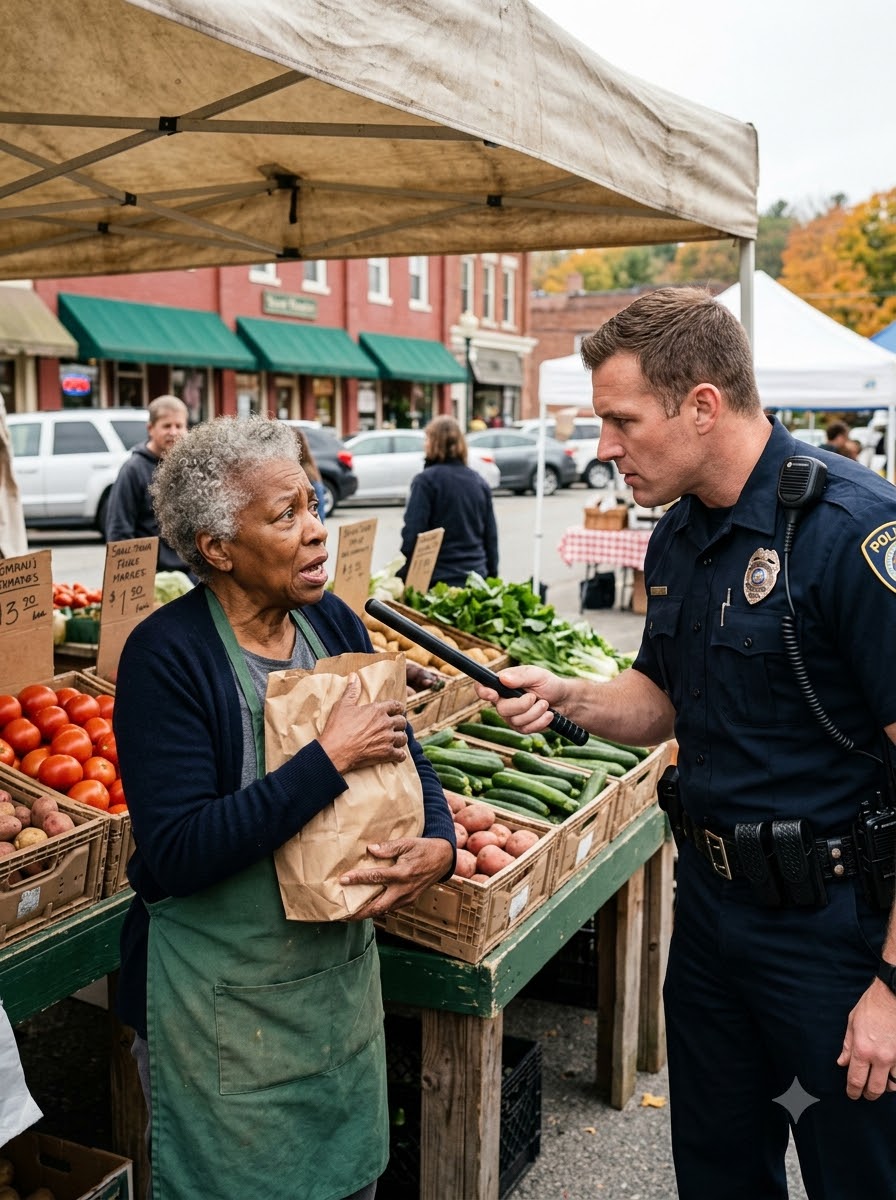
The slap echoed across Harbor Square Market, cutting through the noise of a busy Virginia afternoon.
For one extraordinary moment, even the sizzling fryer at the seafood stand seemed to fall silent.
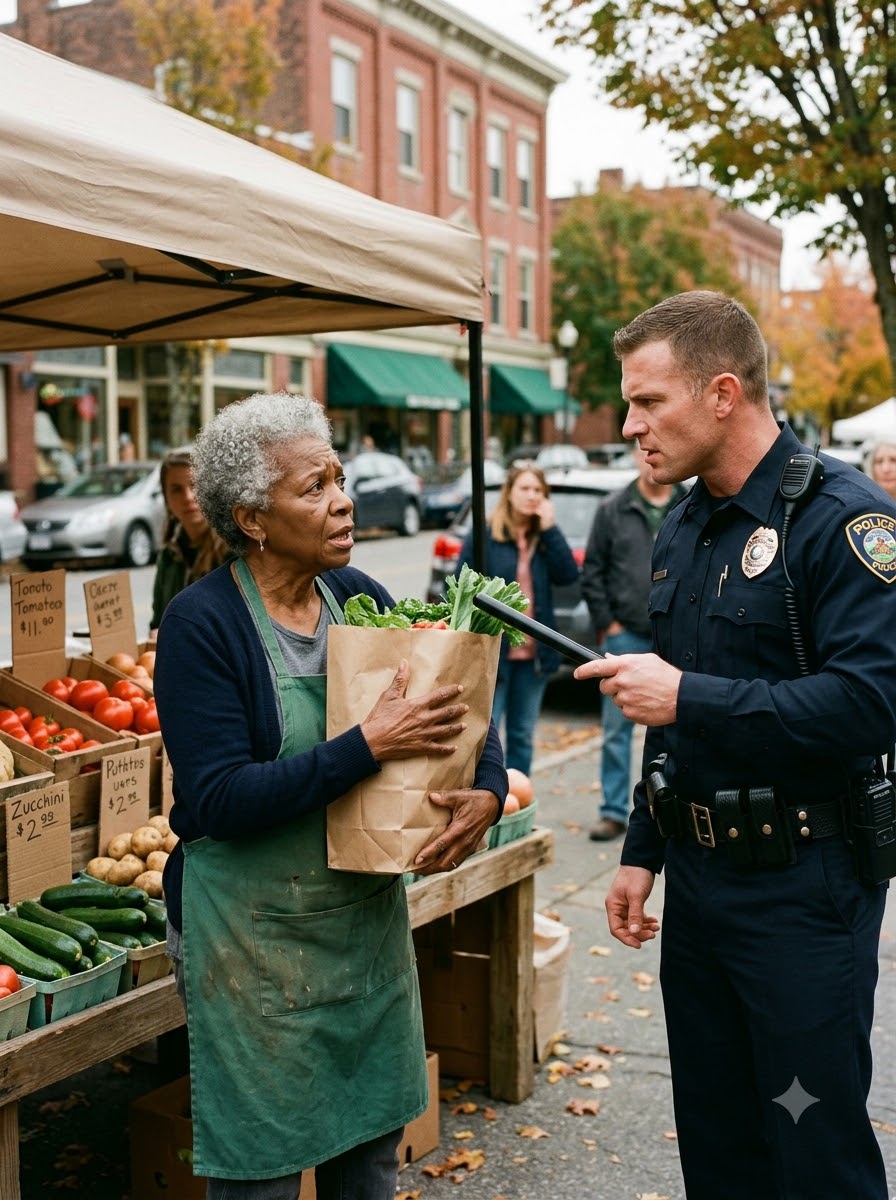
Seventy-four-year-old Vivian Brooks stood motionless beneath the summer sun, pressing one trembling hand against her cheek. Her paper bag had split open on the pavement, scattering pastries around her feet.
Officer Tyler Harlan towered over her, looking more irritated than remorseful.
“You remember who you’re talking to next time,” he said.
Nobody moved.
Years later, Vivian would remember that silence more clearly than the pain.
Not the officer’s hand.
Not the pastry crushed beneath his boot.
The silence.
People she had greeted every Saturday suddenly became fascinated by their vegetables, their phones, their registers, and the cracks in the pavement.
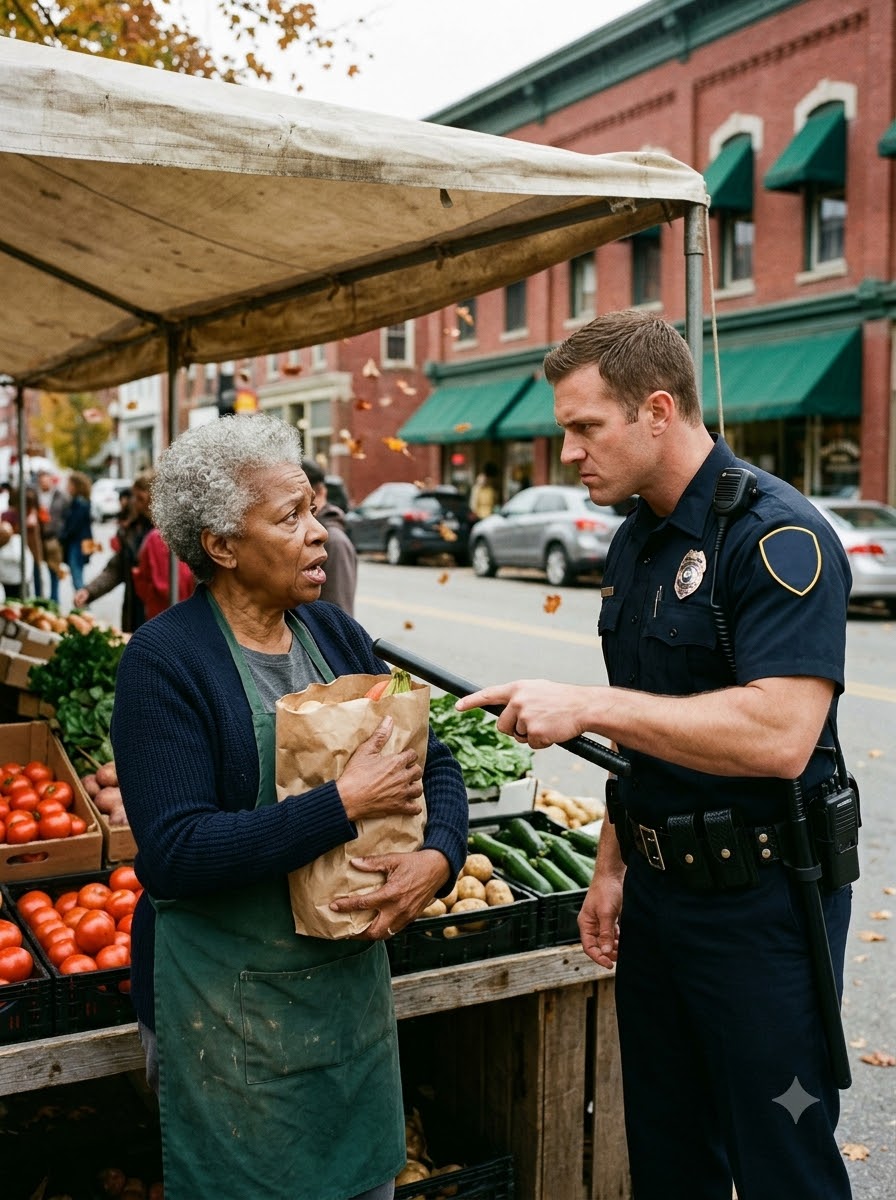
They weren’t indifferent.
They were frightened.
Then a man’s voice broke through the stillness.
“Officer.”
Harlan turned.
A tall, broad-shouldered man in his early sixties stood several feet away. He wore khaki trousers, a pale blue polo shirt, and dark sunglasses. He looked like an ordinary retired serviceman who had stopped by the market for groceries.
Nothing about his appearance suggested the decades he had spent making decisions in places where hesitation could cost lives.
“Step away from Mrs. Brooks.”
Harlan gave him a contemptuous stare.
“Mind your business.”
The stranger removed his sunglasses.
“I am.”
Vivian lifted her head.
Her expression changed.
“Elias?”
Rear Admiral Elias Grant had not seen Vivian Brooks in almost four years.
Their last meeting had been at a memorial ceremony in Norfolk. Vivian had sat in the second row, clutching a folded American flag that had spent fourteen years inside a cedar box in her bedroom.
Elias had stood before the gathering and spoken about her only son, Chief Petty Officer Daniel Brooks, one of the finest men he had ever commanded.
Now Daniel’s mother was injured on the pavement, and a local police officer was ordering Elias to walk away.
Harlan glanced between them.
“You know her?”
Elias ignored him.
He approached Vivian and crouched beside her.
“Can you stand?”
“I think so.”
“Did you hit your head?”
“No.”
“Hip?”
“Sore.”
Vivian glanced at the scattered pastries.
“Those were for Jordan.”
Jordan was her thirteen-year-old grandson.
Daniel’s son.
“He’ll survive without a cinnamon roll.”
“He will complain like he won’t.”
Despite everything, Elias almost smiled.
That sounded like Vivian.
He extended his hand.
Before she could reach it, Harlan grabbed his shoulder.
“Back up.”
Elias slowly looked at the officer’s hand.
Harlan released him.
Something in the older man’s expression had apparently persuaded him.
“I said this is an active police matter.”
Elias stood.
“Then state the offense.”
Harlan scoffed.
“You a lawyer?”
“No.”
“Then you don’t need an explanation.”
Elias glanced toward Vivian.
“You struck her.”
“She resisted lawful detention.”
Vivian stared at him in disbelief.
“I was buying bread.”
Harlan pointed at her.
“And now you’re interrupting again.”
A nervous murmur spread through the crowd.
Harlan noticed.
His shoulders stiffened.
He reached for his radio.
“Dispatch, send another unit to Harbor Square. Disorderly subject, resisting, possible assault on officer.”
Vivian blinked.
“Assault?”
“You shoved my arm.”
“You hit me.”
“Because you became combative.”
Elias surveyed the market.
“How many cameras cover this aisle?”
Harlan frowned.
“What?”
Elias pointed toward the seafood stall.
“Camera.”
Then toward the bakery.
“Camera.”
Next, the pharmacy entrance.
“Another.”
Finally, he nodded toward a teenage girl standing behind an apple display.
“And at least one phone.”
The girl froze.
Harlan followed Elias’s gaze.
“You recording?”
She lowered her phone.
Elias spoke calmly.
“Keep recording.”
Harlan’s face reddened.
“You do not give instructions at my scene.”
“No.”
Elias remained composed.
“But she does not need your permission to preserve what she witnessed.”
The girl raised her phone again.
Her name was Maya Ellis.
She was sixteen, and her mother operated the flower stall near the market entrance.
Maya had started recording long before the slap.
She had captured Harlan stopping Vivian outside the bakery and demanding a receipt. She had recorded the bakery owner confirming the purchase, Vivian showing her receipt, and Harlan insisting that she address him as “sir.”
Then came the shove.
The falling bag.
The crushed pastry.
And the slap.
Harlan knew none of that.
All he saw was a teenager refusing to lower her camera.
“Turn it off.”
Maya glanced toward Elias.
This time, he said nothing.
He waited.
She swallowed.
“No.”
The word was quiet, but everyone heard it.
The bakery owner, Mr. Benitez, stepped from behind his counter.
Rochelle Carter, who sold handmade soap, moved closer to Maya.
Walter Ingram, an elderly farmer, left his vegetable stall.
Nobody shouted.
Nobody threatened the officer.
They simply stopped pretending they hadn’t seen anything.
Then another patrol car arrived.
Sergeant Colin Reddick climbed out.
At forty-nine, Reddick had gray beginning to show at his temples and the weary manner of a supervisor accustomed to deciding which complaints would be taken seriously.
Harlan visibly relaxed.
“Sergeant.”
Reddick approached.
“What happened?”
Harlan answered immediately.
“Possible theft. Subject became argumentative, resisted detention, shoved me.”
Vivian stared at him.
Elias remained silent.
Reddick studied the swelling on Vivian’s face.
“You strike her?”
“Control technique.”
Elias’s jaw tightened.
Reddick turned toward him.
“Who are you?”
“A witness.”
“Name?”
“Elias Grant.”
“Identification?”
Elias reached toward his wallet.
Harlan immediately warned, “Watch his hands.”
Elias stopped.
“Would you like me to retrieve identification or keep my hands visible?”
Reddick frowned.
“Just show me.”
Elias opened his wallet.
First came his driver’s license.
Then another credential.
Reddick’s expression changed instantly.
The identification belonged to Rear Admiral Elias Grant of the United States Navy, assigned to Naval Special Warfare command oversight in the Hampton Roads region.
Harlan leaned closer.
Read it.
And went pale.
“Admiral.”
Elias closed his wallet.
“That should not change what happened.”
Nobody answered.
He faced Reddick.
“If your first question becomes different because you know my rank, then we have another problem.”
Reddick cleared his throat.
“Of course.”
“Good.”
Elias nodded toward Maya.
“Start with her recording.”
Harlan interrupted.
“Sergeant, that girl only caught the end.”
Maya spoke immediately.
“No, I didn’t.”
Everyone turned toward her.
“I started before he asked Mrs. Brooks for the receipt.”
Reddick extended his hand.
“Let me see.”
Maya hesitated.
Her mother stepped forward.
“I want to stand with her.”
“Fine.”
They watched the recording together.
Vivian emerged from the bakery holding her receipt.
Harlan stopped her.
Mr. Benitez called out:
“She paid.”
Harlan ignored him.
Then came his demand.
“You say sir when you answer me.”
Vivian looked startled.
She apologized.
He shoved her.
The bag fell.
The pastries scattered.
His boot crushed one.
Vivian protested.
“I did nothing wrong.”
Then Harlan spoke again.
“You people always think the rules don’t apply to you.”
And struck her.
When the recording ended, nobody needed an explanation.
Harlan began offering one anyway.
“She was escalating before the recording.”
Maya shook her head.
“The video starts when she came out of the bakery.”
“You don’t know what happened earlier.”
“She was inside buying bread.”
“Maya.”
Her mother touched her arm.
But the girl continued.
“I saw the whole thing.”
Mr. Benitez stepped forward.
“So did I.”
Rochelle followed.
“Me too.”
Walter added:
“And me.”
Harlan turned toward Reddick.
“Sergeant, they’re feeding off each other.”
Elias answered quietly.
“No.”
“They stopped being afraid of you at the same time.”
Harlan glared at him.
“What did you say?”
“You heard me.”
Elias straightened.
For the first time, something unmistakably commanding entered his posture.
“Your problem is no longer Mrs. Brooks.”
Harlan stared.
“Your problem is evidence.”
Reddick looked at the phone.
Then at Vivian.
Finally, he faced Harlan.
“Officer Harlan.”
“Give me your weapon.”
The market fell silent again.
Harlan blinked.
“What?”
“Your duty weapon.”
“Sergeant.”
“Now.”
Harlan’s face turned crimson.
“You’re taking my gun because some old woman—”
“Stop talking.”
Harlan stared at him.
Slowly, he surrendered his handgun.
Reddick secured it.
“Badge too.”
“Colin.”
“Do not call me Colin.”
Elias noticed that exchange.
So did Vivian.
The two men knew each other well enough for Harlan to use his supervisor’s first name when he wanted protection.
Harlan surrendered his badge.
Reddick directed him into the patrol car.
Then he returned to Vivian.
“Mrs. Brooks, an ambulance is coming.”
“I do not need an ambulance.”
“You were struck.”
“I’ve been struck before.”
Elias looked at her.
“Vivian.”
She sighed.
“All right.”
Medical staff later documented bruising along her cheek, a cut lip, and swelling around her right knee. Nothing was fractured, but doctors kept her under observation because of her age.
By late afternoon, Maya’s video was spreading across the internet.
And people had begun recognizing the quiet man who appeared behind Officer Harlan.
A United States Navy rear admiral.
A man whose connection to Vivian reached back to a battlefield fourteen years earlier.
But when Vivian’s grandson arrived at the hospital, furious and trembling, she was determined he would understand something important.
The admiral’s rank was not what made the assault wrong.
And the truth did not become more valuable because a powerful man had witnessed it.
Part 2: The Complaints Nobody Wanted to Hear
Jordan arrived at the hospital after seeing the video online.
He was thirteen, tall for his age, with the same eyes as his late father.
“Why didn’t you hit him back?”
Vivian looked at him.
“Because I am seventy-four.”
“That’s not what I mean.”
“I know.”
Jordan dropped into the chair beside her bed.
“He hit you.”
“Yes.”
“And everybody just stood there.”
“At first.”
Vivian reached for his hand.
“Then a girl held up a phone.”
“That doesn’t fix it.”
“No.”
“Admiral Grant fixed it.”
Vivian shook her head.
“No.”
Jordan frowned.
“The video fixed the lie.”
He looked unconvinced.
“Admiral Grant made them listen.”
“Yes.”
She squeezed his fingers.
“That is different.”
An hour later, Elias arrived carrying fresh pastries from another bakery.
Vivian laughed.
“You think cinnamon rolls solve police brutality?”
“No.”
Elias handed Jordan the box.
“But your grandmother made me feel guilty about breakfast.”
Jordan opened it.
“Fair.”
Elias sat beside the window.
Vivian studied him.
“You look angry.”
“I am.”
“You always get quiet when you’re angry.”
“You always notice.”
“Daniel did too.”
The room softened.
Jordan had been five when his father died during a special-operations mission overseas.
The official account described extraordinary bravery.
The private truth was simpler.
Daniel Brooks had gone back to rescue another man.
That man was Elias Grant.
For fourteen years, Elias had lived knowing that Jordan grew up without his father partly because Daniel refused to abandon him.
Vivian had never blamed Elias.
That made his guilt harder to bear.
“Your dad saved my life,” Elias told Jordan.
“I know.”
“You probably know the official version.”
“Grandma tells the embarrassing version.”
Vivian smiled.
“Your father tripped over his own rifle sling before becoming a hero.”
Jordan laughed.
Then he asked:
“Was Admiral Grant why that officer got suspended?”
Vivian answered.
“No.”
“The camera was.”
Elias nodded.
“And witnesses.”
“And policy.”
“And hopefully people doing their jobs after failing to do them initially.”
Jordan considered that.
“So if you weren’t here?”
Elias paused.
“I don’t know.”
Vivian looked toward him.
“That’s why this isn’t over.”
She was right.
On Sunday morning, East Haven Police Chief Rachel Morgan announced that Officer Tyler Harlan had been placed on unpaid suspension pending an external investigation.
Sergeant Colin Reddick was removed from supervisory duties while officials examined earlier complaints involving Harlan.
The chief described the footage as “deeply disturbing.”
Vivian disliked the phrase.
Disturbing sounded like a thunderstorm or a bad dream.
A police officer striking an elderly woman after inventing grounds for suspicion was something more specific.
On Monday, civil-rights attorney Nia Franklin visited Vivian’s house.
Nia had spent twelve years handling cases throughout Virginia.
She arrived with a laptop, two legal pads, and an insistence that evidence be preserved before memories faded or records disappeared.
She listed what they needed.
“Market video.”
“Body camera.”
“Dispatch.”
“Prior complaints.”
“Personnel records.”
“Radio traffic.”
“Any report Officer Harlan wrote before seeing Maya’s video.”
Vivian raised an eyebrow.
“Why before?”
“Because first drafts are honest in ways corrected drafts aren’t.”
Elias sat nearby.
He was there because Vivian had invited him.
Not as an admiral.
As Daniel’s friend.
Nia turned toward him.
“You cannot run this investigation.”
“I know.”
“You cannot lean on local officials.”
“I know.”
“You can be a witness.”
“I know.”
Nia smiled.
“You’re going to be annoying.”
Vivian laughed.
“He’s always been.”
Preservation letters went out that afternoon.
Two days later, the first major contradiction emerged.
Harlan’s written incident report claimed Vivian matched the description of a woman suspected of repeated petty thefts.
He alleged she became aggressive, struck his forearm, and required “minimal open-hand stabilization.”
The report had been created fourteen minutes after Harlan was removed from the market.
Maya’s video contradicted nearly everything in it.
There was no corresponding theft report.
Not that day.
Not that week.
Not that month.
Nia read the document twice.
“This wasn’t panic.”
Vivian watched her.
“He had time.”
“Yes.”
“To choose words.”
“Yes.”
That distinction mattered.
A sudden mistake could happen in seconds.
A false report required deliberate decisions.
Then other people began calling.
Mr. Benitez.
Rochelle.
A butcher named Leon Banks.
Two brothers who operated a produce stand.
Each had a story.
Harlan demanded receipts from Black shoppers more frequently than from white shoppers.
He threatened vendors with inspections.
He issued disorderly-conduct citations when people questioned him.
Teenagers waiting for their parents were ordered to leave for “loitering.”
And he collected cash payments that vendors called “inspection envelopes.”
Sometimes fifty dollars.
Sometimes one hundred.
Harbor Square had no official fee of that kind.
Vivian listened as Leon described the arrangement.
“He’d say code enforcement might come by.”
“What happened if you paid?”
“Nothing.”
“And if you didn’t?”
Leon glanced toward Nia.
“Suddenly my loading zone became a problem.”
Mr. Benitez nodded.
“My delivery van got ticketed three times in one month.”
Rochelle added:
“He told me my permit renewal could become difficult.”
Nia continued taking notes.
Elias remained silent.
Vivian finally understood why so many people had lowered their eyes that afternoon.
They weren’t merely afraid of one angry officer.
They had learned that resisting him could threaten their livelihoods.
And Sergeant Reddick’s name kept appearing.
When vendors complained, he responded.
When they questioned the payments, he described them as a “voluntary market-support contribution.”
Nobody could produce a written policy.
Nobody could explain where the money went.
Chief Morgan called in the Virginia State Police Public Corruption Unit.
The city attorney objected privately.
The mayor worried about publicity.
Morgan insisted.
Investigators began reviewing financial records, citations, body-camera archives, and closed complaints.
Over three years, Harlan had initiated 118 low-level enforcement contacts in and around Harbor Square.
Seventy-nine involved Black residents.
Twenty-three involved Latino residents.
Sixteen involved white residents.
Those figures differed sharply from the surrounding area’s demographics.
Statistics alone could not establish motive.
The recordings revealed more.
In one, Harlan told a Black teenager:
“People like you make this place look dangerous.”
In another, he threatened an immigrant fruit vendor:
“You want inspectors crawling through here?”
Another recording showed Reddick laughing after a vendor handed Harlan a white envelope.
“Market tax collected.”
Reddick later insisted it was a joke.
Investigators were less amused by the bank deposits.
Small amounts of cash appeared repeatedly after market weekends.
Then they opened a locked cabinet in Reddick’s office.
Inside were twenty-seven complaints that had never entered the official tracking system.
Some were four years old.
Isaiah Freeman, a sixty-eight-year-old Black man, reported being shoved against a produce truck after refusing to explain where he bought his watch.
Marisol Vega, a Latina mother, reported that Harlan threatened to arrest her after her teenage son laughed as officers walked past.
Mr. Benitez had complained about the cash demands.
Nothing had been done.
Vivian read the reports with trembling hands.
Nia noticed.
“Angry?”
“Very.”
“You don’t sound it.”
“My sister used to say that.”
Vivian looked at the stack of documents.
“Twenty-seven people told them.”
Nia nodded.
“And the system decided not to hear.”
The investigation was no longer about one slap.
It was about years of fear protected by official silence.
Maya’s recording became central to the case.
Her mother, Carmen Ellis, was frightened by the prospect of her daughter facing hostile lawyers.
“I don’t want grown men tearing my daughter apart because she held a phone.”
But prosecutors explained why her testimony mattered.
Elias knew Vivian personally.
Defense attorneys could argue that he was emotionally invested.
Maya had no such connection.
She began recording before Elias intervened.
At her deposition, Harlan’s attorney asked:
“Were you angry with Officer Harlan before recording?”
“No.”
“Had you had prior negative interactions?”
“No.”
“Why did you begin filming?”
Maya considered the question.
“Because everybody got quiet when he showed up.”
The lawyer paused.
“That’s not evidence of misconduct.”
“I didn’t say it was.”
“Then why record?”
“Because adults were scared.”
Vivian almost smiled.
Elias testified separately.
The defense focused on his rank.
“You are a Rear Admiral.”
“Yes.”
“Former Naval Special Warfare operator?”
“Yes.”
“You have significant influence?”
“I have authority within my chain of command.”
“You made calls after the incident.”
“Yes.”
“Did your status pressure East Haven officials?”
“I told them I was a witness.”
“Did the chief know who you were?”
“Yes.”
“Would the response have been different if you were not an admiral?”
Elias paused.
“That is one of the questions Mrs. Brooks intends to ask in court.”
The attorney changed direction.
“You personally knew her son.”
“Yes.”
“Closely?”
“He saved my life.”
The room became quiet.
Elias continued.
“That makes me emotionally connected to Mrs. Brooks.”
“Which is why I have never asked anyone to rely on my opinion where the video answers the question.”
Five months after the incident, Harlan appeared before an employment hearing board.
He wore a dark suit.
No badge.
No weapon.
His attorney argued that the market had been disorderly and that Harlan had been under stress.
Harlan claimed Vivian’s movement toward her fallen pastry bag had looked like resistance.
Then the video played.
Vivian bending.
Harlan’s boot crushing the pastry.
His voice:
“Maybe you’ll learn.”
Then the slap.
The hearing officer asked:
“What immediate threat did Mrs. Brooks pose?”
Harlan stared at the screen.
“She was defiant.”
The hearing officer leaned forward.
“Defiance is not a threat.”
Harlan tried again.
“She refused direction.”
“What lawful direction?”
He had no answer.
“The market had become disorderly.”
The hearing officer checked the timestamp.
“The market became disorderly after you struck her.”
The board voted unanimously to terminate him.
His appeal failed.
But the criminal investigation had uncovered something much larger.
More than $41,000 in unexplained cash was linked to Harlan and Reddick over four years.
Not every dollar could be connected to vendors.
Enough could.
Then investigators obtained an old text exchange.
A vendor had written:
“Harlan said Saturday fee went up. Is that you or him?”
Reddick had replied:
“Just keep Tyler happy and inspections stay easy.”
After that, Reddick stopped describing the payments as voluntary.
He began cooperating.
He identified two city inspection employees who had helped threaten vendors and pleaded guilty to conspiracy and obstruction.
Harlan faced charges involving extortion, deprivation of rights under color of law, and false statements.
Each man blamed the other.
The market knew better.
At sentencing, vendors described the years they had spent paying for peace.
Mr. Benitez told the court:
“For years, I paid because I thought paying fifty dollars was cheaper than becoming the man police decided was difficult.”
He faced Harlan.
“You trained us to believe silence was safer.”
Rochelle spoke.
Then Marisol.
Then Isaiah.
Vivian was last.
She rose slowly.
Her knee still ached in cold weather.
The judge asked whether she wished to describe the assault.
Vivian shook her head.
“The video already did.”
Then she looked toward the courtroom.
“What I want to describe is the market.”
Her voice remained steady.
“People stopped laughing when you arrived.”
“Children learned which aisle to avoid.”
“Vendors learned how much cash to keep aside.”
“People who did nothing wrong rehearsed answers before you spoke to them.”
She rested both hands on the podium.
“That is what authority can do when fear becomes normal.”
Then she turned toward Harlan.
“I do not want the longest sentence because you hit me.”
“I want the court to understand that the slap lasted one second.”
“The fear lasted years.”
Harlan received a substantial federal prison sentence after pleading guilty shortly before trial.
Reddick received a lesser sentence because of his cooperation, but lost pension eligibility connected to his criminal conduct.
People called it justice.
Vivian called it consequences.
Because punishing the men who had terrorized Harbor Square did not automatically repair the community they had taught to be afraid.
That work was only beginning.
Part 3: The Day Nobody Lowered Their Eyes
After the scandal, Harbor Square Market struggled to survive.
For several weekends, customers stayed away.
Reporters arrived instead.
Vendors who had once wished someone would notice their suffering now dreaded the cameras.
The city proposed emergency business grants.
Some residents objected.
“Why should taxpayers pay because a few cops were bad?”
Vivian attended the council meeting and answered.
“Because the city collected taxes while vendors paid fear money.”
The room quieted.
“You do not get to call the damage private when public authority helped create it.”
The grants passed.
Police reforms took longer.
Chief Morgan established an independent complaint portal outside the regular patrol chain.
Body-camera deactivation triggered automatic review.
Officers assigned to the market began rotating instead of remaining indefinitely.
Cash payments between officers and vendors were prohibited and required reporting.
A civilian market liaison board was created.
Vivian initially refused to participate.
“I came for bread.”
The mayor laughed nervously.
“I’m serious.”
“So am I.”
Eventually, she agreed, but only after insisting that vendors hold the majority of seats.
Mr. Benitez became chair.
Rochelle handled complaints.
Maya, now seventeen, served as the youth representative.
Elias attended one meeting in civilian clothes.
Vivian noticed.
“You hiding?”
“No.”
“Good.”
Afterward, they walked through the market together.
The place sounded different.
People were talking.
Laughing.
Arguing about prices.
A new patrol officer, Kelly Monroe, passed between the stalls.
Vendors greeted her without stopping their conversations.
Elias watched.
“That’s better.”
Vivian nodded cautiously.
“Maybe.”
“You don’t trust easy.”
“I am old.”
“That is not an explanation.”
“It has worked for seventy-five years.”
He smiled.
Jordan, meanwhile, struggled with his anger.
At fourteen, he watched the video repeatedly, read court updates, and argued with strangers online.
One evening, Vivian took his phone.
“You cannot spend your childhood prosecuting people in comment sections.”
“He hit you.”
“I know.”
“He lied.”
“I know.”
“And people defended him.”
“I know.”
Jordan looked furious.
“How are you not angrier?”
Vivian sat across from him.
“I am angry enough to want something useful.”
He stared.
“Anger is energy.”
She continued.
“You can burn your own house with it.”
“Or cook dinner.”
Jordan rolled his eyes.
“That sounds like something old people put on Facebook.”
Vivian laughed.
“Probably.”
Then she became serious.
“You want to honor me?”
“Yes.”
“Learn the difference between being loud and being effective.”
Jordan considered her words.
It would take years for him to fully understand them.
Elias carried a different burden.
He visited Vivian more frequently after the incident.
Sometimes with groceries.
Sometimes with no excuse at all.
One afternoon, Vivian finally confronted him.
“You think Daniel would have prevented it.”
Elias looked surprised.
“What?”
“You think if he were alive, Tyler Harlan never would have touched me.”
He looked away.
Vivian continued.
“And because Daniel died saving you, part of you thinks you owe me protection forever.”
He said nothing.
“So?”
“So stop.”
His eyes returned to hers.
“Vivian.”
“My son made his choice.”
“He had a wife.”
“I know.”
“A five-year-old boy.”
“I know.”
“He went back for me.”
“Yes.”
Elias’s voice began to break.
“I should have—”
“No.”
Vivian leaned toward him.
“You are not allowed to rewrite Daniel’s courage into your debt.”
He stared at her.
“He loved you.”
“Like a brother.”
“He made a terrible, brave choice because that is who he was.”
“You surviving does not make you responsible for every bad thing that happens to us afterward.”
Elias’s eyes filled with tears.
Vivian continued gently.
“You stood behind me at that market.”
“Yes.”
“You helped.”
“Yes.”
“You did not save me.”
He looked confused.
“People always want one hero.”
Vivian smiled sadly.
“It is easier than admitting forty frightened people had to become witnesses.”
Those words stayed with Elias.
When national reporters requested interviews, he repeated them.
“The most important person in the market was not the admiral.”
Whenever they asked who mattered most, he answered:
“The first person who refused to look away.”
Maya disliked the attention.
Nevertheless, she eventually accepted a journalism foundation scholarship after her recording became part of a wider national conversation about witnesses and police accountability.
Vivian teased her.
“You caused all this with a phone.”
Maya smiled.
“I thought you said the video didn’t cause it.”
Vivian raised an eyebrow.
“Do not use my words against me.”
“You taught me.”
“That was my mistake.”
They laughed.
Two years after Harlan’s arrest, Harbor Square held its first summer street festival without police officers stationed permanently in the central aisle.
Officers remained nearby for traffic and emergencies.
But the market no longer treated an armed presence as the center of ordinary life.
Music played.
Children ran between stalls.
People complained about parking.
Vivian loved that.
Normal communities were supposed to complain about ordinary things.
She bought peaches, bread, and pastries.
Jordan, now fifteen, met her near the entrance.
“You got cinnamon rolls?”
“Yes.”
“Two?”
“No.”
“Grandma.”
“You are fortunate I still feed you.”
They started walking home.
Halfway across the market, Vivian heard boots.
Her body tightened involuntarily.
She turned.
Officer Kelly Monroe was approaching the bakery.
Vivian watched her stop beside an elderly Asian man who appeared confused about where his wife had parked.
Monroe listened.
Pointed toward another exit.
Then accompanied him.
Nobody fell silent.
Nobody looked away.
Vivian exhaled.
Jordan noticed.
“You okay?”
“Yes.”
“Real yes?”
She smiled.
“Getting there.”
Three years after the original incident, Vivian’s civil lawsuit settled.
The amount remained confidential.
The reforms did not.
East Haven agreed to independent review of use-of-force complaints.
Harbor Square received restitution connected to the extortion scheme.
Complaint-retention rules changed.
Supervisors could no longer dismiss repeated allegations against the same officer without command review.
The city established a public dashboard documenting stops, citations, force incidents, and complaint outcomes by demographic category.
Some officers disliked the transparency.
Some residents remained skeptical.
Vivian considered both reactions reasons to keep examining the information.
She used part of her settlement to establish a scholarship in Daniel’s name.
It was not restricted to military families or future police officers.
It recognized civic courage.
Applicants had to describe a time they had spoken up despite social pressure.
The first recipient was Maya.
She tried to decline.
Vivian refused to let her.
“That seems unfair.”
“I am seventy-seven.”
Vivian smiled.
“I have seniority.”
At the scholarship dinner, Elias delivered a brief speech.
He wore no uniform and displayed no medals.
He spoke about Daniel.
Not the mission in which he died.
Instead, he remembered an incident when Daniel spent forty minutes arguing with a supply officer because junior sailors had received damaged cold-weather equipment while senior personnel received new gear.
“He could be deeply irritating,” Elias said.
Vivian laughed louder than anyone.
“He believed rank created responsibility downward.”
Elias looked toward Jordan.
“Not privilege upward.”
The sentence became the scholarship’s unofficial motto.
Years passed.
Jordan finished high school.
Then college.
He chose civil engineering rather than the military or law enforcement.
Vivian pretended to be disappointed because he moved three hours away.
She called him every Sunday.
Harbor Square continued changing.
Some longtime vendors retired.
New families opened stalls.
The bakery expanded.
Mr. Benitez’s daughter eventually took over the business.
Maya left for college but returned during summers, carrying a better camera and even less patience for injustice.
Chief Rachel Morgan retired.
Her successor was Kelly Monroe.
The same officer Vivian had once watched helping a confused elderly man find his wife’s car.
Vivian attended Monroe’s swearing-in ceremony.
Afterward, the new chief approached her.
“Mrs. Brooks.”
“Chief.”
“Thank you for coming.”
“I was promised cake.”
Monroe laughed.
“Of course.”
Then her expression became serious.
“I studied your case at the academy.”
Vivian groaned.
“Everyone says that now.”
“It mattered.”
Vivian studied her.
“What did they teach?”
Monroe considered her answer.
“That Harlan violated policy.”
Vivian waited.
“That witnesses matter.”
Still waiting.
“That supervisors can turn misconduct into culture when they protect outcomes instead of truth.”
Better.
Then Monroe added:
“And that discovering the victim has important connections should never be the moment professionalism begins.”
Vivian smiled.
“There you go.”
Elias retired from active duty at sixty-five.
His retirement ceremony took place in Norfolk.
Vivian and Jordan attended.
During his final remarks, Elias mentioned Daniel only once.
He did not describe the mission that had taken his life.
Instead, he spoke about Vivian.
“Years ago, I watched one woman refuse to let the worst thing done to her become the most important thing about her.”
Vivian shook her head.
Elias noticed.
“Mrs. Brooks disagrees.”
The audience laughed.
“She usually does.”
More laughter.
Then he continued.
“She taught me that power arriving late does not repair dignity taken earlier.”
Vivian became still.
“That is something leaders should remember.”
Afterward, Jordan found Elias near the reception table.
“You know Grandma hated being used in your speech.”
“I know.”
“She’ll complain all the way home.”
“I know.”
“Why do it?”
Elias smiled.
“She’d complain if I didn’t.”
Jordan laughed.
He was right.
At eighty-one, Vivian stopped driving at night.
At eighty-two, she admitted her knee hurt more than she usually claimed.
At eighty-three, she began carrying a cane on longer market visits.
But she continued going every Saturday.
Same bakery.
Same familiar faces.
Different pastry prices.
She complained about them constantly.
One summer morning, a young officer approached her at Harbor Square.
He was Black, perhaps twenty-three, and looked nervous.
“Mrs. Brooks?”
She narrowed her eyes playfully.
“Depends.”
He smiled.
“My academy class watched the Harlan video.”
Vivian sighed.
“Again.”
“I wanted to say thank you.”
“For being slapped?”
The young man panicked.
“No, ma’am.”
She smiled.
“Relax.”
He laughed.
“I mean for what changed.”
Vivian looked around.
The flower stall.
The bakery.
The produce tables.
Children moving between shoppers.
Ordinary conversations filling the air.
“What changed?”
The officer seemed uncertain.
She nodded toward the market.
“Tell me.”
He thought.
“People trust us more?”
Vivian gave him a skeptical look.
“Some.”
He tried again.
“Complaints get reviewed differently.”
“Yes.”
“Body-camera policy.”
“Yes.”
“Supervisors have outside review.”
“Yes.”
Vivian pointed toward a group of teenagers laughing near the fruit stand.
“What else?”
The officer watched them.
Then understood.
“They don’t stop talking when I walk by.”
Vivian smiled.
“There it is.”
That was the measure she trusted.
Not speeches.
Not press releases.
Not settlements.
Whether ordinary people could remain ordinary in the presence of authority.
The young officer thanked her again and continued his patrol.
Vivian bought pastries for Jordan.
He was thirty-two now and lived in Richmond.
She planned to freeze them.
Habit did not care about distance.
Mr. Benitez’s daughter handed her the receipt.
Vivian tucked it into the bag.
For a moment, the old memory returned.
Harlan’s boot.
The crushed pastry.
His demand.
“Receipt?”
Then another memory followed.
Maya raising her phone.
Rochelle stepping forward.
Walter refusing to look away.
Mr. Benitez leaving his counter.
Elias calling her name.
The second memory had become stronger than the first.
Outside, Vivian settled onto a bench.
The sunlight warmed her shoulders.
People passed around her without fear.
She opened the pastry bag and ate half a cinnamon roll.
Jordan could survive.
A patrol car drove slowly along the street.
The officer glanced toward the market and continued.
Nobody noticed.
Perfect.
Years earlier, reporters had repeatedly tried to simplify the incident.
A racist officer struck an elderly Black woman, unaware that a Navy admiral was standing nearby.
Then everything changed.
Vivian disliked that telling.
It made powerful connections seem like the source of justice.
Elias disliked it too.
During one interview, a reporter asked:
“Was Harlan’s biggest mistake attacking someone connected to you?”
Elias answered immediately.
“No.”
The interviewer waited.
“His biggest mistake was believing there existed a kind of person he was allowed to treat that way.”
Vivian saw the interview later.
She called him.
“That was good.”
“I know.”
“Do not get arrogant.”
“Too late.”
She laughed.
And that, more than the prison sentences or public ceremonies, became the true ending of the story.
An elderly woman could walk through a market and buy bread without fearing the sound of approaching boots.
Vivian had once believed courage belonged mainly to people trained to face danger.
Soldiers.
Police officers.
Firefighters.
Men like Daniel.
Age had taught her otherwise.
Courage could be a teenager refusing to lower her phone.
A baker stepping out from behind his counter.
A vendor admitting he had paid money because he was frightened.
A supervisor refusing to bury another complaint.
A police chief allowing an investigation that exposed failures inside her own department.
And sometimes courage was simply an old woman saying:
“I did nothing wrong.”
Even when the person standing over her expected fear to sound like obedience.
Tyler Harlan had ordered Vivian to remember her place.
She never forgot those words.
But her place had never been beneath his badge.
It had never been at the edge of a market aisle with her eyes lowered.
Her place was beside her neighbors.
Inside her community.
Buying bread for her family.
Expecting the law to protect her rather than frighten her.
And if authority ever forgot that again, Vivian knew Harbor Square had learned something it would not easily forget.
Someone would watch.
Someone would remember.
Someone would speak.
Perhaps one person first.
Then another.
Then another.
Until silence no longer protected the wrong person.
Because the admiral standing behind Vivian had never been the most important part of that afternoon.
The most important part was that, eventually, the entire market stood with her.
