

Part 1: The Sheriff Who Thought He Owned the Highway
The August heat hung over Faulkner County, Georgia, like a heavy blanket. On Route 9, the asphalt shimmered beneath the afternoon sun, and the towering pine trees offered little relief from the suffocating humidity.
Sheriff Thomas Briggs sat inside his Dodge Charger patrol car with the air conditioning blasting against his flushed face. He was a large, thick-necked man whose badge had become less a symbol of public service than a weapon of personal power.
For nearly fifteen years, Briggs had ruled Faulkner County through intimidation, extortion, and carefully manufactured criminal charges.
Out-of-state drivers were his favorite targets.
A suspicious vehicle could be stopped, searched, and stripped of its cash under questionable asset forfeiture claims. Sometimes the money entered department accounts. Sometimes it disappeared into offshore accounts controlled by Briggs and his associates.
Beside him sat Deputy Kyle Harrison, a young rookie who had spent the previous six months learning how the sheriff operated.
“Quiet day, boss.”
Briggs took a drink of iced tea.
“Quiet just means the rats are hiding, Kyle.”
He adjusted his dark aviator sunglasses.
“They always come out eventually. You just got to know how to spot them.”
A black Chevrolet Suburban appeared in the distance.
The SUV was immaculate, with heavily tinted windows and Washington, D.C., plates. It traveled steadily along the highway, maintaining the posted speed limit of fifty-five miles per hour.
Briggs leaned forward.
“Look at this high roller.”
He watched the vehicle approach.
“Tint’s too dark, probably pushing 56, 57. Reckless driving.”
Harrison glanced at the radar.
“Sheriff, the radar says he’s doing exactly 55. And DC plates could be government.”
Briggs slammed his hand against the gearshift.
“I don’t care if it’s the ghost of Abraham Lincoln.”
He started the engine.
“In my county, nobody rolls through looking that arrogant without paying a toll. That vehicle reeks of out-of-town money. Probably some hotshot lawyer or a drug runner trying to look professional. Let’s see how tough they are when they’re staring down the barrel of Faulkner County justice.”
The Charger accelerated onto the highway.
Briggs drove aggressively behind the Suburban, flashing his lights and sounding his siren. He hoped the driver would panic, swerve, or brake suddenly, giving him a genuine traffic violation to cite.
Instead, the SUV slowed smoothly, signaled, and pulled onto the gravel shoulder.
Briggs scowled.
“Thinks he’s smart. Let’s go, Kyle. Hand on your weapon. We don’t know what kind of cartel trash is hiding behind that tint.”
The two officers approached.
Briggs struck the rear taillight with his flashlight before moving toward the driver’s window.
“Roll it down.”
He rapped against the glass.
“All the way down. Now.”
The window descended.
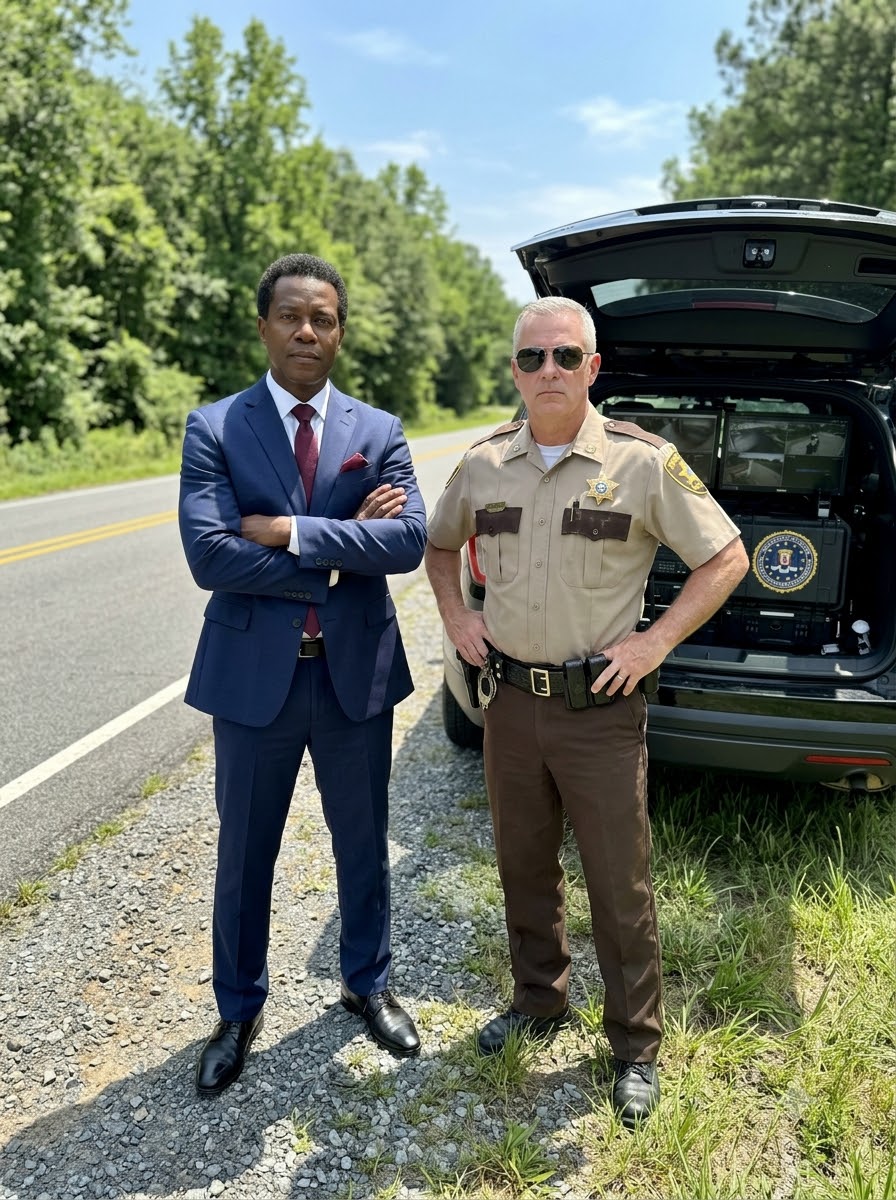
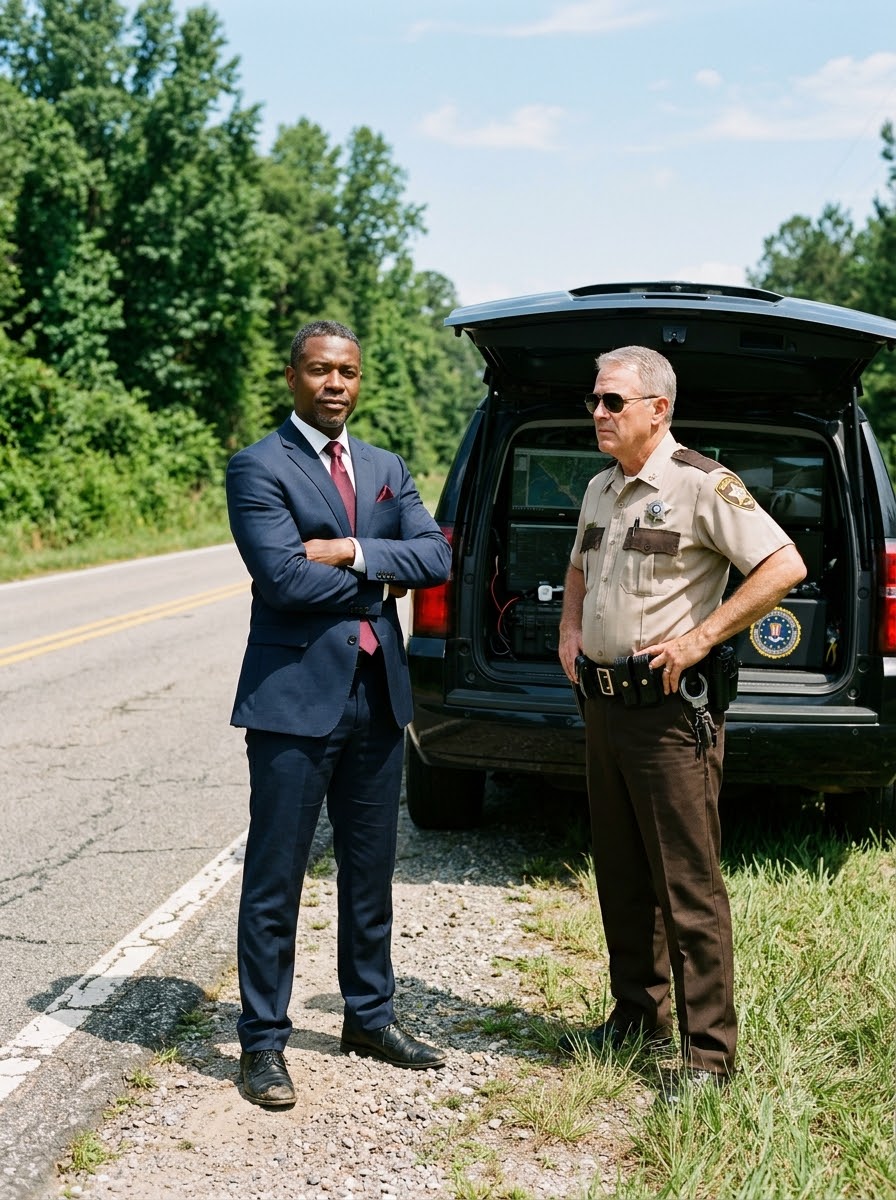
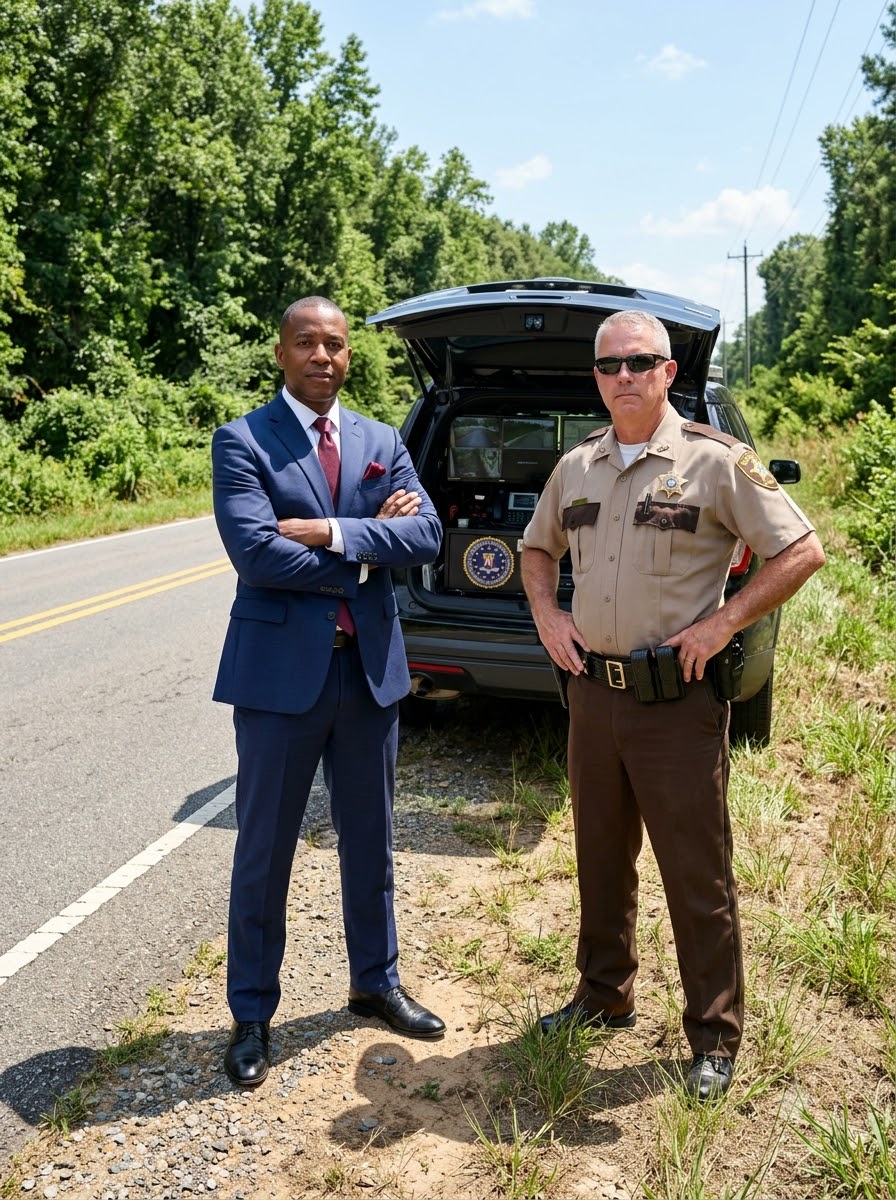
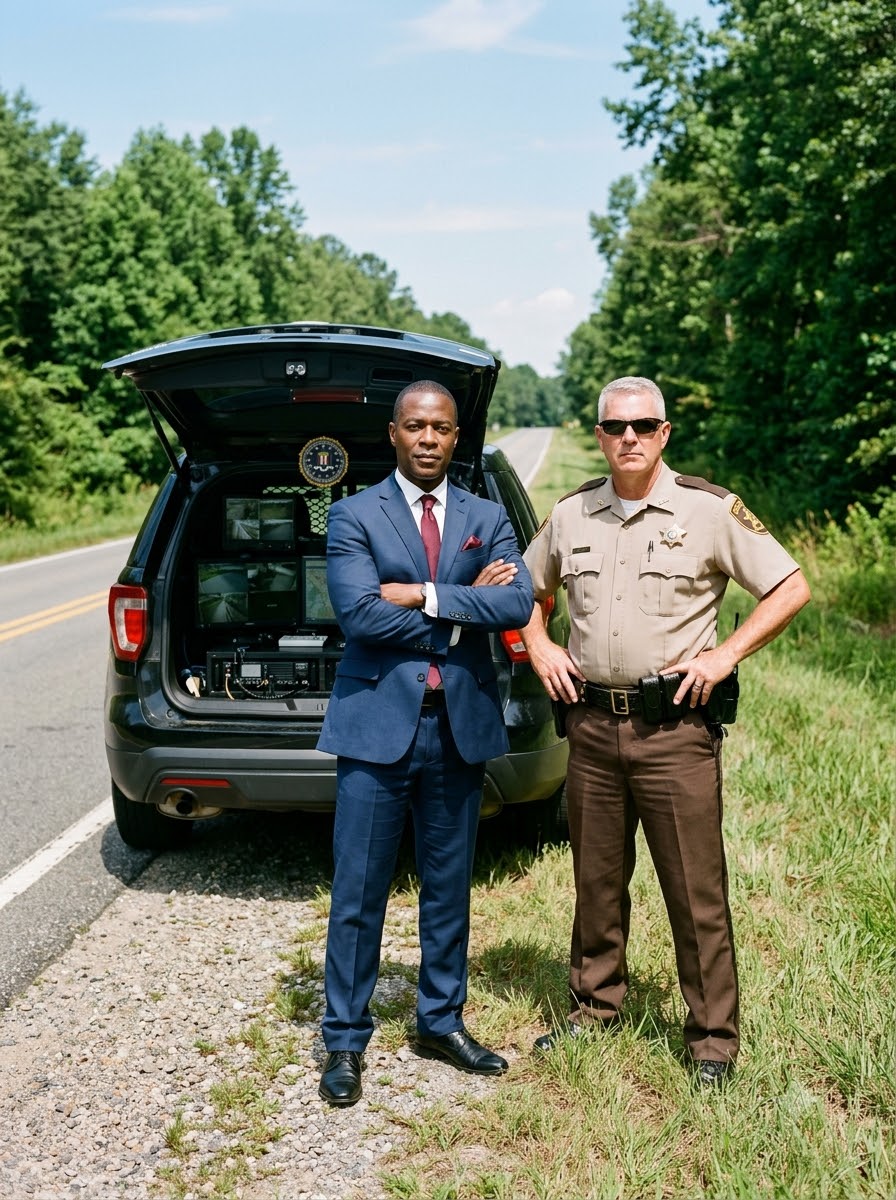
Inside sat a Black man in his late fifties, wearing a perfectly tailored navy suit and an expensive silk tie. He was composed, his posture straight and his hands resting visibly on the steering wheel.
His expression showed neither fear nor anger.
“Good afternoon, deputy.”
Briggs stiffened.
“It’s sheriff.”
He pushed his chest forward.
“Sheriff Thomas Briggs, and you’re a long way from home, boy. License, registration, and proof of insurance. Hand them over.”
The driver held his gaze.
“May I ask the reason for this traffic stop, Sheriff Briggs?”
Briggs answered without hesitation.
“You were swerving back there. Crossed the center line, plus that window tint is illegal in the state of Georgia. Now, are you going to hand over your documents or am I going to have to drag you out of this vehicle for resisting a lawful order?”
The man moved one hand toward his jacket.
Briggs immediately reached for his pistol.
“Slowly.”
“I am simply retrieving my identification, Sheriff.”
He produced a driver’s license.
Briggs examined it.
Aaron Fletcher.
Virginia address.
“Aaron.”
The sheriff deliberately used his first name.
“What brings you down to Faulkner County? You lost? Because people who look like you, driving cars like this, usually have a very good reason to be passing through my town.”
“I am conducting business in the area.”
Fletcher’s voice remained even.
“I assure you, Sheriff, my driving was exemplary. And this vehicle meets all federal and state regulations.”
“Federal regulations don’t mean spit in my county.”
Briggs leaned toward the open window.
“I decide what’s legal here, and right now, I smell something funny.”
He glanced over the SUV.
“You smell that, Kyle?”
From the passenger side, Harrison answered uncertainly.
“I don’t smell anything, Sheriff.”
“Smells like marijuana to me.”
Briggs smiled.
“Step out of the vehicle, Aaron. Keep your hands where I can see them.”
Fletcher regarded him for a moment.
“Sheriff Briggs, I strongly advise you to reconsider this course of action.”
The sheriff’s face darkened.
“You have made a traffic stop without probable cause. You are now fabricating reasonable suspicion to initiate an illegal search. If you walk back to your cruiser right now, this ends as a minor footnote.”
Briggs had spent years making other people afraid.
He could not tolerate being challenged.
“You listen to me, you arrogant son of a [ __ ].”
His hand tightened around his weapon.
“Get out of the car before I pull you through this window.”
Fletcher calmly shifted into park and released his seat belt.
“As you wish, Sheriff.”
He stepped onto the gravel.
At six feet two inches, he was taller than Briggs expected. He straightened his jacket while the sheriff removed his handcuffs.
“Turn around and face the vehicle.”
“I am not under arrest, Sheriff.”
Fletcher remained still.
“And I will not be cuffed. You asked me to step out. I have complied. If you wish to search my vehicle based on your fabricated olfactory evidence, proceed. But know that you will be held accountable for every action you take from this second forward.”
Briggs hesitated.
There was something unnerving about a man who understood exactly what was happening and refused to appear intimidated.
“Watch him, Kyle.”
Briggs moved toward the rear of the SUV.
“If he twitches, tase him.”
Harrison raised his taser.
“Yes, sir.”
Briggs reached for the tailgate.
He imagined discovering cash, drugs, or something valuable enough to confiscate. He had already decided that the expensive vehicle would not leave his county without paying a price.
“Last chance, Aaron.”
He smiled over his shoulder.
“Anything in here I should know about?”
Fletcher’s answer came quietly.
“Oh, there is quite a lot in there you should know about, Sheriff.”
He watched Briggs grip the handle.
“But, I think it is best you see it for yourself.”
The tailgate rose.
Briggs stared into the cargo compartment.
His smile disappeared.
The rear of the Suburban had been transformed into a sophisticated mobile command center. Four high-definition monitors displayed the traffic stop from multiple camera angles. A laptop showed live audio recordings.
Every threat Briggs had made was preserved.
Every invented violation.
Every false claim about marijuana.
Every word.
But the equipment was not what terrified him most.
Three men sat among the monitors, wearing tactical armor and helmets.
Across their vests were three unmistakable letters.
FBI.
The agent in the center removed his headset and reached for a thick folder.
“Sheriff Thomas Briggs.”
His voice was firm.
“I’m Special Agent Frank Sullivan, Federal Bureau of Investigation, Public Corruption Unit.”
Briggs stumbled backward.
His gaze moved from the monitors to the agents and finally toward Fletcher.
“Who? What is this?”
Fletcher approached the open tailgate.
“You asked for my license and registration, Sheriff Briggs.”
He reached into his jacket and removed a federal credential case.
“Allow me to properly introduce myself.”
The gold badge caught the sunlight.
“My name is Aaron Fletcher. I am the director of the Federal Bureau of Investigation and you Sheriff are the target of a three year federal probe into extortion, civil rights violations and racketeering.”
Briggs stood motionless.
For fifteen years, he had believed nobody could challenge his authority.
Now the man he had tried to intimidate was the director of the FBI.
Fletcher stepped closer.
“You took the bait Thomas.”
He lowered his voice.
“And now your county belongs to me.”
Briggs tried to speak.
“I I don’t understand.”
His fingers trembled against his duty belt.
“Director, you’re uh you’re driving a civilian vehicle. This is entrapment. You can’t just—”
“Entrapment implies I coerced you into committing a crime you were not already predisposed to commit, Thomas.”
Fletcher interrupted without raising his voice.
“I did not force you to pull me over without probable cause. I didn’t force you to threaten to pull me through my window. And I certainly didn’t force you to falsely claim you smelled narcotics as a pretext for an illegal search. You did all of that entirely on your own. It is muscle memory for you at this point, isn’t it?”
Sullivan stepped from the SUV with the other agents.
“Sheriff Thomas Briggs, keep your hands exactly where they are.”
Briggs looked desperately toward his deputy.
“Kyle! Kyle, call dispatch. Get every unit out here. We have a situation on Route 2 9. These guys are they’re impersonating federal agents. Call it in.”
Harrison did not reach for his radio.
Instead, he removed a small transmitter from his uniform.
“Dispatch isn’t going to answer, Sheriff.”
Briggs stared at him.
“Kyle, what are you doing? What is that?”
The young deputy pulled the Faulkner County Sheriff’s patch from his shoulder.
“My name isn’t Kyle Harrison.”
He dropped the patch onto the gravel.
“It’s Special Agent Kyle Reed, FBI Undercover Operations Division. And I haven’t been calling dispatch for the last 6 months, Thomas. I’ve been calling Director Fletcher.”
Briggs nearly collapsed.
His own rookie deputy had been an undercover federal agent.
Every boast, every threat, and every illegal instruction had been recorded.
“You wore a wire.”
His voice was barely audible.
“For 6 months you sat in my car.”
“1,400 hours of recorded audio to be exact.”
Reed stepped forward.
“We have the dashcam footage of you stealing $40,000 from that landscaping crew from Florida last month. We have the audio of you threatening Mayor Hughes. We have the bank routing for the offshore shell companies you set up in the Caymans. We have everything, Briggs.”
Fletcher faced the sheriff.
“For 3 years, your department has been a black hole for constitutional rights.”
Briggs’s breathing became shallow.
“You turned a badge into a license to steal. You targeted minorities, out-of-state plates, and the working class. You thought because you were a big fish in a small pond, the ocean wouldn’t eventually swallow you.”
Briggs began pleading.
“I I can make a deal.”
He looked from one agent to another.
“Director listen to me. There are higher-ups, state politicians, judges. I can give you names. I can give you the whole network. Just just don’t do this here. Not on the side of the road.”
Fletcher’s expression remained unchanged.
“We already have the network, Thomas. Thanks to you, and thanks to Agent Reed. We don’t need your cooperation. We only need your surrender.”
Sullivan removed Briggs’s weapon and secured his wrists.
“Thomas Briggs.”
The agent announced the arrest.
“You are under arrest for violations of Title 18, United States Code, Section 1962, the Racketeer Influenced and Corrupt Organizations Act, as well as multiple counts of extortion, wire fraud, civil rights violations, and conspiracy.”
Briggs lowered his head.
But Fletcher was not finished.
He removed an encrypted radio from his jacket.
“This is Vanguard One.”
His voice was steady.
“The primary target is secured. Operation Iron Sweep is a go. I repeat, Iron Sweep is a go. Burn it to the ground.”
For a moment, the highway remained silent.
Then engines thundered from the hidden roads beyond the trees.
Armored vehicles appeared.
A helicopter passed overhead.
A convoy of federal SUVs swept toward Faulkner County.
Briggs watched helplessly as the operation he had spent years believing impossible began unfolding around him.
Fletcher stood beside the road.
“Watch closely, Thomas.”
He looked toward the approaching convoy.
“That is the sound of your empire ending.”
And ten miles away, inside the sheriff’s department, Captain Roy Dempsey had just received a telephone call that made him reach for the secret ledgers he had sworn nobody would ever find.
Part 2: The Empire Hidden Behind the Badge
Captain Roy Dempsey was sitting behind his desk when the call arrived.
A stack of hundred-dollar bills lay in front of him.
The money had been taken during a traffic stop the previous night. Dempsey was working out how to record only a fraction of it in the official evidence log.
His private telephone rang.
He answered impatiently.
“Dempsey?”
“Roy, it’s Judge Holloway.”
The judge sounded terrified.
“The feds The feds are everywhere. They just kicked in the door to my chambers. They have warrants, Roy. Federal warrants.”
Dempsey stood.
“What? What are you talking about? Where is Briggs?”
“I don’t know.”
The call ended abruptly.
Dempsey locked his office door.
He hurried toward a filing cabinet and pulled out two black leather ledgers.
The books contained years of illegal seizures, payments to corrupt officials, and financial arrangements that connected the sheriff’s department to a much larger criminal network.
If federal investigators obtained them, the entire operation could be reconstructed.
Dempsey dropped the ledgers into a metal trash can and reached for lighter fluid.
He needed only a few minutes.
Then a tremendous impact shook the building.
Federal agents had entered the sheriff’s department.
“FBI, get on the ground. Show me your hands. Nobody move.”
Dempsey fumbled with his lighter.
It slipped from his fingers.
He dropped to his knees.
Before he could retrieve it, his office door burst inward.
Special Agent Rebecca Shaw entered with a tactical team.
“Don’t even breathe, Roy.”
Dempsey froze.
Agents moved behind her, securing the room and surrounding the captain.
Shaw noticed the ledgers inside the trash can.
“Smart choice.”
She moved the container away from him.
“Grab those. Bag them. That’s the crown jewel.”
Dempsey was handcuffed beside his desk.
Outside, agents secured evidence lockers, computer systems, records, and weapons.
The deputies who had helped Briggs operate his criminal enterprise were being detained.
Dempsey turned toward Shaw.
“Where is Sheriff Briggs?”
His voice was full of disbelief.
“He won’t let you get away with this.”
Shaw leaned closer.
“Sheriff Briggs is currently sitting in the back of a federal transport crying like a child. Your kingdom is gone, Roy.”
Elsewhere in Faulkner County, another team entered Briggs’s two-million-dollar estate.
Behind a concealed wall in the master bedroom closet, investigators discovered a large safe.
Inside were more than three million dollars in cash, unregistered firearms, narcotics missing from evidence storage, and hard drives containing records of the extortion network.
The evidence was far greater than a collection of corrupt traffic stops.
It revealed an organized criminal operation.
Money had passed through businesses, shell companies, and offshore accounts. Certain dealers received protection. Innocent drivers were threatened, searched, and robbed.
People who challenged the department sometimes faced fabricated charges.
The sheriff’s badge had become the centerpiece of an enterprise built on fear.
Back on Route 9, Briggs sat shackled inside a federal transport vehicle.
Fletcher approached the open doors.
“I thought you should know, Thomas.”
The former sheriff stared at the floor.
“We just secured your precinct. Captain Dempsey is in custody. We secured your estate. We found the safe in the closet. And our financial crimes division has just frozen 14 different offshore accounts linked to your shell companies.”
Briggs did not answer.
“You built an empire on fear.”
Fletcher’s voice remained quiet.
“You looked at that badge and saw a weapon to use against the vulnerable. You looked at me, a black man in an expensive car, and you saw a victim you could exploit because you thought the system would always protect you. But the system is exactly what is going to crush you.”
Briggs finally looked up.
“What happens now?”
Fletcher stepped away.
“Now?”
He paused.
“Now, become exactly what you treated everyone else like today. A footnote.”
The transport doors closed.
Forty-eight hours later, Briggs sat inside a federal interrogation room in Atlanta.
The sheriff who had once strutted through his county like an untouchable ruler now wore an oversized orange jumpsuit.
His hands trembled.
His eyes were swollen from sleeplessness.
Beside him sat Stephen Walsh, an expensive defense attorney who had been hired to negotiate whatever deal might still be possible.
Fletcher entered with federal prosecutor Diane Croft.
Croft placed a thick binder on the table.
“Good morning, Thomas.”
Fletcher sat across from him.
“I trust the accommodations are a stark contrast to your $2 million estate.”
Briggs stared downward.
Walsh cleared his throat.
“Director Fletcher, Ms. Croft, we requested this proffer session to discuss a mutually beneficial arrangement. My client has served his community for over two decades. While there may have been administrative irregularities in how the Faulkner County Department operated, we are prepared to offer substantial cooperation in exchange for leniency.”
Croft opened the binder.
“Mr. Walsh, I don’t think you fully grasp the gravity of the room you are sitting in. We don’t have administrative irregularities.”
She looked toward Briggs.
“We have a textbook RICO case. We have wire fraud, extortion, witness tampering, and civil rights violations under the color of law. Your client was caught on tape extorting an undercover FBI agent. We have the burn book from Captain Roy Dempsey’s office. We have the $3 million in cash from the hidden safe. We do not need his cooperation. We already have the entire puzzle.”
Walsh leaned forward.
“You have his subordinates, but my client can give you the political umbrella, State Senator Richard Hayes. He shielded the department from state oversight in exchange for campaign contributions funneled through shell companies. My client will testify to that. But in return, we want the RICO charge dropped, and we want a recommendation of no more than 10 years in a minimum security facility.”
For the first time since his arrest, Briggs appeared hopeful.
He believed Senator Hayes was the one person investigators had not reached.
Fletcher watched him for several seconds.
Then he placed a photograph on the table.
Briggs leaned forward.
The photograph showed Senator Richard Hayes in handcuffs, escorted from his office by Special Agent Frank Sullivan.
“We arrested Senator Hayes at 4:00 yesterday afternoon.”
Croft’s tone was cold.
“He was indicted by a grand jury under seal a week ago. He actually started crying when Agent Sullivan put the cuffs on him. So, as you can see, Mr. Walsh, your client has nothing of value left to trade. The political umbrella has already been collapsed.”
Briggs stared at the photograph.
“How?”
His voice cracked.
“How did you get all this? You can’t build a RICO case, get a senator, get my bank records, and get my captain all from a 6-month wire on a rookie deputy. It’s impossible.”
Fletcher leaned back.
“You are correct, Thomas. Agent Reed’s undercover placement was merely the final nail in the coffin.”
Briggs looked up.
“The operation didn’t begin 6 months ago. It began 3 years ago.”
“But how?”
Briggs could barely contain himself.
“I kept everything tight. Nobody in my circle talked. Dempsey was loyal. Holloway was loyal. Who gave you the opening?”
Fletcher answered carefully.
“You built your entire world on the concept of loyalty, Thomas. But loyalty bought with fear and dirty money is a fragile thing. When the pressure is applied, it shatters.”
Croft activated a recording.
A man’s voice filled the room.
“He brings the cash in on Thursday nights. Usually 40, sometimes 50,000. I run it through the dealership service department logs. Make it look like cash repairs on fleet vehicles. Then I transfer it to the Cayman accounts on Monday mornings. He’s crazy, man. He’s completely out of control. If he finds out I’m talking to you, he’ll kill me.”
Briggs stopped breathing for a moment.
He knew the voice.
Paul Stanton.
Owner of the county’s largest automobile dealership.
His longtime money launderer.
His brother-in-law.
“Paul.”
Briggs shook his head.
“No. No. Paul is family. He wouldn’t.”
Fletcher explained.
“Paul was caught by the IRS 3 and 1/2 years ago for underreporting his own income.”
He watched Briggs’s face.
“When they squeezed him, he panicked. He didn’t just give us the money laundering operation, Thomas. He gave us the Cayman accounts. He gave us the names of the shell companies. He gave us Captain Dempsey. And he gave us Senator Hayes.”
Briggs’s expression collapsed.
“Your own brother-in-law wore a wire to family barbecues. He copied your ledgers while you were drinking beer on his patio.”
For years, Briggs had trusted Paul with the most sensitive details of his criminal enterprise.
He had shared meals with him.
Celebrated holidays.
Boasted about his power.
All while Paul was helping federal investigators build the case that would destroy him.
Fletcher leaned forward.
“Why do you think I was driving a brand new, fully loaded black Suburban on Route 9?”
Briggs looked at him.
“Paul procured that vehicle for the Bureau. He knew exactly what kind of car you couldn’t resist pulling over. He knew exactly what time you patrolled that stretch of highway. He set the bait, Thomas. I just drove the car.”
Briggs buried his face in his hands.
The vehicle had not simply appeared by chance.
His brother-in-law had helped arrange the encounter.
The rookie beside him had been an undercover agent.
The traffic stop had been recorded from several angles.
And the corruption investigation had begun years before Briggs suspected anything.
Croft closed the binder.
“Mr. Walsh, we are not here to negotiate a plea.”
She looked directly at Briggs.
“We are here to offer an ultimatum. Your client will plead guilty to every single count on the indictment. He will waive his right to an appeal. He will forfeit the three million dollars in cash, his estate, and his pension, which will be placed into a restitution fund for the innocent motorists he terrorized. In exchange, we will not seek the death penalty for the attempted murder conspiracy involving the witnesses he tried to silence in 2021.”
Walsh turned toward his client.
“Thomas, you have to take this. They have you.”
Briggs slowly lowered his hands.
“I’m a dead man in a federal prison.”
His voice was broken.
“A cop in gen pop, I won’t last a year.”
Fletcher stood.
“Then I suggest you request protective custody.”
He adjusted his jacket.
“Though I imagine the isolation of a supermax cell will give you plenty of time to reflect on the people you put in cages for your own profit.”
Fletcher turned toward Walsh.
“We need a signature by 5:00, Mr. Walsh. Otherwise, we go to trial, and we will make sure the world sees every second of it.”
He left the room.
Briggs remained seated, staring at the evidence that had ended his career, his fortune, and his freedom.
But outside that room, dozens of families were waiting for something more important than the sheriff’s surrender.
They wanted the truth about what had happened to them.
And when their stories finally reached a federal courtroom, the scale of the suffering Briggs had caused would become impossible for anyone to ignore.
Part 3: The Voices He Could No Longer Silence
Eight months later, the federal courthouse in Atlanta was filled with people whose lives had been changed by Sheriff Thomas Briggs.
They were not there to celebrate his downfall.
They had come because, for years, their complaints had been ignored.
Working families had lost their savings during unlawful traffic stops. Drivers had been threatened, assaulted, and accused of crimes they had not committed.
Some had lost vehicles.
Others had lost jobs.
Parents had watched their children go to prison after evidence was fabricated against them.
For the first time, they would speak in a courtroom where Briggs could not interrupt them, threaten them, or order them into handcuffs.
The former sheriff sat at the defense table.
He had lost fifty pounds.
His hair had turned white, and his once-powerful frame seemed diminished beneath his prison uniform.
He avoided looking toward the gallery.
Judge Margaret Cohen presided over the hearing.
Over three days, she listened to seventy-two victim impact statements.
Each testimony revealed another part of the criminal system Briggs had controlled.
A landscaping crew from Florida described losing forty thousand dollars during a traffic stop.
Families explained how money taken from them had never been returned.
Others spoke about fabricated charges, intimidation, and the humiliation of being treated like criminals because they were poor, Black, Latino, or simply passing through Faulkner County.
The accounts differed in detail.
The pattern did not.
Briggs had used the authority of his office to exploit people he believed lacked the resources to challenge him.
Judge Cohen looked toward the defendant.
“Thomas Briggs.”
Her voice carried across the courtroom.
“Over the past 3 days, I have listened to 72 victim impact statements. I have heard stories of unimaginable cruelty. You were entrusted with a badge, a solemn oath to protect and serve the citizens of your county. Instead, you weaponized that badge. You operated not as a law enforcement officer, but as a cartel boss running an extortion racket funded by the blood and terror of innocent people.”
Briggs closed his eyes.
“You believed that because you wore a star, you were above the law. You believed that your victims had no voice, no power, and no recourse.”
The judge continued.
“But the law caught up to you. And today, the voices of those you silenced are the only ones that matter.”
Near the back of the courtroom sat Director Aaron Fletcher.
He wore the same style of navy suit he had worn on Route 9.
His posture was straight, his expression controlled.
He had not come to enjoy Briggs’s humiliation.
He had come to witness the conclusion of an investigation that had taken three years and exposed a network of corruption extending far beyond a single sheriff’s office.
Judge Cohen turned to the sentence.
“For the charges of racketeer influenced and corrupt organizations, extortion, wire fraud, and severe civil rights violations under the color of law, it is the judgment of this court that you, Thomas Briggs, be committed to the custody of the Federal Bureau of Prisons.”
The gallery became silent.
“You are hereby sentenced to serve a term of life in prison without the possibility of parole. You will be transferred to the United States Penitentiary Administrative Maximum Facility in Florence, Colorado, where you will serve out the remainder of your natural days.”
The gavel struck.
For a moment, nobody moved.
Then several people began crying.
Others held their relatives’ hands.
A few simply sat motionless, absorbing the fact that the sheriff who had terrorized their county would never return to his position of power.
Briggs did not protest.
Federal marshals helped him stand and escorted him toward the side door.
His chains rattled against the floor.
He never turned toward the families seated behind him.
Fletcher watched until the door closed.
Then he quietly left the courtroom.
Outside, Atlanta’s afternoon sunshine illuminated the courthouse steps.
Special Agent Kyle Reed waited beside a black government SUV.
He was wearing a sharp suit and holding a coffee.
When he saw Fletcher, he straightened.
“It’s done, Director?”
Fletcher nodded.
“It’s done, Kyle.”
A rare smile crossed his face.
“Life without parole. Dempsey got 40 years. Holloway is looking at 20. The sweep is complete.”
Reed looked toward the courthouse.
“It feels strange. I spent so long pretending to be one of them, listening to the poison every single day. There were times I thought we’d never get enough to bring the whole house down.”
Fletcher placed a hand on his shoulder.
“Evil is loud, Kyle. It boasts, it brags, and it believes it is invincible.”
He paused.
“But justice is quiet. It watches. It gathers. And when it finally strikes, it is absolute.”
Reed nodded slowly.
His six months inside Briggs’s patrol car had been difficult.
He had listened to the sheriff describe innocent motorists as opportunities for profit. He had watched him turn routine stops into intimidation campaigns.
He had heard him boast about judges, politicians, and department officials who would protect him.
Every day, Reed had needed to maintain his cover while preserving evidence that could withstand scrutiny in court.
Now the investigation was over.
But the consequences for Faulkner County were only beginning.
“What happens to Faulkner County now, sir?”
Fletcher opened the SUV door.
“The governor appointed a new interim sheriff this morning.”
He looked toward Reed.
“A good woman. 20 years in state patrol. Spotless record. She’s bringing in her own deputies. Cleaning house. The asset forfeiture funds are being dispersed back to the victims starting next week. The town is breathing again.”
Reed smiled.
“That’s good to hear.”
The restitution process would not undo everything.
Money could be returned.
Wrongful convictions could be reviewed.
Property could sometimes be recovered.
But no court could restore the years families had spent frightened of the very officers sworn to protect them.
Fletcher understood that.
He also knew Briggs had not operated alone.
Captain Roy Dempsey had helped conceal thefts and falsify records.
Judge Holloway had provided protection from the bench.
Senator Richard Hayes had helped shield the department from oversight while receiving money through corrupt financial arrangements.
Paul Stanton had laundered stolen funds before cooperating with investigators.
Each person had played a different role in sustaining the same criminal enterprise.
The sheriff’s downfall was dramatic because he had believed his own authority was absolute.
The real work of dismantling his network had been quieter.
Financial analysts had traced transfers through shell companies.
Undercover agents had recorded conversations.
Investigators had compared evidence logs with actual cash seizures.
Witnesses had risked retaliation to describe what they knew.
And a family member Briggs believed completely loyal had spent years helping expose him.
The highway stop was simply the moment the hidden investigation became visible.
Reed looked at Fletcher.
“Where to next, Director?”
Fletcher climbed into the driver’s seat.
For a moment, he studied his reflection in the rearview mirror.
He remembered Briggs’s expression when the Suburban window first lowered.
The sheriff had seen a Black man in an expensive vehicle and decided that was enough reason to stop him.
He had ignored the radar.
Invented a traffic violation.
Claimed to smell marijuana.
Threatened to drag the driver from the vehicle.
He had behaved that way because he believed the person in front of him had no power to resist.
Only when he discovered Fletcher’s identity did he become frightened.
That detail remained important to Fletcher.
Briggs’s wrongdoing had not begun when he threatened the FBI director.
It had begun years earlier, with motorists who lacked federal credentials, hidden cameras, and armed agents waiting inside their vehicles.
The landscapers whose cash had disappeared deserved the same protection under the law.
So did the families whose sons had been falsely accused.
So did the people who had been too afraid to file complaints.
Fletcher had been able to expose the sheriff because he possessed extraordinary resources.
But the rights Briggs violated had never depended on who was sitting behind the steering wheel.
That was the principle the investigation had been meant to restore.
Faulkner County would need time to recover.
Its new sheriff would inherit a department whose reputation had been shattered.
The courts would face years of reviews.
Families would continue fighting to clear records and recover what had been taken.
Some residents would remain suspicious of law enforcement long after the corrupt officers were imprisoned.
Trust would have to be earned through conduct, not demanded through a badge.
Yet something fundamental had changed.
For years, Briggs had convinced the county that resistance was pointless.
He had surrounded himself with people who reinforced that belief.
Now his closest associates were facing prison, his wealth had been seized, and the people he had intimidated had finally been heard.
The man who once treated Route 9 like his personal hunting ground would never patrol it again.
Reed stood beside the SUV.
Fletcher started the engine.
“Back to work, Agent Reed.”
He looked ahead.
“Back to work.”
The black vehicle pulled into Atlanta traffic and disappeared among the other cars.
There would be more investigations.
More people willing to misuse authority.
More communities waiting for someone to listen.
But the case in Faulkner County had demonstrated something Briggs never understood.
A badge could give a person legal authority.
It could not make corruption lawful.
Wealth could purchase silence for a time.
It could not guarantee that every witness would remain silent forever.
And fear, no matter how carefully organized, could not make evidence disappear once people were determined to preserve it.
On that sweltering Georgia highway, Thomas Briggs believed he had stopped another vulnerable motorist.
He thought the black SUV represented an easy opportunity for money and intimidation.
He never imagined that the driver was Aaron Fletcher.
He never suspected that the deputy sitting beside him had spent six months recording his crimes.
And he certainly never expected the rear compartment of the vehicle to contain federal agents watching his every move.
Yet the most important revelation was not the FBI badge, the command center, or the convoy of armored vehicles.
It was the evidence gathered from years of people who had suffered beneath Briggs’s authority.
Their experiences were no longer isolated complaints.
Together, they revealed an entire criminal enterprise.
The sheriff had believed that power meant never being questioned.
In the end, it was the questions he refused to answer, the records he thought nobody would examine, and the people he believed nobody would defend that brought his empire down.
Justice had taken years.
For many victims, it had arrived painfully late.
But when the courtroom finally heard their voices, Thomas Briggs no longer had the power to silence a single one of them.
