

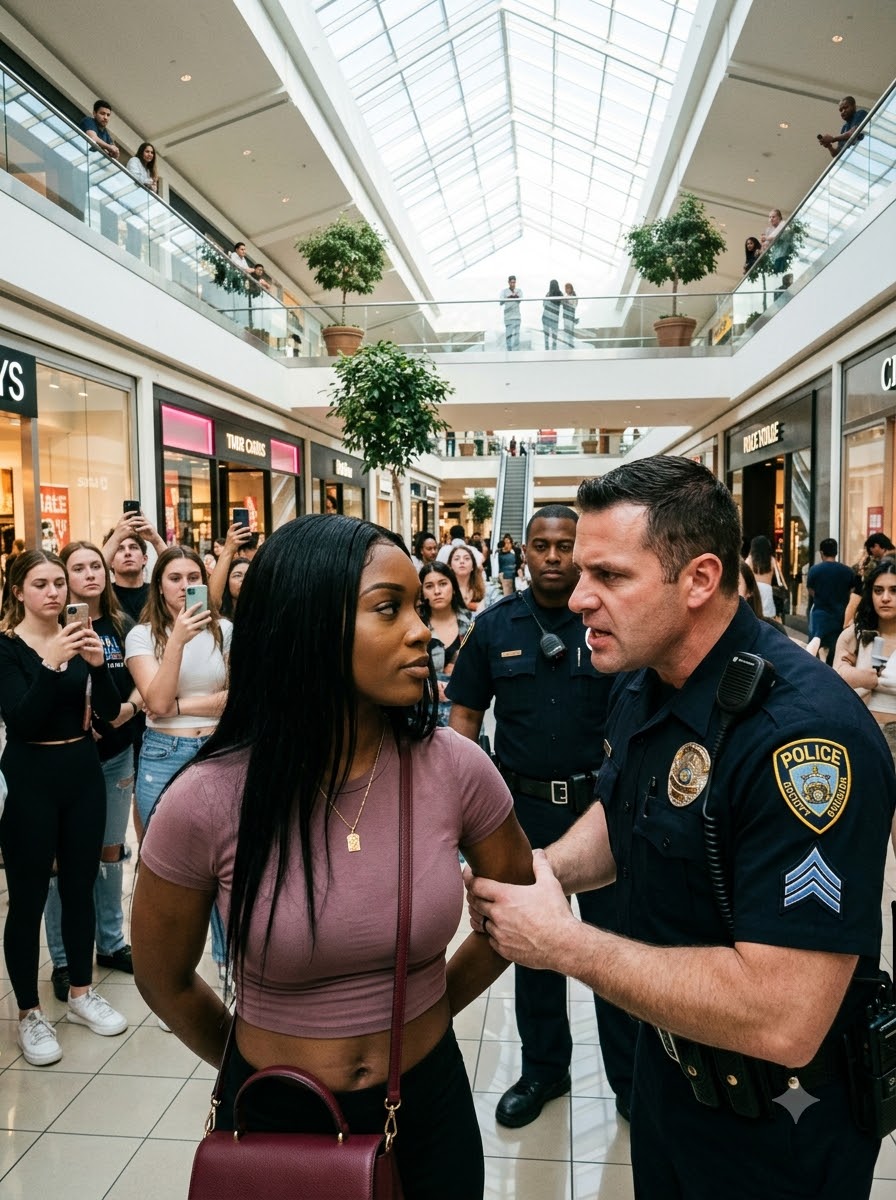
Part 1: The Woman They Decided Was Guilty
Captain Renee Holloway had been walking through Briarwood Galleria for only eleven minutes when she noticed the security officer following her.
She first spotted him reflected in the window of a cosmetics store. A heavyset white man wearing a navy security blazer stood near the mall directory, pretending to examine the map while repeatedly watching her brown leather shoulder bag.
Renee changed direction.
Thirty seconds later, he did too.
She said nothing.
At forty-six, Renee had spent twenty-two years in law enforcement. She understood that noticing suspicious behavior and proving wrongdoing were two entirely different things.
She had worked patrol, investigated robberies and domestic violence, handled major crimes, and eventually moved into command. Now she supervised nearly two hundred officers in Eastborough, North Carolina.
Her career had taught her to recognize surveillance.
Her life as a Black woman had taught her what it felt like to be its target.
But she had no desire to spend her Saturday dealing with either.
Her niece Camille was turning thirteen the following day, and Renee had promised to buy her something special.
Camille had recently announced that she was “too mature” for the gifts her aunt normally chose.
That complicated matters considerably.
Renee planned to find a bracelet, eat lunch, and return home before the college football game began.
She wore cream-colored shorts, a sleeveless black blouse, white sneakers, and small gold hoop earrings.
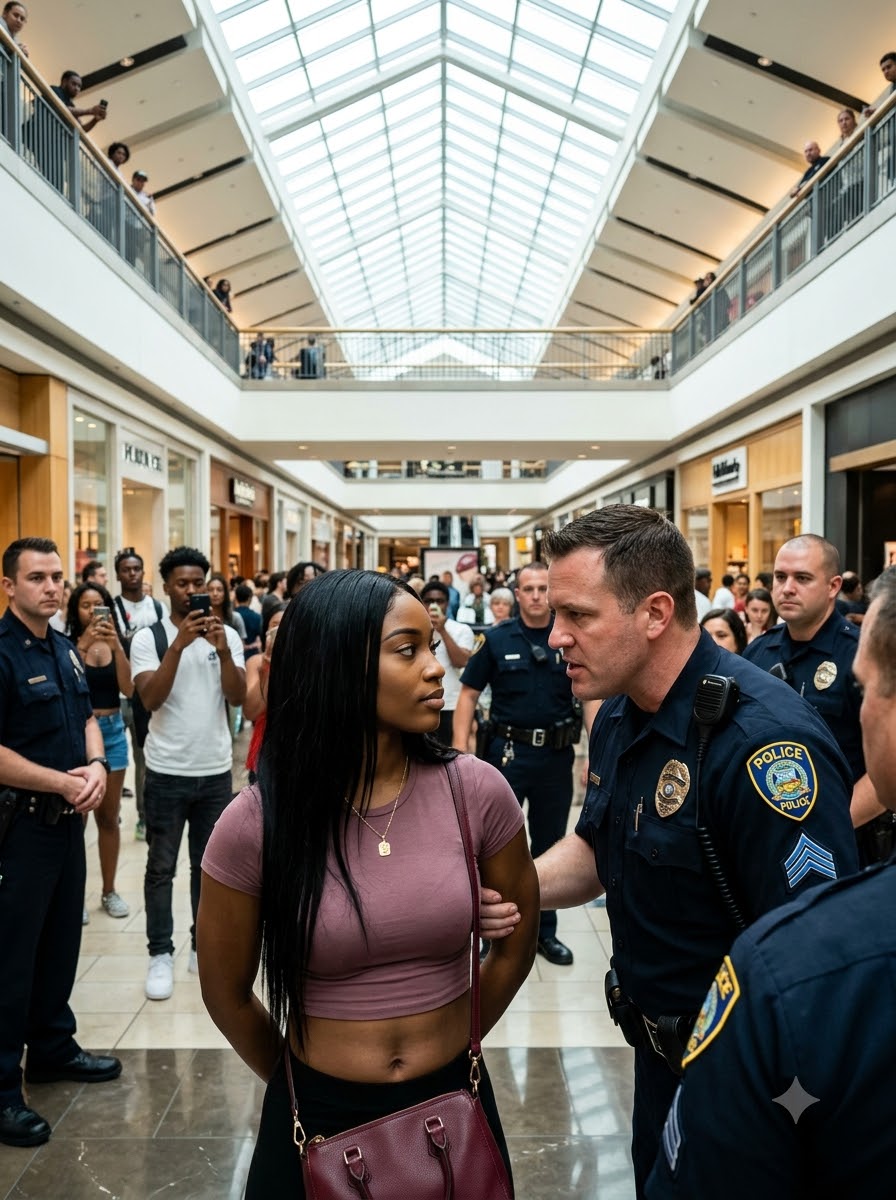
Her service weapon was safely stored at home.
Her police credentials, however, remained zipped inside an inner compartment of her purse.
It was a habit developed over two decades.
She had no reason to believe she would need them.
The security guard’s name tag read FRANK DOYLE.
He followed her past a shoe store, paused whenever she paused, and raised his radio as she approached the central atrium.
Another guard remained farther away.
He was a younger Black man named Marcus Reed, and he looked increasingly uncomfortable whenever Doyle spoke.
Renee could not hear every transmission.
One sentence, however, carried clearly through the crowd.
“Black female, brown leather bag, moving toward Sterling & Finch.”
Renee stopped walking.
Anger rose in her chest.
Then discipline pushed it aside.
She considered confronting Doyle and asking what specific behavior justified his attention.
Instead, she continued toward the jewelry boutique.
She had come to buy a birthday present, not deliver an unpaid lesson about racial profiling.
Sterling & Finch occupied an elegant corner of the mall’s second floor.
Soft piano music played overhead. Spotlights illuminated silver chains, gold earrings, watches, and gemstone bracelets inside glass display cases.
Behind the register stood a woman in her early fifties wearing a charcoal blazer and a silk scarf.
Her name tag identified her as Carolyn Wells, store manager.
“Can I help you?”
The question sounded polite.
The delivery did not.
“I’m looking for a birthday gift,” Renee said.
“For who?”
“My niece.”
Carolyn glanced at Renee’s purse.
“What price range?”
Renee nearly smiled.
“I’ll know when I see it.”
She moved toward the bracelet display.
A younger associate named Anna Kim approached and welcomed her warmly.
Unlike Carolyn, Anna showed Renee several pieces without questioning whether she could afford them.
One bracelet immediately caught Renee’s eye.
It was sterling silver, with a small moonstone charm surrounded by tiny blue stones.
Camille had loved astronomy since childhood. Despite insisting she had outgrown childish decorations, she still had glow-in-the-dark planets attached to her bedroom ceiling.
Renee pointed.
“That one.”
Anna smiled.
“Good choice.”
She unlocked the display case, removed the bracelet, and placed it on a gray velvet pad.
Renee examined the clasp and asked about engraving.
Anna explained that the downstairs engraving counter could add a personalized tag within an hour.
Renee decided to purchase it.
The price was $285.
She paid with her credit card.
Anna printed the receipt, placed the bracelet in a small navy jewelry box, wrapped it in silver tissue, and slipped it into a white Sterling & Finch shopping bag.
Renee thanked her and headed toward the exit.
Carolyn was watching.
So was Frank Doyle.
The security guard stood directly outside the boutique.
Marcus Reed waited several feet behind him.
“Ma’am,” Doyle said. “I need you to come with us.”
Renee glanced at the shopping bag.
“For what?”
“We need to discuss some merchandise.”
“What merchandise?”
Doyle stepped closer.
“Let’s not make a scene.”
Renee looked around.
Nearby shoppers had already begun watching.
“You approached me outside a store and implied I stole something. The scene is already happening.”
Carolyn emerged from behind the counter.
“We’re missing an item.”
Renee faced her.
“What item?”
“A bracelet.”
Renee lifted her shopping bag.
“I just bought a bracelet.”
“Not that one.”
Carolyn crossed her arms.
“A second piece was removed from the same tray.”
Renee turned toward Anna.
The young associate looked genuinely confused.
“I only showed her the moonstone bracelet.”
Carolyn’s expression hardened.
“Anna.”
The warning was unmistakable.
Anna fell silent.
Renee returned her attention to the manager.
“Did you see me take a second bracelet?”
“I saw you handling merchandise.”
“Under your employee’s supervision.”
“You also opened your purse.”
“I put my wallet back inside.”
Doyle moved between them.
“Ma’am, we can clear this up privately.”
Renee looked toward Marcus.
He was staring at the floor.
“Do you have video?”
Doyle answered.
“We have surveillance.”
“Then review it.”
“We will.”
“Before detaining me.”
Doyle’s jaw tightened.
“You are already being detained.”
Renee felt her professional instincts engage.
Approximately 2:17 p.m.
Security officer Frank Doyle.
Second guard Marcus Reed.
Store manager Carolyn Wells.
Sales associate Anna Kim.
Several potential civilian witnesses.
Multiple surveillance cameras.
She carefully placed her shopping bag on the counter.
“Then I am asking you to state what specific evidence supports detention.”
Doyle laughed dismissively.
“I’m mall security. I don’t have to debate legal terminology.”
“You’re accusing me of theft.”
“You fit the circumstances.”
Renee held his gaze.
“What circumstances?”
Carolyn interrupted.
“The bracelet was present before you entered.”
“Which bracelet?”
“A diamond tennis bracelet.”
“Value?”
“About twelve hundred dollars.”
“And when did you verify it was missing?”
Carolyn hesitated.
“After you handled the display.”
Renee nodded.
“Who else accessed that counter?”
Carolyn’s jaw tightened.
“This isn’t an interrogation.”
“No.”
Renee remained calm.
“It’s a very basic question.”
Doyle reached for her shopping bag.
“I’m checking this.”
Renee moved it out of his reach.
“You can inspect the purchased item after you show me the basis for believing I possess anything else.”
“Ma’am.”
“No.”
Doyle’s face reddened.
“You don’t get to dictate the investigation.”
Renee looked toward the ceiling cameras.
“Call police.”
Carolyn blinked.
“What?”
“If you believe a felony or misdemeanor theft occurred, call police.”
Doyle stared.
“You want police?”
“Yes.”
Her answer clearly surprised him.
Renee knew why.
People frightened by accusations often agreed to private searches simply to end the humiliation.
Someone demanding that the accusation be investigated properly was harder to intimidate.
Doyle lifted his radio.
“Fine.”
Marcus finally spoke.
“Frank, maybe we should check the camera first.”
Doyle looked at him.
“Why?”
“Because if it shows she paid and left—”
“She bought one item.”
Marcus glanced toward Renee.
“That doesn’t mean she took another.”
Doyle lowered his voice.
“Do your job.”
Marcus fell silent.
Renee noticed.
He had tried to intervene.
Only briefly.
But he had tried.
Six minutes later, Briarwood Police arrived.
Officer Trevor Maddox entered first.
He was white, in his late thirties, and carried himself like someone who had spent nearly a decade on patrol.
Behind him came Officer Sofia Ramirez, a Latina officer in her late twenties.
She appeared younger and considerably more observant.
Doyle intercepted them.
“Shoplifting. Expensive jewelry.”
Maddox immediately turned toward Renee.
“You got ID?”
Renee almost laughed.
“Do you want to know what allegedly happened first?”
“I asked for identification.”
“My driver’s license is in my purse.”
“Get it.”
Renee slowly reached toward the zipper.
Maddox’s hand shifted toward his holster.
She stopped.
“You want me to retrieve it?”
“Yes.”
“Then take your hand away from your weapon.”
His expression hardened.
“What?”
“You ordered me to reach into a purse.”
“I know what I ordered.”
“Then don’t treat compliance as a threat.”
Ramirez glanced toward her partner.
Maddox stared at Renee.
“Just get the license.”
Renee opened her wallet and handed over her North Carolina driver’s license.
Her police credentials remained hidden in another compartment.
Maddox read the name.
“Renee Holloway.”
“Yes.”
“Address is Eastborough.”
“Yes.”
“What are you doing over here?”
Renee stared at him.
“Shopping.”
Maddox turned toward Doyle.
“What did she take?”
Carolyn answered.
“Diamond bracelet.”
“Where is it?”
“We believe in her purse.”
Renee spoke.
“They have not searched my purse, and nobody here has shown me footage of concealment.”
Maddox looked irritated.
“You need to stop interrupting.”
Renee raised her eyebrows.
“I’m the person being accused.”
“And I’m conducting the investigation.”
“Then investigate.”
Ramirez briefly lowered her gaze.
Maddox pointed toward Renee’s purse.
“Open it.”
“Do you have probable cause to search it?”
Doyle laughed.
“There she goes again.”
Maddox’s expression darkened.
“The store says merchandise is missing.”
“That establishes a possible loss.”
Renee looked toward Carolyn.
“It does not establish that I possess it.”
“Open the bag.”
“No.”
The surrounding corridor grew quieter.
Several shoppers stopped.
Phones appeared.
Renee disliked being filmed, but she understood the value of an accurate record.
Maddox stepped closer.
“You’re refusing a lawful investigation.”
“I’m refusing a warrantless search of my purse based solely on an unsupported accusation.”
Carolyn interjected.
“I saw her acting suspicious.”
Renee faced her.
“What specifically did I do?”
“You kept looking around.”
“I was being followed by mall security.”
“You handled multiple items.”
“One item.”
“You opened that purse three times.”
Renee almost smiled.
“Once for my wallet, once to put my wallet back, and once when Officer Maddox ordered my license.”
She continued.
“Your surveillance system should show all of that.”
Ramirez finally intervened.
“Can we review the video?”
Doyle frowned.
“Our loss-prevention office is downstairs.”
“Then let’s do that.”
Maddox shook his head.
“We don’t need to spend twenty minutes watching video if the store wants prosecution.”
Renee turned toward him.
That sentence told her exactly where the investigation had gone wrong.
“The store wanting prosecution is not evidence that I committed theft.”
Maddox pointed at her.
“Turn around.”
Ramirez looked sharply toward him.
“Trevor.”
“Turn around.”
Renee remained still.
“Am I under arrest?”
“Yes.”
“For what?”
“Shoplifting.”
“Based on what evidence?”
Maddox removed his handcuffs.
“Based on the complainant statement and your refusal to cooperate.”
Renee looked directly into his body camera.
“For the record, I purchased the only item I handled. I offered the receipt. I requested surveillance review. I have not consented to a purse search because no one has articulated evidence that I concealed merchandise.”
Maddox stepped behind her.
“Hands back.”
Renee complied.
The handcuffs closed around her wrists.
Someone near the escalator raised a phone.
Another shopper whispered:
“That’s crazy.”
Maddox tightened the second cuff.
Renee spoke quietly.
“Double-lock them.”
He paused.
“What?”
“The cuffs.”
Maddox frowned.
“Double-lock them so they don’t ratchet tighter.”
Ramirez looked at Renee.
It was an unusually specific request.
Maddox noticed too.
“You a lawyer?”
“No.”
“Then stop telling me procedure.”
Renee looked toward him.
“Procedure should not depend on who reminds you of it.”
Ramirez reached over and double-locked the cuffs herself.
“Thank you,” Renee said.
Maddox looked annoyed.
Carolyn stood with folded arms.
Doyle appeared satisfied.
Marcus looked sick.
Maddox picked up Renee’s purse.
“We’re searching this now.”
Renee answered:
“Document every item you remove.”
He opened the main compartment.
Wallet.
Sunglasses.
Phone charger.
Makeup bag.
Reading glasses.
A paperback novel.
No bracelet.
He searched the side pocket.
Keys.
Tissues.
Nothing.
Then he opened the inner zipper.
His hand disappeared inside.
When he withdrew it, he was holding a black leather credential wallet.
Renee watched him.
Maddox opened the case.
The first thing he saw was a gold badge with blue enamel.
EASTBOROUGH POLICE DEPARTMENT.
Beneath it was an identification card.
CAPTAIN RENEE HOLLOWAY.
Maddox stopped moving.
Ramirez leaned closer.
Her eyes widened.
“Oh.”
Doyle looked confused.
Carolyn stepped forward.
“What is it?”
Maddox did not answer.
He stared at the badge.
Then at Renee.
Finally, he whispered:
“You’re a police captain?”
“Yes.”
Ramirez straightened.
“Captain.”
Renee looked at her.
“Officer.”
Maddox immediately reached toward the handcuffs.
Renee stepped away.
“No.”
He froze.
“What?”
“Do not remove them because you found my badge.”
Everyone stared.
Renee’s voice remained steady.
“If you had probable cause thirty seconds ago, explain it and proceed.”
Maddox swallowed.
“If you did not have probable cause, remove them for that reason.”
He glanced toward Doyle.
Then Carolyn.
Their confidence had disappeared.
But nothing about the alleged theft had changed.
Only the identity of the woman they had accused.
Ramirez spoke quietly.
“We should review the surveillance.”
Renee nodded.
“You should have done that first.”
Part 2: The Evidence They Refused to See
Doyle suddenly became eager to cooperate.
“Absolutely. We can pull everything.”
Renee turned toward him.
“You could pull everything ten minutes ago.”
He said nothing.
Carolyn’s face had lost much of its color.
“This was clearly a misunderstanding.”
Renee glanced at the handcuffs.
“Was it?”
Carolyn opened her mouth.
No words came.
Maddox removed the cuffs.
Red impressions remained on Renee’s wrists.
She did not rub them.
Instead, she turned toward Ramirez.
“Photograph those.”
Ramirez asked:
“For the report?”
“For the record.”
Ramirez used her department phone.
Maddox tried to apologize.
“Captain, I apologize.”
Renee looked directly at him.
“What changed?”
He had no answer.
Carolyn spoke again.
“The bracelet is still missing.”
Everyone turned.
The manager appeared relieved to have found something she could still insist upon.
“We still have inventory loss.”
Renee nodded.
“Then let’s find it.”
They went downstairs to the mall security office.
Six monitors displayed footage from store entrances, corridors, and parking areas.
Security supervisor Leonard Price arrived after Doyle summoned him.
The moment Leonard learned Renee was a police captain, his manner changed.
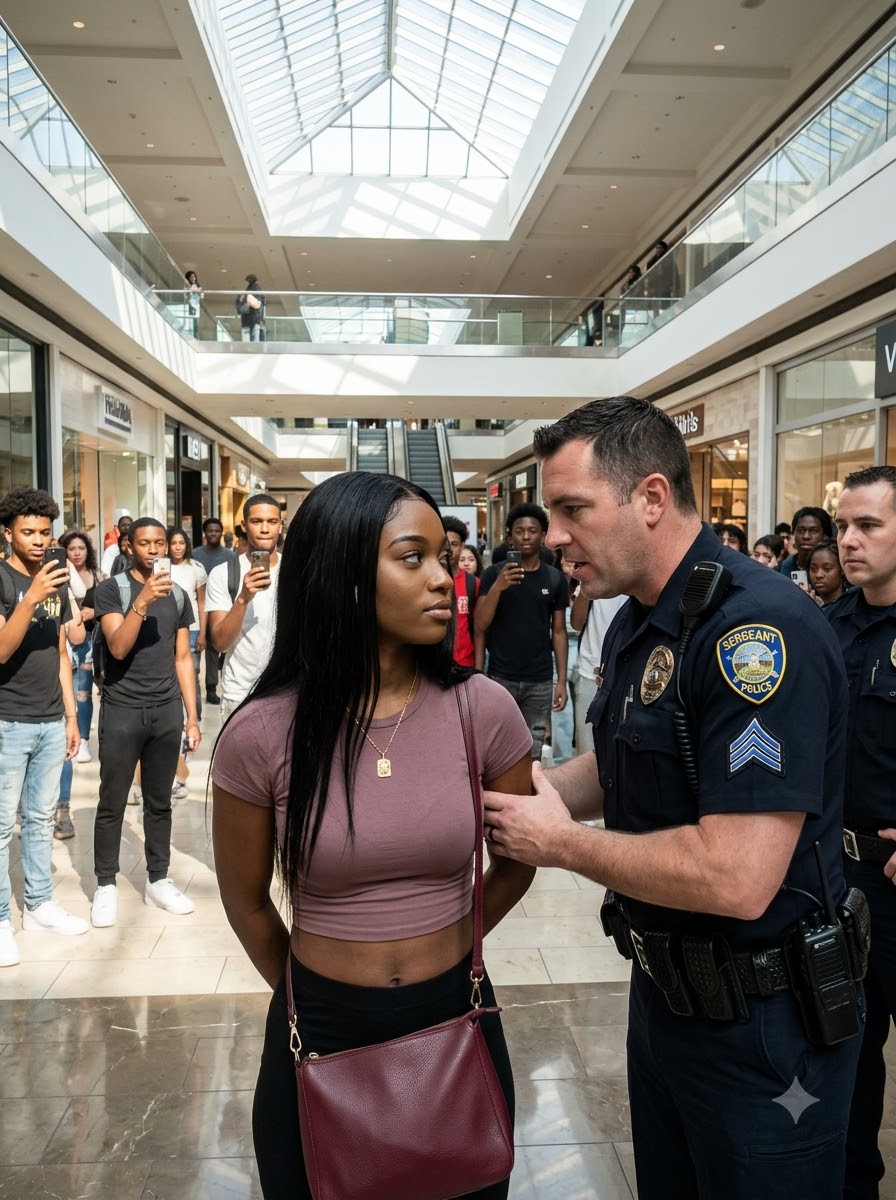
Renee noticed.
Again.
Respect had arrived only after the badge.
The Sterling & Finch recording began at 2:03 p.m.
Renee entered the boutique.
Anna greeted her.
Carolyn watched from the register.
Another camera showed Anna unlocking the display case and removing the moonstone bracelet.
One bracelet.
One gray velvet pad.
Renee never touched the locked display itself.
At 2:09, another employee named Brooke carried a tray from the rear counter toward the gift-wrapping station.
A small silver object rested near its edge.
Leonard paused the recording.
“What’s that?”
Carolyn leaned forward.
“It could be anything.”
Renee remained silent.
They continued watching.
At 2:11, Brooke picked up the object.
Examined it.
Then placed it inside a shallow drawer beneath the wrapping counter.
Carolyn went still.
Marcus spoke.
“So the missing bracelet went into that drawer.”
Carolyn snapped:
“We don’t know that.”
“Check.”
Nobody moved.
Renee looked toward Leonard.
“Check the drawer.”
Leonard radioed the boutique.
Anna answered.
Three minutes later, her voice came through the speaker.
“We found it.”
Silence filled the room.
Leonard looked toward Carolyn.
“Found what?”
“The diamond bracelet.”
“Where?”
“The gift-wrap drawer.”
Exactly where the footage had shown Brooke placing it.
Renee leaned back.
There had been no theft.
No concealment.
No missing bracelet by the time police had handcuffed her.
Then Anna said something unexpected over the radio.
“Mr. Price?”
“Yes?”
“I told Ms. Wells we might have moved it before she called security.”
Carolyn turned sharply.
Leonard frowned.
“When?”
“Right after Ms. Holloway paid.”
Renee looked toward Carolyn.
“Explain.”
The manager’s expression tightened.
“Anna was uncertain.”
Anna continued over the radio.
“I said Brooke had taken a tray toward gift wrap and we should check there.”
Carolyn reached for the radio.
“That is not exactly what you said.”
Anna fell silent.
Marcus glanced at Renee.
She understood the significance immediately.
Carolyn had been given an opportunity to verify the inventory.
She had chosen to continue the accusation instead.
Renee faced Maddox.
“You arrested me after the store manager had been told the merchandise might have been relocated internally.”
Maddox stared at Carolyn.
“You didn’t mention that.”
She crossed her arms.
“I had no confirmation.”
“You told us she stole a bracelet.”
“I said we believed she did.”
Renee shook her head.
“No.”
Everyone looked toward her.
“You said the bracelet was present before I entered and missing after I handled the display.”
Carolyn said nothing.
Renee continued.
“The video shows I never handled that display tray.”
Doyle shifted uncomfortably.
Renee turned toward him.
“And you followed me before I entered the store.”
Doyle narrowed his eyes.
“That’s routine loss prevention.”
“Based on what?”
He did not answer.
“Based on what, Mr. Doyle?”
“Behavior.”
“What behavior?”
“You were looking into stores.”
Renee nearly laughed.
“At a mall.”
“You kept touching your purse.”
“That is not evidence of theft.”
Doyle crossed his arms.
“We watch everybody.”
Marcus finally spoke.
“No, we don’t.”
Doyle spun toward him.
“What?”
Marcus looked frightened.
But he continued.
“We don’t watch everybody.”
Leonard warned him.
“Marcus.”
The younger guard shook his head.
“No.”
He faced Renee.
“He called you out before you went into Sterling & Finch.”
“I heard him.”
“He does it a lot.”
Doyle stepped closer.
“Watch yourself.”
Maddox moved between them.
Renee noticed the irony.
The officer who had arrested her without reviewing evidence was now protecting a security employee from another employee’s intimidation.
Marcus continued.
“He calls it instinct.”
Doyle’s expression hardened.
“Marcus.”
“He watches Black shoppers more.”
The room went quiet.
“And teenagers.”
Marcus hesitated.
“And people wearing hoodies if they go near the jewelry stores.”
Doyle pointed at him.
“You’re done.”
Leonard raised a hand.
“No one is done until I know what’s going on.”
Renee turned toward Marcus.
“Have you documented any of this?”
He hesitated.
Then nodded.
“I have incident numbers.”
Doyle swore.
That answer transformed the afternoon.
It was no longer simply an embarrassing arrest.
It was the beginning of a much broader inquiry.
Renee took out her phone.
She called Deputy Chief Samuel Grant in Eastborough.
Not to threaten anyone.
Not to demand special treatment.
She explained what had happened.
Grant reacted immediately.
“Where are you?”
“Briarwood Galleria.”
“You were handcuffed?”
“Briefly.”
“Who?”
“Briarwood Police.”
A long silence followed.
“Do you want me there?”
“No.”
“Renee.”
“I need this handled without anyone confusing my rank with the facts.”
Grant understood.
“What do you need?”
“An outside attorney contact and evidence preservation.”
“I’ll call Camille Jackson.”
Camille Jackson was a civil-rights attorney Renee had known through earlier police litigation.
She was not Renee’s niece, despite sharing her first name.
Grant asked:
“Internal affairs?”
“Briarwood needs to initiate its own.”
“And if they don’t?”
“Then we’ll know something else.”
Renee ended the call.
Maddox looked uncomfortable.
“Captain, this doesn’t need to become bigger than it is.”
Renee stared at him.
“How big is it?”
He said nothing.
“That is the problem.”
Before leaving, Renee collected the bracelet she had purchased, her receipt, her purse, and the incident number.
She recorded the names of everyone involved.
She requested preservation of surveillance footage, body-camera recordings, dispatch audio, inventory records, and all communications relating to the accusation.
Leonard assured her the material would be saved.
Renee looked directly at him.
“Put that assurance in writing.”
He did.
The following afternoon, Renee arrived late to Camille’s birthday dinner.
Her niece opened the jewelry box and gasped.
“Aunt Renee!”
“Too old for moonstones?”
“I never said that.”
“You said jewelry was boring.”
“I said your jewelry was boring.”
Renee laughed.
Across the table, her sister Alicia watched quietly.
She had already heard what happened.
After dinner, when the children disappeared downstairs, Alicia pulled Renee aside.
“Show me your wrists.”
“They’re fine.”
“Show me.”
Renee held out her hands.
Faint marks remained.
Alicia’s eyes filled with tears.
“You didn’t tell them who you were?”
“They found out.”
“That’s not what I asked.”
Renee understood.
“No.”
“Why?”
“Because being Captain Holloway should not have been the reason they checked the evidence.”
Alicia stared.
“But it became the reason.”
“Yes.”
“That doesn’t make you angry?”
Renee glanced toward the basement stairs, where Camille was laughing with her cousins.
“It makes me very angry.”
“You don’t sound angry.”
“I don’t need to sound like something to be it.”
Alicia nodded.
She had heard her sister say that since childhood.
On Monday morning, Renee returned to Eastborough Police headquarters in uniform.
The story had already spread.
Several officers greeted her awkwardly.
One lieutenant attempted a joke about being arrested while off duty.
Renee stared at him until he stopped smiling.
Then she went to work.
At 9:15, Briarwood Police Chief Harold Benton called.
“Captain Holloway.”
“Chief.”
“I’ve reviewed the preliminary report.”
“Good.”
“I want to apologize.”
“For what?”
He paused.
“For how the incident was handled.”
“That is broad.”
Benton exhaled.
“I see why you’re a captain.”
“That has nothing to do with it.”
Another pause.
“No.”
Renee leaned back.
“I want your officers investigated the same way you would investigate them if I taught fifth grade.”
“That is exactly what we intend.”
“Good.”
“And Trevor Maddox has been placed on administrative assignment pending review.”
“What about Officer Ramirez?”
“She remains on duty.”
Renee considered that.
“She requested surveillance review.”
“Yes.”
“She also participated in the arrest.”
Benton fell quiet.
“I understand.”
“Keep both facts.”
“I will.”
At noon, attorney Camille Jackson arrived.
She wore a red suit and carried no briefcase.
“You look terrible.”
“Thank you.”
“You sleeping?”
“Enough.”
“That means no.”
Renee handed over the documents.
Camille examined Maddox’s incident report.
Then read it again.
“Interesting.”
“What?”
“Officer Maddox wrote that you became increasingly evasive.”
Renee stared.
“I answered every question.”
“I know.”
“He also says you refused multiple opportunities to resolve the matter voluntarily.”
“I asked for video.”
Camille looked up.
“Apparently asking for evidence is evasive.”
She continued reading.
Then frowned.
“Store manager says she personally observed you conceal merchandise.”
Renee leaned forward.
“She said what?”
Camille showed her the statement.
Manager Carolyn Wells observed suspect manipulate jewelry display, then place hand into personal bag before leaving sales area.
Renee’s voice became quieter.
“I never touched the display.”
“I know.”
“And her own camera proves it.”
“I know.”
Camille smiled without humor.
“Now we have more than bad judgment.”
The mall security reports contained additional contradictions.
Doyle claimed Renee had repeatedly watched security personnel before entering the boutique.
Marcus’s report explained that she appeared to notice Doyle after he broadcast her description over the radio.
Camille tapped the document.
“This is how bias survives documentation.”
Renee looked at her.
“By converting reaction into cause.”
“Exactly.”
A customer notices she is being followed.
The report calls her suspicious for watching security.
She questions an accusation.
The report describes her as argumentative.
She refuses an unsupported search.
The report labels her uncooperative.
Conduct created by the accusation becomes the supposed justification for the accusation itself.
Renee had taught young detectives to recognize that pattern.
Now she had experienced it personally.
On Wednesday, Briarwood Internal Affairs interviewed her.
Renee arrived without her uniform.
Camille accompanied her.
Lieutenant Patrice Monroe conducted the interview.
She was professional and methodical.
“What do you believe Officer Maddox did wrong?”
Renee looked at her.
“That isn’t the first question.”
Monroe raised an eyebrow.
“What is?”
“What evidence did he have at each stage?”
Monroe nodded.
“Fair.”
Together, they reconstructed the encounter.
The security complaint.
Carolyn’s accusation.
No police observation of concealment.
The available receipt.
The unreviewed video.
Renee’s refusal to consent to a purse search.
The arrest.
The search.
The badge.
The immediate change in Maddox’s behavior.
Then the discovery that the bracelet had never been stolen.
Monroe asked:
“Did Captain Holloway’s police status affect Officer Maddox’s decision to release her?”
Camille smiled faintly.
Renee answered.
“You should ask him.”
But Maddox’s body camera had already captured the answer.
Seconds after finding the badge, he whispered to Ramirez:
“Oh, hell.”
Ramirez replied:
“That shouldn’t change anything.”
Maddox answered:
“It changes everything.”
Three words.
Camille replayed them twice.
Renee did not need to.
She had heard enough.
As investigators reviewed mall records, the problem grew.
Over eighteen months, Frank Doyle had initiated seventy-four “behavioral surveillance” contacts.
Fifty-one involved Black shoppers.
Thirteen involved Latino shoppers.
Ten involved everyone else.
Those figures were sharply inconsistent with the mall’s overall customer demographics.
Only six of the seventy-four contacts resulted in confirmed theft.
Four involved teenagers openly concealing merchandise.
The other two were connected to unrelated investigations.
Most contacts produced nothing.
Yet Doyle’s performance reviews praised his “high-risk identification instincts.”
Marcus supplied internal security chat logs.
One message from Doyle read:
Watch the designer purse crowd today. Especially solo Black females near jewelry.
Another stated:
Young Black male, expensive sneakers, probably here for something other than food court.
Leonard Price had occasionally corrected Doyle’s wording.
He had never formally disciplined him.
Management’s silence had allowed the practice to continue.
Sterling & Finch launched a corporate investigation.
Carolyn initially denied treating customers differently because of race.
Then investigators found three previous complaints from Black shoppers.
One woman had been accused of switching price tags on earrings.
Security footage disproved it.
Another had been followed around the boutique and asked for identification before trying on a watch.
A third was stopped because Carolyn claimed a necklace was missing.
It was later discovered in a register drawer.
None of those incidents had resulted in formal discipline.
Regional management had described them as “customer-experience misunderstandings.”
Camille read the phrase aloud.
“Corporate English is beautiful.”
Renee looked at her.
“What does that translate to?”
“We knew.”
Camille closed the file.
“And we preferred cheaper words.”
Then video of Renee’s arrest appeared online.
A headline spread rapidly:
BLACK POLICE CAPTAIN HANDCUFFED IN MALL SHOPLIFTING MISTAKE
Renee hated it.
Not because the headline was inaccurate.
Because it encouraged the wrong conclusion.
People wrote that security had chosen the wrong woman.
Others celebrated the moment Maddox discovered her badge.
Some demanded that everyone involved be fired immediately.
Renee closed the browser.
She did not want the lesson to be that a police captain was too important to arrest.
She wanted the lesson to be that evidence mattered regardless of who was being accused.
That afternoon, Sofia Ramirez appeared at her office.
“Captain Holloway.”
“Officer Ramirez.”
“Can I come in?”
Renee gestured toward a chair.
Ramirez sat carefully.
“I’m not supposed to discuss the investigation.”
“Then don’t.”
“I wanted to apologize.”
Renee remained silent.
Ramirez continued.
“I knew we should watch the video.”
“Yes.”
“I said it.”
“Yes.”
“But when Maddox arrested you, I didn’t stop him.”
“No.”
Ramirez swallowed.
“I kept telling myself he had more experience.”
Renee leaned back.
“How many years do you have?”
“Three.”
“How many does he have?”
“Nine.”
“Does experience change probable cause?”
“No.”
Ramirez lowered her gaze.
“I knew there wasn’t enough.”
Renee allowed the silence to settle.
“Why did you help?”
“Because he was my senior officer.”
“That explains pressure.”
Renee’s voice stayed even.
“It does not create legal authority.”
“I know.”
“Do you?”
Ramirez looked up.
“I do now.”
Renee studied her.
“Now is expensive.”
Ramirez’s eyes filled.
“I know.”
She stood to leave.
Renee stopped her.
“Officer Ramirez.”
“Yes?”
“Tell Internal Affairs exactly what you just told me.”
“I already did.”
Good.
That mattered more than the apology.
Three weeks later, Camille Jackson called with another discovery.
“You are apparently banned from Briarwood Galleria for one year.”
Renee laughed in disbelief.
“What?”
“The security system still lists you.”
“After they confirmed no theft occurred?”
“Yes.”
“Who approved that?”
“Frank Doyle.”
The mall removed the trespass notice within hours.
But Renee asked a larger question.
“How many other people were falsely trespassed?”
Nobody knew.
So investigators checked.
There were 286 active bans.
Forty-seven lacked corresponding police reports.
Twenty-two involved incidents in which no merchandise was recovered.
Nine concerned customers who had successfully disputed the accusations against them.
Their names remained in the system anyway.
Renee realized the problem extended far beyond one mistaken arrest.
Administrative records had continued punishing people even after the original suspicion collapsed.
And now the investigation was beginning to expose just how many lives those records had affected.
Part 3: The Badge Should Never Have Mattered
Camille Jackson filed a civil-rights lawsuit on Renee’s behalf against the mall security contractor, Sterling & Finch, and Briarwood Police.
Renee initially resisted.
“I don’t need money.”
Camille stared at her.
“Good.”
“That’s not why I’m doing this.”
“Also good.”
Renee frowned.
“Then why are you happy?”
“Because money is not the only thing settlements can purchase.”
The lawsuit sought compensation.
More importantly, it sought access to records.
Security procedures.
Training materials.
Trespass lists.
Police arrest practices involving merchant complaints.
Internal messages.
Historical complaints.
Once discovery began, the patterns became increasingly difficult to dismiss.
During the previous two years, Briarwood Police had arrested thirty-eight people for shoplifting at the mall.
In eleven cases, body-camera footage showed officers had failed or refused to review readily available surveillance before making arrests.
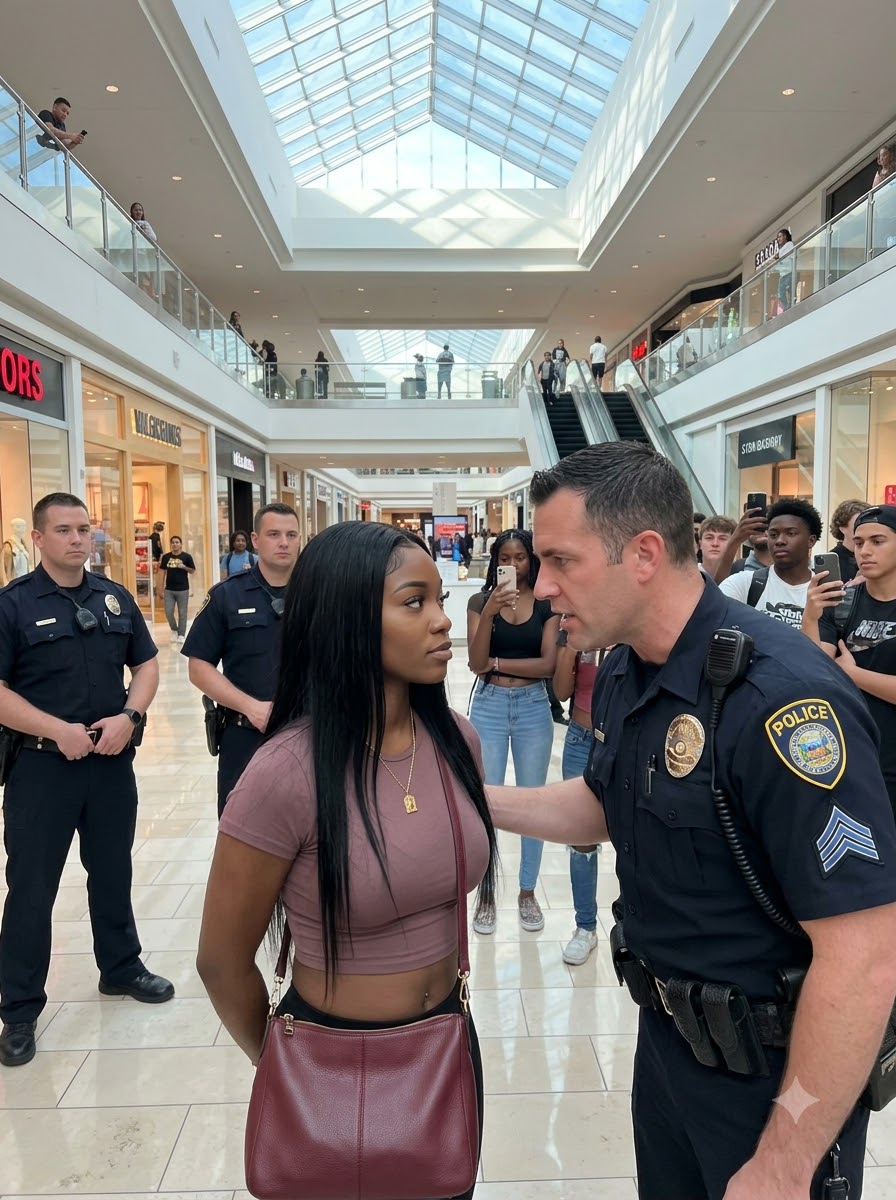
Nine of those eleven defendants were Black.
Seven cases were later dismissed.
Nobody inside the department had examined the incidents together.
Each had been treated as an isolated event.
One accusation.
One arrest.
One report.
One dismissal.
One closed file.
But when investigators examined the records collectively, the pattern became unmistakable.
Chief Harold Benton ordered an external review.
Its conclusions were severe.
Briarwood officers had developed a habit of treating retailer accusations as though they automatically established probable cause.
Store managers were regarded as reliable complainants.
Security guards were assumed to be trained observers.
Accused shoppers were often treated as inherently less credible.
The result was a system that decided whose account deserved trust before testing the evidence.
Renee read one finding twice.
The department’s failure was not that officers never considered evidence. It was that evidence contradicting trusted commercial complainants was frequently treated as something to review after arrest rather than before it.
That was exactly what had happened to her.
Arrest first.
Verify later.
It sounded efficient until an innocent person was wearing handcuffs.
Trevor Maddox requested a disciplinary hearing.
His union attorney argued that Carolyn had provided an eyewitness accusation and that merchants were entitled to report suspected crimes.
Both statements were true.
The attorney also argued that Maddox had faced a rapidly developing situation.
That was true as well.
Then Internal Affairs played the body-camera recording.
Renee requesting surveillance review.
Ramirez requesting surveillance review.
Maddox dismissing the suggestion.
“We don’t need to spend twenty minutes watching video if the store wants prosecution.”
The hearing officer paused the footage.
“Why didn’t you watch it?”
Maddox answered:
“Time.”
“How long did the arrest, purse inventory, walk to security, and later surveillance review take?”
His attorney objected.
The hearing officer already knew.
Thirty-seven minutes.
The relevant footage required less than four.
Maddox lowered his eyes.
Then the recording reached the moment he discovered Renee’s credentials.
“It changes everything.”
The hearing officer paused again.
“What changed?”
Maddox hesitated.
“Her credibility.”
Renee felt a cold sensation settle in her chest.
The hearing room went silent.
“Why?”
Maddox answered too late to recognize the damage.
“Because she was a captain.”
The hearing officer leaned forward.
“So Captain Holloway’s denial became more credible after you learned she was police?”
Maddox swallowed.
“Yes.”
“Would a nurse’s denial have gained credibility?”
Silence.
“A teacher?”
No answer.
“A restaurant worker?”
Maddox stared at the table.
The hearing officer turned off the monitor.
“That is the problem before us.”
Maddox received a lengthy suspension, permanent disciplinary notation, mandatory constitutional-policing retraining, and removal from field-training eligibility.
He was not fired.
Some observers were furious.
Renee was not.
She believed accountability required institutions to identify wrongdoing accurately, not automatically impose the harshest possible punishment.
Ramirez received a shorter suspension for failing to intervene in an arrest she admitted she believed lacked sufficient evidence.
She accepted the decision without appealing.
Frank Doyle lost his position at Briarwood Galleria.
The security company terminated him after the discriminatory messages and previous surveillance contacts became public.
His state security license was referred for review.
Marcus Reed remained employed.
When Renee met him months later during a deposition, she asked why.
Marcus looked embarrassed.
“I almost quit.”
“Why didn’t you?”
“Because if everybody who knows what happened leaves, the next person just gets trained by somebody like Frank.”
Renee nodded.
“That is a better answer than I expected.”
Marcus smiled faintly.
“I’ve had time.”
Leonard Price also remained, but only after acknowledging his failure to address Doyle’s repeated conduct.
The mall established an independent complaint system outside security management.
Security officers were required to identify specific observed actions before classifying customers as theft suspects.
Race could be used in a description when relevant to identifying a particular person.
It could not be treated as suspicious behavior.
That distinction became part of the training manual.
Sterling & Finch terminated Carolyn Wells.
The decision was not based solely on one incorrect inventory assumption.
Investigators found she had received repeated warnings about profiling complaints and had failed to address them.
More damaging was an email sent after Anna warned that the bracelet might have been moved to the wrapping station.
Carolyn had written to Doyle:
She was already acting wrong. Keep her there until police sort it out.
The missing bracelet had become secondary.
Carolyn wanted the accusation to continue even when evidence suggested it was wrong.
Anna Kim was eventually promoted to assistant manager under new leadership.
When Renee learned the news, she smiled.
Anna had spent months regretting that she had not spoken more forcefully.
One afternoon, she sent Renee a handwritten note.
I said the bracelet might have been moved, but when Ms. Wells shut me down, I let being younger become an excuse to stop talking. I won’t do that again.
Renee kept the letter beside Ramirez’s apology.
Both described people who recognized something wrong but allowed hierarchy to silence them.
Age.
Rank.
Experience.
Fear.
Different pressures.
The same hesitation.
Eleven months after the arrest, the civil lawsuit settled.
The financial amount attracted headlines.
Renee cared more about the reforms.
Briarwood Galleria agreed to remove unsupported trespass records and establish a formal appeal process.
Sterling & Finch revised customer-contact procedures across its regional stores.
The security contractor introduced bias audits and independent reviews of complaint patterns.
Briarwood Police adopted a policy requiring review of readily available evidence before custodial shoplifting arrests, except where immediate safety concerns made delay unreasonable.
Part of Renee’s settlement funded legal assistance for people challenging wrongful retail-theft accusations and unsupported trespass orders.
Camille Jackson suggested naming the program after Renee.
Renee refused.
“Why?” Camille asked.
“Because the woman after me may not be a captain.”
Camille smiled.
“You are extremely inconvenient as a client.”
“I’ve been told.”
They named the initiative the Fair Access Project.
Its first beneficiary was Tasha Greene, a twenty-three-year-old nursing student.
Another mall had banned her after a cosmetics store accused her of concealing perfume.
No perfume was recovered.
She was never arrested.
Yet the trespass order remained active for eighteen months.
At a community meeting, Tasha told Renee:
“I stopped going to malls.”
Renee looked surprised.
“All of them?”
“Pretty much.”
“Why?”
“Because I figured somebody would look at me and see the ban before they saw me.”
Renee never forgot that answer.
An accusation could alter someone’s life without ever becoming a conviction.
Sometimes it changed where a person felt welcome.
Throughout the case, Renee continued her work as a police commander.
She supervised officers.
Reviewed shootings.
Approved overtime.
Attended budget meetings.
The contradiction stayed with her.
She could command an entire precinct during the week and be treated as a suspicious shopper on Saturday.
Her rank had not prevented the injustice.
It had merely made institutions more embarrassed after discovering who she was.
One evening, her niece Camille asked about the incident.
They were driving home after dinner.
“Were they racist?”
Renee watched the road.
Thirteen-year-olds rarely asked simple questions.
“Some of what happened was racial.”
“That’s not what I asked.”
Renee smiled faintly.
“You sound like me.”
“Mom says that too.”
Renee considered her response.
“I can’t tell you what every person believed inside their head.”
Camille frowned.
“Then how do you know?”
“Patterns.”
Renee continued.
“Who gets watched.”
“Who gets believed.”
“Whose questions get called attitude.”
“Whose explanation gets treated as an excuse.”
“Who receives the benefit of checking before punishment.”
Camille grew quiet.
“So racism isn’t always somebody saying something racist.”
“No.”
“Sometimes it is.”
Renee stopped at a red light.
“Sometimes it is a system repeatedly deciding who deserves doubt.”
Camille considered that.
“Did the badge help?”
“Yes.”
“That’s good, right?”
Renee looked toward her.
“No.”
Camille appeared confused.
“The badge should help me enter police headquarters.”
Renee smiled slightly.
“It should not be what makes somebody believe I didn’t steal a bracelet.”
Two years passed.
Briarwood Galleria renovated part of its second floor.
Sterling & Finch remained open with new management.
Renee had not returned.
She simply had no reason to.
Then Camille turned fifteen.
This time, she wanted a watch.
Renee objected immediately.
“Absolutely not.”
“Aunt Renee.”
“You lose earbuds weekly.”
“I lose cheap earbuds.”
“That argument makes the watch less likely.”
Eventually, Renee agreed to look.
Camille chose Briarwood Galleria.
Only then did she remember what had happened there.
“Oh.”
“We can go somewhere else.”
Renee considered it.
“No.”
“You sure?”
“No.”
Camille laughed.
“That was honest.”
They entered the mall together.
The same skylights illuminated the polished floors.
Security guards wore different uniforms.
Renee noticed details she wished she could ignore.
A radio clipped to a belt.
A glance from across the atrium.
Footsteps behind her.
Her shoulders tightened.
Camille noticed.
“You okay?”
“Yes.”
“Real yes?”
Renee smiled.
“Working on it.”
They entered Sterling & Finch.
Anna Kim stood behind the counter.
Now assistant manager, she recognized Renee immediately.
Her face brightened.
“Captain Holloway.”
Renee glanced toward Camille.
“Today I’m Aunt Renee.”
Anna smiled.
“That sounds more expensive.”
Camille liked her instantly.
They examined watches.
Tried three.
Argued over prices.
Eventually, Camille chose the least expensive option without being asked.
Renee pretended not to notice how much her niece had matured.
Anna wrapped the watch.
Then paused.
“You know, we still have the moonstone bracelet design.”
Renee looked toward Camille.
Her niece smiled.
“I still have mine.”
“Of course you do.”
“You thought I lost it?”
“I considered the statistical likelihood.”
Camille rolled her eyes.
They paid.
The receipt printed.
Nobody followed them.
Nobody questioned Renee’s purse.
No security guard appeared at the entrance.
No one asked whether she carried police credentials.
They walked toward the food court.
Near the escalator, Renee stopped.
It was the same place where Maddox had handcuffed her two years earlier.
Camille noticed.
“That where it happened?”
“Yes.”
“Do you want to leave?”
Renee looked around.
Families.
Teenagers.
A father pushing a stroller.
Three girls carrying shopping bags.
A Black woman laughing into her phone outside a cosmetics store.
Security walked past without approaching her.
“Not yet.”
They ate lunch.
Camille complained about school.
Renee complained about teenagers.
Nothing extraordinary happened.
And that was precisely why the afternoon mattered.
On their way out, Renee spotted a Briarwood officer speaking with mall security.
She recognized Sofia Ramirez.
Now Sergeant Ramirez.
Her promotion had followed years of strong evaluations and recognition from supervisors who noted how openly she discussed her earlier failure during training.
Their eyes met.
Ramirez approached.
“Captain.”
“Sergeant.”
Camille looked between them.
“This is one of the officers?”
Renee nodded.
Ramirez answered directly.
“Yes.”
Camille studied her.
“The one who arrested her?”
“I helped.”
She did not attempt to soften her responsibility.
Renee appreciated that.
Camille asked:
“Why?”
Ramirez glanced toward Renee.
Renee gave a small nod.
“Because another officer was more experienced than me, and I let that matter more than what I knew.”
Camille frowned.
“That sounds dumb.”
Ramirez laughed softly.
“It was.”
Ramirez turned toward Renee.
“I teach the incident now.”
“In training?”
“Yes.”
“What do you call it?”
Ramirez smiled faintly.
“The bracelet case.”
Renee shook her head.
“Of course.”
“We stop the video before the badge appears.”
Renee became interested.
“Why?”
“So recruits have to decide what they think before they know who you are.”
Renee went still.
Ramirez continued.
“Then we show the badge.”
“And ask what changed.”
Renee smiled slowly.
“Good.”
Camille looked confused.
“What is the right answer?”
Renee turned toward her niece.
“Nothing.”
Ramirez nodded.
“Exactly.”
They said goodbye.
Renee and Camille continued into the parking lot.
Sunlight reflected from the parked cars.
Camille carried her new watch in a small white shopping bag.
Then she spoke.
“I think I get it now.”
“Get what?”
“Why you didn’t tell them you were a captain.”
Renee looked toward her.
“I didn’t hide it.”
“I know.”
Camille considered her words.
“But you wanted the truth to work before the title did.”
Renee smiled.
“Something like that.”
They reached the car.
Camille climbed inside.
Renee paused before opening the driver’s door.
For a long time, she had believed the worst part of that Saturday was being handcuffed for something she had not done.
Eventually, she understood that something else had disturbed her even more.
The instant everyone discovered her badge, they began treating her like a different person.
Before the badge, she was suspicious.
Evasive.
Uncooperative.
Possibly dishonest.
After the badge, she was Captain Holloway.
Credible.
Professional.
Someone whose account deserved investigation.
But Renee herself had not changed.
Neither had the evidence.
Only the institution’s calculation of the consequences of dismissing her.
That realization influenced the rest of her career.
When a young patrol officer described a complainant as “probably exaggerating,” Renee demanded evidence supporting the word probably.
When detectives called someone uncooperative, she asked what the person had actually done.
When a store manager demanded an immediate arrest, she asked whether available footage had been examined.
Some officers found her insistence exhausting.
She did not mind.
Accuracy was worth the effort.
Years later, Renee became deputy chief.
Eventually, Chief Samuel Grant retired and encouraged her to apply for his position.
She nearly laughed.
“I spend half my life telling people I don’t want more meetings.”
Grant replied:
“You also spend half your life fixing what happens in bad ones.”
Renee applied.
She got the job.
At her swearing-in ceremony, reporters asked about Briarwood Galleria.
They always did.
One reporter raised the familiar question.
“Chief Holloway, do you believe those officers picked the wrong woman that day?”
Renee looked directly at him.
“No.”
The room became quiet.
“They made the wrong decision.”
She paused.
“The distinction matters.”
The reporter waited.
“If the lesson is that officers should be careful because the woman they arrest might secretly be a police captain, we have failed completely.”
Renee continued.
“She might be a waitress.”
“A nurse.”
“An unemployed mother.”
“A student.”
“A woman buying a birthday gift.”
“The evidence deserves the same attention.”
The quotation spread widely.
Renee was more interested in what happened afterward.
Briarwood training supervisors reported that custodial shoplifting arrests had decreased, while a greater percentage were supported by video evidence before arrest.
Complaints declined.
Wrongful-arrest claims fell.
Retail managers became more careful when reporting suspected theft.
Security personnel began documenting actual conduct instead of relying on vague impressions.
The revised procedures had not made policing impossible.
They had made unsupported certainty harder to defend.
That was the result Renee had wanted.
Frank Doyle eventually left private security.
Carolyn Wells moved to another state and worked outside retail management.
Trevor Maddox remained in law enforcement after his suspension and retraining, though he never returned to field-training duties.
Years later, he sent Renee an email.
She nearly deleted it.
Then she opened it.
Captain—now Chief—Holloway, I spent a long time being angry that one mistake followed my career. Eventually I understood it was not one mistake. It was a series of moments where evidence gave me a chance to slow down and I chose authority instead. I do not expect a response.
Renee read the message twice.
She did not reply.
Not because the apology was meaningless.
Because forgiveness did not always require reopening a relationship.
She saved it beside Anna’s letter and Ramirez’s statement.
Three people had acknowledged different failures.
One had remained too quiet.
One had followed a wrongful decision.
One had made that decision.
Eventually, all three had accepted responsibility without demanding that Renee comfort them.
She respected that.
On Camille’s eighteenth birthday, Renee gave her another bracelet.
This one was simple silver.
Inside the box was a card.
Your value should never depend on somebody discovering who you know.
Camille read it.
Then looked up.
“That’s extremely serious for jewelry.”
Renee laughed.
“I’m getting old.”
“You’ve always been old.”
“I can still return the bracelet.”
Camille immediately fastened it around her wrist.
“No refunds.”
They hugged.
The moonstone bracelet from Camille’s thirteenth birthday still rested in her jewelry box upstairs.
The gift that had almost become evidence.
The bracelet Renee had purchased on the afternoon she was arrested for a theft that never happened.
Sometimes Renee thought about the diamond bracelet too.
The one lying inside a gift-wrapping drawer while officers placed handcuffs around her wrists.
That detail captured the entire failure more clearly than any report.
The truth had been inside the building all along.
Recorded on camera.
Easy to verify.
Physically present.
Someone simply had to care more about checking the facts than defending an accusation.
That became the lesson Renee carried forward.
Not that she had a badge.
Not that Carolyn lost her job.
Not that Maddox was disciplined.
Not that a lawsuit produced new rules.
Those were consequences.
The deeper lesson was simpler.
Before deciding who someone is, examine what actually happened.
Before suspicion becomes official action, test it against evidence.
Before authority becomes punishment, establish a lawful basis for the next step.
And when facts contradict the story you began with, change the story.
Never change the facts.
Because on one Saturday afternoon at Briarwood Galleria, a Black woman entered a jewelry boutique hoping to buy her niece a birthday gift.
Security saw a risk.
A manager saw a thief.
A police officer saw a difficult suspect.
Then he opened her badge wallet.
Suddenly, everyone saw Captain Renee Holloway.
They should never have needed that badge.
She had been the same woman all along.
