

PART 1 — The Signature That Wasn’t Mine
For nine days, a storm held me offshore. Across the Gulf of Mexico, the water rose into a restless wall, throwing itself against the platform with enough force to shake the metal steps under my boots. My job as an instrumentation technician involved inspecting gauges and communications equipment, and years of offshore work had taught me that no departure was certain until the weather permitted it. Even so, I had never gone so long without hearing my son’s voice. The silence had begun before the storm, when I still believed there was nothing unusual about it.
Owen was seventeen, occupied with training at the athletic academy outside Austin and determined to convince me he could handle his life without constant questions from his mother. During our last conversation, he had sounded happy beneath his impatience. I had ended the call smiling, wanting him to understand that I trusted him. I had no idea that when I finally made it back to land, he would be in a hospital bed, dependent on a machine to breathe and unable to explain how he had ended up there.
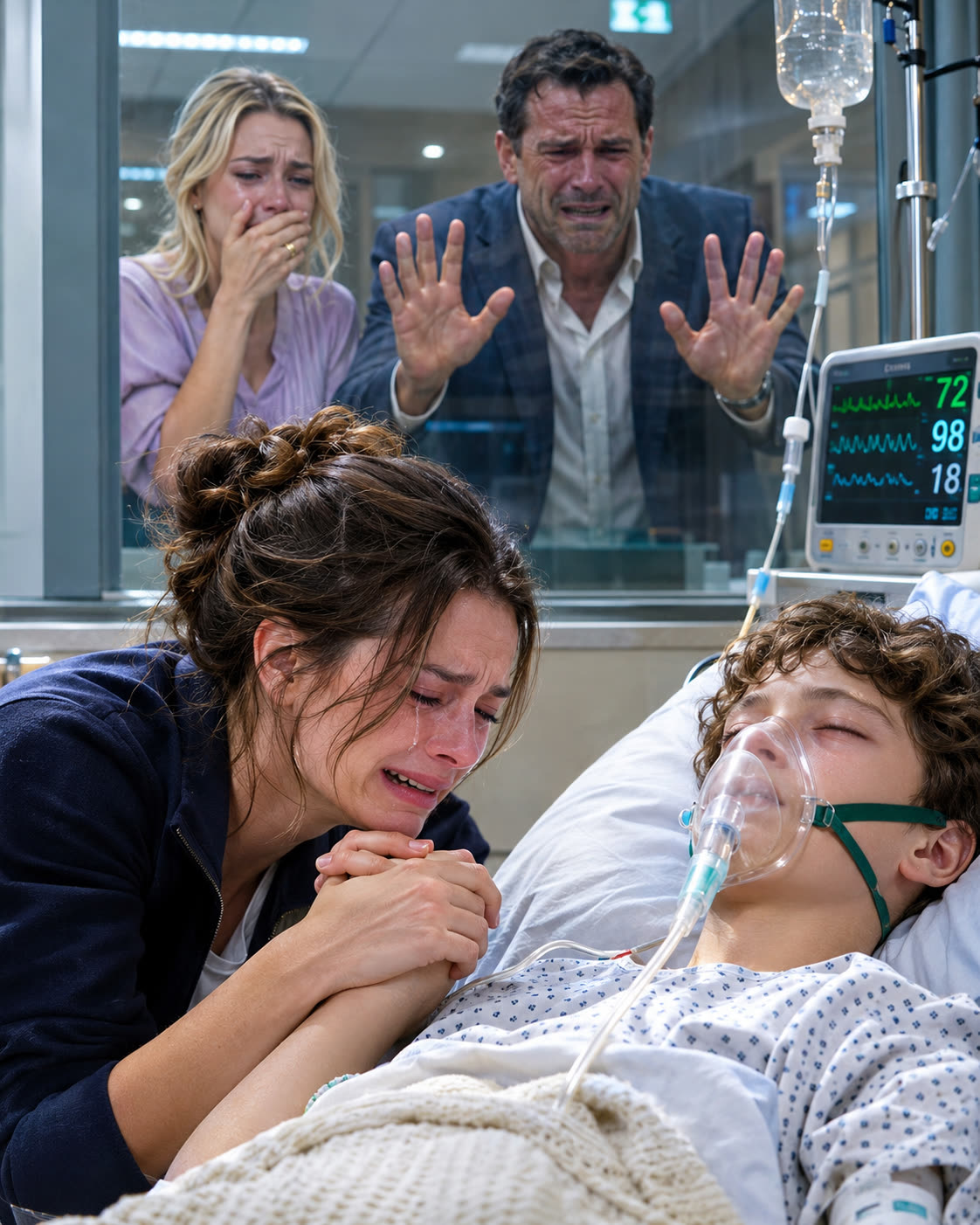
Our crew boat reached shore shortly after sunrise. Still dressed in my salt-stiff work jacket, I climbed into my truck and headed inland, my duffel lying beside me. As soon as we had docked, I had called the hospital. Someone told me Owen was in intensive care, his condition was serious, and his father was already there. After that, the words barely registered. The private medical center in San Antonio had pale stone floors, subdued corridors, and a gleaming reception desk. By the time the elevator doors opened, only one question remained in my mind: Was my son still here?
Andrew was waiting outside intensive care with a woman I knew from photographs, a hospital administrator, and a dark-suited man who introduced himself as Victor Harlan. Owen’s father had never called me, yet my appearance seemed to surprise him very little. “You made it,” he said. His voice was so level that I felt less like an arriving parent than an interruption he had already considered. Looking toward the doors behind him, I asked, “How is Owen?” Andrew inhaled slowly. “The doctors aren’t seeing enough improvement. They’re talking about stopping the ventilator on Friday.”
The corridor seemed to shift beneath me. “What do you mean, stopping it?” Tessa folded her arms. Her cream-colored coat was immaculate, untouched by the exhausting hospital nights I had imagined. “They’ve explained the situation,” she said. “There isn’t much more they can do.” Victor moved closer with a practiced, professional smile. “Victor Harlan. I’m with the academy’s insurance risk office. I’m sorry you’re meeting under these circumstances.” I stared at him. “Why is the academy’s insurance office part of a medical conversation about my son?”
Before replying, he looked at Andrew. “There are administrative matters connected to the accident. We’re trying to make sure the family has the information it needs.” Family was an odd word to hear from people who had not contacted me. When I asked how long the doctors had been discussing this, Andrew said it had been several days. Friday was the date by which a decision was expected. He spoke with the exhausted confidence of someone following an arrangement already made. “You can’t just arrive and turn this into a fight,” he added. “The medical team has looked at the scans.”
I looked from Andrew to Tessa, then at the administrator clutching her folder. “I’m Owen’s mother. I’m not turning anything into a fight. I’m asking why I’m hearing about this in a hallway after you’ve already set a date.” Before anyone replied, a nurse arrived to take me inside. Owen’s room was shadowed, with daylight slipping between the blinds. Machines sounded quietly around the bed, and the ventilator breathed for him beneath the white blanket. His face was unmistakably my son’s, but its stillness made him seem younger than seventeen.
His hair had been trimmed short to accommodate the medical equipment, and faint shadows marked the skin beneath his eyes. One hand rested palm-up on the blanket; the other lay near the rail. I sat beside him and enclosed his warm hand in mine. I had no way to know whether he could hear, but I spoke. “Hi, sweetheart. I’m here now.” When he was six, we had lost each other at a county fair. The separation lasted fewer than five minutes, though neither of us had experienced it that way. By the time I found him among the noise and strangers, he was too overwhelmed to tell me what he needed.
At home that evening, we had invented a way for him to answer when speaking was too difficult. One squeeze meant yes; two meant no. We kept using it through school meetings, medical appointments, and the times when questions from adults made him retreat into silence. Over eleven years, that small habit had become our own language. Now I leaned toward his ear, both hands around his. “Owen, they’re talking about taking away the machine that’s helping you breathe on Friday. Do you want that?”
I waited while the equipment hummed. My eyes stayed on his fingers, although I understood that a tiny movement might be nothing more than a reflex. I tried to brace myself for no response. Then his hand tightened around mine once and released. Several seconds went by. His fingers moved again, closing twice. No one had explained what I should expect from someone in his condition, and I could not pretend those movements answered every medical question. But I recognized the signal we had shared since he was a frightened little boy. I pressed the call button.
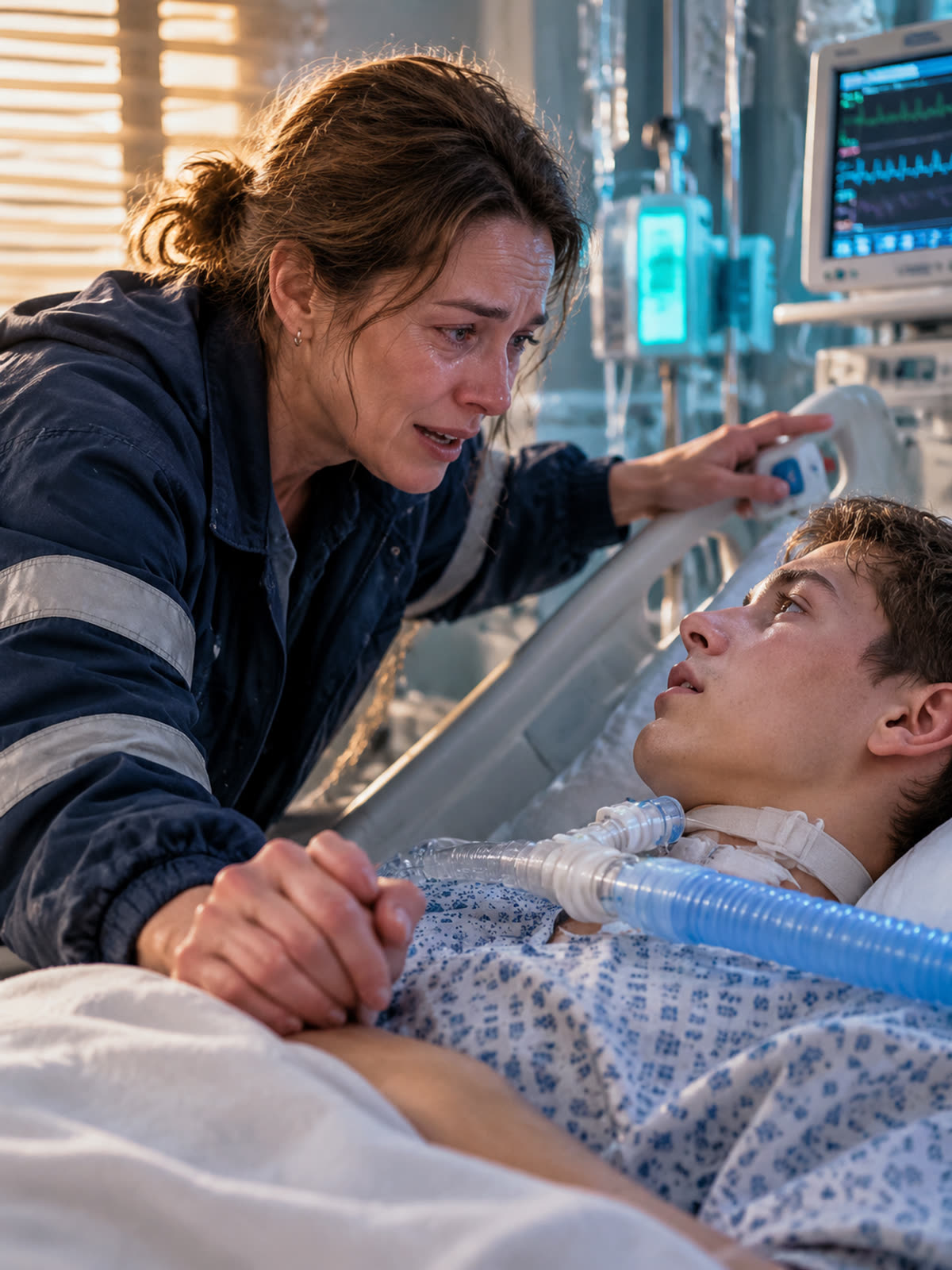
When the nurse came in, I had not let go of his hand. “Please get the doctor. He responded to me.” She glanced at our joined hands and then at Owen. “What did he do?” I answered, “I asked him a question. He squeezed once for yes and twice for no. He said no.” Andrew appeared behind her with Victor following. Tessa remained outside the doorway, watching. “That doesn’t prove anything,” Andrew said. “People have involuntary movements.” I turned to face him. “Then let the doctors determine what it means. But don’t dismiss it before they even look.”
Victor opened his folder. “We’re not dismissing anything. The timing is difficult, and there are forms that have to be addressed. A request was submitted so the team could discuss the next step.” Apparently intending to find another document, he lifted a page and exposed the form underneath. Near the bottom was my printed name. Above it sat a signature that someone wanted the hospital to believe I had written. My attention fixed on it immediately, while the conversation around the bed seemed to recede.
It resembled my handwriting without belonging to me. Whoever had copied it had attempted the sweeping first stroke, the abbreviated tail of the final letter, and the cramped distance between my names. Someone unfamiliar with my signature could easily have accepted it. I could not. The date was three days earlier, when I had been stranded on the platform, outside cell service, while the storm prevented every vessel from leaving. I looked up from the page. “I never signed this.” Andrew’s expression hardened. “It was just paperwork to start the conversation.”
“You used my name to request a medical decision while I was out of reach.” Victor reached toward the folder. “The document was submitted to help the hospital understand the family’s position. It does not, by itself, direct the doctors to do anything.” I refused to let the distinction end the matter. “Then you can explain that to the medical director while they document that I object to every decision made on the basis of this signature.” The nurse’s gaze moved between us before she quietly stepped nearer Owen. She looked uncertain, but she was listening.
Only then did I begin to understand what I had walked into. This process already had direction and momentum. There were deadlines to meet, forms to complete, expenses to discuss, and people speaking with the assurance that agreement had been reached. Meanwhile, the person whose future they were discussing lay in front of them without the ability to speak for himself. My absence had somehow been treated as permission. They had confused being unable to reach me with having my consent, and they had made a serious mistake.
The charge nurse arrived with another nurse and introduced herself as Paula. She asked me to describe exactly what I had witnessed. I explained our signal, the first squeeze, the interval afterward, and the pair of squeezes that followed. I demonstrated how I had held his hand and repeated my question without changing it. Paula let me finish. She did not hurry my account or interrupt to supply an explanation before she had heard everything I could tell her.
“We can’t draw a full conclusion from one response,” she said. “But if he’s showing a consistent, purposeful response, the physicians need to know about it. I’ll make sure they do.” Her restraint mattered to me. I did not need someone offering a certainty the evidence could not support. I needed someone willing to consider what had happened. Paula was careful without being dismissive, and after the conversations in the corridor, that difference felt enormous.
Soon afterward, the attending physician, Dr. Rebecca Sloan, entered with another doctor. At the foot of Owen’s bed, she explained that the team had been watching him closely. His injury remained severe. Earlier in the week, they had noticed slight movements, but those responses had varied, and they had not established whether they were deliberate. I listened while keeping one part of my attention on my son. Nothing about his condition had suddenly become simple because I had felt his fingers close.
“If what you observed is repeatable, it could change how we assess his awareness,” Dr. Sloan said. “We need to examine him carefully and get a specialist’s opinion.” There was no dramatic announcement, no promise that the days ahead would unfold the way I wanted. Instead, she described another examination and the need for someone with more specialized experience. It was a cautious answer, but it acknowledged that what I had felt might matter.
I asked the only question I could manage. “Will the Friday decision wait?” Dr. Sloan met my eyes. “We won’t proceed with any change in support while we reassess the evidence.” I wanted to take those words and make them stronger than they were. I wanted them to mean safety, recovery, and a future in which this room became a memory. The concern in her face would not let me mistake a pause for a guarantee.
Owen was still critically ill. The equipment around him was still performing work his body could not yet carry out alone. Neither the disputed paperwork nor the movements of his hand explained what would happen over the coming week, much less the coming year. His response did not erase the injury. It did not tell us how much he understood or what he might eventually regain. All it gave us was a reason to stop accepting answers that had been treated as final.
For the moment, Friday would have to wait. So would the people who had moved ahead without me. My son had given us something that deserved a closer look, and the doctors were finally preparing to ask him questions. I stayed beside his bed, holding the hand that had interrupted their plans. The next answer had not come yet—and everything now depended on whether he could give it again.
PART 2 — The Photograph They Hadn’t Explained
The doctors started with straightforward instructions. They examined Owen’s pupils, asked him to orient toward a voice, and tried questions whose answers could be checked. I remained nearby so he would know I had not left, but stood far enough aside that I would not influence their observations. After a while, Dr. Sloan invited me to use our familiar signal. I bent beside him. “Owen, is your middle name James?” His fingers closed once. “Is it Patrick?” This time, two weak but separate squeezes followed.
Paula looked toward Dr. Sloan. The doctor did not declare a miracle or even smile; she recorded what she had observed and continued. “Are you in a hospital?” One squeeze. “Are you at home?” Two. I kept watching his hand, almost afraid that looking elsewhere would break the fragile connection. His responses required time and effort. Some questions brought no movement at all, and other movements were too uncertain to interpret. The team repeated prompts, compared what they saw, and refused to rush.
By the end of the examination, there was enough evidence to suspend Friday’s plan and seek a neurologist experienced in disorders of consciousness. Andrew waited by the doorway, his jaw rigid. Tessa had entered and was studying the equipment with an expression that made me think of an unwanted account statement. “We can’t keep extending this indefinitely,” she said. “The bills are already enormous.” I faced her. “Owen is not a bill.” She glanced down briefly. “I’m saying the family needs to be realistic.” I answered, “The family needs accurate medical information.”
Victor intervened with a soothing gesture, as though the disagreement concerned an ordinary business arrangement. “The academy has an obligation to help manage the costs connected to Owen’s injury. We have a proposed payment that could cover a significant portion of what’s accrued.” I asked, “Why would the academy be paying his medical costs?” He replied, “Because he was injured during a sanctioned training session,” then continued, “The circumstances are still under review, but we want to make sure the family isn’t left without support.”
Again, his use of family unsettled me. I requested a copy of the document bearing the signature I had not written. Victor said he would have to determine whether it could be released. I told him to do that while I waited. Paula remained beside me. “The patient’s legal guardian is entitled to review relevant paperwork in the chart,” she said, steady and firm. Victor’s smile disappeared. He turned to her and questioned whether this was necessary. She held her position. “We need accurate records,” she said. “That includes documenting Ms. Mercer’s objection.”
Until that moment, I had felt like an obstacle other people were trying to work around. Paula was treating me as someone whose presence and objections belonged in the record. After the doctors and nurses left, I returned to Owen’s side and explained what had happened, uncertain how much he could follow. “They’re going to take another look, honey. You don’t have to explain everything at once. Just keep giving us what you can.” His fingers lay still against mine. I remained there until a nurse reminded me that he needed to rest.
In the hallway, Andrew was absorbed in his phone. “Who filled out that form?” I asked. He put it away. “I didn’t.” I said, “You knew it existed.” He looked toward Owen’s room. “It was supposed to be a request for a conversation. Everyone was trying to make a difficult situation manageable.” I could hardly bear the explanation. “You could have called me.” His answer was immediate. “You were at sea.” I said, “I was unreachable. I was not gone.” Rubbing his face, he replied, “You always think there’s a right answer if you keep asking enough questions.”
That familiar accusation hurt, but I would not let an old disagreement about our marriage replace the question of Owen’s care. I left it unanswered and went back to wait. The following morning, Dr. Martin Kessler arrived. He had silver hair and a deliberate manner. When he suspected an answer had been influenced by someone’s expectations, he asked the question again. Before examining Owen, he spoke separately with me, Andrew, and the nurses. His care in gathering those accounts gave me another reason not to demand quick reassurance.
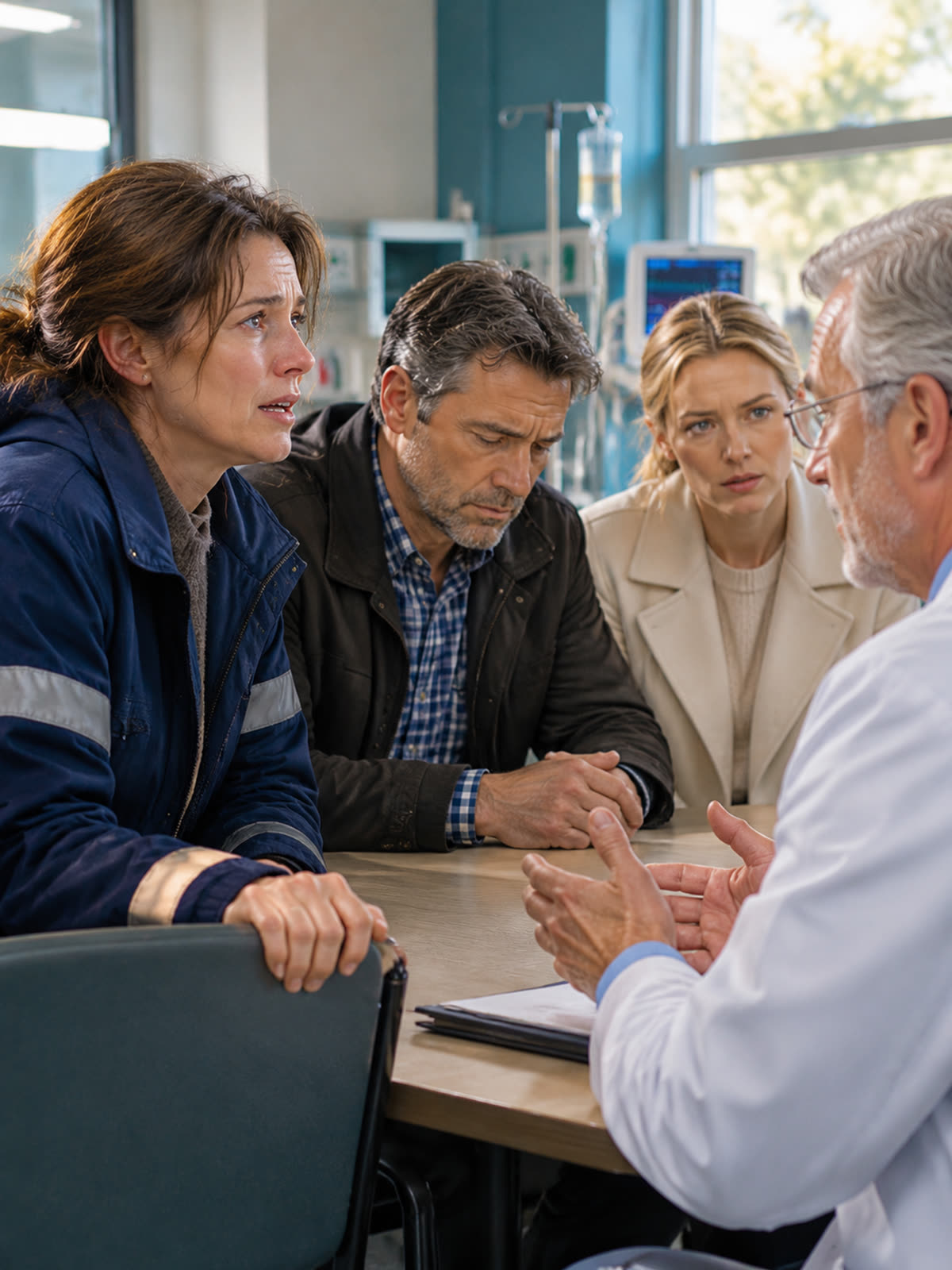
The assessment occupied most of the morning. Owen responded slowly. Some reactions could not be reproduced; others appeared purposeful. I had to watch the difference between what I desperately wanted to see and what the doctor could actually establish. When the examination was over, Dr. Kessler brought us into a small consultation room. “At this point, I believe Owen may be moving into a minimally conscious state,” he said. “He is not showing reliable responses to everything, but some of the responses we observed suggest intentional awareness. We need more time and continued assessment.”
My hands tightened around the back of a chair. “So the plan to remove support is off?” Dr. Kessler answered, “The team has put that on hold. There is no basis for rushing forward while this evaluation is underway.” Andrew stared at the tabletop. Tessa wanted to know how long the reassessment might continue, but the doctor could not predict that. Owen’s condition and the pattern of his responses would determine what happened next. The deadline that had nearly swallowed my son’s future was no longer controlling the room.
Afterward, I wanted nothing more than to sit beside Owen and hold his hand without another conversation. But I still knew almost nothing about the accident itself. He had been hurt during practice, and the explanation offered to me had amounted to little more than a statement that he fell. I asked Andrew for the academy’s incident report. He said it was still being prepared. Victor assured me the insurance office would supply documents through the appropriate channels. I told them both I expected the report that day.
That afternoon, I called Meredith Shaw, an attorney I had met through a colleague. She practiced in San Antonio. As I described the signature, the proposed medical deadline, and the academy’s involvement, she asked me to send every document in my possession. By the time she came to the hospital, she had reviewed the form. “This needs to be preserved exactly as it is,” she told me. “Don’t write on it, don’t let anyone take the original out of your sight without a record, and keep a list of everyone who has handled it.”
From a quiet stretch of the waiting area, Meredith called the hospital’s records department and then the academy. She followed those conversations with written preservation requests covering security recordings, access logs, training records, and reports concerning Owen’s accident. She also advised me to create a formal record with local law enforcement about the signature. Watching her work did not lessen my fear for Owen. It did give shape to a problem that, until then, had felt like an argument everyone else could keep redefining.
Several hours later, I finally obtained a copy of the form. Tessa’s name appeared on the witness line. I remembered her in the corridor, speaking about expenses while my son lay nearby, and I found it harder to dismiss the questions gathering in my mind. Her name connected her to the document in a way her presence alone had not. Still, a witness signature could not tell me everything that had happened, and I had Meredith beside me to insist that I remember the difference.
She read over my shoulder. “This is a reason to ask questions. It isn’t proof of everything you suspect.” I said, “I know.” Her response was simple. “Then we start with what we can establish.” That was harder than surrendering to anger. I knew I had not signed the form. I knew a decision had been moving forward while I was unreachable. What I did not yet know was who had written my name, how the document had arrived in the chart, or what each person involved had understood.
That evening, a message came from one of Owen’s teammates. His name was Eli. He was a quiet boy who had visited the hospital before I returned and had apparently been too nervous to say much. Now he said he had something I ought to see. I called him rather than trying to untangle it through messages. He explained that on the day Owen was injured, he had taken a photograph from near the edge of the track.
Eli had been waiting beside the equipment shed after practice when a company pickup entered through a gate reserved for maintenance vehicles. The truck made a sharp turn onto the service road. Moments later, Owen went down on the far side of the track. Eli had not understood that his photograph might be important. From where he stood, he had assumed the adults responsible for practice already knew what had occurred and had dealt with it. His hesitation made more sense as he explained.
“I didn’t know it mattered,” Eli said. “I thought the coaches had already handled it.” I did not want him to mistake my questions for blame. “You’re not in trouble,” I told him. “I’m glad you told me.” Owen could not yet describe the moments before his injury, and the report I had requested had still not supplied those missing details. Eli was offering something different from the carefully limited explanations I had been hearing: a photograph taken by someone who had actually been there.
The picture was grainy and distant. It was not a complete account of an accident, and I knew better than to make it one. But the academy’s contractor logo could be seen on the truck’s side panel. More importantly, the driver’s face was visible through the windshield. I looked at it and recognized Tessa. The woman who had spoken about the mounting bills, and whose name appeared as a witness on the disputed form, had been driving inside the restricted area before Owen fell.
I remained seated with my phone in my hand for a long time. There was no way to determine from that single frame exactly what made Owen lose his footing. It did not establish every movement of the truck or every action on the track. It could not replace records, footage, or an investigation. Yet it showed something the simple account of a fall had left out, and the omission was no longer something I could ignore.
Until then, the paperwork and the accident had seemed like questions running alongside each other. Now the same person appeared in both. Meredith had warned me to begin with what could be established, and I intended to follow that advice. But the photograph had changed the question I needed to ask. Tessa had been behind the wheel. What I still did not know was why no one had told me—or how much Andrew already knew.
PART 3 — The Answers We Had to Wait For
Meredith instructed me to send the original photograph file directly to her and not circulate it. We requested the academy’s gate records and security footage, and she urged me to wait for those materials before deciding what the picture proved. I was doing my best to follow that advice when Andrew found me in the hospital cafeteria. He looked as though he had not slept. His collar hung open, and his hair was flattened on one side. Without asking, he took the chair opposite mine.
I laid my phone between us and turned the screen toward him. “Do you recognize this truck?” At first, his expression did not change. Then his shoulders sank as if the effort of holding them upright had finally become too much. “Where did you get that?” he asked. I answered, “From someone who was there.” He bent closer to examine the image and then pushed the phone away. “Tessa was driving.” Hearing him say it aloud made the photograph feel different, though I had already recognized her face.
“Why was she inside a restricted area?” I asked. He pressed a hand against his forehead. “She took a shortcut across the service road. She wasn’t supposed to. The truck startled Owen, and he lost his footing when he was coming around the turn.” The cafeteria went on around us: dishes clattering, a request for more coffee, a child laughing nearby. None of it seemed connected to the words I had just heard. I felt as though Andrew and I were sitting somewhere entirely separate from everyone else.
“You knew that?” I asked. “I found out after.” I kept looking at him. “And the report said he simply lost his footing?” He lowered his eyes. “Andrew.” Finally, he spoke. “Tessa was afraid she’d lose her job. The academy has strict rules about that gate. Walter said there was a way to cover the medical costs while the insurance review was handled. He said if the request moved quickly, the family wouldn’t have to wait for the claim.”
I stared across the table. “What did that have to do with the form?” He put both hands over his face. “They were saying Owen’s outlook was poor. They said the hospital was already talking about Friday. Tessa thought the form would make it easier to keep everything moving. I let her believe the signature could be handled later.” I asked, “You let her put my name on it?” When he looked up, his eyes were wet. “I didn’t sign it.” I answered, “You didn’t stop it.”
He had nothing to say to that. For once, his silence seemed more truthful than his explanations. He told me the academy’s insurer had discussed forty-five thousand dollars to help meet Owen’s expenses while the claim was resolved. The proposed payment was connected to paperwork presenting the accident in terms that limited the academy’s responsibility. Andrew said the money would have helped. He had feared a denied claim, Tessa losing her employment, and being left with a medical decision he did not know how to make.
“You thought a payment could make this easier,” I said. He replied, “I thought we were running out of time.” I could not let him place all of us inside that explanation. “Owen was the one running out of time. You decided what his answers meant before anyone had properly checked.” Andrew looked down again. His shame was visible, but it could not return the days I had missed at my son’s bedside. It could not make my signature real or explain away the choice to use it.
After I called her, Meredith joined us. Andrew repeated his account while she listened. Then she asked him to write down everything he remembered, including names and dates. She made no promises about where an investigation might lead or what conclusions the authorities would reach. What she could do was help preserve the records and ensure that the appropriate people received the information. That distinction mattered now as much as it had when the doctors first examined Owen’s hand movements.
That evening, we went to the county sheriff’s office to report the signature and the way the academy had handled the accident. Meredith separately notified the district attorney’s office, providing the documents and photograph. We refused the proposed payment. I did not experience that decision as courage. There was no triumphant feeling in it, no relief strong enough to compete with knowing where Owen was spending the night. It simply felt like something that had to be done.
My son was not an insurance claim to close before the weekend. He was not a convenient account of an accident, a mounting expense, or a difficult decision that could be made easier by putting someone else’s name on a page. He was our son. While the adults around him had been discussing how to move forward, his hand had given the answer they had not expected. He had said no, and we had finally begun to act as though that answer belonged to him.
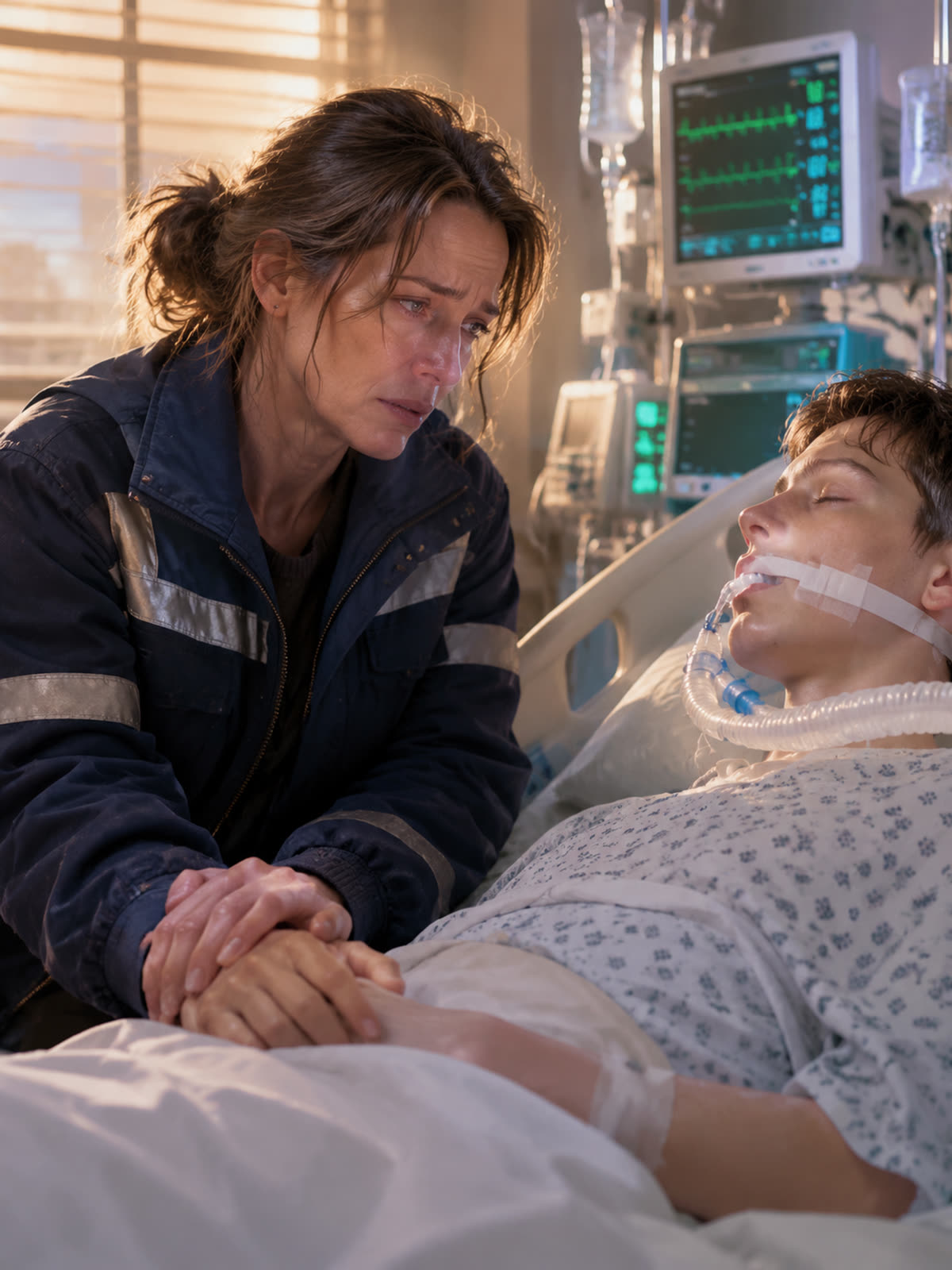
The months afterward refused to follow any predictable course. At first, progress could mean a response that appeared several times on a good day and could not be found the next. Then Owen developed a respiratory infection, requiring changes to his care. Eventually, doctors placed a tracheostomy so he could breathe more safely. There were weeks when my days narrowed to the monitors, the nurses’ explanations, and the hope that the next hour would demand no more of him than the last.
Rehabilitation started with efforts that might have seemed too small to count as achievements before the accident. Owen practiced turning his eyes toward a voice, raising a finger, and maintaining attention on a basic picture board. Some sessions left him worn out and frustrated. On other days, one unmistakable response could change the feeling of the entire room. I learned that improvement did not arrive in a straight, reassuring sequence. A better afternoon did not promise an easier morning, and difficulty did not necessarily erase what he had gained.
I rearranged my life around being nearby. I sold my old truck and took a safety coordinator job at a refinery outside San Antonio. The schedule was steady, and the pay was lower, but the work meant I no longer had to leave on extended offshore assignments. I could visit every day. After what had happened while the storm kept me away, that ordinary ability to arrive mattered more to me than the work arrangements I had known before.
I stopped asking Owen about running. For years, his father had imagined a future measured in race times and medals, scholarships and college recruiters. Owen had loved competing, but I began to question how much of that love stood on its own and how much had formed around the approval he received for being fast. I did not have a simple answer. I only knew that his recovery should not become another demand to return to a life other people had already designed for him.
Instead, I asked what he wanted in the moment. Sometimes he could not tell me. I offered choices small enough to manage: music or silence, an open window or a closed one, company now or later. On some days, he directed his eyes toward a picture. On others, he worked with a word board, selecting letters at a slow pace while therapists helped him locate the buttons he intended to touch. I had to learn not to complete every pause for him. Waiting became part of listening.
Meanwhile, the investigation continued beyond his hospital and rehabilitation rooms. Academy records established that Tessa had taken the contractor’s pickup onto the restricted service road. Security recordings showed the vehicle at the gate, and the academy’s review confirmed that she had no authorization to drive there. She was suspended while the insurer examined the claim. The academy also began a wider review of access to the track and the procedures used to report incidents. Those findings supplied facts that the photograph alone could never have established.
The signature remained under investigation as well. I was careful about claiming more than I personally knew. I had not written it. Andrew had acknowledged knowing that my name was being used. But determining who completed the form and how it became part of the hospital’s records belonged to the authorities. Meredith assisted with requests for information and helped ensure that investigators could obtain the original documents. Certainty about my own handwriting did not allow me to substitute assumptions for the rest of the evidence.
Andrew kept visiting Owen. In the beginning, I left whenever he arrived. I could not remain beside him and behave as though this had been an ordinary disagreement between parents. Caring for Owen occupied almost every part of me, leaving nothing available to soothe the man who had helped push my voice aside. Still, he was Owen’s father. I would not remove that relationship from our son simply because I could not bear the hurt Andrew had caused. I required that visits be coordinated through the care team and that decisions include me.
Our marriage had already ended in most of the ways that mattered, although we had avoided saying so plainly. The hospital stripped away what remained of the idea that time alone might repair it. We began divorce proceedings and addressed the practical matters through our lawyers. Andrew continued paying what bills he could and attended rehabilitation when Owen wanted him there. He did not ask me to forgive him. I was thankful for that restraint, even while forgiveness remained something I could not imagine reaching.
One Sunday in late spring, the clinic was unusually quiet. Light poured through the large windows, and a faint smell of coffee drifted from the family lounge. Owen had completed a therapy session and was sitting in his wheelchair, weary but attentive. I had brought a small tin containing keepsakes from home: old ticket stubs, a smooth stone from a camping trip, and the county fair keychain associated with the beginning of our hand-squeeze rule. They were ordinary things from the life we had shared before the hospital.
The keychain was a blue carousel horse with a chip beside one ear. I had paid two dollars for it at a booth near the fair entrance. Afterward, Owen had carried it for months, and I had kept it long after he lost interest in asking for it. I raised it where he could see. “Do you want me to leave this with you at the clinic?” He looked at the little horse, then at me. For a moment, I could not tell whether he remembered it.
He began lifting his right hand. The movement was slow. His fingers shook, and his wrist rose only slightly, but he was reaching toward mine. When our hands met, he squeezed once. I smiled. “Yes?” He let go and rested. Then his fingers closed twice. A laugh escaped me even as my eyes filled. “No, huh? You don’t want that old thing cluttering up your room?” One corner of his mouth lifted into a tiny smile.
I returned the keychain to the tin and settled beside him. The choice was small, but that was not what mattered. It was his. He had made it at his own pace, using a signal whose meaning came from the history we shared. For months, I had wanted words broad enough to contain everything I felt. None seemed adequate. I was furious with those who had hurried toward a decision they did not fully understand, and grateful to the nurses who had listened and the doctors who had reconsidered.
I was also frightened by how easily a parent’s absence could be used to move her aside, and by how quickly paperwork could travel when the person most affected could not speak. More than anything, though, I was grateful Owen had found a way to answer. His hand was still weak. His rehabilitation was not finished, and no one could say what he would ultimately be able to do. The little refusal in that sunlit room did not resolve any of those uncertainties.
But it had the same meaning as the signal we had invented after losing each other in a crowd when he was six. He had something to tell me, and I was there to listen. I could not know what the road ahead would ask of him, or which answer would come easily and which would take everything he had. For now, his hand rested in mine. The next choice was still his—and I waited to learn what he would tell me next.
Disclaimer: This story is a work of fiction inspired by real-life themes. Names, characters, places and events are fictionalized, and any resemblance to real persons is purely coincidental. Images are for illustration purposes only.
