

PART 1: The Life He Left in Ashes
The first time my ex-husband saw me in six years, he laughed. There was no surprise softened by affection, no trace of the man who had once murmured marriage vows against my skin. It was a small, condescending sound, released almost without thought. In the carefully arranged world Daniel Bennett inhabited, I was something that had slipped through a crack. I did not fit among the powerful people gathered around him, and he seemed certain that everyone else would recognize the mistake as quickly as he had. I stood still and let him look.
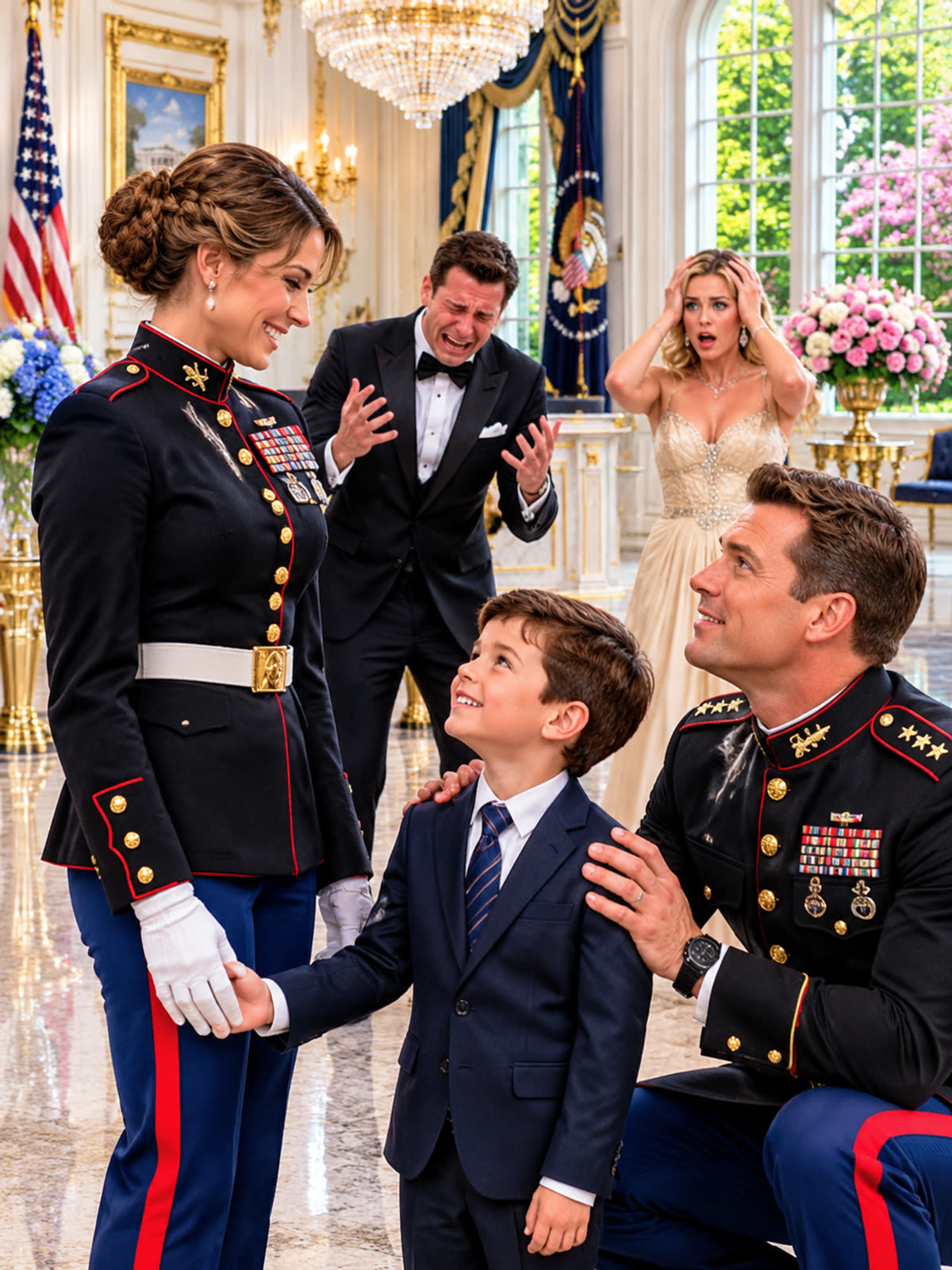
We were in the White House’s magnificent foyer, surrounded by the perfume of costly orchids and the subdued conversation of Washington’s elite. Crystal chandeliers scattered light across marble polished to an icy shine. Daniel wore a custom midnight-black tuxedo, with a weighty platinum watch at his wrist and the comfortable arrogance of someone who believed success had confirmed every opinion he held. His new wife, Vanessa, stood tucked against his arm in a flowing cream gown. Everything about them seemed chosen to communicate effortless importance, from the clothes to the way they occupied the room.
He flipped his VIP invitation between his fingers as though the card itself settled the question of who deserved to be there. “You’re lost, Claire,” he murmured, examining my tailored Marine Corps dress blues with open amusement and contempt. I met his eyes without answering. He glanced toward the Secret Service checkpoint, then returned his attention to me. “Did you honestly think you could just wander into an event like this? Are you working the coat check?” Vanessa gave a light, breathy giggle and covered her painted mouth with a manicured hand. Daniel leaned closer, bringing the sharp cologne I once hunted down on clearance into the space between us. “You don’t belong here,” he smirked.
I could have answered him with six years of truth. I could have reminded him of the night he walked away, unaware that the child I carried was his. I could have described the bathroom floor, the tears, and the kind of exhaustion that settled so deeply into my bones that sleep barely touched it. He knew nothing about what it had cost to rebuild my life, or about the woman that rebuilding had made of me. But I would not offer him my pain as proof of my worth. I opened my clutch instead and took out my embossed invitation.
The young hostess accepted it, her earpiece resting neatly against her cheek. Her scanner chirped. She looked at the screen, then abruptly at my face. The practiced smile disappeared. What replaced it was not suspicion but a startled, unmistakable reverence. Her eyes moved to my gold insignia before she glanced past my shoulder. A formidable four-star Marine general had entered the foyer. “Sir,” the hostess whispered, her voice unsteady. “She’s here.” He turned toward us. As he started across the marble, Daniel’s easy smile began to lose its shape. To understand why that moment mattered, though, you have to understand what came before it.
Six years earlier, before the ribbons, the salutes, and the title of Staff Sergeant Bennett, I had simply been Claire. I was twenty-six and living in a cramped two-bedroom walk-up outside Jacksonville, North Carolina. Daniel was an overworked junior contractor, not the celebrated defense executive now standing beneath White House chandeliers. I worked as an administrative assistant at a local clinic. Our lives consisted of bills, lukewarm takeout, and conversations on Friday evenings about everything we hoped would eventually change. I loved him with a faith that made sacrifice feel natural. When he spoke about building an empire, I believed my place was beside him.
I read his proposals at two in the morning until the words blurred and my eyes stung. I kept wearing shoes after their soles were worn because he needed suits that would help him look credible in rooms we could scarcely imagine entering. His ambitions became the structure around which I arranged my own days. Back then, I thought that was what partnership meant. When his firm began winning substantial government contracts, I celebrated each one as something we had reached together. I did not understand that he was already learning to regard the life we had shared as evidence of everything he wanted to leave behind.
As the figures in his accounts grew, the tenderness between us diminished. The man who once divided a single anniversary cupcake with me began finding fault with my clothes, my car, and the way I spoke. One evening, I dressed for his company’s holiday gala in a simple, conservative navy dress. Daniel stopped by the door and looked me over with an expression that made my skin feel exposed. “Is that what you’re wearing?” I glanced down, already ashamed without knowing precisely why. “What’s wrong with it?” He checked his reflection. “Nothing,” he sighed. “It’s just… the other wives know how to present themselves. Try to blend in, Claire.”
I changed my dress. I swallowed the humiliation because I still wanted to believe the man I loved was somewhere beneath the criticism. Then came the late nights, unfamiliar credit card charges, and telephone calls he insisted on taking outside, even when freezing rain swept the balcony. Eventually, I saw the message that stripped away the last of my excuses: “Last night was absolute magic. I hate playing pretend at the office, Dan”. The sender was Vanessa Reed. When I confronted him, he did not bother inventing a denial. He looked irritated, as if I had interrupted something more deserving of his attention.
“We’ve outgrown each other, Claire. I want a life of consequence. You’re… comfortable with mediocrity.” Those were the words he offered in place of remorse. He wanted a divorce, and he expected me out of the apartment before the month ended. What he did not know was that I had planned a romantic dinner for that very evening because I had news of my own. At the bottom of my purse lay a pregnancy test with two unmistakable pink lines. While Daniel spoke about how little our life meant to him, I stood there carrying the beginning of another life, one that belonged to both of us.

I watched him fill a duffel bag, my palm drifting toward my still-flat stomach. The knowledge in my purse seemed unbearably heavy. I could have told him. I could have made him stop packing long enough to confront a responsibility he did not know existed. But the cold resentment in his face gave me a clarity that was as frightening as it was complete. I would not turn my child into the reason an unwilling man remained. I would not make a baby the chain that bound Daniel to a life he openly despised. “Goodbye, Daniel,” I whispered, keeping the greatest secret of his life behind my lips.
When the door closed, the silence seemed to spread through every corner of the apartment. I lowered myself to the floor, feeling the chill of the linoleum through my clothes. Divorce was no longer a cruel conversation I might somehow reverse. Motherhood was no longer news waiting to be celebrated over dinner. Both were real, and I would have to face them together. Fear pressed so hard against my chest that it seemed to leave no room for breath. Yet beneath it was the understanding that I could not remain helpless. I reached for my phone and called a number I had saved weeks earlier.
The recruiter’s clear voice cut through my despair. I explained the divorce and the pregnancy, expecting those facts to close the conversation before it began. Instead, I found a way forward through delayed entry. There would be waiting before I could leave, and that waiting became its own difficult campaign. For nine months, I worked two jobs, saving every amount I could manage while my ankles swelled and the shape of my life changed around me. Nothing about those days felt heroic. They were long, uncomfortable stretches of doing what had to be done because the child I carried would need more than my love alone.
Noah arrived weighing seven pounds, four ounces, red-faced and furious and miraculous. When the nurses placed him against my chest, his warmth seemed impossibly delicate. His fingers curled around my thumb, and something fierce rose through every exhausted part of me. I breathed into his dark, soft hair that it was just the two of us against the world. My mother moved in to help, bringing a quiet steadiness that kept me from coming apart during those sleepless early weeks. Daniel never called. He never asked about the life he had left. While he disappeared into his glittering future, my world narrowed to feeding, comforting, and protecting our son.
As soon as I received medical clearance, I kissed my crying baby and left him in my mother’s tearful arms. Then I boarded a bus bound for Parris Island. Recruit training had no interest in the ache that separation left inside me. It did not soften because I was newly divorced or because I missed the weight of my infant against my chest. My body was driven past everything I had thought it could endure. My muscles burned, my lungs scraped with the taste of dust and copper, and at night I sometimes cried silently into the rough wool of my blanket, afraid I had chosen disastrously.
Whenever quitting began to look like relief, I took out a creased photograph of Noah. His gummy smile brought me back to the reason I had come. Failure was not something I could treat as an ordinary possibility. I needed to become strong enough to make a secure life for him, and every punishing day was part of that work. I graduated. I earned the title of Marine. Then I put my grief, anger, and devotion into learning my job until competence became something I could trust. Logistics suited the mind I was building: disciplined, practical, and determined not to leave people stranded when preparation could bring them home.
During my third year, at a sprawling command center, I met Richard Hayes. He was thirty-nine and already a brigadier general, his rapid rise matched by a reputation for formidable strategic ability. There were invisible scars behind that reputation, the residue of classified deployments he did not wear as conversation. He was also striking in a way that made looking away require intention: storm-gray eyes, a sharply defined jaw, and a powerful presence that changed the balance of a room. He was not a distant figure disappearing behind a desk. He was a warrior in his prime, and during our first operational readiness inspection, his full attention settled on me.
I was presenting a complicated logistics overhaul to a room of senior officers. Others studied the pages in front of them; Richard studied me. “Staff Sergeant Bennett,” he said, his deep voice carrying through the room. “Your data is flawless, but it lacks a contingency for catastrophic communications failure in sector four. Why?” I held his gaze. “Because, General, if communications fail in sector four, the protocol shifts to localized analog command. The contingency isn’t on the spreadsheet, sir; it’s in the training of the Marines on the ground. I’ve personally drilled them.” A slow smile transformed his face. “You trust your people, Staff Sergeant.” “With my life, sir.” I meant every word, although neither of us yet knew how brutally that promise would be tested.
PART 2: The Name on the Guest List
Something began between Richard and me after that inspection, although neither of us gave it a name. At first, everything remained firmly professional. He expected more of me than anyone else did, and I discovered that his demanding attention made me sharper rather than smaller. I had once lived with a man whose criticism taught me to doubt myself. Richard’s expectations did the opposite. He challenged what I knew because he believed I could defend it. Even so, beneath the briefings and passing conversations, there was an awareness neither of us could mistake. A glance could linger just long enough to make an ordinary corridor feel suddenly charged.
The rules of rank and command stood around that awareness like iron fencing. We knew they were there. We conducted ourselves within the daily structure of work, but professionalism did not erase the pull between us. Then an overseas deployment turned all those carefully managed feelings into something far more difficult to contain. A routine patrol became a catastrophe when an improvised explosive device detonated beneath a convoy. Communications filled with overlapping voices. Wounded Marines needed help, routes were dangerous, and confusion threatened to consume the minutes they could not afford to lose. Whatever else I might have been feeling disappeared beneath the immediate demands of the emergency.
I concentrated on the work in front of me. With ordinary channels jammed, I found another way through and coordinated a dangerous medical evacuation across hostile territory. One severely wounded Marine, Corporal James Whitaker, remained on the radio with me as he lost blood and struggled against panic. I kept talking. I would not let his fear carry him into silence, and I would not let him close his eyes before help reached him. Every part of the operation required decisions, but his voice made the stakes painfully personal. He was not a figure on a readiness report. He was a man who needed to survive long enough for the medevac to take him.
Hours later, after the evacuation was secured, I sat alone on a crate outside the command tent. There was nothing left for my hands to do, and they began shaking so badly I could not steady them. The force that had carried me through the emergency had drained away, leaving the terror behind. The tent flap opened. Richard stepped outside, his collar stars catching the hard light of the floodlamps. He came straight toward me without speaking, his broad frame sheltering me from the restless wind. Then he crouched in front of the crate and enclosed my dirty, trembling hands in his.
“He’s alive, Claire,” Richard murmured. His thumb moved lightly over my knuckles, and warmth shot through the exhaustion in my chest. It was the first time he had addressed me by my first name. “Because of you. He is going home to his daughters because you refused to break.” I looked into his gray eyes and felt the distance between us vanish. For one terrifying, exhilarating moment, there was no command structure, no uniform, and no battlefield surrounding us. There was only the unguarded admiration in his face and the realization that what I had sensed between us was not something I had imagined.
He leaned closer. I caught the mingled scent of rain, gunpowder, and clean sweat, and my breath caught as the space between our faces narrowed. Then the radio at his hip broke through the moment. “General,” a voice barked. “We have an incoming priority transmission from the Pentagon.” His jaw tightened. For another suspended heartbeat, he did not move, his attention still fixed on my lips. When he finally rose, the familiar expression of command returned. “We will finish this conversation, Claire. Count on it.” He left me sitting in the dark, shaken for reasons that no longer had anything to do with the evacuation.
The years that followed brought promotions, commendations, and a connection with Richard that only grew harder to deny. He rose to his fourth star, becoming the youngest full general in the theater of operations, and arranged for my transfer to his central command. Our closeness remained carefully hidden because the military’s rules had not changed merely because our feelings had deepened. We learned to speak through looks across crowded briefing rooms and through late-night telephone conversations that drifted from everyday matters into things neither of us shared easily. The secrecy remained part of the relationship, but so did a trust I had once believed I would never feel again.
Richard also became part of Noah’s life. By then, my son was six: bright, observant, stubborn around the chin like me, and painfully familiar around the eyes. Those deep brown eyes were Daniel’s. Noah loved dinosaurs and intricate LEGO sets, and he adored the towering visitor he called “Mr. General.” Richard would arrive at our off-base home supposedly delivering files and end up on the living-room floor, his large body folded awkwardly beside Noah while they assembled a plastic starship. Watching them from the kitchen one evening, a dish towel held loosely in my hands, I felt a peace so complete that it almost hurt.
Still, there were questions peace could not answer for me. A few days earlier, Noah had looked at me with a troubled little frown. “Does my dad know about me, Mom?” I knelt in front of him and swallowed the old bitterness before it could reach my voice. “No, sweetheart. He doesn’t. But that is his loss, not yours.” The answer was honest, but honesty did not make the past disappear. I had built a life around the space Daniel left, and for years I had imagined that space could remain untouched. Then, one crisp Tuesday morning, Richard entered my office, closed the heavy oak door, and locked it behind him.
The unusual breach of protocol sent my heart racing. He came to my desk and set down a thick cream envelope stamped with the White House’s gold seal. “You’re being honored, Claire,” he said. “A Presidential recognition for the Whitaker medevac and your overhaul of the regional logistics grid. It’s next weekend.” I struggled to find words. “Sir… this is… I don’t know what to say.” He leaned forward, palms against the desk, bringing his face close to mine. “Say you’ll let me escort you. Say you’ll finally let me take you to dinner afterward, out in the open, where I don’t have to pretend I don’t want to drag you away from the crowd.” Flushing, I opened the invitation. Then I reached the accompanying list of civilian underwriters, and the warmth left me. Printed there was Daniel Bennett’s name.
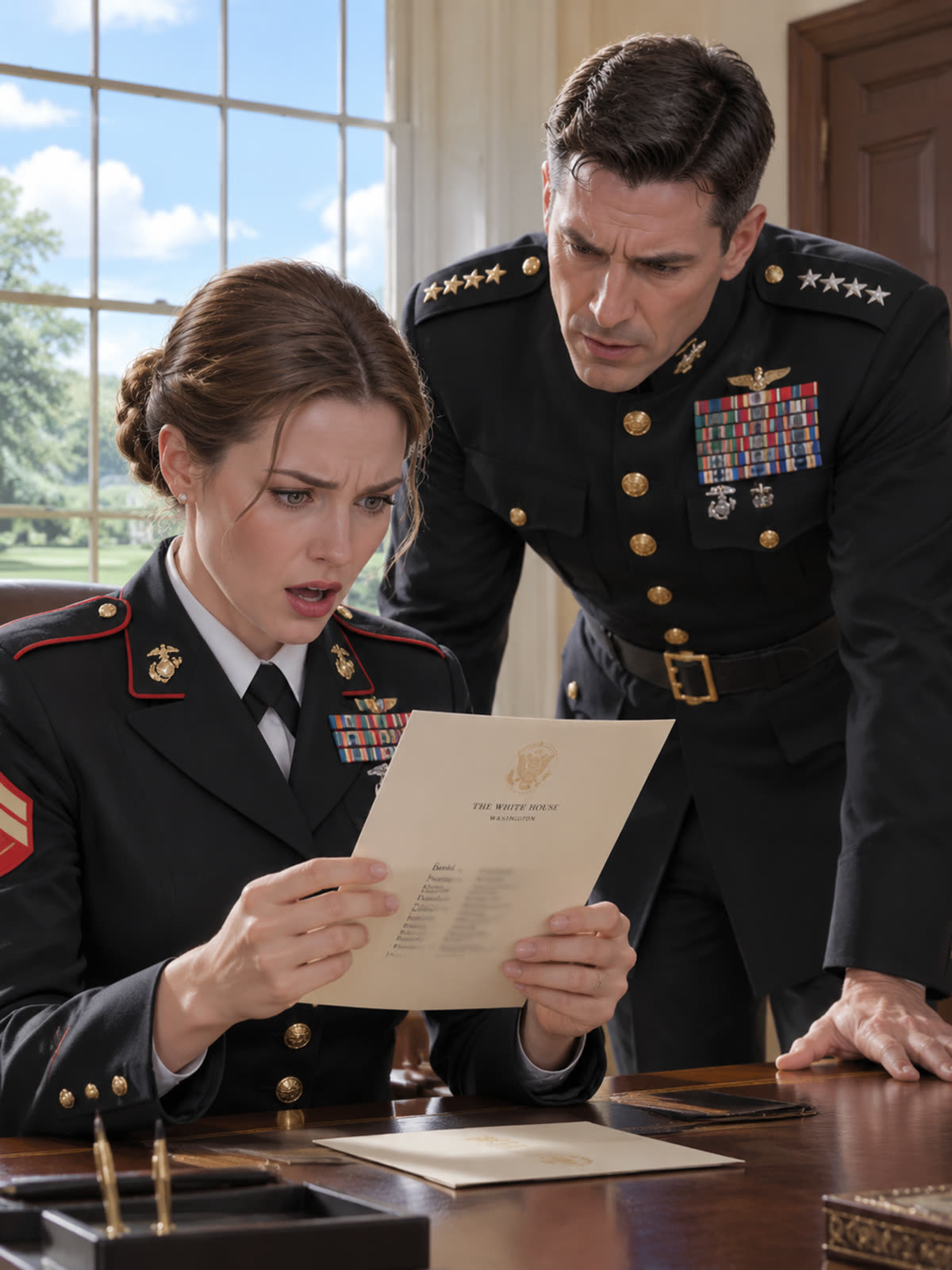
VIP Underwriter: Daniel Bennett, CEO, Bennett Defense Solutions. I stared at the line until the beautiful stationery began to crease beneath my fingers. The room seemed short of air. After everything I had survived, the sight of his name still reached a place in me that had never entirely forgotten abandonment. Richard’s expression changed immediately. “Claire?” The warmth in his voice sharpened into concern as he moved around the desk and stopped beside me. “What is it? Talk to me.” I could barely force the answer past the tightness in my throat. “He’s going to be there,” I whispered. “Daniel.”
Richard already knew the story. Months earlier, on a rainy night, I had told him about the divorce, the cruelty, and the pregnancy I had kept to myself. There was nothing about Noah’s paternity that I had hidden from him. Now a cold, possessive anger settled into his face. “I’ll have him removed from the guest list,” he said, reaching for his phone. “It takes one call.” The offer should have relieved me. Instead, it made me recognize how close I was to letting Daniel’s memory decide where I could stand. I had spent too much of my former marriage arranging myself around his comfort.
“No.” I stood so abruptly that my chair scraped against the floor. A frightening calm replaced the first rush of panic. I looked at the name of the man who had broken my heart and understood that the woman he had abandoned no longer existed in the form he remembered. I had rebuilt myself through motherhood, training, and work he knew nothing about. “No, Richard. Let him come. I’m bringing Noah.” Richard paused, studying my face. Then a slow, dangerous smile appeared. He saw that I meant it. This was no longer a question of escaping an unpleasant encounter. I would not hide the life I had made.
“Copy that, Staff Sergeant,” he murmured. He stepped closer and lifted a hand to my jaw, brushing it gently while his thumb rested near my racing pulse. “Dress to kill. I’ll handle the battlefield prep.” The words did not erase my apprehension, but his certainty steadied me. For years, Daniel had occupied a sealed chamber in my memory, a place associated with shame and loneliness. The approaching ceremony meant opening that chamber in a room full of people who knew me as someone entirely different. I could not control what he would say. I could decide that his opinion would not send me running.
The days before the gala passed in a rush of careful preparation. I bought Noah a small navy suit and fastened his striped tie in our hotel room while he bounced impatiently on his heels. He studied himself in the mirror, delighted by the occasion and by the unfamiliar seriousness of his clothes. “Am I important today, Mom?” he asked, beaming. I bent to kiss his forehead. “You are the most important person in the world,” I promised. Whatever the evening brought, that truth stood above the ceremony, above the people attending it, and above the man who did not yet know he was Noah’s father.
Then I dressed in my blues. The buttons shone, and the ribbons across my chest carried memories no one could see simply by looking at them. Each familiar piece of the uniform belonged to a life I had earned through work, not one someone had granted me out of kindness. In the mirror, I searched for the woman who had collapsed on the apartment floor six years earlier. I remembered her grief, but I no longer saw her helplessness reflected back at me. The woman adjusting her uniform had endured things that Daniel’s judgment could not undo. I took my son’s hand and prepared to walk into the evening.
At the White House entrance, anticipation seemed to hum through the air. The foyer opened around us in marble, flowers, and light. I had barely stepped into it when I heard the laugh. Daniel stood with Vanessa, looking at me as though I were an embarrassment that security had neglected to remove. “You don’t belong here,” he smirked. For an instant, the past and present pressed together: the navy dress he had criticized, the duffel bag, the pregnancy test, and the uniform I wore now. But my hand remained steady around Noah’s. I did not need Daniel to understand me before I claimed my place.
I handed the hostess my invitation. The scanner sounded, and her expression changed as she read what appeared on the screen. “Sir, she’s here.” Richard turned. His eyes found mine across the foyer, and I saw recognition become protectiveness before he took his first step. Daniel still held his VIP card, still unaware of everything unfolding beyond the limits of his own importance. I watched Richard begin to cross the room and felt the secret I had carried for more than two thousand days waiting behind my teeth. Daniel had mistaken my silence for weakness once before. This time, he was about to discover what it concealed.
PART 3: The Son He Never Knew
General Richard Hayes did not simply cross the foyer. His presence seemed to determine how everyone around him moved. Politicians and distinguished guests shifted aside almost instinctively, opening a path across the gleaming marble. In his formal uniform, with four stars bright beneath the chandeliers, he was arresting enough to draw attention without saying a word. Yet rank was not what made Daniel retreat a step. It was the focused hostility in Richard’s expression when his eyes passed over him. Daniel had expected the room to confirm his superiority. Instead, the most commanding man in it was approaching with an expression that made his certainty falter.
Richard went past him as though an introduction had never been necessary. When he reached me, the severity in his face softened so completely that my chest tightened. “Staff Sergeant Bennett,” he said, his voice easily reaching the people nearby. He took my gloved hand rather than offering the distant courtesy of a formal handshake, lifting it slightly with unmistakable respect. “You look magnificent. The President is eager to meet you.” The words seemed to travel outward through the surrounding guests. Beside Daniel, Vanessa stared from my uniform to Richard’s face and back again, struggling to reconcile what she was seeing with the woman her husband had just dismissed.
Daniel had gone an unhealthy gray. The smirk vanished, leaving confusion that quickly became alarm. I watched him try to recover the version of himself he understood: the successful executive who belonged wherever important people gathered. He stepped forward and extended his hand with a familiarity that sounded forced even before the sentence was finished. “General Hayes! Daniel Bennett, Bennett Defense Solutions. We supply the—” Richard did not accept the offered hand. He turned just enough to stop the introduction, and the air around us seemed to grow still. Daniel’s arm remained extended between them, suddenly conspicuous and painfully unanswered.
“I am intimately aware of who you are, Mr. Bennett,” Richard interrupted, each word precise. “And I am aware of your… historical connection to Staff Sergeant Bennett. A connection you surrendered.” Daniel flinched. Slowly, he lowered his hand and looked toward me with an expression that tried to make an appeal out of disbelief. “Claire… I didn’t realize… you have connections at this level.” Even then, that was what he understood. Not the uniform, not the work, not the years in which I had become someone he had never taken the trouble to imagine. He was looking for an influential person who could explain my presence.
“Staff Sergeant Bennett does not need ‘connections’ to justify her presence,” Richard replied, his voice dropping into something more dangerous than a shout. He moved closer, his height forcing Daniel to look up. “She is here because she bled for this country. She is here because she possesses a profound integrity and strength that cowards could never comprehend. Do not ever speak to her with that tone again. Are we perfectly clear?” There was no mistaking the command. Richard had not raised his voice enough to turn the exchange into a spectacle, but the people nearest us had fallen silent, and every word landed where it was intended.
Vanessa trembled beside Daniel, holding her costly handbag tightly against herself. His throat worked as he swallowed. “Yes. Yes, General. I meant no disrespect.” Richard held his gaze a moment longer. “See that you don’t,” he murmured. Then he turned back to me, and the warmth returned as quickly as the threat had appeared. “Shall we go in, Claire?” I was ready to move. I had not come to the White House for Daniel, and I would not let him become the center of an evening earned through years of work. But before we could leave him behind, his voice broke through the silence again.
“Wait,” Daniel gasped. His attention had finally dropped from Richard’s stars and the ribbons on my chest to the little boy holding my left hand. Noah looked up at him with the open curiosity of a child who did not understand why adults had become so tense. His dark hair lay across his forehead, and his deep brown eyes were an unmistakable reflection of Daniel’s own. I watched recognition begin in fragments. Daniel looked at Noah, then at me, then back again. The resemblance gave him the first piece. The years between our last meeting and this one began supplying the rest.
His mouth opened without producing a sound. The confidence that had carried him into the foyer was gone so completely that he seemed unable to stand comfortably inside his own body. “Claire,” he whispered at last, his voice scraped raw. His knees bent slightly, as though the marble had shifted beneath him. “Claire… how old did you say he was?” I held his gaze. The abandoned woman who once believed his judgment defined her worth felt farther away than she ever had. “He is six years old, Daniel,” I answered, evenly enough that he could not escape the meaning by mistaking my tone.
He staggered backward into Vanessa. I could see the calculation complete itself, reaching through those six years to the night he had packed his bag. His eyes widened, and tears gathered before he managed to force out the question. “Is he…?” I tightened my fingers gently around Noah’s hand. The secret had once seemed too enormous to speak, bound to the worst evening of my marriage and the most frightening beginning of my life. Now it was simply a fact, one Daniel could no longer remain outside. “Daniel,” I said, my voice carrying clearly through the hush. “This is Noah. Your son.”
Vanessa gave a sharp cry and turned on him. “Your son? Daniel, what the hell is she talking about?! You told me you didn’t have kids! You told me she was crazy!” Daniel barely seemed to hear her. His eyes stayed fixed on Noah, and his hands shook openly. “I… I didn’t know. Claire, I swear to God, I didn’t know.” He looked as though repeating it might make it less unbearable. The room had not changed, but his place in it had. Minutes earlier, he had been deciding whether I deserved admission. Now he stood before a child whose entire life had unfolded without him, unable to look away from the evidence.
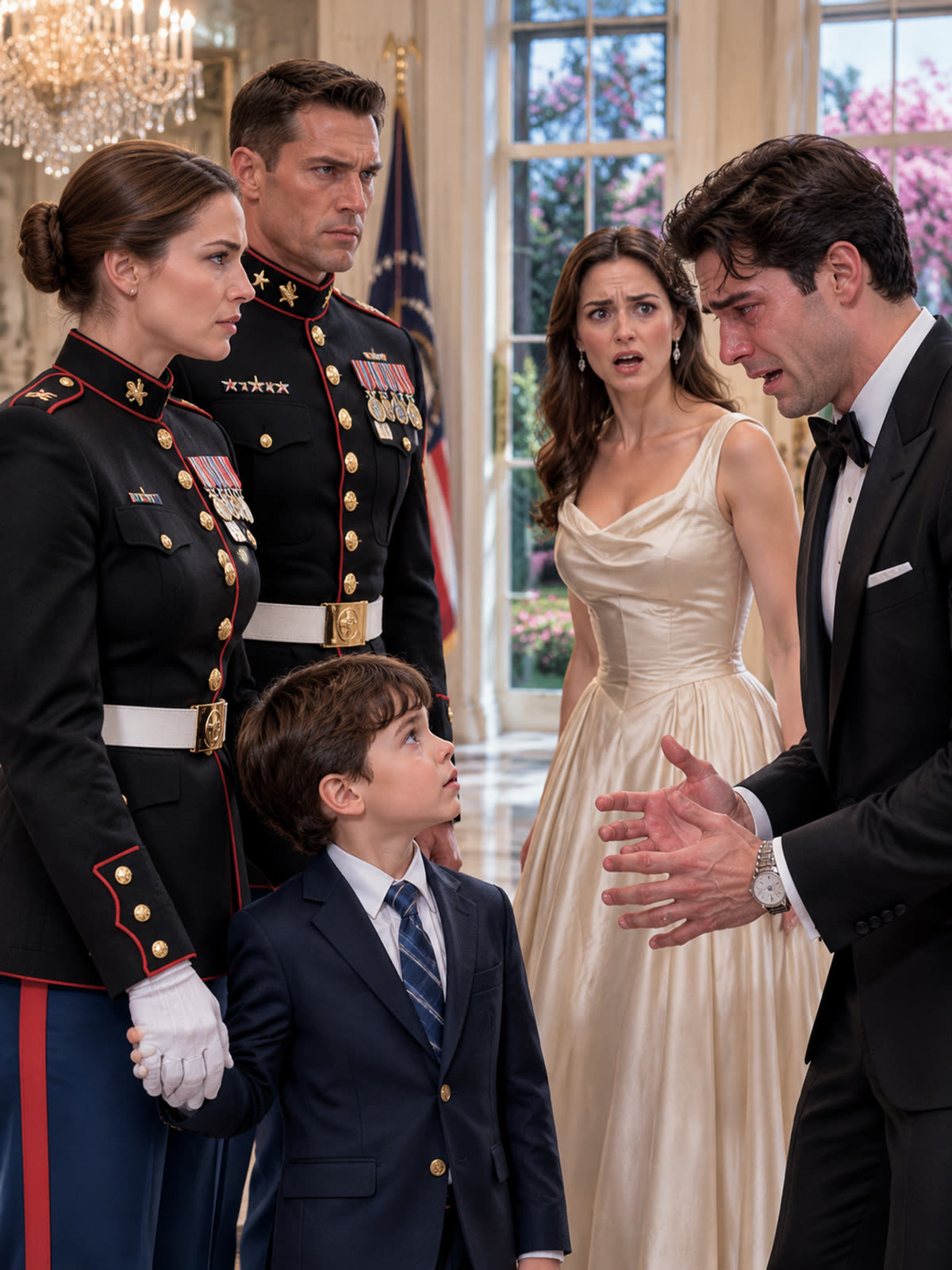
“You didn’t ask,” I replied. There was no anger in my voice, and that absence seemed to strike him harder than accusation. “Do you remember the night you demanded a divorce? Do you remember me telling you I had something important to say? You looked at your watch. You told me you had a meeting. You told me you were exhausted by my mediocrity.” I stepped forward, hearing the faint movement of the medals against my uniform. He had reduced that night to an ending and walked away. I had lived through everything that followed it, and I no longer needed to soften the memory for him.
“I was holding the positive pregnancy test in my bag, Daniel. But I realized something as I watched you walk out the door. My son deserved a father who wanted him, not a man who stayed out of obligation to an inconvenience.” Daniel began crying. The sound was ragged and uncontrolled, nothing like the polished voice he had used moments earlier. “Oh my God. Oh my God, Claire, I’m so sorry. I’m so sorry.” I heard him, but the apology could not travel backward. It could not reach the clinic shifts, the swollen ankles, the sleepless nights, or the bus that had carried me away from my infant.
He reached toward Noah. Richard moved immediately, placing himself half a step in front of us. He drew no weapon and needed none; the sudden tension in his powerful frame made the boundary unmistakable. “Do not touch them,” he ordered quietly. Daniel stopped, sobbing openly now. “He’s my son. He’s my flesh and blood. You can’t keep him from me.” His grief was real, but it did not change the fact that Noah was a child facing a stranger’s overwhelming reaction. Richard remained between them, still and immovable, while I kept hold of my son’s hand. Whatever Daniel had just discovered, Noah’s safety came first.
Noah tugged at my fingers and looked up at the crying man. “Mom? Why is that man crying? Is he the man who left us?” Daniel gasped and covered his face. Around us, guests were no longer pretending not to watch. I lowered myself to Noah’s height, shutting out the gathering attention so that he could see only me. “Yes, sweetheart,” I said softly. “But you don’t ever have to worry about him. You are safe. You have me.” Nothing about the evening mattered more than making sure he understood that the ground beneath his own life had not disappeared just because Daniel’s had.
“And you have me, son,” Richard added. The command had left his voice, replaced by a warmth so fiercely protective that it made my throat tighten. He rested a large hand gently on Noah’s shoulder. “Always.” Noah smiled and leaned against his leg. “I know, Mr. General.” Daniel looked up in time to see it. His face was blotched and wet with tears, and the sight seemed to wound him all over again. The place he had never known existed had not remained empty. Someone had sat on the floor with Noah, listened to him, and become a person whose promise he accepted without hesitation.
Vanessa pulled hard at Daniel’s arm, her humiliation turning into open fury. “We are leaving. Now. I am not standing here to be humiliated because you’re a lying sociopath!” He tried to reach for her with his voice. “Vanessa, please—” She recoiled from even that. “Don’t speak to me!” Then she turned and strode toward the exit, leaving him alone beneath the chandeliers. He watched her go only briefly before looking back at me. The man who had laughed when he saw my uniform now seemed emptied of everything that had made the laugh possible. “Claire… please. Let me fix this. Let me give him what he deserves.”
I stood and adjusted my cover. Looking at him, I searched for the feelings I might once have expected: hatred, satisfaction, some last ache of love. What remained was pity, deep and distant. “You can’t buy back time, Daniel. We will establish a legal framework for visitation, under supervision, on my terms. But you will never, ever be his savior. He doesn’t need one.” I did not say it to punish him. There were years no promise could restore, and Noah already had a life built around people who loved him. Whatever came next would have to acknowledge that life rather than sweep it aside for Daniel’s remorse.
Then I turned away. I did not look back to watch him collapse onto the floor. Richard offered his arm, and I placed my hand in its crook while Noah remained beside us. Together, we entered the grand ballroom, leaving the foyer and the wreckage of Daniel’s certainty behind. Applause rose around us. For the first time that evening, I could feel the occasion waiting beyond the confrontation: the recognition, the work that had brought me there, and the future I had fought to make possible. But the night was not finished. Daniel’s reckoning had only been one part of it. Richard Hayes still had a campaign of his own to carry out.
The ceremony passed in a dizzying rush of camera flashes, thunderous applause, and the almost unbelievable sensation of having the President personally fasten a medal to my chest. Yet through every moment of the celebration, Richard never once took his eyes off me. There was a fierce, controlled intensity in his gaze, silently promising that we would have a very different conversation once we were finally alone.
Several hours later, after Noah had fallen fast asleep in the private VIP suite upstairs, Richard and I found ourselves standing together on a White House balcony. The winter wind carried a sharp, penetrating chill, but I was too overwhelmed to notice it. Far beyond us, the Washington Monument shone against the darkness, its towering silhouette rising alone into the midnight sky.
I rested my hands against the stone railing, feeling the last of the day’s adrenaline slowly drain from my body. A long, unsteady breath escaped my lungs.
“He looked so small, Richard. After all those years of nightmares… he was just a small, sad man.”
Richard approached from behind. Rather than stopping at a polite distance, he moved close enough that there was no space left between us. His broad chest settled against my back, and his strong arms wrapped around me, surrounding me with comforting warmth. He lowered his face into the curve of my neck and drew in a deep breath.
“He was a fool,” Richard murmured against my skin, sending a violent shiver down my spine. “A blind, arrogant fool who held a diamond and threw it away because he was looking for glass.”
I turned within his embrace and lifted my gaze to meet his storm-gray eyes.
“Thank you. For today. For standing in front of us.”
The teasing warmth in Richard’s expression disappeared. In its place came a depth of sincerity so powerful that my breath caught.
“I didn’t do it for the theater, Claire. I did it because it is where I belong. It is where I have wanted to be since the day you argued with me over logistics and refused to back down.”
My heartbeat accelerated, pounding wildly beneath my ribs.
“Richard…”
He slipped one hand into the pocket of his military jacket.
“I am a man of strategy, Claire. I plan for every contingency. But the one thing I could not plan for was you completely dismantling my heart.”
Then he withdrew a small box covered in velvet.
Richard did not kneel. Grand, rehearsed gestures had never been part of his nature. Instead, he remained standing before me, his posture proud and steady, his expression filled with an unwavering devotion that needed no theatrical display.
He opened the box.
Inside, a diamond glittered beneath the moonlight. Yet even its brilliance seemed insignificant compared with the emotion shining in his eyes.
“I am not an old man looking for a nurse, and I am not a boy looking to play house,” Richard said, his voice a low, rough rumble. “I am a man who wants to spend the rest of his life standing between you and anything that tries to hurt you. I want to be Noah’s father in every way that matters. I want you, Claire Bennett. Marry me. Let me give you the empire you actually deserve.”
Tears immediately filled my eyes, spilling so quickly that his face blurred before me. But these were nothing like the tears I had shed during the darkest chapters of my life.
They came from happiness so intense and unexpected that I could barely contain it.
In that instant, everything changed. It was my own personal coup d’état, the complete dismantling of the story other people had written for me.
I was no longer the abandoned woman who had been expected to accept whatever scraps of love and dignity remained.
I was standing before a man who saw my worth without hesitation and wanted to build a future beside me.
I lifted my hands, slid my fingers into Richard’s hair, and gently drew his face toward mine.
“Yes,” I breathed against his lips. “Yes, General.”
He kissed me with breathtaking intensity, a passionate, overwhelming kiss that seemed to make the entire world disappear. It carried the sweetness of victory and swept away the final shadows that had lingered from my past.
The months that followed became living proof of how completely my life had transformed.
I established firm, nonnegotiable boundaries with Daniel, refusing to allow him another opportunity to disrupt the peace Noah and I had fought so hard to find.
The court permitted him only limited visitation under strict supervision.
Daniel attended those visits, often arriving with expensive presents in a desperate attempt to purchase his son’s affection. But Noah remained courteous without becoming emotionally attached. He accepted the interactions with quiet reserve, showing little interest in the extravagant gifts or the attention Daniel was suddenly determined to provide.
By then, Daniel’s biological connection to Noah was little more than a minor detail in a childhood already filled with genuine love and stability.
Not long after Richard and I married, he legally adopted Noah.
I will never forget the sight of my little boy racing toward a four-star General with his arms stretched wide, calling him “Dad” without the slightest uncertainty.
Richard caught him effortlessly and lifted him high into the air, laughing as Noah squealed with delight.
Watching them together, I finally understood something I had spent years getting wrong about revenge.
True vengeance was never about making the people who betrayed you suffer.
It wasn’t about witnessing their downfall, watching them endure pain, or waiting for remorse to consume them.
Those things might offer a moment of satisfaction, but they could never restore the years that had been stolen or erase the wounds that had been left behind.
The most powerful form of revenge was something entirely different.
It was building a life so rich in love, peace, and genuine happiness that the betrayal which once threatened to destroy you became the unexpected turning point that led you toward everything you deserved.
It was reaching a place where the people who hurt you no longer possessed the power to influence your joy.
And that was exactly where I had arrived.
I had once been abandoned in the darkness, discarded as though my life had no value and left with almost no hope of surviving what came next.
But the people who tried to destroy me had overlooked one essential truth.
I was never something that could simply be buried and forgotten.
I was a seed.
And while they believed the darkness would be my ending, I was quietly growing roots strong enough to withstand anything.
Roots of steel.
Disclaimer: This story is a work of fiction inspired by real-life themes. Names, characters, places and events are fictionalized, and any resemblance to real persons is purely coincidental. Images are for illustration purposes only.
