

Daniel did not answer the rehab center.
He stared at the screen until it stopped ringing.
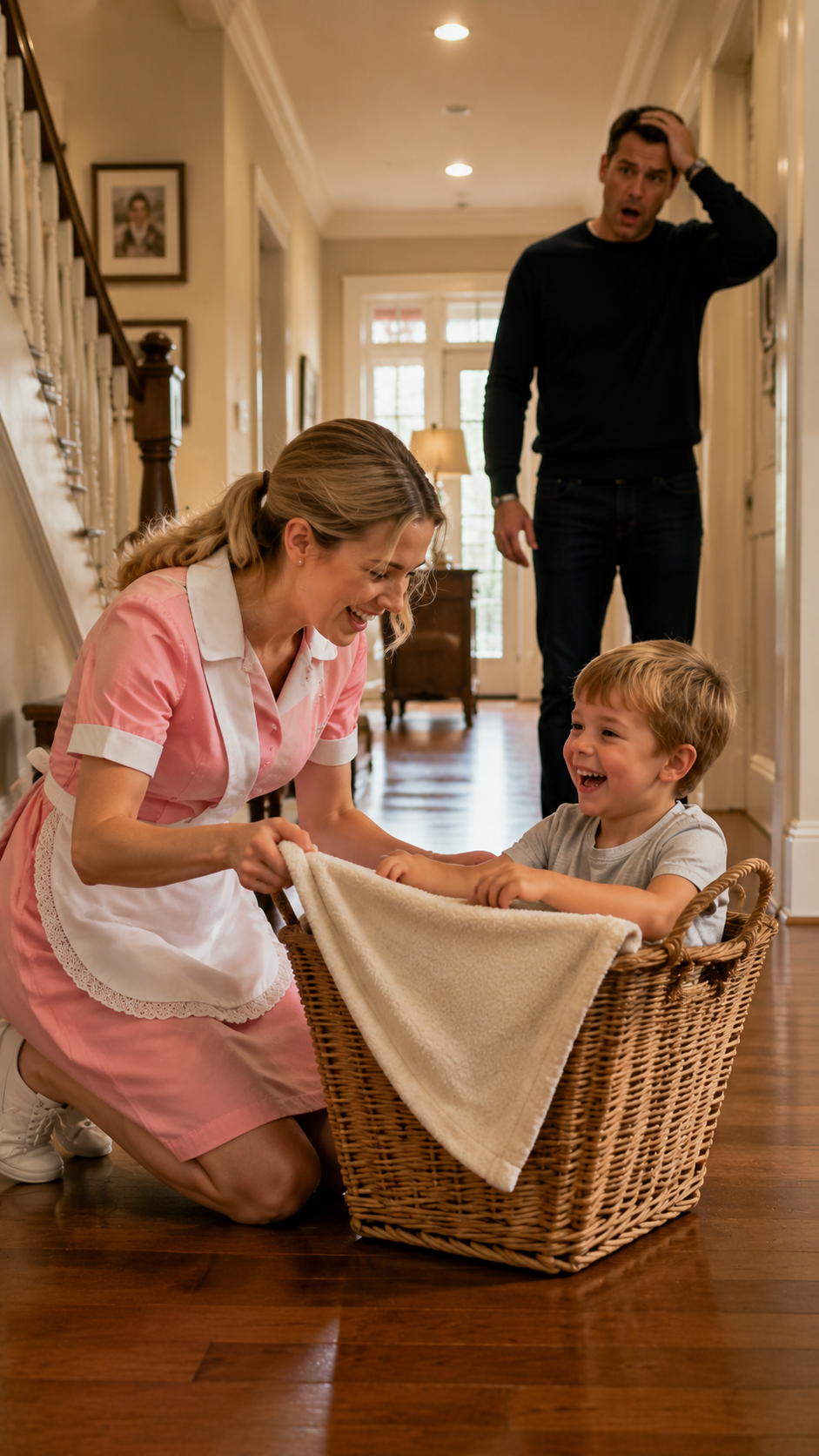
Then he looked up and saw Oliver still watching Lena, his eyes bright in a way Daniel had almost forgotten. It wasn’t a miracle. Oliver’s legs were still rigid. His torso still leaned awkwardly to one side. But his face had changed. It had opened for one second, and that one second hit Daniel harder than every expert report stacked in his office.
The house manager, Mrs. Bell, recovered first.
“This has to stop now,” she said sharply. “If he slips, if he twists something, if anyone records this—”
Lena stood still with the rope in her hand. “He laughed.”
Mrs. Bell looked offended by the sentence itself, like feeling was not a proper answer.
Daniel should have agreed with her. Normally he would have. Daniel Hayes believed in discretion, protocols, and things with signed liability forms. He ran his life that way. He ran grief that way too.
Instead he heard himself say, “One more lap.”
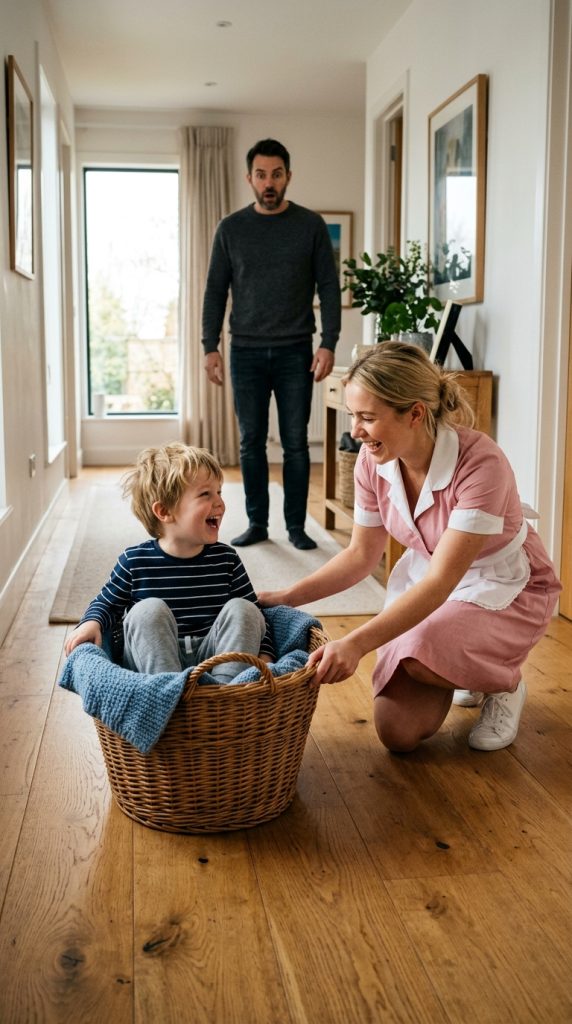
Mrs. Bell turned to him in disbelief. Lena didn’t smile. She just nodded once and pulled the basket again, slower this time.
Oliver made a strained little sound deep in his throat. Daniel thought it was distress, but Lena shook her head slightly, listening in a way he didn’t know how to.
“He wants the turn again,” she said.
“How could you possibly know that?” Mrs. Bell snapped.
Because Oliver’s right hand had lifted a little and dropped toward the rope. Because his shoulders had tightened before the corner, not in fear but in anticipation. Because Lena had spent only a few hours in the apartment and had already started watching the child instead of the chart.
She took the basket around the corner one more time.
This time Oliver’s laugh came quicker.
It was rough and rusty, like a sound unused for too long. But it was real.
Daniel sat down hard at the kitchen counter because his knees suddenly felt unreliable. He had spent fourteen months learning not to hope too fast. Hope had become dangerous in that apartment. Every time someone said progress, another week of refusal followed. Every time a specialist promised a breakthrough, Oliver withdrew further.
Still, now there was a boy in a laundry basket laughing at fake sharks in a penthouse kitchen.
Mrs. Bell left the room with the expression of someone witnessing a social collapse.
Lena stopped after a few minutes, breathing harder than she let show. She knelt by the basket. “All done, Captain.”
Oliver’s eyes locked on her face. His fingers twitched once, then again.
Slowly, awkwardly, he reached.
Not far. Not with clean control. His hand just found the cuff of her sleeve and held it.
Daniel looked away for a second because the sight felt too private and too devastating at once.
That afternoon should have become a celebration. It didn’t.
The external world arrived exactly on time, as it always did in Daniel’s life, ready to interrupt anything soft.
At three o’clock the board members began arriving for the birthday charity photo op Daniel’s late wife had founded years earlier: a children’s mobility initiative that now carried her name. It was the kind of event the press loved. Elegant donors. Generous father. Brave child. Beautiful cause.
Daniel had almost canceled, but his office insisted it mattered for the foundation.
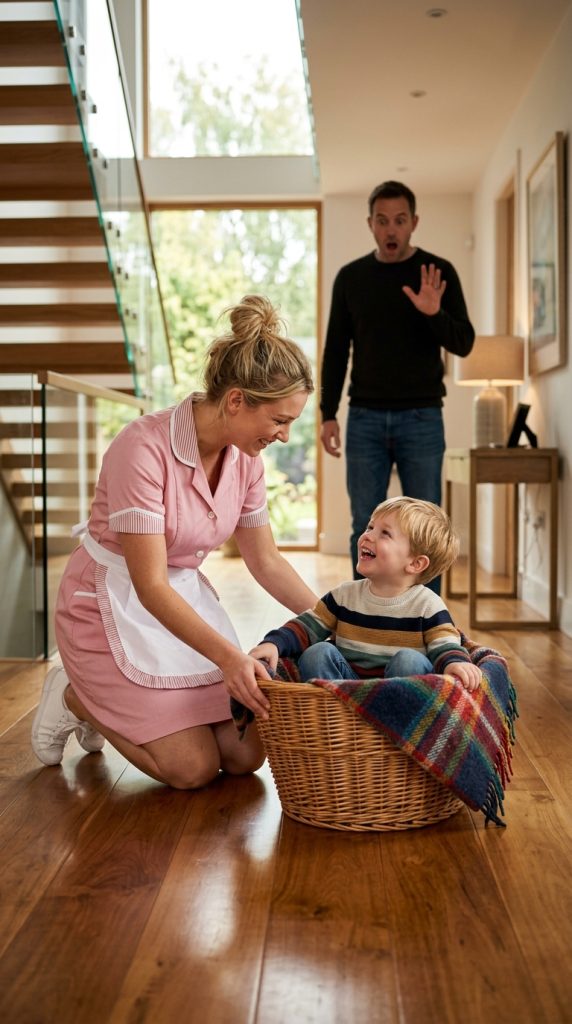
By then Oliver had fallen asleep in the laundry basket with one hand still wrapped in Lena’s sweater. She had rolled towels around his hips and knees to support him and sat beside him on the kitchen floor so he could sleep without startling awake. The sight was humble and a little ridiculous in the middle of a designer kitchen.
It was also the calmest Oliver had looked in a year.
Then the first guests came in.
Voices. Perfume. Heels. Sympathy wrapped in polished smiles.
Oliver’s eyes flew open. His body locked at once.
The hand in Lena’s sleeve clenched.
Daniel saw the whole thing happen in seconds: the flood of unfamiliar energy, the pressure, the way adults in expensive clothes bent toward Oliver with practiced pity.
“There’s our birthday boy.”
“Sweetheart, look how big you are.”
“Daniel, this setup is lovely.”
Oliver began to shake.
Lena immediately put one hand on the side of the basket and lowered her own voice. “Still water,” she murmured. “Still water. No waves.”
Mrs. Bell reappeared as if summoned by class instinct. “Take him back to his room,” she ordered.
The old system was trying to restore itself.
Daniel opened his mouth, ready to agree from habit.
Then he saw Oliver’s face. Not blank. Not absent. Terrified.
If they took him now, the day would become another extraction. Another moment where adults decided his fear was best managed by removing him from life.
Lena looked at Daniel and waited.
It was the first real test.
“Clear the kitchen,” Daniel said.
Nobody moved.
He straightened to his full height, the voice that ran companies dropping into place. “Now.”
The guests blinked. Mrs. Bell looked scandalized. But one by one they backed out. The caterer froze with a tray of sparkling drinks. Two board women exchanged a look that said Daniel Hayes had lost perspective. Daniel did not care.
When the room finally emptied, the silence was different. Not dead. Protective.
Oliver’s breathing slowed under Lena’s hand.
She glanced at Daniel. “Too many people come at him from above. Too much talking. Too much trying to get something out of him.”
Daniel leaned against the counter. “And this works because?”
“Because she used to do the same thing,” Lena said quietly.
He looked at her.
“My aunt. After her stroke. Everybody wanted her to perform recovery in front of them. Sit right. Hold this. Say that. She got smaller every day. But if somebody washed potatoes near her, or folded towels with her, or rolled her down the hall in the laundry cart while the radio was on, she came back. Not all at once. Just enough to stay in the room with us. Bodies calm down before words do.”
Daniel said nothing.
Nobody had explained Oliver that way before. Everything he had heard for a year was framed as treatment, compliance, regression, intervention. Necessary words. Expensive words. None of them sounded like his son.
Lena looked toward the hallway. “This place is too careful. He feels every person waiting for him to fail.”
That landed harder than Daniel wanted.
Because it was true.
After his wife, Claire, got sick, the penthouse had become a command center. Nurses. Schedules. Medication alarms. Filtered food. Hushed phone calls. Then grief came in and nothing ever got unscripted again. Daniel had thought order was mercy. But maybe Oliver had been suffocating inside other people’s management.
The birthday event ended early. Daniel apologized to donors and sent the photographer away without the family picture they expected. By evening, social media was already murmuring that the Hayes foundation event had been “private due to the child’s condition.”
Mrs. Bell requested a word in Daniel’s study.
“I must be candid,” she said. “This girl is too informal. She started dough without permission. She moved your son in a laundry basket. She had him sleeping on a kitchen floor. Now the board has seen disorder in this house.”
Daniel was tired enough to tell the truth.
“They saw my son,” he said.
Mrs. Bell pressed her lips together. “There are standards.”
“For what?” Daniel asked. “For looking like we’re helping him?”
That ended the conversation more than any raised voice could have.
Still, resistance didn’t stop there. It simply changed form.
The rehab center called back the next morning. The intake director reminded Daniel that the bed they had held for Oliver would be released by noon. A residential program. Full support. Daily physical therapy. Controlled environment. It had sounded responsible when Daniel first considered it. Almost noble.
Now he stood outside Oliver’s room with the phone in his hand and heard laughter again.
Tiny. Brief. But there.
He walked in and saw Lena on the floor with three couch cushions arranged like islands. The laundry basket was now “the ferry.” Oliver sat inside it while she pulled him from cushion to cushion. Each stop had a task: tap the pillow, ring a spoon against a mug, toss a washcloth into a bowl. Movement without command. Participation without pressure.
Oliver’s legs still resisted. His torso still collapsed if unsupported. But he was alert. Engaged. Waiting for the next turn.
Lena looked up. “He likes knowing where he’s going.”
Daniel nodded slowly and declined the rehab bed.
By the third day, the penthouse sounded different.
A mixing bowl clinked in the kitchen. Music played low from someone’s phone, not hidden ceiling speakers. Lena narrated ordinary things as if they mattered: socks found, oranges peeled, towels warm from the dryer. She did not force eye contact. She did not praise every breath. She simply made life happen near Oliver until he began leaning toward it.
Daniel started noticing details no report had ever taught him to see.
Oliver tolerated being transferred better if someone counted with him in rhythm.
His left shoulder loosened when warm fabric was tucked beneath it.
He focused longer when there was a task with noise and sequence.
He panicked less if he could see the doorway.
He slept better after movement that felt playful instead of corrective.
Daniel had not failed to love his son. That truth would have been too easy. What he had failed to do was stay with him in the shape grief had left him. He kept trying to drag Oliver back into old expectations: therapy goals, school plans, public appearances, progress markers. Lena met the child who actually remained.
On the fifth day came the separation that triggered everything.
Lena had to leave for two hours to handle paperwork for a younger brother who had gotten into trouble over an unpaid traffic fine. She almost didn’t ask, but Daniel insisted she go.
“I can manage two hours,” he said.
He believed it when he said it.
The second she left, Oliver changed.
Daniel tried to recreate the morning exactly. Same blanket. Same kitchen light. Same route from window to hall. But he moved too briskly. He watched Oliver too closely. He kept asking, “Like this? Is this okay?”
Oliver’s breathing went shallow. His hands clawed at the blanket. His body hardened.
Daniel got the basket, set it down, and realized with a cold flush that he had never actually learned the rhythm. He had observed it. Admired it. Protected it. But he had not entered it.
He knelt in front of his son, suit pants against the floor, and for the first time in months he stopped performing calm and simply spoke.
“I don’t know how to do this yet.”
Oliver’s eyes were wet with panic.
Daniel remembered something Lena had done every time a transition went wrong: she lowered the world before she asked anything of him.
So Daniel shut off the television in the next room. Sent away the hovering staff. Opened the kitchen door so Oliver could smell the bread warming in the oven. Then he put one hand on the laundry basket and said quietly, “Still water.”
Oliver’s shoulders trembled.
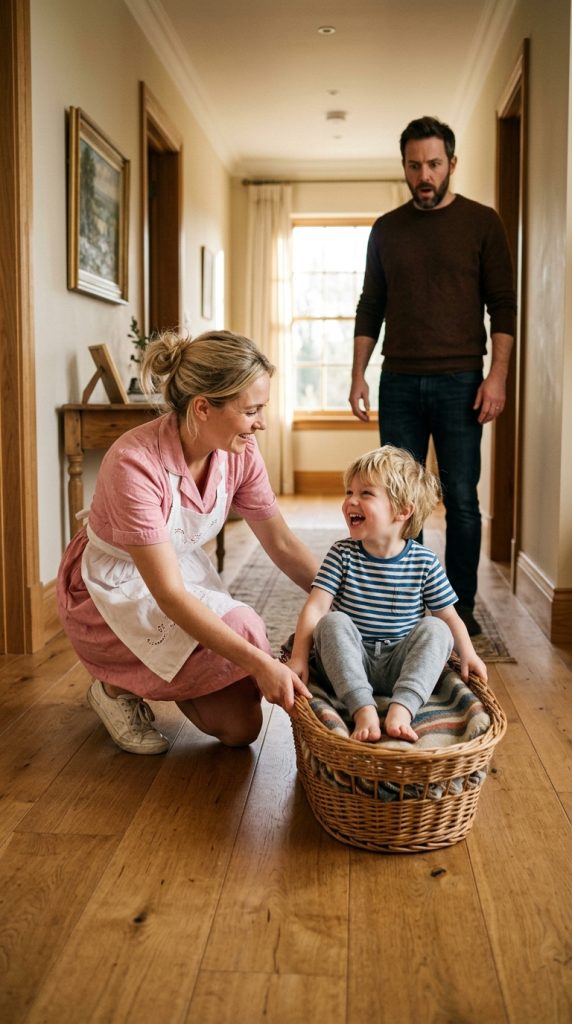
Daniel pulled the basket one foot.
Then another.
Not smooth. Not playful. But steady.
He took Oliver to the kitchen, tapped a spoon against a mug the way Lena did, and after a long minute Oliver’s fingers loosened enough to answer with one crooked tap of his own.
Daniel had negotiated acquisitions worth billions without sweating. That single return tap nearly broke him.
When Lena came back, she stopped in the doorway.
Daniel was on the floor. His tie was gone. One sleeve was dusted with flour. Oliver sat in the basket beside him, and between them on a tray was lopsided dough Daniel had clearly failed to knead well.
“What happened here?” Lena asked.
Daniel gave a tired half laugh. “A hostile takeover.”
For the first time, she laughed with him.
Oliver turned his face toward the sound.
That night, while Lena was helping settle him, he made the throat sound again. Longer this time. His lips moved with visible effort. Lena stayed still. Daniel stayed even stiller.
“Luh,” Oliver said.
Then again, with frustration, “Leh.”
Lena’s eyes filled instantly, but she didn’t rush him.
Daniel’s heart slammed against his ribs.
Oliver looked right at her, hand twisted in her sleeve, and pushed one more sound out.
“Lena.”
It was rough. Broken. Barely shaped.
It was also the first clear word he had spoken since Claire died.
Daniel sat down on the edge of the bed because standing became impossible.
The next week changed the apartment in ways no contractor could have.
Daniel moved the formal birthday photo from the hallway and replaced it with a candid frame the staff photographer had accidentally caught through the kitchen door: Oliver in the laundry basket, laughing so hard his head had tipped back, Lena pulling the rope, sunlight on the floor, Daniel blurred in the background like a man waking up.
Mrs. Bell gave notice.
Not dramatically. Just with icy dignity. She said the household had become “too informal for her style of management.”
She was right.
The apartment was no longer run like a private museum with grief sealed into the walls. There were dish towels over chair backs. Bread rising near the stove. A basket in the hallway that no one dared put away. Daniel began taking breakfast at the kitchen counter instead of alone in his office. Some mornings he canceled calls just to sit through Oliver’s ferry game.
He also changed the foundation event that had once demanded performance from his son. Quietly, but completely.
At the next board meeting, Daniel announced that the Claire Hayes Mobility Initiative would fund in-home family support and adaptive everyday play, not just institutional programs and showcase therapies. Donors raised eyebrows. Some called it sentimental. One board member asked whether “domestic methods” were evidence-based.
Daniel answered with unusual bluntness. “If a child can laugh in his own kitchen, that is evidence I intend to respect.”
The line traveled fast.
So did the story, though Daniel never officially shared it. Staff talked. A driver mentioned the laundry basket. Someone from the board repeated that Daniel Hayes had cleared a room full of donors for a nanny. For once, the gossip didn’t hurt anything. It stripped away some of the family’s polished myth and left something human in its place.
Winter turned slowly.
Oliver did not become magically healed. That was never the story.
His gait remained severely limited. Some days his legs would not cooperate at all. Some days grief shut him down again for hours. But now there was a route back. Sound. Rhythm. Motion. Warmth. Presence.
He started accepting his braces again if the ferry game came first.
He began doing short supported transfers from basket to couch cushion.
He laughed more often.
He spoke in pieces: “more,” “again,” “bread,” and always the clearest one, “Lena.”
Then one rainy evening, months after the birthday, Daniel came home early and found the biggest change yet.
The balcony doors were open to the enclosed terrace. Safe, screened, warmed. Rain streaked the glass beyond it. Lena had set the laundry basket near the threshold with a blanket inside. Oliver was gripping the side, pushing through a supported stand while she held his hips.
“Dock,” she told him softly. “Captain has to reach the dock.”
He shook with effort. One foot dragged. The other planted badly. Daniel’s instinct was to rush in, to save him from struggle.
Lena lifted one hand without looking back, asking Daniel silently to wait.
Oliver took one step.
Then a second, collapsing into the basket with a breathless, furious little grunt.
And then he laughed at himself.
Daniel covered his mouth.
Oliver looked up, saw his father crying openly for the first time in years, and said with great seriousness, “Daddy.”
Not a title thrown into air. A call.
Daniel went to him then. Not to lift him out of effort, but to kneel beside the basket and press his forehead gently to Oliver’s hair.
“Right here,” he said.
That became the new center of the apartment. Not the living room with city views. Not the dining room set for people who mattered on paper. The kitchen, the hallway, the terrace threshold, the patched-together places where Oliver could feel life and answer it.
By spring, Daniel had made Lena a permanent family support director on paper and something much more personal in practice: a trusted equal in the house. He paid for her training in pediatric mobility care because she wanted the credentials, but everyone understood the truth. The credentials were catching up to what she already knew.
She was no longer treated like hired background. She had keys, authority, and a voice at every medical meeting. When specialists came, they no longer spoke over her. If they did, Daniel ended the habit quickly.
The penthouse still held grief. Claire was still missing from every season. Her picture still stood by Oliver’s bed. They still spoke her name.
But her death no longer turned every room cold.
On the next birthday, there was another cake in the kitchen. Not the fancy one from the elite bakery. A crooked homemade one with uneven frosting because Oliver had helped stir it from the basket while Lena called out instructions and Daniel got powdered sugar all over his shirt.
When the candles were lit, Oliver did not stay by the window.
He was at the table.
Supported, strapped carefully, tired but present.
Daniel started to sing first, badly and without embarrassment. Lena joined in. Then Oliver, voice thin and rough but real, joined on the last line.
After they clapped, Oliver looked at the old white laundry basket waiting near the hall and grinned.
“Boat,” he said.
Daniel laughed. “After cake.”
Oliver considered this, then pointed at Lena and said the word that still undid them both every single time.
“Again.”
And for once, in that high quiet world that had spent so long mistaking perfection for love, the answer came easily from every corner of the family.
Again.
