

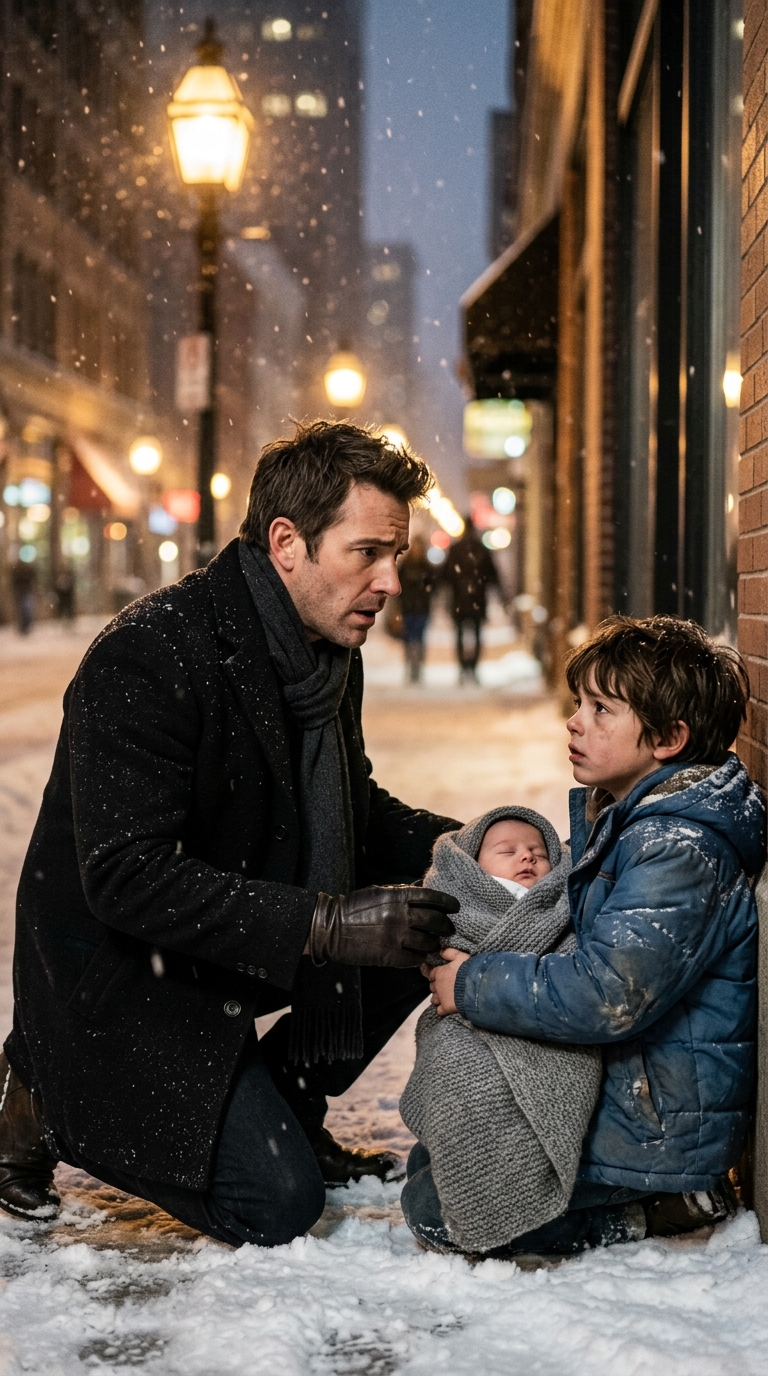
“Please don’t die, Elle… please,” Caleb whispered, clutching the tiny bundle against his chest as snow buried the world around them.
The storm had swallowed the city whole. Streetlights flickered like dying stars. Cars vanished beneath layers of white. Every sound faded into the freezing silence, as if the night itself had decided no one would hear cries for help.
And on a forgotten park bench beneath a trembling lamp sat a little boy too young to understand abandonment — but old enough to feel it.
Caleb was only four. His coat was thin, stretched tight around his tiny body, the zipper crooked from being forced shut too many times. He curled inward against the wind, shaking violently, trying to trap the last traces of warmth inside him.
Yet he barely cared about the cold anymore. Everything he had left was wrapped in his arms. Elle. His baby sister.
The blanket around her was ripped and damp from snow. Her cheeks burned red with fever while her lips turned a terrifying shade of blue. Every weak breath sounded smaller than the one before. Caleb rocked her carefully.
“Shhh… I got you,” he whispered, though his own teeth chattered so hard he could barely speak. “Mom said she’d come back. She promised.”
Children believe promises. Even when the world gives them every reason not to.
Hours had passed. Maybe more. Caleb didn’t know anymore. The snow kept falling. The benches disappeared beneath white drifts. The trees groaned in the wind like ghosts whispering through the dark.
Still no footsteps. Still no mother.
Elle stopped crying first. That terrified him most.
“Elle?” His voice cracked as he touched her freezing cheek. “Hey… stay awake, okay? Please?” No response.
Panic tightened in his tiny chest.
Then — Crunch.
A sound behind him. Slow footsteps cutting through the snow.
Caleb froze instantly and pulled Elle closer.
Out of the darkness emerged a tall man in a black wool coat, the kind Caleb had only seen on people through restaurant windows. His shoes were polished. His gloves untouched by winter. He looked completely out of place in the middle of this frozen nightmare.
But when he saw the children — he stopped dead. The color drained from his face.
For one long moment, he simply stared, like his mind refused to accept what was in front of him. Then he rushed forward and dropped to his knees in the snow.
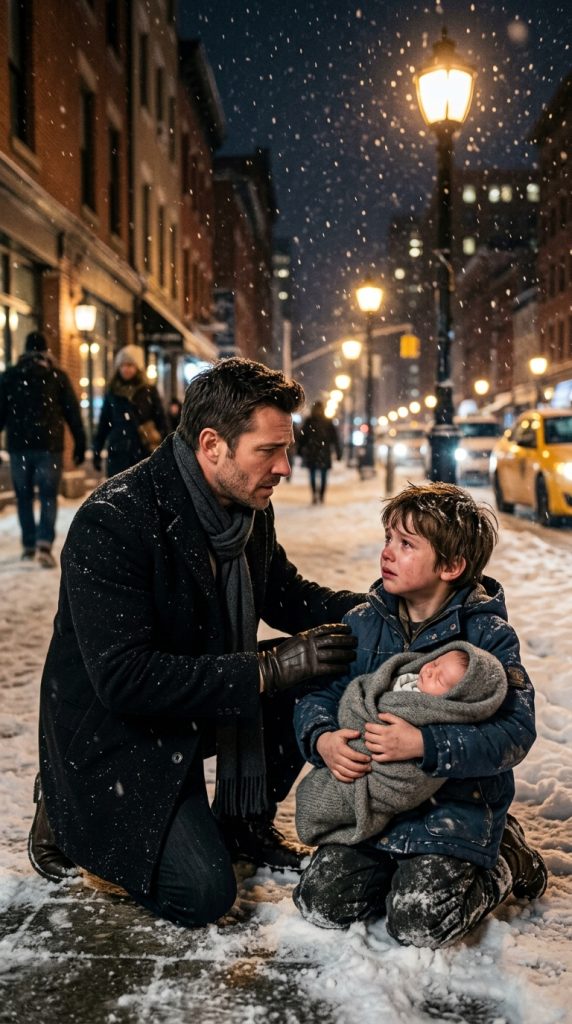
“Hey… hey, kid,” he said softly, his voice suddenly unsteady. “Where are your parents?”
Caleb tried to answer, but his lips barely moved.
The man’s eyes shifted to Elle. And something inside him shattered.
No business deal. No amount of money. No power he’d ever held — could prepare him for the sight of a freezing baby dying in her brother’s arms.
“How long have you been out here?” he demanded, panic rising in his voice.
Caleb looked at him with the last fragile spark of hope left inside him. Then he whispered weakly — “Mister… my sister’s so cold.”
The man reached toward the baby — and suddenly froze when he felt how icy her tiny body had become.
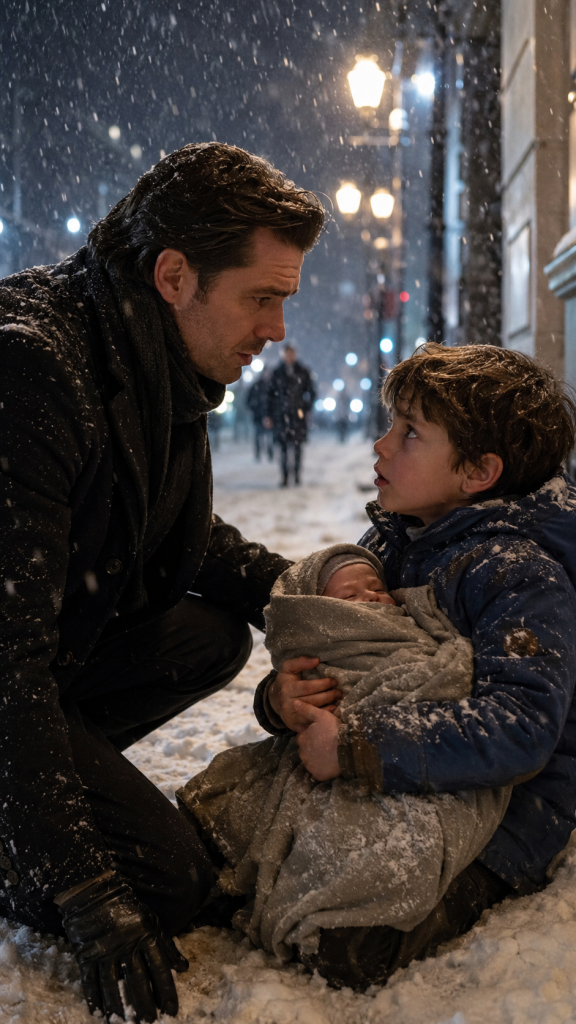
The man pulled off his coat with frantic hands and wrapped it around Caleb and the baby together.
“Stay with me,” he said, voice breaking. “Both of you. Do you hear me?”
Caleb blinked up at him, snowflakes clinging to his lashes.
“Are you… taking Elle home?”
The man froze. For a second, pain flashed across his face so sharply it looked almost like fear.
Then he lifted them both into his arms. “Yes,” he whispered. “But not the home you came from.”
Caleb was too weak to ask what that meant.
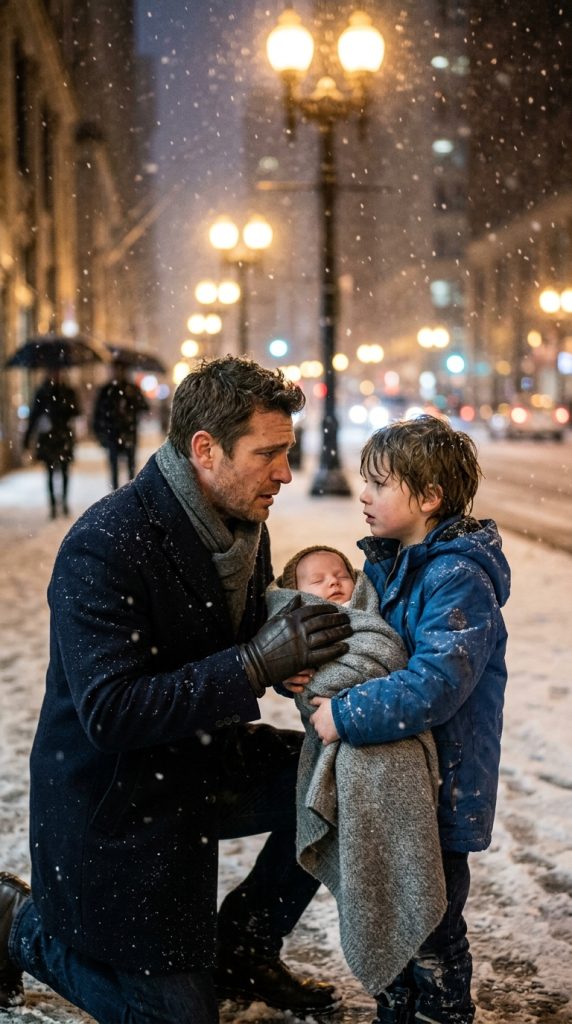
The last thing he remembered was the man’s heartbeat pounding against his ear as he carried them through the blizzard, shouting into a phone.
“Send an ambulance now! Two children—one infant, critical condition. North entrance of Whitmore Park. Hurry!”
Elle made a tiny sound. Barely a breath. But Caleb heard it. He held her tighter.
“Don’t die,” he mumbled again, slipping into darkness. “Please don’t die.”
Warmth came back like pain.
Caleb woke to bright lights, strange voices, and the smell of medicine. His first thought was Elle.
He tried to sit up, but something tugged at his arm. A tube. Tape. A blanket tucked tightly around him.
“Elle!” he cried.
A nurse appeared beside him. “Sweetheart, calm down.”
“My sister! Where’s my sister?”
The curtain moved. The man in the black coat stepped inside.
He looked different now. Less powerful. Less untouchable. His expensive shirt was wrinkled, his hair damp from melted snow, his eyes red from not sleeping.
“She’s alive,” he said.
Caleb stared at him. The words did not reach him at first.
Then the man said it again, softer. “Elle is alive.”
Caleb’s face crumpled. He sobbed so hard the monitors beside him began to beep faster. The nurse tried to soothe him, but he only reached toward the man.
“Can I see her?”
“Not yet,” the man answered, kneeling beside the bed. “Doctors are helping her breathe. She’s very sick, Caleb.”
Caleb went still. “You know my name?”
The man’s expression changed. A silence fell between them. Too long. Too heavy.
Finally, he said, “The police found your backpack. Your name was inside.”
Caleb accepted that because he was four, and four-year-olds still believed adults when they spoke gently enough.
“What’s your name?” he asked.
The man looked down. “Adrian.”
“Thank you, Adrian.”
Something in him broke again. He bowed his head until his forehead nearly touched Caleb’s blanket. “You don’t thank me,” he whispered. “Not for this.”
By morning, the storm had passed, but the world outside remained buried.
News vans gathered outside the hospital. A nurse had leaked the story: two abandoned children found freezing in Whitmore Park by billionaire Adrian Vale, CEO of Vale Industries.
The city wanted a miracle. The cameras wanted tears. The police wanted answers.
But Caleb wanted only his sister.
When they finally wheeled him to the neonatal intensive care unit, he saw Elle behind clear glass, swallowed by wires and tubes. She was impossibly small. Her tiny chest rose and fell with mechanical help.
Caleb pressed both hands to the glass. “Elle,” he whispered. “I’m here.”
Adrian stood behind him, silent.
A doctor approached. “Mr. Vale?”
Adrian turned.
“She survived the night,” the doctor said carefully. “But the hypothermia, the infection, the fever… she is not out of danger.”
Caleb heard only part of it.
“Can she hear me?”
The doctor’s face softened. “Maybe.”
Caleb leaned close to the glass. “I kept you warm,” he told her. “I tried really hard.”
Adrian shut his eyes. Because those words were worse than any accusation.
The police came that afternoon.
A woman named Detective Marlow sat beside Caleb’s hospital bed with a notepad in her lap and a kindness in her voice that did not quite hide the steel underneath.
“Caleb, can you tell me what happened?”
Caleb clutched a stuffed rabbit Adrian had bought from the gift shop.
“Mommy said she had to talk to someone.”
“Where?”
“In the park.”
“Did she leave you there?”
Caleb nodded.
“She said, ‘Watch Elle. I’ll be right back.’”
Detective Marlow’s pen stopped moving.
“And did she come back?”
Caleb shook his head.
Adrian stood by the window, facing away. His reflection showed a man holding himself together with force alone.
“Do you know your mommy’s name?” the detective asked.
“Lena.”
Adrian’s hand curled into a fist.
Detective Marlow noticed.
“Mr. Vale,” she said, “do you know a woman named Lena?”
The room became very quiet.
Caleb looked between them.
Adrian did not answer immediately. Then he turned around.
“Yes.”
The detective’s gaze sharpened. “How?”
Adrian’s voice was low. “She worked for me.”
Caleb frowned. “My mommy knows you?”
Adrian looked at him. And for the first time, Caleb saw something frightening in the man’s eyes. Not anger. Not cruelty. Guilt.
“Yes,” Adrian said. “She knew me.”
Three days passed. Elle lived. Barely, stubbornly, beautifully.
Each morning, Caleb asked if she was better. Each morning, the answer was not yet.
Adrian never left the hospital. He held meetings in hallways, ignored calls from board members, and slept in a chair outside Caleb’s room. Nurses whispered that men like him did not do things without reason.
They were right.
On the fourth night, Caleb woke to voices outside his door.
Detective Marlow. And Adrian.
“We found the mother,” the detective said.
Adrian’s face went pale.
“Where?”
“Bus terminal camera. She boarded a midnight coach under a false name.”
“Alone?”
“Yes.”
Adrian leaned against the wall.
Detective Marlow studied him. “You’re hiding something.”
“I already told you she worked for me.”
“That’s not all.”
Adrian said nothing.
“Two children were left to die,” Marlow said. “One of them may still die. If you know why Lena did this, now is the time.”
Adrian looked toward Caleb’s door. His voice lowered.
“Lena came to me six months ago.”
“For what?”
“Money.”
“Why?”
Adrian swallowed. “She said the children were mine.”
Inside the room, Caleb lay perfectly still. He did not understand everything. But he understood enough to stop breathing for a moment.
Detective Marlow stared at Adrian. “And were they?”
Adrian’s eyes shone. “I don’t know.”
The truth arrived in pieces.
Lena Hart had worked as Adrian Vale’s private archivist five years ago. Quiet. Brilliant. Invisible in the way poor women learn to become around powerful men.
Then she disappeared. No resignation letter. No goodbye.
Six months before the storm, she returned with two children and desperation carved into her face. She told Adrian that Caleb was his son. That Elle was his daughter. That she had run because Adrian’s family would never allow it.
Adrian had not believed her. Worse — he had believed she was trying to trap him. He gave her money. A lot of it. And told her never to come back without proof.
“She cried,” Adrian confessed one night, sitting beside Caleb while the boy pretended to sleep. “She said I was the only person who could protect you.” His voice cracked. “I thought she was lying.”
Caleb opened his eyes. “Are you my daddy?”
Adrian stopped breathing. Slowly, he turned.
Caleb stared at him with devastating innocence.
Adrian lowered himself onto the edge of the bed. “I don’t know yet.”
Caleb looked down at the rabbit in his arms. “My mommy said daddies come back.”
Adrian covered his mouth with one hand. Then he whispered, “Sometimes they come too late.”
The DNA test took two days. Adrian changed in those two days. He became both more present and more terrified. He learned how Caleb liked his apple juice without pulp. He memorized the way Elle’s fingers twitched when Caleb sang to her. He discovered that Caleb hated hospital oatmeal but ate it anyway if someone called him brave.
On the morning the results came, snow began to fall again. Gentler this time.
Adrian stood in the hallway with the envelope in his hand. Detective Marlow waited nearby. Caleb watched from his room.
“Open it,” the detective said.
Adrian did. His eyes moved across the page. Once. Twice. Then his knees nearly gave out.
Caleb slipped from the bed and ran toward him. “Adrian?”
The paper trembled in his hand. Adrian looked at Caleb, and all the walls inside him collapsed.
“You’re mine,” he whispered.
Caleb froze.
Adrian fell to his knees in front of him. “You’re my son.”
Caleb’s lips parted. “And Elle?”
Adrian’s tears finally spilled over. “Your sister too.”
Caleb stared at him as if the world had been rewritten in a language he could almost understand. Then he reached out with one small hand and touched Adrian’s face.
“You found us.”
Adrian pulled him into his arms. “No,” he said, holding him with a desperation that shook them both. “I should have found you sooner.”
For the first time in his life, Caleb had someone who came back.
Adrian became “Daddy” slowly. Not in one grand moment. But in pieces. A blanket tucked around Caleb’s shoulders. A hand waiting when nightmares came. A voice beside Elle’s incubator, reading fairy tales like business contracts had never existed.
Yet the world outside the hospital was not gentle. The media devoured the story. “Billionaire’s Secret Children Abandoned in Blizzard.” “Runaway Mother or Desperate Victim?” “Vale Heir Found Near Death.”
Adrian tried to shield Caleb from it, but whispers found their way in. One nurse called Lena a monster. Caleb heard.
That night, he refused to speak. Adrian found him sitting beside Elle’s glass room, knees tucked to his chest.
“Caleb?”
“Was Mommy bad?”
Adrian sat beside him on the floor despite his expensive suit. “I don’t know everything yet.”
“She left us.”
“Yes.”
“She promised.”
Adrian’s jaw tightened. “Yes.”
Caleb’s voice trembled. “But she used to sing to Elle.”
Adrian looked at his daughter through the glass. “People can love you and still break you,” he said quietly.
Caleb leaned against him. “Did she love us?”
Adrian did not answer quickly. Because the honest answer was the cruelest one.
“I think,” he said at last, “she was afraid.”
“Of what?”
Adrian stared into the sterile white light. “I’m trying to find out.”
Elle opened her eyes on the ninth day. Caleb was there. Adrian was there. The doctor was adjusting a monitor when her tiny lashes fluttered.
Caleb gasped. “Daddy!”
Adrian turned sharply. Elle’s eyes, dark and unfocused, moved weakly beneath the oxygen tubes.
Caleb pressed close to the glass. “Elle! It’s me!”
Her fingers moved. Just once. But enough.
Caleb burst into tears. Adrian laughed and cried at the same time, one hand over his heart as if it hurt to feel that much.
The doctor smiled. “That’s a very good sign.”
Adrian whispered, “She’s fighting.”
Caleb nodded fiercely. “She’s Elle.”
And for one fragile afternoon, hope filled the room so completely that even the machines seemed to breathe easier.
But hope has enemies.
That evening, Adrian returned to his penthouse briefly to gather documents for the custody hearing. He had fought boardrooms, hostile takeovers, and men who smiled while sharpening knives behind their backs. None of that prepared him for what waited on his desk.
A white envelope. No stamp. No return address. Inside was a photograph of Caleb and Elle on the park bench. Taken before Adrian found them.
He stared at it, blood turning cold. On the back, written in black ink: SHE DID NOT ABANDON THEM. SHE DELIVERED THEM.
Adrian’s phone rang. Unknown number. He answered slowly.
A woman breathed on the other end. Not Lena. Older. Calmer.
“Mr. Vale,” she said. “You found your children. Good.”
“Who is this?”
“Someone who kept them alive long enough for you to arrive.”
Adrian’s grip tightened. “You were there?”
“I arranged everything.”
His voice dropped into something dangerous. “You left two children in a blizzard.”
“No,” the woman said. “Lena did. Because she was told the alternative.”
“What alternative?”
A pause. Then the woman said, “Your daughter was never meant to survive.”
Adrian went still.
“The fever wasn’t natural,” she continued. “Look into the medication Lena was given. Look into your mother’s foundation. Look into the children your family erased before Caleb.”
Adrian could not speak.
The woman’s voice softened. “You think this began with Lena. It didn’t.”
“Where is she?” Adrian demanded. “Where is Lena?”
Another pause. Then — “Running from the same people you invited to tomorrow’s custody hearing.”
The call ended.
Adrian stood in the silence, the photograph still in his hand. Then he looked at the guest list for the hearing. His mother’s name sat at the top. Vivienne Vale. Chairwoman of the Vale Foundation. Family matriarch.
The woman who had smiled at the hospital cameras and said she was praying for the children.
Adrian picked up the photograph again. Only now did he notice the figure reflected faintly in the icy window behind Caleb. A woman standing across the street. Watching. Not Lena. Vivienne.
The next morning, Caleb held Elle’s tiny hand through the incubator opening while Adrian stood behind them, unable to tell his son that the monster might not have been the mother who left. It might have been the grandmother waiting to claim them.
The hospital doors opened. Elegant heels clicked down the hallway.
Vivienne Vale arrived dressed in winter white, pearls at her throat, a soft smile on her face.
“My darling Adrian,” she said. “I came as soon as I could.”
Caleb turned. Vivienne’s eyes settled on him. Warm. Tender. Perfectly practiced. Then she looked at Elle. For half a second, the smile disappeared.
Adrian saw it. And understood.
Vivienne leaned down toward Caleb. “You must be my grandson.”
Caleb hesitated. Adrian stepped forward.
But before he could speak, Caleb looked up at Vivienne and said softly, “Were you the lady watching us in the snow?”
The hallway went silent. Vivienne’s smile froze. Adrian’s blood turned to ice.
And inside the incubator, Elle’s monitor suddenly began to scream.
The shrill alarm sliced through the hallway like a blade. Nurses surged forward, their soft-soled shoes squeaking against the polished floor. A doctor barked orders as the incubator’s lights flashed red.
“Elle!” Caleb cried, pressing his small body against the glass.
Adrian moved on instinct, one arm sweeping his son behind him while the other reached for Vivienne’s shoulder. His grip was iron.
“Mother,” he said, voice low and lethal, “what did you do?”
Vivienne’s face remained a masterpiece of concern — brow furrowed, lips parted in practiced shock. But her eyes… her eyes flickered with something colder than the blizzard outside.
“Adrian, darling, don’t be absurd. I only just arrived.” She placed a manicured hand over her pearls. “The poor child must have taken a turn. These things happen with premature infants —”
The doctor interrupted, voice tight. “We need everyone out. Now. She’s crashing.”
Caleb began to sob, clutching Adrian’s leg. “Daddy, don’t let her die! You promised!”
The word Daddy hit Adrian like a second blow. He knelt quickly, cupping Caleb’s tear-streaked face.
“She’s going to be okay. I need you to be brave for her, alright? Stay with the nurse. I’ll be right back.”
A young nurse gently pulled Caleb aside, murmuring comforts. Adrian rose, turning on his mother with a fury he had never allowed himself to show in boardrooms or press conferences.
The hallway emptied except for the three of them — Adrian, Vivienne, and the ghost of everything unspoken.
“You were there that night,” Adrian said. His voice didn’t rise. It didn’t need to. “The photo. The reflection in the window. You watched them freezing.”
Vivienne sighed, as if disappointed by a minor business error. “Always so dramatic, Adrian. I was ensuring the delivery went according to plan. Lena was… unreliable. Weak. She’d grown attached.”
“Attached?” Adrian’s laugh was bitter. “They’re her children. My children.”
Vivienne stepped closer, lowering her voice to the velvet tone she used when closing impossible deals. “They were never supposed to be yours. Not really. A momentary lapse with that archivist girl. I handled it quietly five years ago — paid her to disappear, made sure there were no complications. But she came back. And then she had the nerve to demand more. To threaten exposure.”
Adrian’s hands curled into fists at his sides. “So you told her to abandon them? In the middle of the worst storm in twenty years?”
“I told her to give them a chance to be found,” Vivienne corrected smoothly. “By you. Or by nature. Either way, the problem would solve itself. A tragic accident. No messy custody battles. No public scandal. The Vale name remains pristine.”
Behind the glass, the medical team worked frantically. Caleb’s small voice carried down the hall, singing the same lullaby he’d used on the park bench — trembling but determined.
Adrian felt something inside him snap cleanly in two.
“You poisoned my daughter,” he said. It wasn’t a question.
Vivienne shrugged delicately. “The medication was meant to be… kinder. Faster. Lena was supposed to administer the final dose before leaving them. She failed even at that.”
The monitor inside the room flatlined for one horrifying second — then resumed its erratic rhythm as the team shocked the tiny body back.
Adrian took one step forward. Vivienne instinctively stepped back, her elegant façade cracking at the edges.
“I will destroy you,” he said quietly. “Every foundation. Every board seat. Every dirty secret you’ve buried under the family name. You will never touch my children again.”
For the first time, real fear flashed across Vivienne’s face.
“You wouldn’t dare. The Vale empire —”
“Is mine,” Adrian cut in. “Not yours. Not anymore.”
Detective Marlow appeared at the end of the hallway, flanked by two uniformed officers. Adrian had texted her the moment he saw his mother arrive.
“Vivienne Vale,” Marlow said, voice carrying the weight of authority, “you’re wanted for questioning in connection with the attempted murder of Elle Vale and the endangerment of Caleb Vale.”
Vivienne’s smile returned, brittle and sharp. “This is ridiculous. I’m their grandmother.”
Caleb had slipped away from the nurse. He stood a few feet away now, eyes wide, taking in the scene with a child’s terrible clarity.
“Grandma?” he whispered. Then, softer, “You made Mommy leave us?”
The question hung in the air — small, devastating, final.
Vivienne opened her mouth, but no polished lie came out fast enough.
Adrian lifted Caleb into his arms, holding him tight against his chest.
“Take her,” he told Marlow without looking away from his mother. “And find Lena. She may be the only one who can still help Elle.”
As officers moved in, Vivienne’s voice rose for the first time — sharp, ugly, stripped of its elegance.
“You’re making a mistake, Adrian! Blood is blood. These children will ruin everything we built!”
Adrian turned his back on her, carrying Caleb toward the NICU window.
The alarms had quieted. Elle’s tiny chest rose and fell again, fragile but fighting.
Caleb buried his face in Adrian’s neck. “Daddy… is the bad lady going away?”
Adrian pressed a kiss to his son’s dark hair, the same color as his own. “Yes,” he whispered. “And I’m never letting anyone hurt you or your sister again. That’s a promise I’m going to keep.”
Outside, the snow had stopped. A thin, pale sunlight broke through the clouds for the first time in days, falling gently across the hospital windows.
Inside, Adrian Vale — billionaire, father, survivor — stood guard over the only empire that mattered.
And for the first time in his life, he understood what it truly meant to be rich.
