

PART 1: THE DAUGHTER HE TRIED TO ERASE
Fifteen years after my father forced me out of his house, I found myself standing in the same room as him at my younger sister’s wedding.
For fifteen long years, I had imagined what our reunion might look like.
Sometimes I pictured myself returning with confidence, showing him that I had created a meaningful life without his money or approval. Other times, I imagined seeing him across a crowded room and quietly walking away before he noticed me.
But never, in all those imagined reunions, had I expected him to look straight into my eyes, lift a glass of expensive red wine, and repeat the kind of words that had once shattered my confidence.
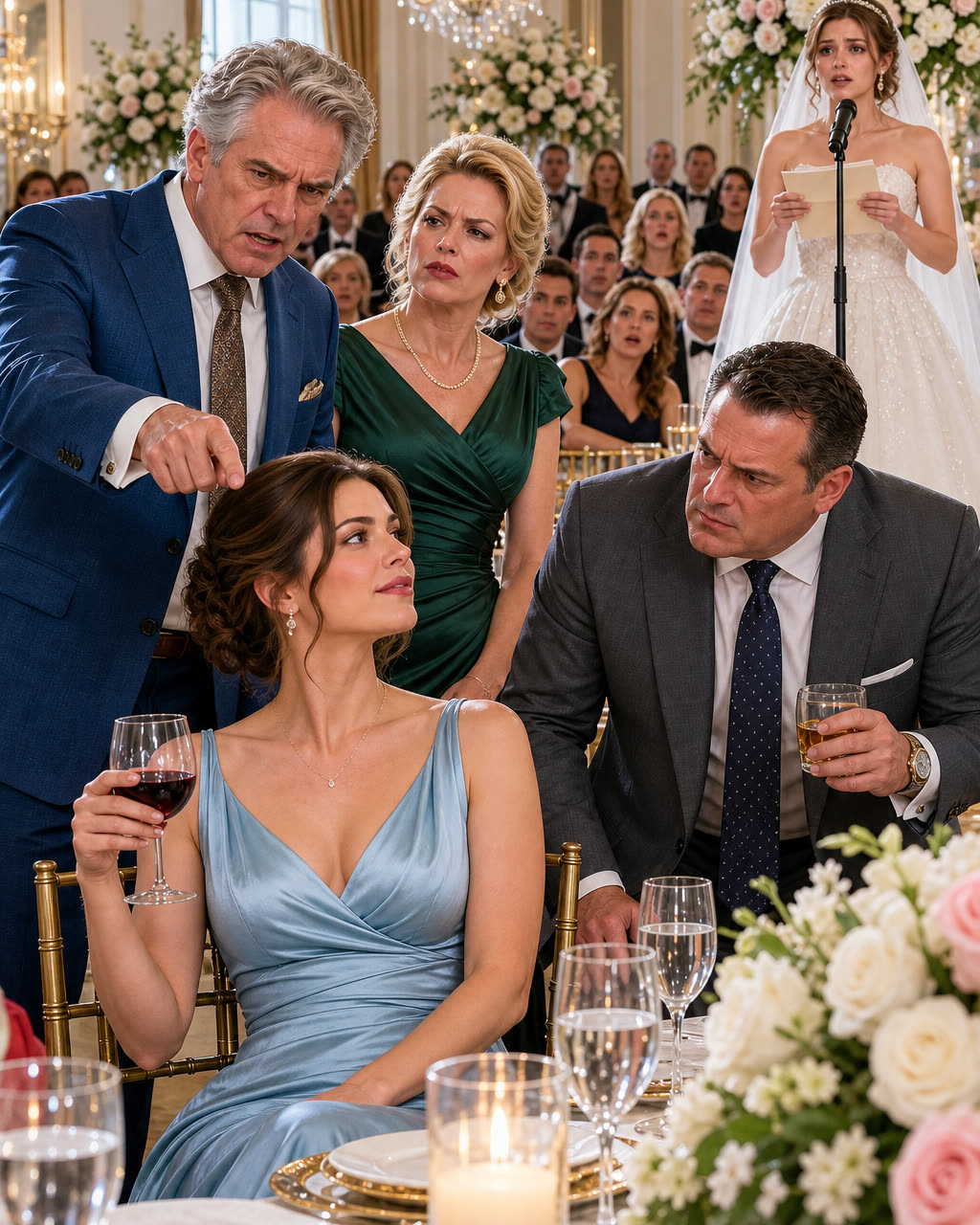
“If it wasn’t for pity, no one would have invited you,” he announced, making certain the people nearby could hear.
He wore a satisfied smile, clearly expecting me to break down in front of the guests.
Instead, I slowly raised my glass, took a measured sip, and smiled back.
I said nothing.
My father believed he had just reminded me of my place in the family.
What he did not realize was that my younger sister, Valerie, had spent years waiting for an opportunity like this.
Before the celebration ended, she would stand before two hundred and fifty guests, take the microphone, and reveal something about my life that our father had never once bothered to discover.
And when she did, every face in that ballroom would turn toward me.
The evening had begun with humiliation rather than celebration.
The first insult came during the cocktail reception at the Grandview Manor Club, before dinner had even been served.
I was standing beside one of the tall cocktail tables, holding a glass of Pinot Noir, when my father approached.
Benedict Delacroix looked much as I remembered him.
Time had thinned his silver hair and deepened the wrinkles around his eyes, but it had done nothing to soften his personality.
He wore a perfectly tailored dark suit, expensive polished shoes, and the commanding expression of a man who believed his presence entitled him to control every conversation.
He inspected my simple dark green dress before glancing toward the adjoining ballroom, where wealthy guests chatted beneath glittering crystal chandeliers.
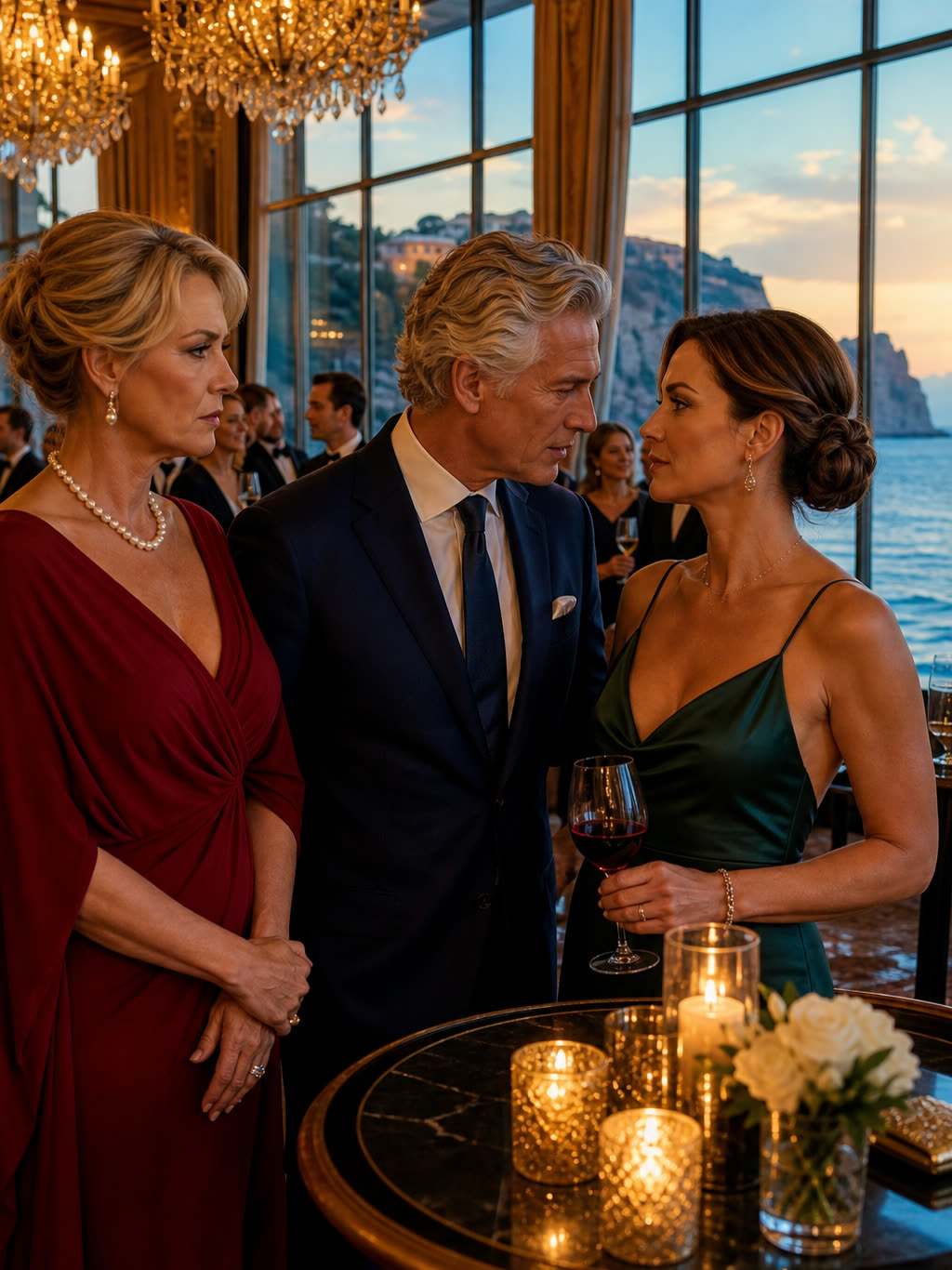
“I didn’t realize Valerie’s guest list included charity cases,” Benedict remarked.
I met his stare without lowering my eyes.
“Hello, Dad.”
Before he could continue, Gwen appeared beside him.
My father’s second wife wore a brilliant crimson gown and a pearl necklace. Her cold smile suggested that she had anticipated our reunion almost as eagerly as Benedict.
He stepped closer.
“If you embarrass this family tonight, I will make sure Valerie regrets inviting you,” Benedict warned.
I remained silent.
My father had always viewed money as more than wealth.
To him, it was a method of controlling people.
An apartment he helped finance could become a bargaining tool. A vehicle he purchased could be taken away whenever someone disappointed him. Even Valerie’s wedding, which he had paid for, gave him an excuse to decide who deserved to attend.
His generosity never came without conditions.
Every gift carried an invisible chain.
Fifteen years earlier, I had finally refused to wear that chain.
I was twenty-two when I told him I would not enter the Delacroix family real estate corporation.
He had already arranged my future.
I was supposed to join the business, learn its operations, and eventually become part of the empire he had spent decades building.
But I wanted something different.
I wanted to serve in the Coast Guard.
More specifically, I wanted to become a pilot and fly search-and-rescue missions.
I wanted to help people who might otherwise never make it home.
Benedict regarded my decision as a personal betrayal.
He could not understand why I would abandon a profitable family business for military service.
Or perhaps he understood perfectly well and simply refused to accept that I possessed the right to choose my own future.
“You made your choice, and now you have to live with the consequences,” he told me.
By the end of that week, the consequences had become brutally clear.
The locks on the family estate were replaced.
My health insurance disappeared.
My photographs began vanishing from the walls.
It was as though my father had decided to remove every visible sign that I had ever belonged to the Delacroix family.
I left carrying one suitcase.
My savings amounted to approximately eleven hundred dollars.
My younger sister was only fifteen.
I still remembered Valerie standing at my old bedroom window, tears running down her face as she watched me walk down the driveway.
Neither of us understood then how much damage fifteen years of complete silence could cause.
Now Valerie was getting married.
And she was the only reason I had returned.
Her wedding invitation had arrived without a return address.
Inside, she had written a short personal message.
“Please come, because I really need you there,” the note read.
I nearly declined.
I had no desire to enter another room where my father could treat me as an embarrassment.
But I kept rereading Valerie’s words.
Eventually, I drove three hours to the Grandview Manor Club.
The moment Valerie saw me in the bridal suite, she ran toward me.
Her elaborate white gown swayed around her as she wrapped both arms around my neck.
For a moment, she was no longer a bride preparing for her wedding.
She was the fifteen-year-old girl who had watched her older sister disappear down the driveway.
“Dad doesn’t know I sent it,” Valerie whispered into my shoulder.
I gently stepped back.
“Valerie, you shouldn’t have done this.”
“Gwen tried to stop me from mailing it, but I didn’t care,” she replied.
I knew exactly how our father would react.
“You are going to cause a massive scene on your special day,” I warned her.
But Valerie took both my hands and held them tightly.
“Trust me, and please stay no matter what Dad says to you tonight,” she pleaded.
There was something unmistakable in her expression.
During my military career, I had seen that same look on the faces of service members preparing for difficult missions.
It was not the absence of fear.
It was the determination to move forward despite it.
So I agreed to stay.
I remained when I passed the enormous welcome board at the entrance.
It proclaimed:
The Delacroix Family, Established 1988.
The date was painfully ironic.
The family history supposedly began in the year I had been born, yet the display contained no reference to me.
I remained when I discovered where I had been seated.
Table twenty-two.
Near the swinging kitchen doors, far from the family’s head table.
Even my place card avoided identifying me.
Instead of my name, it displayed only:
Guest of the Bride.
I studied those words for several seconds.
Then I drew a deep breath and took my seat.
I had spent fifteen years learning how to survive difficult conditions.
Surely, I told myself, I could survive one wedding reception.
But I had underestimated how determined my father was to make sure everyone knew I no longer belonged.
PART 2: THE INSULT THAT SILENCED THE BALLROOM
Gwen wasted little time turning my presence into gossip.
During the cocktail reception, she introduced me to passing guests in a tone that made my supposed failure sound like an amusing family anecdote.
“This is Benedict’s older daughter who left the family years ago to do something with helicopters,” she informed a group of local business owners.
I gave them a courteous smile.
“I am a pilot in the Coast Guard.”
Gwen tilted her head, pretending to be sympathetic.
“Right, and is it still just you and that green uniform?”
Several people exchanged uncomfortable smiles.
Nobody challenged her.
The guests understood the unspoken rules surrounding Benedict Delacroix.
You did not contradict him.
You did not embarrass Gwen.
And you certainly did not question why his eldest daughter had been absent from the family for fifteen years.
By dinner, my father was preparing to present his preferred version of our history.
He stood near table one, holding a glass of Bordeaux, and began speaking about family loyalty, duty, and the importance of knowing one’s responsibilities.
He praised children who respected their parents and understood where they belonged.
Then his eyes deliberately shifted toward table twenty-two.
Several guests followed his gaze.
I raised my glass and smiled.
Fifteen years earlier, hearing him speak that way would have devastated me.
At twenty-two, I might have escaped into a restroom, cried into a paper towel, and spent the remainder of the evening wondering what terrible thing I had done to deserve his contempt.
But I was no longer that frightened young woman.
I had spent years flying rescue aircraft through dangerous storms.
I had landed in conditions where visibility disappeared almost entirely.
I had entered places filled with smoke, wreckage, and freezing water to help people I had never met.
I had learned what genuine responsibility looked like.
And I had learned that another person’s rejection did not give them the authority to decide my worth.
My father still imagined me as the weak daughter who had run away from the family.
He had no idea what I had accomplished after leaving.
He had never asked.
Then Raymond Vance approached my table.
Raymond was Gwen’s brother and one of Benedict’s principal business partners.
He was broad-shouldered, thick-necked, and dressed in a costly suit. A gold watch flashed beneath the lights whenever he moved his wrist.
He stopped beside my chair and looked down at me.
“Military work, huh?” Raymond asked, sipping his whiskey. “Well, I suppose somebody has to do it, but I prefer people who can actually build a financial empire instead of just following basic orders.”
Conversation around my table faded.
I noticed my father approaching from the other side.
Within moments, Benedict stood to my left, Gwen positioned herself behind me, and Raymond remained across the table.
It felt less like a family wedding and more like a carefully arranged tribunal.
My father leaned close enough for me to recognize his familiar cologne.
“You see all these wealthy people in this room?”
“I see them,” I answered evenly.
“Every single one of them knows you are the shameful daughter who abandoned her family,” he said.
I held his gaze.
He continued, pleased with himself.
“You are still searching for something you will never get from me.”
“And what would that be, Dad?” I asked.
“My approval,” he whispered.
There it was.
The wound he had spent so many years pressing.
He wanted me to beg.
He wanted proof that his opinion still controlled my happiness.
He wanted the entire ballroom to witness me becoming the frightened daughter he remembered.
But I had already survived fifteen years without his approval.
I did not need it now.
I remained quiet.
My silence irritated him more than any argument might have.
He straightened, raised his voice, and delivered the sentence he believed would finally humiliate me.
“If it wasn’t for pity, no one would have invited you.”
The surrounding tables went still.
Silverware stopped clinking.
A waiter paused with a basket of bread in his hands.
Guests who had been speaking moments earlier turned toward us.
Gwen touched Benedict’s arm, not in an attempt to stop him, but as though she wanted to keep the confrontation looking respectable.
I slowly lifted my wineglass.
I took one sip.
Then I looked directly at my father.
“The funny thing about pity is that the people who offer it usually need it the most.”
For the first time that evening, Benedict had nothing immediate to say.
His smug expression faltered.
I set down my glass.
I could have told him about the missions.
I could have listed the storms I had flown through or the people who had survived because of my crew.
I could have explained what courage looked like when the person depending on you was a stranger trapped in a sinking vehicle.
But I refused to turn my service into another argument for his approval.
My career did not need his recognition to have meaning.
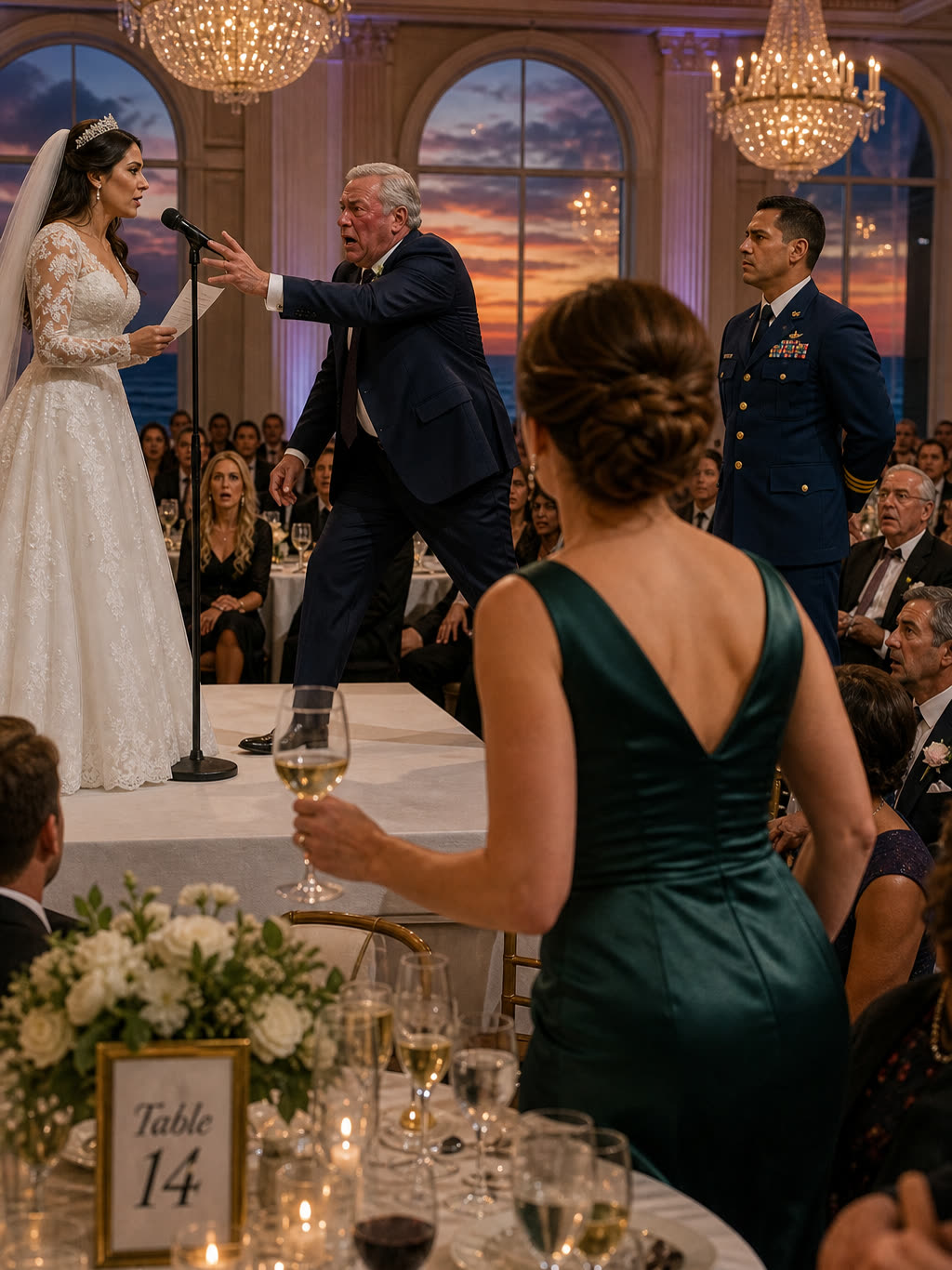
Across the ballroom, Valerie suddenly rose from the head table.
Her new husband helped gather the long train of her wedding gown as the musicians stopped playing.
A spotlight shifted toward the stage.
Valerie walked to the microphone holding a thick brown envelope.
Her face was pale.
Her shoulders remained steady.
I remembered the determination I had seen in the bridal suite.
Now I understood that she had been preparing for something all along.
Benedict settled back in his chair.
He appeared to expect a sentimental wedding speech celebrating family values.
Gwen smiled, apparently convinced the evening had unfolded exactly as she wanted.
But Valerie was not looking at either of them.
Her eyes were fixed on me.
“I need to honor someone very special tonight,” she began, her voice trembling slightly through the speakers. “I need to honor someone this family tried to erase completely.”
A wave of murmurs moved through the ballroom.
My father’s expression changed.
Valerie raised the envelope.
An official military seal was stamped on its front.
I recognized it immediately.
My fingers tightened around my glass.
I had never told Valerie that I wanted my military history brought into a family confrontation.
Yet somehow, she was holding records I knew could only have come from official sources.
She opened the envelope.
Then, before two hundred and fifty guests, my little sister began telling a story I had never expected her to share.
“Seven years ago, I nearly lost my life in a terrible accident.”
The ballroom fell silent.
“Some of you know parts of that story, but most of you do not,” she continued. “I was driving home during a severe winter storm when my car slid off the icy road and plunged into the freezing waters of Blackwood River.”
People gasped.
Valerie described the terrible cold, the water flooding her vehicle, and the helplessness of being trapped.
“I remember the water filling the car, I remember the terrifying cold, and then I remember losing consciousness,” she said, struggling to control her emotions.
Her car had sunk into the river.
Her seat belt had jammed.
She had lost consciousness, and her heart had stopped.
Then a Coast Guard rescue helicopter located the submerged vehicle in the darkness.
Valerie lifted the official report.
“A rescue pilot dove into the freezing river, cut me free from the wreckage, and pulled my lifeless body to the shore,” she said through tears. “That pilot performed CPR over and over again until my heart started beating again, and the official military report right here identifies that rescue pilot as Captain Samantha Delacroix.”
Benedict went pale.
He stared at Valerie.
For fifteen years, he had dismissed my choice to serve.
Seven years earlier, that very choice had saved his youngest daughter.
Valerie looked across the room and smiled at me.
“Yes, Captain Samantha Delacroix, my older sister,” she announced.
I lowered my eyes.
I had never discussed the rescue with my father.
He had never contacted me to learn about my service.
He had never asked whether I had flown important missions or helped anyone.
He did not even know that one of the people I had saved was his own child.
But Valerie had not finished.
She raised a second document.
“And her service did not stop there, because the career our father mocked and reduced to just playing with helicopters was actually a distinguished military life.”
She began describing my years of service.
The difficult missions.
The promotions.
The official commendations.
The leadership responsibilities I had assumed.
Then her voice grew stronger.
“Today, my sister holds the rank of Colonel,” Valerie declared. “She has been officially credited with saving two hundred and thirty-seven human lives.”
The room erupted in astonished whispers.
Dozens of people turned toward me.
I remained seated, overwhelmed by the sudden attention.
Valerie looked directly into my eyes.
“To the military, she is a decorated officer, but to me, she is simply the hero who gave me my life back.”
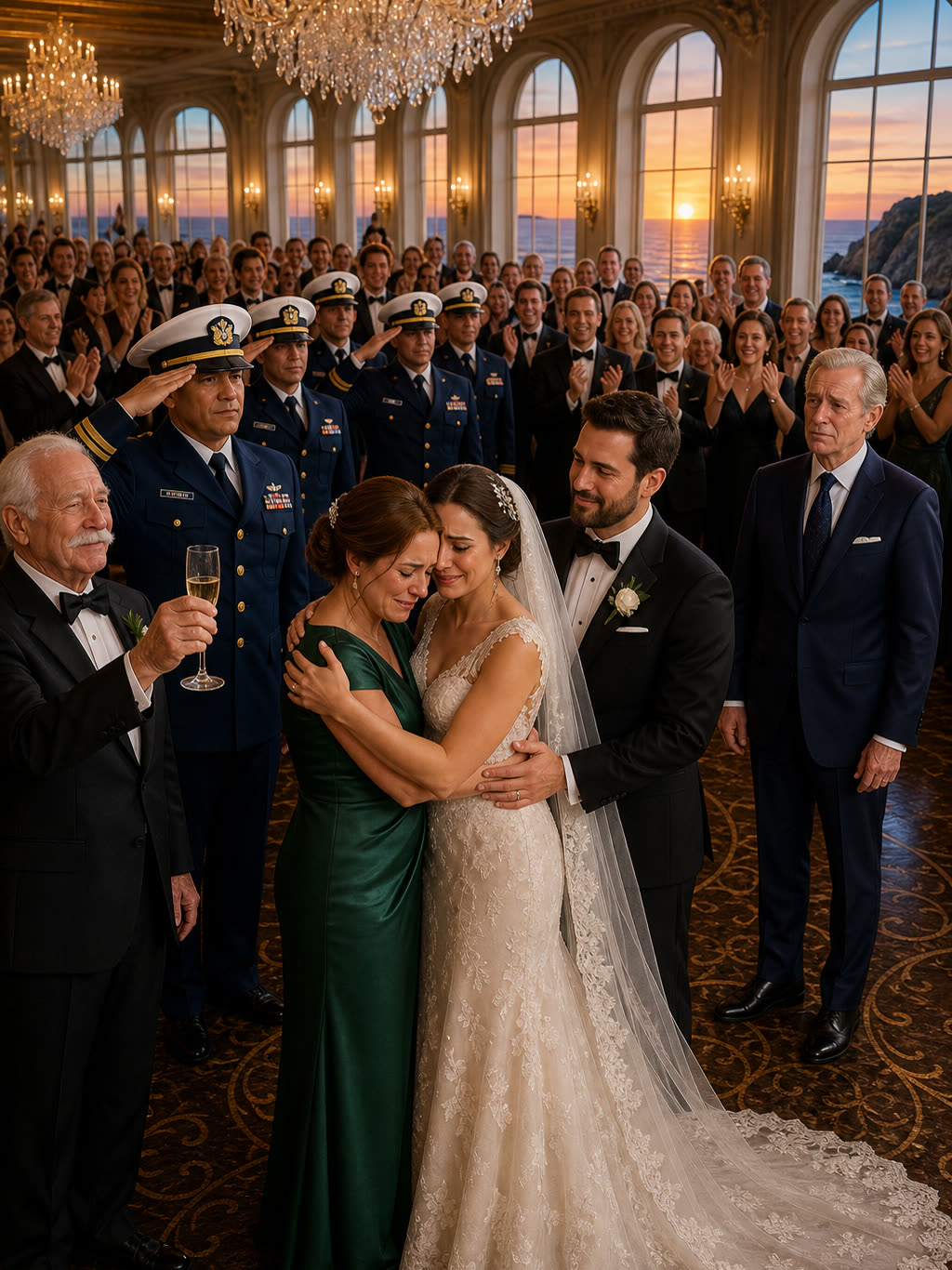
Then she raised her right hand.
Standing in her wedding gown, Valerie gave me a precise military salute.
My throat tightened.
I rose and returned it.
A retired military officer near the front stood and saluted as well.
Three other veterans followed.
Then the entire ballroom burst into applause.
The sound swelled until the room seemed to tremble.
I looked toward my father.
He was sitting motionless.
He did not applaud.
He did not stand.
He simply stared at me as though I were someone he had never met.
“This could all be exaggerated for dramatic effect,” Benedict muttered.
Valerie immediately raised the papers again.
“These are official federal records verified by the government.”
A prominent lawyer seated nearby examined the documents and confirmed their authenticity.
The citations were legitimate.
The service records were official.
The rescue report was real.
And my father could no longer dismiss the truth as another story he did not like.
Then, before the applause and whispers had fully subsided, a terrible sound came from beside the head table.
Raymond Vance gasped.
Both hands flew to his chest.
His face reddened.
And the man who had mocked my military career less than twenty minutes earlier collapsed face-first onto the floor.
PART 3: THE TWO HUNDRED AND THIRTY-EIGHTH LIFE
For one heartbeat, the ballroom froze.
Then the screaming began.
Chairs scraped across the floor.
Guests jumped from their seats.
Someone shouted for a doctor.
Raymond lay motionless near the head table.
I moved before anyone had time to decide what to do.
Years of emergency training took over.
I pushed through the crowd, dropped to my knees beside him, and checked his breathing and pulse.
He was in critical condition.
“Call emergency services right now and bring me the automated defibrillator from the lobby!” I ordered.
My voice carried across the room.
The panic surrounding us began to give way to action.
I started chest compressions.
The man beneath my hands had insulted me only minutes earlier.
That did not matter.
His wealth did not matter.
His arrogance did not matter.
His opinion of my career did not matter.
He was a human being in immediate danger.
And I knew what to do.
“Clear the area and give her space!” Benedict shouted.
For the first time that evening, my father used his authority to help instead of intimidate.
The crowd moved backward.
A staff member ran toward the lobby.
I continued CPR, concentrating on the rhythm and depth of each compression.
The ballroom had become eerily quiet.
No music played.
No one spoke above a whisper.
The only sounds came from my instructions, the movement of the staff, and the frightened breathing of people watching a life hang in the balance.
After two cycles of CPR, the staff member returned carrying the automated defibrillator.
I opened the equipment, applied the pads to Raymond’s chest, and allowed the machine to analyze his heart rhythm.
When the device advised a shock, I made sure everyone was clear and delivered it.
Then I immediately resumed chest compressions.
Seconds stretched.
I continued working.
Then Raymond’s chest suddenly moved.
A weak pulse returned.
I checked his breathing again.
His condition remained serious, but he was alive.
When paramedics hurried through the ballroom doors, he had regained consciousness and was breathing independently.
I gave the emergency crew a concise report of what had happened and the treatment provided.
They transferred Raymond onto a stretcher.
As they secured him, he turned his head toward me.
His expression held fear, exhaustion, and unmistakable regret.
“I was completely wrong about you,” Raymond whispered.
I rested a reassuring hand on his shoulder.
“Save your energy and take care of yourself, Raymond.”
The paramedics carried him toward the exit.
For several seconds, nobody moved.
Then conversations began rising around the room.
The irony was impossible to ignore.
Raymond had ridiculed my military career.
That training had just helped save his life.
My father had treated my decision to join the Coast Guard as an embarrassing rebellion.
That same decision had allowed me to rescue Valerie seven years earlier.
The woman they had deliberately seated beside the kitchen doors had become the person everyone depended on during an emergency.
I did not feel triumphant.
I felt exhausted.
Saving a life had never been a competition to me.
It was a responsibility.
And I was relieved that Raymond would have another opportunity to return home to the people who loved him.
Later that evening, I slipped away from the crowded ballroom.
I stepped onto the stone terrace, where the warm night air felt refreshing after the emotional chaos inside.
Beyond the railing, the golf course stretched into darkness.
The wedding continued behind me.
I could hear faint music and the distant murmur of guests discussing everything that had happened.
I placed my hands on the cool stone.
I needed a moment alone.
Then the terrace door opened.
Benedict stepped outside.
He approached slowly.
Without the crowd, his expensive suit and commanding posture seemed strangely unimportant.
For the first time, I did not see the powerful businessman who had controlled my childhood.
I saw an aging man who had spent fifteen years defending a terrible decision.
He stopped beside me.
For a long while, neither of us spoke.
Then he looked toward the dark golf course.
“I was completely wrong,” Benedict said quietly.
I kept my gaze forward.
He continued.
“I should have known what kind of person you had become.”
I turned slightly.
“You could have asked me at any point over the last fifteen years.”
He lowered his head.
“I spent fifteen long years telling myself that you were the selfish daughter who abandoned this family.”
I looked directly at him.
“You changed the locks and threw me out on the street when I was twenty-two years old, Dad.”
His face tightened.
“I know I did, and I was far too proud to admit my mistake.”
For once, there was no accusation behind his words.
He did not insist that I had forced him to act.
He did not claim he had been protecting the family.
He simply acknowledged what he had done.
Benedict spoke about my late mother.
He spoke about Valerie.
He spoke about the property empire he had devoted his life to expanding.
And slowly, he began admitting that his obsession with authority had damaged the very relationships he claimed to value most.
“I was just too proud to reach out,” Benedict whispered.
I felt the old ache inside me.
But I no longer confused pain with helplessness.
“Pride does not give us those missing fifteen years back, Dad,” I replied.
“No, it certainly does not.”
“It does not erase the pain or the exile either,” I reminded him.
“I know that now.”
I breathed deeply.
For years, I had imagined him apologizing.
Sometimes those imaginary apologies had ended with a warm embrace.
Sometimes I had imagined refusing to listen.
But standing beside him now, I understood that reconciliation could not be completed in one conversation.
He had changed the locks.
He had erased my photographs.
He had allowed fifteen years to pass without asking whether his daughter was safe.
One apology could not remove those choices.
Yet acknowledging the truth was still important.
I turned toward the distant horizon.
“But being completely honest with each other tonight gives us a small place to finally begin.”
Benedict looked at me.
His expression held sorrow and gratitude.
I had not forgiven everything.
I had not invited him to reclaim the role he had abandoned.
But I had offered the possibility of beginning again.
And for that night, it was enough.
EPILOGUE: THE PHOENIX WHO NEVER NEEDED APPROVAL
Before leaving the wedding venue, I stopped near the front coat check.
Valerie found me there.
She was carrying a heavy leather scrapbook against her wedding dress.
Her cheeks were still flushed from the evening, and her eyes shone with emotion.
She placed the book into my hands.
“I have been building this for you over the last seven years,” Valerie said.
I opened the cover.
Inside were carefully arranged newspaper articles about my Coast Guard missions.
Photographs from military bulletins.
Reports describing successful rescues.
Promotion announcements.
Copies of official commendations and citations.
I turned page after page, growing more emotional with each one.
Valerie had followed my career even while the rest of our family pretended I no longer existed.
She had gathered the proof of a life my father had never cared to understand.
I looked up at her.
“You kept track of all these things over the years?”
“Of course I did, because you are my big sister,” Valerie answered.
Tears filled my eyes.
Then she held out her hand.
On the inside of her custom gold wedding band was a tiny engraving.
Phoenix.
I recognized the word immediately.
It was my military radio call sign.
“That is my military radio call sign,” I said, laughing through tears.
“I know, because you will always be the hero who saved my life,” Valerie replied.
She pulled me into a tight embrace.
For a moment, I remembered her at fifteen, standing by the bedroom window as I walked away from the Delacroix estate.
That little girl had become a strong woman.
A woman who had refused to let our father decide whether we remained sisters.
She had kept my photographs and my achievements.
She had written the invitation herself.
She had faced Gwen’s opposition.
And on her wedding day, she had stood before two hundred and fifty people and spoken the truth.
The most meaningful recognition I received that evening had not come from the applause.
It had come from knowing that my sister had never stopped believing in me.
I hugged her again before leaving.
Then I drove home alone.
The highway stretched through the darkness.
Soft music played on the radio as the wedding venue disappeared behind me.
At the beginning of the evening, Benedict’s insults had sounded painfully familiar.
For years, those words had remained lodged inside me.
I had once measured success by imagining the day my father would realize he had been wrong.
I thought proving myself would finally free me from his judgment.
But something had changed.
His approval was no longer the prize I was pursuing.
It never should have been.
My father measured human worth through wealth, property, power, and influence.
He understood success through bank balances and ownership documents.
I had chosen another way to measure my life.
I measured it in people who had survived.
In families who received loved ones back after fearing they were gone forever.
In heartbeats that returned after stopping.
In strangers rescued from burning wreckage, freezing waters, and violent storms.
Seven years earlier, Valerie had been one of those heartbeats.
Tonight, Raymond Vance had become another.
I thought about the official military record Valerie had read aloud.
Two hundred and thirty-seven lives saved.
By the time I reached the open highway beyond town, that number had changed.
I was not counting the inheritance I would never receive.
I was not counting the expensive gifts my father had taken away.
I was not counting the cruel words spoken at the wedding.
And I was no longer counting the fifteen years I had spent waiting for an apology.
I was thinking about the people who were still alive because I had chosen my own path.
The sky ahead began to lighten as morning approached.
I drove toward home with a quiet smile.
Because the number that mattered to me was no longer two hundred and thirty-seven.
It was two hundred and thirty-eight.
And for the first time in my life, I understood that I had never needed my father’s permission to become someone worth being proud of.
THE END.
Disclaimer: This story is a work of fiction inspired by real-life themes. Names, characters, places and events are fictionalized, and any resemblance to real persons is purely coincidental. Images are for illustration purposes only.
