

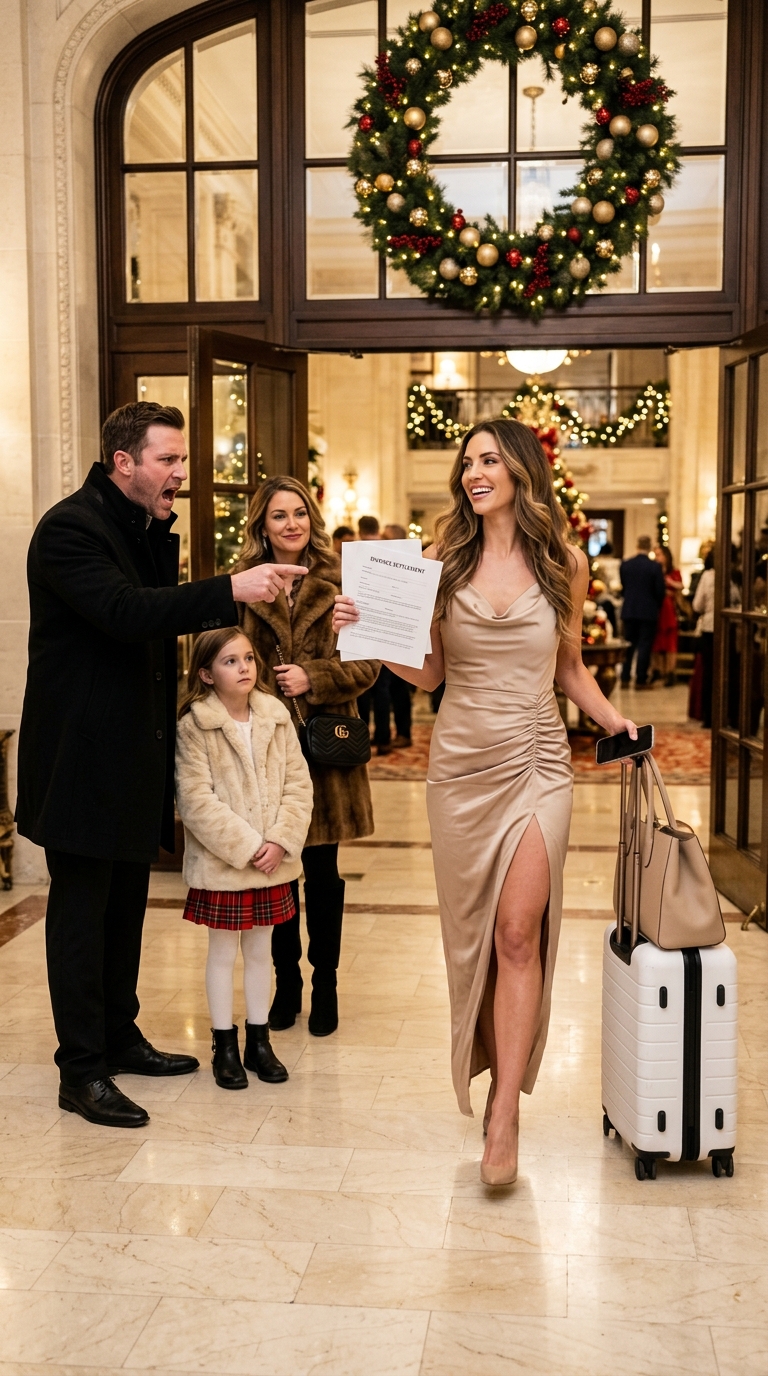
Mariana stayed awake the entire night. She sat alone in the silent kitchen of the Brooklyn brownstone, watching the glow of her laptop screen while the house carried on as though nothing had changed. Upstairs, Camila slept peacefully with a half-finished package of glitter pens beside her bed, still believing Christmas would mean cinnamon cookies, skating at Bryant Park, and a mother-daughter movie marathon in matching pajamas. Down the hall, Alexander spoke softly into his phone, using a tenderness he no longer reserved for his wife, chuckling quietly at something Renata said as though he hadn’t just broken seven years of Mariana’s life during Sunday dinner.
At 1:17 a.m., Mariana pressed send.
The email addressed to Oscar, Renata’s husband, contained no anger and no theatrics. It was organized, factual, and precise, filled with dates, screenshots, hotel receipts, credit card records, flight confirmations, and three photographs gathered by a private investigator she had hired two months earlier when her instincts became impossible to ignore. The subject line read simply: I Think You Deserve to Know the Truth.
For three long minutes, there was no response.
Then her phone lit up.
Oscar: Is this real?
Mariana stared at the words until they blurred together. She had only met Oscar twice, both times at Camila’s school functions. He had seemed like a reserved man who stood quietly behind Renata while she performed motherhood in designer coats and bright lipstick. A pediatric surgeon in Boston, he missed family dinners because he was saving children, not because he was sneaking into hotel rooms with another woman’s husband. Thinking of him reading those files alone beneath harsh hospital lights made Mariana feel slightly less isolated.
She replied: Yes. I’m sorry.
His answer arrived almost instantly: Don’t be sorry. She should be. He should be.
Mariana placed the phone face down and released a slow breath. She had expected anger, denial, perhaps even blame. Betrayed people often attacked the messenger before facing the truth. But Oscar’s calm response made her chest ache. It reminded her that somewhere beyond the dining table where Alexander’s mother had smiled while Mariana was erased, another person had been humiliated in silence.
The following morning, she rose before anyone else and packed nothing. Not yet. Instead, she made snowman-shaped pancakes for Camila, decorating them with blueberry buttons and whipped cream that slowly melted around the edges. Camila came downstairs in fuzzy socks, her dark curls tangled from sleep, and wrapped her arms around Mariana’s waist the way she did every morning.
“Mom, can we still bake gingerbread houses this week?” Camila asked.
The word Mom nearly shattered Mariana.
She quickly turned toward the stove so the little girl would not see the pain on her face. “Of course, sweetheart. We’ll make the biggest one.”
Camila grinned. “Can we make one with a little dog?”
“Two little dogs,” Mariana replied, forcing cheerfulness into her voice. “And a crooked chimney.”
Camila laughed and climbed onto the stool. For seven years, Mariana had built her entire world around that laugh. She had declined a regional CFO promotion in Seattle, another opportunity in Chicago, and most recently one in San Diego because she believed mothers stayed where their children needed them. And Camila had needed her through fevers, nightmares, school bullies, ballet recitals, spelling tests, scraped knees, and the day she cried because Renata forgot her birthday for the third consecutive year.
Twenty minutes later, Alexander entered the kitchen freshly showered, carrying the scent of expensive cologne and cowardice. He kissed Camila on the head, then glanced toward Mariana as if expecting tears or pleading. He found neither. She poured coffee into a travel mug and set a plate in front of Camila.
“We need to talk about the trip,” Alexander said.
Mariana never looked at him. “No, we don’t.”
His jaw tightened. “Mariana.”
“Camila is eating breakfast.”
Camila looked between them. “What trip?”
Alexander’s expression shifted. He had hoped to control the conversation, to package it as a gift instead of an exile. He crouched beside Camila and smiled too broadly.
“Your mom—Renata—and I thought it would be nice if you spent Christmas in Aspen this year,” he said. “Snow, skiing, a cabin. Just the three of us.”
Camila’s smile disappeared. “What about Mom?”
Alexander hesitated.
Mariana froze with the coffee pot in her hand.
Camila looked at her, confused. “You’re coming too, right?”
The silence answered before anyone else could.
Alexander cleared his throat. “This is more of a biological family trip, sweetheart. Mariana has work, and you’ll have so much fun. Renata really wants to spend time with you.”
Tears instantly filled Camila’s eyes. “But Mom promised we would see the lights.”
Mariana turned away, gripping the counter until her knuckles lost color. She wanted to scream that she was the one who knew Camila hated ski boots because they hurt her ankles. She wanted to point out that Renata didn’t know Camila still slept with a night-light whenever she felt anxious. She wanted to ask Alexander how a father could watch his daughter’s face crumble and continue lying.
Instead, she walked around the island, knelt beside Camila, and gently took both of her hands.
“Sweetheart,” Mariana said gently, “sometimes grown-ups make plans that are hard to understand. But I need you to know something very important. No trip, no house, no city, no paper, no person can change how much I love you.”
Camila’s lips trembled. “But are you mad at me?”
Mariana pulled her into a hug. “Never. Not for one second.”
Alexander looked uncomfortable, but not guilty enough to stop. Men like him always wanted neat exits from messy decisions. He wanted Camila excited, Mariana silent, Renata satisfied, and history rewritten so he could appear noble instead of cruel. But events were already shifting against him, and he had no idea.
By noon, Oscar sent another message.
I confronted her. She denied it until I showed her the hotel receipt. She says Alexander told her you two were separated. I know that’s a lie. I’m flying to New York tonight. We need to talk.
Mariana read it twice from her office at the financial firm where she served as senior finance director. Beyond the glass walls, winter sunlight reflected off Manhattan skyscrapers. Her assistant knocked and reminded her the CEO needed a final answer on the San Diego promotion by five o’clock. Mariana looked down at the city and the life she had repeatedly made smaller for people who never intended to value her sacrifices.
“Tell him I already answered,” Mariana said. “I’m taking it.”
Her assistant blinked. “Really?”
Mariana turned around. “Really.”
By the end of the afternoon, HR sent the contract. The position was Regional Chief Financial Officer, West Coast Division. The compensation package included a $310,000 salary, bonus opportunities, relocation assistance, executive housing for six months, and complete oversight of a division Alexander had once dismissed as “too intense for a woman who cares about home life.” Mariana signed at 4:42 p.m. and felt something shift inside her—not happiness exactly, but air returning to her lungs.
That evening, she met Oscar at a quiet hotel bar near Columbus Circle. He arrived wearing a gray coat, exhausted but composed in the unsettling way people become when pain has moved beyond anger. Before ordering anything, he set a folder on the table.
“I brought more,” he said.
Mariana studied him carefully. “More what?”
“Proof,” Oscar answered. “Renata didn’t just restart things with Alexander. She’s been planning to leave me since September. She transferred money from our joint savings, opened another account, and told her sister she planned to use Christmas in Aspen to ‘test family life’ with him and Camila.”
A chill spread through Mariana’s body. “Test family life?”
Oscar’s mouth tightened. “Her words.”
He opened the folder. Inside were printed text messages between Renata and her sister, Claudia. Mariana read each one slowly, feeling every sentence strike like a slap.
If Camila adjusts well, Alex will file right after New Year’s. Mariana has no legal claim. She’ll cry, but she’ll get over it.
Patricia says Mariana was always too career-focused anyway. We can say Camila needs stability with her real mother.
Alex thinks Mariana won’t fight because she loves the girl too much.
For a long moment, Mariana could not breathe.
Oscar watched quietly. “I’m sorry.”
Mariana closed the folder. “They were going to take her from me.”
“Yes.”
“Not because Renata suddenly wanted to be a mother.”
“No,” Oscar said. “Because Alexander wanted a cleaner story.”
Mariana looked toward the hotel windows where snow had started falling across the city. A month earlier, this revelation would have destroyed her. A week earlier, it might have made her beg. But now something inside her hardened into a shape she neither recognized nor feared.
“What do you want to do?” Oscar asked.
Mariana looked back at him. “I’m leaving on the twenty-third.”
He looked surprised. “Leaving?”
“San Diego. New job. New life. I accepted the promotion.”
Oscar studied her carefully. “Does Alexander know?”
“No.”
“Does Camila?”
The question hit hardest. Mariana looked down at her hands. “Not yet.”
Oscar leaned back, understanding immediately. “You know they’re going to blame you.”
“They already erased me,” Mariana said quietly. “Blame is just the sound they’ll make when they realize I’m gone.”
Oscar didn’t smile, but respect flickered across his face. “Then make sure you leave protected.”
That was the moment the plan became real.
During the next ten days, Mariana moved through her life like a woman carrying a hidden flame. She met with a lawyer specializing in step-parent custody and divorce. She learned that the law was complicated, painful, and far less sentimental than bedtime stories. She was not Camila’s legal mother. She had never adopted her because years earlier Renata refused, insisting she was “not ready to give up that title,” despite rarely showing up to earn it. Mariana had accepted the humiliation because she believed love mattered more than legal documents.
Now the documents mattered.
Her attorney explained that Mariana could not simply demand custody, but she could document her role as Camila’s primary caregiver and seek visitation if the court believed cutting contact would harm the child. It would be difficult. Expensive. And it would force everyone to acknowledge what had been true for years: Renata gave birth to Camila, but Mariana raised her.
Mariana handed over everything. School emails addressed to “Camila’s mom.” Medical records listing Mariana as the emergency contact. Receipts for therapy, tuition, uniforms, camp fees, ballet classes, braces consultations, and the coding camp Camila adored. Photos from birthdays Renata missed. Voice messages from Alexander saying, “Can you pick up Camila? I’m stuck at work,” when he was actually having dinner with Renata.
The attorney reviewed the files and finally said, “Mrs. Whitman, whether the court grants standing or not, one thing is clear. You were not a babysitter.”
Mariana nodded, her eyes burning. “I know.”
“No,” the attorney replied. “You need to really know. Because they are counting on you forgetting.”
Meanwhile, Alexander became cheerful in the most painful way possible. He bought ski jackets for Aspen and left them hanging in the hallway like trophies. His mother visited with gifts and loudly discussed “real family healing.” Renata called Camila almost every evening, suddenly interested in school, favorite foods, and Christmas wishes as if studying for a role she had neglected for years.
Camila tried to be polite, but Mariana saw the confusion. Children always knew the difference between love and performance. They might not have the vocabulary, but they felt the difference.
One evening, Camila entered Mariana’s room holding a stuffed rabbit.
“Mom?”
Mariana looked up from a relocation checklist. “Yes, baby?”
“If Renata is my real mom, what are you?”
The question stopped time.
Mariana closed the laptop and patted the bed. Camila climbed beside her, small and warm, carrying a fear no child should have. Mariana brushed the curls from her forehead.
“I am the person who has loved you every day,” Mariana said. “I may not have the first page of your story, but I have been in almost every chapter since.”
Camila thought quietly for a moment.
“Can a kid have two moms?”
Mariana spent the entire night awake.
She sat alone in the quiet kitchen of the Brooklyn brownstone, the soft glow of her laptop illuminating her face while the rest of the house carried on as though nothing had changed. Upstairs, Camila slept peacefully beside a half-finished package of glitter pens, still believing Christmas would bring cinnamon cookies, skating at Bryant Park, and a movie marathon with her mother in matching pajamas. Down the hall, Alexander spoke softly into his phone, laughing at something Renata had said with a warmth he no longer shared with his wife, as though he had not shattered seven years of Mariana’s life during Sunday dinner.
At exactly 1:17 a.m., Mariana pressed send.
The email addressed to Oscar, Renata’s husband, contained no anger and no theatrics. It was precise, organized, and impossible to dismiss. Dates. Screenshots. Hotel receipts. Credit card statements. Flight confirmations. Three photographs captured by the private investigator Mariana had hired two months earlier when her instincts became impossible to ignore.
The subject line read:
I Think You Deserve to Know the Truth.
For three long minutes, there was no response.
Then her phone lit up.
Oscar: Is this real?
Mariana stared at the message until the words blurred together.
She had only met Oscar twice, both times during school events for Camila. He always seemed like a quiet man standing slightly behind Renata while she performed motherhood in expensive coats and bright lipstick. He was a pediatric surgeon in Boston, the kind of man who missed family dinners because he was saving children, not because he was sneaking into hotels with another woman’s husband.
Imagining him reading the evidence alone under harsh hospital lights, Mariana felt something unexpected.
For the first time that night, she did not feel completely alone.
She replied:
Yes. I’m sorry.
His answer appeared almost instantly.
Don’t be sorry. She should be. He should be.
Mariana placed her phone face down on the table and released a slow breath.
She had expected anger. Denial. Accusations. Betrayed people often attacked the messenger before accepting the wound.
Instead, Oscar’s calm response made her chest ache.
It reminded her that somewhere beyond the dining table where Alexander’s mother had smiled while Mariana was being erased, another person had also been humiliated in silence.
The following morning, Mariana rose before anyone else.
She packed nothing.
Not yet.
Instead, she made snowman-shaped pancakes for Camila, using blueberries for buttons and whipped cream that melted around the edges.
Camila padded downstairs in fuzzy socks, dark curls messy from sleep, and wrapped her arms around Mariana’s waist the way she did every morning.
“Mom, can we still bake gingerbread houses this week?” Camila asked.
The word Mom nearly shattered her.
Mariana turned toward the stove before the little girl could see her face.
“Of course, sweetheart. We’ll make the biggest one.”
Camila smiled.
“Can we make one with a little dog?”
“Two little dogs,” Mariana replied, forcing brightness into her voice. “And a crooked chimney.”
Camila laughed and climbed onto her stool.
For seven years, Mariana had built her entire life around that laugh.
She had declined a regional CFO position in Seattle, another opportunity in Chicago, and most recently a promotion in San Diego because she believed mothers stayed where their children needed them.
And Camila had needed her.
Through fevers.
Nightmares.
School bullies.
Dance recitals.
Spelling tests.
Scraped knees.
And the birthday when Renata forgot her for the third year in a row.
Twenty minutes later, Alexander entered the kitchen, freshly showered and smelling of expensive cologne and bad decisions.
He kissed Camila’s head and glanced toward Mariana as though expecting tears or pleading.
He found neither.
Mariana poured coffee into a travel mug and handed Camila her breakfast.
“We need to talk about the trip,” Alexander said.
Without looking at him, Mariana replied, “No, we don’t.”
His jaw tightened.
“Mariana.”
“Camila is eating breakfast.”
Camila looked between them.
“What trip?”
A flicker of discomfort crossed Alexander’s face.
He had clearly hoped to control the conversation and present it as a gift rather than an exile.
Kneeling beside Camila, he forced a smile.
“Your mom—Renata—and I thought it would be nice if you spent Christmas in Aspen this year,” he said. “Snow, skiing, a cabin. Just the three of us.”
Camila’s smile disappeared.
“What about Mom?”
Alexander hesitated.
Mariana froze with the coffee pot still in her hand.
Camila looked at her in confusion.
“You’re coming too, right?”
The silence answered before anyone spoke.
Alexander cleared his throat.
“This is more of a biological family trip, sweetheart. Mariana has work, and you’ll have so much fun. Renata really wants to spend time with you.”
Tears instantly filled Camila’s eyes.
“But Mom promised we would see the lights.” Mariana turned away, clutching the edge of the counter so tightly her knuckles turned white. She wanted to shout that she was the one who knew Camila hated ski boots because they always rubbed her ankles raw. She wanted to remind them that Renata had no idea Camila still slept with a night-light whenever she felt anxious. She wanted to demand what kind of father could watch his daughter’s face fall apart and continue lying to her without hesitation.
Instead, she stepped around the kitchen island, lowered herself beside Camila, and gently took both of the little girl’s hands.
“Sweetheart,” Mariana said gently, “sometimes grown-ups make plans that are hard to understand. But I need you to know something very important. No trip, no house, no city, no paper, no person can change how much I love you.”
Camila’s lips trembled. “But are you mad at me?”
Mariana pulled her into a tight embrace. “Never. Not for one second.”
Alexander shifted uneasily, but not enough to stop what he had set in motion. Men like him always wanted tidy exits from messy betrayals. He wanted Camila excited, Mariana silent, Renata pleased, and the entire story rewritten so he could appear honorable instead of selfish. What he did not realize was that events had already begun turning against him.
By noon, Oscar responded to the email.
I confronted her. She denied it until I showed her the hotel receipt. She says Alexander told her you two were separated. I know that’s a lie. I’m flying to New York tonight. We need to talk.
Mariana read the message twice from her office at the financial firm where she served as senior finance director. Beyond the glass walls, the December sunlight reflected sharply from Manhattan’s towers. Her assistant knocked and reminded her that the CEO needed her final answer regarding the San Diego promotion before five o’clock. Mariana gazed down at the city and the life she had repeatedly shrunk for people who never intended to value it.
“Tell him I already answered,” Mariana said. “I’m taking it.”
Her assistant blinked in surprise. “Really?”
Mariana turned toward her. “Really.”
By the end of the afternoon, HR had delivered the contract. The position was Regional Chief Financial Officer, West Coast Division. The compensation package included a $310,000 salary, bonuses, relocation assistance, six months of executive housing, and authority over a division Alexander had once mocked as “too intense for a woman who cares about home life.” Mariana signed at exactly 4:42 p.m. and felt something move inside her chest—not happiness, but something close to breathing again.
That evening, she met Oscar in the lounge of a quiet hotel near Columbus Circle. He arrived wearing a gray coat, exhausted but composed in the unsettling way people become after pain moves beyond anger. Before even ordering a drink, he placed a folder on the table.
“I brought more,” he said.
Mariana studied him carefully. “More what?”
“Proof,” Oscar replied. “Renata didn’t just restart things with Alexander. She’s been preparing to leave me since September. She transferred money from our joint savings, opened another account, and told her sister she planned to use Christmas in Aspen to ‘test family life’ with him and Camila.”
A chill spread through Mariana.
“Test family life?”
Oscar’s expression hardened. “Her exact words.”
He opened the folder. Inside were printed conversations between Renata and her sister, Claudia. Mariana read every message slowly, each sentence striking harder than the last.
If Camila adjusts well, Alex will file right after New Year’s. Mariana has no legal claim. She’ll cry, but she’ll get over it.
Patricia says Mariana was always too career-focused anyway. We can say Camila needs stability with her real mother.
Alex thinks Mariana won’t fight because she loves the girl too much.
For several seconds, Mariana could barely breathe.
Oscar watched quietly. “I’m sorry.”
Mariana closed the folder. “They were planning to take her away from me.”
“Yes.”
“Not because Renata suddenly wanted to be a mother.”
“No,” Oscar said. “Because Alexander wanted a cleaner story.”
Mariana stared toward the hotel windows where snowflakes drifted through the evening air. A month earlier, this revelation would have broken her. A week earlier, it would have made her beg. Now something inside her was hardening into a form she neither recognized nor feared.
“What are you going to do?” Oscar asked.
Mariana looked at him. “I’m leaving on the twenty-third.”
His eyebrows lifted. “Leaving?”
“San Diego. New job. New life. I accepted the promotion.”
Oscar studied her carefully. “Does Alexander know?”
“No.”
“Does Camila?”
The question hurt. Mariana lowered her gaze to her hands.
“Not yet.”
Oscar leaned back in his chair. “You know they’ll blame you.”
“They already erased me,” Mariana said quietly. “Blame is just the noise they’ll make when they realize I’m gone.”
Oscar didn’t smile, but there was unmistakable respect in his eyes.
“Then make sure you leave protected.”
That was the moment the plan became real.
Over the following ten days, Mariana moved through her life like someone carrying a hidden flame. She consulted a lawyer who specialized in divorce and step-parent custody. She quickly learned that the law was complicated, unforgiving, and far less sentimental than any bedtime story. She was not Camila’s legal mother. She had never adopted her because Renata refused years earlier, insisting she was “not ready to give up that title,” despite rarely acting like a parent. Mariana had endured that humiliation because she believed love mattered more than paperwork.
Now paperwork mattered very much.
Her attorney explained that she could not simply demand custody, but she could document her role as Camila’s primary caregiver and seek visitation if the court believed severing the relationship would harm the child. It would be difficult. It would be costly. Most of all, it would force everyone to acknowledge what had always been true: Renata gave birth to Camila, but Mariana raised her.
Mariana handed over everything. School emails addressed to “Camila’s mom.” Medical documents listing Mariana as the emergency contact. Receipts for therapy appointments, tuition, uniforms, camps, ballet lessons, orthodontic consultations, and the coding program Camila adored. Photographs from birthdays Renata never attended. Voice messages from Alexander saying, “Can you pick up Camila? I’m stuck at work,” even when he was actually having dinner with Renata.
After reviewing the records, her attorney finally looked up.
“Mrs. Whitman, whether the court grants standing or not, one thing is clear. You were not a babysitter.”
Mariana nodded, her eyes stinging.
“I know.”
“No,” the attorney replied. “You need to truly understand that. Because they are counting on you forgetting.”
Meanwhile, Alexander became cheerful in the most painful way possible. He bought ski jackets for Aspen and hung them in the hallway like trophies. His mother stopped by with presents and loudly discussed “real family healing.” Renata called Camila almost every evening, suddenly interested in her school, favorite foods, and Christmas wishes, as though cramming for a test she had failed for seven years.
Camila tried to be polite, but Mariana saw the confusion in her eyes. Children recognized the difference between genuine love and performance. They might not have the vocabulary for it, but they always felt it.
One evening, Camila appeared in Mariana’s room clutching a stuffed rabbit.
“Mom?”
Mariana glanced up from a relocation checklist.
“Yes, baby?”
“If Renata is my real mom, what are you?”
The question seemed to stop time itself.
Mariana closed her laptop and patted the bed. Camila climbed beside her, small and warm, carrying a fear no child should have to bear. Mariana gently brushed curls away from her face.
“I am the person who has loved you every day,” Mariana said. “I may not have the first page of your story, but I’ve been in almost every chapter after that.”
Camila considered it.
“Can a kid have two moms?”
Mariana’s throat tightened. “A kid can have as many people loving her as her heart can hold.”
“Then why does Dad act like I have to choose?”
Mariana briefly closed her eyes. There it was—the wound adults created and children were forced to understand.
“Because sometimes grown-ups are scared, and instead of being honest, they try to control things,” Mariana said. “But you do not have to choose love like it’s a contest.”
Camila leaned against her shoulder.
“I don’t want to go for two weeks.”
Mariana wrapped her arms around her.
“I know.”
“Can you tell Dad?”
“I can tell him,” Mariana whispered. “But he may not listen.”
Camila’s voice became barely audible.
“Will you still be here when I get back?”
Mariana didn’t answer right away.
That pause said everything.
Camila pulled back and stared at her.
“Mom?”
Mariana felt her heart split open. She had intended to tell her after Christmas, hoping to spare her another hurt before the trip. But enough damage had already been done through lies.
“I got a new job,” Mariana said softly. “In California.”
The color drained from Camila’s face.
“You’re leaving me?”
“No.” Mariana immediately took both her hands. “I’m leaving this marriage. I’m leaving a house where people think they can hurt me and call it peace. But I am not leaving you in my heart. Never.”
Tears spilled down Camila’s cheeks.
“But I can’t go with you.”
Mariana swallowed the truth like broken glass.
“Not right now.”
Camila began sobbing, deep heartbreaking sobs that shook her entire body. Mariana held her and rocked her gently, just as she had years earlier when nightmares woke her in the middle of the night. Downstairs, Alexander heard the crying and came upstairs irritated.
“What happened?” he demanded from the doorway.
Camila turned toward him with a fury Mariana had never witnessed before.
“You’re making her leave!”
Alexander froze.
Mariana rose slowly.
“Not in front of her.”
But Camila was already crying harder.
“You said she’s not my mom! You said she can’t come to Christmas! You said Renata is my real mom, but Mom is here every day and Renata doesn’t even know I hate raisins!”
Alexander’s face tightened with embarrassment, not regret.
“Camila, calm down.”
“No!” Camila shouted. “I don’t want Aspen! I want Mom!”
Mariana stepped between them.
“Alexander, leave the room.”
His eyes flashed.
“This is my daughter.”
“And she is in pain because of you,” Mariana said.
For a moment, it looked as though he might argue. Then he noticed Camila behind Mariana, crying into her stuffed rabbit, and something inside him wavered. But as always, his pride arrived before his love could.
“We’ll talk tomorrow,” he said coldly.
He turned and walked away.
The following morning, Renata called Alexander in a rage. Camila had refused to speak with her. Alexander immediately blamed Mariana, accusing her of manipulating the child, weaponizing her feelings, and deliberately sabotaging Christmas. Mariana sat across from him at the kitchen table, so calm it seemed to unsettle him.
“You told a child the woman raising her has no right to love her,” she said. “You poisoned the house without my help.”
Alexander leaned across the table. “You are not taking my daughter from me.”
A sad smile touched Mariana’s face.
“You’re so used to taking from me that you think leaving is theft.”
His eyes narrowed.
“What does that mean?”
“It means my attorney will contact yours.”
The color drained from his face.
“Attorney?”
“Yes.”
“You’re serious about divorce?”
“You offered it at dinner,” Mariana said. “I’m accepting.”
He stared at her as though the word accepting itself offended him. He had expected tears, resistance, bargaining, maybe even pleading. What he had never expected was a woman who had already organized her heartbreak into legal documents.
“You won’t get much,” he said. “The house is complicated.”
For the first time in days, Mariana smiled.
“The house is in my name.”
His jaw tightened immediately.
“The car I drive is in my name. The savings account you forgot I funded is in my name. The retirement accounts are documented. And your consulting business? The one I supported for four years while you told everyone you were rebuilding? My accountant has questions about that too.”
His confidence visibly faltered.
“You’ve been planning this.”
“No,” Mariana replied. “You planned this. I just stopped being unprepared.”
On December 22, Oscar officially filed for divorce from Renata in Boston. He also sent Alexander a message containing only a single sentence:
Do not bring my wife near your daughter until our attorneys speak.
Alexander exploded.
Renata called screaming, insisting Mariana had ruined everything, while Patricia rushed to the Brooklyn brownstone determined to defend her son. She arrived to find Mariana calmly labeling moving boxes in the living room.
“You should be ashamed,” Patricia hissed. “That little girl needs her real family.”
Mariana placed a tape dispenser into a box before looking up.
“Then maybe her real family should have shown up before Christmas became useful.”
Patricia’s lips pressed into a thin line.
“I always knew you were cold.”
Mariana rose to her feet.
“No, Patricia. I was polite. You confused the two.”
“You think a promotion will keep you warm at night?”
“No,” Mariana said. “But self-respect will.”
Patricia lifted her hand as though she intended to slap her.
Then Camila appeared halfway down the staircase.
“Grandma, don’t.”
Patricia froze.
Camila slowly descended the stairs, one hand gripping the railing. Her face looked pale, but there was determination in her eyes.
“Don’t talk to my mom like that.”
Patricia looked stunned.
“Camila, sweetheart, this is adult business.”
“No,” Camila said. “It’s my business too.”
Mariana had never felt more proud or more heartbroken at the same time.
That evening, she and Camila baked gingerbread together anyway. The house filled with the scent of cinnamon, sugar, and endings. Camila decorated one cookie to look like a woman wearing a red scarf and another to look like a little girl with frosting all through her hair.
Alexander spent most of the night locked inside his office, fielding calls from Renata, Patricia, and eventually his attorney.
Just after midnight, Mariana found an envelope slipped beneath her bedroom door.
Inside was a drawing from Camila.
It showed two houses—one in snowy New York and one in sunny California surrounded by palm trees. A bright red line connected them. Written along that line were the words:
This is not goodbye. This is our bridge.
Mariana pressed the drawing against her chest and cried in silence.
December 23 arrived bright and cold.
Alexander’s flight to Aspen was scheduled for 10:30 a.m.
Mariana’s flight to San Diego departed at 10:45.
The timing felt strangely poetic. They would all leave New York within minutes of one another, but only one of them understood that nothing would be waiting when they came back.
At the airport, Camila held onto Mariana so tightly that Alexander shifted impatiently nearby. Renata had flown in that morning and stood beside him in an elegant white cashmere coat, looking noticeably less confident than usual. Oscar’s divorce filing had shaken her. So had Camila’s refusal to hug her.
“Sweetie,” Renata said gently, “we’re going to have so much fun.”
Camila didn’t even look at her.
Alexander crouched beside his daughter.
“Camila, say goodbye to Mariana.”
Mariana flinched at hearing her name used that way.
So did Camila.
“She’s Mom,” Camila whispered.
Alexander closed his eyes.
“Camila—”
“She’s Mom,” Camila repeated, louder this time.
Several travelers nearby glanced over.
Mariana knelt in front of her.
“Listen to me. You have my number. You can call me anytime. Morning, night, Christmas Eve, Christmas morning, whenever you need me.”
“What if Dad says no?”
Mariana lifted her eyes to Alexander.
“Then Dad will have to explain that to a judge.”
His expression darkened, but he remained silent.
Mariana wrapped Camila in one final hug.
“Remember the bridge.”
Camila nodded through tears.
“This is not goodbye.”
“No,” Mariana whispered. “Never goodbye.”
Then she stood, picked up her carry-on suitcase, and headed toward security without turning around. She knew that if she looked back, she might run to the child, cancel the flight, and return to being useful in a home where usefulness had been mistaken for worth.
So she kept walking while her heart screamed behind her.
By the time Alexander landed in Aspen, Mariana was already flying over the desert, watching clouds turn gold beneath the winter sunlight.
He didn’t truly understand that she had left.
Not yet.
He assumed she would still be in the Brooklyn house when he returned. He assumed she would answer Camila’s calls, cry in private, and eventually settle for whatever limited role he allowed her to keep. He assumed the bills would still be paid, the refrigerator stocked, the house warm, and the entire life maintained by the woman he had so casually dismissed.
Men like Alexander rarely noticed the structure holding everything together until the roof vanished.
Christmas Eve in Aspen was a disaster.
At first, Renata tried hard. She bought matching pajamas, arranged a private sleigh ride, and posted carefully selected photographs online that made them appear like a happy reunited family.
But Camila refused to smile in most of them.
She spent hours in her room texting Mariana, sending pictures of snowstorms and sad-face emojis, asking whether California had Christmas lights.
Mariana answered every message.
She never criticized Alexander.
She never insulted Renata.
She simply remained steady, because that was what she had always been for Camila—the safe place, even from 2,800 miles away.
On Christmas morning, Camila called in tears.
Mariana answered from her temporary San Diego apartment, where three unopened moving boxes sat beside a small artificial Christmas tree she had purchased at a drugstore.
“Mom,” Camila sobbed, “Renata gave me perfume.”
Mariana sat upright.
“Okay. What happened?”
“I told her thank you, but then she said I’m old enough to stop carrying my rabbit around, and Dad said maybe she’s right, and I miss you, and I want pancakes.”
Mariana closed her eyes.
The cruelty was tiny.
That was what made it worse.
No one would go to jail for mocking a stuffed rabbit. No judge would gasp in horror over a bottle of perfume. But childhood was built from small moments, and trust was destroyed exactly the same way—one careless comment at a time.
“Sweetheart,” Mariana said calmly, “go get your rabbit.”
Camila sniffled.
“Really?”
“Yes. Hold him tight. Then breathe with me.”
For ten minutes, Mariana guided her through slow breaths while Christmas morning unfolded without her.
When Camila finally calmed down, she whispered:
“I wish you were here.”
Mariana looked around the lonely apartment and the tiny glowing tree in the corner.
“Me too, baby.”
Later that afternoon, Alexander called.
“What did you say to her?” he demanded.
“Merry Christmas to you too.”
“She’s been crying all morning.”
“Then comfort her.”
“You think I haven’t tried?”
Mariana’s tone sharpened.
“No, Alexander. I think you tried to force her into a fantasy where Renata becomes the mother of the year and I disappear quietly.”
His voice lowered.
“Where are you?”
Mariana looked out the window at sunlight shining through palm trees.
“Home.”
“The Brooklyn house?”
“No.”
Silence filled the line.
“Mariana,” he said slowly, “where are you?”
“California.”
The silence that followed was almost beautiful.
“You left?” he asked.
“Yes.”
“You actually left?”
“You told me I had no right to Christmas. So I gave you exactly what you asked for: a life without my opinion.”
His breathing changed.
“You can’t just abandon everything.”
“I didn’t abandon anything. I packed what belonged to me, accepted the job I delayed for your convenience, and filed the paperwork you requested.”
“You filed?”
“My attorney sent it yesterday. Check your email.” Alexander muttered a curse beneath his breath. “You did this on Christmas?”
“No. You did this at Sunday dinner. Christmas is just when you noticed.”
The call ended.
By New Year’s Eve, the illusion had completely unraveled. Camila barely acknowledged Renata. Alexander and Renata argued nonstop, largely because their affair no longer seemed exciting once reality settled in. Oscar had already frozen several shared accounts and initiated discovery proceedings. Renata’s carefully crafted image as the returning mother was beginning to crumble, especially after Camila admitted she wanted to leave early and go back home.
“There is no home,” Alexander snapped one night, worn out and irritated.
Camila looked directly at him. “Because Mom left?”
The words struck with the weight of a verdict.
Alexander parted his lips to respond, then thought better of it.
When they arrived back in Brooklyn on January 6, the house greeted them with silence. It was spotless, orderly, and noticeably emptier. Mariana had not gutted the place out of spite. She had simply taken what belonged to her: her wardrobe, her books, her grandmother’s dishes, her work materials, the framed photographs of her and Camila, and the blue armchair where bedtime stories had once been read. Everything Alexander considered his remained untouched—his suits, trophies, golf clubs, his mother’s china, and the possessions that only resembled family from afar.
Three envelopes rested neatly on the kitchen island.
One addressed to Alexander.
One addressed to Camila.
One addressed to Patricia.
Alexander opened his first.
Inside were divorce documents, a breakdown of marital assets, formal notice of Mariana’s legal representation, records of her financial contributions to the household, and a request for structured visitation with Camila based on her role as the child’s psychological parent and primary caregiver.
Tucked at the bottom was a handwritten note.
You told me I was not her legal mother. Now a court can hear what I actually was.
Alexander lowered himself into a chair.
Camila opened her envelope with trembling fingers. Inside was the bridge drawing she had created, now placed inside a silver frame. Alongside it were a plane-ticket voucher and a letter.
My sweet girl, this is not goodbye. I am building a safe home with a room that has your name on it, whether you visit tomorrow, next month, or years from now. No adult can erase love that was real. Keep the bridge. I love you beyond every state line. —Mom
Camila broke down crying. For the first time, Alexander understood something his pride had refused to accept. Mariana had never been an inconvenience. She had been the person who made his daughter feel secure, and he had ripped that away.
Patricia opened her envelope last after arriving to “put the house back in order.” Her face flushed red as she read Mariana’s brief message.
Patricia, you were right about one thing. Blood matters to people like you. That is why you never understood love freely given. Please do not contact me unless it concerns Camila’s emotional well-being.
Patricia called Mariana ungrateful, manipulative, dramatic, and cruel.
Mariana ignored every call.
In San Diego, she started over.
Her executive apartment overlooked the bay, and the first week felt almost surreal. She rose early, spent long hours working, learned unfamiliar systems, met new colleagues, and returned each evening to a quietness that no longer felt like punishment. Some nights she sat crying on the kitchen floor because grief cared nothing about promotions. Other nights she ordered Thai food, watched terrible reality television, and laughed simply because nobody was there to diminish her happiness.
At work, she thrived.
The West Coast division had struggled for two years, but Mariana identified the issues within ten days. Poor forecasting, bloated vendor agreements, weak compliance practices, and executives hiding behind vague optimism. She eliminated waste, renegotiated contracts, rebuilt reporting systems, and soon earned a reputation as the CFO who could enter chaos in high heels and leave behind a spreadsheet sharp enough to terrify seasoned executives.
Three months after her relocation, the company CEO flew in from New York and shook her hand before the board.
“You saved us eight million dollars in one quarter,” he said.
Mariana smiled. “Actually, eleven. The last three will show up next month.”
Laughter filled the room, but the CEO’s expression remained impressed.
That same evening, Camila called from Brooklyn.
“Mom,” she said carefully, “Dad says maybe I can visit you for spring break.”
Mariana tightened her grip on the phone. “Really?”
“He said my therapist thinks it would be good.”
Mariana closed her eyes.
The therapist.
The one she had located, scheduled, and paid for before leaving because she knew Camila would need a neutral voice when the adults around her failed.
“That sounds wonderful,” Mariana said.
Camila brightened immediately. “Do I really have a room?”
Mariana glanced toward the second bedroom. Pale yellow walls. A white desk. Shelves lined with books. A stuffed rabbit waiting on the pillow. Tiny star-shaped lights hanging across the room.
“Yes,” Mariana said. “It has been waiting for you.”
Spring break changed everything.
Camila stepped into the San Diego airport wearing a denim jacket and carrying the stuffed rabbit tucked into her backpack. Alexander accompanied her because the court arrangement required him to handle travel for the first visit. He looked tired when he spotted Mariana—not broken, not cruel, simply diminished from the man who once carried certainty everywhere he went.
Mariana wore a simple green dress, sunglasses resting in her hair. She looked peaceful.
That seemed to surprise him most.
Camila ran straight toward her.
“Mom!”
Mariana wrapped her in a tight embrace, and for a brief moment the airport vanished around them. Alexander stood nearby watching a reunion he had once tried to stop.
No words were needed.
Once Camila pulled away, she launched into a stream of questions.
“Did you get the pancake mix? Can we go to the beach? Did you find the ice cream place? Is my room really yellow? Can I call Dad tonight so he knows I’m okay?”
Mariana laughed through tears.
“Yes to all of it.”
Alexander cleared his throat.
“Her return flight is Saturday at noon.”
Mariana nodded. “I have the itinerary.”
He shifted uncomfortably.
“She has allergy medicine in the front pocket.”
“I know.”
Naturally she did.
She had been the one who discovered the allergy in the first place.
Alexander looked as though he wanted to say more, but Camila was already pulling Mariana toward baggage claim.
Before they disappeared, he spoke quietly.
“Mariana.”
She turned.
He swallowed.
“Thank you for not making this harder for her.”
Mariana held his gaze.
“I was never the one making it hard for her.”
He nodded once, accepting the truth.
That week, Camila slept in the yellow room, ate pancakes on the balcony, built sandcastles, visited the zoo, and cried only once. On Thursday night, she admitted she hated feeling forced to choose between homes.
Mariana sat beside her and gently reminded her that love was not a courtroom and children were not prizes.
Camila listened carefully before asking if the bridge drawing could stay in California.
Mariana placed it on the desk.
“This is where it belongs.”
By the time Camila returned to New York, the court had granted Mariana regular communication and scheduled visitation based on her established parental role. It was not custody. It was not adoption. It was not the legal miracle she had secretly hoped for.
But it was recognition.
A judge had effectively stated that completely removing Mariana from Camila’s life would cause harm.
For Mariana, that was enough to continue building forward.
Renata did not last.
Her divorce from Oscar became ugly once financial records surfaced. The affair with Alexander was only part of the damage. There were hidden transfers, dishonest travel explanations, and messages showing she had planned to use Camila as emotional leverage while securing a new life before abandoning her old one.
Oscar left with his dignity intact, primary custody of his younger son, and the quiet respect of being the man who refused to turn his personal pain into a public spectacle.
Renata moved to Miami, posted photographs about “healing,” and saw Camila less frequently than before.
Alexander never married her.
That surprised everyone except Mariana.
Affairs fueled by fantasy rarely survive laundry, frightened children, legal bills, and the reality of daily life. Once Mariana was gone, Renata could no longer play the role of the chosen woman competing against the abandoned wife.
She had to become a partner.
A mother.
A consistent presence.
She had wanted the title, not the responsibility.
Slowly, Alexander began to understand the difference.
