

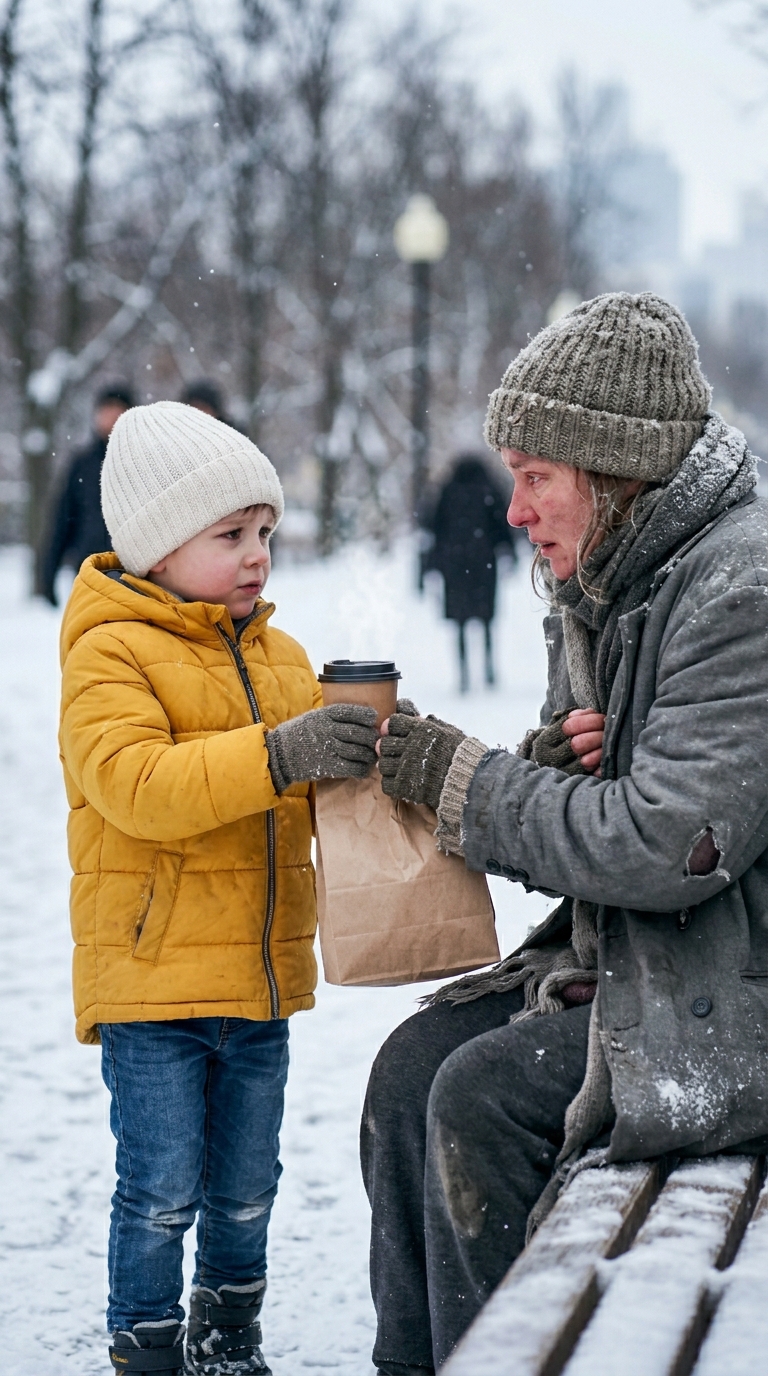
The city park lay frozen in silence under a heavy blanket of winter night. Snow fell in lazy, deliberate spirals, catching the pale glow of the streetlights like fragments of forgotten dreams. The wind moved through the bare branches of ancient oaks with a low, mournful whisper, sweeping across empty benches and slick, frozen pathways. In the distance, the muffled hum of city traffic reminded everyone that life continued somewhere beyond this quiet corner, but here, in the heart of the park, time itself seemed suspended.
People hurried past in their expensive wool coats and fur-lined boots, heads down, shoulders hunched against the cold. Their breaths rose in visible clouds, but their eyes remained fixed forward, avoiding any unnecessary connection. No one slowed. No one lingered. No one noticed the woman trembling alone on the weathered wooden bench tucked near the far edge of the park, half-hidden by the shadow of an old lamppost.
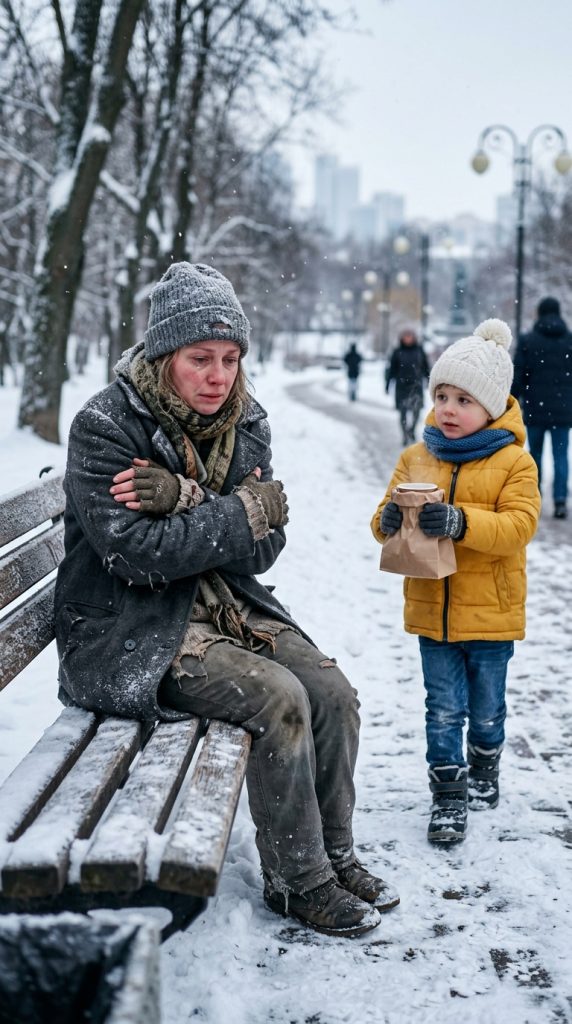
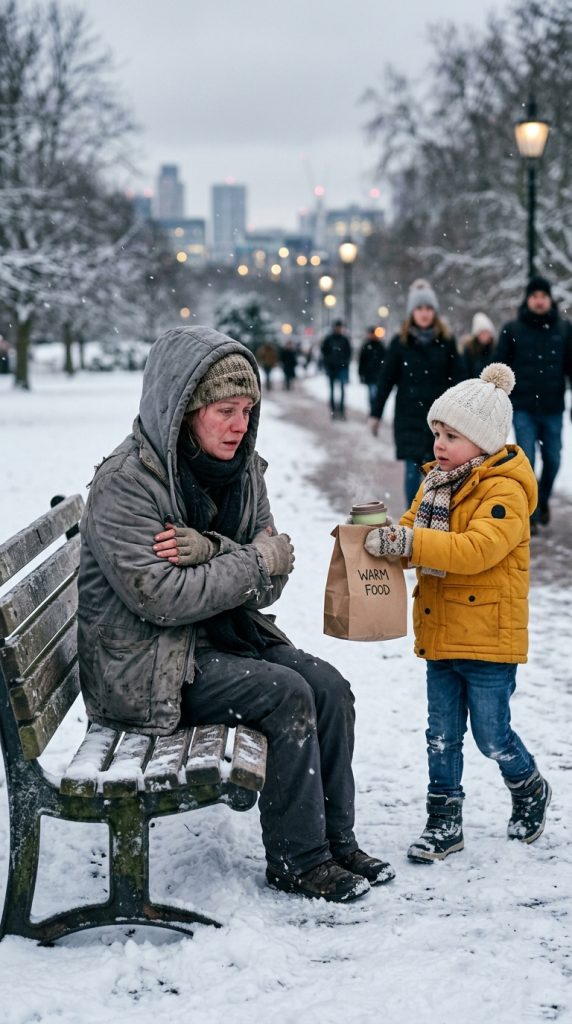
She sat curled tightly into herself, trying to conserve what little warmth remained in her frail body. Her thin gray cardigan, frayed at the cuffs and missing two buttons, offered almost no protection against the biting wind. Worn leather boots, cracked and soaked through, were dusted with fresh snow. She kept her arms wrapped desperately around her knees, fingers buried in the thin fabric of her sleeves. Her lips had taken on a bluish pallor, and every few moments a violent shiver ran through her. Beside her rested a small paper cup, its rim bent, containing only a few scattered coins that glinted coldly under the lamplight—barely enough for a cup of coffee, if anyone had bothered to stop.
Most people walked past as though she were part of the scenery, another frozen element of the winter landscape. She had grown used to it over the years. The invisibility had become its own kind of shelter, protecting her from pitying glances and harsh judgments alike. But tonight, the cold cut deeper than usual. Hunger gnawed at her stomach with sharp, insistent teeth. Days had blurred together since her last real meal.
Then, through the hush of falling snow, came a new sound.
Crunch. Crunch.
Tiny footsteps, deliberate and light, approached from the main path. The woman lifted her head weakly, surprised by the sound. A little boy in a bright yellow puffer jacket was walking toward her. The jacket looked new and expensive, a vivid splash of color against the monochrome world. A wool hat with a pom-pom was pulled low over his ears, and snow clung to the tops of his small boots. His round cheeks glowed pink from the freezing wind, but his eyes—large, dark, and impossibly warm—held a depth that seemed out of place for someone so young. They were filled with quiet worry.
He stopped directly in front of her bench, studying her with the unfiltered honesty only children possess. The woman tried to force a smile, though her body continued to shake.
“Are you cold?” the boy asked. His voice was soft, innocent, and carried the slight lisp of early childhood.
She swallowed, her throat raw. “Just a little…” Her voice cracked like thin ice. “But I’m okay, sweetheart. You should go back to your family. It’s too cold out here for a little one like you.”
The boy stared at her silently for several long seconds, as if weighing her words and finding them wanting. He knew she was lying. Children often sense truth more clearly than adults. Then, with great care, he lifted a small brown paper bag with both gloved hands. Warm steam curled gently from the folded top, carrying the comforting aroma of fresh food into the frigid air.
“This is for you,” he said simply.
The woman blinked, confusion breaking through her exhaustion. “For me?”
“My dad bought it for me,” the boy explained, lowering his gaze shyly. Snowflakes settled on his lashes. “But I think you’re much hungrier.”
For a moment, she could only stare at the bag. Her trembling hands reached out slowly, almost afraid it would vanish like a mirage. Inside lay a warm sandwich wrapped in foil and a container of soup, still hot enough that the steam fogged the plastic lid. The scent of chicken broth and melted cheese hit her like a memory of better days. Tears welled up instantly, blurring the world around her. No one had offered her warm food in so long. The simple kindness felt almost too heavy to bear.
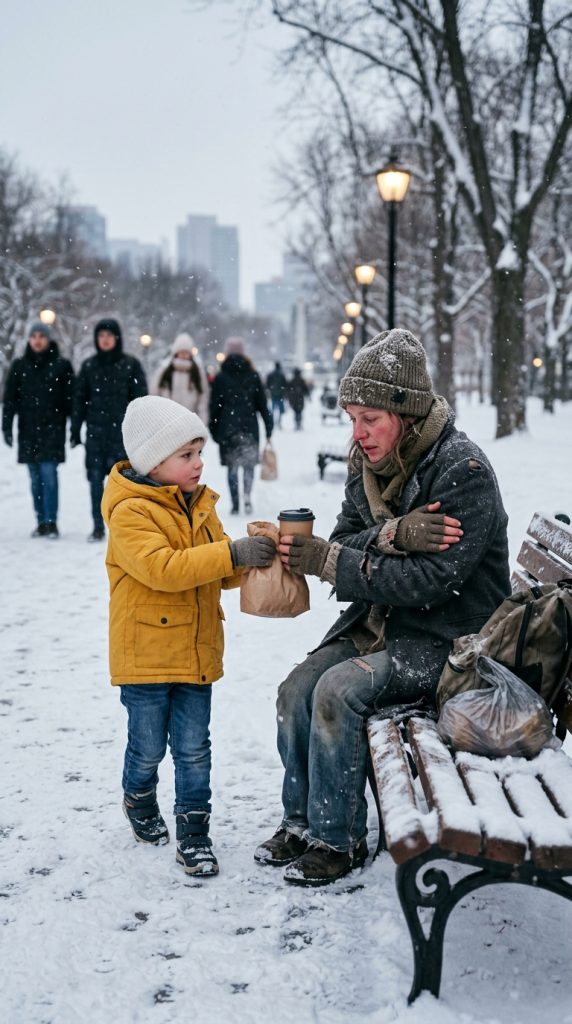
She clutched the bag tightly against her chest, as though it were something sacred. “Thank you,” she whispered, her voice nearly breaking. Snow continued to drift around them, soft and indifferent. In the distance, cars hissed past on salted roads, but in this small circle of lamplight, the world had grown quieter, gentler, more intimate.
The boy smiled—a small, gentle curve of his lips—and then, without hesitation, climbed onto the bench beside her. Snow crunched under his weight as he settled in, seemingly unconcerned by the cold seeping through his jacket. The woman looked at him in shock.
“Your parents will worry if you stay out here too long,” she said, glancing nervously toward the path.
The boy stared out at the falling snow. “Do you have a home?” he asked quietly.
The question landed like a stone in still water. She lowered her eyes immediately. “No,” she answered, the single word barely audible, carried away on the wind.
He nodded slowly, as if he had already suspected as much. His small gloved hands fidgeted in his lap. “You need a home…” he murmured. Then his voice trailed off. Something shifted in his young face—not simple sadness, but a profound loneliness that no child should ever have to carry. His shoulders seemed to slump under an invisible weight.
“What do you need?” she asked gently, sensing the depth behind his hesitation.
The boy swallowed hard, his breath visible in the cold air. “…a mom,” he whispered.
The words struck her like a physical blow. Hope and heartbreak collided across her features in the same instant. She stopped breathing for a long moment, staring at this small boy who had just given her his dinner. Suddenly, everything made terrible, beautiful sense. He wasn’t just being kind out of childish generosity. He was lonely too—achingly, deeply lonely.
Fresh tears spilled down her weathered cheeks, freezing almost instantly in the night air. The boy looked nervous. “I’m sorry,” he said quickly. “I didn’t mean to make you cry…”
But she covered her mouth with one hand, sobbing softly into the freezing night. For years, no one had looked at her as though she mattered. No one had seen beyond the dirt and the despair. Yet this tiny stranger, this child in a yellow jacket, had reached out with a warmth that the entire indifferent city lacked.
The boy hesitated, then slowly reached out and took her freezing hand in his small gloved one. The contrast in temperature was startling. “My mommy died when I was little,” he said, his voice trembling. “My dad says people disappear forever when they’re gone… but I don’t think that’s true.”
Her heart shattered completely at his words. She understood that pain better than he could ever know—the hollow ache of absence, the endless wondering. She squeezed his hand gently, unable to speak.
Suddenly, a man’s voice cut through the snowy silence.
“Ethan?!”
The boy turned quickly. A tall man in a dark wool coat was running toward them through the drifts, his face a mask of panic and relief. Snow flew from his boots with each stride. He dropped to his knees beside the bench and pulled the boy into a tight embrace.
“I told you not to run off alone!” His voice was hoarse with fear. “You scared me half to death.”
“I’m sorry, Dad,” Ethan mumbled against his father’s shoulder. Then he pointed toward the woman. “She was cold.”
The man finally lifted his gaze to her. For a heartbeat, the world stopped.
Both of them froze.
Because in that instant, recognition crashed over them like an avalanche.
Ten years earlier, before the grip of addiction had tightened, before the streets had claimed her, before everything beautiful in her life had crumbled into ruin—she had known him. Daniel Harper. The man she had once loved with her entire heart. The man whose child now sat between them on this frozen bench.
Daniel’s face drained of color. His lips moved soundlessly at first. “…Claire?”
The woman—Claire—immediately lowered her eyes in shame, unable to meet his stare. Snow drifted silently between them, filling the chasm of lost years. She could feel the weight of his gaze: shock, heartbreak, disbelief. This was the woman he had searched for desperately after she vanished one terrible night. The woman he had mourned, believing her lost forever.
Ethan looked back and forth between them, confusion knitting his small brows. “You know each other?”
Neither adult answered immediately. The silence stretched, heavy and electric.
Daniel stared at Claire, taking in every detail—the hollow cheeks, the trembling frame, the tears frozen on her lashes. This broken woman on the bench was the same vibrant soul he had once planned a future with. The mother of his son.
Claire tried to stand, her legs unsteady. “I should go—”
“No!” Ethan grabbed her hand tighter, his voice cracking with desperation. “You said people shouldn’t be alone in the cold.”
The words hung in the air, simple and devastating. Daniel’s eyes moved from his son to the warm paper bag still clutched against Claire’s chest, then to the tears on her face. Finally, he looked at Ethan—his brave, lonely little boy who had unknowingly bridged an impossible gap beneath the falling snow.
Daniel’s voice, when it came, was soft and trembling with emotion. “Come home with us.”
Claire’s eyes widened in disbelief. “No… I can’t. I’m not… I’m not who I was.”
But Ethan smiled then—a bright, hopeful smile that lit up his entire face for the first time that night. “Yes you can,” he said simply, as if the matter were already settled.
Snow continued to fall gently around the lonely park bench while the city rushed on, oblivious to the quiet miracle unfolding in its midst. In that small circle of light, three broken hearts had found the first fragile threads of healing. The wind whispered through the trees, carrying away the worst of the cold, as a family—lost, found, and newly rediscovered—began the long journey home together.
