

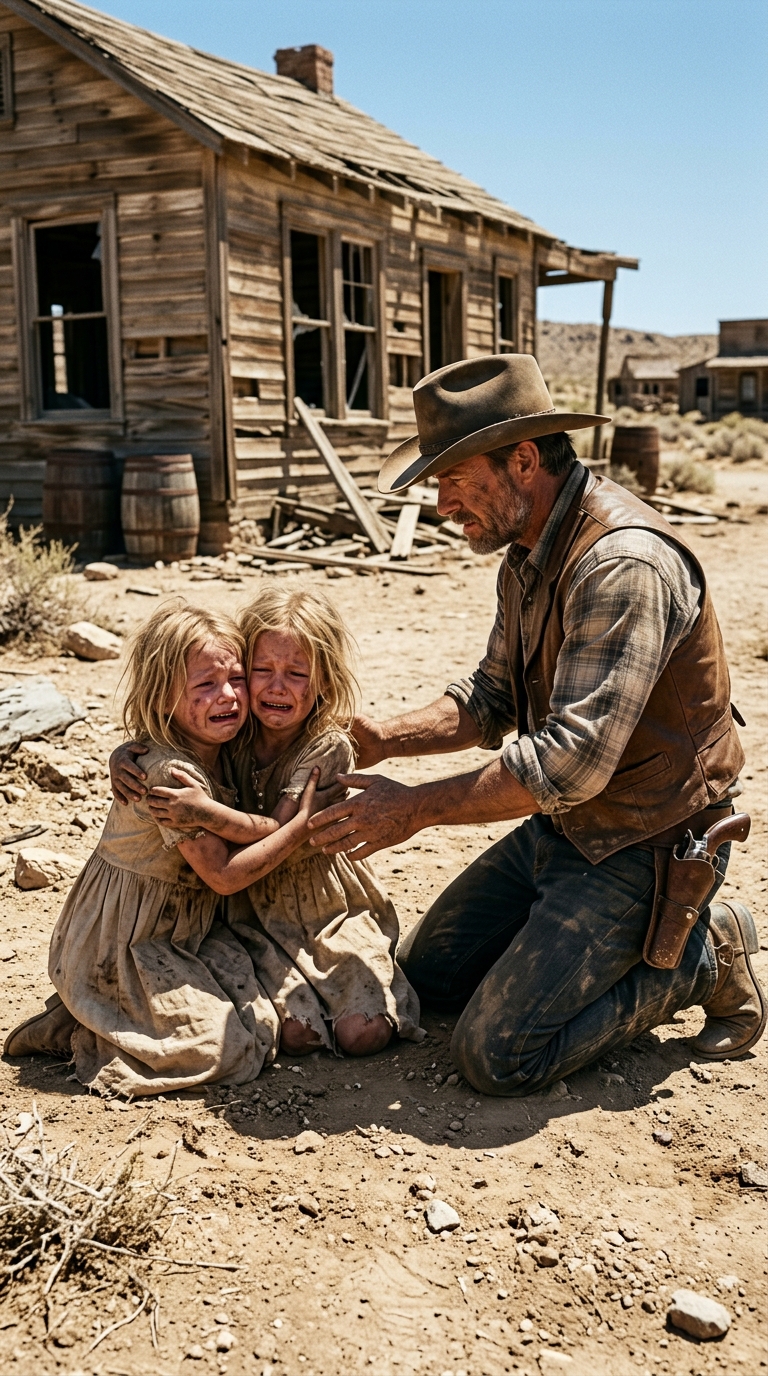
The wooden door splintered under Sebastián Robles’s kick.
He entered with the pistol in his hand, breathing hard, while the wind from the Sierra de Chihuahua blew dust and dry leaves into the abandoned shack. The place smelled of dampness, old earth, and fear.
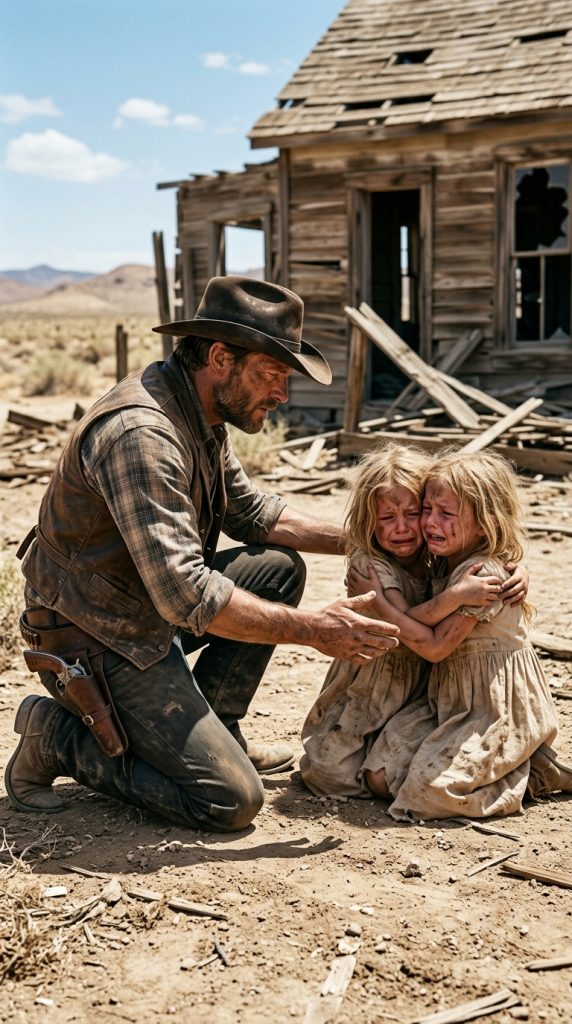
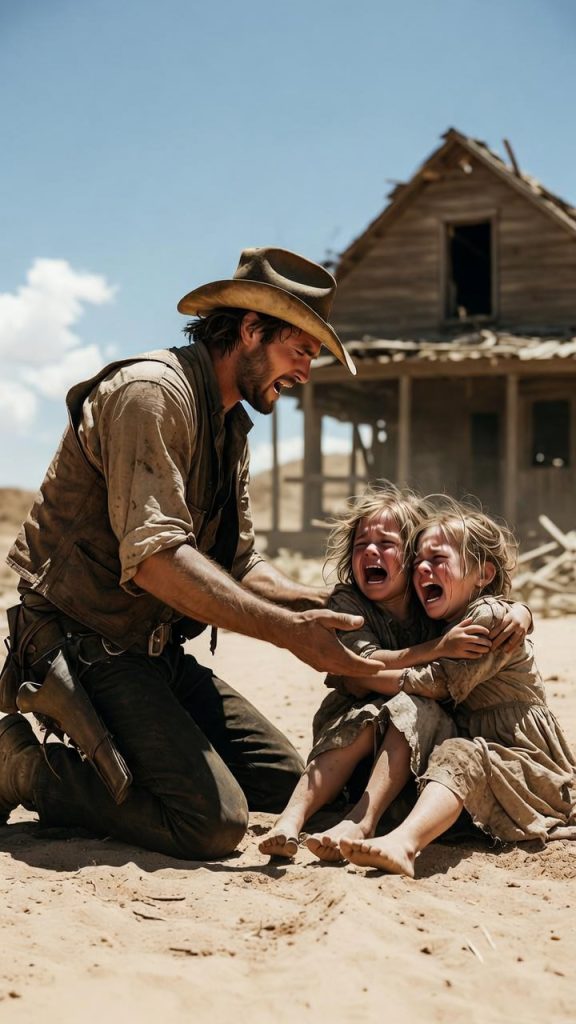
In a corner, on the dirt floor, two little girls were huddled together. They were twins, no more than four years old. One of them lifted her head with great effort. Her lips were cracked, her face dirty, and her eyes enormous, as if she had already seen more pain than a human being should ever know.
“Sir…” she whispered. “Please, save us before my little sister dies.”
The other girl wasn’t moving.
Sebastián felt his heart stop. He had been a soldier, a farmhand, a ranch pistolero, and later a solitary rancher. He had seen men die on dusty roads and horses fall in storms. But nothing had prepared him for seeing two little girls abandoned like animals.
He knelt beside them.
“What’s your name, sweetheart?”
“Lupita.”
“And your little sister?”
“Rosita. She’s been asleep since yesterday. She doesn’t answer me anymore.”
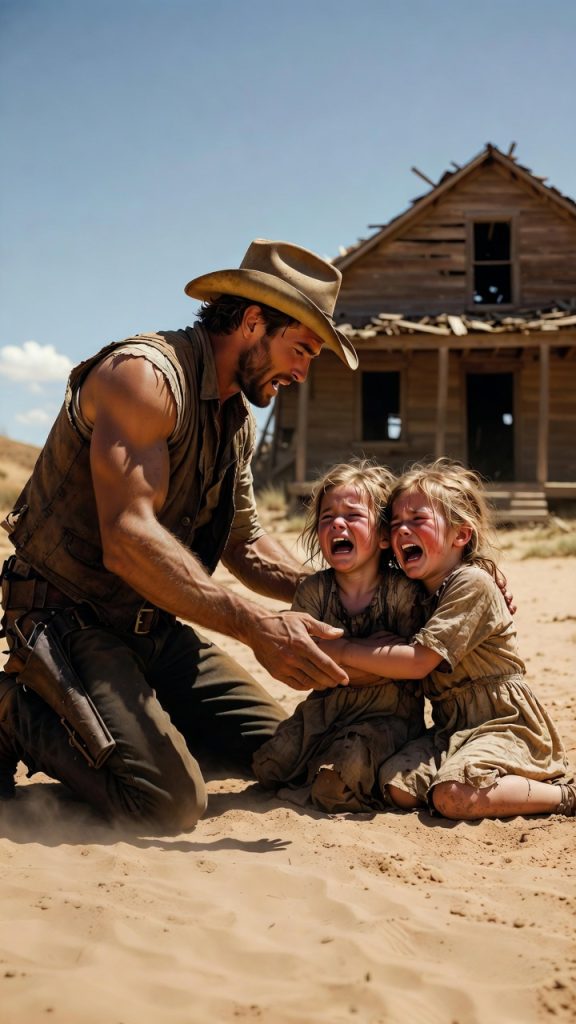
Sebastián touched Rosita’s forehead and clenched his teeth. The girl was burning with fever.
“How long have you been here?”
Lupita tried to count on her fingers.
“Three nights… maybe four. Mom said to stay very quiet. That she would come back before the moon came out.”
“What’s your mom’s name?”
“Isabel.”
The name pierced his chest like a thorn.
Isabel.
It had been ten years since Sebastián had heard that name without feeling guilt. Isabel had been the younger sister of his wife, Magdalena, the woman he had buried under a mesquite tree after a fever that no doctor wanted to treat because Sebastián couldn’t pay on time.
Magdalena had died at twenty-five years old, with a child who never got to be born.
Since then, Sebastián lived alone at Rancho Los Encinos. He received no visitors, went to no parties, and spoke no more than necessary. The town said he had turned to stone. He never denied it. It was easier to be stone than to keep being a man.
But that night, seeing the girls, something inside him broke again.
“Listen to me, Lupita. I’m going to carry both of you. I won’t hurt you.”
“Do you promise?”
“I promise on my soul.”
The little girl clung to his vest with her weak hands.
Sebastián lifted them carefully. They weighed so little that it filled him with rage. Outside, his horse, Relámpago, waited beside some dry nopales. He mounted as best he could, with the twins pressed against his chest, and rode toward the ranch before the night closed in completely.
During the ride, he spoke without stopping.
“Lupita, don’t fall asleep. Tell me something. What do you like?”
“When Mom sings.”
“What does she sing?”
“A song about the river… and a white flower.”
“Then sing it to me softly.”
The girl began to sing in a voice so weak it seemed to come from another world.
When Sebastián arrived at the ranch, he shouted from the courtyard:
“Doña Petra! Open the door!”
The old woman who took care of the house came out with a lamp in her hand.
“Holy Virgin, Sebastián, what are you bringing there?”
“Girls. One of them is slipping away. Heat some water, broth, clean cloths. And send someone for Doctor Villaseñor.”
“Where did they come from?”
“From the old shack by the stream.”
Doña Petra crossed herself.
“That shack has been abandoned for years.”
“Not anymore.”
Sebastián carried them to the room that had remained closed since Magdalena’s death. The bed still had the quilt she had embroidered with red flowers. No one had slept there in ten years.
He laid Rosita down gently and placed Lupita beside her.
“She’s not going to die, right?” Lupita asked.
Sebastián looked her in the eyes.
“Not tonight. Not while I’m here.”
The doctor arrived close to midnight. He examined Rosita, gave her drops, water with honey, and ordered damp cloths. Then he pulled Sebastián aside in the hallway.
“She’s very ill. Dehydration, fever, hunger. If she had spent one more night…”
“But she’s going to live.”
The doctor sighed.
“If God wills it, yes.”
Sebastián returned to the bedside and did not move until dawn. He fed Rosita broth drop by drop. Lupita never let go of his hand, even in her sleep.
When the sun rose, Rosita opened her eyes.
“Mom…” she murmured.
Lupita woke up with a start.
“Rosita!”
Sebastián felt his legs almost give out.
“You’re here, little one. You’re safe.”
Rosita looked at him with glassy eyes.
“Are you an angel?”
For the first time in years, Sebastián almost smiled.
“No, sweetheart. I’m Sebastián.”
Lupita sat up.
“Mom said not to trust anyone. But you came back.”
“And I will always come back.”
Then Lupita said something that changed everything:
“The man in the black jacket took Mom. He had a silver chain with a little horse.”
Sebastián felt his blood run cold.
He knew that chain.
Don Anselmo Cárdenas wore it—the most powerful man in the region. Moneylender, owner of cantinas, lands, and wills. Everyone owed him something. Even the local sheriff owed him favors.
And Sebastián knew him for another reason.
Don Anselmo had been the one who refused medicine for Magdalena when he couldn’t pay the interest on an unjust debt. He had said, smiling: “Feelings don’t cancel accounts, Robles.”
Magdalena died two days later.
Sebastián stepped out onto the porch, looked at the sierra, and clenched his fists.
“Not this time,” he whispered. “This time you won’t get away with it.”
He went to town that same morning. He entered Rita Salgado’s cantina, a brave woman who knew everything that moved in those streets.
“I’m looking for Isabel,” Sebastián said.
Rita turned pale.
“Get out of here.”
“Her daughters are at my house. One of them almost died.”
Rita dropped the glass she was cleaning.
“My God…”
She told him that Isabel had arrived four nights earlier, beaten, asking for money to flee. Don Anselmo found her before she could catch the stagecoach. His men took her to an old house south of the river, where they held indebted women and forced them to work for him.
“There’s more, Sebastián,” Rita said quietly. “Not just Isabel. There are several.”
Sebastián returned to the ranch at nightfall. Lupita was waiting for him, sitting on the bed.
“Did you find Mom?”
“I know where she might be.”
“Are you going to bring her?”
He knelt in front of her.
“I’m going to bring her or I won’t come back.”
Lupita hugged his neck.
“Then come back with her.”
That night, Sebastián rode alone toward the old house by the river. He did not take the main path. He circled through mesquites and rocks, as he had learned in his soldier years. He saw two armed men at the entrance and a light on the second floor.
He waited.
When one of the men walked away to urinate among the trees, Sebastián took him down silently. He surprised the second from behind and left him tied to a post.
He went inside.
In a locked room he found Isabel. She was thin, her face bruised, her wrists marked by ropes. When she saw him, she didn’t recognize him at first.
“Who…?”
“Sebastián Robles.”
Her eyes widened.
“Sebastián? My girls?”
“Alive. Rosita is sick, but alive. Lupita is waiting for you.”
Isabel covered her mouth with her hands and fell to her knees, crying.
“I left them… I left them there because Anselmo said that if I brought them he would sell them. I thought someone would find them. I prayed to Magdalena all night.”
Sebastián cut the ropes.
“Then Magdalena heard you.”
When they left, Isabel could barely walk. Sebastián lifted her onto the horse and rode back under a cold moon.
They arrived before dawn. Lupita ran barefoot from the room.
“Mom!”
Isabel fell to her knees and hugged her daughters as if she wanted to put them back inside her heart.
Rosita, weak but awake, murmured:
“I knew you would come.”
Sebastián stood in the doorway, not entering. That moment did not belong to him.
But the peace lasted only a short time.
At dawn, four riders arrived at the ranch. Don Anselmo rode at the front, in his black jacket, fine hat, and the silver chain with the little horse shining on his chest. Beside him rode the municipal commander.
“Robles,” Anselmo shouted. “You have something of mine in your house.”
Sebastián stepped out onto the porch with the rifle in his hand.
“There’s nothing of yours here. There’s a mother and two little girls.”
Anselmo smiled.
“Isabel owes me money. Her daughters are collateral.”
Sebastián pointed the rifle at the ground but did not lower it.
“A person is not collateral for anyone.”
The commander swallowed hard.
“Sebastián, don’t complicate this.”
“Shut up, Víctor. We all know who pays for your uniform.”
Anselmo got off his horse. In a quick movement, he pulled out a knife and grabbed Lupita, who had slipped out behind Sebastián without anyone noticing. He pressed her against his chest, the blade close to her neck.
“Drop the rifle, Robles.”
The world stopped.
Isabel screamed from inside the house. Rosita began to cry. Lupita trembled but looked at Sebastián with impossible trust.
He saw the silver chain. He saw the little horse. He saw Magdalena in her bed, without medicine. He saw Isabel beaten. He saw the girls on the dirt floor.
And he fired.
The bullet tore the knife from Anselmo’s hand and shattered his fingers. Lupita fell forward, and Sebastián caught her before she hit the ground. Anselmo’s men raised their weapons, but from the barn came Rita, the doctor, Doña Petra, and half a dozen ranchers whom Sebastián had warned before going to the rescue.
“Lower your weapons!” Rita shouted. “We’ve already sent word to the federal judge. The house by the river is surrounded.”
The commander tried to flee, but the townspeople themselves pulled him from his horse. Anselmo, pale with pain and rage, spat on the ground.
“This isn’t over.”
Sebastián hugged Lupita.
“For you, it is.”
Two weeks later, Don Anselmo Cárdenas was taken to trial. Isabel testified. So did other women rescued from the house by the river. False debts, stolen deeds, bribes, and disappearances were uncovered. The commander lost his badge and ended up in prison. Anselmo’s properties were seized to compensate his victims.
Isabel and the girls stayed at Los Encinos.
At first, she wanted to leave.
“I can’t be another burden for you, Sebastián.”
He looked at her from the porch, where the twins were playing with an old dog.
“You’re not a burden. You and your daughters brought life to a house that had been dead for ten years.”
Isabel cried silently.
“Magdalena was my sister. I should have looked for you sooner.”
“And I should have come out of my grief sooner. Neither of us could. But we’re here now.”
The months passed. Rosita regained her color. Lupita learned to read with Doña Petra. Isabel planted flowers beside the well. The house once again smelled of bread, broth, clean clothes, and home.
One December afternoon, as the first frost fell over the fields, Rosita took Sebastián’s hand.
“Can I call you Dad?”
He felt his soul break and heal at the same time.
“Only if you want to, sweetheart.”
Lupita ran and hugged his other leg.
“I want to too.”
Isabel watched them from the doorway, tears in her eyes.
A year later, Sebastián and Isabel were married under the mesquites of the ranch. Rita brought flowers. The doctor played the guitar. Doña Petra cried throughout the entire ceremony. The twins walked ahead of Isabel, scattering white petals.
That night, Sebastián looked up at the sky full of stars and thought of Magdalena. For the first time, her memory did not hurt like a wound. It hurt like a light.
He had believed his life ended the day he buried her.
But a broken door, a dark shack, and the voice of a little girl asking for help had taught him the truth.
Sometimes God does not give back what you lost.
Sometimes He puts you in front of someone else who is also broken, so that together you can learn to live again.
