

The Dust in Locker B17
The fluorescent tubes in the Fort Liberty logistics annex gave off a stubborn, low hum, like a hornet caught inside a mason jar. It was twenty past two on a Thursday afternoon in mid-October. Outside, North Carolina’s humidity was at last giving way to an early autumn chill, but my office smelled only of industrial floor wax, warm printer toner, and filing cabinets two decades old.
My name is Staff Sergeant Rebecca Whitmore. At forty-two, I have spent close to half my life in digital camouflage, tracking military equipment, arranging manifests, and teaching young soldiers to respect paperwork, since paperwork is the only thing holding chaos back from order. I am also the sole guardian of ten-year-old twins, Noah and Emma, whose world had caved in beneath them six months earlier.
My desk phone chimed twice, and then my personal cell began rattling frantically against an open manifest sheet. A local Fayetteville prefix I didn’t recognize lit the screen. During duty hours I normally let unknown numbers roll to voicemail. But Emma had gone to the school bus that morning pressing a hand to her stomach, her pale face shadowed by the silent, lingering worry that had become a permanent houseguest in our family. I grabbed the receiver before the third ring. “Staff Sergeant Whitmore.” “Mrs. Whitmore? Mrs. Rebecca Whitmore?” The voice was dry and weathered, with the slow, deliberate drawl of a man who had spent his life reading carbon copies. “Speaking. Who is this?” “My name is Calvin Brooks, ma’am. I’m calling from Cape Fear Storage out off Raeford Road. I’m contacting you regarding locker unit B17. Your rental account is currently sixty-three days delinquent, and under state lien law, we are required to issue final notice before the contents are inventoried for public auction.” I leaned back and set my pen on the desk blotter. My first instinct was to wave it off as a clerical matter. “Mr. Brooks, you have the wrong number. I don’t own a storage unit. I have a three-bedroom house off Reilly Road with a two-car garage full of yard equipment I barely have time to use. I’ve never rented from Cape Fear Storage in my life.”
Paper rustled heavily on the line, followed by the unmistakable sound of a man resettling his spectacles. “Ma’am, I’m looking directly at the primary tenant ledger. Rebecca Whitmore. Current mailing address on file matches a residence on Sweetwater Drive, Fayetteville. Social Security digits ending in four-eight-two-one. You were listed as the sole lessee on March fourteenth.” A small, cold prick of dread settled between my shoulder blades. Four-eight-two-one was my number, and Sweetwater Drive was the home I had bought after my divorce two years earlier. “Mr. Brooks,” I said, holding my tone level, using the measured cadence I saved for when an eighteen-year-old private lost a night-vision optic, “I am telling you under no uncertain terms that I did not sign that lease. On March fourteenth, I was in the middle of a three-week field rotation at the Joint Readiness Training Center in Fort Johnson, Louisiana. I was six hundred miles from Fayetteville.”
A long, uneasy pause stretched across the line. Calvin Brooks was plainly no aggressive collector. He was an old clerk who recognized the moment a discrepancy stopped being an administrative mistake and began to look like a crime. “Well,” Calvin said softly. “That presents us with a serious complication. I’ve got an overlock on the door because of the non-payment. If you’re telling me your identity was used without your authorization, you need to come down here with proper military and civilian identification before five o’clock. If we open this unit together and confirm it’s fraudulent, we’ll secure the property and get local law enforcement involved. But if nobody claims responsibility, the facility owner will cut that lock tomorrow morning.” “Keep the lock on,” I ordered. “I’ll be there by sixteen-thirty.” I hung up and stared at the green blotter, my fingertips gone numb. March fourteenth. March was the last month in which my life had still held the illusion of ordinary struggle. I picked up the landline and dialed Diane Keller.
Diane lived two doors down from me on Sweetwater. She was sixty-one, a retired middle school secretary whose husband had died a decade earlier. Ever since Ethan vanished, she had been the ballast keeping my small ship from capsizing. She met the twins at the bus, pushed casseroles on me that she pretended to have made by accident, and gave me blunt, unsparing wisdom whenever the guilt threatened to drown me. “Diane, it’s Rebecca. Can you pull Emma and Noah off the bus at three-thirty?” “Of course I can, honey. Emma’s stomach still bothering her?” “No, she’s fine, it’s—there’s an administrative issue in town I need to clear up. A billing error.” “Billing errors don’t usually make your voice drop half an octave, Sergeant,” Diane observed astutely. “Is it about Ethan’s estate again?” “I don’t know,” I admitted, my voice dropping lower. “I genuinely don’t know. I’ll explain everything when I get back.” “Take your time. We’re making sugar cookies with too much almond extract. Noah’s already complaining about it in spirit.”
I thanked her, signed out with my shop chief, and crossed the motor pool to my twelve-year-old Ford Explorer. Raeford Road was clogged with late-afternoon traffic—sedans, heavy tactical vehicles, and battered pickups crawling through the strip-mall intersections. On the rusted tailgate ahead of me, a faded sticker read: A smooth sea never made a skilled sailor. A bitter knot tightened in my throat. Six months ago, the sea had taken everything. On a bright, breezy Saturday morning in mid-April, my ex-husband, Ethan, and his twenty-seven-year-old bride, Marissa, had driven to Wrightsville Beach. They had chartered a twenty-two-foot center-console fishing boat from an independent marina on the Intracoastal Waterway. The forecasts had been flawless at dawn, but an unpredictable squall line swept in from the Gulf Stream by late afternoon. By Sunday morning the vessel was found eleven miles off Masonboro Inlet, wallowing in the swells, the ignition key turned to Auxiliary, the twin outboards cold. Ethan’s wallet, Marissa’s purse, both their phones, and two untouched sandwiches were recovered from the center console. The United States Coast Guard, local marine patrol, and volunteer flotillas combed thousands of square miles of gray, churning ocean.
No bodies were ever recovered. After three weeks the flags came down and the search was formally suspended, and Wilmington began treating Ethan as a tragic memory. But grief is a different beast when there is no casket. You cannot bury an absence. Emma kept Ethan’s last birthday card pinned to her corkboard and traced his looping, enthusiastic handwriting with her fingers. Noah spent his evenings watching documentaries on ocean survival, asking me again and again whether a person could live on rainwater and sea turtles on an uncharted reef. Ethan had been a terrible husband—financially reckless, chronically dishonest, always chasing get-rich-quick schemes—yet he had an infectious, golden charm that made the children worship the ground he walked on. He could fix any boat engine in North Carolina, play three instruments by ear, and make you believe his next venture would change our lives forever. Until the creditors started calling. Until the hidden credit cards surfaced. Until I discovered he had secretly taken out a personal loan against my parents’ retirement account behind my back. When I divorced him, I believed I had walled off the blast radius of his poor decisions.
Cape Fear Storage sat behind a rusted chain-link fence topped with three strands of barbed wire, wedged between an auto salvage yard and an abandoned lumber depot. Gravel crunched under my tires as I parked in front of the single-story rental office. Calvin Brooks was exactly what he had sounded like: thick-framed spectacles dangling from a nylon lanyard, sleeves rolled over gray-dusted forearms, a worn flannel shirt tucked into faded denim. He studied my active-duty ID, my North Carolina driver’s license, and my vehicle registration with agonizing bureaucratic precision. “Well, Staff Sergeant,” he murmured, turning the chunky monitor toward me. “The name, the address, and the birthdate are yours. But take a look at the signature line on the original digital pad.” I leaned over the laminate counter. The name Rebecca Whitmore was scrawled across the electronic agreement, but the strokes were clumsy, jerky, and uneven—the unmistakable work of someone forging cursive with their non-dominant hand. The notification email was listed as [email protected]. My stomach dropped. It was an address Ethan had used three years earlier when he ran a private fiberglass repair business out of a rental shed near Carolina Beach. “That’s my ex-husband’s email,” I said, the words tasting like copper. “He disappeared at sea six months ago.” Calvin removed his glasses and let them fall against his chest. “Jesus, Mary, and Joseph. The boater from Wilmington?” “Yes.” He took a set of heavy brass master keys from beneath the counter and picked up a clipboard. “Come with me, ma’am. Let’s see what the hell was worth stealing your name for.” We walked down aisle B between long rows of corrugated beige metal units under the glare of security floodlights. The autumn wind whistled through the gap between the rooflines, carrying dry pine needles and old diesel exhaust. Calvin stopped at locker B17, where the facility’s yellow overlock hung beside a personal, heavy-duty stainless steel cylinder lock. He fetched an industrial bolt cutter from a utility cart near the corner, and with two sharp, grunting heaves of his shoulders the personal lock snapped and clattered on the concrete. He bent and yanked the roll-up door upward. It squeaked loudly into the overhead frame. The locker was ten by fifteen feet, stacked with cardboard moving boxes, a folded aluminum cot, three heavy plastic totes, and several pieces of dark cherrywood furniture wrapped in dusty moving blankets.
I took one step inside, and the breath left my lungs in a violent rush. Sitting squarely on the concrete floor, lined up side by side as if waiting for the morning school bus, were two brand-new, premium nylon trail backpacks. One was deep royal purple; the other, forest green. Across the top flaps, in clean white chain-stitching, were two names: Emma and Noah. The plastic retail tags still dangled from the zippers. I dropped to my knees, my hand shaking violently as my fingers brushed the purple fabric. Ethan had promised these very bags to the twins for their tenth birthday. He had phoned me from a Wilmington sporting goods store two weeks before he vanished, asking me to confirm the spelling of their names so he could order the custom embroidery. I’ll bring them with me when I take them out on the water for their birthday, Becs, he had promised in that smooth, honeyed drawl. Best bags on the market. Indestructible. They had been sitting here. In a locker rented on March fourteenth.
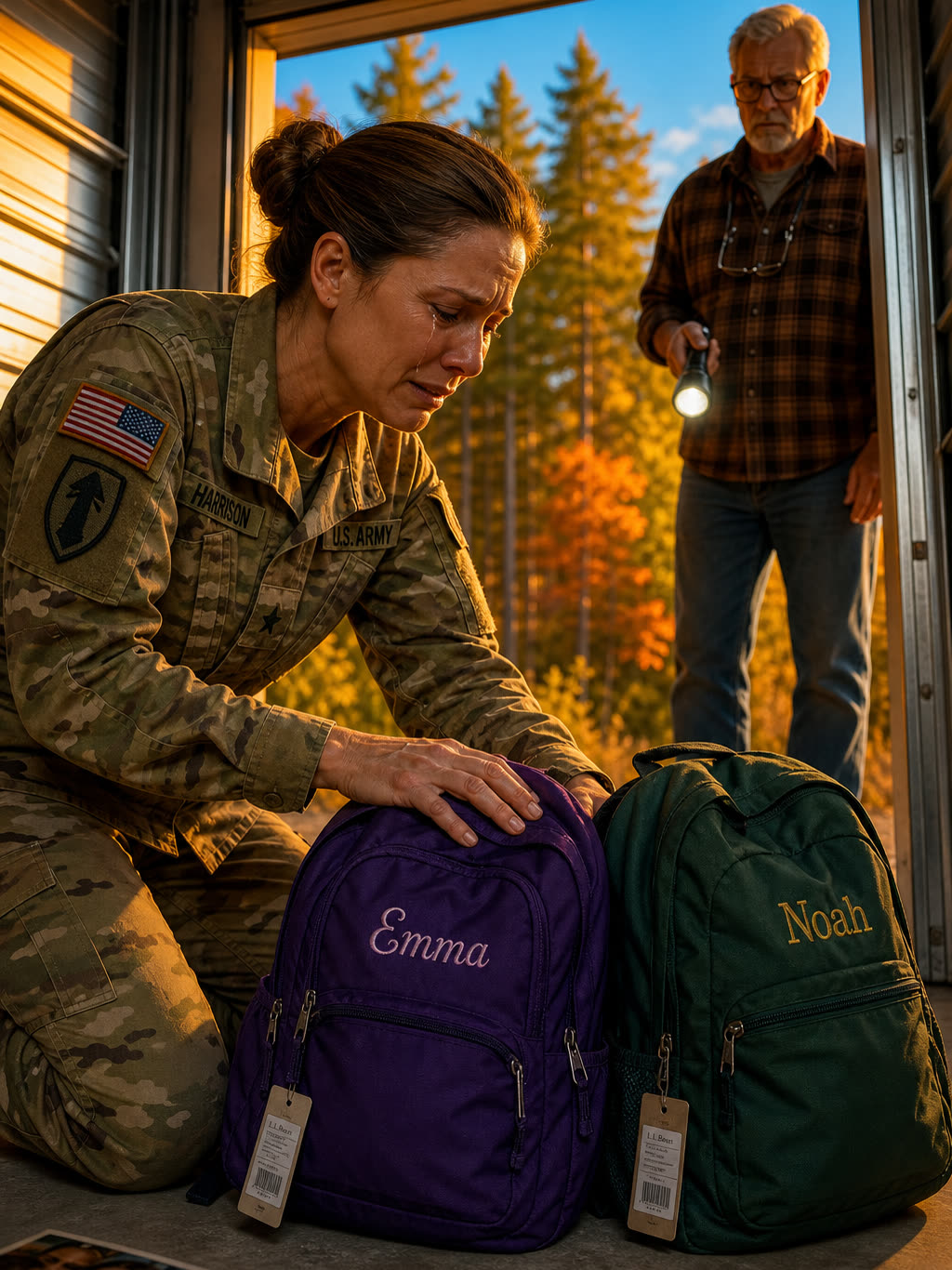
“Ma’am?” Calvin’s voice sounded as if it were traveling down a long, hollow pipe. “You okay?” “These are for my children,” I whispered, the words catching in my chest. “He never gave them these. He told them they were lost in the mail.” I scrambled backward on my palms and rose to my feet, my military training overriding the shock. I pulled out my pocket flashlight and swept the beam around the perimeter. Near the back wall, on top of a dark plastic tote, sat a flat plastic organizer. Inside it, through the clear plastic, was a thick, cream-colored manila envelope labeled in black permanent marker: FAMILY ESSENTIALS & TITLES. I took a pair of nitrile gloves from my field jacket—standard issue for logistics inspections—and pried open the lid. Inside the envelope were certified copies of Emma’s and Noah’s birth certificates, their original Social Security cards, which I had thought were lost in our last move, and a handful of vehicle titles.
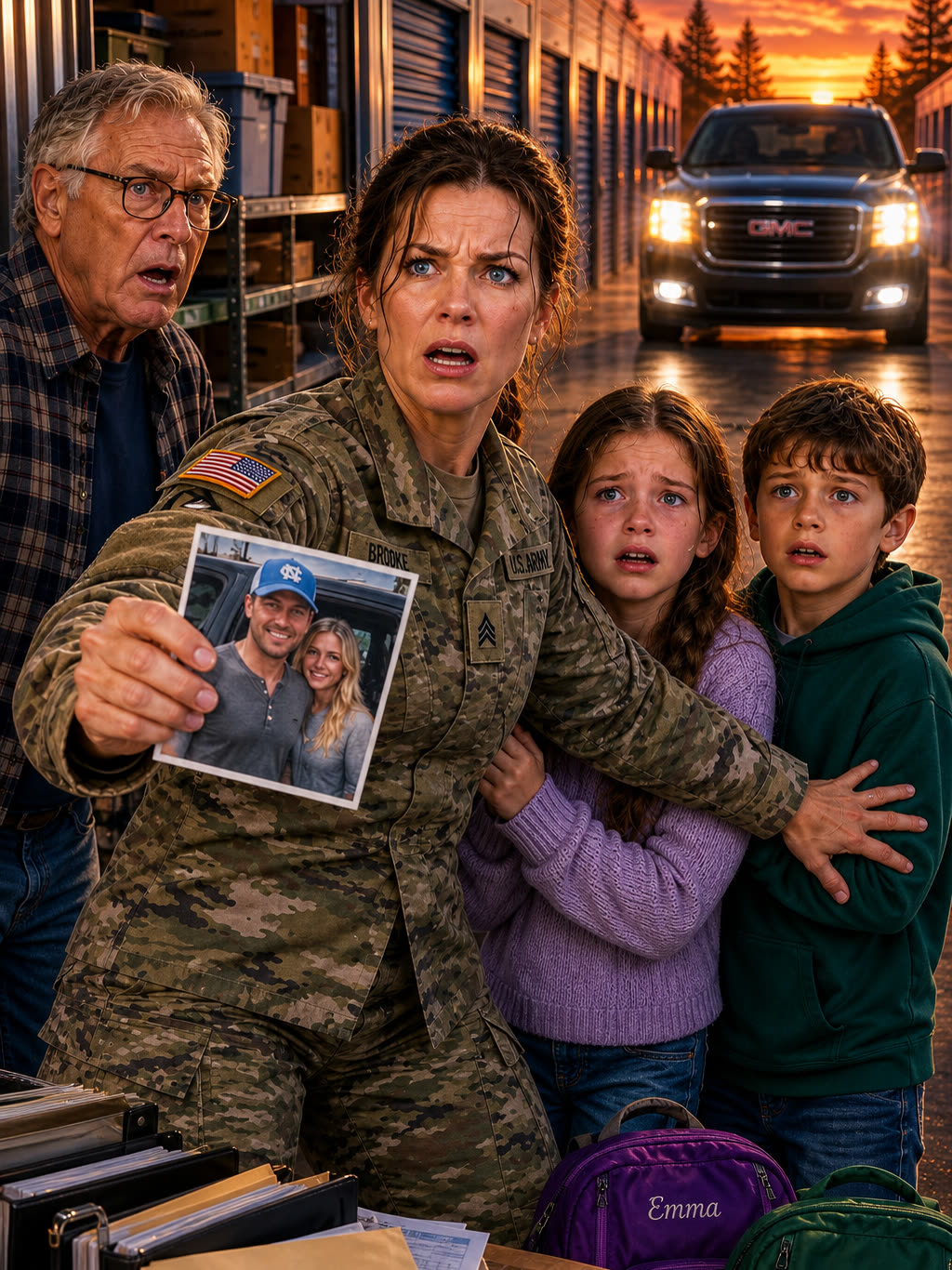
And beneath the paperwork, sliding into the beam of my flashlight, lay a four-by-six glossy photograph. My heart stopped entirely. It showed a sun-drenched convenience store parking lot with a distinctive interstate sign in the background: I-95 South, Exit 49. Beside the rear quarter panel of a dark navy GMC Yukon stood Ethan. He wore a clean gray Henley, designer sunglasses pushed up on his forehead, and the royal blue North Carolina Tar Heels baseball cap Noah had bought him with his own allowance for Father’s Day. He held a plastic fountain soda and grinned straight into the lens with the easy, predatory charm that had once made me surrender my heart. In the Yukon’s passenger seat, visible through the tinted window rolled halfway down, sat Marissa, her bleached blonde hair in a messy topknot, one arm resting lazily across the door frame.
I turned the photograph over with trembling, gloved fingers. On the white backing, in Ethan’s distinctive, left-slanting cursive, was a single date: May 9th. On the road to the clean slate. May ninth. Three weeks after the United States Coast Guard had called off the active recovery operation for his drowned remains. “Calvin,” I whispered, my voice unrecognizable even to me. “Put your phone away. Don’t touch the door. Don’t touch the concrete.” Calvin looked at the photograph in my palm, slowly lowered his cell phone, and his face drained of color. “My God… that’s the dead man.” “He was never dead,” I said, a wave of rage so absolute and icy climbing my throat that my vision blurred at the edges. “He was never in that water.” I took out my phone and dialed Detective Paul Hensley of the Wilmington Police Department, but before I could press the green button, the soft clatter of gravel shifted at the mouth of the storage corridor, followed by the slow, distinct idle of an approaching vehicle.
The Forged Foundation
The vehicle turned out to be only the facility’s security guard making his routine rounds, but my nerves had already been frayed down to bare wire. Within forty minutes, Detective Paul Hensley pulled his unmarked cruiser into the gravel lot of Cape Fear Storage, with Officer Ruiz from the local Fayetteville precinct beside him. Hensley was built like a fire hydrant—broad-shouldered, thinning gray hair, and the tired, sunken eyes of a coastal detective who had dragged too many canals for people who didn’t want to be found. He stepped into the lit perimeter of locker B17, his eyes sweeping over the cardboard boxes, the children’s backpacks, and finally the manila envelope in my gloved hands. “Let me see it, Rebecca,” he said quietly.
I gave him the photograph. Hensley took an evidence magnifier from his jacket and tilted the glossy surface toward the overhead light. For two full minutes he said nothing. The only sounds were the wind against the metal eaves and the low rumble of Raeford Road traffic. “May ninth,” Hensley murmured, reading the inscription aloud. “Three weeks post-incident. The exit sign in the background… that’s Exit 49 off 95, just outside of Fayetteville. He was right under our noses while the Coast Guard was burning fifty thousand dollars of fuel a day scouring the Atlantic.”
“He stole my identity to rent this locker, Detective,” I said, my voice vibrating with an intensity that made Officer Ruiz step back slightly. “He forged my signature on the lease. He stole our children’s Social Security cards. And he left those backpacks here like discarded trash while my daughter slept with his picture under her pillow!” “Calm down, Sergeant,” Hensley said gently, though his jaw was clamped so tight it bulged. “I’m not discounting a single breath of what you’re saying. We are impounding this entire unit right now under a felony fraud and false-report warrant. Ruiz, call the crime scene technician out here. I want every single box, every roll of packing tape, and every surface dusted for latent prints. If Ethan Whitmore touched a single cardboard flap in this room, I want his ridge details on file.”
Before they walked me outside the yellow tape, Hensley aimed his pen at a second manila folder resting near the back of the plastic tote. The tab read: FIRST HORIZON – REFINANCE / HE. “What is that?” I asked, stepping forward. Hensley used a sterile wooden tongue depressor to lift the flap. Inside lay a sixty-page loan application package dated March eighteenth. The header read: Application for Junior Lien Equity Mortgages – $148,000. The primary applicant was Rebecca A. Whitmore. The collateral was my home on Sweetwater Drive—the property awarded entirely to me in our divorce decree, free and clear of Ethan’s name. Clipped to the back were a photocopied utility bill, my military pay stub from February, and a forged deed of trust bearing a counterfeit notary stamp from New Hanover County.
The air rushed out of my chest as though I had taken a direct hit from a kinetic round. “He tried to mortgage my house,” I gasped, gripping the doorframe of the storage unit. “He tried to pull one hundred and forty-eight thousand dollars out of the equity my parents and I built.” “We’re going to run the transaction numbers first thing tomorrow morning,” Hensley said grimly, closing the folder. “Go home to your kids, Rebecca. Do not speak to anyone about this. If Ethan knows this locker has been accessed, if he has an associate monitoring this facility, we don’t want to spook him before we track the financial wire.”
It was past seven in the evening when I pulled into the driveway of my Sweetwater Drive home. The small, single-story ranch with its pale blue siding and white trim looked utterly ordinary against the darkening Carolina sky. A single porch light cast a warm, amber pool over the front steps, where Emma’s bicycle leaned against the handrail. Inside, the house smelled of melted butter, garlic, and Diane’s famous sugar cookies.
“Mom!” Emma bounded down the hallway, her dark hair in twin braids, clutching a large piece of green poster board. “Look! Mrs. Patterson said I have the best handwriting in fifth grade! Did you know black bears in North Carolina can climb eighty feet up an oak tree in less than thirty seconds?” Behind her, Noah sat at the kitchen table methodically assembling a complex Lego semi-truck, his face set in the serious, quiet mask that had become permanent over the past six months. He looked up, his pale blue eyes—so terrifyingly identical to his father’s—searching my face with an adult’s intuition. “You look tired, Mom,” Noah said softly. “Just military logistics, sweet boy,” I lied, kneeling to press my face into Emma’s neck and breathe in baby shampoo and cookie dough. My hands were still shaking. I squeezed them into tight fists behind her back so she wouldn’t feel the tremors. He was going to leave you, my mind screamed. He was going to take everything and leave you with nothing.
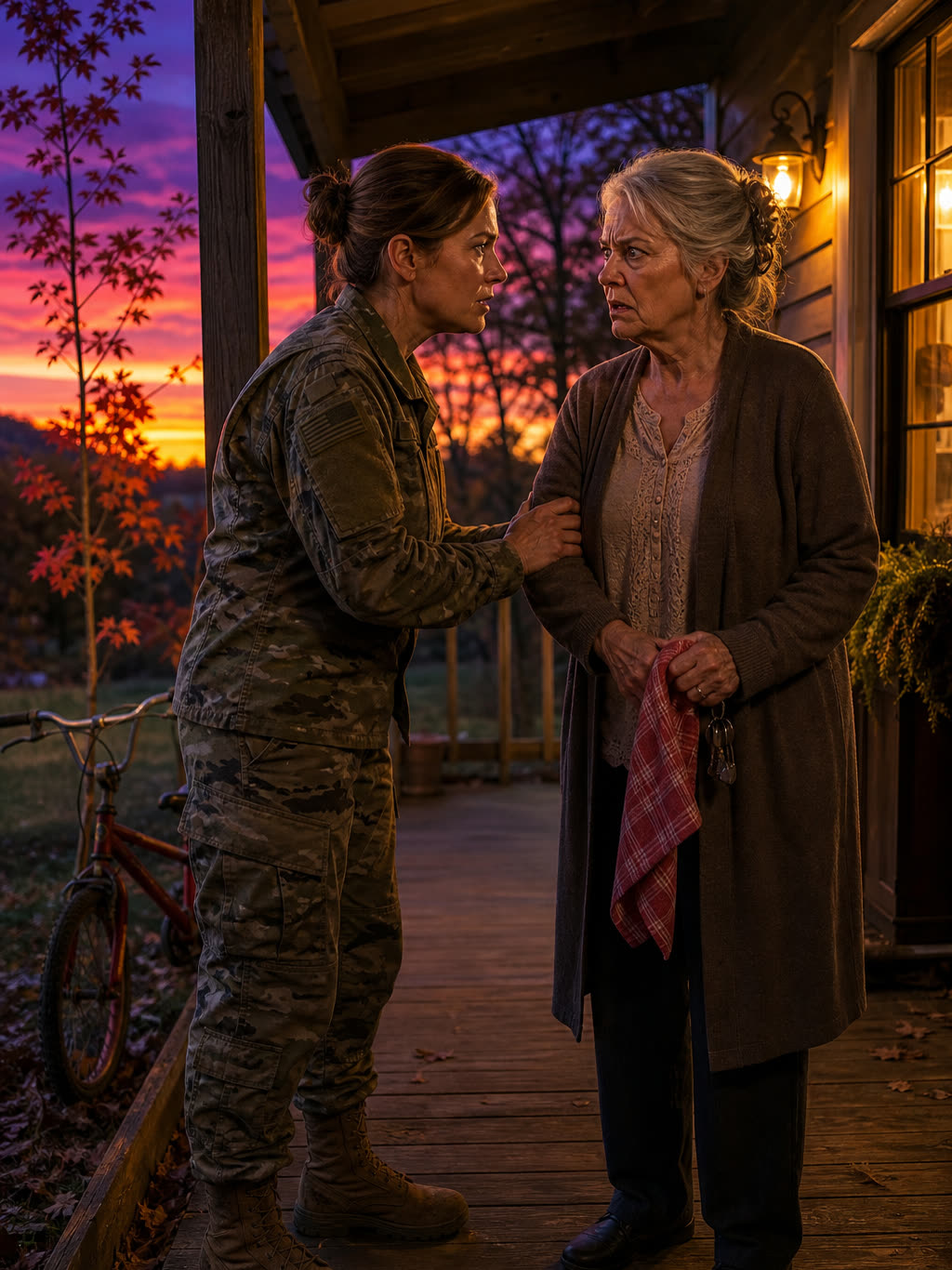
Diane stepped out of the kitchen, wiping flour-dusted hands on a red dish towel. Her sharp, perceptive eyes took in the tightness around my mouth, the pale cast of my skin, and the mud clinging to my combat boots. She asked no questions in front of the children. “Dinner’s in the warmer, Sergeant,” Diane said briskly. “Spaghetti with extra oregano, just the way Noah likes it. I’m heading home to watch my crime shows, unless you need me to stay?” “No, Diane. Thank you. I’ll walk you to the porch.” On the wooden front porch, the cool night air wrapping around us and crickets chirping in the shrubbery, I gripped Diane’s forearm. “He isn’t dead,” I whispered. Diane froze, her keys clinking softly in her hand. “What did you say?”
“Ethan didn’t drown. He staged the entire thing. I found a storage locker in my name off Raeford Road. He has a photograph from May ninth. He’s alive, Diane. And he tried to steal one hundred and forty-eight thousand dollars against this house before he ran.” Diane’s face hardened into a mask of pure, unadulterated fury I had never seen on the gentle church secretary. She looked toward the darkened street, her lips pressed into a thin, bloodless line. “That miserable, cowardly dog,” she breathed, her voice shaking with quiet venom. “All those tears those babies cried. All those nights Noah sat by that window waiting for the Coast Guard truck to bring news. I hope they put him in a concrete cage and throw away the key.” “There’s more,” I said, swallowing hard. “He had the kids’ birth certificates and Social Security cards packed in the unit.” Diane turned back to me, her eyes widening in sheer horror. “Rebecca… he wasn’t just running away from his debts. A man doesn’t take his children’s identity papers to a grave.” The weight of that implication hung between us like a guillotine blade.
After I tucked the twins into bed—kissing Noah’s forehead while he clutched his stuffed bear, listening to Emma’s steady breathing as she finally gave in to sleep—I sat at the kitchen table with my bank statements, my divorce decree, and a legal pad. At ten-forty-five my cell phone buzzed against the wood. The screen lit with a name I hadn’t seen in nearly four weeks: Margaret Whitmore. Ethan’s mother. I answered, bracing myself. “Hello, Margaret.” There was no greeting, no question about her grandchildren. Only a sharp, trembling intake of breath. “Rebecca,” Margaret said, her voice crackling with defensive venom. “I hear you’ve been running around town making shameful accusations about my son.”
My fingers tightened around the phone until the plastic creaked. “Who told you I was anywhere, Margaret?” “People talk!” she snapped. “Wilmington is a small town, and word gets around when someone starts disrespecting the memory of the dead. My boy is resting at the bottom of the ocean, and you’re treating his memory like he’s some common criminal!” I stood and walked to the kitchen window, staring into the pitch-black yard where Noah’s crooked maple sapling swayed in the wind. “Margaret,” I said, keeping my voice dead, cold, and razor-sharp. “We don’t know that he’s at the bottom of anything. But I do know someone forged my name on a six-figure home loan.” A brief, suffocating silence fell over the connection. When Margaret spoke again, her voice had dropped to a low, hissed warning that chilled me to the marrow. “You should have left that storage unit alone, Rebecca. You always did have to poke your nose into things that didn’t concern you.” Before I could demand an explanation, the line went dead.
I stood in the dark kitchen, the dead dial tone humming in my ear like an accusation. You should have left that storage unit alone. I had never mentioned Cape Fear Storage to Margaret. Detective Hensley hadn’t yet filed the formal impound inventory with the district court. The only people who knew about locker B17 were Calvin Brooks, the two investigating officers, Diane, and me. Unless the man who rented it had called his mother. I forwarded the call log and time stamp to Hensley’s personal cell. Within ninety seconds, my phone rang back. “Hensley,” he answered before I could speak. “Did she say anything else?” “She knew about the locker,” I whispered, leaning on the counter, my heart hammering against my ribs. “Paul, she knew. She told me I should have left that storage unit alone. Ethan called her. He’s in contact with her!”
“Do not call her back, Rebecca,” Hensley commanded, his professional composure returning with absolute authority. “I am submitting an emergency wire intercept and pen-register application to the Cumberland County magistrate right now. If Ethan is communicating with Margaret via a burner cell or an offshore VoIP routing, we need the carrier records clean. If you confront her, she flushes the device.” “He tried to take my house, Paul,” I choked out, exhaustion finally cracking my voice. “He was going to leave me with a forged lien that would have put my children on the street.” “The loan didn’t fund,” Hensley said, and the news hit me like a sudden gasp of oxygen. “My financial investigator just pulled the preliminary audit from First Horizon. The underwriter flagged the notary seal as invalid on March twenty-eighth. The loan application was rejected forty-eight hours before Ethan took that boat out of Wrightsville Beach. That’s why he staged the drowning, Rebecca. His escape capital fell through. He was out of moves, out of money, and the bank was preparing to send the fraudulent file to the state attorney general.”
I slid down the counter until my knees hit the linoleum. The house wasn’t encumbered. The roof over my children’s heads was secure. But the relief was instantly swallowed by a terrifying realization: if he didn’t have the one hundred and forty-eight thousand dollars, how was he funding his life? And what had he intended to do with my children?
The following Monday was a blur of military discipline battling domestic chaos. At Fort Liberty, my shop chief, Sergeant First Class Alvarez, pulled me into his small office after morning accountability formation. Alvarez was a veteran of three combat tours in the Middle East, a man whose resting expression looked chiseled from granite. “Whitmore,” he said, setting down his coffee mug. “You’ve made three errors on the battalion ammunition requisition sheets this morning. You haven’t made three administrative errors in the four years you’ve worked under my command. What’s the situation?” I stood at modified parade rest, eyes fixed on the division unit crest on the wall behind him. “Personal family matters, Sergeant. Legal complications involving my ex-husband’s estate.” Alvarez studied me for a long moment. “The one who drowned in the spring?” “He may not be as deceased as the paperwork suggests, Sergeant.” Alvarez didn’t flinch. He leaned back, his chair squeaking in the quiet office. “Listen to me, Rebecca. The United States Army expects you to do your duty, but the Army does not own your soul. You have four days of accrued personal leave on the books. Take the remainder of the week. Handle your business, protect your children, and get your head right. But if someone is threatening your household, you notify the provost marshal’s office. Understood?” “Understood, Sergeant. Thank you.”
By Wednesday afternoon, the investigation took a sudden, violent turn into the light. I was sitting in the parking lot of the Cumberland County Family Court, having just signed emergency protective petitions with my family law attorney, Laura Bennett, when my phone buzzed with a call from Detective Hensley. “Rebecca, I need you to come to the Wilmington field office immediately,” he said without preamble. “We have Marissa’s sister in an interview room.” “Lauren?” I asked, starting the engine. “Marissa’s older sister?” “She walked into the New Hanover Sheriff’s Department two hours ago carrying a digital voice recorder. You need to hear this yourself.”
I drove the ninety miles down Highway 87 to Wilmington with both hands locked on the wheel at ten and two, the flat pine forests of southeastern North Carolina streaking past my windows like an endless green fence. The New Hanover County Sheriff’s Annex was a sterile brick building behind the county courthouse. Hensley met me in the lobby, tie loosened, holding two Styrofoam cups of lukewarm machine coffee. He led me down a linoleum corridor to an audio analysis suite where a female detective sat before a desktop computer with audio editing software open on the monitors. In the corner sat Lauren Vale. She looked like a ghost of her younger sister—the same delicate bone structure and wide blue eyes, but her hands were raw from nervous picking and her eyes ringed with dark, purple exhaustion. “Rebecca,” Lauren whispered, looking up at me with tears spilling over her lashes. “I swear to God… I swear on my mother’s life, I didn’t know until three weeks ago. I thought they were dead. I held a memorial service at my church!” “Play the recording, Detective,” Hensley said softly.
The technician tapped the spacebar. A burst of digital static crackled through the monitors, followed by the muffled, unmistakable sound of a woman crying into a low-quality cellular microphone. “Lauren… please don’t hang up. Please, God, don’t tell Mama.” It was Marissa. Her voice was cracked, ragged, breathless with absolute terror. “He lied about everything, Lauren. He told me the money was already transferred to an offshore corporate account in Belize. He told me the boat was just a clean break from the tax liens. But there is no money. He’s completely unhinged. He keeps watching the news on his laptop… he keeps talking about the twins. He told me we’d be gone before anyone figured it out, but now he’s saying he can’t leave without Noah and Emma. He says Rebecca doesn’t deserve them because she chose the uniform over him. He’s got their passports, Lauren… he stole their passports from her house before the boat trip!” A door slammed in the background. Marissa let out a tiny, stifled shriek, and a harsh male voice shouted in the distance: “Who the hell are you talking to on that phone?” The audio clipped abruptly into a screech of digital silence.
I gripped the edge of the technician’s laminate desk so hard the plastic edging bit into my palms. “Where was that call placed from?” I demanded, my voice dropping into the terrifying, cold register of a mother who realizes her children are being hunted. “A prepaid burner cell registered to a convenience store outside of Savannah, Georgia,” Hensley answered, his eyes locking onto mine. “Timestamp is eighteen days ago. Marissa ran from him, Rebecca. She ditched him at a motel off Interstate 95 and hitched a ride north. She’s currently in protective custody with the state police in Raleigh, providing a full deposition.” “And Ethan?” I asked, every muscle coiled like a high-tension spring. “Where is Ethan?” Hensley picked up a freshly printed administrative warrant sheet from the printer tray. “Marissa gave us his secondary vehicle description. A 2018 dark gray Ford F-150 with stolen South Carolina plates. And according to his internet search history recovered from their Savannah motel room, he was looking up the youth baseball schedule for the Fayetteville Parks and Recreation Department.” My blood turned to liquid nitrogen. Noah’s first autumn exhibition baseball game was scheduled for tomorrow afternoon at five o’clock.
The Hunter at the Baseline
The drive back to Fayetteville took an eternity. Highway signs flickered past in the headlights like warnings: Fayetteville 45, Fort Liberty 52. My mind ran tactical scenarios, mapping every entry point to Arnette Park where the children’s baseball league played, checking every perimeter, every parking lot exit, every line of sight from the surrounding pine scrub. When I reached Sweetwater Drive at nine o’clock, the neighborhood was entirely dark except for Diane’s living room lamp and my own front porch. I walked in, turned the double deadbolts, set the heavy security chain, and went straight to the children’s rooms. Emma slept on her side, her face half-buried under a plush fleece blanket covered in galloping horses. Noah lay sprawled across his bed, one arm dangling over the edge, his baseball glove resting on the floor beneath his fingers like a loyal dog.
I knelt by Noah’s bed and gently lifted the glove. It was an old Rawlings leather mitt, carefully oiled and conditioned. Ethan had bought it for him when he was seven, burning N. Whitmore #7 into the wrist strap with a branding tool. I thought about the man who had sat at our kitchen table teaching our boy to field a grounder while planning to forge a six-figure debt onto our family home and vanish into the Caribbean. He had not seen our children as human beings with tender, vulnerable hearts. He had seen them as possessions—trophies to be seized in his grand, vindictive war against me.
“Mom?” Noah’s voice was thick with sleep. He blinked against the dim hallway light and rubbed his eyes with the back of his hand. “Are you home?” “I’m home, baby,” I whispered, sitting on the edge of the mattress and smoothing his unruly hair. “Everything’s okay. Go back to sleep.” Noah didn’t close his eyes. He reached out and touched my wrist, his small fingers feeling the rigid, tense tendons beneath my skin.
“Is Dad really dead, Mom?” The question tore through my chest like jagged shrapnel. For six months I had cushioned the blow. I had offered gentle non-answers, held him while he wept, and let the mystery of the sea shield him from the monstrous truth of his father’s character. Protecting them doesn’t mean you have to pretend everything is normal, the family counselor, Mrs. Price, had told me. I looked into my son’s clear, intelligent eyes. He was ten years old, and smart enough to notice the deadbolts, the closed-door phone calls, and the way the adults in his life looked at him with pity. “Noah,” I said, my voice steady, refusing to let a single tremor of fear contaminate the truth. “Your father did not die on that boat.” Noah went entirely still. The house seemed to hold its breath around us. “He’s alive?” Noah whispered, his voice cracking down the middle. “Yes. He’s alive.” “Then… why didn’t he come get us? Why didn’t he call me on my birthday?”
There it was. The fatal, inevitable wound of abandonment. The poison every abandoned child drinks, believing that if they had only been better, smarter, or more lovable, their parent wouldn’t have walked away. “Because your father made terrible, selfish choices,” I told him, looking directly into his face with an intensity that allowed no doubt. “He broke the law, Noah. He ran away because he didn’t want to take responsibility for his own mistakes. And nothing he did—not one single thing—was ever your fault, or Emma’s fault. Do you hear me? You are the best thing he ever had a hand in making, but he was too weak to be the father you deserved.” Noah didn’t cry. A single, heavy tear escaped his left eye, tracked slowly down his cheek, and dropped onto his collar. He looked at the branded baseball glove in my lap, reached out, and slowly pushed it away until it fell off the bed and landed in the shadows beneath the nightstand. “I don’t want to wear his number tomorrow,” Noah said quietly. “Then you won’t,” I replied. “We’ll get a new patch at the park.”
The next afternoon, Arnette Park buzzed with the sounds of autumn youth sports—the sharp crack of aluminum bats, the shrill whistles of umpires, the smell of cheap hot dogs and damp turf grass. To the casual observer it looked like an idyllic Carolina Friday. But beneath the surface, the baseline of Field 3 had become a tactical containment zone. Hensley had placed four plainclothes investigators around the perimeter of the field. One sat in an unmarked sedan near the main vehicle exit; another leaned against the concession stand in a faded Atlanta Braves cap; two more were stationed along the outfield walking trail that backed into the dense pine woods bordering the Cape Fear River.
I sat on the second tier of the aluminum bleachers beside Diane, in civilian jeans and a black fleece jacket, my civilian-licensed sidearm holstered against my hip on my service belt beneath the fleece. My eyes never settled on the batter’s box. They scanned the tree line, the gravel walkway, and every vehicle that slowed as it entered the parking lot. Emma sat two rows below us, happily sharing a paper boat of cheese nachos with two girls from her class, her laughter floating over the cheers of the parents.
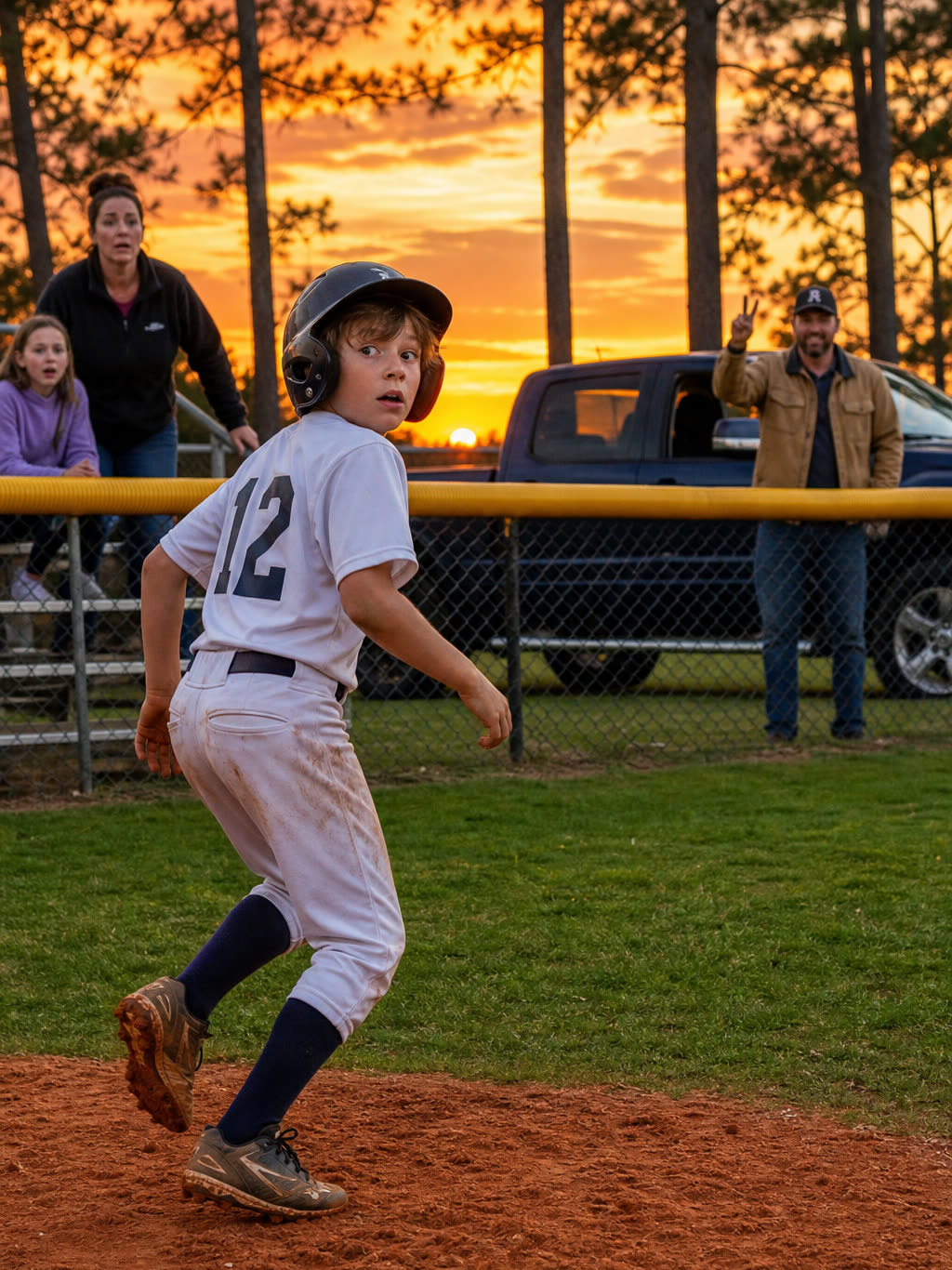
In the bottom of the fourth inning, Noah walked to the plate. His new jersey carried a simple white number 12, secured with safety pins over the old stitching. He dug his cleats into the red clay, raised his bat, and locked his eyes on the pitcher. A dark navy Ford F-150 with heavily tinted windows and mismatched license plates turned slowly into the gravel drive behind the outfield fence. My heart slammed against my ribs like a sledgehammer. The truck didn’t take an open stall. It idled along the grass shoulder in the shade of three towering loblolly pines, fifty yards behind the center-field fence. The driver’s window cracked open about two inches. Sunlight glinted off the chrome rim of a pair of high-end aviator sunglasses. Beside me, Diane gripped my knee so hard her knuckles whitened. “Rebecca… look at the tree line.” “I see him,” I whispered.
I didn’t reach for my phone. Hensley’s team had already spotted the vehicle. Across the outfield, the plainclothes officer near the walking trail casually stepped behind a maintenance shed, speaking rapidly into the lapel of his windbreaker. Noah took a ball outside. The umpire bellowed: “Ball one!” The driver’s door of the F-150 swung open. A man stepped onto the gravel in faded work boots, a tan canvas field jacket, and a navy baseball cap pulled low over his eyes. Even from fifty yards away, through the shimmering heat rising off the outfield turf, I recognized the swagger in his walk—the easy, arrogant tilt of his shoulders that had once convinced me he could conquer the world. Ethan. He didn’t look at the bleachers. His eyes were fixed entirely on the boy in the batter’s box with Whitmore printed across his back. Ethan took three slow steps toward the outfield chain-link fence, lifting his sunglasses to the brim of his cap.
Noah swung. The aluminum bat met the baseball with a clean, explosive PING! The ball sailed in a high, beautiful arc over the shortstop’s head and bounced deep into the left-center gap. The bleachers erupted. Emma jumped up, screaming her brother’s name at the top of her lungs: “Run, Noah! Go to second! Go!” Noah rounded first base, his helmet wobbling, his face lit with the pure, unfiltered joy only a child chasing an extra-base hit can feel. And as he rounded the bag, his eyes drifted toward the center-field fence. Noah stopped dead midway between first and second, frozen in the baseline. The second baseman caught the relay throw and tagged him on the shoulder. “You’re out!” the umpire signaled, waving his arms. Noah didn’t care about the tag. He stood on the red clay, staring through the chain-link at the man in the tan canvas jacket, and the entire field fell silent around him. Ethan smiled—that broad, dazzling, predatory smile—and lifted his right hand in a lazy two-fingered salute. He took one step toward the pedestrian gate.
“Ethan Whitmore!” Hensley’s voice roared through a portable megaphone from the tree line. “State police! Do not move! Keep your hands where we can see them!” Ethan’s smile vanished in an instant. He didn’t surrender. He didn’t drop to his knees. He spun on his heel like a cornered fox and sprinted back toward the idling F-150. What Ethan hadn’t anticipated was Officer Ruiz. Before he could touch the chrome handle of his truck, an unmarked black Dodge Durango swerved across the gravel access lane and slammed its reinforced push-bumper into the driver’s side door of the Ford with a sickening crunch of tearing sheet metal. Ethan stumbled back, boots slipping on the pine needles. He reached beneath his canvas jacket—a desperate, frantic motion—and two plainclothes officers tackled him from behind, driving him face-first into the red Carolina clay.
The bleachers exploded into pandemonium. Parents screamed and pulled their children behind the aluminum risers. “Stay here with Emma!” I commanded Diane, already sprinting down the bleacher stairs, my boots hitting the dirt track with military precision. “Mom!” Emma screamed behind me, her voice shrill with terror. “Mom, what’s happening?!” “Stay with Diane!” I reached the outfield fence in twelve seconds flat. Noah was still standing between first and second base, his cap knocked askew, trembling like a leaf in an autumn storm. The coach, a good-natured local mechanic, had thrown his arms around the boy’s shoulders to shield him from the violence unfolding twenty yards away. I vaulted the low outfield gate.
Through the chain link, I watched Hensley plant his knee into the small of Ethan’s back and wrench his right arm behind him until the steel cuff snapped shut around his wrist. Ethan spat dirt and pine needles, his face smeared with red clay. His designer sunglasses lay crushed under Officer Ruiz’s boot. “You’re making a mistake, Paul!” Ethan snarled, his voice muffled by the earth. “I’m the victim here! I got disoriented after the boat wrecked! I suffered head trauma! You can’t pin this on me!” “Save it for the grand jury, Ethan,” Hensley grunted, hauling the man up by the collar of his canvas jacket. “We’ve got your storage locker. We’ve got the fake notary from Wilmington. We’ve got your rental house in Savannah, and Marissa’s in Raleigh right now singing like a choir girl about the Belize wire transfers.”
Ethan’s eyes darted across the clearing until they locked onto mine. He stopped struggling. His chest heaved beneath his torn jacket, his hair matted with sweat and dirt. For a single second the arrogant mask fell, and I saw the hollow, terrified core of the man I had married—the boy who had spent his whole life running from bills, from debts, from the wreckage he created. “Rebecca,” he gasped, his voice sliding into the pleading, manipulative register he used whenever a credit card was maxed out. “Becs, honey, listen to me… you have to tell them. It was Marissa! She planned the whole thing! She wanted the insurance money! She threatened to take the kids if I didn’t go along with it! You know I’d never leave you and the twins! Tell them, Becs!”
I walked slowly toward him until I stood two feet from his face. The smell of cheap bourbon, stale cigarettes, and cold sweat rolled off him. I looked into his eyes—the same eyes that had looked at me when we exchanged vows in that small chapel in Jacksonville fourteen years ago. I searched for the man who had promised to protect our family, the man who had held our premature babies in the neonatal unit and wept with gratitude. There was nothing left of him. If he had ever existed at all, he was only a performance, built to draw loyalty from the people who loved him.
“You left those backpacks in a dusty locker to rot, Ethan,” I said, my voice so quiet, so empty of emotion, that it cut through his frantic excuses like an executioner’s blade. “You forged my name to steal the only home our children have. You let Noah believe you were drowned in the Atlantic.” Ethan swallowed, his eyes shifting toward the baseball diamond where Noah watched from between the bases. “Noah!” Ethan screamed suddenly, straining against the detectives’ grip, his voice rising into a hysterical shriek. “Noah, buddy! Look at me! It’s Dad! Don’t let them take me, buddy! Tell your mom! Tell her to drop the charges!” Noah didn’t move toward him. The ten-year-old stood his ground in the middle of the red dirt, his shoulders slowly dropping, his chin lifting into the proud, stubborn posture he had inherited from me. Slowly, deliberately, Noah turned his back on his father and walked toward his dugout to collect his equipment. Ethan’s face went slack. It was the first time in his life that his charm hadn’t worked on a child.
Hensley shoved him toward the rear door of the patrol cruiser. “Watch your head, Ethan. You’ve got a long ride ahead of you.” As the squad car door slammed shut, cutting off Ethan’s muffled curses, an older gray sedan pulled frantically onto the grass shoulder fifty yards away. Margaret Whitmore stepped out, her gray hair wild, clutching her purse against her stomach like a shield. She looked at the police cruisers, the crushed pickup, and finally at her son sitting in the back of the patrol unit behind the wire mesh.
She walked toward me, her face pale, her lips trembling with an agonizing mix of shame and defensive fury. “Rebecca…” she whispered, her hands shaking. “You didn’t have to do it like this. Not in front of the whole town. He’s sick… he made mistakes, but he’s still their father.” I stood tall in the autumn breeze, letting my military posture assert itself. I didn’t raise my voice. I didn’t scream. “He isn’t their father, Margaret,” I said with absolute, unyielding clarity. “A father doesn’t use his children as leverage for an offshore escape. He’s a felon facing federal wire fraud, identity theft, and child abandonment. And if you ever approach my children without my written permission again, I will have Detective Hensley serve you with an accessory warrant before the sun goes down.”
Margaret looked into my face, searching for a single flicker of the compliant, quiet daughter-in-law she had bullied for a decade, and found only steel. She turned around, got back into her car, and drove away without looking back.
The legal consequences following Ethan’s arrest unfolded neither quickly nor with the dramatic simplicity of a movie. Instead, they became an exhausting, unforgiving succession of depositions, grand jury appearances, and administrative proceedings that continued throughout the winter and well into the next spring.
Investigators eventually discovered that Ethan’s financial dishonesty reached much further than even Hensley had initially suspected. Across three counties, he had amassed more than three hundred and twenty thousand dollars in commercial liabilities, inventing fraudulent business identities to obtain financing for boat restoration projects, inventory purchases, and privately secured loans. His fabricated drowning had been a reckless, desperate scheme intended to activate a seven-hundred-and-fifty-thousand-dollar term life insurance policy he had dishonestly obtained from an independent maritime insurer. The policy designated Marissa as its principal beneficiary and Margaret as the secondary trustee.
Their intention had been to reunite in Costa Rica after the insurance proceeds passed through probate.
Marissa escaped a federal prison sentence by accepting an extensive plea arrangement. Under its terms, she received three years of supervised probation and was required to pay substantial civil restitution to the search-and-rescue agencies whose personnel and resources had been unnecessarily deployed during the ocean search.
In March, Ethan appeared at the Cumberland County Courthouse and entered a negotiated guilty plea involving four counts of aggravated identity theft, wire fraud, and the falsification of official maritime emergency reports.
I attended his sentencing dressed in my military service uniform. It wasn’t an attempt to display my status or impress anyone. I chose to wear it because Ethan had repeatedly accused me in his cowardly letters of valuing my uniform more than our family. I wanted him to understand that the uniform had provided food for our children, protected the stability of our home, and symbolized a level of personal integrity he had never been capable of understanding.
Ethan stood in front of the judge wearing a worn orange prison jumpsuit, his handcuffed wrists fastened to a chain around his waist. He appeared diminished, almost emptied out by five months inside the county detention facility, deprived of his carefully chosen hair products, luxury watches, and the admiring attention he had always craved.
The presiding judge, a formidable woman with two decades of judicial experience, imposed an eight-year state prison sentence, followed by five years of federal supervised release. She also ordered Ethan to pay two hundred and ten thousand dollars in direct restitution.
As officers escorted him through the courtroom’s side entrance, he never turned toward me.
Not even once.
Summer returned with its usual oppressive, stifling temperatures, yet for the first time in twenty-four months, the atmosphere inside our house on Sweetwater Drive seemed genuinely fresh. The fraudulent liens had been formally erased from the county’s property records. My credit reports had been corrected, and the fraud alerts were finally lifted. Even the kitchen faucet that had been dripping for so long was replaced by a plumber Diane had recommended, a man who charged only half his normal fee after learning what our family had endured.
Emma devoted much of the summer to mastering the butterfly swimming stroke at the neighborhood community pool, her cheerful laughter carrying across the surrounding concrete deck. For four consecutive months, Noah never brought up his father’s name. Instead, he became a member of a nearby youth hiking group, exchanged his baseball glove for a durable pair of hiking boots, and developed a fascination with collecting topographical maps of the Appalachian Mountains.
Toward the end of October, exactly one year after the life-changing telephone call from Calvin Brooks at Cape Fear Storage, I loaded our belongings into my Ford Explorer and took the twins into the Blue Ridge Mountains near Boone.
We rented a modest, weathered log cabin situated along the mountain’s eastern ridge, surrounded by vast stretches of oak, maple, and sourwood trees whose autumn leaves glowed in spectacular shades of crimson, bronze, and radiant gold.
On the second morning of our stay, we followed the hiking path climbing toward the summit of Grandfather Mountain. The refreshing air carried the scents of chilled stone, fallen autumn foliage, and pine trees growing at higher elevations.
Noah walked ahead of us with a lightweight nylon backpack resting against his shoulders. It was a plain blue pack without any decorative stitching, one he had personally selected from a local outdoor equipment store. Emma kept pace beside him, talking excitedly and almost without stopping about a red-tailed hawk she had noticed riding a rising thermal current above the valley.
By noon, we arrived at the overlook near the summit. Beneath us, the Carolina Piedmont extended toward the distant horizon like an enormous sea of autumn colors, its rolling landscape unfolding beneath a sky of almost impossibly brilliant blue.
Noah approached the edge of the rocky overlook and rested against the solid wooden safety railing. The mountain breeze swept through his hair, bringing a healthy, rosy glow to his cheeks.
I stepped up behind him and gently placed my hands on his shoulders. “What do you think, buddy?”
Noah gazed across the seemingly endless landscape, his hands resting comfortably on the wooden rail. He was growing at an astonishing pace; the crown of his head had already reached the level of my collarbone.
“You know what, Mom?” he asked, speaking with the calm, assured confidence that had gradually taken the place of his former anxious silence.
“What, sweetheart?”
“Out here, you can see everything coming from miles away.”
I smiled and leaned forward to kiss the top of his head. “Yes, you can. No surprises.”
Emma hurried over to join us, eagerly displaying two smooth pieces of gray quartz she had discovered beside the hiking trail. “Look, Mom! They’re completely clear in the middle if you hold them up to the sun! Mrs. Price said when something gets pressed under the earth long enough, it turns into crystal instead of dirt.”
I accepted one of the stones from her outstretched hand and raised it toward the dazzling autumn sunshine. Its surface felt cool, its weight substantial, and its interior seemed to glow.
“She’s right,” I replied, wrapping an arm around each of my children and drawing them securely against my sides while the mountain wind swept across the ridge. “Pressure makes things strong.”
Later that evening, once the children had fallen asleep in the loft bed beneath a generous pile of thick wool blankets, I settled onto the cabin’s wooden porch with a steaming cup of black coffee.
Far below, the valley was sprinkled with tiny points of light from isolated farmhouses, each one flickering against the darkness like a glowing ember. The familiar chorus of crickets had faded, leaving only the gentle, continuous murmur of wind passing through the pine branches.
For many months, I had believed that justice meant witnessing Ethan face punishment. I had imagined it was about watching the handcuffs close around his wrists, listening to the heavy prison doors shut behind him, and finally demonstrating to everyone that I had been telling the truth from the beginning. Yet as I sat quietly on that mountain porch, knowing my children were sleeping peacefully and safely inside, I came to understand something far more important.
Justice had never truly been about the man locked behind bars.
Justice was the stillness that returned to a household once deception could no longer survive. It was Emma being able to draw pictures of our home without a moment of uncertainty. It was Noah facing his reflection without searching for the presence of someone who had disappeared. And it was a mother finally being able to fall asleep at night without feeling compelled to inspect the door locks three separate times.
Through his own decisions, Ethan had thrown away his freedom, his future reputation, and everything he might have left behind, scattering them across the ocean as though they were nothing more than worthless sea foam.
He had attempted to steal our future as well.
But the mountains remained steadfast, our home still belonged to us, and when the following morning’s sunlight rose above the Carolina ridgelines, the three of us would descend the trail side by side, moving forward into a life that could never again be reached or damaged by another person’s cowardice.
Disclaimer: This story is a work of fiction inspired by real-life themes. Names, characters, places and events are fictionalized, and any resemblance to real persons is purely coincidental. Images are for illustration purposes only.
