

Part 1: The Live Feed
The architectural drafts for the Elliott Bay suspension overhaul lay sprawled across my desk: sixty square feet of high-tensile specifications, load-bearing stress calculations, and wind-shear models that had swallowed eight months of my life. Beyond the twenty-eighth-floor glass of my downtown Seattle office, the October sky sagged like a bruised sheet of lead, pressing a steady, glacial drizzle against the panes. On an ordinary day I would have spent four hours picking apart the seismic tolerances of the foundation piers. As a senior partner at Vance & Sterling Engineering, precision was more than my trade; it was the psychological framework through which I understood the whole world. When an engineer miscalculates a load, bridges collapse. When an engineer misses a hairline fracture in the concrete, people die.
But that Tuesday afternoon, the ink lines and formulas were nothing but meaningless black smudges on pale blue linen. My head throbbed with a dull, rhythmic ache that ran from the base of my skull down to my shoulder blades. I hadn’t slept more than ninety consecutive minutes in seventy-two hours. Every time I closed my eyes, my mind dragged me back to the sterile glare of the surgical theater at Swedish Medical Center: the sharp metallic reek of antiseptic and pooled blood, the shrill, terrifying flatline tone of the cardiac telemetry unit, and the frantic bark of the lead obstetrician: “Uterine rupture! She’s dumping blood into the peritoneal cavity! Get two units of O-negative on the rapid infuser right now!”
I had stood in that room in blue surgical scrubs, frozen by a terror so total it stripped the breath from my lungs, watching the love of my life slip away. Lily Vance, my wife of four years, was twenty-six years old and thirty-four weeks pregnant, and she was dying on a stainless-steel table. When they finally managed to stabilize her, the chief surgeon looked at me through sweat-fogged goggles and delivered the news with grave, exhausted honesty: “We saved her, Mr. Vance, and we saved your boy. But her lower abdominal wall took catastrophic trauma. She has twenty-four stainless steel staples holding her fascia and epidermis together. She lost nearly forty percent of her circulating volume. For the next three weeks, she cannot lift more than five pounds. She cannot climb stairs unassisted. Severe physical or emotional shock could trigger an internal tear. She needs total, uncompromised bed rest.”
We had brought our son, Leo, home forty-eight hours earlier. He was five pounds, nine ounces of miraculous, breathing perfection, resting in the handmade cedar crib I had spent three weekends sanding and varnishing with organic beeswax.
I should have stayed home. Every instinct in my gut had screamed at me to barricade the doors, draw the blinds, and sit at Lily’s bedside with a basin of warm water and a cup of broth. But the firm was in the middle of executing a ninety-million-dollar municipal infrastructure contract, and one signature was required in person to validate the municipal bond escrow before the three-o’clock banking cutoff. My partner, David Sterling, had pleaded with me: “Julian, give me ninety minutes. Just ninety minutes to execute the indemnification affidavits with the city controller. Then go home for a month. We will cover everything.”
I would never have agreed to leave Lily’s side, even for those ninety minutes, if my mother hadn’t stepped in. Eleanor Vance was sixty years old, a woman of impeccably tailored cashmere cardigans, pearl studs, and an ironclad social pedigree that commanded reverence in every country club from Broadmoor to the Highlands. All my life she had played the benevolent, stoic matriarch, the devoted widow who carried the Vance name with immaculate dignity after my father succumbed to leukemia fifteen years ago.
When she arrived at our home on Queen Anne Hill that morning, carrying a silver tureen of organic chicken bone broth and a bouquet of white lilies, she embraced me with moist, adoring eyes. “Go to your office, Julian,” she whispered, patting my cheek with a manicured hand that smelled of expensive French lavender soap. “You carry the weight of that company on your shoulders, just like your father did. Lily is our little porcelain bird right now. I will sit by her bed, I will warm her tea, and I will care for that precious angel in the bassinet. You have my word as your mother: she will not lift a single finger until you return.”
I believed her. God help me, I kissed her forehead, walked out the front door, and drove downtown, convinced that my mother’s presence was a shield forged of generational love.
At 2:14 PM, the signature ceremony in the executive conference room wrapped up. David took the notarized bond portfolio, clapped my shoulder, and told me to get out of the building. I walked back to my corner desk, dropped into my high-backed leather chair, and felt an immediate, overwhelming urge to check on my wife.
I unlocked my main desktop display and opened the icon for CradleCam-Secure, a closed-circuit, commercial-grade security application that routed direct 4K feeds from four high-resolution, wide-angle optical sensors I had personally installed throughout the nursery and master suite. These were no cheap wireless baby monitors. They were professional surveillance units with high-gain, noise-canceling stereo microphones, wired into my private server through an encrypted virtual private network, installed so that I could watch my son breathe while I worked late nights at the drafting board. The monitor blinked twice, split into quadrants, then expanded into a single, razor-sharp ultra-high-definition feed of the nursery.

Cold autumn light poured through the tall plantation shutters, lighting the ivory walls, the white rocking chair, and the dark walnut changing table. Leo slept peacefully in his bassinet, swaddled in a pale yellow muslin blanket, his tiny chest rising and falling in rhythmic tranquility.
Then my eyes dropped to the floor beside the crib, and the breath left my lungs as if a concrete piling had been dropped across my sternum.
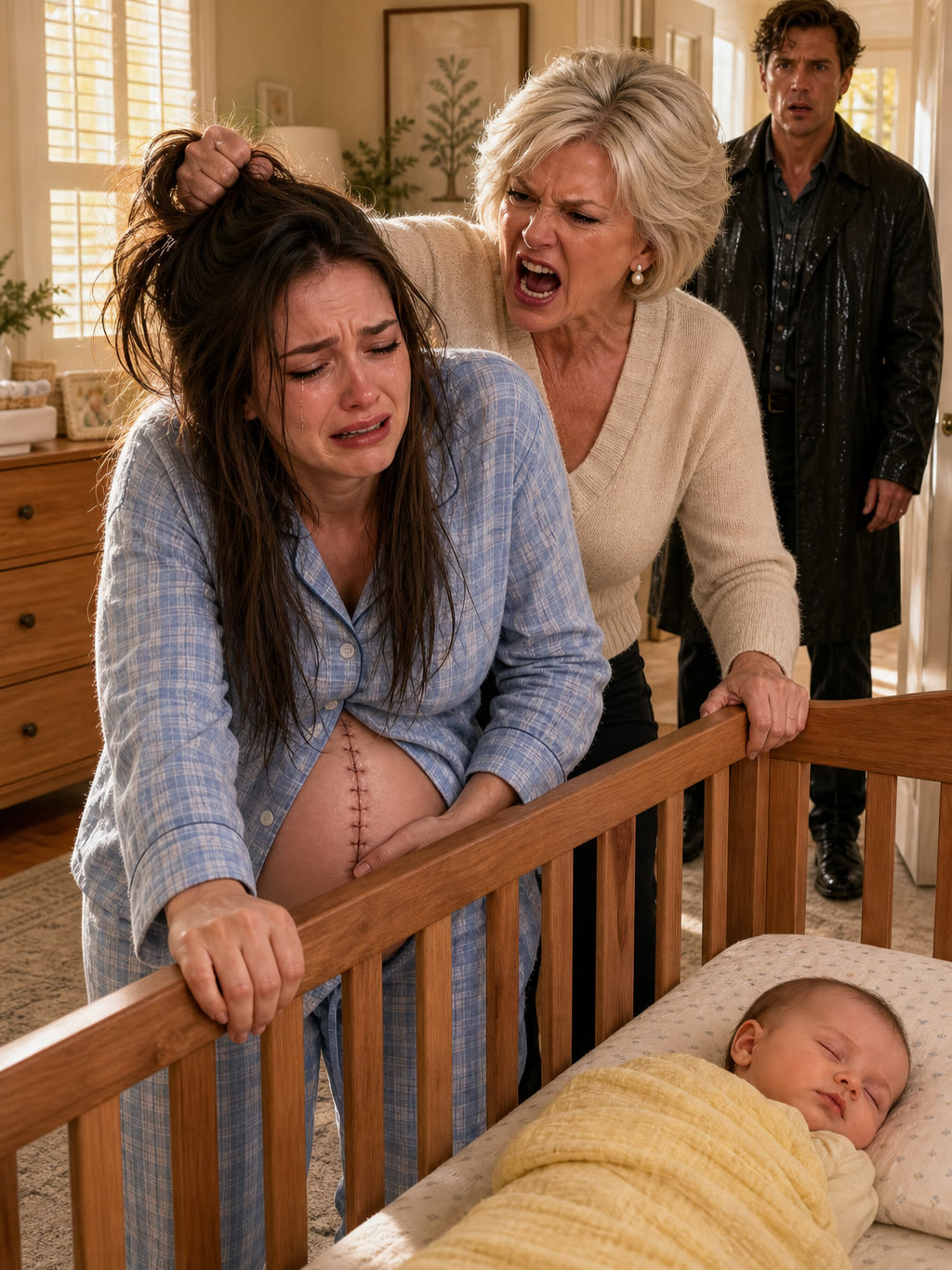
Lily stood on the hardwood floorboards, barefoot, in the pale blue flannel pajamas I had bought her for her birthday. Her skin wasn’t merely pale; it was the translucent, waxy gray of wet chalk. Her left hand pressed desperately against her lower abdomen, holding a blue gel ice pack over the tender ridge of the twenty-four surgical staples beneath her clothing. Her shoulders trembled violently. Her right hand gripped the edge of the changing table, knuckles white, to keep her knees from buckling.
Six inches from her, looming with the predatory posture of a vulture descending on a dying fawn, stood my mother.
There was no warmth in Eleanor’s stance, no grandmotherly softness. Her tailored cream cardigan was pulled tight across rigid shoulders, the cords of her neck standing out like steel wire rope. Her face was twisted into an expression of raw, vitriolic disgust so profound that it rendered her unrecognizable.
The studio-grade microphone captured the sound with horrifying, crystalline fidelity. The nursery was dead quiet apart from the hum of the white noise machine and the venomous, razor-edged hiss of my mother’s voice.
“…pathetic, manipulative little beggar,” Eleanor snarled. She leaned forward, driving her manicured index finger again and again into Lily’s hollow collarbone, each jab rocking my wife’s fragile frame backward. “You think because you managed to squeeze out an heir that you’ve bought yourself a lifetime of luxury in this house? You think you can lie in that king-sized bed all morning, ringing a bell for service, pretending your belly hurts?”
Lily’s voice was a ragged, weeping whisper, breathless with agonizing pain. “Eleanor… please… the doctor said… the doctor said if I stand for more than five minutes, the incision might tear… I just came in to give him his pacifier… please, my stitches are burning…”
“Your stitches?” Eleanor scoffed, her lip curling into a sneer of pure malice. “Women in real families have babies in the fields and go back to work the next morning! You are weak. You are common. You were an orphaned nobody working in a second-rate art gallery when my son found you, and you are an orphaned nobody now. You live off my son like a parasite, and you still dare to complain that you’re exhausted to change a diaper?!”
“I’m not… I’m not complaining…” Lily choked out, tears sliding silently down her colorless cheeks. “I love Julian… I love Leo… please, Eleanor, let me sit down… I feel dizzy… the room is spinning…”
“You don’t sit down until I tell you to sit down!” Eleanor snapped.
Before Lily could take half a step toward the glider chair, Eleanor’s right hand shot out like a striking serpent. Her fingers didn’t push. They didn’t slap. Her fist clamped into the thick, dark roots of Lily’s hair at the crown of her skull, and with a vicious downward torque she yanked my wife’s head backward until Lily’s spine arched with a sharp, sickening gasp of agony.
The ice pack slipped from Lily’s fingers and hit the floor with a dull, wet thud. Her hands flew up and hovered inches from my mother’s wrists, trembling in the air, too terrified to touch her, too terrified to defend herself.
Lily didn’t scream. She didn’t call for help. She didn’t fight back. She simply closed her eyes, her lips parting in a silent, suffocated whimper, her slender frame sagging toward the floor as Eleanor twisted her scalp tighter. It was a posture of total, hollow, conditioned surrender, the response of a creature beaten down behind closed doors for so long that she believed pain was her only natural inheritance.
A catastrophic roar erupted in my ears, like an avalanche tearing through a glacial valley. The blood in my carotid arteries hammered against my temples with such hydraulic pressure that my vision blurred with static.
On the screen, Eleanor shoved Lily’s head violently toward the edge of the changing table and raised her open palm high, her face a mask of unhinged fury, ready to bring her hand down across my wife’s tear-streaked face.
I lunged out of my leather chair with an explosive, primal roar. My knee slammed into the heavy mahogany desk, sending the signed bond contracts, the technical pens, and a heavy crystal tumbler of ice water crashing to the floor. The glass burst into a thousand gleaming missiles on the hardwood. I didn’t feel the shards that sliced through the leather of my shoe. I didn’t hear David Sterling shouting my name from down the hallway.
I hit the heavy oak door of my corner suite with my shoulder, tore down the carpeted corridor toward the private executive elevators, and jammed my thumb into the call button hard enough to crack the plastic casing.
The elevator plunged twenty-eight floors in twenty-eight agonizing seconds, but to my adrenalized mind each floor was an eternity. The descent felt like falling down an abandoned mine shaft. My heart hammered against my ribs like a pneumatic piston, my breath coming in ragged, shallow gasps that tasted of pure copper.
The doors parted at the parking concourse. I sprinted across the polished concrete, my heavy work boots echoing like gunshots under the low ceiling. I hit the remote unlock on my Ford F-250 Super Duty, a heavy, four-wheel-drive work truck with a twin-turbo diesel engine built to tow twenty thousand pounds of industrial steel. I threw myself behind the wheel, slammed the key into the ignition, and brought the eight-cylinder engine roaring to life with a deafening, mechanical snarl.
I didn’t wait for the security gate to finish its upward swing. I threw the transmission into reverse, spun the wheel, slammed the shifter into drive, and launched three tons of American iron up the concrete ramp into the gray Seattle daylight. The heavy all-terrain tires shrieked against the wet pavement at the corner of 4th and Madison, leaving broad black ribbons of rubber across the pedestrian crosswalk.
The rain had turned violent, hammering the windshield in sheets of blinding gray. I flipped the heavy-duty wipers to high, but they could barely clear the water fast enough to reveal the brake lights of the afternoon traffic ahead. Queen Anne Hill was four miles away. Under normal downtown congestion it was a twenty-five-minute crawl through twenty-two sets of synchronized traffic signals. I had no intention of waiting twenty-five minutes.
With a trembling, white-knuckled hand, I snatched my iPhone from my coat pocket and shoved it into the magnetic dashboard mount beside the steering wheel. With my thumb, I bypassed the live camera view and toggled the CradleCam interface to its forensic back-end: Event Log: Motion & Acoustic Sensor Cloud Archive. The system didn’t just stream video; it used artificial intelligence to flag anomalous acoustic signatures, such as elevated decibels, weeping, and rapid changes in tone, and automatically archived ninety days of continuous rolling footage on an offsite encrypted server.
While my right hand steered the massive truck through a red light at 4th and Mercer, sending a delivery van swerving into the bike lane with a blaring horn, my left hand scrubbed through the timestamped thumbnails on the screen. I tapped the log for Tuesday, three days earlier, the night before Lily’s emergency cesarean, when she had been bedridden with severe preeclampsia and excruciating abdominal cramps.
The truck’s cabin speakers filled with crystal-clear, binaural audio captured by the hidden kitchen microphone near the pantry. My mother’s voice leaked out, not the soft, motherly tone she used to greet me at the front door, but a low, conspiratorial, businesslike whisper. She was speaking on the landline to someone she addressed by name.
“…Dr. Higgins, I am telling you, the girl is fundamentally unstable,” Eleanor murmured, the clink of an ice spoon against a silver tumbler audible behind her. “The orphan background, the lack of familial structure… she has always exhibited latent borderline tendencies. I am merely asking for the prescription to be renewed in liquid form. Concentrated lorazepam. Three drops in her chamomile tea twice a day is completely undetectable. It mimics postpartum depression perfectly. Lethargy, slurred speech, maternal detachment, mild hallucinations.”
A muffled, hesitant voice came through the receiver, but Eleanor cut the man off with an aristocratic sneer. “Don’t lecture me on medical ethics, Arthur! You know very well that my family’s trust fund has underwritten your private clinic’s mortgage for twelve years. Julian is completely blinded by this girl’s helpless, waif routine. He is working eighty hours a week on the city bridge project. Two weeks of documented maternal unfitness, a couple of staged hysterical outbursts when the home health nurse visits, and Child Protective Services will have no choice but to issue an emergency protective custody order. Julian will be devastated, but he will have to yield to practicality. He will sign the temporary legal guardianship papers over to me to protect the child. That peasant girl will be remanded to an inpatient state psychiatric facility where she belongs, and my grandson will be raised in a proper Vance household, under my roof, with my values.”
A wave of scalding bile surged up the back of my throat, burning my vocal cords. My vision tunneled until the taillights on Aurora Avenue looked like streaks of arterial blood. She wasn’t just abusing Lily. She was executing a premeditated, clinical coup d’état. She was poisoning my recovering wife with heavy prescription sedatives to induce synthetic postpartum psychosis, aiming to use the state court system to legally kidnap our son and reduce Lily to a certified lunatic.
My shaking fingers tapped another thumbnail, this one from two weeks earlier, on a Thursday morning when I had supposedly been down at the Tacoma shipping docks inspecting pre-stressed concrete girders. The feed snapped open on the sunlit breakfast nook of our kitchen. Lily sat at the oak table, thirty-two weeks pregnant, her swollen ankles resting on an ottoman, quietly sketching a charcoal portrait of baby boots in her sketchbook. Eleanor stood behind her chair. In this clip my mother didn’t touch her. Instead she bent until her mouth was less than two inches from Lily’s ear and spoke in a venomous, soft-spoken cadence that made the hairs on my forearms rise.
“You think you’re clever, don’t you, little girl?” Eleanor’s voice purred from the dashboard. “You think that ring on your finger makes you untouchable. Let me make something abundantly clear to your tiny, uneducated brain: if you ever utter a single word to Julian about how I treat you, if you shed one dramatic tear in his presence, I will destroy you. I will tell him that the child in your belly isn’t his. I will produce hotel receipts and witness affidavits from my private investigators. I will swear on his dead father’s grave that you were sleeping with your gallery manager in Belltown. Julian worships his father’s memory; he will believe me over an impoverished orphan every day of the week. He will throw you onto the street without a dime, and you will never, ever lay your eyes on this baby again. Do you understand me, you pathetic little leech?”
On the screen, Lily’s charcoal pencil snapped in half between her trembling fingers. She lowered her head onto the table and covered her face with her arms, her whole body shaking with silent, suffocated sobs. And Eleanor simply smiled, adjusted the diamond tennis bracelet on her wrist, and walked gracefully toward the pantry to pour herself another cup of coffee.
“You monster,” I whispered into the empty cabin of the truck, the words tearing from my throat like broken glass. “You absolute, demonic monster.”
I remembered the past three months: the sudden, inexplicable shifts in Lily’s behavior, the way she flinched whenever the front door opened, the way she had stopped painting, stopped smiling, stopped singing while making breakfast. I remembered finding her sitting in the dark of our bedroom at two in the morning, clutching her pregnant belly, weeping so violently she couldn’t breathe. When I held her, desperate to know what was wrong, she had only buried her face in my chest and whispered: “I’m just so afraid of losing you, Julian. Promise me you won’t let them take me away. Promise me you won’t believe them.”
I had thought it was third-trimester hormonal anxiety. I had kissed her wet eyelashes, called her my sweet girl, and told her she was completely safe. All that time she had been living in a psychological concentration camp inside our own home. She had endured the threats, the venom, the terror, and the isolation completely alone, in absolute silence, convinced that telling the truth would cost her the husband and family she had prayed for her entire life.
I slammed my heavy boot onto the accelerator. The twin-turbo diesel let out a deafening, metallic scream as the truck surged up the steep, winding incline of Queen Anne Avenue. The dashboard navigation chimed in a calm, automated female voice: Approaching destination: 1420 Highland Drive. Destination is on your right.
Rain lashed the hood in a furious torrent. Through the gray downpour, the warm, stately silhouette of our Craftsman home appeared behind the tall cedar hedge. The carriage lantern on the front porch was lit, casting a soft, deceitful golden glow across the wet flagstone walkway.
I didn’t touch the brakes until the last possible second. I threw the wheel hard to the right, sliding three tons of steel across the wet crushed-gravel driveway, the tires hurling plumes of mud and stone, until the truck slammed to a halt six inches from the front steps. I left the engine roaring. I left the driver’s door swinging open in the freezing rain.
I took the three porch steps in a single, earth-shaking leap.
Part 2: The Shattered Cup
I seized the heavy brass handle of the front door, drove the latch downward, and shoved forward with all my weight. The door didn’t move. The deadbolt was engaged; she had locked it from the inside. She had locked in a twenty-six-year-old mother, a woman who had undergone major, life-threatening abdominal surgery seventy-two hours earlier, whose body was held together by twenty-four stainless steel staples, cutting off any chance of escape.
A terrifying, volcanic pressure detonated behind my eyes. I didn’t reach for my keys. I didn’t knock. I stepped back with my right leg, coiled my entire two-hundred-pound frame like a steel suspension spring, and drove the heavy steel toe of my size-twelve construction boot into the deadbolt housing, inches from the brass plate.
CRACK-BOOM! The four-inch solid fir frame splintered with a sound like a high-caliber rifle discharge. The brass strike plate tore free from the wall studs, ripping a six-inch gouge through the white-enameled trim. The heavy mahogany door flew inward and rebounded off the foyer drywall with enough violence to crack the plaster and send framed family photographs tumbling from the console table.
Freezing wind and driving October rain rushed into the warm, scented air of the foyer behind me. The house smelled of cedar, vanilla potpourri, and fresh-brewed Earl Grey tea, an atmosphere of pristine, upper-crust serenity that turned my stomach.
At the edge of the open-concept gourmet kitchen, leaning casually against the polished white Carrara marble island, stood Eleanor. She hadn’t run upstairs to check on the baby. She hadn’t panicked. She held an antique, hand-painted porcelain teacup by its delicate gilded handle. She wore her pristine cream cashmere cardigan, her platinum-blonde hair styled in an immaculate, lacquer-stiff bob that defied the humidity.
For a fraction of a second, as her eyes locked onto me in the splintered doorway, a flicker of startled annoyance crossed her features. Within a single heartbeat, the aristocratic mask snapped back into place with practiced, sociopathic fluidity. “Julian!” she gasped, her voice pitched in exaggerated, motherly reproach. She placed a hand over her pearl necklace and shook her head, offering me that patronizing, benevolent smile that had dictated every holiday, every family dinner, and every milestone of my existence. “Good heavens, darling! Have you completely lost your senses?! Kicking the front door like a common street hooligan?! You nearly scared me half to death! You’ll wake the baby!”
I didn’t answer. I stepped across the threshold, my wet boots leaving heavy, muddy tracks across the hand-scraped hardwood. I didn’t take off my coat. Water dripped from my collar and ran down my jawline in freezing droplets. My hands hung loose at my sides, fingers curled into rigid, vibrating talons. Eleanor took a delicate sip of her tea, watching me approach with an air of theatrical exhaustion.
“I am so glad you came home early, Julian,” she sighed, turning her head toward the ceiling as if asking the heavens for patience. “I have been through absolute hell with that wife of yours for the past two hours. It is worse than I feared. Much worse. I was just coming down to the kitchen to compose myself and make a cup of tea before calling Dr. Higgins.”
She took two steps toward me, her eyes brimming with counterfeit tears, her voice dropping into a conspiratorial, sorrowful whisper. “The girl has completely detached from reality, darling. She refused to feed the infant. She left him screaming in the crib while she paced around the room like a madwoman. When I gently tried to take the child to comfort him, she flew into an uncontrollable rage. She threw an ice compress at my head, Julian! She screamed the most vile, ungodly obscenities at me. I tried to calm her down, I tried to hold her, but she began clawing at her own face and threatening to run out into the street. Her psychological state has deteriorated rapidly. I don’t know what kind of trauma she brought from that miserable orphanage, but she is completely unfit to care for that child. For Leo’s safety, Julian, we need to have her admitted to an emergency evaluation clinic immediately—”
I closed the remaining four feet between us in one predatory stride. I didn’t speak. I didn’t raise my voice. My left hand shot out, not to strike her, but to clamp around the delicate porcelain rim of the antique teacup she held inches from her chest. Eleanor froze, her eyes widening in sharp shock. “Julian, what are you—” With a violent downward flick of my forearm, I ripped the cup from her manicured fingers and slammed it onto the hardwood floor directly between her polished leather designer loafers.
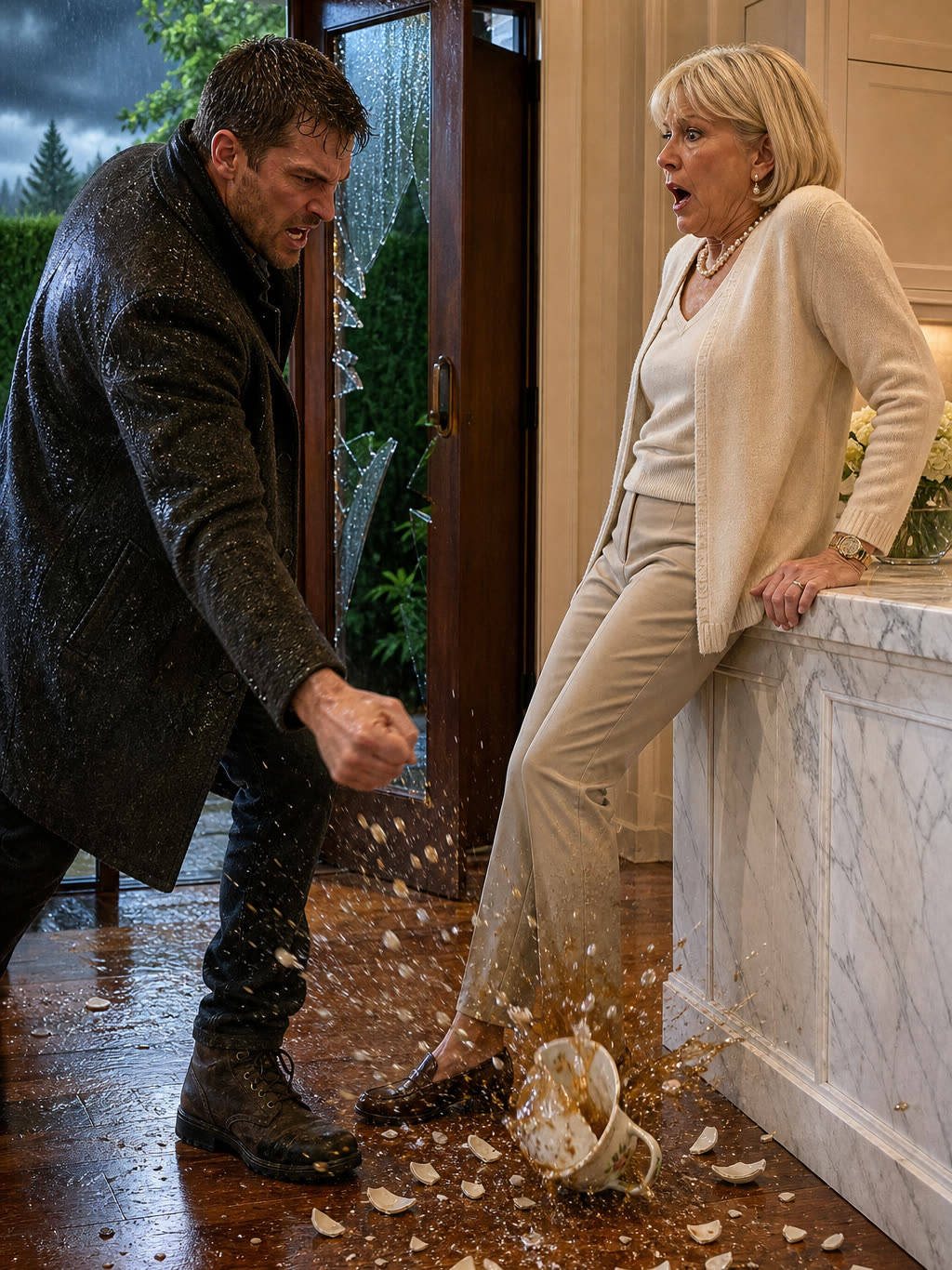
SMASH! The fine bone china exploded into a hundred razor-sharp shards. Boiling Earl Grey tea splashed across the cream fabric of her designer trousers and soaked into her leather shoes. Eleanor let out a sharp, aristocratic shriek and leapt backward against the marble island, her hands flying to her throat. “Julian! Have you gone completely insane?! That was your great-grandmother’s Meissen china! What is the matter with you?!”
I stepped directly into her personal space. I stood six feet two inches tall, built with the broad, muscular density of a man who had spent ten years working high-iron structural steel before earning his partnership at the firm. Eleanor stood five feet four. I bent until my face was six inches from hers, close enough that she could smell the cold rain, the raw ozone, and the icy, homicidal stillness radiating from my skin.
My voice wasn’t a roar. It was a flat, freezing whisper that vibrated through the foundation of the house. “Shut your mouth, Eleanor.”
The use of her first name hit her like a physical blow. Her aristocratic composure began to fracture at the edges, her thin eyebrows drawing together in indignant fury. “How dare you!” she hissed, her voice trembling with an ugly, shrill authority. “I am your mother! I gave you life! I built the Vance name so you could have a future! You do not address me by my Christian name, and you do not bring this unhinged, violent behavior into my presence! If you think for one second that you can treat me like this because of that common little—”
I reached into my heavy wool coat with my right hand, pulled out my iPhone, and thrust the glowing, four-thousand-pixel display straight into her face.
The high-definition video looped on the screen in terrifying, relentless clarity. On the 4K display, Eleanor’s face filled the frame, her features twisted into that grotesque, predatory sneer, her fingers knotted like iron cables in the thick, dark hair at the top of Lily’s skull, wrenching my wife’s spine backward. The stereo speakers were turned to maximum volume, and the audio echoed through the cavernous foyer, bouncing off the ten-foot ceilings with the force of an indictment:
“…You live off my son like a parasite, and you still dare to complain that you’re exhausted to change a diaper?!”
Then came the sickening sound of Lily’s muffled, agonizing gasp. The sound of the ice pack hitting the hardwood floor. The sight of Eleanor raising her open hand to strike a mother seventy-two hours post-surgery.
Eleanor stared at the glowing screen. For two seconds, three seconds, five seconds, the room was dead silent except for the wind howling through the shattered front door and the looping sound of her own venomous voice. The color didn’t drain from my mother’s face; it evacuated her body in a sudden, catastrophic collapse. Her skin turned the gray-green of wet river slate. Her pupils dilated until the blue of her irises almost vanished. Her jaw went slack, her lip trembling as the realization crashed through her sociopathic vanity like a wrecking ball.
Every second had been recorded. Every word had been captured. The soundproofed walls, the closed doors, the isolation, the entire private kingdom of terror she had built over nine months had been broadcast in four thousand pixels to the downtown office.
“Julian…” she stammered, her voice suddenly high, thin, and breathless. The domineering matriarch was gone, replaced by the cornered, desperate panic of a predator caught in a snare. “Julian… darling, wait… listen to me… that is… that is out of context! You don’t understand what happened before the recording started! She provoked me! She dropped the formula, she was hysterical, she lunged at me—I was merely restraining her! You know how unstable orphans can be! I did it to protect your son!”
“I listened to the audio logs from Tuesday, Eleanor,” I whispered. Every syllable was an iron nail driven into her coffin. “I heard you speaking to Dr. Higgins. I heard you demanding concentrated liquid lorazepam to slip into Lily’s chamomile tea. I heard you planning to induce postpartum psychosis so you could file for emergency guardianship and put my wife in an asylum.”
Eleanor’s breath hitched. She choked on her own saliva and took a frantic, stumbling step backward until her spine hit the edge of the kitchen island. “No… no, Julian, that’s not… that was a theoretical discussion! I was worried about her! I was seeking medical counsel—”
“And I heard the recording from two weeks ago,” I continued, my voice cutting through her lies like a diamond blade through plate glass. “I heard you standing over my pregnant wife in the kitchen. I heard you threaten to tell me the baby wasn’t mine. I heard you tell her that if she ever spoke a single word to me, you would throw her into the street with nothing.”
Eleanor’s eyes darted toward the shattered front door, then the staircase, searching for an escape route that didn’t exist. The mask was completely gone now. What remained beneath the cashmere and the pearls was the naked, hideous essence of an unrepentant narcissist whose dominion had crumbled into dust. Her lips pulled back over her porcelain veneers in a sudden, feral snarl, and she lunged forward, her manicured nails clawing at the lapels of my wet wool coat.
“I did it for you!” she shrieked, her voice cracking into an ugly, grating scream. “I did it to save you from your own stupidity! You threw your life away on a girl who came from the gutter! She has no pedigree! She has no money! She has no bloodline! She doesn’t belong in this family! I built this empire with your father! I am your mother, Julian! Blood is thicker than water! You cannot take that pathetic orphan’s side over your own flesh and blood!”
I looked down at her clawing hands. Then, with the slow, deliberate precision of a crane operator lowering a thousand-ton steel girder, my right hand reached down. My fingers clamped around Eleanor’s right wrist, the exact wrist, the exact hand, the exact fingers she had used to twist my wife’s hair and wrench her surgical staples. My grip tightened, not enough to break the radius bone, but enough to crush the nerve against it with the unyielding force of a vise.
Eleanor let out a sharp, genuine cry of pain, her manicured fingers flying open. “Julian! Let go of me! You are hurting me! Let go!”
“You are not my family,” I said, looking directly into the terrified, watering pupils of her eyes. “You are not a mother. You are a parasite who preyed on a bleeding girl in her own home.”
I spun on my heel, keeping an iron grip on her wrist, and walked toward the shattered front door. “Julian! Stop! What are you doing?!” Eleanor screamed, her leather loafers slipping and skidding across the wet hardwood as I dragged her through the foyer. Her left hand clawed at my forearm, trying to break my grip, but my arm was a solid bar of reinforced concrete. “Julian, this is assault! Unhand me this instant! I will disinherit you! I will strip you of every cent of the Vance trust! I will ruin your name in this city!”
I didn’t slow down. I didn’t break stride. I dragged her through the splintered threshold, out onto the covered veranda, and straight into the freezing, torrential downpour of the October storm. The icy rain hit Eleanor like a physical slap, instantly collapsing her stiff platinum hair against her skull, soaking her cream cashmere cardigan until it clung like wet parchment, smearing her expensive mascara into black, jagged streaks down her cheeks.
I hauled her down the three wet stone steps of the porch and onto the muddy expanse of the front lawn. THUD. I released my grip and shoved her forward. Eleanor lost her balance, her designer loafers sliding through the slick, saturated clover, and she collapsed hard onto her hands and knees in the cold Seattle mud. The water soaked into her trousers, turning the cream wool a dark, filthy brown.
The noise echoed through the quiet, affluent neighborhood of Highland Drive. Across the street, the front door of the Henderson residence opened, and old Mr. Henderson, a retired federal judge, stepped onto his porch with an umbrella, staring in paralyzed disbelief. Two doors down, the Miller family, members of the same historic preservation board Eleanor had chaired for a decade, stood pressed against their large bay window, eyes wide, as they watched the undisputed queen of Queen Anne society sprawled like a discarded rag in the mud.
Eleanor pushed herself up onto her knees, shivering violently, her soaked hair plastered across her eyes, coughing on the rain pouring into her open mouth. I stood on the bottom stone step of my home, towering over her, my wet coat open, my boots planted firmly in the earth.
“Listen to me very carefully, Eleanor,” I roared across the lawn, my voice cutting through the rumble of thunder and the hiss of the rain with terrifying, final authority. “This house is dead to you! My wife is dead to you! My son is dead to you! If you ever set foot on this property again, if you ever send a letter, if you ever make a phone call, if you ever come within five hundred yards of Lily or Leo for the rest of your miserable life, I will take these surveillance drives to every television station, every newspaper, and every partner in this city! I will strip your name from every charity, every board, and every country club until you are nothing more than a pariah living in shame!”
Eleanor sat back on her heels in the freezing mud, shivering uncontrollably, her vanity destroyed, her social dominance obliterated in front of the very peers she had spent forty years looking down upon. She pointed a shaking, mud-caked finger at me, her teeth chattering with rage and shock.
“You… you will regret this!” she choked out, her voice a pathetic, waterlogged shriek. “I will call the police! I will have you arrested for domestic violence! I will tell them you attacked your own mother! You are going to prison for this, Julian!”
Through the rhythmic pounding of the rain, a new sound cut through the autumn air. From the base of Queen Anne Hill, rising fast and loud, came the two-tone, wailing howl of municipal emergency sirens.
Part 3: The Handcuffs and the Sanctuary
Two black-and-white Seattle Police cruisers rounded the corner of Highland Drive, their light bars painting the wet cedar trees and gray stone facades of the neighborhood in rapid flashes of cobalt blue and arterial red. The tires splashed through the standing water along the curb and pulled onto the gravel driveway behind my idling truck. Before the cruisers had fully stopped, the doors flew open. Two uniformed patrol officers and a senior sergeant stepped into the rain, hands resting cautiously near their utility belts, eyes scanning the splintered front door, the shattered doorframe, and the woman in soaked cashmere kneeling in the mud.
“Seattle Police! Nobody move!” shouted the sergeant, a broad-shouldered, graying veteran whose name tag read Miller.
Eleanor saw her opportunity. The desperate, predatory instinct reignited in her eyes. She scrambled to her feet, slipped once in the mud, then lunged toward the officers, holding out her trembling, mud-splattered hands with an expression of hysterical, theatrical victimhood. “Officer! Sergeant! Thank God you’re here!” she wailed, her voice cracking into high-pitched, manic sobs. She threw herself toward Sergeant Miller, pointing a shaking finger back at me. “Arrest him! Arrest him right now! My son has completely lost his mind! He kicked down the front door! He attacked me! He dragged me out into the rain and threw me into the mud! He is dangerous, officer! He has a gun in the house! Look at what he did to me!”
Sergeant Miller held up a gloved hand and stepped between Eleanor and his junior officers. “Ma’am, calm down. Step back toward the cruiser. Davis, secure the perimeter.”
I didn’t move from the bottom step of the porch. I didn’t raise my voice. I kept my hands wide open, in plain sight of the officers, letting the rain wash the tension from my posture. “Sergeant Miller,” I said, my voice steady, deep, and completely devoid of aggression. “My name is Julian Vance. This is my property. I am the one who placed the automated 911 dispatch request through my private security console five minutes ago from downtown.”
Sergeant Miller turned from the hysterically sobbing woman to me, noting my calm posture, the open hands, and the professional authority in my tone. “You called this in, sir?”
“I did,” I replied, reaching slowly into my coat pocket with two fingers, pulling out my phone, and extending it toward him. “I have a 4K closed-circuit surveillance feed hardwired into the nursery upstairs. Twenty minutes ago, that woman, my mother, Eleanor Vance, physically assaulted my wife. My wife is seventy-two hours post-op from a traumatic emergency cesarean section with twenty-four active surgical staples across her abdominal wall. My mother grabbed her by the hair, dragged her backwards, and battered her beside our newborn’s crib.”
Eleanor’s face contorted into a shrieking mask. “He’s lying! He’s fabricating evidence! He’s trying to cover up his own abuse!”
“Furthermore, Sergeant,” I continued, ignoring her screams completely, “if you scrub the local audio archives on that drive to eleven o’clock this morning, you will find recorded conversations between Eleanor Vance and a private physician discussing the administration of unprescribed, liquid lorazepam into my wife’s tea to induce synthetic postpartum psychosis.”
Sergeant Miller took the phone, his eyes narrowing as he tapped the screen. The female patrol officer, Officer Davis, stepped under the porch overhang to shield the display from the rain. For forty-five seconds, both officers watched the high-definition video of Eleanor twisting Lily’s hair and listened to the crystal-clear audio of her spitting venom at a bleeding, defenseless mother. I watched Sergeant Miller’s jaw tighten until the muscles along his cheekbones resembled iron knots. The professional detachment on his face vanished, replaced by cold, unadulterated disgust.
He lowered the phone and looked up at Eleanor. “Officer Davis,” Miller said, his voice flat and dangerous. “Check the suspect’s purse. It’s sitting right there on the kitchen island through the broken door.”
“What?!” Eleanor shrieked, backing toward the driveway hedge. “You have no right to search my belongings! I am Eleanor Vance! My family donates to the police athletic league! You cannot search my property without a warrant!”
“Under Washington state law, ma’am, an active domestic violence investigation with digital evidence of a violent felony provides complete exigent probable cause,” Miller said coldly. “Davis, get the bag.”
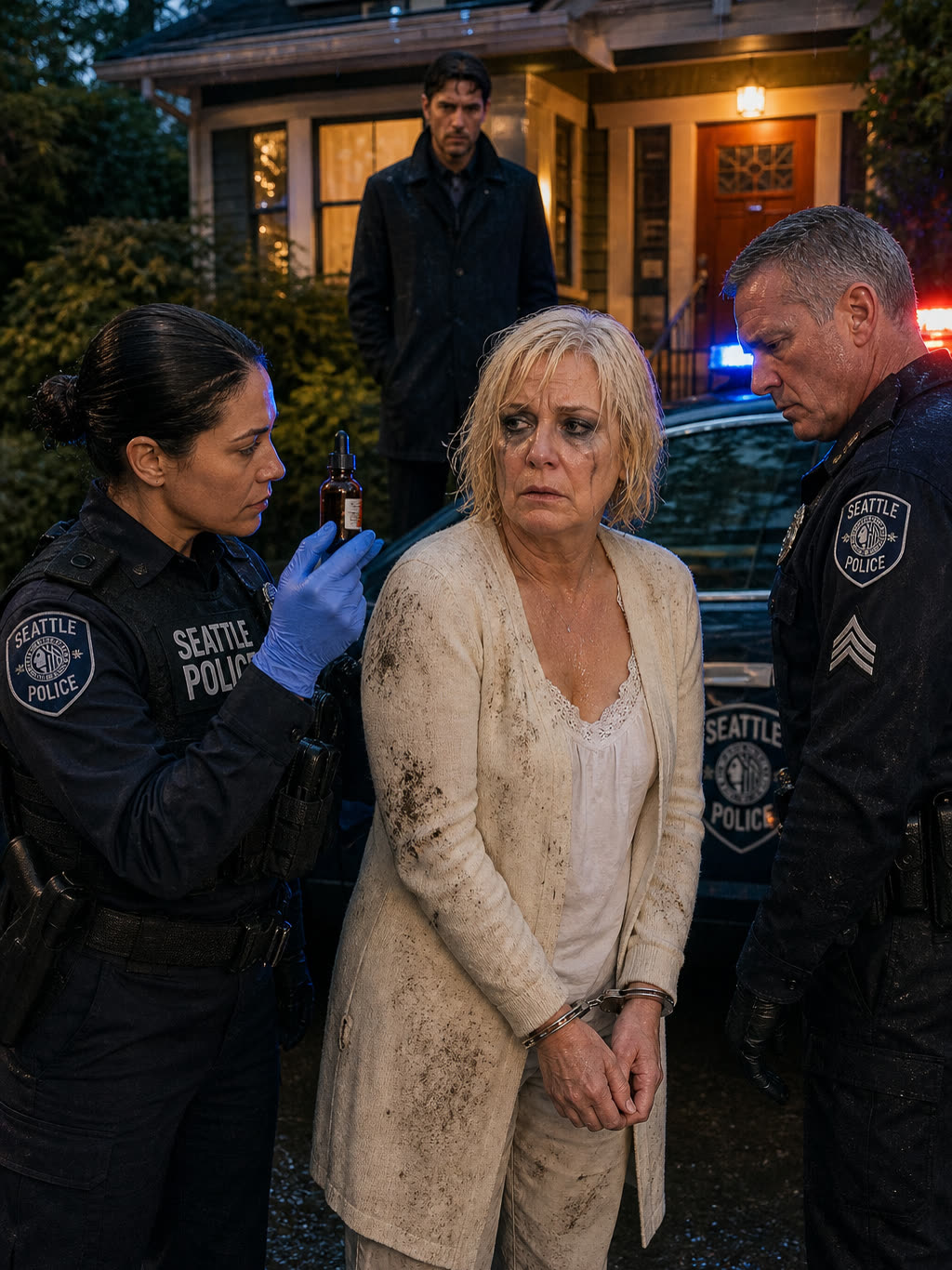
Officer Davis stepped through the splintered front entrance. Less than thirty seconds later she walked back onto the porch carrying Eleanor’s cream leather Hermès handbag. In her gloved right hand she held a small, unlabelled amber glass dropper bottle with a black rubber pipette. Davis held it up to the porch light. “Sergeant. Concentrated liquid suspension. No pharmacy label. Matches the description in the audio log.”
Eleanor’s knees gave out. She didn’t fall into the mud this time; she simply sagged, her mouth opening and closing like a dying fish, every ounce of her social dominance, aristocratic pride, and sociopathic arrogance evaporating into the freezing autumn air.
“Eleanor Vance,” Sergeant Miller said, stepping forward and pulling a pair of heavy steel handcuffs from his duty belt. “Turn around and place your hands behind your back.”
“Julian!” she screamed, her voice breaking into a ragged, pathetic squeal as Miller seized her wrists. “Julian, tell them! Tell them it’s a mistake! You can’t let them do this to me! I am your mother! Think of the Vance name! Think of the shame!”
CLACK-CLACK. The ratchet of the stainless-steel teeth locking into place sounded like the closing of a bank vault. Miller didn’t handle her gently. He marched her firmly toward the rear of the patrol cruiser, his hand pressed against the back of her soaked neck, and pushed her down into the hard plastic rear seat. “You have the right to remain silent,” Miller recited through the rain. “Anything you say can and will be used against you in a court of law…”
The heavy metal door of the cruiser slammed shut with a final, hollow thud. Through the reinforced, tinted glass, Eleanor sat pressed against the cage, her wet face smeared with black mascara and mud, screaming silent, furious curses that no one would ever listen to again.
Sergeant Miller walked back up the porch steps and handed my phone back to me. His face was pale, his eyes heavy with the grim weight of what he had witnessed. “Paramedics are three minutes out, Mr. Vance,” Miller said quietly. “We’ll need you to come down to the precinct later tonight to sign the formal sworn depositions, but right now, your priority is upstairs. She’s looking at felony domestic battery on an incapacitated person, reckless endangerment, and attempted administration of a controlled substance without a prescription. With this video and the audio logs, the prosecutor will ask for no bail. She won’t be coming anywhere near this house again.”
“Thank you, Sergeant,” I whispered.
I turned my back on the flashing lights, my mother’s screams, and the neighborhood spectators. I stepped through the splintered door of my home, kicked the loose pieces of the shattered mahogany frame out of the way, and walked into the foyer. The silence inside the house was deafening. I stepped over the pool of cold Earl Grey tea and the jagged shards of the porcelain cup and climbed the broad, carpeted staircase, my heavy boots moving without a sound.
The nursery door at the end of the hall stood open two inches. I pushed it with a trembling hand. The room was dim, lit only by the soft, warm glow of the cloud-shaped nightlight beside the changing table. In the cedar crib, Leo was still asleep, his tiny fist curled against his cheek, completely oblivious to the war that had just torn through his world.
Sitting on the soft wool rug beside the crib, pressed tightly into the corner between the wall and the heavy bookshelf, was Lily. She had pulled her knees up to her chest, her arms wrapped tightly around her legs, her face buried against her shins. She shivered in silent, violent convulsions, her pale blue flannel pajamas stained with drops of sweat and tears. She held her lower abdomen with one hand, rocking back and forth in a desperate, agonized attempt to manage the tearing fire of her twenty-four surgical staples.
When the floorboard creaked beneath my boot, her entire body seized. She flinched violently, pulling her head down between her shoulders, her hands flying up to protect her scalp, her eyes squeezing shut in absolute, conditioned terror.
“I’m sorry…” she wept, the words coming out in a broken, suffocated gasp that tore straight through my ribs and shredded my heart into bleeding ribbons. “Julian… I’m sorry… I didn’t mean to drop the ice… I didn’t mean to make her angry… please don’t let her take the baby… please, Julian, I love him so much… please don’t send me away…”
She thought I had come to finish what my mother had started. She thought the sirens outside were for her. The tears that had burned behind my eyes finally broke. They poured down my cheeks, hot and unrestrained, washing away the cold rain.
I dropped to my knees on the soft rug. I didn’t care about the mud on my trousers or my soaked coat. I reached out with infinite, trembling gentleness, sliding my arms beneath her shaking frame, being meticulously careful not to put an ounce of pressure on her bandaged abdomen. I pulled my shattered, battered, heroic wife into my chest and buried my face in the soft, dark hair of her neck.
“No, Lily… no, my sweet girl,” I sobbed, my voice breaking into ragged, weeping gasps as I kissed her bruised scalp, her temple, her tear-streaked cheeks. “Look at me, Lily. Look at my eyes.” She opened her eyes, her dark irises wide and swimming with unspeakable fear.
“I saw everything,” I wept, pressing my forehead against hers and letting my tears mingle with hers. “I saw the cameras from my desk. I heard the recordings from the kitchen. I know what she did to you. I know what she tried to do.”
Lily’s breath caught in her throat. “You… you saw?”
“I saw,” I whispered, wrapping my arms tighter around her, becoming an impenetrable, physical wall between her and the memory of the terror. “The police took her in chains, Lily. She is in a squad car right now. She will never step foot in this house again. She will never lay her eyes on you again. She will never touch our son again. You are safe. You are the queen of this house. You are my entire world.”
A long, ragged, shuddering gasp tore from Lily’s lungs, a sound that carried nine months of hidden terror, nine months of poison, nine months of silent, heroic endurance. Her trembling hands reached up, her fingers digging into the wet wool of my coat with desperate, clawing strength, and she collapsed against my chest. She buried her face in the hollow of my throat and let out the deep, agonizing wail of a captive who had finally, miraculously, been carried across the threshold of freedom.
I held her on the floorboards beside our sleeping son, rocking her in the dim light of the nursery, kissing the top of her head while her tears soaked through my shirt to my skin.
Ten minutes later, the front door downstairs creaked open, and the quiet, hurried footsteps of Dr. Chen, our trusted private obstetrician, whom I had called from the highway, climbed the stairs. She carried her medical kit and stepped into the nursery, her face grim with concern, and immediately knelt beside us to inspect Lily’s dressings, checking each of the twenty-four staples to make sure the physical integrity of my wife’s body had held.
As Dr. Chen began gently applying a fresh sterile dressing to Lily’s incision, my phone vibrated in my coat pocket. I pulled it out with my left hand, keeping my right arm securely wrapped around Lily’s waist. It was Sergeant Miller, calling from the precinct booking desk.
“Mr. Vance,” Miller’s voice sounded grim through the speaker, heavy with professional shock. “We just executed an emergency search on your mother’s phone and her personal banking applications during processing.”
“What did you find, Sergeant?” I asked, my voice cold and steady.
“Forty-eight hours ago, Eleanor Vance completed a wire transfer of forty thousand dollars to a discredited private investigative agency in Tacoma,” Miller said. “The memo on the transaction was marked ‘Postpartum Behavioral Surveillance & Custody Evidence Package.’ Mr. Vance… she wasn’t just planning to call CPS. She had hired two men to stage photographic evidence of your wife abandoning the child in a public park next week.”
A year had passed.
The morning sunshine spilling across our backyard on Queen Anne Hill was gentle, clear, and golden. The ferocious October storms that had once nearly destroyed everything we cherished had faded into distant memories, replaced by the dazzling colors and flourishing beauty of late spring. Our old mahogany front door, once cracked and splintered, had been exchanged for a thick, solid panel of quarter-sawn white oak, strengthened with substantial iron strap hinges and sophisticated mortise locks accessible only with keys belonging to Lily and me. The wooden floorboards in the entrance hall had been thoroughly sanded and restored with warm, honey-colored oil, removing every trace of the spilled Earl Grey tea and shattered porcelain that had once marked them.
The fragrant breeze carried the scents of flowering lilacs, salty air rising from Puget Sound, freshly ground dark-roast coffee, and a peace so complete that nothing could contaminate it.
On the terrace below, across the thick, clover-covered lawn, one-year-old Leo Vance was running.
His unsteady little legs carried him forward with the boundless enthusiasm of an innocent child, his plump cheeks glowing with health and his dark eyes shining beneath the sunlight as he pursued a delicate yellow swallowtail butterfly fluttering over the grass. Every few steps, a bright, musical giggle escaped his lips and rang throughout the garden. He knew no fear, was surrounded by unconditional affection, and remained completely protected inside the sanctuary we had created for him.
Lily sat before a wooden painting easel on the cedar deck, bathed in the morning sunshine.
She wore a modest, sleeveless white linen summer dress, leaving her shoulders exposed to the sun and revealing their healthy, golden-bronze glow. Her long, dark hair, once brutally pulled and damaged by a monster’s hands, had grown full, lustrous, and beautiful, cascading in gentle waves beyond her shoulder blades. The frightening, bloodless whiteness that had drained her complexion twelve months earlier had vanished, giving way to the radiant energy of a woman who had finally recovered control over her existence, her physical well-being, and her independence.
The twenty-four surgical staples belonged entirely to the past. All that remained was a slender, silvery scar across her lower abdomen, a courageous reminder of survival that I kissed tenderly every night before we fell asleep.
A fine sable watercolor brush rested between the fingers of her right hand, gliding over the textured cotton paper in smooth, assured movements. She was creating a portrait of our garden, no longer producing the gloomy, suffocating drawings she had once hidden away, but filling the page with magnificent greens, vivid amethyst shades, and glowing golden tones.
Two hundred miles east of our home, amid the dry, scrub-covered landscape beyond Spokane, the imposing concrete buildings of the Washington Corrections Center for Women stretched long, colorless shadows across the gravel-covered recreation yards.
Eleanor Vance stood among four hundred prisoners waiting in line for the midday cafeteria announcement, dressed in a dull, regulation wool prison uniform.
The judicial system she had once believed she could bend to her will in order to ruin an orphaned young woman had instead fulfilled its duty with ruthless, methodical accuracy. Prosecutors had presented the 4K surveillance recordings, forensic sound evidence recovered from the kitchen, testimony from Dr. Higgins, who had relinquished his medical license rather than face federal conspiracy prosecution, and financial records documenting the forty-thousand-dollar agreement with a private investigator. After reviewing the evidence, the jury required fewer than ninety minutes to reach its decision.
Guilty on every charge: Felony Domestic Battery on an Incapacitated Person, Reckless Endangerment, and Premeditated Criminal Solicitation.
The presiding judge, a longtime acquaintance of Mr. Henderson who had personally witnessed Eleanor’s humiliating public removal from her home while standing across the street, had shown no special consideration for her privileged social background. He imposed a six-year sentence in state custody with no opportunity for early parole. Within forty-eight hours of the verdict, the wealthy acquaintances who had once welcomed her into their circles removed her name from historical society records, museum governing boards, and country club membership directories throughout King County. Every letter she mailed from prison was sent back without being opened, and her ability to reach our telephone numbers had been permanently disabled.
For us, she no longer existed. She had reduced herself to a forgotten shadow, surrendering her son, her grandson, and her liberty in pursuit of the meaningless prestige of a crown she had never deserved.
I stepped through the French doors onto the cedar deck with two tall glasses of freshly squeezed lemonade, chilled with ice and decorated with sprigs of mint picked from Lily’s garden.
After placing both glasses on the little wrought-iron café table, I moved behind my wife’s chair and gently slipped my arms around her waist, lowering my chin to rest against the warm curve of her neck.
Lily settled comfortably against my chest with a quiet sigh of happiness, placing her paintbrush across the palette. She lifted her hands to cover mine where they rested against her ribs. Her skin felt warm and calm, without the slightest trace of the trembling that had once revealed the fear buried deep within her.
“Look at him, Julian,” she whispered softly, watching Leo lose his balance and tumble harmlessly onto the cushion of grass before immediately sitting upright and clapping his little hands toward the passing clouds. “He’s so brave. He isn’t afraid of anything.”
I brushed my lips against the side of her neck, breathing in the delicate fragrance of jasmine oil on her skin and the fresh, comforting sweetness of the air surrounding our home.
“He gets that from his mother,” I murmured. “He gets that from the bravest woman I have ever known.”
Lily turned toward me, meeting my gaze with her beautiful dark eyes. There was no suffering left in them, no lingering shadow of terror. Instead, they held a profound, unwavering confidence that had been shaped through the fiercest trials imaginable. She raised her hand and gently stroked my cheek with her thumb, offering the same luminous, peaceful smile that had captivated me from the very first instant we met.
“Thank you for coming home, Julian,” she whispered. “Thank you for being my shield.”
“I will always come home, Lily,” I replied, kissing her tenderly, allowing every promise I had ever made to be expressed through that gentle embrace. “As long as I draw breath, no one will ever touch you. No one will ever hurt this family again.”
Below us on the lawn, Leo lifted his head toward the terrace. His little face brightened with overwhelming excitement, and he pushed himself upright, stretching one chubby finger in our direction.
“Daddy! Mommy!” he cried happily, his tiny legs moving as quickly as they could carry him toward the terrace stairs. “Look! I run fast!”
Smiling, I descended from the deck and lifted my laughing, wriggling little boy into my arms with one hand, while reaching out with the other to draw Lily into our embrace. Beneath the welcoming warmth of the Washington sunshine, we stood together as a family—father, mother, and son—an enduring sanctuary founded on honesty, defended through courage, and held together by a fierce, protective devotion that no force of darkness could ever destroy.
“You run as fast as you want, Leo,” I said with a laugh, kissing his soft cheek as his little arms tightened around my neck. “Our house is safe forever.”
Disclaimer: This story is a work of fiction inspired by real-life themes. Names, characters, places and events are fictionalized, and any resemblance to real persons is purely coincidental. Images are for illustration purposes only.
