


I closed my eyes in the sitting room of my Nashville mansion and stayed completely motionless. I wanted everyone around me to believe I was asleep. More than that, I wanted to discover what people did when they thought I wasn’t watching.
In my world, wealth did not reveal honesty. It often hid it. People smiled with purpose, offered compliments with purpose, and showed loyalty with purpose—until the money disappeared or someone offered them something better.
At twenty-eight years old, I possessed more wealth than many men twice my age. My name, Ethan Cole, was connected to luxury buildings, private communities, and real estate projects that transformed cities across the country. People described me as intelligent, ambitious, impossible to reach. But inside my fourteen-thousand-square-foot mansion outside Nashville, none of those titles meant anything.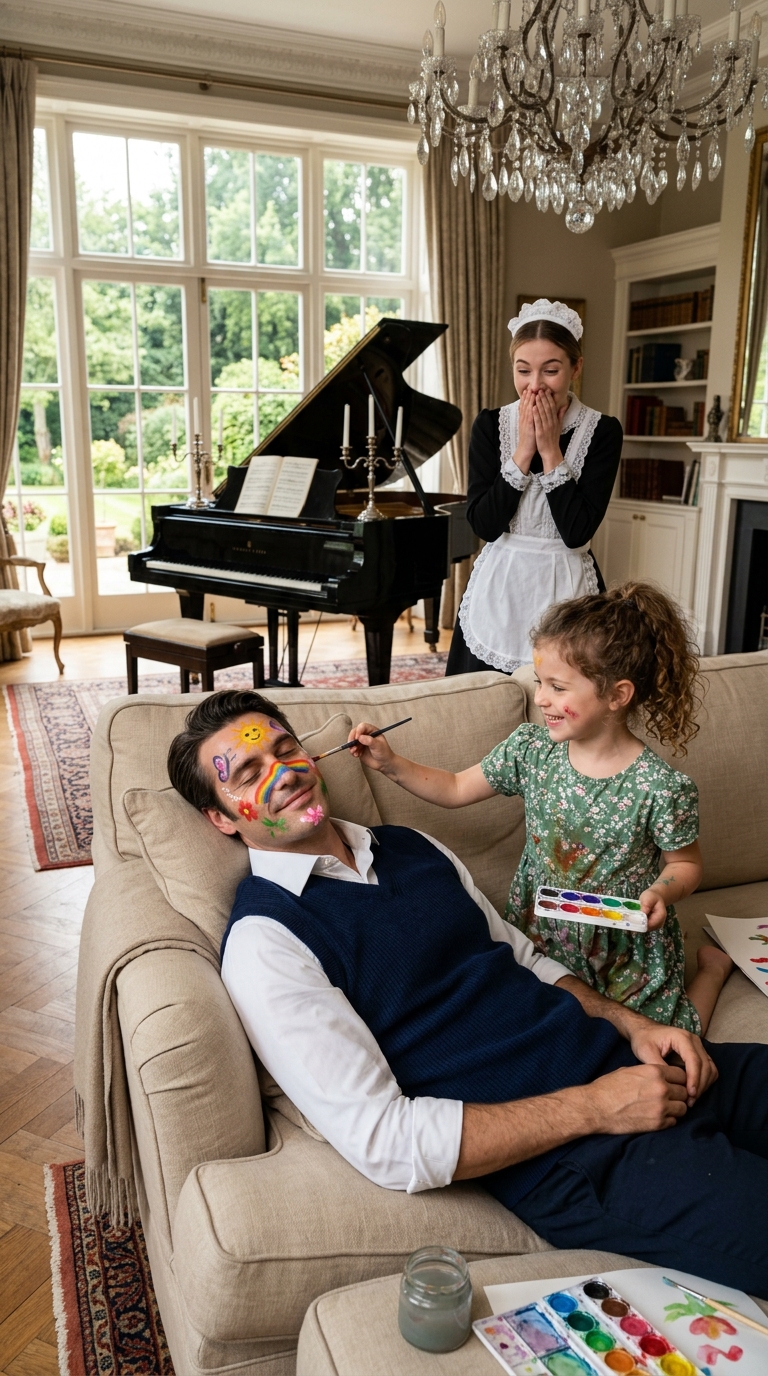
The house was painfully quiet.
Not calm. Quiet.
There was a difference, and I had learned that difference through experience. Peace felt alive. Silence felt like emptiness dressed up in expensive clothing.
I felt it in the dining room designed for celebrations that never happened. I felt it in hallways built for footsteps that rarely came. I felt it in guest rooms that remained flawless, untouched, and lifeless.
Then Maria Delgado entered my life.
She was thirty-two, originally from San Antonio, and carried herself like someone who understood that one wrong decision could change everything. She never stopped to admire the chandeliers. She never ran her fingers along the marble counters or stared at the expensive artwork. She arrived, completed her work, and made sure everything was better than when she found it.
That interested me more than I expected.
During her second week working in my home, she walked through the service entrance holding a small hand. A little girl stood beside her wearing a yellow raincoat, with brown curls falling out of messy pigtails and a stuffed rabbit tucked beneath her arm like a tiny protector.
Maria looked nervous.
“I’m sorry, Mr. Cole. My babysitter canceled at the last minute. She’ll stay with me. I can leave if—”
The little girl lifted her hand.
“Hi.”
I stopped.
Most adults around me apologized before I even spoke. They worried about upsetting me before anything had happened. But this child simply stood there, looking at my mansion with curiosity instead of fear.
“What’s your name?” I asked.
“Sophia.” She held up the stuffed rabbit. “This is Noodle. He is brave but floppy.”
Maria looked like she was waiting for me to tell them to leave.
I should have.
My house had rules. Limits. Security concerns. Everything was supposed to be organized and controlled.
But before my mind could object, I heard myself say, “She can stay in the sitting room. No stairs. No offices. Under supervision.”
Maria released a breath like I had just given her something she desperately needed.
Sophia smiled.
“Thank you, Mr. House Man.”
That was the first small crack in the wall I had spent years building around myself.
After that day, Sophia came whenever Maria’s childcare plans fell apart. Some days it was only for a few hours. Other times, she stayed through long evenings while Maria handled unexpected responsibilities.
She colored at the small table. She whispered secrets to Noodle. She sang quiet songs that were often out of tune.
And I pretended not to notice.
But I noticed everything.
At first, her voice was just another sound inside the mansion.
Then somehow, it became the only sound that made the house feel alive.
One rainy Friday evening, water tapped gently against the tall windows. Maria had an important dinner meeting she could not miss, and Sophia sat in the sitting room painting carefully on a sheet of paper.
I brought my laptop there and told myself the room had better lighting.
I told myself I would work.
I told myself I would leave.
I did none of those things.
The room was warm. The rain was calming. Sophia’s tiny paintbrush moved across the paper in a soft rhythm. Noodle rested beside her as if he had an official duty to protect her artwork.
Eventually, I leaned back.
Only for a moment.
Then I closed my eyes.
When Maria returned, her shocked gasp pulled me out of the quiet.
I sensed her standing in the doorway before I opened my eyes.
Then I heard her whisper in horror:
“Sophia—what are you doing?”
My eyes opened slowly.
Sophia stood beside me holding a paintbrush.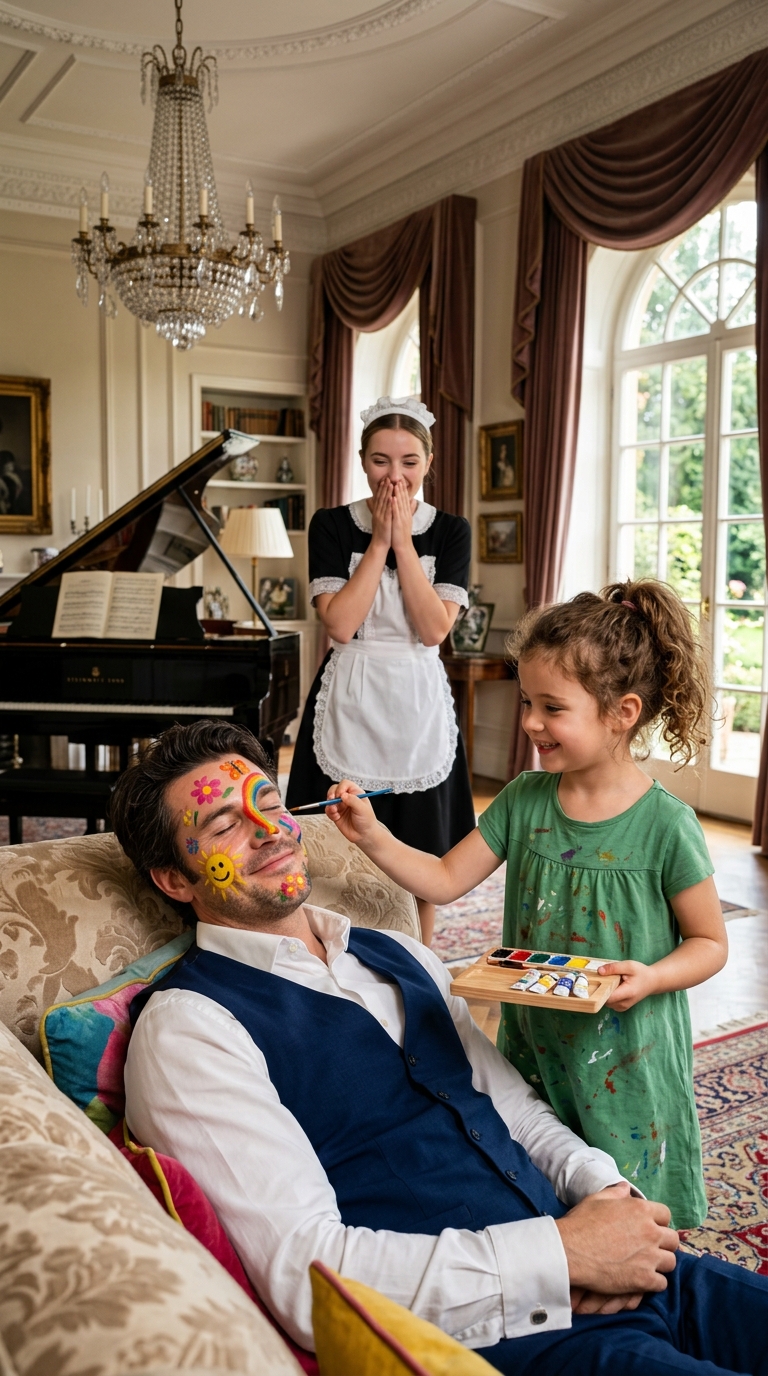
There was a yellow sun on my cheek, a blue butterfly across my forehead, and a crooked rainbow stretching over my nose.
She did not look afraid.
She looked proud.
“He looked sad,” she said softly. “So I made him pretty.”
The room became completely silent.
I looked at her tiny hand.
Then I looked at Maria’s worried expression.
Then I saw my reflection in the dark window.
I looked ridiculous.
Paint covered my face. My expensive shirt had a small blue mark near the sleeve. My carefully controlled image had disappeared.
And somehow, for the first time in years, I didn’t care.
I didn’t feel like a man being judged.
I didn’t feel like someone everyone wanted something from.
I felt noticed.
Maria stepped forward quickly, panic written across her face.
“I’m so sorry, Mr. Cole. I don’t know why she thought—”
I raised my hand gently.
“Don’t apologize.”
She stopped.
Sophia tilted her head.
“You’re not mad?”
I looked at the little girl who had walked into my empty mansion carrying nothing but a stuffed rabbit and a fearless smile.
“No,” I said quietly. “I’m not mad.”
A small smile appeared on her face.
“Good. Because you needed a rainbow.”
I laughed.
Actually laughed.
The sound surprised even me.
Maria stared.
I realized she had probably never heard it before.
Neither had I.
That night, after they left, I stood alone in front of the mirror for a long time.
The paint had already started drying.
For years, I had spent millions building walls, buying security, and protecting myself from disappointment.
But a little girl with a paintbrush had walked through every barrier without trying.
The next morning, I arrived downstairs earlier than usual.
Maria looked surprised when she saw me.
“Good morning, Mr. Cole.”
“Good morning, Maria.”
She hesitated.
“About yesterday…”
I smiled.
“Yesterday was the first time this house felt like a home.”
Her expression softened.
“I hope Sophia didn’t cross a line.”
“She did,” I said.
Maria looked worried.
Then I smiled.
“She crossed the one I needed crossed.”
Over the following months, things changed.
I started eating dinner at the table instead of at my desk.
I stopped leaving empty rooms untouched.
I learned that Sophia’s favorite color was yellow because “yellow looks like happiness.”
I learned that Noodle had a birthday every year because, according to Sophia, “all brave rabbits deserve cake.”
And slowly, the mansion that once felt like a museum became a place where someone laughed.
Then one afternoon, Maria received a phone call that changed everything.
Her old apartment building had been sold, and she was struggling to find a safe place for herself and Sophia.
She tried to hide it.
But I noticed.
“You don’t have to carry every problem alone,” I told her.
She looked down.
“I’ve always had to.”
I understood that sentence more than she knew.
So I offered her something she never expected.
Not charity.
Not pity.
A real opportunity.
I helped create a position managing a children’s community foundation connected to my company. Maria had always cared for people, organized resources, and protected families who needed support.
She belonged there.
Months later, the empty guest wing of my mansion was transformed into a place where children from local programs could visit, read, and create.
Sophia painted the first picture for the wall.
It was a terrible drawing.
The proportions were wrong.
The colors were everywhere.
But in the center was a large house with three people standing outside.
Me.
Maria.
And Sophia.
At the bottom, she had written:
HOME IS WHERE SOMEONE SEES YOU.
Years earlier, I believed money could protect me from loneliness.
I was wrong.
Money could buy a mansion.
It could buy comfort.
It could buy security.
But it could never create the one thing I needed most.
Connection.
The little girl who once covered my face in paint gave me something no business deal ever had.
She reminded me that beneath the success, the wealth, and the reputation, I was still just a person hoping someone would see me.
And every morning after that, when sunlight filled the sitting room and Sophia’s laughter echoed through the halls, I looked around the house I once thought was empty.
And I finally understood.
It had never been empty.
It was just waiting for someone to bring it back to life.
