

Part One: Fine, Twice
Sadie was sitting at the kitchen table when the call came.
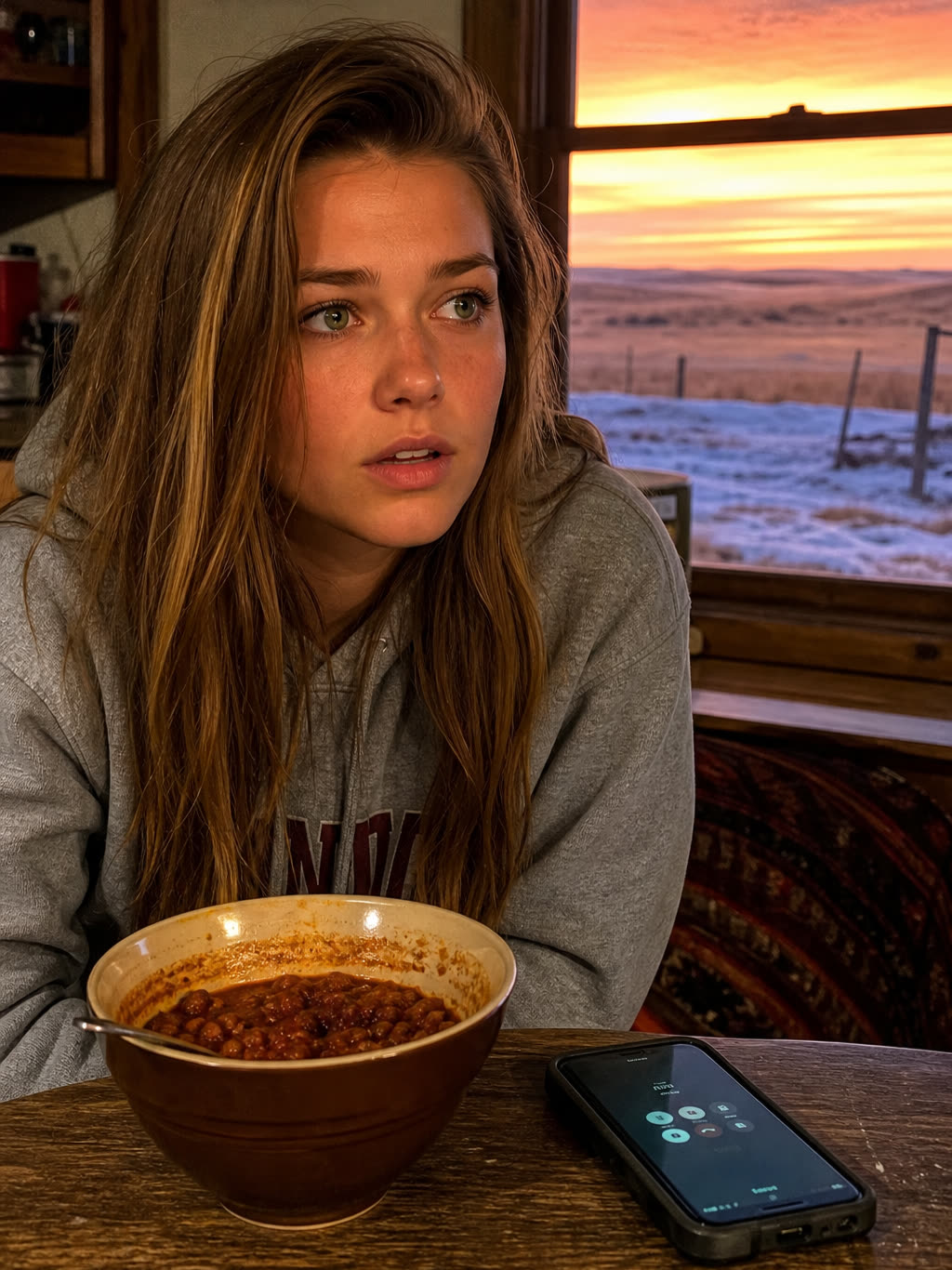
It was a Tuesday in March, and a bowl of chili was going cold in front of her. Outside the window, the snow along the fence line had turned gray and crusted over, the way it does in South Dakota when winter has forgotten how to end.
Her phone buzzed on the table beside the bowl. She glanced at the screen. Dad.
She smiled, as she always does when he calls. Even after eleven years.
She put him on speaker, the way she always does.
She does that so I can hear. She has done it since she was little. I used to believe it was because she wanted me to be part of the call. Now I think she just didn’t want to be alone with whatever he was about to say.
“Hey, Dad.”
“Hey, kiddo.” Rory’s voice came crackling out of the little speaker. He was in his truck. I could hear the heater fan running and the radio playing low behind him. “How’s school?”
“Fine. We had a sub in chemistry. She didn’t know anything.”
“That’s how you get to go home early,” Rory said. “Teach the sub something.” Sadie laughed, a real laugh. Then the line went quiet, for just a second too long.
“Listen, Sade,” he said. “About prom.”
She had asked him two weeks earlier, on a Sunday, at the end of a weekend visit. She was standing in his driveway in Mitchell with her backpack on her shoulder while Tasha watched from the kitchen window.
Dad, can you help me with a dress for prom? It’s in April.
He had told her he’d think about it. He had told her he’d call.
Now he was calling.
“Kiddo, I can’t swing a dress this year,” he said. “Welding’s been slow since Christmas. I’m only getting three days a week at the shop. I’m sorry.”
Sadie looked down at her chili.
“That’s fine, Dad,” she said.
“I feel bad about it.”
“It’s fine, Dad,” she said again. “It’s totally fine. I’ll figure something out.”
She said it was fine twice.
They talked for another minute. About the Twins’ spring training. About his truck, which needed new brakes. About whether she’d heard back from South Dakota State.
Then he said he had to go, he was pulling into the gas station, love you, kiddo.
“Love you too, Dad.”
She hung up and sat for a moment, staring at her phone.
Then she stood, rinsed her bowl at the sink, and watched most of the chili swirl down the drain. She set the bowl in the drying rack.
Then she went upstairs.
I stayed at the kitchen table alone.
I wanted to follow her. I didn’t. I know my daughter. When she climbs the stairs that quietly, she doesn’t want company. She wants to lie on her bed with her earbuds in and stare at the ceiling until whatever it is stops hurting.
I knew it was going to hurt. I had known the instant he said kiddo in that voice.
I cleaned the kitchen. I put the chili in a Tupperware. I wiped the counters twice.
Then I sat back down with my laptop and looked at the balance in my checking account.
Four hundred and twelve dollars.
Rent was due Friday.
At 9:40 that night, his wife Tasha posted a picture.
I saw it because I was in bed scrolling through my phone, the way you do when sleep won’t come. Tasha and I aren’t friends. But we’re friends on Facebook, the way people in small towns are. You click accept and then forget about it.
The photo appeared at the top of my feed.
Her daughter, Madison, also seventeen, in a six-hundred-dollar gown from Sioux Falls.
It was a long, fitted dress in champagne gold, covered in sequins that caught the light, with a slit up one side and thin straps. Madison stood in front of a three-way mirror in a bridal shop, her blonde hair down, smiling at the camera over her shoulder.
Tasha’s caption read: Found THE dress! Madison’s going to be the prettiest girl at Mitchell prom. Thank you Boutique 605!
I knew what that cost. Boutique 605 is the fancy dress shop on Phillips Avenue, downtown Sioux Falls. Everybody in eastern South Dakota knows it. Their prom dresses start at four hundred dollars.
And Rory had commented underneath.
Right there, the very first comment, posted eight minutes after the photo went up. Four hours after he told our daughter he couldn’t swing a dress.
Beautiful girl. So proud. ❤️
I lay in the dark and read it three times.
Beautiful girl. So proud.
I tried to remember the last time Rory had commented on a picture of Sadie. I scrolled back through his page. A month. Two months. Six.
Nothing. Not a single comment. Not on her homecoming photo in September. Not on her volleyball trophy in November. Not on the picture I posted for her seventeenth birthday in January.
He had hearted a few of them. That was all. A little red heart, no words.
Then I heard Sadie’s door.
Across the hall. I had thought she was asleep. Her light had been off for an hour. But I heard her door open, heard her cross into the bathroom, heard the water run.
Then her door closed again, very softly, the way you close a door when you don’t want anyone to know you were awake.
She had seen it.
Of course she had. She’s seventeen. Her phone is her whole world. She follows Tasha. She follows Madison. She follows her dad.
She had seen her stepsister in a six-hundred-dollar dress. And she had seen her father’s comment underneath.
Beautiful girl. So proud.
I got up and stood outside her door in the dark hallway, one hand on the doorknob.
I could hear her breathing on the other side. Not crying. Just breathing, slow and careful, the way you breathe when you’re trying very hard not to cry.
I didn’t open the door.
I went back to bed and lay there staring at the ceiling until two in the morning.
I did not call him.
I want that understood. At two in the morning I held my phone with his name pulled up and my thumb hovering over the call button. I could have woken him and said everything I’d been holding in for eleven years.
I didn’t.
I have been divorced from Rory for eleven years, and I know every way that call goes.
If I call angry, he gets defensive. He says I’m always trying to make him the bad guy. He says I don’t understand how hard it is. He says Tasha’s money is Tasha’s money and he doesn’t control what she spends it on.
Then he hangs up. And then he doesn’t call Sadie for two weeks. And Sadie thinks it’s her fault.
If I call calm, he agrees with everything I say. He says he’ll fix it. He says he’ll call Sadie. He says he’s sorry.
Then he doesn’t. And Sadie thinks it’s her fault.
Rory and I married at twenty-two, in the Lutheran church in Howard, where his mother did the hair of every woman in town. Sadie was born when we were twenty-five.
He was a good husband for about five years. He was a welder at a trailer manufacturer in Madison. He was funny. He could fix anything. He used to lift Sadie onto his shoulders at the county fair so she could see the tractor pull.
Then he started staying late at the bar after work. Then he started not coming home. Then, when Sadie was six, I found the messages from Tasha on his phone.
We were divorced eight months later.
He moved to Mitchell and married Tasha two years after that. She had a daughter, Madison, Sadie’s age, six months younger.
He got Sadie every other weekend. He paid child support, six hundred and twelve dollars a month, through the state. The Department of Social Services takes it straight out of his paycheck.
He has never missed a payment. I’ll give him that. Eleven years. Not one.
But he missed everything else.
He missed her first piano recital. He missed most of her volleyball games. He missed her eighth-grade graduation because Madison had a dance competition in Sioux Falls that same day.
He calls on her birthday, most years. He sends a card with a twenty tucked inside.
He takes her every other weekend. Usually. When he isn’t working. When Madison doesn’t have something.
He loves her. I believe that. I always have.
He just loves her from a distance, like she’s a picture on a wall he walks past every day without really seeing.
He was Sadie’s father, not mine to fix.
That’s what I told myself, lying there at two in the morning. It’s what my counselor told me five years ago, when I was still crying about it every week.
You can’t make him be the father she needs, Jodi. You can only be the mother she needs.
And I couldn’t make him pay.
The child support was what the court ordered. Six hundred and twelve dollars a month. A prom dress isn’t in the court order. Neither is showing up.
But I knew who loved her.
I knew one person who had never once missed anything. Not one birthday. Not one concert. Not one volleyball game. Not one Christmas.
At six in the morning, while Sadie was in the shower, I picked up my phone.
I called his mother instead.
Darla Lindstrom is seventy-two.
She did hair in Howard for forty-one years. Darla’s Beauty Nook, in a little brick building on Main Street next to the bank. Two chairs, two dryers, a radio that only played KJAM out of Madison, and a coffee pot that was always on.
She retired three years ago and sold the shop to a girl she’d trained. But every Friday morning she still does the hair of eleven women from the Lutheran church in her own kitchen, because they won’t let anybody else touch it.
She raised Rory by herself.
His father, Gene Lindstrom, left when Rory was seven. He drove to Rapid City one Friday for a job interview and never came back. Darla found out three months later that he had another family out there.
She raised Rory on what she earned doing hair. She never took a dime from Gene, because Gene never sent one. She packed Rory’s lunches, went to his Little League games, and sat in the bleachers at his wrestling meets.
She bought him a suit for his own prom. I know because she told me once, at Christmas, a few years after the divorce. She said she did six extra perms that month to pay for it.
She has never missed one of Sadie’s birthdays, not even the year of the ice storm.
That was 2016. Sadie was eight. Her birthday is in January. A storm swept through eastern South Dakota the night before and coated everything in two inches of ice. Power lines were down from Sioux Falls to Huron. Interstate 90 was closed.
Darla drove anyway. From Howard to Salem, twenty-two miles of county roads in her old Buick, at fifteen miles an hour, with a birthday cake riding on the passenger seat.
It took her an hour and forty minutes. She arrived at seven that night. The cake was perfect. Chocolate, with pink frosting and eight candles.
Rory called the next day. He said the roads were too bad to get out of Mitchell.
She answered on the second ring. She’s always up by five-thirty. She has been getting up at five-thirty her whole life.
“Jodi?” she said. “Is everything all right? Is Sadie okay?”
“She’s okay,” I said. “Physically.”
“What happened?”
I told her plainly, with no commentary.
I had decided that on the drive to work the day before. If I ever called Darla about Rory, I would tell her straight. Just the facts. No adjectives. No opinions. No you should’ve seen her face. Darla was Rory’s mother. Whatever I said about him, she would feel it twice.
So I told her. Rory called Sadie at supper. He said he couldn’t swing a dress this year. Welding was slow. Sadie said it was fine. Twice.
At nine-forty, Tasha posted a picture of Madison in a six-hundred-dollar gown from Boutique 605.
Rory commented under it. Beautiful girl. So proud.
Sadie saw it.
That was all I said.
She was silent for a long time.
So long I thought the call might have dropped. I checked my phone. Still connected. Forty-one seconds.
I could hear her breathing. I could hear her kitchen clock ticking. I could hear a dog barking somewhere outside her house in Howard.
Then she spoke.
“Is she crying?”
“Not where I can hear,” I said.
Darla let out a long breath.
“That’s worse,” she said. “You know that’s worse.”
“I know.”
“Rory did that too,” she said quietly. “When Gene left. He never cried where I could hear. He’d go up to his room and close the door real quiet. I’d stand outside it and listen and he wouldn’t make a sound.”
She went silent again.
“Saturday,” Darla said. “I’ll pick her up at eight.”
“Darla, you don’t have to…”
“Saturday,” she said again. “Eight o’clock. Tell her to wear comfortable shoes. We’re going to Sioux Falls.”
“I can’t let you pay for…”
“Jodi,” Darla said. “You come too.”
I opened my mouth to argue. Then I closed it.
“Okay,” I said.
“And Jodi?”
“Yeah?”
“Don’t tell her where we’re going,” Darla said. “Just tell her Grandma wants to take her to lunch.”
On Saturday she drove the forty minutes to Sioux Falls herself.
She pulled into our driveway in Salem at seven-fifty-five, five minutes early, in her old maroon Buick LeSabre with a hundred and ninety thousand miles on it and a dent in the back bumper from a deer on Highway 81 in 2019.
She honked twice, like she always does.
Sadie looked out the front window. “Grandma’s here? It’s eight in the morning.”
“She wants to take you to lunch,” I said.
“At eight in the morning?”
“It’s a long lunch.”
Darla wouldn’t let me pay for gas. We stopped at the Cenex in Salem on our way out of town, and I tried to hand her a twenty. She pushed it back across the console.
“I don’t need gas money,” she said. “I’ve got a full tank and nowhere I’d rather be.”
Sadie sat in the back seat with her earbuds in, silent. She had been silent all week. She went to school, came home, did her homework, and went upstairs.
She hadn’t said one word about the dress. Or the picture. Or her dad.
It was forty minutes to Sioux Falls on Interstate 90. Flat brown fields on both sides, still patched with snow. Grain bins. Feedlots. A red barn every couple of miles.
Darla drove exactly the speed limit. Seventy-five. Both hands on the wheel at ten and two, the way they taught you in 1969.
Around Hartford, Sadie pulled out one earbud.
“Grandma,” she said. “Where are we going for lunch?”
“Sioux Falls,” Darla said.
“That’s kind of far for lunch.”
“We’ve got some shopping to do first,” Darla said.
Sadie went very still in the back seat.
Part Two: The Seventh Dress
Darla took the Phillips Avenue exit into downtown and parked on the street, right out front.
Boutique 605. A narrow brick storefront with big glass windows, mannequins in prom dresses of every color. Prom season.
Sadie stared at it through the car window. “Grandma,” she said, in a small voice. “No.”
“Get out of the car, honey,” Darla said.
“Grandma, I can’t. Dad said…”
“I know what your dad said,” Darla said. “Get out of the car.”
Inside, racks of gowns stood in bright daylight pouring through the front window.
That’s what I remember most. The light. It streamed through those big windows and lit every dress on every rack. Sequins and satin and chiffon and tulle. Pink and blue and black and red and silver. All of them glowing.
A young woman with a name tag that read BRITT came over. She was maybe twenty-five, in a black dress, with her hair in a perfect bun. “Good morning!” she said. “Are we shopping for prom?” “We are,” Darla said. “This is my granddaughter, Sadie. She’s a senior at McCook Central. Prom’s April twentieth.”
Britt smiled at Sadie. “What colors do you like?” Sadie didn’t answer. She was staring at the price tag on the nearest dress. $520.
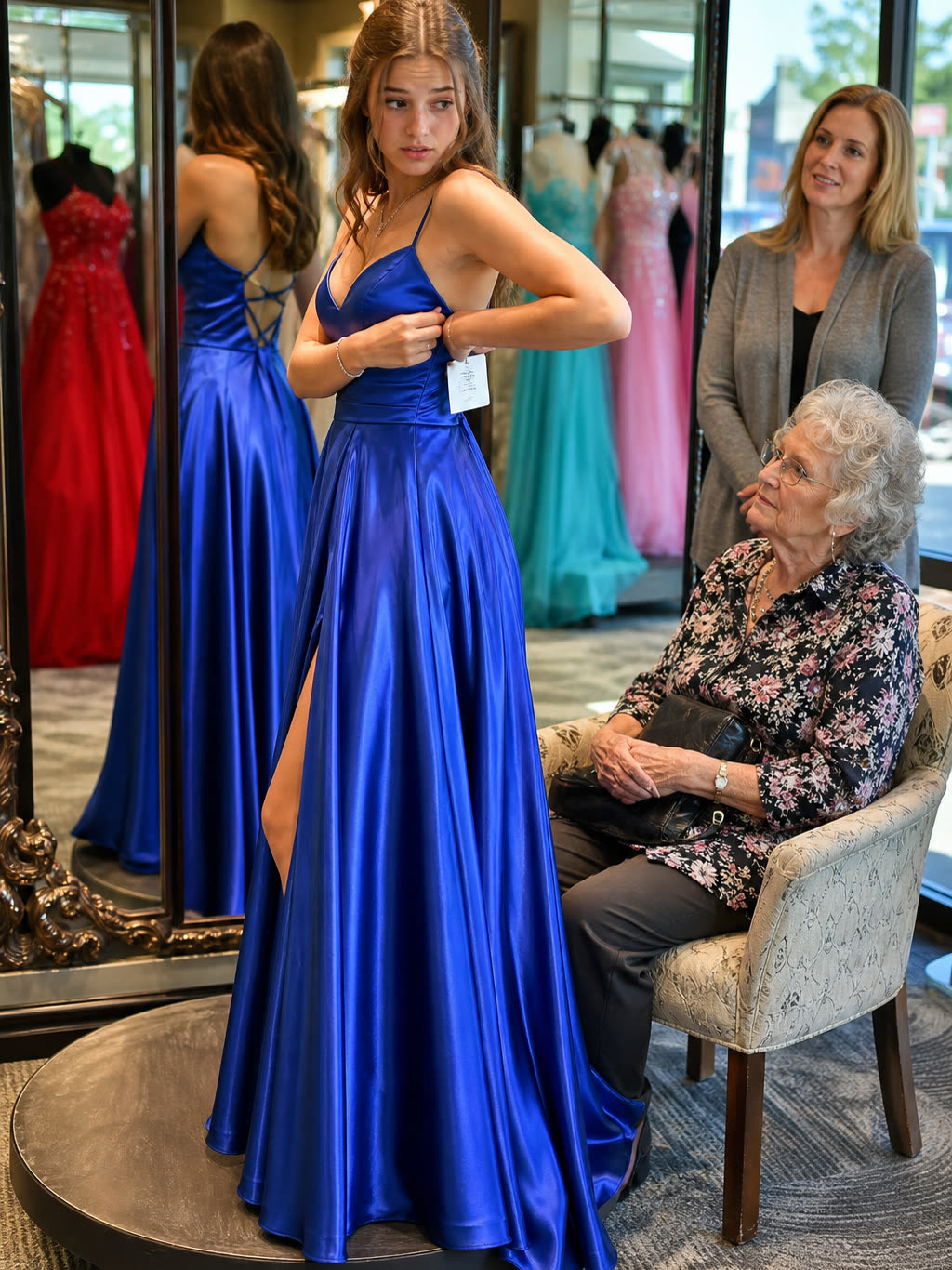
Sadie tried on six dresses. Britt carried them to the fitting room one at a time. A blue one. A pink one. A black one with lace sleeves. A red one. A lavender one with a big skirt. A silver one with beads.
Darla sat in the big upholstered chair outside the fitting room, the kind they set out for mothers and grandmothers, her purse in her lap. I stood a step behind her in my gray cardigan with my hands in my pockets.
Sadie checked every price tag before she checked the mirror.
That’s what broke my heart. Every single dress. She’d step out of the fitting room, and before she even looked at herself in the three-way mirror, she’d reach under her arm, find the tag, and read it.
$480. She’d glance in the mirror. “It’s okay.”
$410. “It’s kind of itchy.”
$545. “I don’t think the color’s right.”
$395. “The straps are weird.”
She didn’t like any of them. That’s what she said. But I knew. She liked all of them. She just couldn’t stand the numbers.
Six dresses. Six price tags. Six times she said it’s okay, it’s not right, it’s itchy.
On the sixth, the silver one with beads, she came out, checked the tag, and her face drained of color. $615.
“No,” she said. She was already reaching for the zipper. “Grandma, this is too much. All of these are too much. Can we just go? We can go to Target. They have dresses at Target.”
Darla stood up.
She walked to the rack where Britt had hung the dresses Sadie had already tried. She took each hanger, found each little white price tag on its string, and tore it off. One after another. Rip. Rip. Rip.
She folded them and tucked them into her purse. Then she snapped the purse shut.
Britt watched with her mouth slightly open. She didn’t say a word.
Darla walked back to the fitting room and stood in front of her granddaughter.
“Grandma picks the numbers today,” she said. “You pick the dress.”
Sadie stared at her.
“Grandma…”
“I’ve done hair for forty-one years,” Darla said. “I’ve got a little put back. It’s mine. I can spend it on whatever I want.” She folded her arms. “And today, I want to spend it on this.”
“But Dad…”
“Your dad’s not here,” Darla said. “I am. Go try on another one. And don’t you dare look for the tag. There aren’t any.”
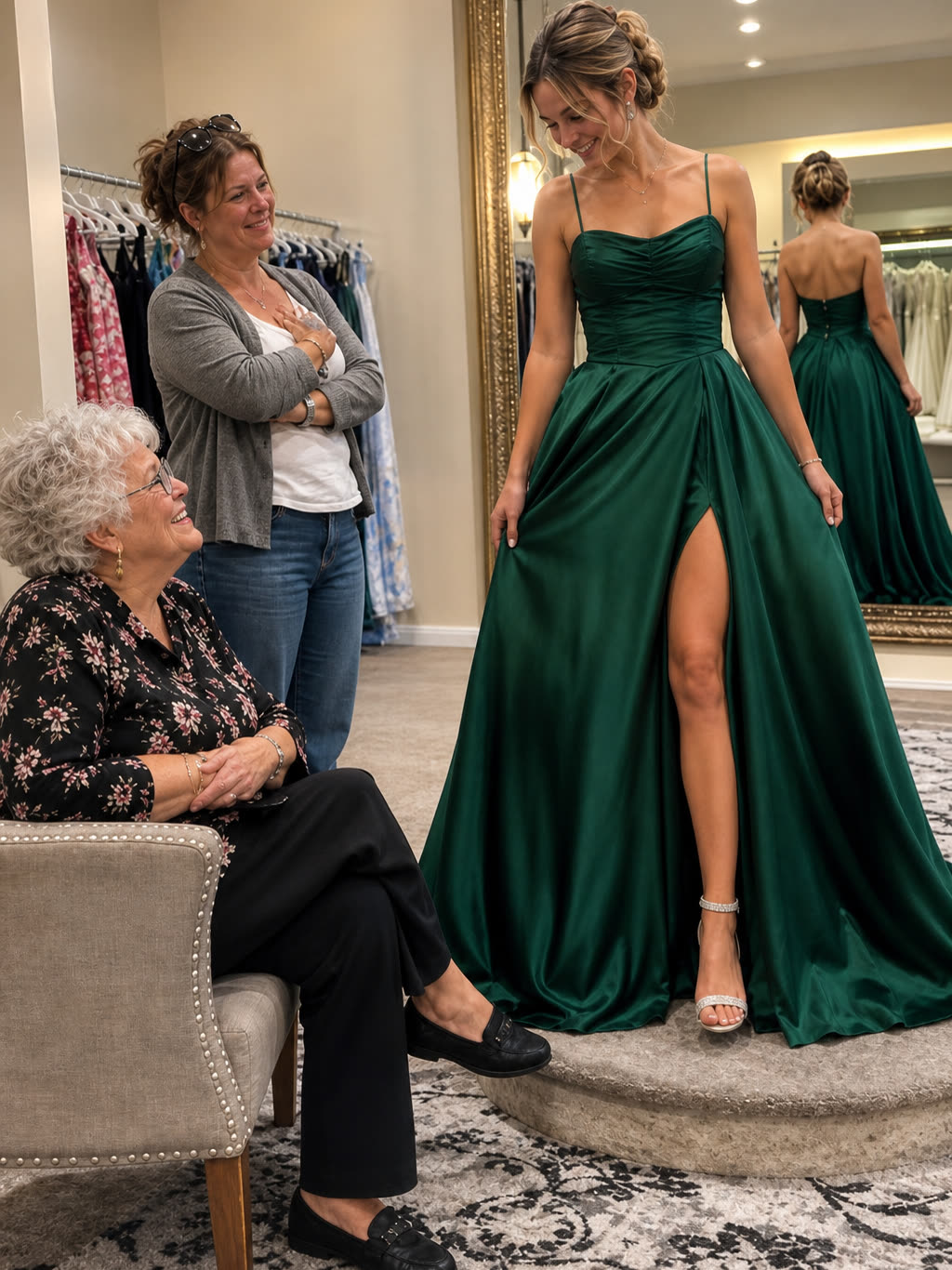
The seventh one was emerald green.
Britt brought it. She had been watching, and she must have seen something. She went to a rack in the back of the store, behind the counter, and returned with a dress over her arm that had never been on the floor.
“This one just came in Thursday,” she said quietly. “I haven’t even put it out yet. I think it might be right.”
Sadie carried it into the fitting room.
She was in there a long time. Longer than for any of the others.
Darla sat back down in the big chair and folded her hands on top of her purse. I stood behind her.
Then the curtain opened.
Emerald green. Satin. Floor-length. A simple neckline and thin straps. Fitted through the waist, then falling straight down, plain and smooth, with a soft shine when she moved.
No sequins. No beads. No lace.
Just green. Deep, rich green. The color of a cornfield in July.
It was the color of her eyes. I had never noticed that before. Sadie has green eyes. Rory’s eyes. Darla’s eyes.
Sadie stepped up onto the little round platform in front of the three-way mirror and said nothing.
She stood and looked at herself. Front. Side. Back.
She didn’t reach for a tag. There wasn’t one.
She just looked.
Darla sat in the chair beside her, holding her purse, smiling.
Not saying anything. Just smiling, the way she smiles at the women in her kitchen on Friday mornings when she takes out the rollers and hands them the mirror.
I stood a step behind Darla in my gray cardigan and kept my mouth shut.
It was not my moment.
I wanted to say something. Lord, I wanted to. I wanted to say you’re beautiful, baby, you’re the most beautiful girl in the world. I wanted to cry. I wanted to take a hundred pictures.
But it wasn’t my moment. I’d had a hundred moments with Sadie. I’d have a hundred more.
This one belonged to her grandmother.
“Oh, honey,” Darla said softly. “There you are.”
Sadie turned to see the back.
The dress was open in the back, just a little. A low scoop with a thin satin strap across the middle. She looked at it over her shoulder in the mirror.
Her face changed, just for a second. Something opened up in it. Something I hadn’t seen since before Christmas. Maybe before that.
Then she looked down at the floor.
“Grandma,” she said. “Dad said he couldn’t.”
“I know what your dad said.”
“I don’t want you mad at him.”
That was it. That was the thing. Standing on that platform in a dress that made her look like a movie star, my daughter wasn’t thinking about herself.
She was worried about her father.
Worried that Grandma would be mad at him. Worried that he’d get in trouble. Worried that this dress would start a fight.
Seventeen years old. And she had already learned the thing I’d spent eleven years trying not to teach her. That her job was to keep the peace. That if she asked for something and didn’t get it, the right thing was to say it’s fine. Twice.
Darla set her purse down on the floor beside the big upholstered chair. She stood, walked to the platform, and took her granddaughter’s hand.
“I’m not mad at anybody,” she said. “I’m buying my granddaughter a dress.”
Sadie’s chin was trembling.
“Listen to me,” Darla said. “Your father is my son. I love him. I’ll love him till the day I die. Nothing you do or I do is going to change that.” She squeezed Sadie’s hand. “But that’s got nothing to do with you. You hear me? Nothing. You don’t have to protect him. That’s not your job.”
“But…”
“Your job,” Darla said, “is to stand up there and be seventeen. And look like that. And let your grandma buy you a dress.”
Sadie cried then.
Right there on the platform, in the emerald green dress, in front of the three-way mirror and Britt and the other customers and me.
Not loudly. Just tears running down her face. Darla held her hand and let her cry.
I turned around and stared very hard at a rack of shoes for a minute.
It was $389.
Britt rang it up at the glass counter. She said nothing about the price tags in Darla’s purse. She simply found the dress in her computer and typed it in.
Three hundred and eighty-nine dollars. Plus sales tax.
Darla paid in cash, counted out slowly on the glass.
She pulled a thick white bank envelope from her purse, from First Bank & Trust in Howard. She took out the bills one at a time. Twenties, mostly. Some tens. A few fives.
She counted them out loud, very slowly, laying each bill flat on the glass.
“Twenty. Forty. Sixty. Eighty. One hundred.”
I knew where that money came from.
Not a pension. Hairdressers in small towns don’t have pensions. Not savings, exactly. Darla’s savings are a coffee can in her pantry. Everybody in the family knows about the coffee can.
That money came from Friday mornings. Eleven women from the Lutheran church. Fifteen dollars a wash and set. Cash. Every week. For the three years since she retired.
Darla had been saving it in that coffee can for something. She never said what.
Now I knew.
“Three hundred and eighty,” Darla said. “Three ninety. Four hundred. Four twenty.”
She pushed the stack of bills across the glass to Britt.
Britt counted it and handed Darla her change. Twelve dollars and sixty-four cents.
Then Britt did something I hadn’t expected. She came around the counter with the dress in a long black garment bag and placed it in Sadie’s hands herself.
“You look beautiful in it,” she said quietly. “Have the best prom ever.”
In the parking lot, Darla took a picture of Sadie holding the garment bag.
Right there on Phillips Avenue, in front of Boutique 605, with the big glass windows behind her and the dresses glowing in the sunlight.
“Hold it up, honey,” Darla said. “So I can see it.”
Sadie held up the garment bag. She was smiling, a little shy, her eyes still red from crying.
Darla took the picture on her phone, holding it out at arm’s length and squinting at the screen. She took three more, just to be sure.
Then she sat behind the wheel and typed with one finger for a long time.
Sadie climbed into the back seat with the garment bag across her lap. I took the passenger seat.
Darla didn’t start the car. She sat with her phone in both hands, holding it close to her face because her reading glasses were in her purse and she didn’t want to dig for them. She typed with her right index finger, one letter at a time.
Tap. Tap. Tap.
She stopped. She read what she’d written. She deleted something. She typed some more.
I didn’t ask what she was writing.
I wanted to. I could see her face. It was very serious, her lips pressed together. Every few seconds she paused and looked out the windshield at Phillips Avenue, then went back to typing.
It took her almost ten minutes.
Then she pressed something on the screen and set the phone face down on the console.
She started the car.
She had posted it before we reached the interstate.
We were on Russell Street, heading north toward I-90, when Darla’s phone buzzed on the console. Then again. Then again.
“Aren’t you going to look?” I asked.
“Nope,” Darla said. “I’m driving.”
I didn’t look either. I wanted to. My phone was in my lap. But I didn’t.
I don’t know why. I think I was afraid. Of what she’d written. Of what Rory would do when he saw it. Of what Sadie would see.
Sadie was in the back seat with her garment bag. Her earbuds were in again. She was watching the Sioux Falls skyline shrink behind us.
She didn’t know Darla had posted anything. She hadn’t seen her typing.
Eleven minutes later, my phone buzzed.
We were just past Hartford, on I-90, at seventy-five miles an hour exactly, the fields flat and brown on both sides.
I looked down at my phone.
Rory.
He never calls me.
Not in eleven years, unless it’s about a weekend. Can you bring her Friday instead of Saturday. I’ve got to work, can we switch to next week. She left her charger here.
That’s it. That’s all. Eleven years of calls about weekends.
My phone kept buzzing in my hand, his name lit on the screen.
Sadie saw it and went very still in the back seat.
I hadn’t known she was watching. I hadn’t known she’d taken out her earbuds. But I glanced into the mirror on the sun visor and saw her face.
White. Very still. Watching my phone.
Darla glanced over at me. She said nothing. She kept her eyes on the road.
I answered.
He didn’t say hello.
“Jodi. Did you see what my mother just posted?”
Part Three: Steel Rose
“No,” I said.
It was the truth. I hadn’t looked.
“Well, you’d better,” Rory said. His voice was tight. “It’s all over. Tasha’s sister already called. My boss called. Everybody in Mitchell’s seen it.”
“Rory…”
“Did you put her up to this?” he said. “Did you call her? Did you tell her about the dress?”
I didn’t answer right away.
“Yes,” I said. “I called her.”
He went quiet on the line.
“I didn’t tell her to do anything,” I said. “I told her what happened. That’s all. Plain. No opinions. She decided the rest.”
“She made me look like…” He stopped. “She made me look like the worst father in South Dakota.”
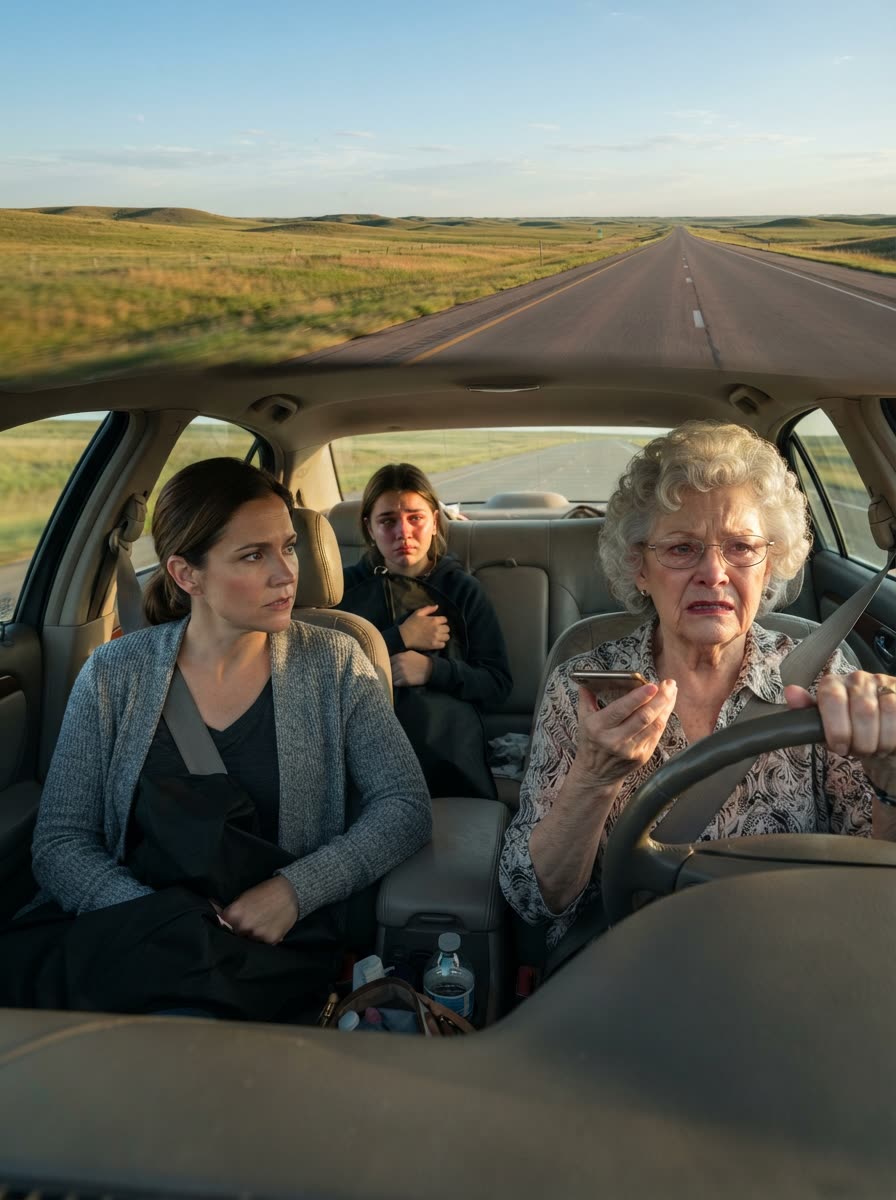
I put the phone on speaker.
I don’t know why. I think because Sadie was watching. I think because she had always put him on speaker so I could hear, and now it was her turn.
“Rory,” I said. “You’re on speaker. Your mom’s driving. Sadie’s in the back seat.”
Silence.
Total silence on the line. I could hear him breathing. I could hear a TV in the background.
Then Darla reached over and took the phone out of my hand. She held it up in front of her mouth, her other hand still on the steering wheel at ten o’clock.
“Rory,” she said. “It’s your mother.”
“Mom.” His voice was different now. Smaller. “Mom, why would you do that? Why would you post that?”
“Did you read it?” Darla said.
“Yes, I read it.”
“All of it?”
“Yes.”
“Then read it to your daughter,” Darla said. “Right now. Out loud. She’s sitting right here. She hasn’t seen it.”
A long silence.
“Mom…”
“Read it, Rory.”
Another silence. The interstate hummed under the tires. Sadie was clutching the garment bag to her chest with both arms.
Then, very slowly, Rory began to read.
“My granddaughter Sadie,” he read. His voice was quiet. “Seventeen years old. Senior at McCook Central. Volleyball. Honor roll. Works twenty hours a week at the Casey’s in Salem and gives half her paycheck to her mom for groceries.”
He stopped and cleared his throat.
“Keep going,” Darla said.
“This week,” Rory read, “she needed a prom dress. She asked one person for help. That person said he couldn’t. She said it was fine. Twice.”
His voice cracked on twice.
“So today, Grandma drove her to Sioux Falls. She tried on six dresses and checked every price tag before she looked in the mirror. On the seventh one, I tore the tags off. She looked like her great-grandma Ingrid. She looked like herself.”
Silence.
“Keep going, Rory.”
“Fifty-one years ago,” Rory read, very slowly, “I didn’t go to my own prom. My dad said he couldn’t swing a dress that year. I stayed home and said it was fine.”
He stopped. I heard him breathe.
“I’ve never told anybody that,” Darla said quietly. “Not even you.”
“I said it was fine twice,” Rory read. His voice was shaking now. “I’ve been saying it was fine for fifty-one years.”
“Finish it,” Darla said.
“Some things you can’t fix for yourself,” Rory read. “But you can fix them for somebody else, if you get the chance. Today I got the chance.”
A long pause.
“Beautiful girl,” he read. “So proud.”
Nobody said anything.
The Buick hummed along at seventy-five miles an hour. Past the Humboldt exit. Past a feedlot where a thousand head of black cattle stood in the mud.
In the back seat, Sadie had both hands over her mouth.
On the phone, Rory wasn’t saying anything at all.
“Rory,” Darla said finally, very gently. “Are you still there?”
“I’m here.”
“Do you know why I wrote that?”
He didn’t answer.
“I didn’t write it to embarrass you,” Darla said. “I swear to God, son. I didn’t.”
“Then why?”
“Because I watched your daughter check a price tag before she looked at herself in a mirror,” Darla said. “Six times. And I’ve seen that before.”
She paused.
“I saw it on you,” she said. “When you were eleven. At the Shopko in Madison. Buying school shoes. You’d pick up a pair and turn it over and look at the price before you’d even try it on. And if it was over twenty dollars, you’d put it back and say you didn’t like the color.”
Silence on the line.
“I remember,” Rory said finally, very quietly.
“Your father taught you that,” Darla said. “By leaving. By never sending a dime. You learned that whatever you needed was too much to ask for.”
“And I watched you do it again,” she said. “At seventeen. When you didn’t ask me for a prom suit because you knew I’d have to do extra perms to pay for it. I found out from your friend’s mother. I did the perms anyway.”
“I know, Mom.”
“And now your daughter’s doing it,” Darla said. “Checking tags. Saying it’s fine. Twice.” Her voice broke. “Three generations, Rory. Three generations of us saying it’s fine when it isn’t. I am done. It stops with me today. On Phillips Avenue.”
Rory said nothing for a long time.
Then he said, “Sade?”
Sadie took her hands from her mouth. She looked at the phone in her grandmother’s hand.
“Yeah, Dad?”
“I need to tell you something,” Rory said. “And it’s not an excuse. It’s just true.”
Sadie waited.
“I didn’t buy Madison’s dress,” he said. “Tasha’s mom did. Her grandma, in Pierre. She sent the money.” He swallowed. “I didn’t pay a dime for it. I couldn’t. I really can’t swing it, kiddo. The welding shop cut me to three days in January. Tasha’s been covering our mortgage. I’ve got four hundred dollars in my checking account and the truck needs brakes.”
Sadie said nothing.
“But that’s not the point,” Rory said. “Is it.”
“I commented on her picture,” he said. “I said beautiful girl. So proud. Because Tasha was standing right there and asked me to. And because Madison doesn’t have a dad. Hers left when she was three. Never calls. Never sends anything.” He took a breath. “And I’ve been trying to be that. For her. For eight years.”
“I know, Dad,” Sadie whispered.
“And I forgot,” Rory said. “I forgot you needed it too. I figured you were fine. You’ve always been fine. You’re the one who never asks for anything. You’re the one I never have to worry about.”
His voice broke completely.
“And that’s exactly what my dad thought about me,” he said.
Darla handed me the phone. She needed both hands on the wheel, and she was crying too hard to drive with one.
She pulled onto the shoulder of I-90 just past the Salem exit, put the Buick in park, and turned on the flashers.
She sat there with her hands over her face.
I held the phone. I didn’t know what to say.
“Dad,” Sadie said from the back seat, very quietly. “It’s okay.”
“It’s not okay, Sade.”
“I know,” Sadie said. “That’s what I meant. It’s not fine. But it’s okay. Those are different.”
Silence on the line.
“Where’d you learn that?” Rory asked.
Sadie looked at her grandmother in the front seat, hands over her face, shoulders shaking.
“Grandma,” she said. “Just now.”
Rory didn’t call for a week after that.
I thought maybe he was angry. Or ashamed. Or both. I thought maybe that was it, and he’d go back to calling about weekends, and we’d never speak of any of it again.
Sadie said nothing about it either. She hung the emerald green dress at the back of her closet, still in its garment bag. Every night I heard her open the closet door, stand there, and close it again.
Then, on Friday night, my phone rang.
Rory.
“Jodi,” he said. “Can I talk to you? Just you. Not Sadie.”
“Okay.”
“I need to ask you something,” he said. “About prom. About the twentieth.”
“What about it?”
“Is there,” he said, and stopped. He tried again. “Do they still do pictures? Before? At the house?”
“Everybody does pictures,” I said. “At Jensens’ park, by the river. Five o’clock. All the parents come. It’s a whole thing.”
“Would it be okay if I came?” he said. “To pictures. I don’t want to make it weird. I don’t want to take anything from your day. Or my mom’s.”
I didn’t answer right away.
“I’ve never been to one of her things,” Rory said quietly. “Not really. I’ve missed everything. Recitals. Games. Eighth-grade graduation.” He took a breath. “I don’t want to miss this one.”
“Ask her,” I said. “Not me. Ask Sadie.”
“Okay,” he said. “Okay. I’ll ask her.”
“And Rory?”
“Yeah?”
“If she says no, you don’t argue,” I said. “You say okay. You don’t make her feel bad. You don’t make her say it’s fine.”
He was quiet.
“I won’t,” he said. “I promise.”
He called her the next morning. She put him on speaker. She didn’t do it so I could hear this time. I just happened to be in the kitchen.
“Hey, kiddo.”
“Hey, Dad.”
“Can I come to prom pictures?” he said. Just like that. No preamble. “On the twentieth. At the park. I’d really like to see you in the dress.”
Sadie was quiet for a second.
“Yeah,” she said. “I’d like that.”
“Yeah?”
“Yeah, Dad.”
Then he said something else.
“And Sade? I’ve got a favor to ask.”
“What?”
“Don’t buy flowers,” he said. “For your wrist. The corsage thing. Don’t buy one.”
“Why not?”
“Because I’m making you one,” Rory said.
Sadie looked at me across the kitchen, confused.
“You’re making one? Dad, you don’t know how to make flowers.”
“No,” Rory said. “But I know how to weld.”
Prom was April twentieth, a Saturday. Warm for South Dakota in April. Sixty-two degrees, a little wind, and the cottonwoods just starting to leaf out along the Vermillion River.
Darla came over at noon and did Sadie’s hair in our kitchen. She had brought her old curling irons, a whole tackle box of bobby pins, and a can of Aqua Net older than Sadie.
She spent two hours on it. An updo with soft curls framing Sadie’s face, the way she had done the hair of a thousand girls for a thousand proms in that little brick building on Main Street in Howard.
When she finished, she handed Sadie a mirror.
Sadie looked at herself for a long time.
“Grandma,” she said. “It’s perfect.”
“I know,” Darla said. “I’m good.”
Sadie put on the dress in her bedroom. Emerald green. Satin.
She came down the stairs at four-thirty.
I was standing at the bottom of the staircase, and Darla stood beside me holding her purse.
Neither of us said anything. We couldn’t.
Jensens’ Park is a little strip of grass and cottonwood trees on the edge of Salem, at a bend in the river. Every prom, every senior at McCook Central goes there for pictures. Every parent. Every grandparent. Every little brother and sister. It’s a whole town thing.
By five o’clock there were probably two hundred people. Girls in dresses of every color in the rainbow. Boys in rented tuxes, tugging at their collars. Parents holding up phones. Grandmas in lawn chairs.
Sadie was going with a group, six girls and five boys, no dates. They were all standing by the river, laughing.
I looked around for Rory. I didn’t see him.
At five-ten, I heard a truck.
An old red Chevy pickup with bad brakes, squealing as it rolled into the gravel lot. Rory’s truck.
He climbed out.
He wore a white button-up shirt, his good jeans, and his church boots. He’d gotten a haircut. He’d shaved.
He was holding something small in his hand, wrapped in a white handkerchief.
He walked across the grass toward the river.
He stopped about ten feet from Sadie. She was standing with her friends, laughing at something. She hadn’t seen him yet.
Then one of her friends nudged her. She turned around.
She saw her dad.
He looked at her for a long time. He didn’t say anything. He just looked.
I watched his face. I watched it crumple. All of it. Right there in front of two hundred people.
“Oh, Sade,” he said. “Oh, kiddo.”
He couldn’t say anything else.
Then he held out the handkerchief.
Sadie took it and unfolded it.
Inside was a rose.
A steel rose. Hand-welded. Every petal cut from thin sheet metal, shaped with a hammer, and welded together at the base. The stem was a length of steel rod, bent and twisted. Two leaves, cut and welded on.
And he had painted it. The petals were a deep, rich, shining green. Emerald green. The exact color of her dress.
At the base of the stem he had welded a little loop, with a green satin ribbon threaded through it to tie around her wrist.
“I made it at the shop,” Rory said. “After hours. I don’t get paid for after hours, so it’s fine.” He stopped and shook his head. “I mean. It’s not fine. I just wanted to. I wanted to make you something.”
Sadie stared at it.
“I didn’t have money for flowers,” Rory said. “But I had scrap. And a torch. And a can of paint.” He swallowed. “It took me nine tries. The first eight looked like cabbages.”
Sadie laughed through her tears and held out her wrist.
Rory tied it on, his big welder’s hands, scarred and calloused, fumbling with a little green satin ribbon.
When it was fastened, he stepped back and looked at her.
“Beautiful girl,” he said quietly.
Then he stopped.
“No,” he said. “That’s what I wrote on Madison’s picture. I’m not saying that to you. You deserve your own words.”
He thought about it. He stood there in the grass by the Vermillion River in front of his daughter, thinking.
“You look like my grandma Ingrid,” he said finally. “Mom showed me pictures, when I was a kid. Ingrid had green eyes like you. And she held her chin up like you. Like she wasn’t going to apologize for anything.”
He took a breath.
“You never have to say it’s fine to me again, Sade,” he said. “Not ever. If it’s not fine, you tell me. And I’ll try. I might mess it up. But I’ll try.”
Sadie threw her arms around him.
In front of two hundred people. In her emerald green dress. With a steel rose on her wrist.
Rory held her. He pressed his face against her hair, against Darla’s perfect curls, and held on.
Darla stood next to me in the grass with her purse in both hands. She didn’t say anything. She didn’t need to. She was crying. So was I.
We took pictures. A hundred of them.
Sadie with her friends. Sadie by the river. Sadie with me. Sadie with Darla, both of them holding up their wrists, because Darla had worn a corsage too, a white carnation she’d bought at the Hy-Vee.
And Sadie with her father. Standing by the cottonwood tree. Her in emerald green, him in a white shirt and church boots, his arm around her shoulders, her holding up her wrist so the steel rose caught the light.
That night at 11:40, after prom, Sadie posted her own picture.
Just one. Her and her dad by the cottonwood tree, the steel rose shining green on her wrist.
The caption was short. She wrote it herself.
Dad made my corsage. Nine tries. Grandma bought my dress. Mom stood a step behind and let them. Best prom ever.
I was lying in bed when it came up on my phone. I read it three times.
Then I scrolled down to the comments.
There were already forty. Her friends. My sister. Teachers from McCook Central. Britt from Boutique 605, who must have found her somehow. Darla, who had written, in her one-finger typing, There you are. ❤️
And Madison, Sadie’s stepsister, who had written: You look AMAZING. That dress is everything. Love you, sis.
And at the top, the very first comment, posted three minutes after the picture went up.
Rory.
This time he had written more than four words. It went on for a while. I won’t put it all here. Some of it belongs to her.
But it ended the way his mother’s post ended. The way it should have ended the first time.
Not beautiful girl. Not so proud. He had found his own words, just as he promised.
My girl. My green-eyed girl. Never fine. Always worth it.
I heard Sadie’s door open across the hall. I heard her step out into the dark. She stood outside my bedroom door for a moment.
Then she knocked softly.
“Mom? You awake?”
“I’m awake.”
She came in and sat on the edge of my bed in her pajamas, her hair still up in Darla’s curls, half of them falling down now. She had her phone in her hand. And on her wrist, still tied with the green ribbon, the steel rose.
She hadn’t taken it off.
“Did you see what Dad wrote?” she asked.
“I saw.”
She looked down at the rose and turned it on her wrist. It caught the light from the hallway.
“Mom,” she said. “Can I tell you something? About that night. In March. When he called about the dress.”
“Of course.”
She was quiet for a long moment.
“It wasn’t fine,” she said.
I reached over and took her hand, the one with the rose on it.
“I know, baby,” I said. “I know it wasn’t.”
She lay down next to me on top of the covers, the way she used to when she was little, and I held her hand, and neither of us said anything else. We didn’t have to. The steel rose rested between us on the blanket, cold at first, then warm, the way metal gets when somebody holds onto it long enough.
Disclaimer: This story is a work of fiction inspired by real-life themes. Names, characters, places and events are fictionalized, and any resemblance to real persons is purely coincidental. Images are for illustration purposes only.
