

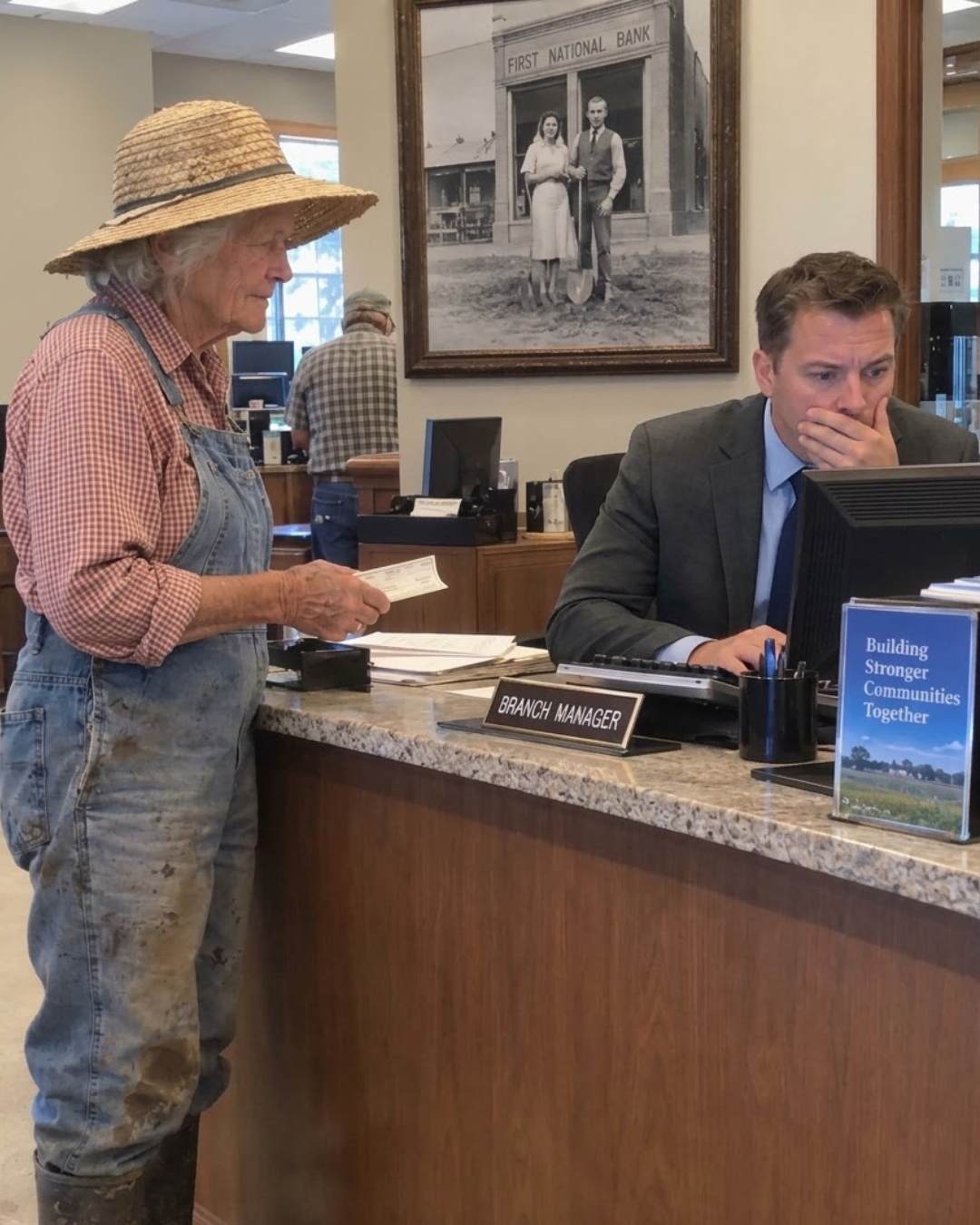
PART 3: The Bank Built for People Like You
Brandon arrived the following Saturday at eight in the morning.
He wore jeans, a gray T-shirt, and inexpensive white sneakers.
Later, he told me he had bought them at Dollar General on Route 9.
He wanted them to resemble his grandmother’s shoes.
He knew absolutely nothing about gardening.
He couldn’t distinguish a tomato sucker from a healthy leaf.
At one point, he pulled up nearly half a row of carrots, believing they were weeds.
“Those were carrots, Brandon.”
“Oh no. I’m so sorry.”
“It’s all right. We’ll have carrot soup.”
By the third Saturday, he no longer apologized for every mistake.
By the fifth, he could tie tomato plants without asking for instructions.
By the eighth, dirt had worked its way so deeply beneath his fingernails that he couldn’t remove it before Monday.
“My staff noticed,” he told me with a grin, holding up his hands. “Shelly asked if I’d been digging graves.”
He also began working the teller window every Thursday.
No suit.
No expensive tie.
Just jeans, a gray T-shirt, and his Dollar General sneakers.
On his first Thursday, many customers didn’t recognize him.
Some asked whether the manager was available.
“I’m the manager,” he told them.
Not everyone believed him.
One visitor from the city demanded three forms of identification before trusting Brandon with a deposit.
“He made me show him three forms,” Brandon told me while pulling weeds that Saturday. “I didn’t have three on me. Just my license. He said, ‘You can’t be too careful.’”
He tried to laugh.
But I could tell the experience had hurt.
“How did it feel?”
Brandon sat back on his heels.
“Like I was eight years old,” he admitted. “Standing in that bank in Chicago. Holding my grandmother’s hand.”
He studied the soil beneath his fingers.
“I didn’t know it would feel the same. Even now. Even knowing I’m the manager. Even knowing I’m wearing these clothes on purpose. It still felt like they were looking right through me. Like I wasn’t a person.”
“Now you know.”
“Now I know.”
Throughout that summer, Brandon began changing the bank.
Not with grand announcements or expensive renovations.
With small decisions.
He removed the corporate notice requiring three forms of identification for every check-cashing transaction.
He spent two weeks arguing with Heartland’s compliance department.
Eventually, they agreed that established Millbrook customers could use a single form of identification.
“Or none,” Brandon said, “if Shelly knows you.”
That particular exception never appeared in the official policy.
But everyone understood.
He found the old peppermint bowl in a storage closet and returned it to the counter.
Every morning, he filled it himself.
He began learning customers’ names.
He carried a little notebook in his pocket.
Earl Lindquist.
Ruth Abernathy.
Marlene Voss.
Miguel Ruiz.
He also started visiting local farms.
Once a week, he drove into the countryside wearing jeans and sneakers, walked through fields, and listened to farmers explain their work.
He asked questions constantly.
“He asked me what a combine was,” Earl Lindquist told me at the diner. “A grown man. A bank manager. Didn’t know what a combine was.”
“What did you tell him?”
“I showed him.”
Earl grinned.
“Took him for a ride. Kid about fell out of the cab, he was so excited. Said it was the coolest thing he’d ever seen.”
Earl shook his head.
“Coolest thing he’d ever seen. A combine.”
By August, I brought Shelly another enormous bundle of Peace roses.
She placed them in a coffee can beside the peppermint bowl.
I slid my forty-dollar Methodist church check beneath her window.
She cashed it without hesitation.
“How are the tomatoes this year, Dot?”
“Better than ever. I’ve got help now.”
Shelly glanced toward Brandon’s office.
He was wearing a suit that day, but his sleeves were rolled up.
There was dirt beneath his fingernails.
“I heard,” Shelly said, smiling.
As the summer drew to a close, I began thinking seriously about account number 0001.
George had always assumed it would eventually pass to our daughter, Sarah.
But Sarah lived in Seattle.
She was an architect with a good life, a successful career, and a family of her own.
She returned for Christmas and Thanksgiving.
She loved Millbrook.
But she no longer knew its people the way George and I had.
She didn’t know which farmers were struggling or which families needed help.
And the authority attached to account 0001 was too important to place in the hands of someone living two thousand miles away.
The account holder had to approve any attempt to close the bank or reduce its staff.
That responsibility belonged to someone who lived here.
Someone who understood what the bank meant to Millbrook.
I contacted Danny Brennan, the son of our longtime lawyer Walt.
Danny had taken over his father’s practice.
He came to my porch, drank iced tea, and listened as I explained my plan.
“Are you sure, Dot?”
“I’m sure.”
“It’s irrevocable. Once you sign it, you can’t take it back.”
“I know.”
He prepared the documents.
On the first Saturday in September, he brought them to my garden.
I was kneeling between the tomatoes and roses, wearing George’s old straw hat and my green boots.
Brandon was nearby, pulling weeds from the bean row.
When Danny appeared carrying a briefcase, Brandon sat back on his heels.
“Is everything okay?”
“Everything’s fine,” I answered. “Come here a minute.”
He knelt beside me.
His jeans were filthy.
His once-white sneakers had become permanently brown.
Danny opened his briefcase and spread the papers across an overturned bucket.
“Brandon,” I said. “I’m going to sign something. I want you to watch.”
“What is it?”
“The future of account 0001.”
He became completely still.
I picked up the pen.
Then I signed.
Dorothy Mae Whitaker.
Danny added his signature as witness and pressed his notary seal onto the document.
Brandon stared.
“Mrs. Whitaker. What did you just do?”
“I didn’t give it to you,” I said. “If that’s what you’re thinking.”
He exhaled.
“I gave it to the town.”
“The town?”
Danny explained.
“The Millbrook Community Trust. Dot created it last month. Account 0001, and all the rights that go with it, and the deed to the bank building, all go into the trust. The trust is managed by a board. Seven people. All Millbrook residents. They serve five-year terms. When one leaves, the others pick a replacement.”
“Who’s on the board?” Brandon asked.
I began counting.
“Shelly Haskins. Miguel Ruiz. Ruth Abernathy. Marlene Voss’s grandson, Kyle, who runs their farm now. Reverend Collins from the Methodist church. Kayla Brandt, the young mother with the toddler who was in line that day. And Earl Lindquist, because somebody needs to be cranky.”
Brandon laughed.
Then frowned.
“That’s six. You said seven.”
I looked at him.
“The seventh seat goes to whoever is the branch manager of Farmers & Merchants in Millbrook.”
He stared.
“As long as they live in Millbrook,” I added. “Not commuting from the city. Living here. In town. Shopping at the IGA. Eating at the diner. Going to the bake sale.”
“Mrs. Whitaker—”
“Your year’s up in April,” I continued. “Mr. Hale will offer you a promotion. Back to Des Moines. Regional something. A big office. A big raise. You’ll be able to buy a lot of suits.”
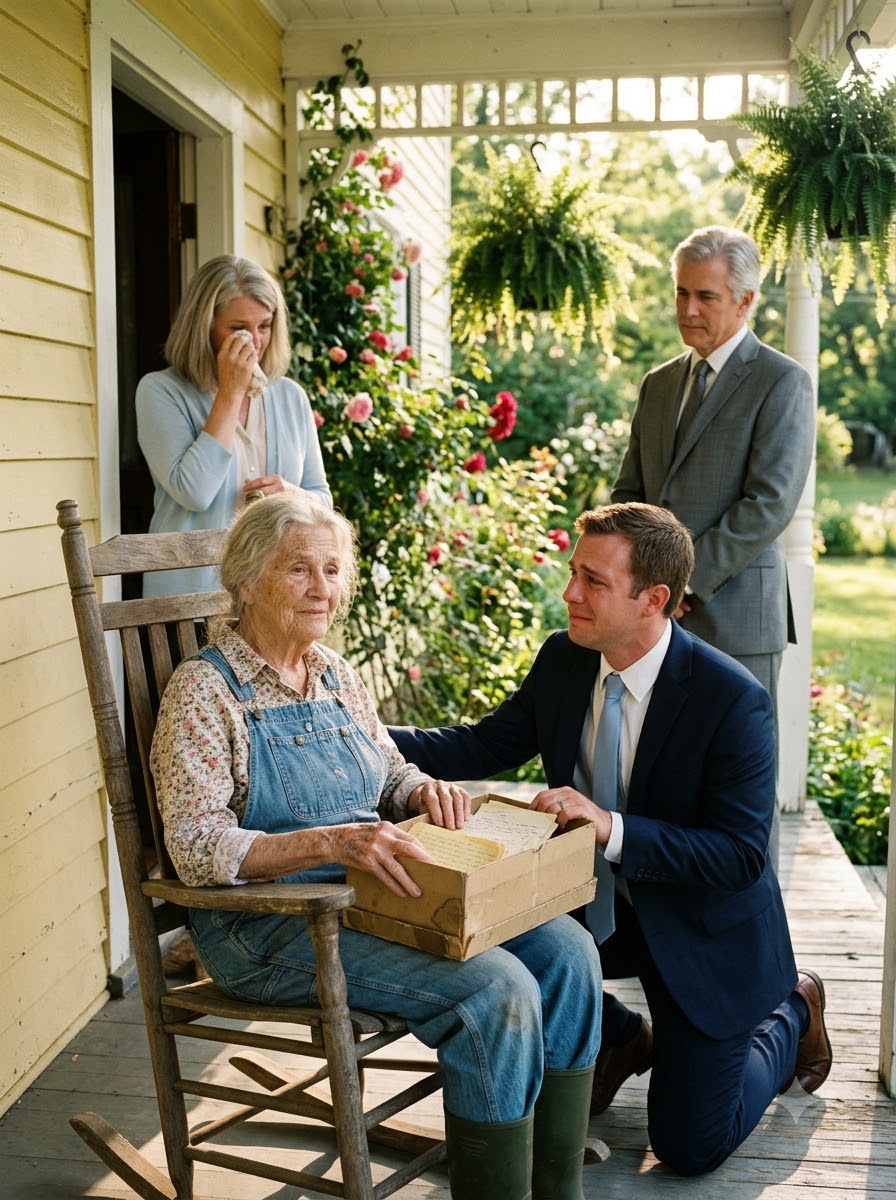
Brandon looked down.
“Or you can stay. Rent a house in Millbrook. Learn to grow your own tomatoes. And sit on the board that decides whether this town keeps its bank.”
His hands were rougher now.
A blister had formed on his right palm from using the hoe.
“That’s your choice. Nobody’s going to make it for you.”
He didn’t answer.
Not that day.
Not for months.
He continued working the teller window on Thursdays.
He kept visiting my garden every Saturday until October’s first frost.
Then he helped me prepare the beds for winter.
We removed tomato cages, covered the strawberries with straw, and mulched the roses.
On the final Saturday of October, we stood together looking at the empty garden.
“It looks so sad,” he said.
“It’s resting. Everything needs to rest.”
“Will it come back?”
“Every spring. For fifty-eight years.”
He was quiet for a while.
Then he spoke.
“My grandmother died in March. Last March. A month before I came here.”
I turned toward him.
“I didn’t tell anybody. Not at work. I just took two days off and flew to Chicago and buried her and came back. And then corporate sent me here.”
He looked toward the bare soil.
“I think I was so angry. At everything. And I came into that bank and I saw all these old people and I…”
He stopped.
“I wanted to be the one who decided. For once. I wanted to be on the right side of the glass.”
I stood beside him.
“There isn’t a right side of the glass. There’s just glass. And people on both sides of it.”
He carried those words with him through the winter.
Then April arrived.
Richard Hale offered Brandon the promotion we had expected.
Regional Vice President of Community Banking.
A prestigious office in Des Moines overlooking the river.
A salary increase of forty thousand dollars a year.
Brandon declined.
Instead, he rented a little white house on Oak Street.
Three blocks from the bank.
Two blocks from mine.
Its backyard had a sunny patch perfect for tomatoes.
That May, he planted his first garden.
I helped him.
He made plenty of mistakes.
He planted the tomatoes too closely together.
Forgot to water the peppers.
And lost his entire lettuce crop to rabbits.
But he kept trying.
He also made another change at Farmers & Merchants.
He removed the old photograph of George and me from the wall near the entrance.
For a moment, I wondered what he was doing.
Then I learned he had taken it to be professionally cleaned.
He bought a new frame made from solid oak.
When he returned the photograph, he didn’t hang it beside the door.
He placed it in the center of the back wall, where every customer could see it upon entering.
Then he began surrounding it with other photographs.
Earl Lindquist standing beside his combine.
Ruth Abernathy outside her hair salon.
Miguel Ruiz and his family outside Casa Ruiz when it opened in 1981, and another photograph of them years later.
Kyle Voss standing in the cornfield his great-grandfather nearly lost.
Shelly smiling at her teller window beside a coffee can filled with roses.
Brandon asked customers to bring pictures of themselves.
They did.
Farmers wearing muddy boots.
Mechanics with grease-stained hands.
Bakers covered in flour.
Mothers holding children.
People who had built their lives through ordinary, difficult work.
Soon, sixty-three photographs covered the wall.
Above them, Brandon placed a small brass plaque.
He had ordered it from the trophy shop on Route 9.
It read:
PEOPLE LIKE YOU.
Farmers & Merchants Bank. Since 1968.
I’m eighty now.
I still visit the bank every Tuesday.
Sometimes I arrive wearing my gardening clothes.
Sometimes George’s straw hat.
Almost always my green rubber boots.
Shelly still works her window.
She still asks about my roses.
The peppermint bowl is always full.
And every Thursday, a young man in jeans, a T-shirt, and brown sneakers works the second teller window.
Customers who don’t recognize him occasionally ask whether the manager is available.
“I’m the manager,” he tells them.
Some believe him.
Some don’t.
He cashes their checks regardless.
Last month, something happened that made me think of George more strongly than I had in years.
It was Thursday.
I had stopped by the bank to bring Shelly some rhubarb.
A woman entered with a little girl.
The woman looked about forty.
She was thin and exhausted, wearing a gray uniform with a CLEAN-PRO SERVICES name patch.
Rubber gloves protruded from her back pocket.
Her inexpensive white sneakers were stained with bleach.
The little girl was perhaps seven or eight.
She held tightly to her mother’s hand.
They approached Brandon’s window.
The woman took out a paycheck.
Her fingers trembled.
“I don’t have an account here,” she said softly. “I just need to cash my check. It’s from my job. It’s a real check. I’m sorry. I only have one ID.”
I stopped moving.
Brandon looked at her.
At the gray uniform.
At the rubber gloves.
At the bleach-stained shoes.
Then at the little girl holding her mother’s hand.
For an instant, something passed across his face.
I knew what he was remembering.
A bank with marble floors in Chicago.
A frightened eight-year-old boy.
His grandmother holding a paycheck.
A teller who judged her by her work clothes.
A security guard escorting them outside.
Then Brandon smiled.
“Good morning,” he said. “One ID is just fine. Let me take care of that for you.”
His voice was ordinary.
Warm.
Respectful.
He accepted the check.
Examined her identification briefly.
Then returned it.
He counted her money carefully and placed it before her.
Afterward, he reached for the peppermint bowl.
He held it toward the little girl.
“Would you like a peppermint?”
She glanced at her mother.
Her mother nodded.
The girl selected one.
“Thank you,” she whispered.
“You’re welcome,” Brandon replied.
Then he turned toward her mother.
“Ma’am, would you be interested in opening an account? It’s free. And you’d never have to worry about cashing a check again. Any time you come in, we’ll know you.”
The woman stared at him.
“You’d… you’d open an account for me?”
“Of course,” Brandon answered. “This bank was built for people like you.”
She opened an account that afternoon.
With forty-two dollars.
Brandon helped her complete every form.
He even allowed the little girl to stamp the deposit slip.
She stamped it four times.
He didn’t mind.
Her account number was 4,117.
As they left, the little girl turned around and waved.
Brandon waved back.
Then he looked across the lobby.
I was standing beside the wall of photographs.
Directly beneath the picture of a young woman wearing a white dress with tiny blue flowers, smiling proudly while holding a shovel.
Our eyes met.
He said nothing.
Neither did I.
There was no need.
George always said a bank was simply a building filled with promises.
A promise that your savings would be safe.
A promise that someone would listen when you needed help.
A promise that the person behind the glass would see you as a human being.
Not as your clothes.
Not as your boots.
Not as the dirt beneath your fingernails.
People like you.
George had spoken those words in kitchens, barns, and church basements throughout Millbrook in 1967.
He used them while asking farmers, shopkeepers, and widows to trust him with their hard-earned savings.
Put your money in a bank that’s owned by people like you.
He meant those words as the highest compliment he could offer.
Fifty-eight years later, a young manager in a blue suit used those same words to humiliate me.
But now he said them every day.
To farmers.
To cleaners.
To young mothers.
To elderly widows wearing their late husbands’ hats.
And he meant them exactly as George had.
Words can wound.
They can also welcome.
Sometimes the difference is simply the heart of the person speaking them.
I’m glad I walked into the bank in my gardening clothes that Tuesday.
Because what seemed like a mistake became the beginning of something wonderful.
And at eighty years old, I can say with certainty:
It was the best mistake I ever made.
