

PART 2: The Promise Hidden in the Contract
Brandon stood behind the teller counter with the telephone pressed against his ear.
His hands were trembling.
I couldn’t hear every word at first.
He had turned slightly away from me and was speaking in a low, urgent voice.
Then his tone rose.
“No, I understand that. I do. I’m looking at it right now. Section fourteen point three. It’s flagged on the account. In red.”
He swallowed.
“Yes. She’s here. She’s standing right in front of me.”
He glanced toward me.
Then quickly looked away.
“I didn’t know,” he said. “Nobody told me. Corporate never said anything about any covenant. They sent me down here with a plan. You approved the plan. You signed off on it.”
He listened.
“I know. I know I already did. Two of them. Last week.”
My attention sharpened.
Brandon lowered his head.
“Shelly Haskins and Harvey Kessler,” he said. “Effective the end of the month. And the closure notice goes out to customers on July first.”
I stopped breathing for a moment.
Behind me, Harvey rose slowly from his desk.
His face had gone gray.
Brandon continued speaking.
“I’m sorry. Yes. Yes, I’ll wait. Yes, sir.”
He ended the call.
For several seconds, he stood motionless.
Then he turned toward me.
“Mr. Pierce,” I said quietly.
He didn’t answer.
“Did I hear that correctly? You’re closing this bank?”
Silence.
“And you’ve fired Shelly?”
He swallowed.
“Laid off. It’s a restructuring. It’s not personal.”
“Shelly’s been at that window for twenty-eight years,” I replied. “Her husband’s on disability. She’s got a grandson with asthma. That’s pretty personal.”
Brandon stared at the floor.
“And Harvey?”
I turned toward the loan desk.
“Harvey, did you know?”
He nodded sadly.
“He told me Friday. He said there’d be a severance package. He said corporate was consolidating operations to the Oak Ridge branch. Thirty miles from here.”
“Thirty miles.”
“He said customers could bank online,” Harvey continued, his voice breaking. “Online, Dot. Half our customers don’t have internet. Earl Lindquist doesn’t own a computer. Ruth Abernathy still uses a flip phone.”
I faced Brandon again.
“Where’s Shelly today, Mr. Pierce?”
He hesitated.
“Mr. Pierce.”
“Home,” he finally admitted. “She took a personal day. She was upset.”
“I’ll bet she was.”
The telephone rang again.
Brandon snatched it up.
“Brandon Pierce.”
He listened briefly.
“Yes, sir. She’s still here.”
Then he held the receiver toward me.
“He wants to talk to you.”
I accepted it through the opening beneath the glass.
“This is Dorothy Whitaker.”
“Mrs. Whitaker.”
The man’s voice sounded older, deep and breathless.
“This is Richard Hale. I’m the president of Heartland Bancorp.”
“Hello, Mr. Hale.”
“Mrs. Whitaker, I want to apologize. I just pulled the merger agreement. I’m reading Section 14.3 right now. I had no idea this was in here. Nobody at corporate knew. The lawyers who drew up the 2015 deal have all left the company.”
He paused.
“I’m afraid there’s been a serious mistake.”
“Yes,” I answered. “There has.”
He explained that the Millbrook branch had been selected for consolidation during the company’s spring review.
Low transaction volume.
An aging customer base.
High operating costs.
Brandon had been transferred to carry out the closure.
“The Millbrook branch was flagged for consolidation in our spring review. Low transaction volume. Aging customer base. Brandon was sent down to implement the plan. He’s been following our instructions.”
“Has he.”
“I’m getting in my car right now,” Mr. Hale said. “I’ll be there in two and a half hours. Please, Mrs. Whitaker. Before you do anything. Before you call a lawyer. Please let me come down and talk to you in person.”
I considered his request.
“All right. I’ll be home. The yellow house on Elm Street with the roses. Mr. Pierce knows the address. It’s on my license.”
“Thank you, Mrs. Whitaker.”
“And Mr. Hale?”
“Yes?”
“Bring Shelly’s job back with you.”
I returned the telephone.
Brandon hung it up carefully.
His confidence had vanished.
He looked at my license lying on the counter.
Then he returned it.
He picked up the forty-dollar check.
“I’ll cash this for you, Mrs. Whitaker,” he said quietly.
I shook my head.
“No. Thank you.”
He blinked.
“I’ll wait for Shelly,” I told him. “She’ll be back. I’ll cash it with her.”
I put my license into my shirt pocket and walked toward the entrance.
Kayla was still holding Wyatt.
Harvey remained standing beside his desk.
Tommy opened the door for me.
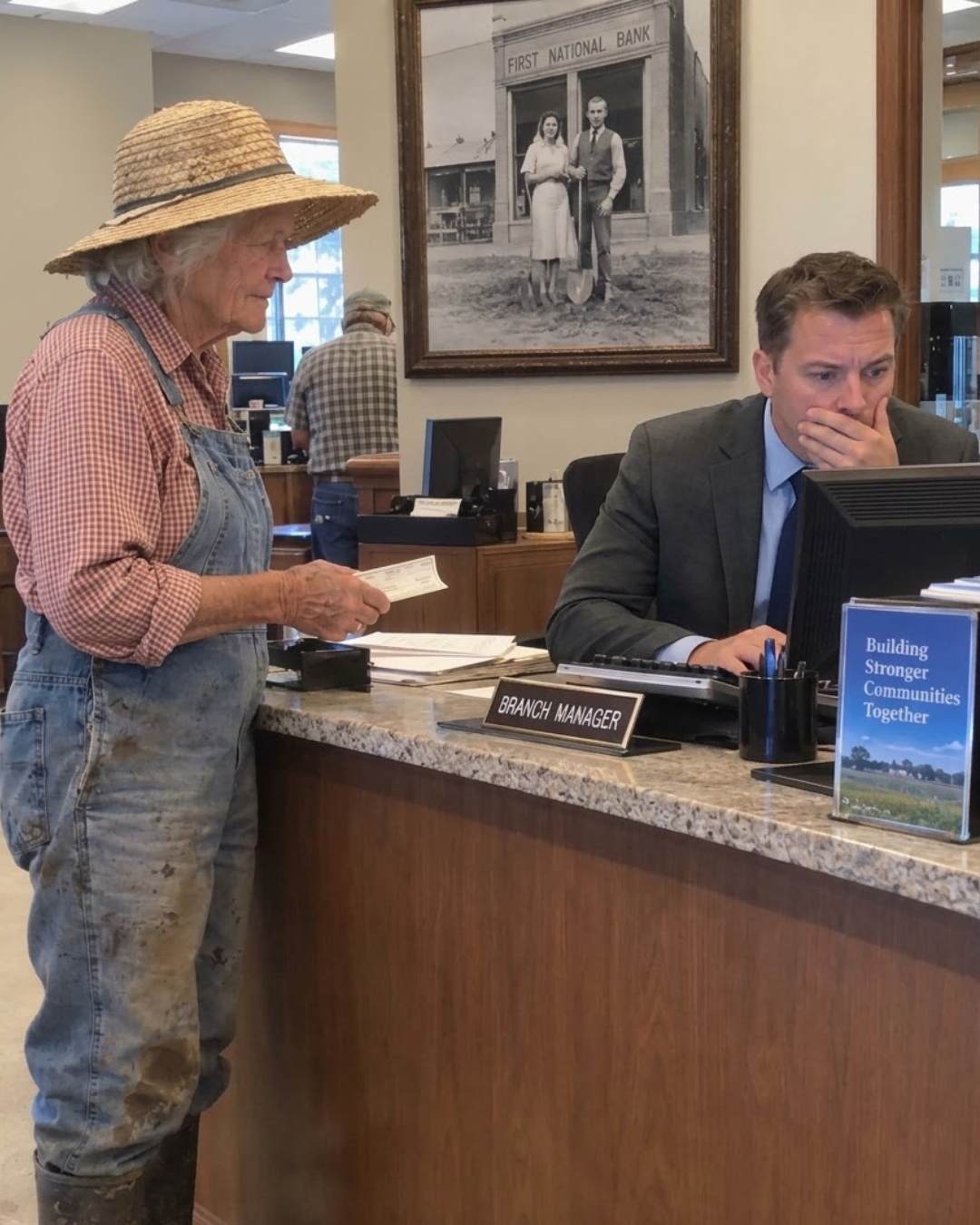
Before leaving, I stopped beneath the old photograph.
The frame was crooked.
It had been crooked for years.
George had always promised to straighten it someday.
I reached up and adjusted it until it hung properly.
The young woman in the white dress smiled down at me.
I smiled back.
Then I stepped into the June heat and walked home to finish my tomatoes.
Richard Hale arrived at 1:40 that afternoon.
His black sedan looked rather out of place outside my little yellow house.
He was about sixty-two, tall, with silver hair and an expensive gray suit.
Brandon emerged from the passenger seat.
Then the rear door opened.
Shelly Haskins stepped out.
I was sitting on the porch in my rocking chair, shelling peas into a bowl.
I had changed into a clean blouse but kept my rubber boots on.
The moment Shelly saw me, she began crying.
She hurried up the walkway, past the roses, and threw her arms around me.
The bowl slipped from my hands.
Peas scattered across the porch.
“Dot,” she sobbed. “Oh, Dot. Oh, Dot.”
I held her tightly.
“Hush now. Hush. It’s all right.”
“Mr. Hale came to my house,” she said. “He knocked on my door. He said I have my job back. He said it was all a mistake. He said you…”
She stepped back.
“Dot, what did you do?”
“I didn’t do anything,” I replied. “George did. A long time ago.”
Richard Hale approached the porch.
Brandon followed several steps behind, staring at his polished shoes.
Mr. Hale looked at the scattered peas.
Then, to my surprise, he knelt on the wooden boards and began collecting them.
One at a time.
He placed each pea back into the bowl.
I watched for a moment.
“You don’t have to do that.”
“My grandmother shelled peas on her porch,” he answered. “In Ottumwa. I used to help her. I haven’t done it in forty years.”
He gathered every pea.
It took several minutes.
Then he stood, brushed his trousers, and handed me the bowl.
“Mrs. Whitaker,” he said. “I owe you an apology. A real one.”
“Sit down, Mr. Hale. There’s iced tea.”
We spent the next two hours talking on my porch.
Shelly brought out the tea.
She knew my kitchen well enough to find everything without asking.
Mr. Hale explained the company’s decisions.
The spring review had identified Millbrook as one of Heartland’s least profitable branches.
Its customers were older than average.
Its transactions were relatively few.
The cost of operating it was high.
“Every bank in the country is doing this,” he said. “Closing small-town branches. Moving everything online. It’s how we survive.”
“I understand.”
He explained that Brandon had been instructed to reduce expenses, dismiss employees, and prepare the location for closure.
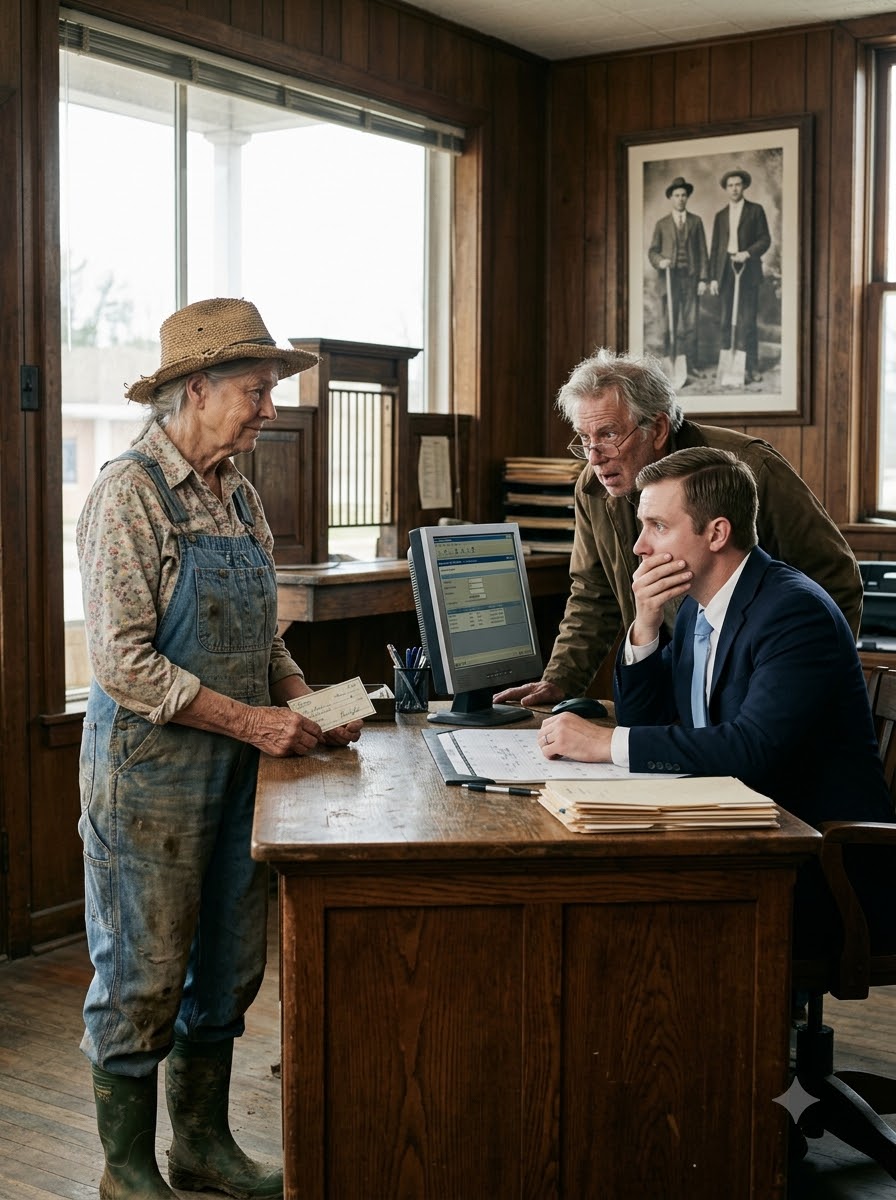
Corporate management had warned him that local customers might resist.
They told him to be firm.
“Was he told to treat them like criminals?” I asked.
Mr. Hale was silent.
Then he answered.
“No. He wasn’t told that.”
Brandon sat on the porch steps, his shoulders bent.
I looked at Mr. Hale.
“I want to show you something.”
I went inside and returned carrying an old Florsheim shoebox.
It had belonged to George.
The corners were reinforced with yellowing tape.
I placed it on the table and removed the lid.
Inside were hundreds of letters.
Some were written on fine stationery.
Others on notebook paper, feed-store receipts, or the backs of seed catalogs.
The handwriting ranged from neat and elegant to shaky and barely readable.
“These came to our house,” I explained. “Over fifty years. From customers.”
I selected one written in pencil on lined paper.
Mr. Whitaker. You gave my husband a loan in 1985 when nobody else would. He passed last week. He told me to tell you we kept the farm. Our grandson is running it now. Thank you. — Marlene Voss.
I picked up another.
Dear George. You probably don’t remember me. I came in to open an account in 1991. I had $14. I was nineteen and pregnant and my parents had kicked me out. The teller (I think her name was Dot?) gave me a peppermint and didn’t make me feel like trash. I own a hair salon now. I have three employees. I just wanted you to know. — Ruth Abernathy.
Shelly covered her mouth.
Then I read a third letter.
To the Whitakers. In 1981, my father asked your bank for a loan to open a restaurant. Every other bank in the county said no. They said nobody in Millbrook would eat Mexican food. Mr. Whitaker came to our house and ate my mother’s enchiladas and signed the papers at our kitchen table. Casa Ruiz has been open for 34 years. My son Tommy is going to take it over someday. God bless you. — Miguel Ruiz.
Tommy Ruiz.
The young security guard who had lowered his eyes while Brandon humiliated me.
I carefully returned the letters to the box.
“There are four hundred and twelve of these,” I said. “George counted. Before he died.”
Mr. Hale stared at the shoebox.
“This bank isn’t a number on your spreadsheet, Mr. Hale,” I continued. “It’s the reason this town still exists. When the big banks pulled out in the eighties, we stayed. When everybody else said no, we said yes. We’re the reason Millbrook has a hair salon and a Mexican restaurant and forty family farms that would be corporate cornfields otherwise.”
I closed the lid.
“And your young man stood behind my husband’s counter, under my husband’s photograph, and told me you have to be careful with people like me.”
Brandon turned around.
His face was flushed.
His eyes glistened.
“I’m sorry,” he whispered. “Mrs. Whitaker. I’m so sorry.”
“For what, exactly?”
He looked startled.
“For… for what I said. For not cashing your check. For—”
“No,” I interrupted gently. “That’s not what I mean. I’m asking what you’re sorry for. Are you sorry you got caught? Or are you sorry you did it?”
He opened his mouth.
Then closed it.
For a long moment, he said nothing.
Finally, he looked directly at me.
“I don’t know,” he admitted. “I don’t know yet.”
I nodded.
“That’s the first true thing you’ve said to me. Come up here and sit down, Mr. Pierce.”
He climbed the steps and settled into George’s old rocking chair.
Nobody had sat there in seven years.
I looked at him.
“Tell me something. Where did you grow up?”
“Chicago,” he answered. “The South Side.”
“Your parents?”
“My mom raised me. And my grandmother. My dad wasn’t around.”
“What did your grandmother do?”
He looked down.
“She cleaned offices. Downtown. Nights. For thirty-one years. She’d leave at nine p.m. and come home at six in the morning and then get me ready for school.”
“Did she bank?”
His expression changed.
“Once.”
I waited.
“I was eight,” he began. “She took me with her. To a bank downtown. A big one. Marble floors. She had her paycheck. She needed to cash it to pay the rent. She was still in her work clothes. She’d come straight from her shift. Gray uniform. Rubber gloves sticking out of her pocket. Her shoes were all… she had those cheap white sneakers. They had bleach stains on them.”
His voice grew unsteady.
“And the teller looked at her. The same way. Up and down. And she said, ‘Ma’am, do you have an account with us?’ Loud. So everybody could hear. And my grandmother said no, she just needed to cash her check, it was from the cleaning company, it was a real check. And the teller said they needed three forms of ID. And my grandmother only had one.”
He stopped speaking.
“What happened?” Shelly asked.
“They called security,” Brandon answered. “They thought she was trying to cash a stolen check. A security guard walked us out. In front of everybody. My grandmother didn’t say a word. She just held my hand and walked out with her head up.”
He looked toward the garden.
“On the bus home, she told me something. She said, ‘Brandon, you’re going to grow up and go to college and wear a suit. And nobody’s ever going to look at you like that. Dress like you belong, and they’ll treat you like you belong.’”
He gave a broken laugh.
“So I did. I went to college. Full scholarship. I wore a suit to every job interview. I got into banking because I wanted to be on the other side of that glass. I wanted to be the one who decided. And I told myself I’d never be like that teller.”
His eyes returned to the shoebox.
“And then I came down here. And I looked at you. In your boots. With dirt on your hands. And I saw…”
His voice failed.
“You saw your grandmother,” I said.
He nodded.
Tears ran down his cheeks.
“And I did to you exactly what that teller did to her,” he whispered. “Exactly. Word for word. ‘Do you have an account with us?’ Three forms of ID. I even talked loud. Just like she did.”
He covered his face.
“I became the thing I hated most in the world. And I didn’t even notice.”
Silence settled over the porch.
A bee hovered around my roses.
A pickup truck passed along Elm Street.
Somewhere nearby, a lawnmower started.
I reached across and rested my hand on Brandon’s knee.
“Brandon. Your grandmother told you the wrong thing.”
He lowered his hands.
“She meant well. She loved you. She wanted to protect you. But she taught you that the clothes make the person. That if you dress right, you belong. And if you dress wrong, you don’t.”
“Isn’t that true, though?” he asked. “Isn’t that how the world works?”
“It’s how bad banks work. It’s not how good ones work.”
I pointed toward the letters.
“George never looked at a single person’s clothes. Not once in fifty years. He looked at their hands. And he didn’t look at their hands to see if they were clean. He looked to see if they were working hands. Because working hands pay back their loans.”
Brandon examined his smooth hands.
“Your grandmother had working hands. Thirty-one years of cleaning offices at night. She’d have paid back any loan you ever gave her. Every cent. Early. That teller couldn’t see that. All she could see were bleach-stained sneakers.”
He began crying again.
“You don’t owe your grandmother a nice suit, Brandon. You owe her a bank that would have cashed her check.”
Mr. Hale cleared his throat.
“Mrs. Whitaker. The closure is canceled. Obviously. Effective immediately. Shelly’s job is restored. Harvey’s job is restored. I’ll put it in writing today.”
“Thank you.”
“I’ll also be reviewing every branch in our system. Every small-town branch we’ve flagged. I want to know how many other Millbrooks we were about to close.”
He shook his head.
“I’ve been looking at the numbers for so long, I forgot what they stood for.”
“That happens,” I replied. “George used to say you have to walk the fields once in a while. Look at the cows.”
Mr. Hale smiled.
“I’d like to walk the fields. If you’d show me.”
“I’d be happy to.”
Then his attention shifted toward Brandon.
“As for Mr. Pierce. Brandon, I’m going to have to—”
“Wait,” I interrupted.
Both men looked at me.
“I’d like to make a request. As the holder of account 0001.”
Mr. Hale nodded.
“Of course.”
“Section 14.3 says no branch in Millbrook can be reduced in staff without my consent. I’m assuming that includes the branch manager.”
“I… suppose it does.”
“Then I don’t consent to Mr. Pierce being fired.”
Brandon stared.
Shelly looked astonished.
“Dot. He fired me. He was going to close the bank. He talked to you like dirt.”
“I know he did.”
“Then why?”
I looked at the young man in George’s chair.
“Because if you fire him, he goes to some other bank in some other town. And he takes everything he learned today and throws it away. Or worse, he learns the wrong thing. He learns that the old lady in the dirty boots was secretly rich and powerful, and that’s why he should’ve been nice to her.”
I shook my head.
“That’s not the lesson. That’s never the lesson.”
“What’s the lesson?” Brandon asked.
“The lesson is that you should’ve been nice to her even if she wasn’t.”
He looked at me without speaking.
“Account 0001 isn’t the point, Brandon. The point is that every account in that bank belongs to somebody like me. Somebody with dirt on their knees. Somebody whose grandmother cleaned offices. Somebody who came in with fourteen dollars and a baby on the way. Every single one of them deserves to be treated the way you treated me after you saw the screen. Not before.”
I turned toward Mr. Hale.
“So here’s what I’d like.”
He listened.
“I’d like Mr. Pierce to stay. As branch manager. For one year.”
“Dot—” Shelly began.
“With some conditions.”
I raised my arthritic fingers.
“One. Shelly gets her job back. With a raise. She’s been underpaid for ten years. Everybody knows it.”
“Done,” Mr. Hale said.
“Two. Harvey gets his job back. And he gets to retire when he decides to retire. Not when a spreadsheet decides.”
“Done.”
“Three. The peppermint bowl goes back on the counter.”
Mr. Hale laughed.
“Done.”
“Four.”
I turned to Brandon.
“For the next year, Mr. Pierce comes to work one day a week in his own clothes. Whatever he’d wear on a Saturday. Jeans. A T-shirt. Old shoes. And he works the teller window. Not the manager’s office. The window. Where Shelly sits.”
Brandon stared.
“Why?”
“Because I want you to stand on the other side of that glass. Not as a manager. As a person. I want you to see what it feels like when people look at your clothes first. And I want you to see what it feels like when they don’t.”
He remained silent.
“And five?” Mr. Hale asked.
I smiled.
“Five. He comes to my house every Saturday morning for the summer. And he helps me in the garden.”
Brandon looked bewildered.
“I’m seventy-nine. My knees are shot. The tomatoes are getting away from me. And I think you could use some dirt on your hands.”
For a long moment, he didn’t respond.
Then he rose from George’s rocking chair.
“Mrs. Whitaker. Why are you doing this? After what I did?”
I considered the question.
“Because George would have.”
I told him about the farm crisis.
About the angry customers who blamed George for circumstances he couldn’t control.
About the man who had thrown a chair through the bank’s front window.
“What did George do?” Brandon asked.
“He gave the man a loan. Fixed the window himself. Never pressed charges. The man paid back every cent. His grandson runs the feed store now.”
I lifted the bowl of peas.
“George used to say there are two kinds of people in a bank. People who’ve been treated badly. And people who are about to be. You can be the one who treats them badly. Or you can be the one who doesn’t. That’s the only choice you’ve got.”
Brandon looked at the bowl.
Then he accepted it.
He sat in George’s chair and placed the bowl in his lap.
Carefully, awkwardly, he split open a pea pod.
Several peas dropped into the bowl.
“Like that?”
“Like that.”
And for the first time that afternoon, his smile looked genuine.
