

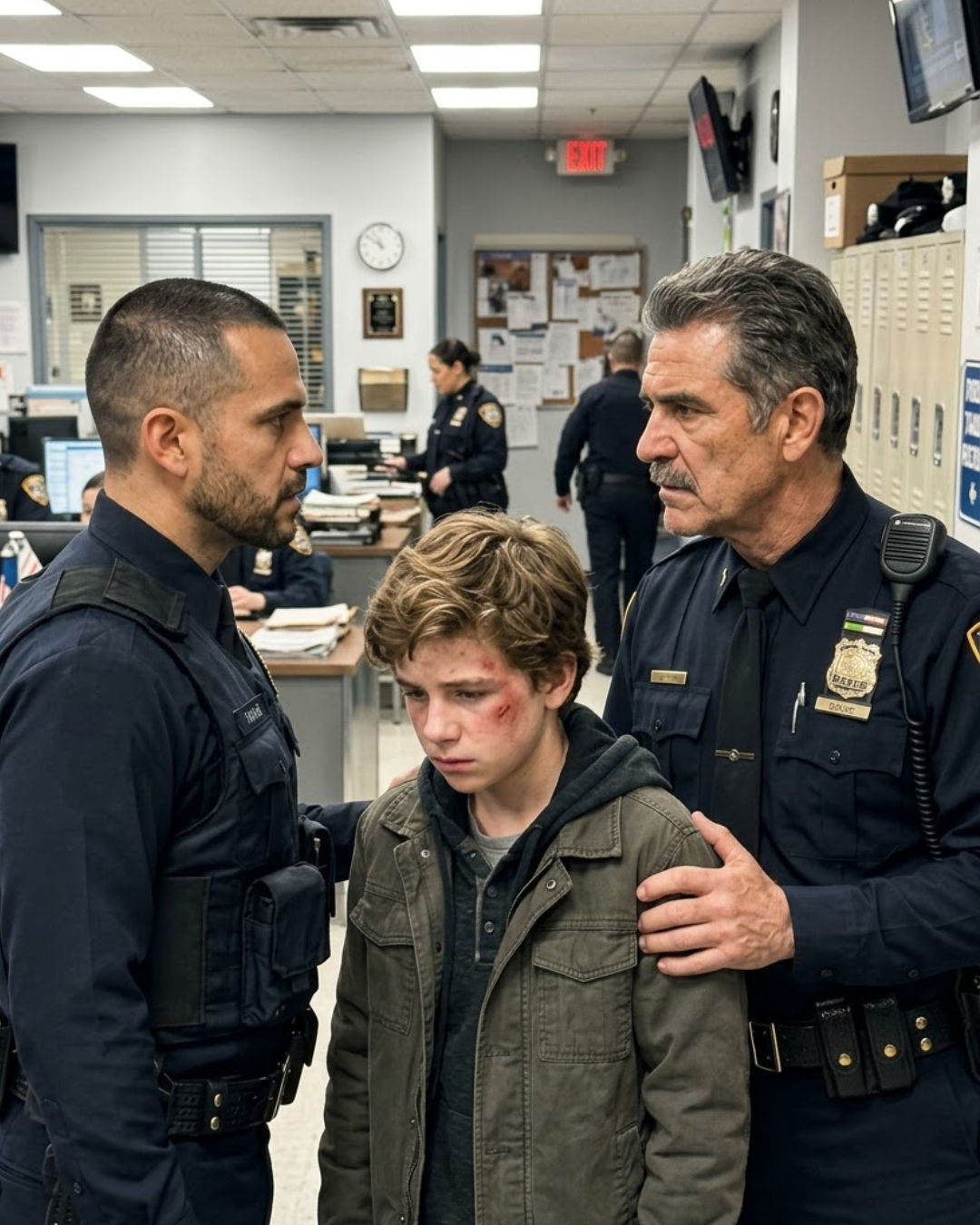
PART 1: The Call That Changed Everything
Rain hammered against the windshield of my patrol cruiser, falling so heavily that the wipers could barely keep up. Every passing streetlight dissolved into a blurry streak of yellow against the wet glass.
I had less than two hours remaining on a brutal double shift.
The dashboard clock read 11:42 PM.
After twenty years in law enforcement, I had learned to function through exhaustion, but that night, even my bones seemed tired. All I wanted was to return to my empty apartment, take a hot shower, and forget about the world until morning.
Then my personal phone rang.
I glanced at the screen.
Blake.
My fifteen-year-old son.
He lived across town with his mother, Sarah, and her new husband, Graham Vance.
Something tightened in my chest.
Blake rarely called this late.
“Blake?” I answered, my voice rough from hours of radio calls and too much coffee.
“Dad,” his voice cracked.
It wasn’t the ordinary uncertainty of a teenage boy’s changing voice. It was fear, sharp and unmistakable, barely contained beneath an effort to sound calm.
“I’m at the police station.”
The rain suddenly seemed quieter.
My exhaustion vanished.
Only a few hours earlier, I had stopped by Sarah’s house to deliver a math textbook Blake had forgotten in my cruiser. He had seemed unusually withdrawn, answering my questions with brief responses and avoiding my eyes.
Now I understood that something had been wrong.
“What happened?” I asked, my voice deadly calm.
“My stepdad… he hurt me,” Blake whispered, his words trembling over the line. “Then he drove me down here. He filed a report saying I started it. He told them I attacked him, Dad. The officers… they believe him.”
My fingers tightened around the steering wheel.
Graham Vance.
A wealthy contractor whose company developed expensive condominiums throughout the city.
He had money, political connections, and a polished public reputation. His suits were expensive, his handshakes firm, and his smile always appeared carefully rehearsed.
But I had never trusted him.
Something about Graham’s eyes never matched the friendly expression on his face.
For Sarah’s sake, I had kept my suspicions to myself.
That restraint ended the moment I heard my son’s frightened voice.
“Which station?” I asked, gripping the steering wheel until my knuckles turned white.
“West District Precinct.”
“Which officer caught the desk?”
“Sergeant Miller.”
I knew Miller.
He was ambitious, politically connected, and far more interested in pleasing influential people than protecting ordinary citizens.
“Stay put,” I commanded, projecting every ounce of authority I possessed into the phone. “Don’t sign anything. Don’t say a single word to anyone. Twenty minutes.”
I ended the call.
For a moment, I sat completely still.
I knew what a lawyer would advise. Preserve evidence. Avoid confrontation. Allow the system to follow its procedures.
But Graham understood how to exploit procedures, and I wasn’t going to leave Blake alone with officers who had already accepted his stepfather’s version of events.
I activated my emergency lights and siren.
Red and blue flashes swept across the rain-soaked road as I accelerated toward West District.
The journey passed in a blur of traffic signals, reflections, and the relentless sound of water striking the roof.
By the time I reached the precinct, I had forced my anger beneath a layer of professional composure.
I stepped out of the cruiser in my captain’s uniform.
Rain ran down my shoulders as I entered the building.
The fluorescent lights were painfully bright.
A desk officer looked up.
Then another.
Within seconds, conversations stopped.
Officers who had been typing reports paused with their fingers above their keyboards. A patrolman holding a paper cup froze halfway through a sip of coffee.
Everyone recognized the brass insignia on my collar.
More importantly, they recognized my expression.
I searched the room.
Then I saw Blake.
He sat alone on a wooden bench near the holding area, his shoulders hunched and his hands clasped tightly together.
A dark purple swelling spread beneath his left eye.
Even from across the lobby, I could see how badly he had been hurt.
For one dangerous instant, anger threatened to overwhelm me.
I wanted to find Graham immediately.
Instead, I walked toward my son.
Sergeant Miller emerged from his office.
His confident expression disappeared when he recognized me.
“Captain David, I—”
“Sergeant Miller,” I cut him off, my tone professional but carrying the weight of a drawn blade. “I got a call that my son was here.”
“Yes, sir,” Miller stammered, wiping a bead of sweat from his brow. “He’s in the waiting area. His stepfather filed a formal complaint. He claims the boy became violent—”
“Is that so?”
I placed my hand on Blake’s shoulder.
He flinched slightly before recognizing my touch.
I felt him trembling.
“Because my son is standing right here, next to me. In fact, he’s been with me all evening.”
I raised my eyes to Miller.
“So, you want to explain to me how you have a minor in custody without notifying his biological father, especially when that father outranks you by three pay grades?”
Miller’s face lost its color.
He glanced toward Blake, then toward the officers watching from their desks.
I could almost see him calculating how much trouble he was in.
“Sir, the stepfather, Graham Vance, is in Interrogation Room C. He’s waiting to finalize his statement.”
“Excellent,” I said, my voice dropping to a controlled, dangerous growl. “Give me fifteen minutes alone with him.”
The lobby became even quieter.
Miller swallowed.
He looked at the bruise beneath Blake’s eye, then back at me.
“I… I didn’t hear anything,” the sergeant finally swallowed hard, stepping back. “I was in my office doing paperwork.”
“Smart man,” I said.
A lieutenant I trusted had arrived in the lobby.
I asked him to remain with Blake and ensure that nobody questioned him further without proper safeguards.
Then I walked toward the interrogation rooms.
My footsteps echoed along the linoleum hallway.
I stopped outside Room C.
I drew one slow breath, opened the door, and stepped inside.
Graham Vance sat at a metal table.
He wasn’t frightened.
He wasn’t apologetic.
He leaned back comfortably, wearing an expensive Italian jacket and the smug expression of a man who believed he had already won.
When he saw me, his smile widened.
“Took you long enough, Captain,” he sneered.
I closed the door.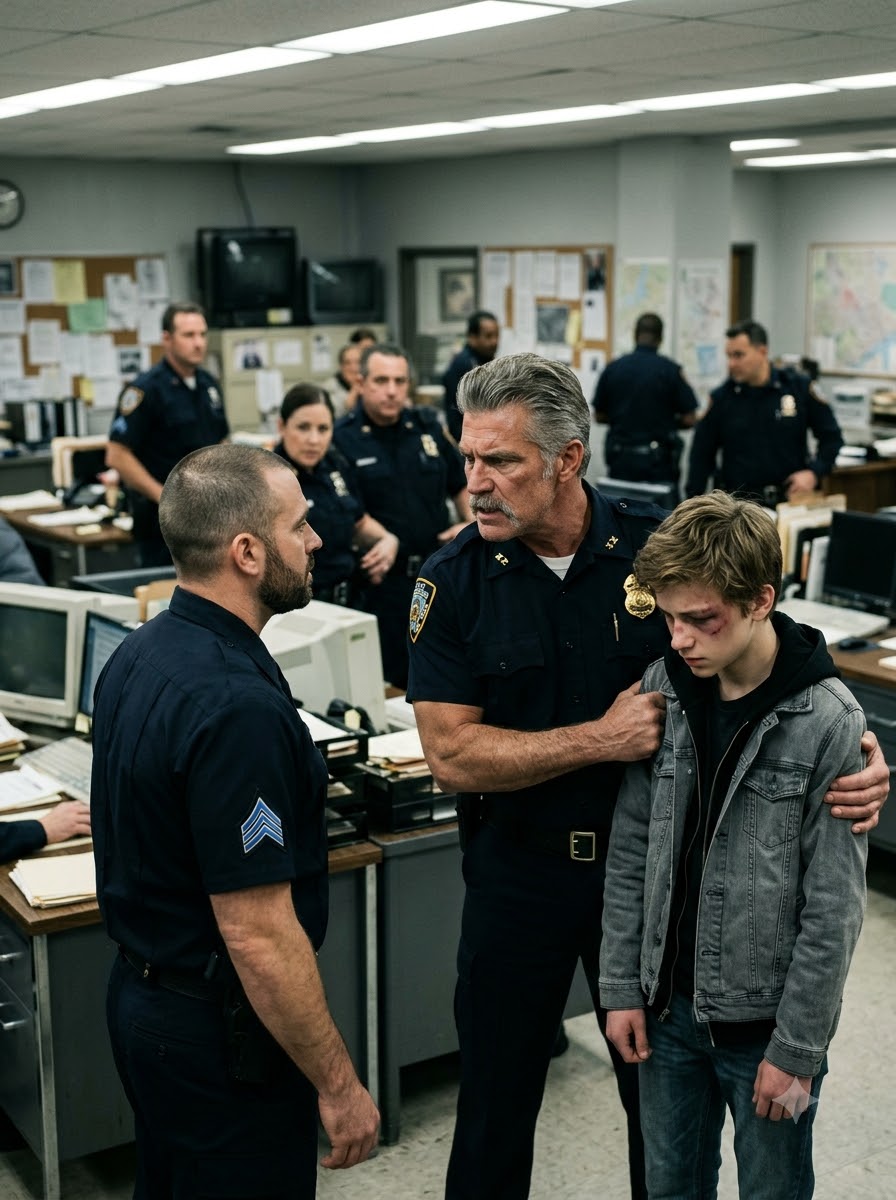
The latch clicked behind me.
“You have a lot of nerve, Graham,” I said, staying near the door, keeping my posture relaxed but ready. “Laying hands on my son. You think your money buys you immunity in this city?”
Graham laughed quietly.
He straightened his jacket.
“You cops are all the same. You see a bruise and you think it’s about a messy divorce or a rebellious teenager. You think I hit Blake because he gave me lip? Please, David. Give me more credit than that.”
His answer unsettled me.
He wasn’t denying that he had struck Blake.
He was suggesting that the assault had served a purpose.
“Enlighten me.”
Graham leaned forward and rested his elbows on the table.
“Your son is a little snoop. A real chip off the old block, always digging where he shouldn’t. He broke into my home office this afternoon. He managed to crack the safe behind my bookshelf.”
I felt a new kind of concern.
Blake had always been exceptionally talented with computers.
He understood systems, passwords, and digital security far better than most adults I knew.
“And?”
“And he found a USB drive,” Graham whispered, his eyes gleaming with malicious delight. “A drive that contains the last five years of my company’s… unofficial bookkeeping. Every bribe paid to city officials, every offshore account, every dime laundered through my construction projects. He took it, David.”
I stared at him.
The entire situation suddenly became clear.
Graham hadn’t attacked Blake simply because he was angry.
He believed my son had discovered evidence capable of destroying his business empire.
He had beaten Blake and brought him to a police station where he expected the officers to help him recover the evidence.
“You’re confessing to grand-scale fraud and money laundering,” I said, my voice dangerously soft. “Right in a police precinct.”
“I’m not confessing to anything,” Graham smiled, showing his teeth. “Because you’re not going to arrest me.”
“Watch me.”
My hand moved toward my handcuffs.
Graham didn’t flinch.
“Touch those, and Sarah goes to federal prison for a minimum of ten years,” Graham stated, his voice devoid of all emotion.
I stopped.
“What did you say?”
Graham leaned back.
He looked pleased that he finally had my full attention.
“Who do you think has been signing off on all my shell company transfers for the past two years? Who do you think is listed as the primary financial director of my offshore holdings? Your lovely ex-wife, Sarah. I’ve spent twenty-four months carefully, meticulously burying her signature on every fraudulent document. I told her they were standard tax forms for the business. She signed them without looking.”
My stomach tightened.
Sarah had never been comfortable with complicated financial paperwork.
She trusted people too easily, especially those she loved.
Graham had apparently used that trust to make her the visible face of his illegal transactions.
If investigators followed the documents without understanding the scheme, Sarah could face devastating consequences.
And Blake might lose his mother.
“You’re a monster,” I breathed, the realization of his depravity washing over me.
“I’m a survivor, Captain,” Graham corrected. “If you try to use whatever is on that USB, the FBI will trace it right back to Sarah. I’ll claim I was a victim of a rogue employee. She’ll take the bullet. So, here’s how this goes. You are going to walk out of here, take your son home, and he is going to hand over that drive. And we will never speak of this night again.”
I remained silent.
Graham had constructed a trap around everyone I cared about.
He believed he could threaten Sarah, intimidate Blake, and force me to protect his crimes.
I was still considering my next move when a violent sound erupted behind me.
BANG.
The interrogation-room door slammed shut.
A heavy lock engaged.
I turned and grabbed the handle.
It wouldn’t move.
Someone had locked us inside.
I looked back at Graham.
He was staring toward the security camera mounted in the corner.
Its red indicator light had switched on.
Graham smiled.
“Like I said, Captain,” Graham whispered, his smile turning into a feral grimace. “I’m a survivor.”
