

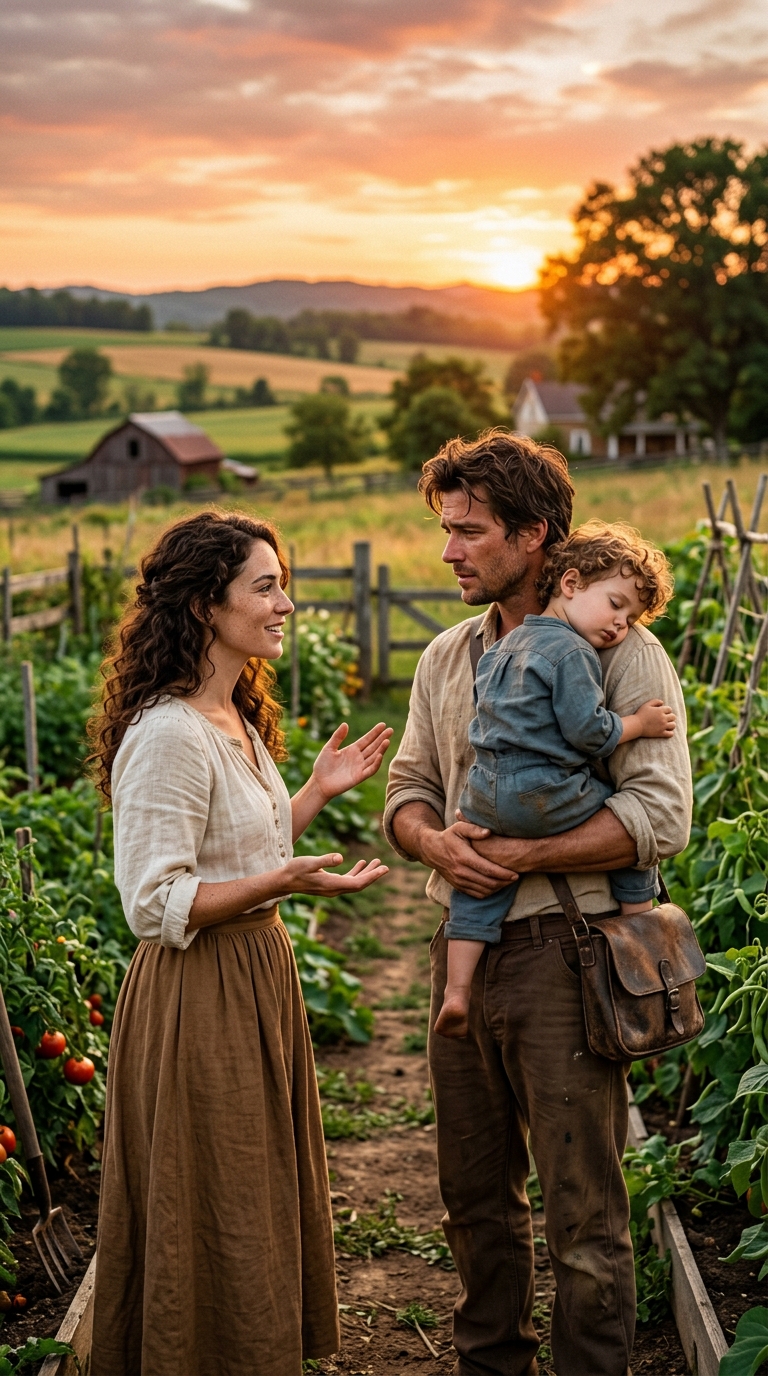
Mateo Salcedo was twenty-eight years old, with a two-year-old child sleeping against his chest, a leather bag full of tools, and no place to call home.
He walked along a dusty path in southern Jalisco, his huaraches worn open, his shirt stuck to his body with sweat, and the sun sinking behind the hills like a giant ember. In his bag he carried a mason’s trowel, a plumb line, a chisel, a hammer, an old wooden level, and everything that remained of a life that seemed determined to collapse every time he managed to raise a wall.
The child’s name was Nicolás, but Mateo called him Nico. He had black curls stuck to his forehead, his mouth slightly open in sleep, and one little hand closed tightly on his father’s shirt, as if even in his dreams he knew that if he let go, the world might take him away.
Three hours earlier, Don Eusebio Rentería had thrown him out of the El Cenzontle hacienda.
“Here we do what I say,” the boss had shouted at him, red with anger. “And if I say the pay is cut in half, it’s cut in half.”
Mateo, who had endured hunger, contempt, and entire nights working under kerosene lamps, could not endure that.
“The wall was built straight, Don Eusebio. The deal should be straight too.”
That sentence was enough. The next morning they gave him one hour to gather his things. They didn’t pay him in full. They didn’t let him say goodbye to anyone. They only let him leave with his son, his tools, and a dry anger that didn’t show on his face but weighed heavier than the bag on his back.
Mateo had not always been alone.
Two years earlier, while working on a stone wall at a hacienda in Colima, he had met Daniela Arriaga, the youngest daughter of the administrator. Daniela had delicate hands, light eyes, and that elegant sadness of girls who have everything except permission to choose their own life. She watched him work from the corridor, first with curiosity, then with tenderness, and later with something Mateo mistook for love.
They had four months of secret meetings behind the corrals, words spoken in low voices, and promises that were never fully made. One morning, Daniela appeared pale, her hands trembling over her belly.
“I’m pregnant,” she said. “But my family can’t know it’s yours.”
Mateo didn’t shout. He didn’t beg. He only asked:
“What do you want to do?”
She lowered her gaze.
“I’m going to have him far away. When he’s born, I’ll give him to you. I can’t keep him, Mateo. I can’t.”
The child was born on a cold December dawn. Daniela handed him over wrapped in a blue blanket, with an envelope of money hidden in the folds. Mateo left the envelope on a table and picked up the baby.
“You don’t even want to see him grow up?” he asked.
Daniela cried without making a sound.
“If I see him, I won’t be able to leave.”
And she left.
Since then, Mateo learned to mix lime with one hand and rock his son with the other. He learned to work with Nico sleeping in a box, crawling over sacks, chasing other people’s chickens, or sticking his fingers in wet sand. He learned that a man could be tired to the bone and still smile when his son woke up looking for him.
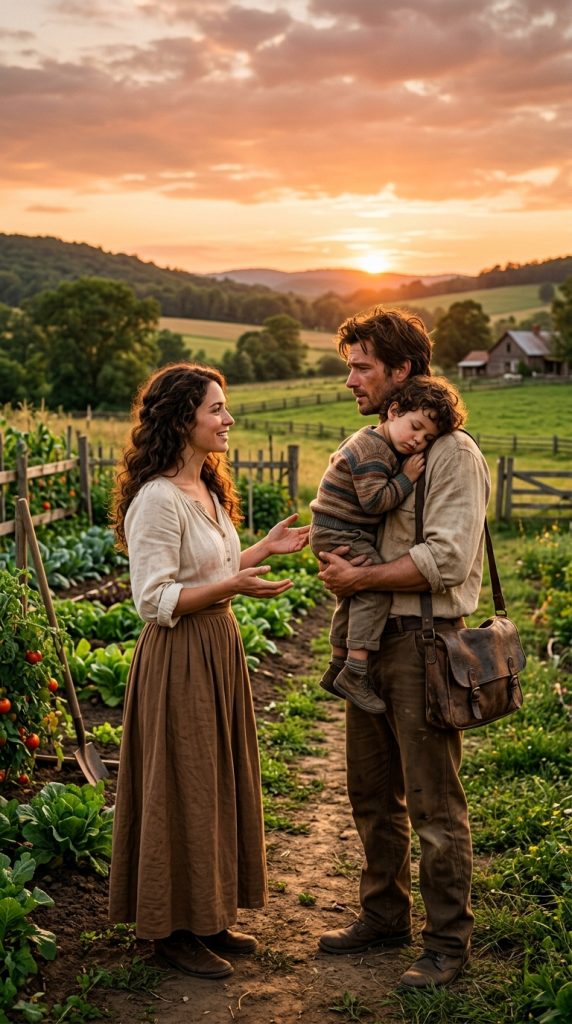
That afternoon, after being thrown out of Don Eusebio’s hacienda, Mateo reached the bottom of a valley where the air smelled of moist earth, roasted chili, and firewood. He saw a well-built stone fence, a corral with two donkeys, a green vegetable garden beside a stream, and an adobe house with a tiled roof. On the porch, a young woman was cleaning beans in a wooden basin.
She didn’t stand up when she saw him. She simply watched him.
She had firm, calm black eyes. Her hair was gathered in a thick braid. Her hands were weathered by the fields. She didn’t seem scared, but she wasn’t trusting either. She was one of those people who look first and speak later.
“Where are you coming from?” she asked.
“From the El Cenzontle hacienda. They threw me out today. I’m looking for a place to spend the night with my son. Tomorrow I’ll continue on my way.”
The woman looked at the sleeping child, then at Mateo’s broken huaraches, then at the bag.
“Do you know how to fix fences?”
Mateo blinked.
“Yes, ma’am.”
“I’m not a ma’am. My name is Luz María Aguilar. And the fence by the stream is falling down. Stay tonight. We’ll see tomorrow.”
That phrase sounded like mercy to him.
He slept on a petate mat in the corridor. Nico woke up in the middle of the night, crying softly, confused by the new smells. Mateo hugged him and whispered in his ear.
“I’m here, my boy. I’m here.”
From her room, Luz María heard that deep voice, rough with exhaustion but soft like freshly baked bread. She didn’t come out. She also didn’t fall back asleep right away.
At dawn, Mateo found coffee on the stove and tortillas wrapped in a cloth. Luz María was already in the garden, checking the tomato plants with the seriousness of someone reading the future in the leaves.
He fixed the fence that day. He made it so solid that Luz María ran her fingers over the stone and mortar joints without saying a word.
“The chicken coop leaks too,” she said finally.
Mateo understood.
The day turned into a week. The week into a month. The petate in the corridor no longer felt borrowed. Nico stopped hiding behind his father when Luz María approached. First he accepted tortillas from her hand. Then he let her comb his hair. Later he began following her around the garden carrying a small empty bucket, convinced he was helping.
The ranch needed Mateo. There were cracks in the kitchen, collapsed sections in the walls, a poorly built oven, and a storeroom that threatened to fall down every rainy season. Mateo fixed everything with stones from the stream, clay from the edge of the property, clean sand, and a patience that seemed endless.
But Mateo also needed the ranch.
He needed that morning smell, that coffee served without questions, that child laughing among the chickens, that woman who promised him nothing but gave him a reason to stay every day.
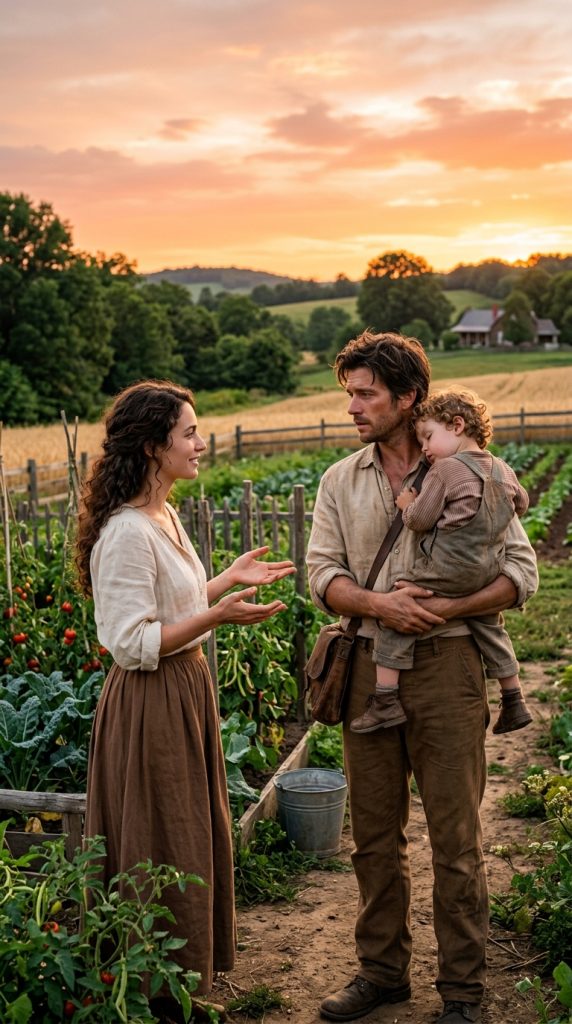
Luz María had inherited the ranch from her father. She had lived alone for five years and had grown used to not asking for help. She planted corn, beans, squash, chili, and tomatoes. She sold her produce in nearby settlements and to the mule drivers who crossed the valley. People respected her because she never owed favors and because her word was worth more than a signature.
That was why it was hard for her to accept that Mateo’s presence did not weaken her. It held her up.
One hot night, Nico resolved what they kept silent. He climbed down from his father’s lap, went into Luz María’s room, climbed onto her bed, and curled up on the pillow as if he had been born there.
Mateo stood at the door, embarrassed.
“Sorry. I’ll take him out right now.”
Luz María looked at the child, then at Mateo.
“Let him be. We’ll see tomorrow.”
Mateo smiled faintly. It was the second time he had heard that phrase, and he understood that in Luz María’s mouth, it didn’t mean doubt. It meant patience.
The following week, Mateo was already sleeping in the room, first on the floor, then in the big bed with Nico in the middle. No one made any declaration. There were no rings, no witnesses, no music. There were only days stacking one upon another until they formed a life.
Misfortune arrived four months later, riding a fine horse.
Don Eusebio Rentería appeared one morning in front of the ranch with two workers armed with work machetes. He wore his hat tilted and the smile of a man used to fear opening doors for him.
“Mateo Salcedo!” he shouted. “I’ve come for what’s mine.”
Mateo stepped out into the patio holding Nico’s hand. Luz María appeared behind him, drying her hands on her apron.
“I don’t have anything of yours,” Mateo said.
Don Eusebio let out a loud laugh.
“You stole tools from my hacienda and a mule. Either you pay me, or I’ll take you to the authorities as a thief.”
Nico squeezed his father’s leg. Mateo felt rage rising in his chest, but he didn’t move.
“My tools I bought with ten years of work. And I left your hacienda walking, just as I arrived.”
“That’s what you say.”
The workers took a step forward. Luz María did too.
“This is my property,” she said. “And no one comes in here to take anyone without proof.”
Don Eusebio looked at her with contempt.
“Don’t get involved, woman. This is men’s business.”
Luz María didn’t lower her gaze.
“Then speak like a man and not like a coward.”
A heavy silence fell.
At that moment, Tomás and Rosario arrived — neighbors from the other side of the stream — who came every Sunday to buy bread and beans. They saw the horses, Mateo’s face, the child’s fear, and stood beside them without asking anything.
Don Eusebio realized he was no longer facing a lone worker.
“You’re all going to regret this,” he said.
Luz María took another step forward.
“I know the mule drivers who cross this valley. I know the foremen from San Miguel, Autlán, and Sayula. If you insist on calling an honest man a thief, tomorrow everyone will know that Don Eusebio Rentería doesn’t pay what he promises and then accuses of theft anyone who dares to demand what’s owed. Let’s see who wants to work for you after that.”
The workers lowered their eyes. Don Eusebio opened his mouth, but found no words stronger than that truth.
Then something unexpected happened.
One of the workers, a skinny young man named Julián, took off his hat.
“The mule wasn’t taken by him, boss.”
Don Eusebio turned as if he had been struck.
“What did you say?”
Julián swallowed.
“Your foreman sold it in Tepatitlán. I saw it. And this man’s tools have always been his. We all knew it.”
Don Eusebio’s face turned purple.
“Shut up!”
But it was too late. The lie had shattered in front of everyone.
Don Eusebio mounted his horse without another word. His workers didn’t follow him immediately. Julián looked at Mateo.
“I’m sorry, sir. Sometimes a man obeys because he’s hungry.”
Mateo nodded.
“Hunger is not a shame. Lying is.”
That day, when the dust from the horses disappeared, Luz María went into the kitchen and came out with coffee for everyone. Nico, who had remained quiet, ran to her and hugged her skirt.
“Mamá Luz,” he murmured.
No one breathed for a moment.
Luz María stood still, her eyes full of an emotion she didn’t know how to show. Then she set the cup on the table, knelt down, and hugged the child.
Mateo looked away so no one would see his tears.
He thought that was the end of the trial. It wasn’t.
A year later, an elegant carriage arrived at the ranch. Daniela Arriaga stepped down from it, dressed in black, thinner, with a worn-out look. Mateo recognized her before she said her name.
Luz María was kneading bread. Nico was playing near the oven.
Daniela looked at the child and brought a hand to her mouth.
“He looks like you,” she whispered.
Mateo felt the past returning with boots full of mud.
“What do you want?”
Daniela cried then as she had not cried when she left him.
“My husband died. I was never able to have children. I thought I would forget, Mateo, but you don’t forget a child. I came to see him. Not to take him away. Just to ask for forgiveness.”
Luz María approached slowly, with flour on her hands.
Nico looked at the stranger and then hid behind Luz.
Daniela understood everything in that gesture. She understood that the mother of that child was not the one who had given birth to him, but the one who had been there when he had fever, hunger, fear, and sleep.
She took some papers out of her bag.
“I brought a letter signed before a notary. I renounce any claim. I also left part of my inheritance in Nicolás’s name. I know it doesn’t buy what I did. But maybe it will help his future.”
Mateo didn’t take the papers right away.
“He doesn’t need money to know who he is.”
“I know,” Daniela said. “That’s why I’m leaving it to him, not to me.”
Nico, curious, came out from behind Luz María. Daniela knelt without touching him.
“Hello, Nicolás.”
The child looked at her seriously.
“They call me Nico.”
Daniela smiled through her tears.
“Hello, Nico.”
There was no hug. There was no immediate miracle. But there was peace. Daniela stayed that afternoon, ate bread from the oven, listened to Nico talk about chickens and stones, and when she left, she kissed the earth of the patio like someone saying goodbye to something sacred.
She returned a few times over the years. Not as a mother, but as a kind visitor who learned to love from afar what she didn’t know how to care for up close.
Daniela’s money was used to buy more land beside the stream. Mateo built a large cistern, a new room for Nico, and later a small classroom where Luz María taught the valley’s children to read in the afternoons.
Nico grew up between mortar and cornfields. From Mateo he inherited the patience to raise walls. From Luz María, the wisdom to read the land. By the age of eighteen, he was already able to build a house and plant a full season without asking for instructions.
Many years later, one afternoon, Mateo was sitting on the same stone bench where he had first seen Luz María cleaning beans. His hair was gray, his hands moved slowly, and his heart was at peace. Beside him, Luz María looked at the garden with those firm eyes that still measured the world before accepting it.
Nico, now a man, was repairing the fence by the stream with a young woman named Isabel, daughter of Tomás and Rosario. The two were laughing too much over a poorly placed stone.
Luz María tilted her head.
“They’re going to get married.”
Mateo smiled.
“Did they tell you?”
“They don’t need to. Mothers see it first.”
Mateo looked at her with tenderness.
“Then we’ll have to build another room.”
Luz María let out a brief, bright, unexpected laugh.
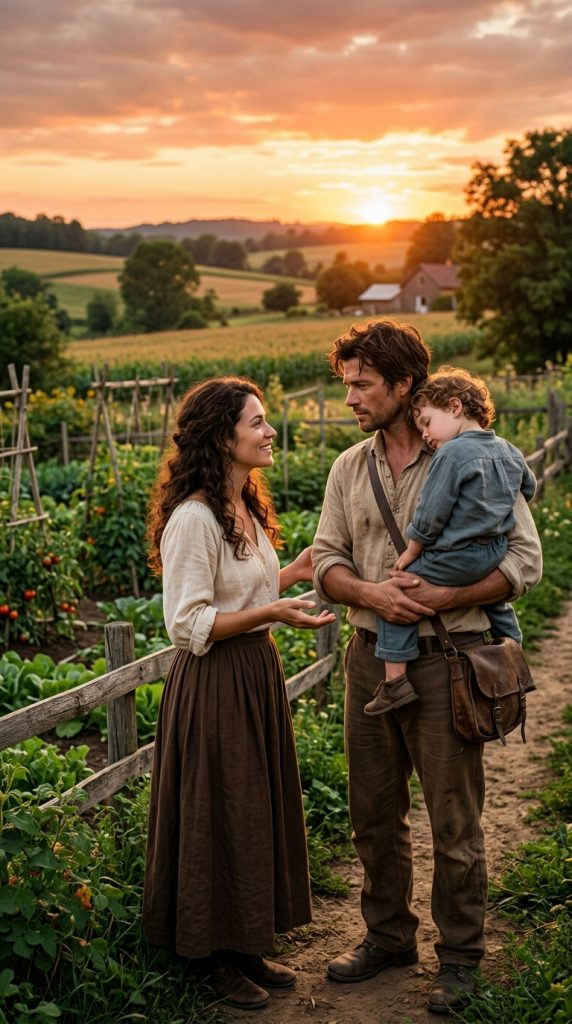
The sky turned orange, just like that afternoon when Mateo arrived with no destination. The smell of moist earth rose from the stream. In the kitchen, the bread was beginning to turn golden.
Mateo thought about everything he had lost to get there: an unfair wage, a woman who didn’t stay, a path with no roof, a false accusation. And he understood that some misfortunes are not the end of life, but the abrupt way God pushes a person toward the place where they truly belong.
Luz María placed her hand over his.
“Do you regret staying?”
Mateo looked at the solid walls, the living garden, the happy son, the woman beside him.
“No,” he said. “I only regret not having arrived sooner.”
She squeezed his hand.
“You arrived when you were meant to.”
And that night, while the chickens sought their roost, Nico and Isabel laughed by the stream, and the valley filled with the smell of warm bread, Mateo finally understood that a home is not found ready-made. It is built. Stone by stone. Day by day. With someone who, when the world throws you out, looks you in the eyes and says:
“Stay tonight. We’ll see tomorrow.”
