

Part 1: The Woman at the Empty Table
On a crisp October morning, a taxi pulled up to the visitor center at Fort Campbell, just outside Clarksville, Tennessee. Quinn Braddock, eighty-one years old, paid the driver, buttoned her gray-and-black tweed blazer, and stepped out into the bright sunshine. The hills beyond the base were on fire with autumn—crimson maples, golden oaks, and the deep green of the pines—and for a moment she simply stood there, one hand on her purse, drinking in the cool air.
She had come alone. Her daughter would not have approved, and her doctor would have approved even less. But Quinn had read a short article in the Clarksville paper about a dining hall on the base and a tradition that had endured for decades, and something in it had tugged at her like a thread snagged on a nail. For years she had believed her memories of Vietnam were gone for good—the heat, the helicopters, the long nights in the field hospital. Yet one line in that article had refused to let her sleep.
At the gate she presented her retiree identification card, its edges worn soft from years in her wallet. The young specialist on duty glanced at the card, then at her, then back at the card. "Army Nurse Corps, ma’am?" he asked. Quinn nodded. "A long time ago," she said. He smiled and waved her through, and she was grateful he asked nothing more. She was not certain she would have had the answers.
The dining hall was bigger than she had imagined. Tall windows ran along one wall, pouring light into the room and framing the blazing hills outside. Across the far wall stretched a vast world map painted in browns and golds, and beneath it, rows of steel tables gleamed. The room buzzed with hundreds of soldiers—trays clattering, chairs scraping, laughter swelling and fading. Quinn took a black tray and made her slow way down the line: a bowl of pasta, a small salad topped with a cherry tomato, a bread roll, and a glass of water.
She chose an empty table near the center of the room and eased herself into the chair. Her knees were not what they had once been. Only after she had settled did she notice the small brass plaque fixed to the pillar beside the door. She squinted, then read the words twice. "No soldier shall ever eat alone here." Her grip tightened on the glass. She could not say why, but her eyes stung, and somewhere deep in her mind a voice she had not heard in fifty years seemed to speak the very same sentence.
She was still gazing at the plaque when a shadow fell across her tray. A sergeant stood beside her table, broad-shouldered and muscular, his dark hair cropped close at the sides and a day’s stubble along his jaw. He wore an olive fleece pullover with the sleeves shoved up to his elbows, exposing a heavy tattoo that coiled down his right forearm to a black tactical watch. Behind him, two younger soldiers in camouflage hovered and watched.
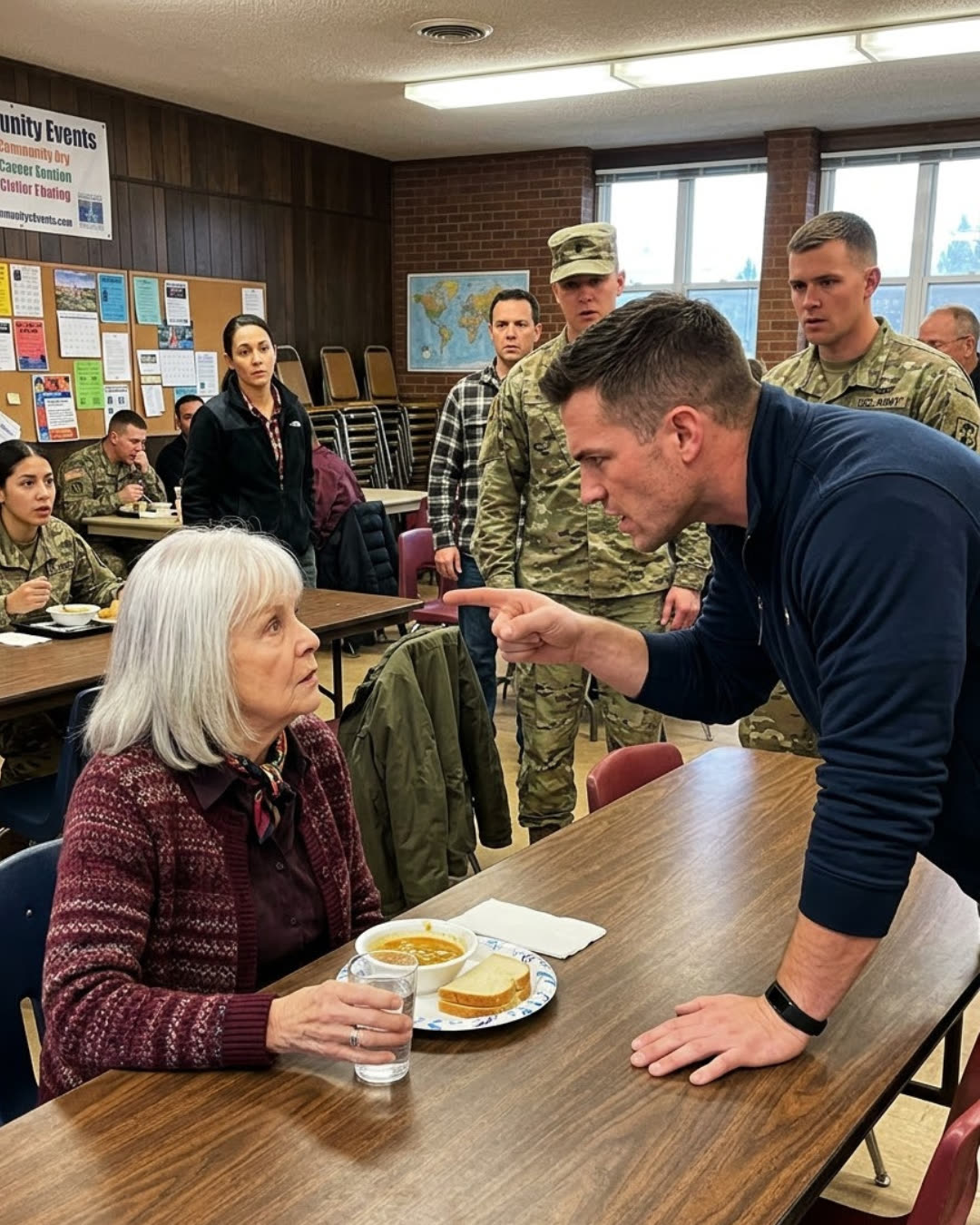
"Ma’am," the sergeant said, in a tone that turned the word into an accusation, "this table is taken. And this hall is for soldiers. Not for tourists looking for a cheap lunch." Quinn raised her eyes to him. His name tape read REESE. "I’m not a tourist, Sergeant," she said softly. "I served." He gave a short laugh and glanced back at his friends. "Sure you did. Everybody’s grandma served."
The chatter at nearby tables began to die away. A young female soldier a few seats down set down her fork and stared, her hand drifting toward her mouth. Sergeant Dylan Reese leaned in and planted a fist on the steel table beside Quinn’s tray, so close she could make out every line of the ink on his arm. With his other hand he jabbed a finger toward her face. "Listen. I’ve got a squad that needs this table. You can eat your pasta somewhere else, or you can eat it outside."
Quinn did not flinch, though her heart was hammering. She had stood up to louder men in worse places, even if she could no longer recall all their faces. "I came here because of that plaque," she said, nodding toward the pillar. "I knew a man once who used to say those exact words. His name was Daniel Cho. He was a medic." Dylan rolled his eyes. "Never heard of him. Now, are you moving, or do I need to call somebody?"
"You won’t need to call anyone, Sergeant Reese. I’m already here." The voice came from behind him, crisp and even. The two soldiers at his back snapped upright. A woman in her mid-forties, wearing a pressed camouflage uniform with a major’s insignia and her auburn hair drawn into a tidy low bun, strode across the floor toward them. Sunlight from the tall windows caught the gold of the hills behind her. Dylan stepped back from the table, his finger still half-raised, his face reddening as the whole hall watched him lower his hand.
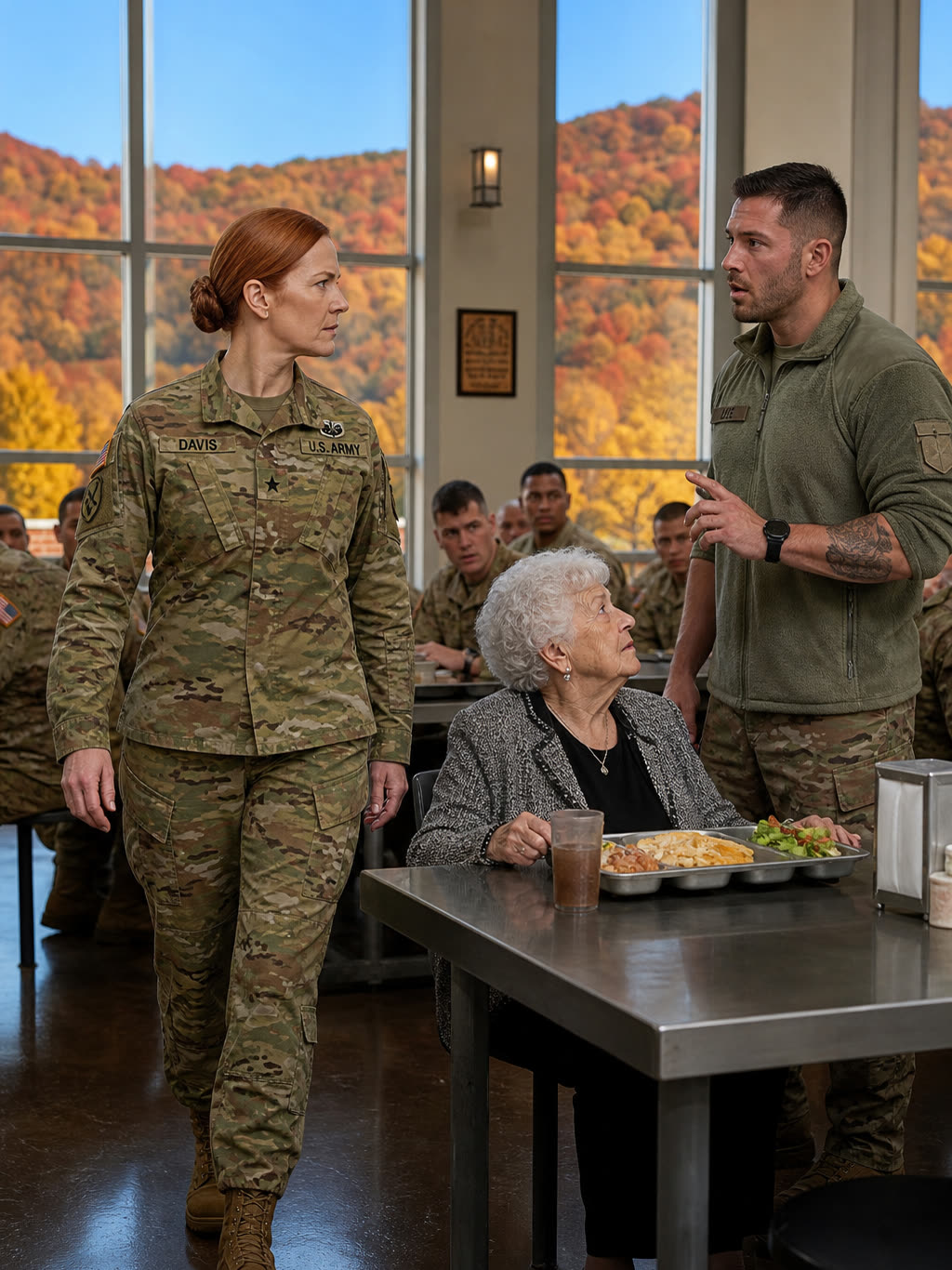
"Major Park," he said stiffly. "I was just explaining to this civilian—" "I heard exactly what you were explaining," Major Helen Park cut in. "Everyone in this room heard it." She turned to Quinn, and her face softened. "Ma’am, I am deeply sorry. May I sit with you?" Quinn motioned to the empty chair. "Please. It seems this table has plenty of room after all."
Helen took the seat and glanced at Dylan, who stayed standing, jaw clenched. "Sergeant, you’ll stay right there," she said. Then, to Quinn: "You mentioned a name. Daniel Cho?" With trembling fingers, Quinn opened her purse and drew out a small, creased photograph. It showed two young people in front of a canvas tent: a nurse with dark curls tucked beneath her cap, smiling shyly, and a slim young medic with a red cross on his armband, laughing at something beyond the frame. On the back, in faded ink, someone had written: Daniel Cho and Lt. Q. Braddock, 1969.
"That’s me," Quinn said, touching the edge of the picture. "I was twenty-four. Daniel worked with our evacuation teams. He said it whenever someone new arrived, or whenever a boy came back from the field and couldn’t stop shaking. He’d sit down beside them with his tray and say, ‘No soldier shall ever eat alone here.’" She paused. "I’d forgotten that until I read the article. I’d forgotten a great many things."
Helen studied the photograph for a long while. "That plaque has been here as long as anyone can remember," she said slowly. "The official history says the tradition began sometime in the 1970s, but nobody knows who started it. There’s no name attached. I always assumed it just grew up on its own." She looked up at Dylan. "Sergeant Reese, after lunch you’ll escort Ms. Braddock to the division archives. Consider it corrective duty. And you’ll treat her with the respect you should have shown her ten minutes ago."
Dylan opened his mouth, shut it, and at last said, "Yes, ma’am." His two companions had already slipped back into the crowd. As Helen rose to go, she gave Quinn’s shoulder a gentle squeeze. "I’ll meet you there at two," she said. "If Daniel Cho served with this division, we’ll find him." Quinn nodded and lifted her fork, but she discovered that her appetite had vanished.
The archives occupied a low brick building at the edge of the museum grounds, beside a row of old oaks whose leaves skittered across the path like spilled coins. Dylan walked half a step ahead of Quinn, hands jammed into the pockets of his fleece, saying nothing. When she slowed on the steps, he hesitated, then held the door for her without meeting her eyes. "Thank you," she said. He shrugged. "Orders."
Inside, the air smelled of paper and dust. Helen was already waiting at a long table stacked with gray boxes. "Unit rosters, medical company records, evacuation logs from 1969 through 1971," she said. "Everything we hold for the units that would have worked with an evacuation hospital." She pushed a box toward Dylan. "Start reading." He sat down with a heavy sigh—but he started reading.
For almost two hours they worked in near silence. Quinn turned the pages slowly, tracing each column of names with a fingertip. Some made her pause—a surname that rang a faint bell, a hometown she thought she recognized—but none of them was Daniel Cho. Helen went through casualty lists and transfer orders. Dylan worked his way through the evacuation logs, his frown deepening page by page. At last he stopped and held up a sheet. "Major. Look at this."
Helen leaned over. It was a roster for a medical detachment dated March 1970. Most of the entries were typed in the same faded black ink, but halfway down, three lines looked different. The letters were crisper, the spacing slightly off, as if someone had pulled the original page and retyped part of it on another machine. "Somebody redid this," Dylan said. "The font doesn’t even match. You can see where the margins shift."
Helen ran her thumb along the edge of the paper. "You’re right," she murmured. "And it isn’t the only one." She leafed through the folder. Two more pages showed the same odd mismatch, and on each, a single name seemed to be absent from the spot where it belonged. A chill crept through Quinn. "They took him out," she whispered. "Someone took him out of everything."
Dylan looked at her, and for the first time something other than irritation crossed his face. "Why would anybody do that?" he asked. "Erase a medic? It’s not like he was a general." Quinn shook her head. "I don’t know," she said. "I wish I could remember. There’s something there—I can feel it—but it’s like trying to see through fog." She pressed a hand to her forehead and shut her eyes.
When she opened them, she looked at Dylan with a moment of confusion. "I’m sorry, young man," she said. "What did you say your name was?" Dylan blinked. "Reese. Sergeant Reese. I told you about two hours ago." "Of course," Quinn said quickly, her cheeks coloring. "Forgive me. It’s been a long day." Helen watched her with quiet concern but said nothing.
Dylan picked up the photograph Quinn had left on the table and tipped it toward the lamp. "There’s someone else in this picture," he said. "Back here, by the tent pole. You can barely see him." Quinn leaned in. Behind Daniel’s shoulder, half lost in shadow, stood another young soldier with a bandaged arm. The name tape on his chest was blurred but legible: WARD.
Helen opened the digital database on her laptop and typed rapidly. "Elias Ward," she read. "Infantry, wounded in action April 1970, medically discharged in 1971." She scrolled. "And then nothing. No VA claims, no change of address, no death record. It’s as though he walked right off the face of the earth." Dylan frowned. "Or changed his name."
Helen gave him a look with a flicker of respect in it. "That’s exactly what I was thinking." She made a string of calls, speaking quietly to someone at Veterans Affairs and then to a friend in the county clerk’s office. Quinn sat with her hands folded in her lap, watching the light fade beyond the window as the sun sank behind the hills. Dylan fidgeted and checked his watch, then stopped checking it.
Nearly an hour later, Helen set down the phone and turned to them. "A legal name change was filed in Montgomery County in 1975," she said. "Elias Ward became Eli Warren. He’s seventy-six years old, and he’s living at Riverbend Care Center, about fifteen minutes from here." Quinn’s breath caught in her throat.
"Can we see him?" Quinn asked. Helen hesitated, then nodded. "Tomorrow morning. I’ll make the arrangements." She turned to Dylan. "And you’re coming too, Sergeant." Dylan began to protest, then stopped. He looked at the photograph again—at the laughing medic whose name had been cut from every page—and simply said, "Yes, ma’am."
That night Quinn hardly slept in her small room at the inn near the base. She lay staring at the ceiling, trying to summon Daniel’s face, his voice, the sound of his laughter. Fragments surfaced—a hand on her shoulder during a night of mass casualties, the smell of rain on canvas, a tin cup of dreadful coffee pressed into her palm—but each time she reached for more, the memory slid away.
Riverbend Care Center stood on a gentle bluff above the Cumberland River, its gardens bright with late chrysanthemums and its lawn rolling down toward the water. A nurse led the three of them outside to a bench beneath a towering red maple, where an old man sat with a cane across his knees, watching the river. He was tall and lean, with a white crew cut and a neatly trimmed white beard, and he wore a brown cardigan over a flannel shirt.
"Mr. Warren," the nurse said gently. "You have visitors." The old man turned his head slowly. His gaze passed over Helen’s uniform, then Dylan’s, and finally came to rest on Quinn. For a long moment he did not move. Then his hand began to tremble on the head of his cane. "No," he whispered. "No, it can’t be."
Quinn stepped forward and held out the photograph. "I think you knew me once," she said softly. "My name is Quinn Braddock. I was a nurse at the evac hospital. And I think you knew him." She pointed to the laughing medic. Elias stared at the picture, and his eyes filled with tears. He reached out and touched Daniel’s face with one shaking fingertip.
"Where did you get this?" he asked hoarsely. "I’ve kept it all my life," Quinn said. "But I’ve lost so much of what happened. Someone erased Daniel from the records, Mr. Ward. Every page. We need to know why." At the sound of his real name, Elias flinched as if he had been struck. He glanced over his shoulder toward the building, then back at the three of them, and dropped his voice.
"Daniel Cho saved my life," he said. "And for fifty years I’ve been too afraid to say his name out loud." He seized Quinn’s wrist with startling strength. "You shouldn’t have come here, Nurse Braddock. The men who made Daniel disappear—they weren’t all killed in that war. One of them is still alive. And he’s closer than you think."
Part 2: What the Medic Carried
For a moment no one spoke. The wind stirred the maple overhead, shaking loose a shower of red leaves that drifted onto the bench and the grass. Helen recovered first. "Mr. Ward," she said carefully, "no one is going to hurt you. But we need you to tell us what happened." Elias studied her uniform for a long time, as though deciding whether it was something he could trust.
At last he released Quinn’s wrist and leaned back. "Sit down," he said. "All of you. It’s a long story, and I’m only going to tell it once." Quinn settled beside him on the bench. Helen took a garden chair the nurse carried over. Dylan stayed on his feet for a moment, then crouched on the grass near Elias’s feet, elbows propped on his knees.
"April 1970," Elias began. "We were on a sweep near the border. Our platoon was led by a lieutenant named Garrick. Young, ambitious, wanted his name in every report that went up the chain. We walked into an ambush in a stretch of elephant grass. Within minutes, half of us were down. I took two rounds—one in the arm, one in the leg. I couldn’t walk."
He gazed out at the river as he talked, his voice steady but far away. "Daniel was attached to us that week as a medic. He’d been working with the evac teams, and they sent him out because we were short. He was crawling from man to man under fire, patching people up. Then Garrick got on the radio. A helicopter was coming in for an extraction, but only for the men who could get themselves to the landing zone."
Elias’s jaw tightened. "Garrick gave the order. He said the wounded who couldn’t move were to be left behind. He said we’d slow everybody down, that we’d get the whole platoon killed. He said it like he was reading a weather report. There were four of us lying in that grass. Four of us he was willing to leave."
Dylan had gone completely still. "He just—left you?" he asked. Elias nodded slowly. "Most of the men obeyed. You have to understand, son. When an officer tells you to move, you move. That’s how it works. That’s how you’re trained." He paused. "But Daniel didn’t move. He looked straight at Garrick and said, ‘I’m not leaving them.’ And Garrick told him if he stayed, he’d be on his own."
Quinn’s hand had found Elias’s arm. Her eyes were wet. "What happened?" she whispered. "Daniel stayed," Elias said. "He dragged us, one at a time, into a ditch where we had some cover. He kept us alive all night. Tourniquets, morphine, water. He talked to us the whole time so we wouldn’t drift off. When the next helicopter came in the morning, he carried me to it on his back. He went back for the other three. All four of us lived."
Quinn closed her eyes. A memory was surfacing—not a picture, exactly, but a feeling. Mud-caked boys being carried into the hospital at dawn. A young medic, gray with exhaustion, refusing to sit until every one of them had been seen. "I remember," she breathed. "I think I was there when he brought you in. He wouldn’t leave your side."
Elias smiled faintly, sadly. "You were there. You were the one who set my leg. Daniel sat with me in the mess tent the next day when I couldn’t hold a fork. He set his tray down next to mine and said what he always said." His voice wavered. "’No soldier shall ever eat alone here.’" Dylan lowered his head and stared at the grass.
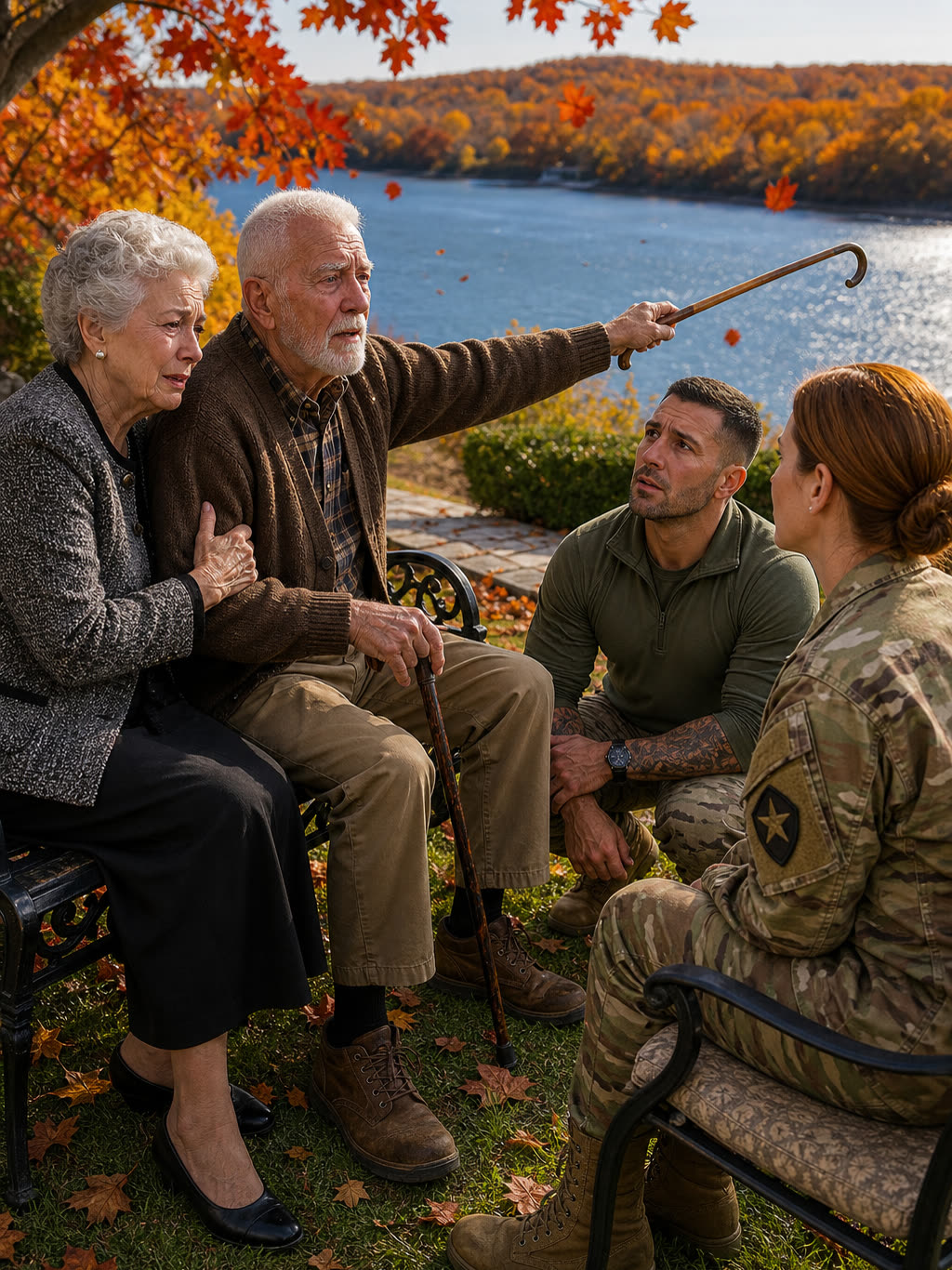
The river sparkled below them, brilliant blue beneath the October sky, and the hills on the far bank glowed orange and gold. Elias raised his cane and pointed across the water as if he could see all the way back to that grassland. "Daniel did everything right," he said, his voice cracking. "And the Army punished him for it." Quinn clung to his arm, tears sliding down her lined cheeks, while Dylan knelt in the grass beside them, tattooed forearms resting on his knees, gazing up at the old man in stunned silence.
"What do you mean, punished?" Helen asked. Elias let the cane fall back across his lap. "Daniel wrote a report. He documented what Garrick had ordered—every detail, the time, the radio call, the names of the wounded. He said he was going to file it with the inspector general. He told me so himself, in the hospital. He said men like Garrick couldn’t be allowed to lead anyone else."
"And then?" Quinn asked. "And then he was gone," Elias said. "One day he was there, the next he wasn’t. No goodbye, nothing. When I asked about him, they said he’d been transferred. When I asked where, nobody knew. A few weeks later, a records sergeant came to see me. Told me Daniel Cho had deserted. Told me if I knew what was good for me, I’d forget I ever met him."
He drew a long breath. "When I got home, I tried to find him. I wrote letters. I called people. Then one night somebody left a note in my mailbox. It said I should stop asking about Cho if I wanted to keep my benefits—and keep my family safe. I was twenty-five with a wife and a baby on the way. I was scared. So I stopped. A few years later I changed my name, and I tried to become someone who’d never been in that grass."
Suddenly he looked at Dylan—truly looked at him, as if seeing his face for the first time. "What did you say your name was, Sergeant?" Dylan hesitated. "Reese. Dylan Reese." Something flickered in Elias’s eyes. "Reese," he repeated. "There was a Reese in our platoon. Corporal Thomas Reese. Tall kid, from right here in Tennessee." The color drained from Dylan’s face. "That was my grandfather," he said.
Elias was silent for a long moment. "Then you ought to know," he said at last, "your grandfather was there. He saw everything. He saw Garrick give the order, and he saw what Daniel did. And when they came around asking questions afterward—" he stopped, then continued more gently "—he said he didn’t remember anything." Dylan rose abruptly and walked a few steps toward the edge of the bluff, his back to them.
Helen exchanged a look with Quinn. Then she got up and went to stand near Dylan, giving him room without leaving him alone. "Sergeant," she said quietly, "did your grandfather leave anything behind? Letters, papers, anything from the war?" Dylan scrubbed his face with both hands. "My mom has a footlocker of his," he said. "It’s been up in her attic since he died. I’ve never opened it. He never talked about Vietnam. Not once."
That evening, Dylan drove to his mother’s house on the outskirts of Clarksville while Helen took Quinn back to the inn. Quinn was tired—more tired than she cared to admit—and when Helen asked whether there was anyone she should call, Quinn shook her head. "My daughter worries enough," she said. Helen jotted something in her notebook anyway and didn’t push.
Dylan called Helen just after nine. "You need to see this," he said. His voice had changed—quieter, rougher. Within the hour, Helen and Quinn were seated at his mother’s kitchen table, the footlocker open on the floor beside them. Inside lay old uniforms folded with military precision, a bundle of letters tied with string, a shoebox of photographs, and a small leather notebook Dylan had found stitched into the lining of the lid.
The photographs showed young men in jungle fatigues, squinting into the sun. In one, Daniel Cho stood with his arm slung around a lanky soldier with a crooked grin. "That’s my grandpa," Dylan said hoarsely. "That’s him with Daniel." Quinn touched the picture. "They look like friends," she said softly. Dylan nodded. "They were. It’s all in the notebook."
He opened the leather notebook with care. The pages were crowded with small, cramped handwriting—dates, names, scraps of events. Thomas Reese had recorded everything he witnessed on the day of the ambush: the radio call, Garrick’s exact words, the four wounded men, Daniel’s refusal. On a later page, he had written about the investigation. They asked me what I saw. I said I didn’t remember. God forgive me, I was afraid.
Below that, another line: Pike said if I talked, my discharge would go bad and I’d never work again. He said Cho was already taken care of. Helen sat up straight. "Pike," she repeated. "Who’s Pike?" No one answered. Dylan reached into the footlocker and drew out one last envelope, sealed and unopened, with his own name written across the front in an unsteady hand.
"I found this at the bottom," he said. "It’s addressed to me. He must have written it before he died. I was nineteen. I’d just enlisted." He turned the envelope over in his hands. "I read it up in the attic. I couldn’t—" He broke off and passed it to Quinn. "Would you read it? Out loud? I don’t think I can do it again."
Quinn unfolded the letter gently. Her voice was soft but clear. "Dylan," she read. "You’re going into the Army, and I’m proud of you. But there’s something I need to tell you that I never had the courage to say. I once watched a good man do the right thing, and I watched the people in charge destroy him for it. I said nothing. I let fear decide for me, and I’ve carried that every day of my life."
She drew a breath and went on. "So here is the only advice I’m worth giving. Never confuse authority with character. Rank doesn’t make a man right, and a uniform doesn’t make him good. Protect the truth, even when it costs you something. Especially then. Be better than I was. Love, Grandpa." When she finished, the kitchen was silent but for the ticking of a clock on the wall.
Dylan sat with his head bowed. "I keep thinking about yesterday," he said finally, without raising his eyes. "The way I talked to you in the dining hall. Pointing at you like that. I thought I had the right because I had the stripes and you were just some old lady in my way." He swallowed hard. "That’s exactly what he warned me about. And I didn’t even read it until tonight."
Quinn reached across the table and rested her hand on his tattooed forearm. "You’re reading it now," she said gently. "That counts for something." Dylan looked at her hand, then at her face, and slowly nodded. Helen, meanwhile, had been inspecting the footlocker. She lifted a false bottom panel that had worked loose and pulled out a small plastic case. Inside was an old audio cassette, its label written in the same shaky hand: Daniel—1988.
Dylan’s mother dug an ancient cassette player out of a closet, and they set it on the table between them. Helen pressed play. For a few seconds there was only hiss and crackle. Then a man’s voice came through, warm and slightly hoarse, with a soft Tennessee drawl underneath. "Tom, you asked me to say it all on tape, so here it is. In case anyone ever wants to know."
Quinn pressed a hand to her mouth. "That’s him," she whispered. "That’s Daniel." The voice continued. Daniel described how, after trying to file his report, he had been pulled from his unit and held for days while a records sergeant laid out his options: sign a statement admitting desertion and go home quietly, or face a court-martial on charges already written. He refused to sign. They sent him home anyway, with no record of his service at all.
"So I came back to Clarksville," Daniel said on the tape. "Took a job at Fort Campbell as a civilian cook in one of the dining halls. Figured if they wouldn’t let me be a soldier, I’d at least look after soldiers. I see these kids come in, scared and alone, and I remember the boys in that grass. So we started something here. Nobody eats alone. Not ever. We even put it on a little plaque by the door."
The recording paused, filled with the creak of a chair. "My name’s not on anything anymore, Tom. That’s all right. The words are what matter. Long as somebody sits down next to the kid in the corner, I did my job." The tape hissed a moment longer, then clicked off. No one stirred. Quinn was crying openly now, and Helen had to turn her face away.
"He built it," Dylan said at last, his voice cracking. "The tradition. The plaque. I eat in that hall every day. I’ve walked past those words a thousand times." He shook his head. "And I tried to throw you out of it." Quinn dabbed at her eyes. "He would have forgiven you," she said. "He forgave everyone. That was the thing about Daniel."
Helen gathered the letters from the footlocker and began arranging them by date. Most were from Thomas’s family, letters from home during the war. But two were different—typed on official paper and folded together. She opened the first and frowned. Then she slid it across the table to Quinn. "Ms. Braddock," she said carefully. "This one has your signature on it."
Quinn picked it up. The letter, dated May 1970, was a statement asserting that Daniel Cho had abandoned his post at the evacuation hospital without permission, signed Lt. Quinn Braddock, ANC. The second, dated 1984, was a brief note addressed to Daniel, claiming she had tried to reach him and asking him to stop writing to her. It carried the same signature. Quinn’s hands began to tremble. "I never wrote these," she said. "That isn’t my hand. Someone forged my name."
Helen examined the bottom of the first page. Beneath the signature, in the corner, were small typed initials: C.P. "Records clerk’s initials," she murmured. "C.P. Pike." She seized her laptop and ran a quick search through the old personnel database. "Sergeant First Class Calvin Pike," she read. "Records section, 1968 to 1974. Served in the same command as Lieutenant Garrick." Her head snapped up. "And Mason Pike—the civilian records contractor I asked to help pull these files last week. He’s Calvin’s son."
Dylan stared at her. "The same guy who’s been handing us the documents?" Helen nodded grimly. "Which would explain why some of those pages looked recently handled." She was already dialing. "Calvin Pike would be ninety-six now. If he’s alive, he’s the last person who knows exactly what happened." She asked a few quick questions, listened, and slowly the color left her face.
She lowered the phone. "Calvin Pike lives at Riverbend Care Center," she said. "The same place as Elias. Down the hall from him." Quinn felt her heart stop. "Then we can talk to him tomorrow," she said. Helen shook her head. "No, we can’t. His son checked him out yesterday afternoon—the same day we found Elias’s name. He left no forwarding address. No destination was recorded." She looked at each of them in turn. "Calvin Pike is gone."
Part 3: The Last Witness
No one slept much that night. Helen spent hours on the phone—with the care center, with base security, with the Montgomery County Sheriff’s Office—while Dylan sat at the kitchen table combing through the notebook page by page. Quinn dozed in an armchair in Dylan’s mother’s living room, wrapped in a quilt, her tweed blazer folded over the arm of the chair. Now and then she woke and asked where she was, and each time someone gently reminded her.
By dawn, Mason Pike still wasn’t answering his phone. His apartment in Clarksville was dark, and his car was gone. The care center confirmed he had signed his father out with a note saying he was taking him "home for a few days," but Calvin had no other home on record. Helen paced the kitchen, her coffee going cold. "He could be anywhere," she said. "Kentucky, Alabama, halfway to Texas."
Dylan looked up from the notebook. "He’s not halfway to Texas," he said slowly. "Last week, when he was bringing boxes into the archives, he was griping about his back. Said he’d been hauling his old man’s things out to the family cabin on Kentucky Lake. Said it was the only place his dad ever felt at peace." Helen stared at him. "Do you remember where?" Dylan nodded. "Near Land Between the Lakes. He said it was right on the water, at the end of a gravel road by an old marina."
Helen snatched up her keys. "Then that’s where we’re going." She turned to Quinn. "Ms. Braddock, you should stay here and rest. This could be—" "No," Quinn said firmly, pushing herself up from the armchair. "Daniel went back for the people who were left behind. I’m not going to sit in a living room while the last man who knows what happened to him slips away." Helen hesitated, then nodded.
Before they left, Helen made one more call, stepping into the hallway so Quinn couldn’t hear. When she returned, she said only, "Someone’s going to meet us." Quinn was too weary to ask who. She buttoned her blazer, picked up her purse with the photograph tucked inside, and let Dylan help her into the back seat of Helen’s car.
The drive took a little over an hour. They crossed into Kentucky as the sun rose higher, and the land opened around them—rolling hills, forests blazing with autumn, and then, flashing between the trees, the broad blue sweep of the lake. Quinn watched it through the window without a word. Dylan sat in the passenger seat with Thomas Reese’s notebook on his knees, his thumb resting on the cover.
"You okay, Sergeant?" Helen asked, glancing over. Dylan didn’t answer at once. "I keep wondering what I would’ve done," he said finally. "If I’d been in that grass with Grandpa. If an officer told me to leave the wounded. I’d like to say I’d be Daniel. But two days ago I was yelling at an eighty-one-year-old woman because she sat at the wrong table." He shook his head. "I’m not sure I’d have been anybody worth remembering."
From the back seat, Quinn spoke up. "Daniel used to say courage wasn’t something you were born with," she said. Then she stopped, startled. "I—I remember that. He said it to a frightened private once. He said courage is just deciding, over and over, to do the next right thing." Dylan twisted around to look at her. "Then I guess I’ve got some deciding to do," he said quietly.
The gravel road wound down through a stand of tall oaks and ended in a small clearing by the water. An old wooden cabin sat back from the shore, its porch sagging, and a long weathered dock reached out into the lake. Mason Pike’s car was parked beside the cabin. Helen shut off the engine. For a moment they all sat motionless, listening to the wind in the trees and the soft slap of water against the shore.
Then they saw them. At the very end of the dock, framed by the glittering blue lake and the red-and-gold blaze of forest on the far shore, sat a frail old man in a wheelchair, a plaid blanket across his knees. Beside him stood a heavyset man in his mid-fifties wearing a navy windbreaker, his graying brown hair tossed by the wind, his glasses flashing in the sun. As Quinn, Helen, and Dylan stepped onto the dock, the younger man spun around and planted himself between them and the wheelchair, one hand raised as if to halt them, his face full of fear.
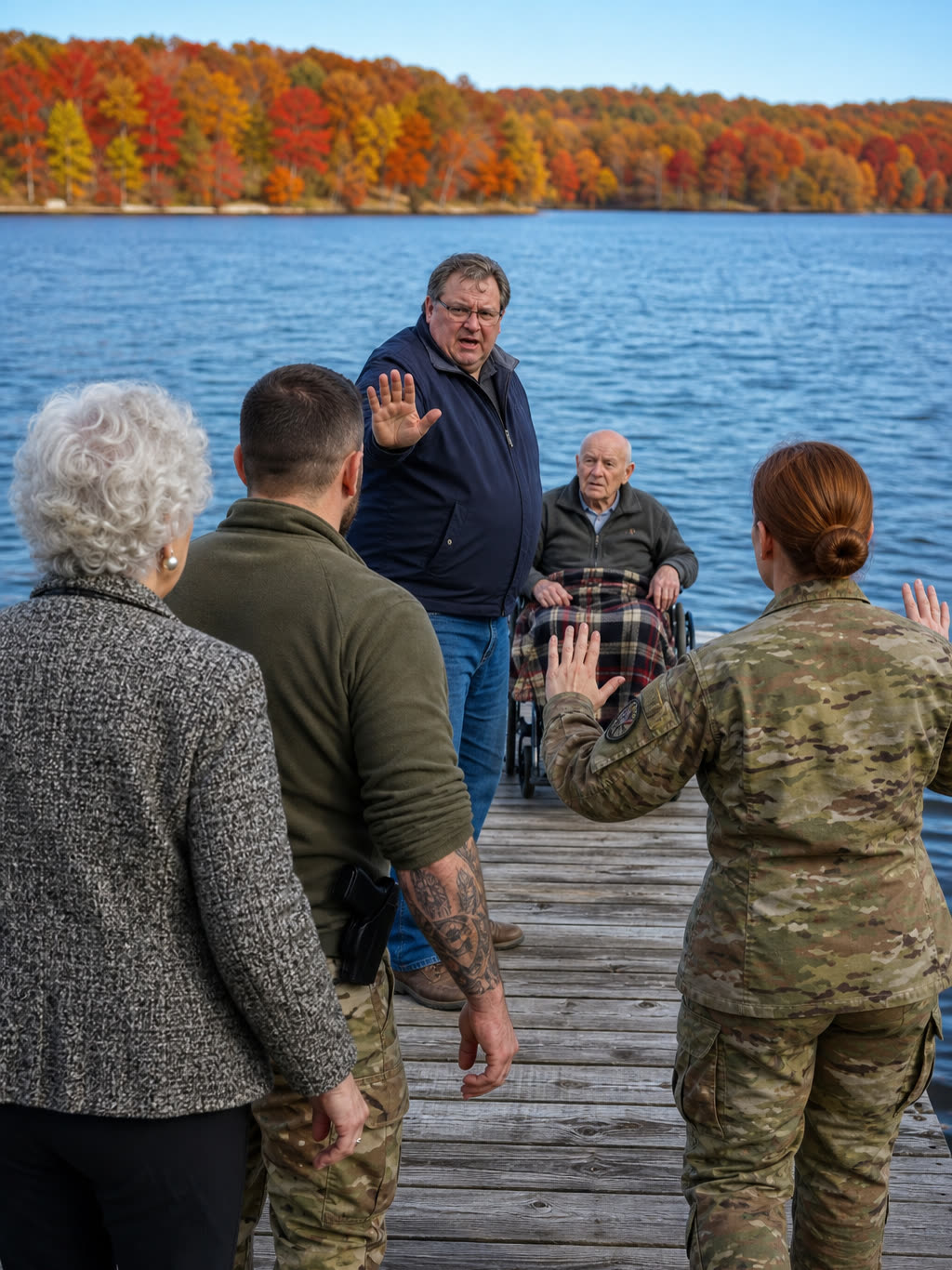
"Stay back," Mason Pike said, his voice shaking. "Please. Just—stay back." Helen stopped a few yards off and lifted her hands. "Mr. Pike, no one is here to hurt you or your father," she said calmly. "But you took a ninety-six-year-old man out of a care facility without telling anyone where you were going. And you’ve been altering documents in a federal archive. We need to talk."
"I haven’t been altering anything," Mason said. "I’ve been trying to find out what he did!" He gestured helplessly at his father. "When you brought me in to pull those files, Major, I recognized his initials on half the pages. I started digging. I found the originals—the real rosters, the ones with Daniel Cho’s name on them. Dad hid them in a storage box in the archive basement fifty years ago. I moved them so nobody else could destroy them before I figured out what to do."
Dylan frowned. "Then why take him out of the care center?" Mason’s face crumpled. "Because I knew you’d found Elias Ward. I saw your names on the visitor log when I went to see Dad. He’s down the hall from Ward. I panicked. Dad’s ninety-six. His heart’s failing. I didn’t want him hauled into some interrogation room in front of cameras. I wanted him to tell the truth himself, here, where he could still—" He faltered. "Where he could still have some dignity."
In the wheelchair, the old man stirred. Calvin Pike was nearly bald, his scalp mottled with age spots, his thin hands blue-veined against the blanket. He raised his head and looked past his son, past Helen and Dylan, until his watery eyes landed on Quinn. "Braddock," he rasped. "Lieutenant Braddock. I wondered if you’d ever come."
Quinn walked slowly down the dock until she stood before him. The wind tugged at her silver curls. "You know me," she said. It wasn’t a question. Calvin nodded weakly. "I signed your name," he said. "God help me. More than once." Mason made a strangled sound and turned away, gripping the dock railing.
"Tell them, Dad," Mason said hoarsely, without turning back. "You promised me. Tell them everything." Calvin’s mouth worked for a moment. Then he began, his voice thin but clear in the cold air. "Lieutenant Garrick came to me after the ambush. Said there was a medic who was going to ruin his career with lies. Said it’d be a shame if that medic’s paperwork got lost. I was a records sergeant. I knew how to make paperwork vanish."
"So you erased him," Dylan said, his voice low and hard. Calvin nodded. "Every roster. Every transfer order. Every evacuation log with his name on it. I retyped the pages myself on my own typewriter. Then Garrick needed a reason for Cho to be gone, so I wrote up a desertion statement. It needed a witness from the hospital." He looked at Quinn. "You were his friend. Your name would make it believable. So I signed it for you."
Quinn closed her eyes. "And the other letter?" she asked. "The one from 1984?" Calvin’s chin quivered. "Cho found me," he said. "Years later. He was working on the base by then, and he came to my office asking about the records—and about you. Said he’d written to you and never heard back. Said he just wanted to know you were all right. I was afraid if he kept digging, someone would turn up the old pages. So I wrote him a letter in your name. Told him you’d tried to reach him once and wanted him to stop writing. After that, he never came back."
For a long while Quinn said nothing. The lake lapped softly against the dock posts. Then she whispered, "He wrote to me. He wrote to me, and I never answered." Her voice broke. "Why didn’t I answer?" "Because you never got his letters, Mom." The voice came from the shore. Everyone turned.
A woman in her mid-fifties was hurrying down the dock, her shoulder-length blonde hair whipping loose, a cream knit sweater pulled tight around her. Quinn’s face filled with confusion, then recognition. "Grace?" she said. "What are you doing here?" "Major Park called me last night," Grace said, reaching her mother and taking both her hands. "She said you’d been having trouble remembering things. She thought I should be here." Helen nodded from a few steps away. "She was your emergency contact," she said gently. "I’m sorry I didn’t tell you."
Grace looked at the others, then back at her mother. "Mom, you were in a car accident in 1983," she said softly. "On the interstate outside Nashville. You had a serious head injury. You were in the hospital for months. When you came home, you’d lost years—most of the war, most of the time afterward. The doctors said some of it might return, and some never would." She squeezed Quinn’s hands. "You moved houses while you were recovering. Any letters that went to the old address—we never saw them. I never even knew there was a Daniel."
Quinn stared at her daughter. "That’s why," she whispered. "That’s why everything has been fog." Grace nodded, her eyes brimming. "And it’s been getting harder lately. That’s why I worry so much. That’s why I didn’t want you going off to Fort Campbell alone." Quinn let out a laugh that dissolved into a sob. "Well," she said. "I took a taxi."
Calvin Pike was weeping now, his thin shoulders heaving beneath the blanket. "She didn’t ignore him," he said. "She couldn’t remember him. And I let him believe she’d turned her back on him. I took his name, his service, and then I took the last friend he had left." He looked up at Dylan. "I’ve carried it for fifty years. I don’t want to carry it into the ground."
Dylan stood over the old man for a long moment, fists clenched at his sides. Then, slowly, he opened them. "My grandfather carried it too," he said. "He kept quiet because men like you and Garrick scared him. He wrote it down and hid it in a footlocker." He drew a breath. "I’m done hiding things. Major Park is going to record your statement. All of it. And then the Army is going to give Daniel Cho his name back."
Calvin nodded. "Yes," he whispered. "Please." Mason knelt beside his father’s wheelchair and took his hand, and for the next hour, on that dock beside the shimmering lake, Calvin Pike told Helen Park everything—the names, the dates, the typewriter, the forged signatures, the threatening note in Elias Ward’s mailbox, which he confessed he had written. Mason turned over the box of original records from the trunk of his car. Every page bore Daniel Cho’s name.
Lieutenant Garrick, it turned out, had died in 1997, a retired colonel with a long list of commendations. Calvin Pike died six weeks after giving his statement, peacefully, at Riverbend Care Center, with his son beside him. Before he passed, he asked Mason to deliver a short handwritten apology to Elias Ward. Elias read it once, folded it, and kept it in his cardigan pocket.
The Army’s review moved faster than anyone had expected. With the original rosters, Thomas Reese’s notebook, Daniel’s recorded testimony, Elias Ward’s account, and Calvin Pike’s sworn confession, the board concluded that Specialist Daniel Cho had been unlawfully removed from the military record. The false desertion statement was voided. His service was formally restored, and he was posthumously awarded the Silver Star for his actions in April 1970. Daniel had died in 2004, never knowing anyone would remember.
As for Sergeant Dylan Reese, he did not walk away untouched. Major Park filed a formal report on his conduct in the dining hall, and he received a written reprimand from his battalion commander. He did not argue. He accepted it, and then he volunteered to serve as an escort for veterans visiting the base. He also began arriving at the dining hall early, sitting with the new privates who ate in the corners, asking their names and where they were from.
"You’re different," one of his old friends told him one afternoon, half joking. Dylan shrugged. "Somebody once told me never to confuse authority with character," he said. "Took me a while to figure out what that meant." He thought of his grandfather’s handwriting, of the voice on the cassette, of an old woman who had not flinched when he pointed his finger in her face.
The ceremony took place on a clear morning in early December, in the same dining hall where it had all begun. The tall windows framed the bare hills outside, silver with frost beneath a bright blue sky. Hundreds of soldiers stood in formation between the steel tables. In the front row sat Elias Ward in a pressed suit with his old unit pin on the lapel, his cane leaning against his chair. Beside him sat Quinn, in her gray-and-black tweed blazer and pearl earrings, with Grace holding her hand.
Major Helen Park stepped to the podium and read Daniel Cho’s citation aloud. She told the story of a young medic who refused to leave four wounded men in the grass, who carried them to safety under fire, and who was punished for telling the truth. Then she told them about a civilian cook who spent years in this very building making sure every soldier who walked through the door had someone to sit with.
When she finished, Dylan Reese stepped forward in his dress uniform, holding a new brass plaque. He walked to the pillar beside the door, where the old plaque had hung for decades, and mounted the new one just below it. Then he stepped back and saluted. The words on the old plaque stayed exactly as they were. Beneath them, the new plaque read: In honor of Specialist Daniel Cho, medic, soldier, and friend, who began this tradition.
Elias rose with the help of his cane and saluted as well, his hand trembling. Quinn stood beside him. She did not remember everything. She probably never would. But she remembered a laughing young man beside a canvas tent, a tin cup of dreadful coffee, and a voice that refused to leave anyone behind. And that, she decided, was enough.
After the ceremony, the soldiers filed toward the serving line, and the room filled once more with the clatter of trays and the scrape of chairs. Quinn took a tray and moved slowly down the line. When she turned to look for a seat, she found Dylan standing beside an empty table near the center of the room—the very table where he had once told her to leave. He pulled out a chair for her.
"Ma’am," he said, and this time the word was full of respect. "Would you join me?" Quinn smiled and sat down. A moment later Elias joined them, then Grace, then Helen, and then, one by one, a handful of young privates who had been hovering nearby with their trays, unsure where to go. Dylan waved them over. Before long, the table was full.
Quinn looked around at the faces—old and young, scarred and unscarred, strangers and friends. She looked up at the two plaques gleaming on the pillar by the door. Then she raised her water glass, and her voice carried across the table, steady and clear, the way Daniel’s once had. "No soldier shall ever eat alone here."
Disclaimer: This story is a work of fiction inspired by real-life themes. Names, characters, places and events are fictionalized, and any resemblance to real persons is purely coincidental. Images are for illustration purposes only.
